
Germany
After 2 1/2 years of no international travel due to the pandemic, we have made our way to Europe- this being our postponed 2020 trip! It was with much excitement, and a lot of intrepidation we set off for our Eastern European adventure. There’s a few extras to pack now – hand sanitizer, masks, rat tests etc… all a sign of the times, and all taking up my valuable shoe space!
So off we go, a little hiccup right at the start – they decided to service our lifts on the morning we left, unbeknownst to us… luckily I have my strong man to carry the bags down the four flights of steps to exit the apartments. What are the chances!
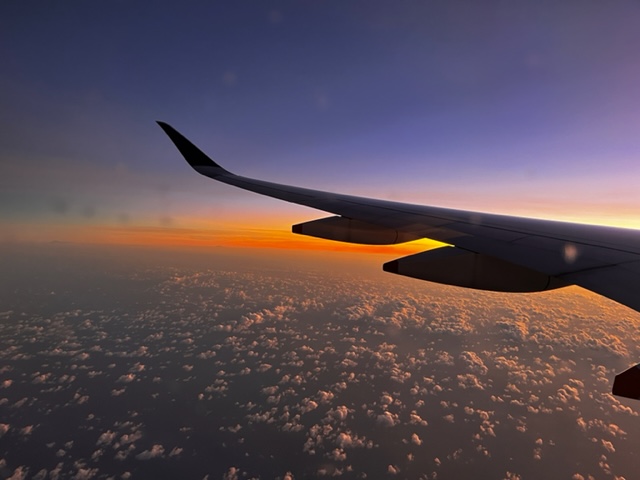
One thing I haven’t missed with travelling is the long haul flights … 8 hours from Brisbane to Singapore, then 12 hours Singapore to Munich, both with the very efficient Singapore Airlines, then another 2 hours from Munich to Berlin with Lufthansa, and all the time with masks on. Such are the times we live in. From the airport, we navigated the rail system, one train change and ended up across the road from the Movenpick hotel- where we were staying! Well done I say!
After a shower to freshen up, it was 2pm, and not wanting to risk crashing and sleeping all afternoon, we set out to explore Berlin. It was hot and humid – 27 degrees, just like our summer. Europe has been experiencing a heat wave, hopefully we are at the end of it.
We thought the Brandenburg Gate was a good place to start – the quintessential symbol of Berlin. A magnificent Neo- Classical structure was once part of the wall separating East and West Berlin.
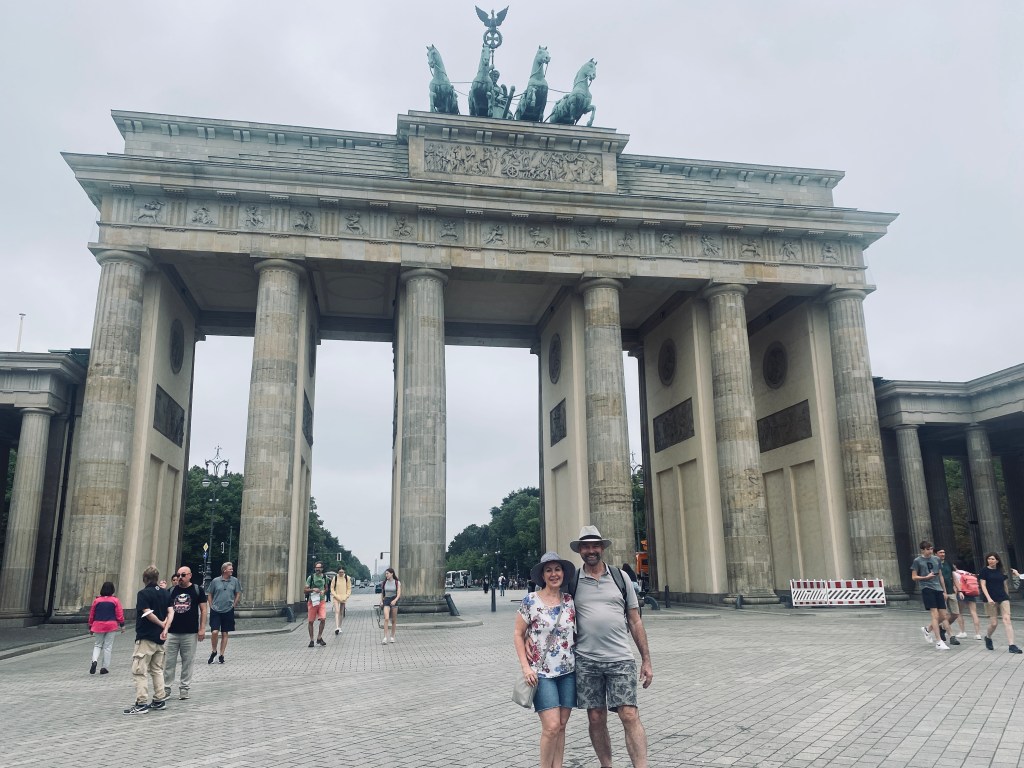
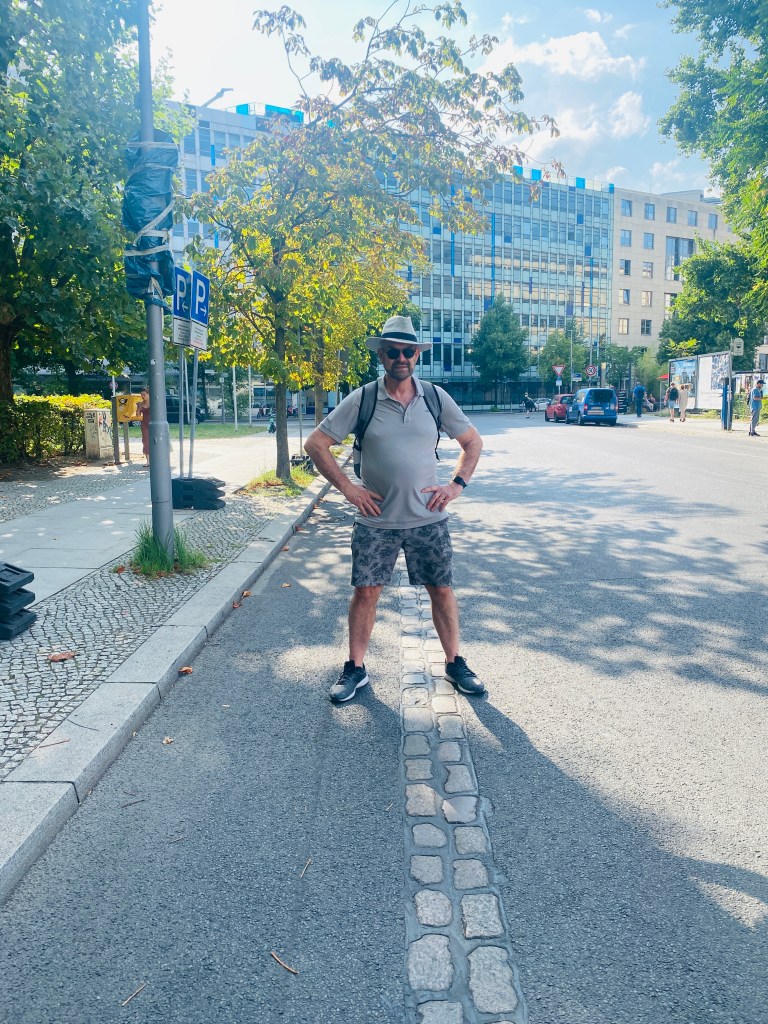
There are many information boards along the Strasse explaining the wall which was part of the city’s profile from 1961 until 1989. I found it particularly interesting as I had visited Berlin in 1982 when you needed a pass to go into East Berlin, and vividly remember the ugly wall covered with graffiti. There is a cobblestone line embedded into the road tracing the course of the former wall (160kms)….a good reminder of the Berlin history. You are on the west side if you can read the writing.



Near the gate is Germany’s Holocaust memorial- it is a large field of 2711 dark grey stones, all the same size length and width, but differing heights, set in a geometric formation on undulating ground. They symbolise the six million Jews and other persecuted groups (homosexual, gypsies) that were murdered by the Nazis from 1933-1945. Underneath is an information centre, that gives a graphic history of the horrors that occurred. The memorial was very sobering, but important for us to remember.


We walked and walked, taking in the sights of Berlin – Potsdam Platz (built on the wasteland that formerly divided East and West Berlin – now a vibrant cosmopolitan precinct), the Mall of Berlin (a modern shopping centre, the Bundestag (where the uprising of 17June 1953 occurred), and ending up at Checkpoint Charlie.
I managed to trip over the cobblestones and crashed to the ground! Two grazed knees, one grazed hand, a bruised ankle- luckily not the recently “repaired” one, and a heightened anxiety about hurting myself , I can tick “falling” off the list!
An early dinner back at the hotel – local cuisine of course – Weiner schnitzel and Veal with mushroom sauce. We were fast asleep by 8pm, and slept for 11 hours! Hopefully that’s the jet lag sorted!
Day 2 Berlin
Hot again- 28 degrees and humid.
A short walk to the Brandenburg Gate where we then joined a walking tour booked on Get your Guide. Our guide Eran led us from the Brandenburg gate to the Reichstag, the Russian Memorial, through the Tiergarten, to the site of Hitler’s bunker (it is underground- they tried to destroy it, but couldn’t as it was so indestructible ), giving us more wall history, and ending up at Checkpoint Charlie.
The name of this notorious border crossing between the American and Soviet sectors comes from the word used for the letter C in the international phonetic alphabet. Between 1961 and 1990, checkpoint Charlie was the only crossing for foreigners between East and West Berlin. It became a symbol of both freedom and separation for the many East Germans trying to escape Soviet communism. I had visited here in 1982, and was trying to remember what I saw then. Today a single watchtower is all that remains.
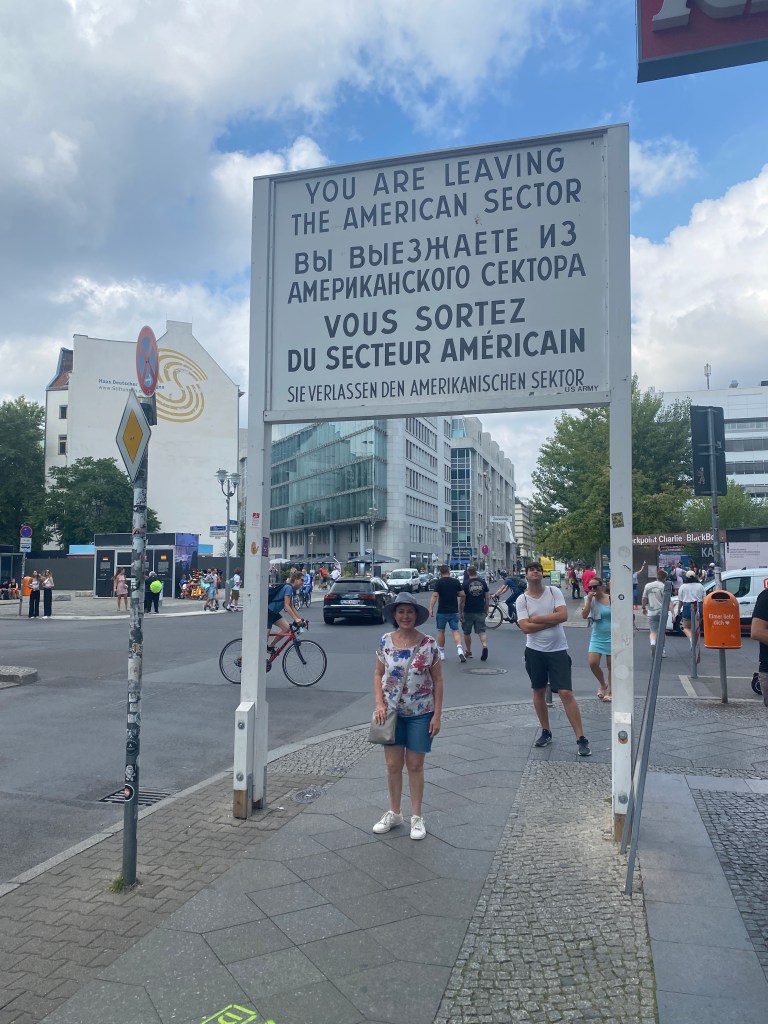

Next to it, the Haus am Checkpoint Charlie museum details the years of the Cold War in Berlin. We spent a couple of hours in there, learning about the war, and also stories of people trying to escape across the wall. We were also trying to avoid the heat, but there was no escape – none of the buildings seem to be air-conditioned!

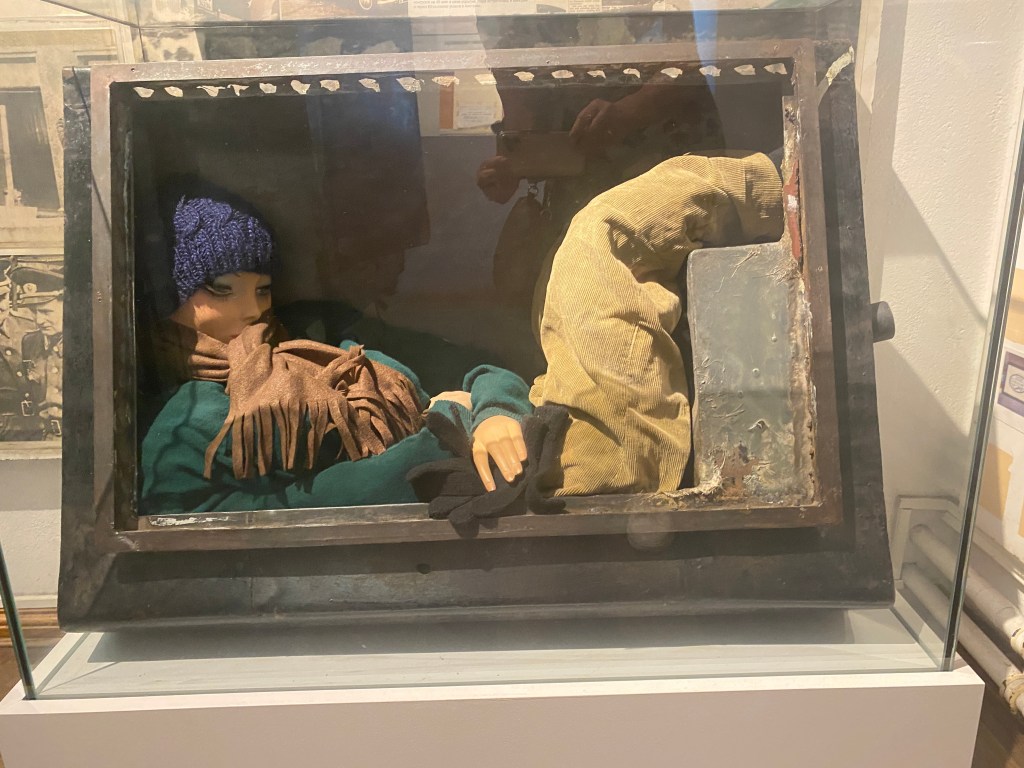
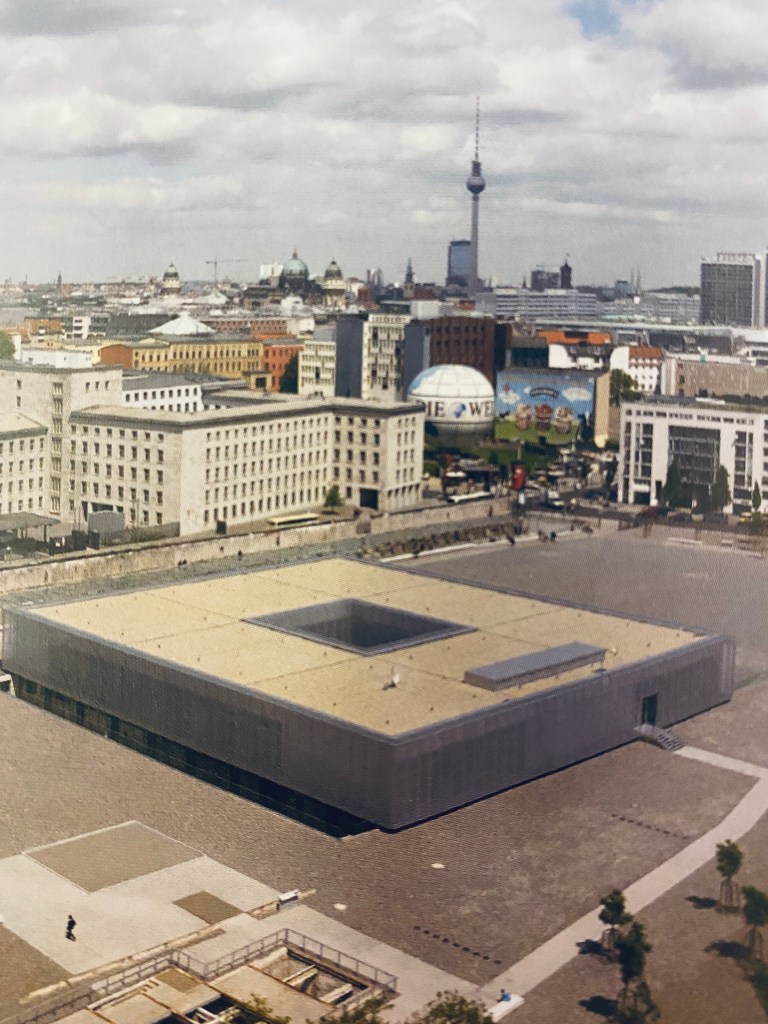
Another museum next, the Topography of Terrors – originally the buildings on this land were the headquarters of SS and Gestapo. After World War II, the bomb damaged buildings were pull down, and a hall was built to house an exhibition on the history of the site – hard to believe such atrocities occurred, and that some powers directed them to happen!
Lucky our hotel was close by, so we went back to cool off for an hour, and refresh our minds after all the horrors we had read about. Out to the train station, and a mad dash to find the boat we were booked on for a late afternoon cruise of the River Spree.
Incidentally, the train station across from our hotel, Althofer, has the facade still standing- 12000 Jews were processed through this station to go to concentration camps. There was also a bunker built for West Berliners right behind the station- unfortunately we didn’t find it until it was too late, therefore missing the opportunity to explore that. I guess it was just one of thousands of history attractions that can be viewed in Berlin.
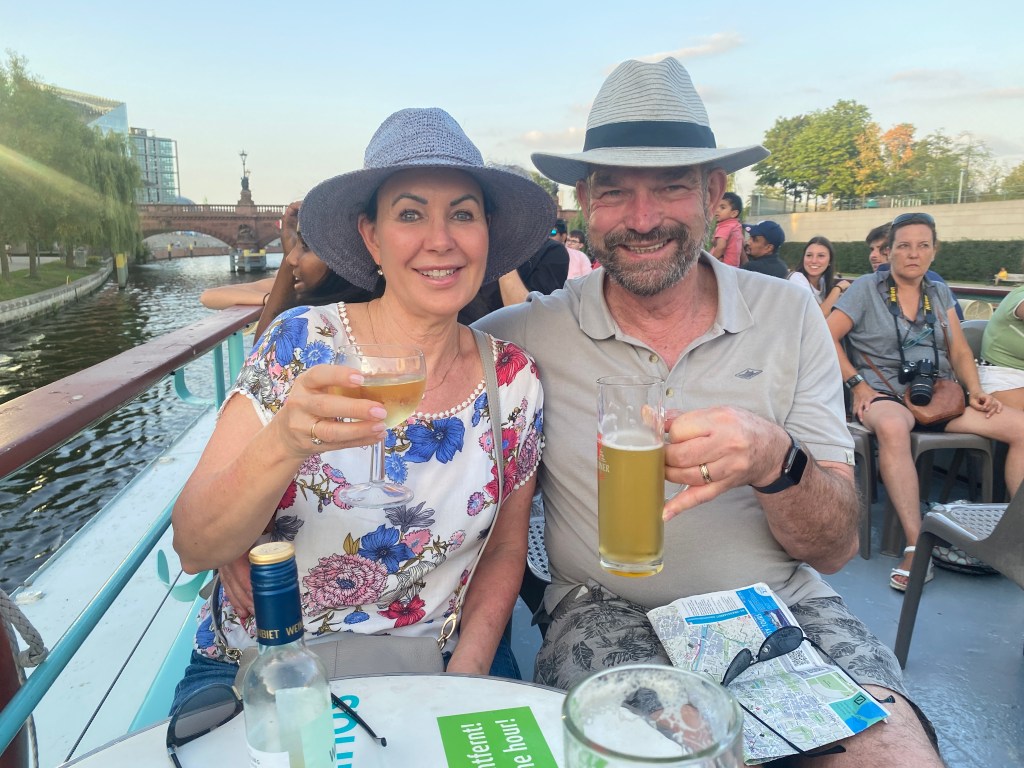
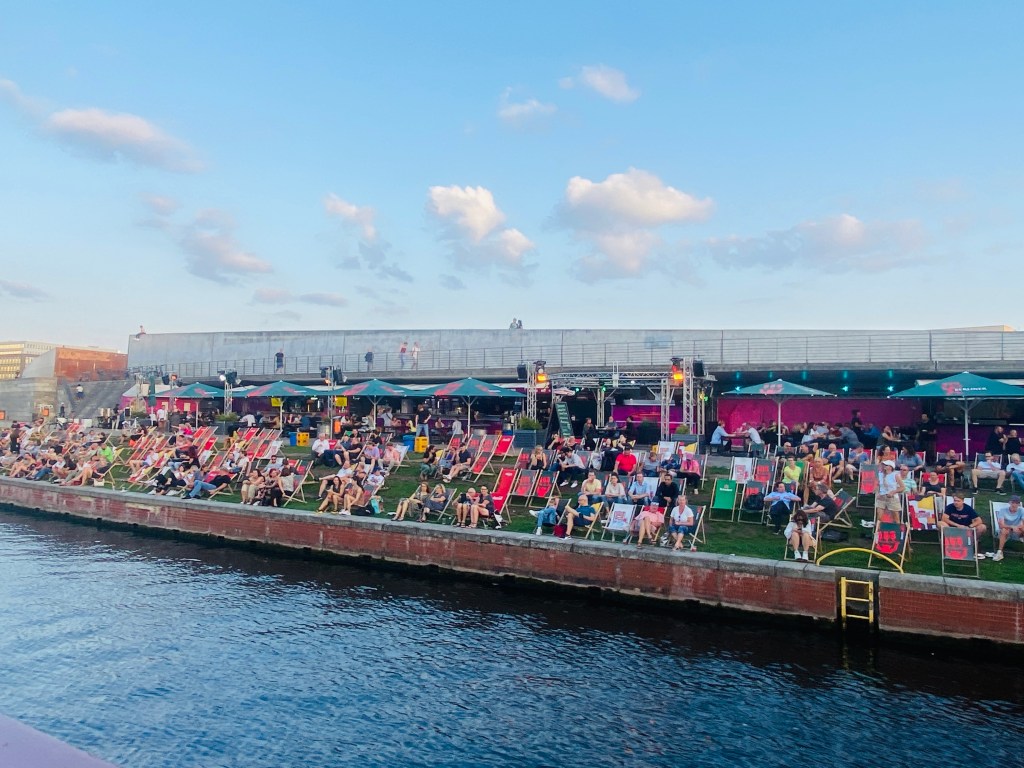
Back to the river cruise… we had a beautiful evening on the River, enjoying the cool breeze with a beer / German reisling, seeing the many interesting buildings of Berlin, all with very informative narration. The Canadian couple sitting opposite us added to the enjoyment- they were quite entertaining! Another Get Your Guide booking. How well they utilise the banks of the river- we need to do more of that in Brisbane – they had deck chairs out everywhere, music, dance lessons going on- it was rocking, and all on a Thursday night.

Looking for a supermarket- no luck so far, but lots of bottle stores! Beer is so cheap – cheaper than the tonic water we bought to go with our gin! 3.5 euros for a bottle of tonic water – you could get 2 beers for that! There’s a bottle opener at the checkout, so you just open your beer and start drinking!
Food is the same price in euros that we pay in $$, so we’d better not complain. Still looking for a decent coffee! 4-5 euro a cup. We tried the currywurst for dinner, left me totally underwhelmed! Basically a sausage with sauce – no curry flavour! Aperol Spritz is a popular refreshment, so I’m happy!
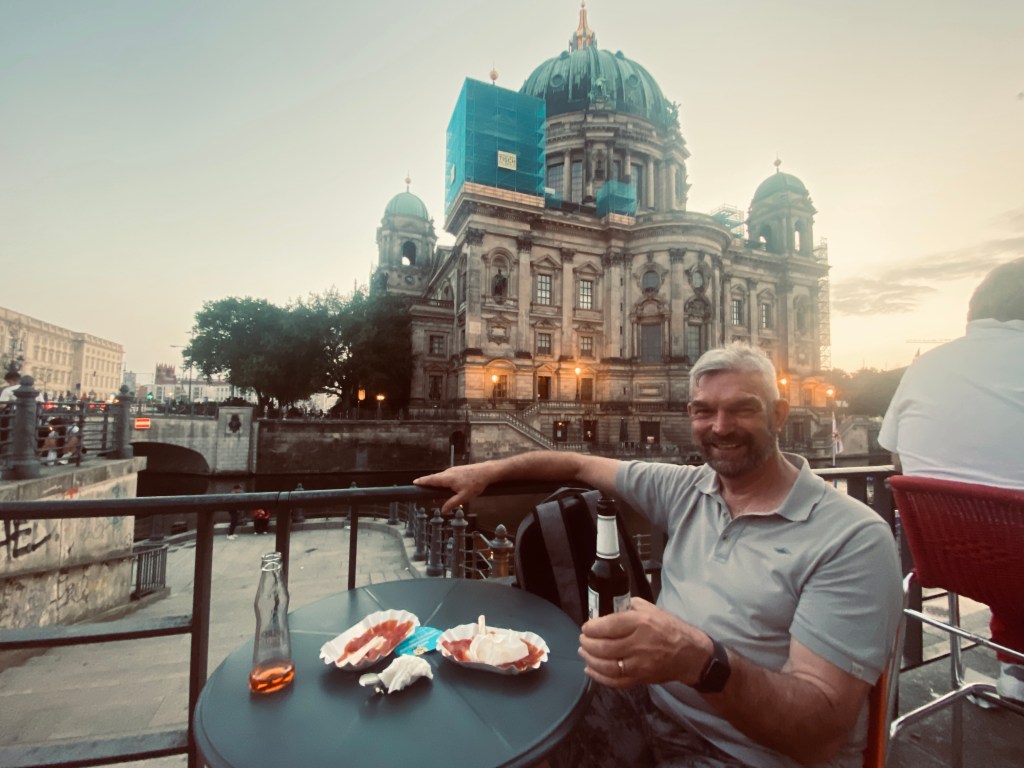
Day 3 Berlin
More hot weather, 30 degrees. And very humid! Hopefully a cool change soon.
Went by train to the Hackescher Markt. Found a yummy Fruhstuck venue breakfast) – scrambled eggs, smoked salmon, a selection of cheeses, fruit and fresh bread- yum!
All fuelled up for our morning walking tour of Berlin, this time a more general overview. Our guide, Toni, actually grew up in East Berlin, he left in 1990. Interestingly he talks of a happy childhood, and not wanting for anything. Tobi gave us a fabulous overview of the history of Germany, and Berlin. Interestingly, Tobi never learned English at school, only Russian! His English was excellent however!
Despite the colossal destruction suffered during WWII, Berlin is still home to an inspiring collection of buildings that showcase the evolution of European architectural styles, from opulent Baroque, to traditional Neo- Classical to Industrial and contemporary styles.
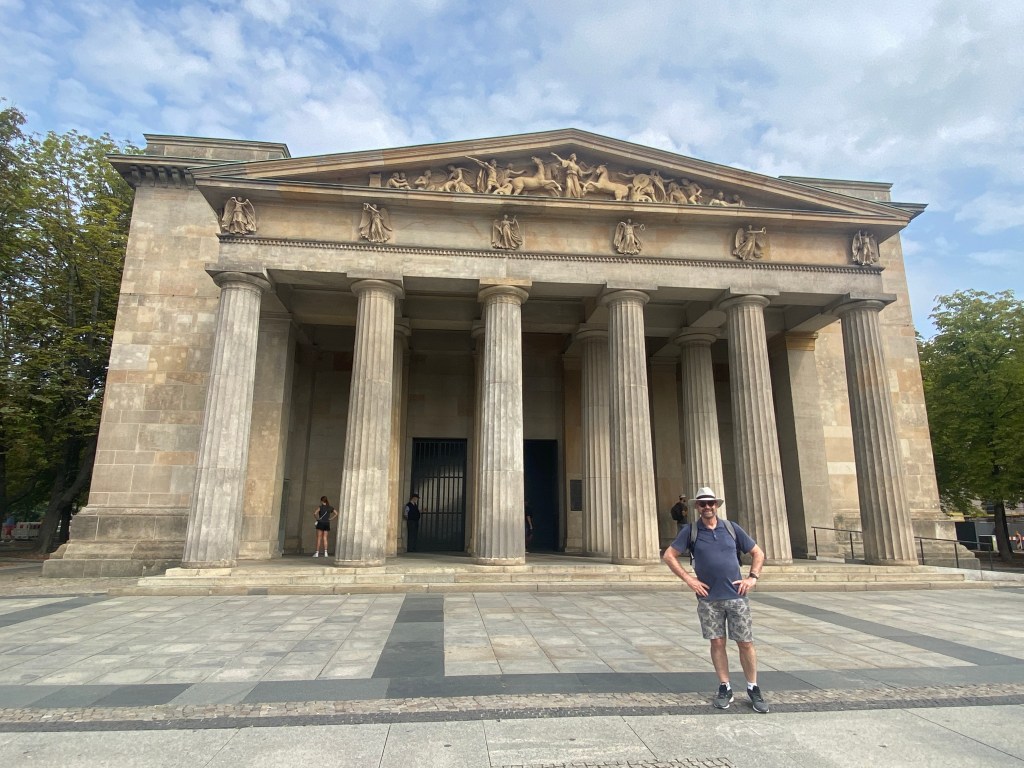
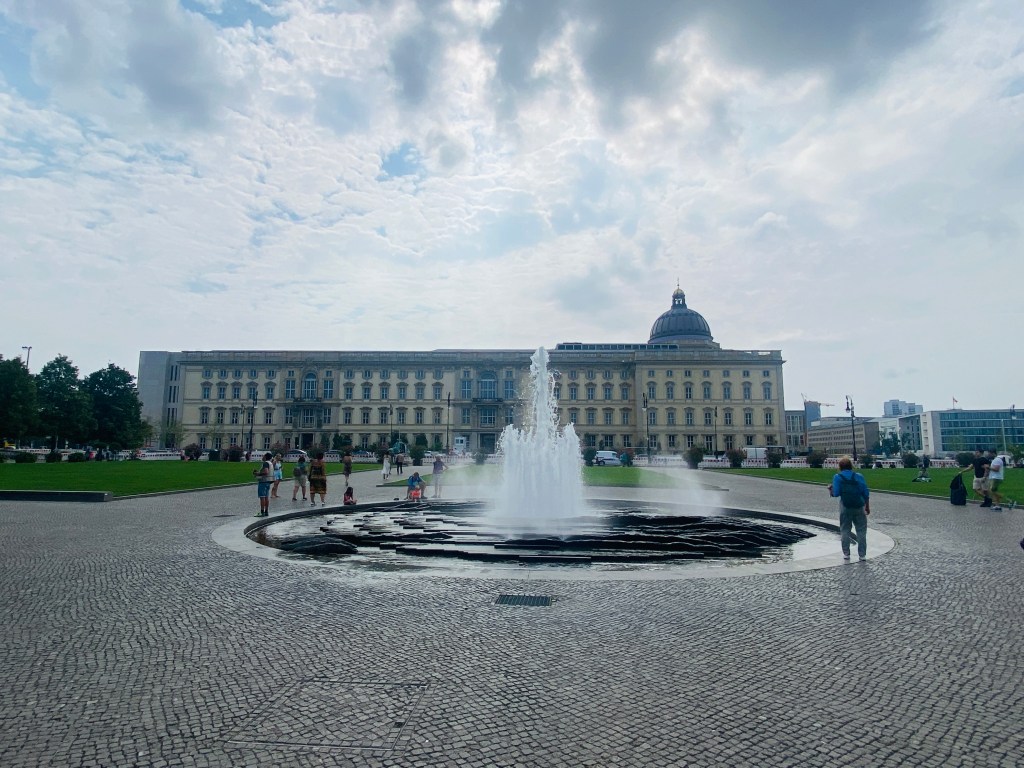
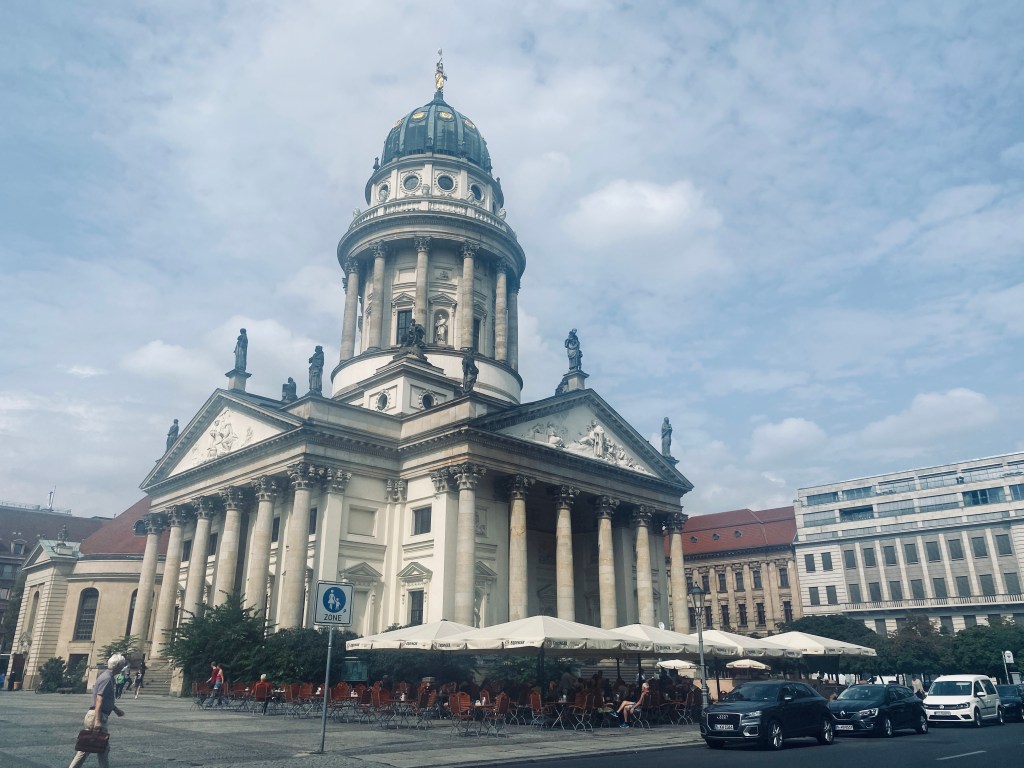
We started at Museumsinsel – an island which is home to 8 Museums and the Berliner Cathedral. We then walked along Unter den Linden, seeing beautiful buildings such as Neue Wache( now a monument to fallen soldiers from WWI), Concert Hall, the French and German Cathedrals, Bebelpkatz (scene of the notorious book burning act organised by the Nazis in 1933), Zeughaus, and so many more beautiful buildings. The interesting thing is, that are two of everything- one set of buildings from the old East Berlin, and then the same set in old West Berlin.
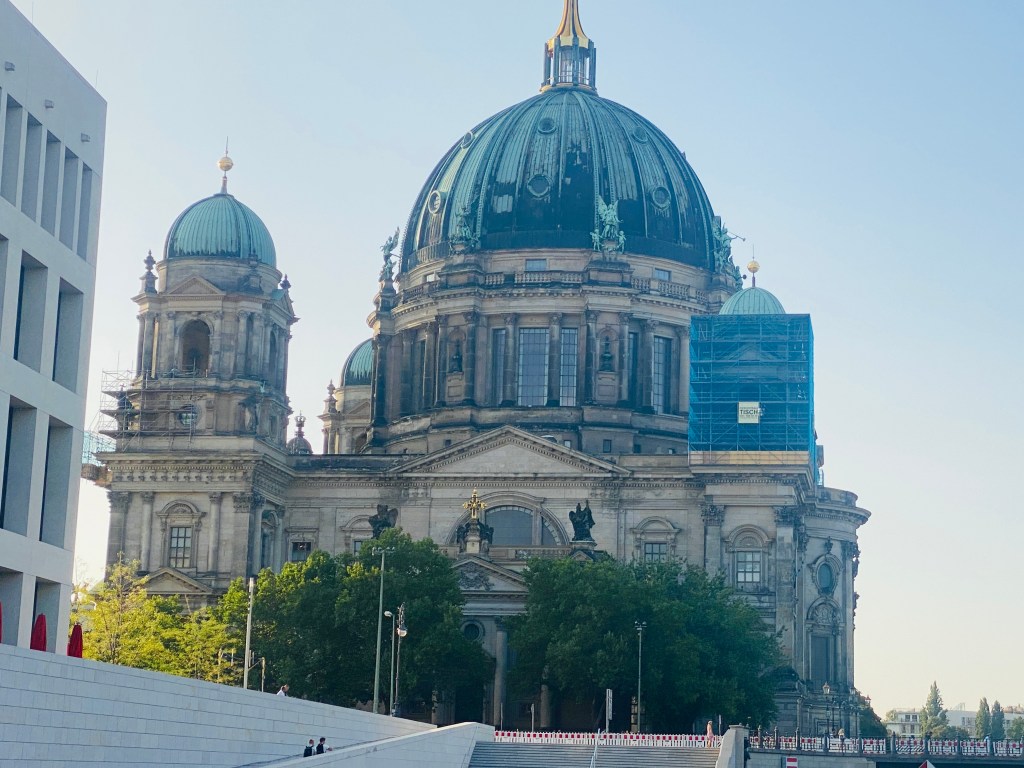
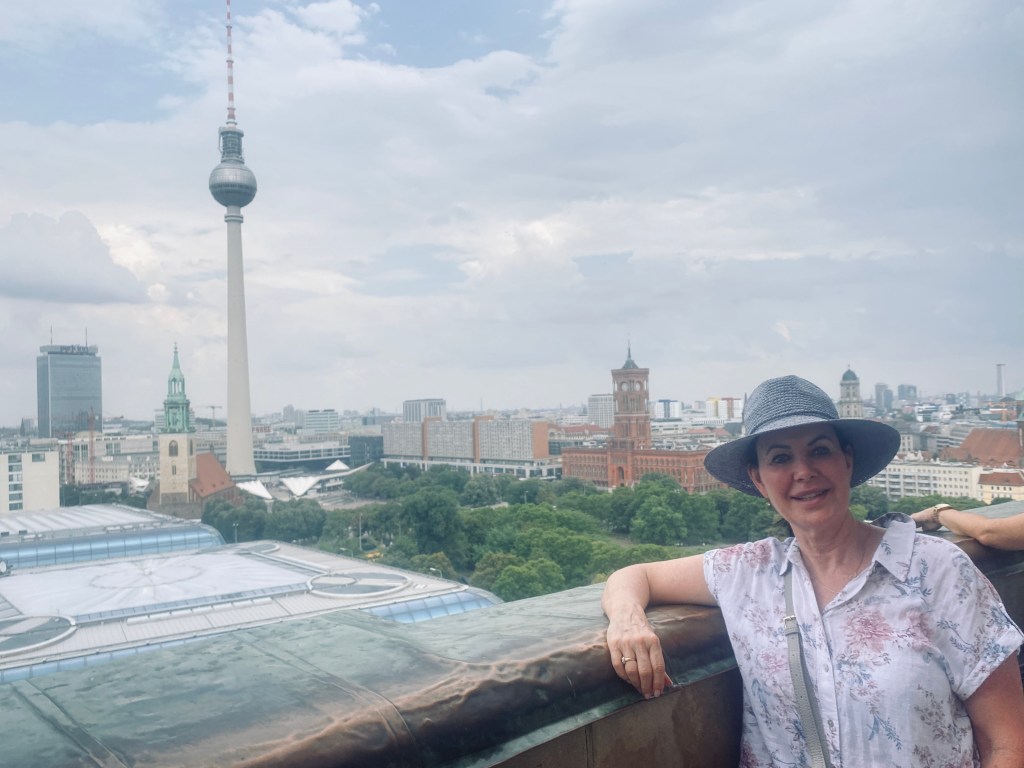
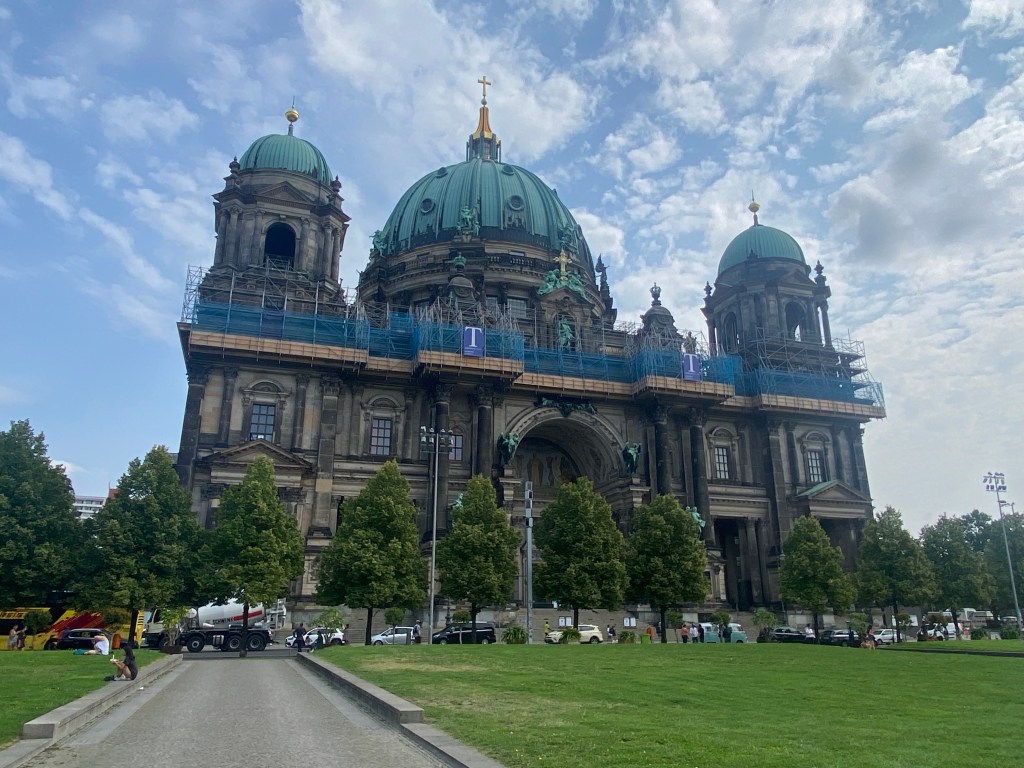
We then walked back to the Berliner Cathedral – to climb the 267 stairs up to the viewing platform at the top. It was hot going , in the heat, but worth the 360 degrees view. Berlin is very flat, and landmarks easy to pick out. Once back down, we bought a beer at the church cafe ( as you do), which is right on the bank of the river – the cool breeze coming off the river was sensational! Then the rain came, and the temperature dropped immediately… instant relief!

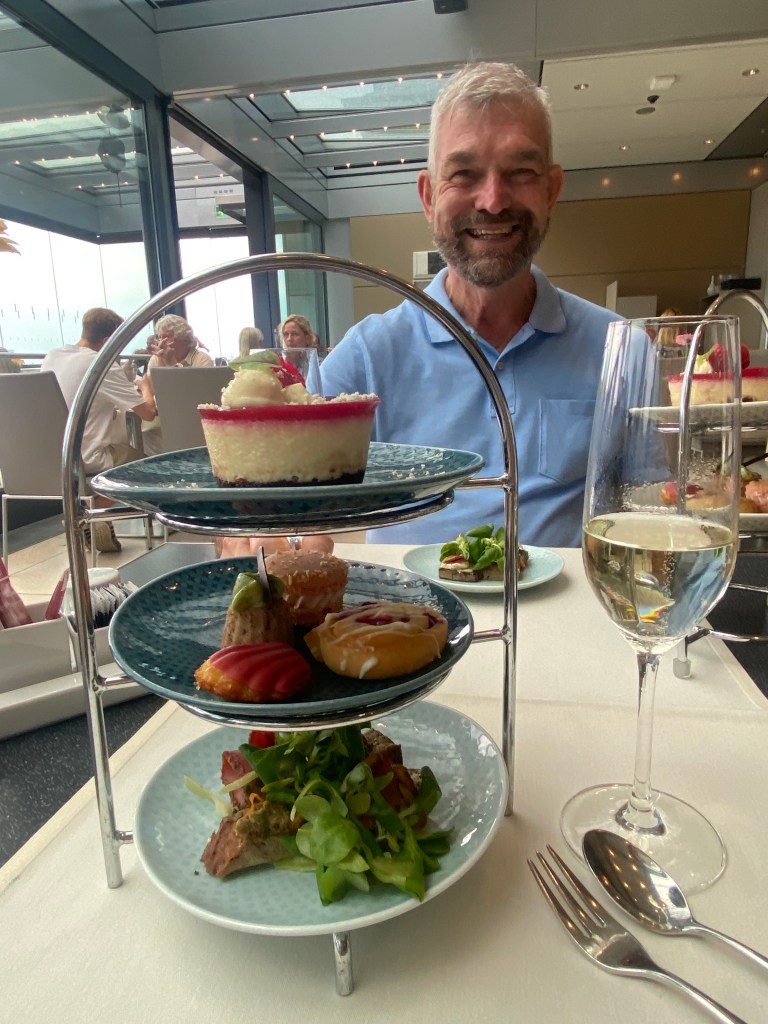
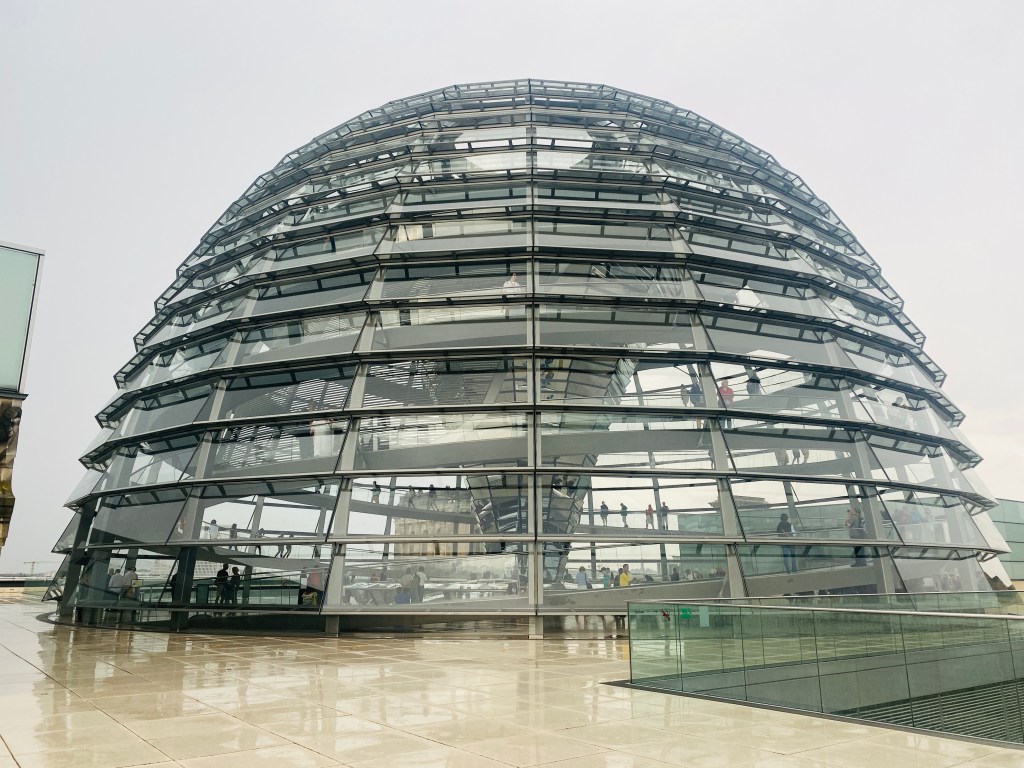
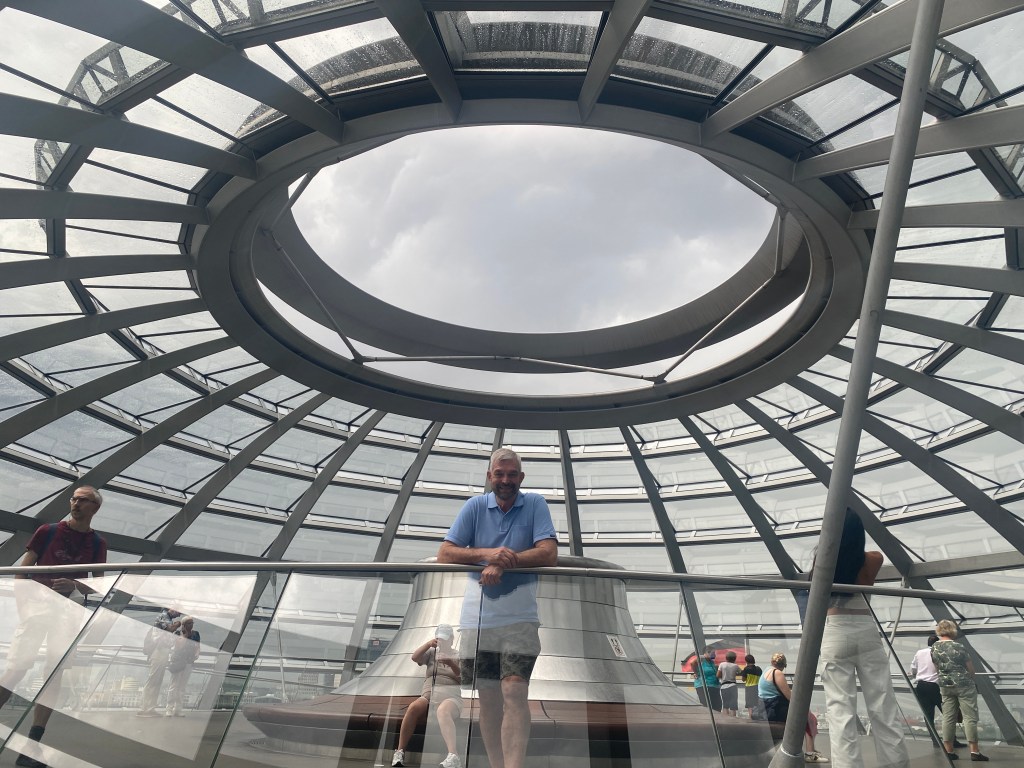
Next onto the Reichstag….seat of Germany’s parliament… is survived fascism, fire and bombardment, to become a symbol of a modern, politically transparent Germany. The magnificent rooftop glass dome was added in 1999 – it symbolises the transparency. Inside is amazing, you can walk all around the dome… it offers stunning views both inside and out. Even the storm that occurred while we were inside looked spectacular. We were booked in for a high tea at the dome restaurant which was a bit special.special.



By the time we got out of the Reichstag it was 6pm and raining. We wandered for a little longer around Potsdamer Platz, found a local pizzeria where we had the most delicious pepperoni pizza, before we called it a day.
Day 4 Berlin – Munich
Travel day today. We caught the local train from our hotel to the airport, for a short flight to Munich. Even though the flight was just over an hour, the transfers, airport waiting times etc fill in half the day! The difficult part was losing our half bottle of Navy gin at security…. the interesting part was that liquids were no problem going from Munich to Berlin, but had to be discarded in the other direction. You can never work it out!
So much cooler! Hopefully the heatwave is over.
The train from the airport proved to be challenging …. we had to change trains at East station, however it was just as the S line closed due to the football game starting in a 3 hours time. Suddenly the lifts closed (which meant carrying bags/ prams etc down the steps again!), and then we had to find the U line to get to Central Station. There were hundreds of police leading the thousands of football supporters through the station. It was just like what you see on the news!
We arrived at Munich Main Station (Hauptbahnhof) – our hotel, the Eden Wolf was right across the road. Finding the hotel can be simple or complicated depending on which exit you take! Luckily we chose well!
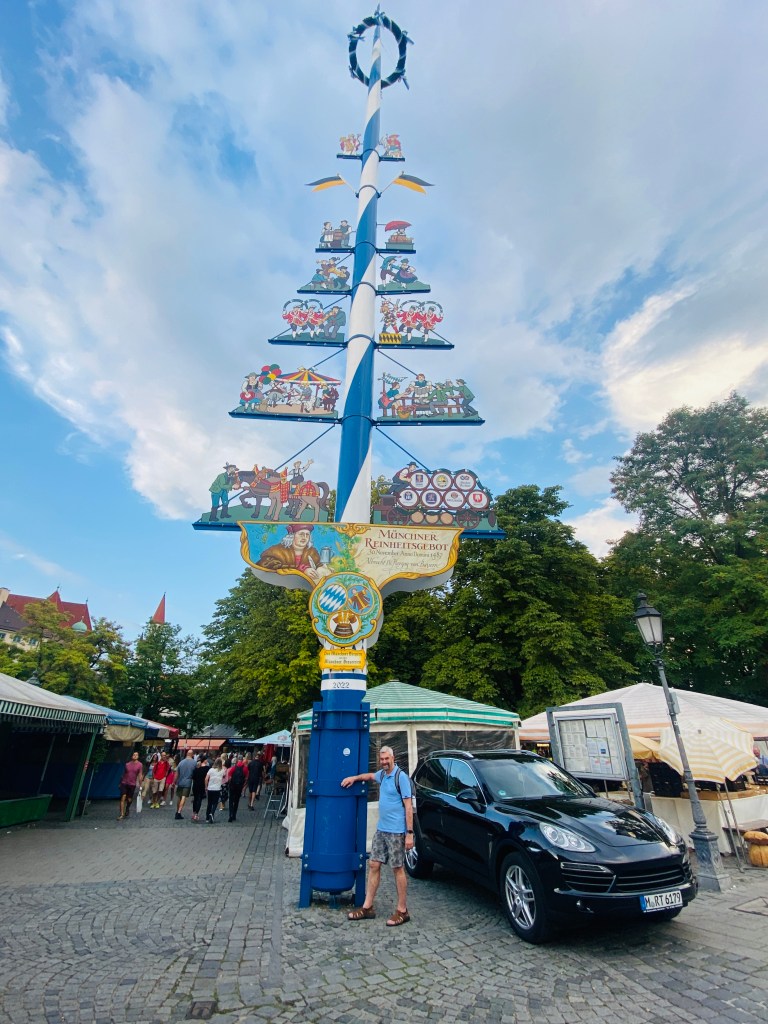
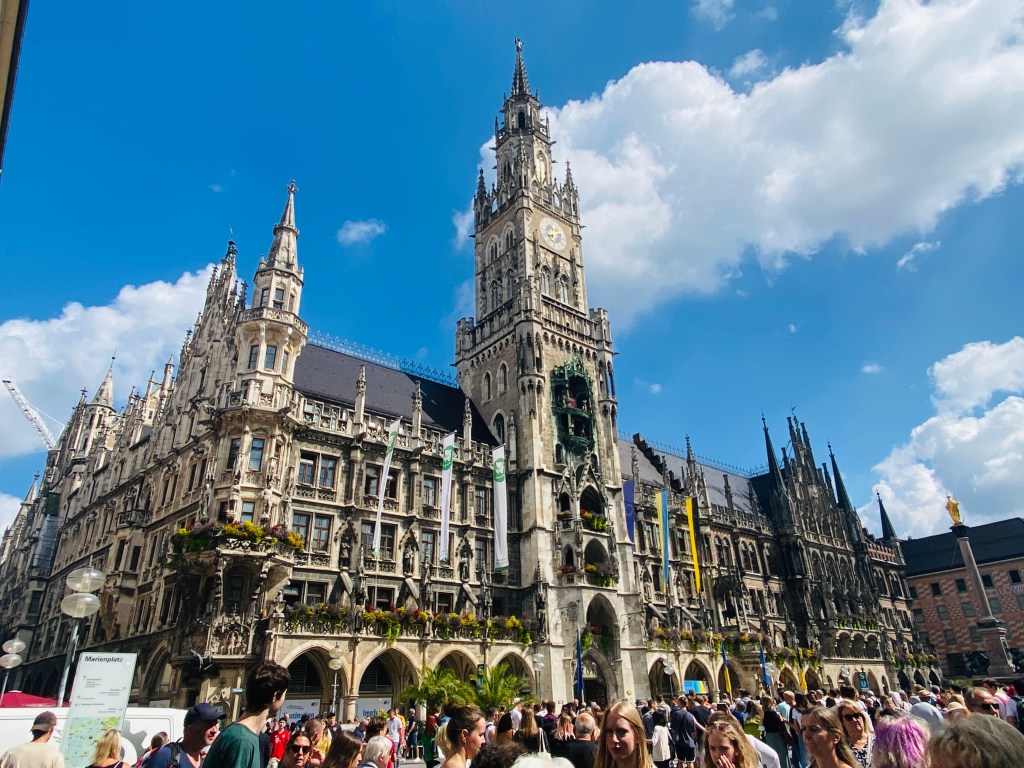
Checked in, then out to find the meeting point for the Beer and Bavarian food tour we were booked in for. It was fabulous! We had a leisurely walk around Munich’s medieval squares – Karlsplatz and Marienplatz – drinking a beer as we went… which is the norm in Munich! Saw the old and new Town Halls in Marienplatz. We walked through the Viktuallienmarkt which is Munich’s main market – the beer gardens here are the only Beer garden which serve beer from all the city’s brewery. Also saw maypoles, and dirndl and lederhosen stores- our guide gave us a lovely overview of life in Munich.


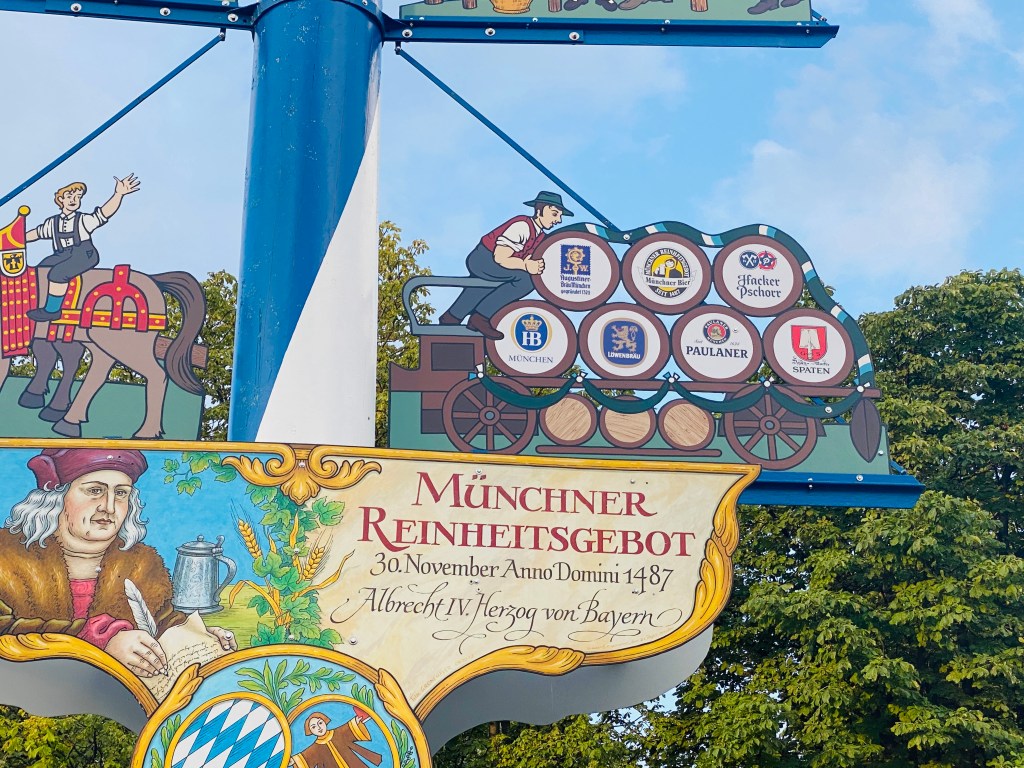
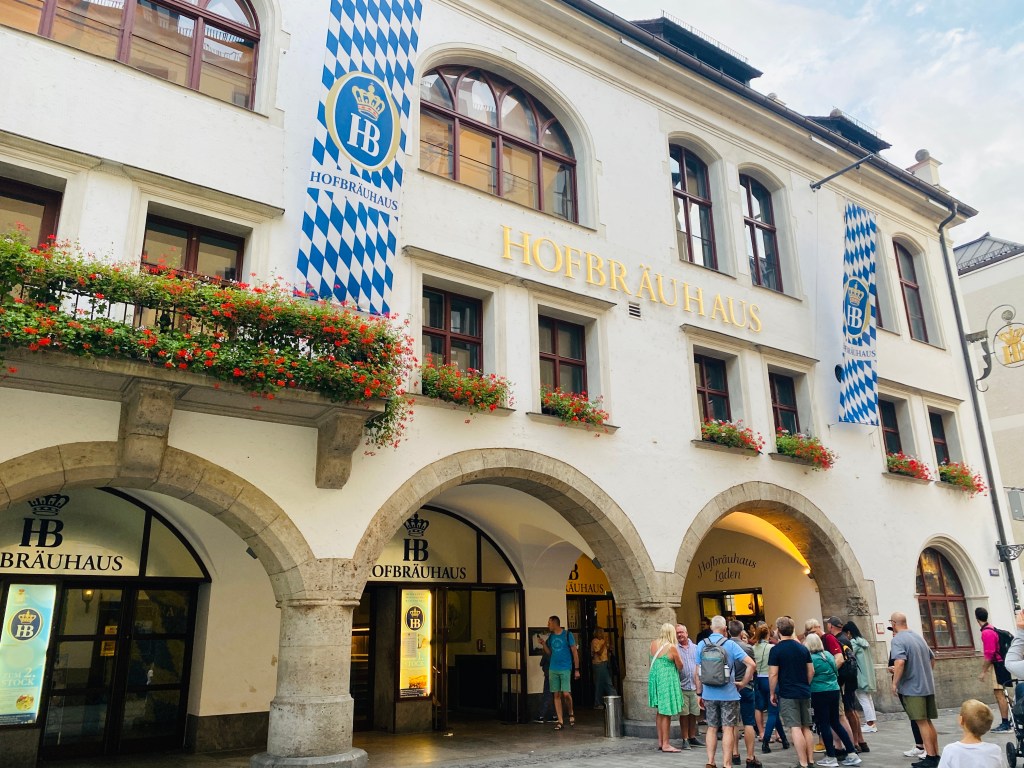
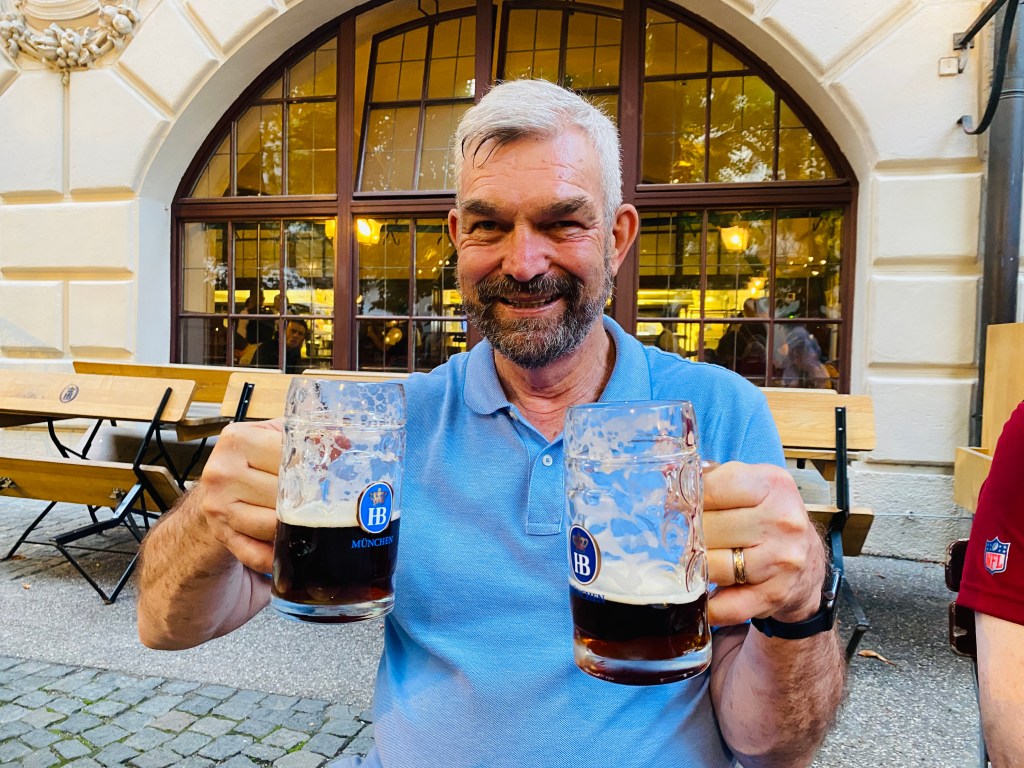
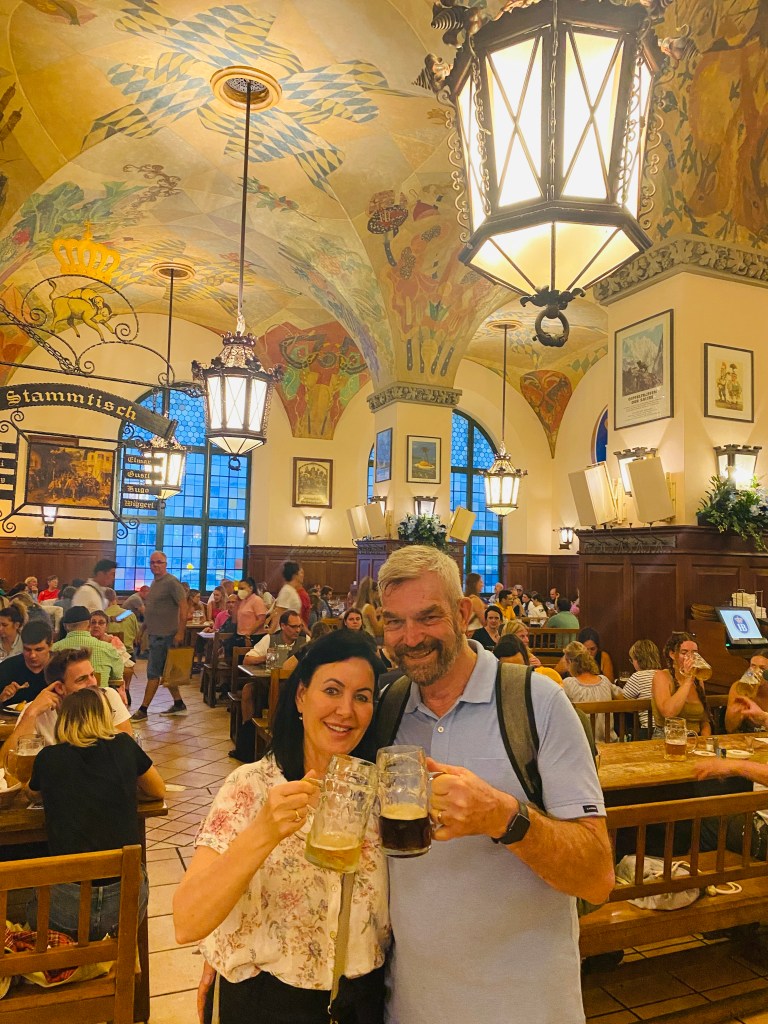
Next, the Hofbrauhaus- the most popular beer hall in Munich. It was first established as a court brewery in 1589. The Schwemme on the ground floor, is a large hall with frescoed ceiling and houses up to 1000 visitors. Our guide gave us an extensive history of beer, types of beer, and samples of beer. There are 6, soon to be a seventh Munich brewer, and 5 types of beers. The Helles is the most popular, and my favourite- very refreshing. Frank was keen on the Dunkel beer, which is a dark beer( from dark amber to red-brown in colour). There is also the Eisbock, Weissbier ( wheat), and Malbock. So much atmosphere in the Hofbrauhaus with a live oompha band providing some entertaining music. Huge pretzels were being sold like hot chips. You can have your very own mug put into a locked cage, but you need to jump through a lot of hoops to earn that privilege!


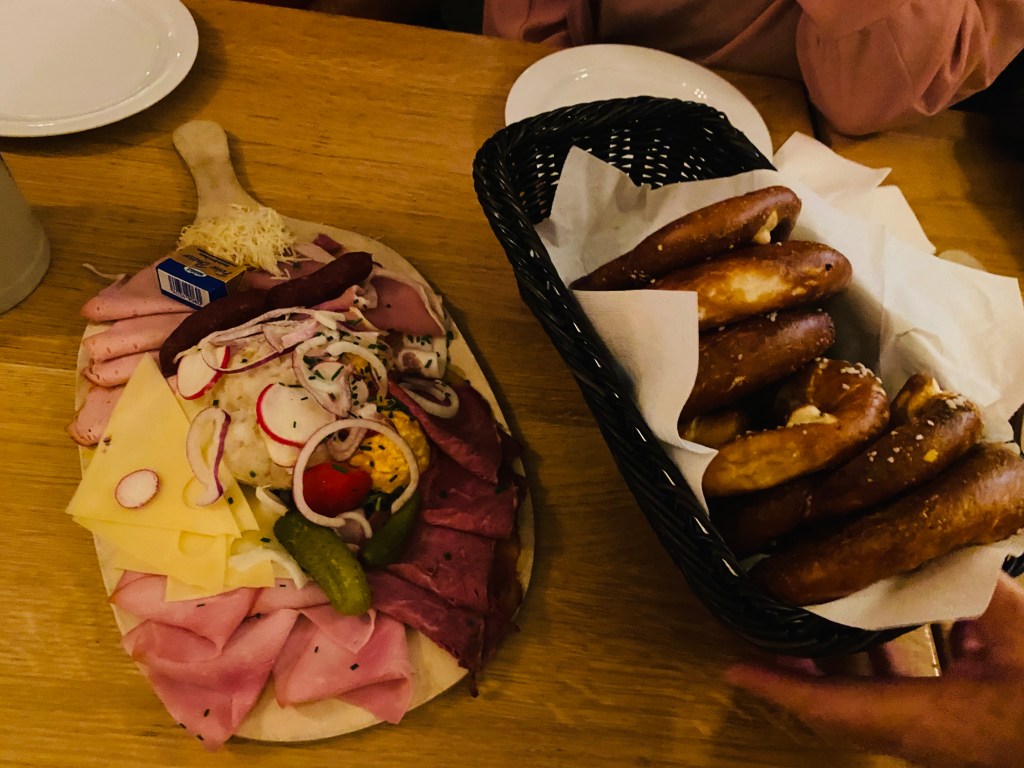
Next a walk to a lovely little restaurant where we had a traditional Bavarian cheese and meat board with bread and of course pretzels – a traditional German dinner…. and more beer! One of the cheeses on the board was a traditional Bavarian cream cheese with radishes, called Obazda- very nice. I had a very nice German Franken Riesling. Spent an hour with some lovely tourists.
Day 5. Munich – Oberammergau
Day 5 – Munich to Oberammergau
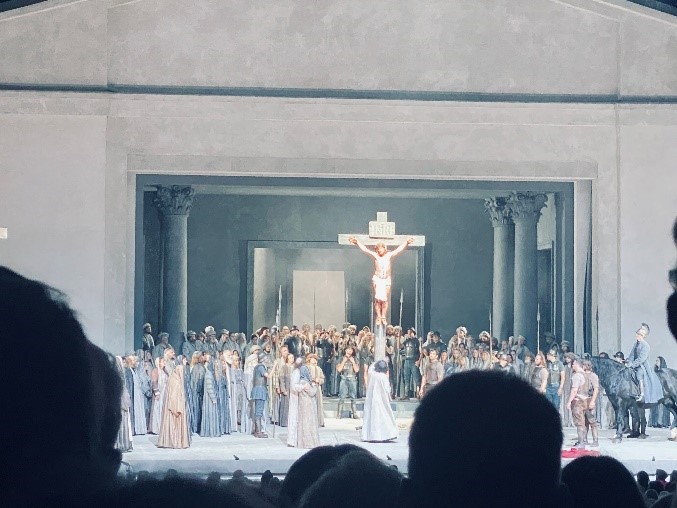
Had a bit of a change with the train timetable which we had to organise, all sorted without any trouble. So today was a train from Munich to Murnau, then bus from Murnau to Oberammergau. Oberammergau is a small town in Bavaria, which is famous for it folk art and passion play. Well we were here for the Passion Play, postponed from our planned 2020 trip. The plague of 1632 came close to wiping out the entire population of the village. It’s surviving inhabitants pledged that if they were saved , they would stage forevermore a play about Christ’s Passion. No further deaths occurred, and to this day the villagers have kept their pledge. Every ten years some 2500 people take part in the six hour long spectacle in which they transform themselves from Bavarians to Jews and Romans from the time of Christ. Apparently they start growing their hair from Ash Wednesday the year before the play. About 100 performances are staged between mid May and mud October in the Passionspielhaus.

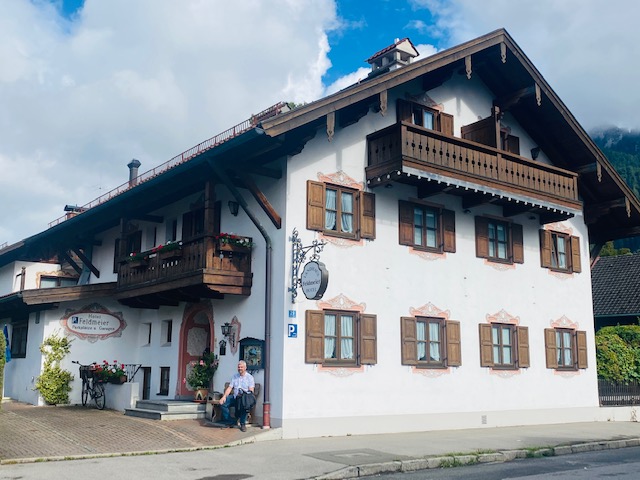
We stayed in a cute little hotel, Landhaus Feldmeier. We walked back there after half the performance to have a traditional Bavarian 3 course meal – pancake soup, pork ghoulash and Bavarian crème.
We then walked back to the theatre for the second half of the experience. The play was all done in German, and we followed the English dialogue in our guidebook. The actors did a great job, the music was beautiful – our problem was the view. We had central seats, but the pitch was poor, and the seats not alternated well. All in all, a very unique experience.

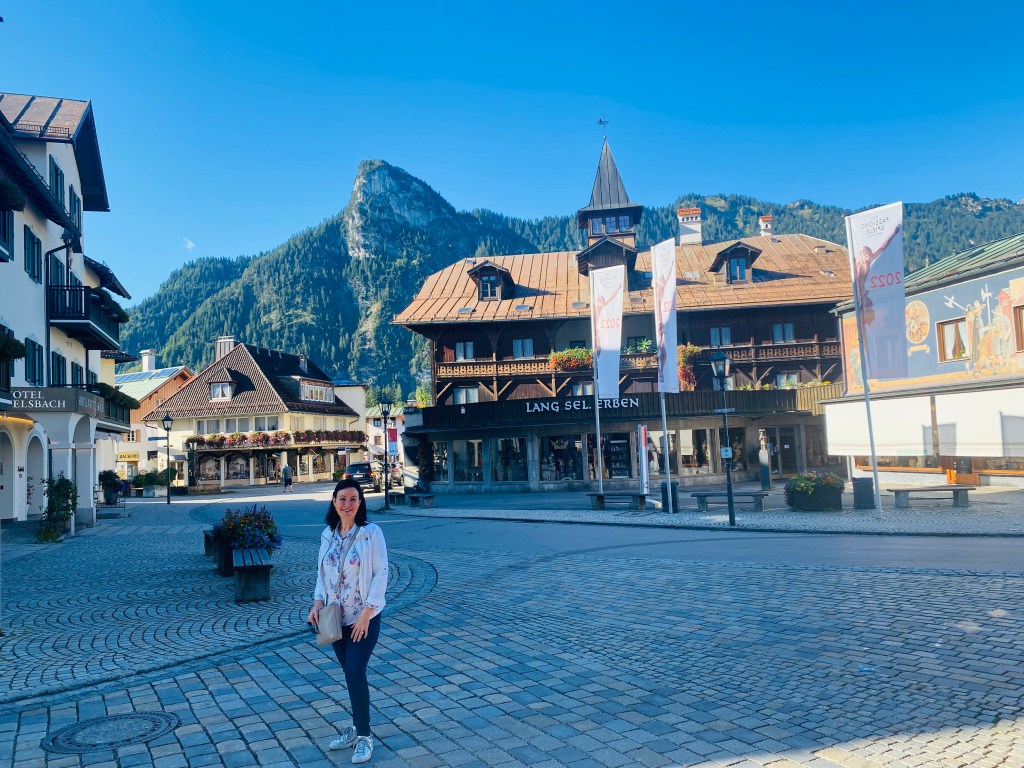
The town of Oberammergau itself is just gorgeous. I had been there in 1982 and remembered the A frame houses with frescoes on the walls, and the gorgeous window boxes filled with brightly coloured flowers of all descriptions. We had a couple of rain showers, but didn’t affect us too much.


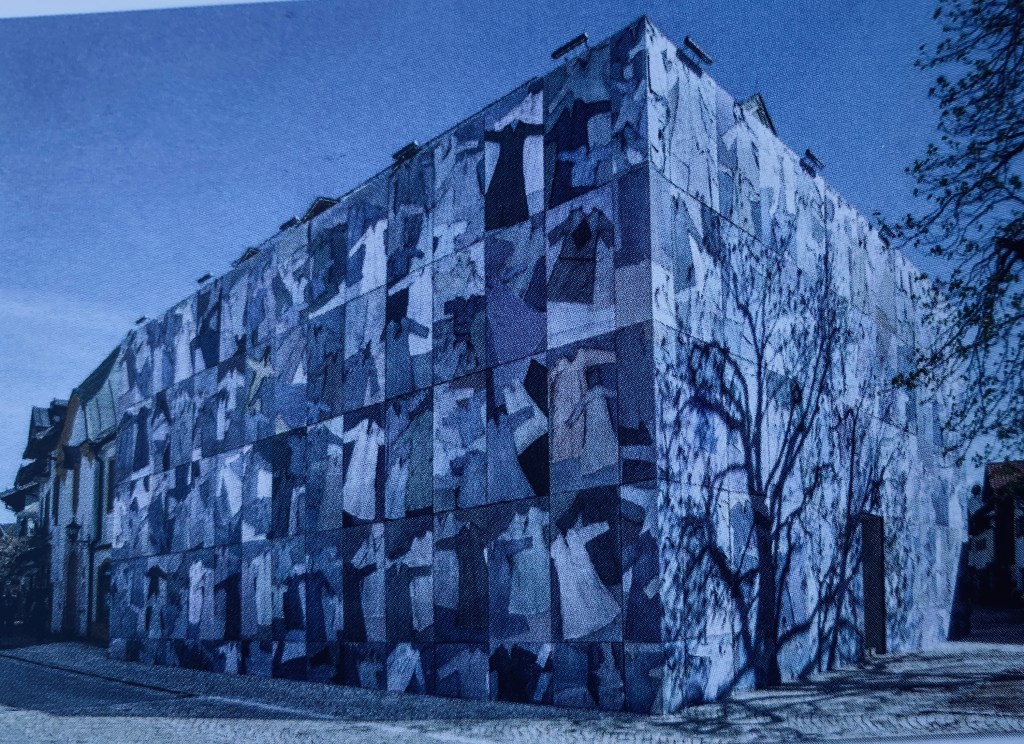
There is a also a temporary museum there displaying costumes from the last two plays (2000 and 2010)- they are on panels on the outside walls of the museum. When the museum closes at the end of the season, each panel will be taken down- each has been sold already. Very unique.

Day 6 Oberammergau – Leipzig
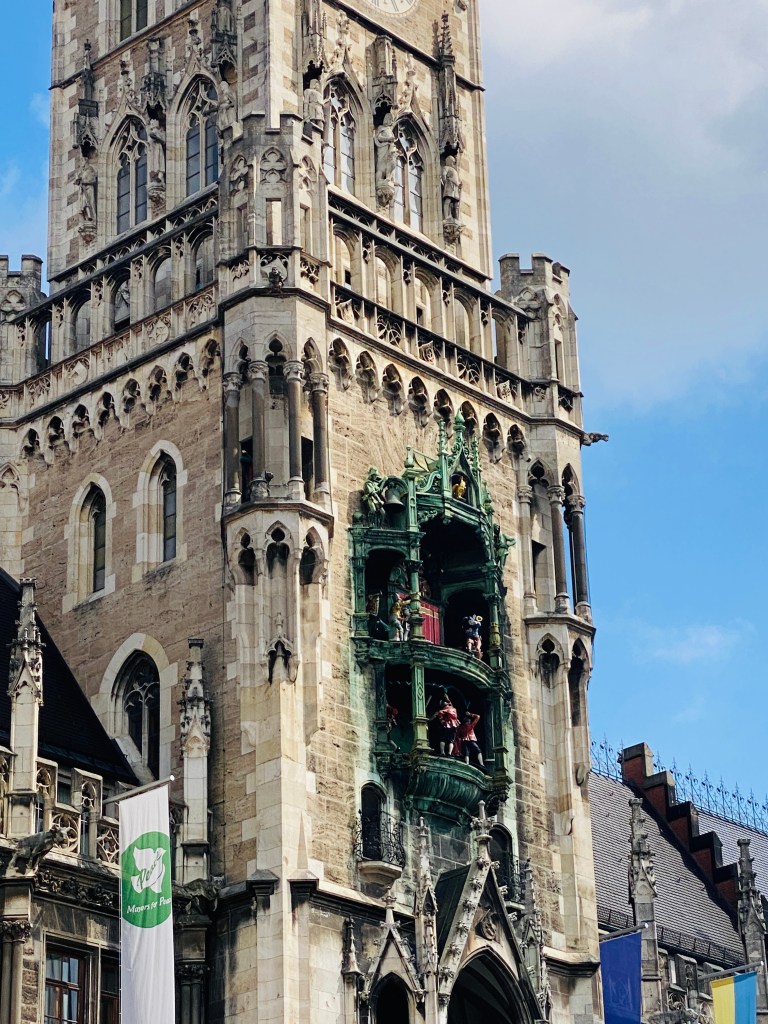
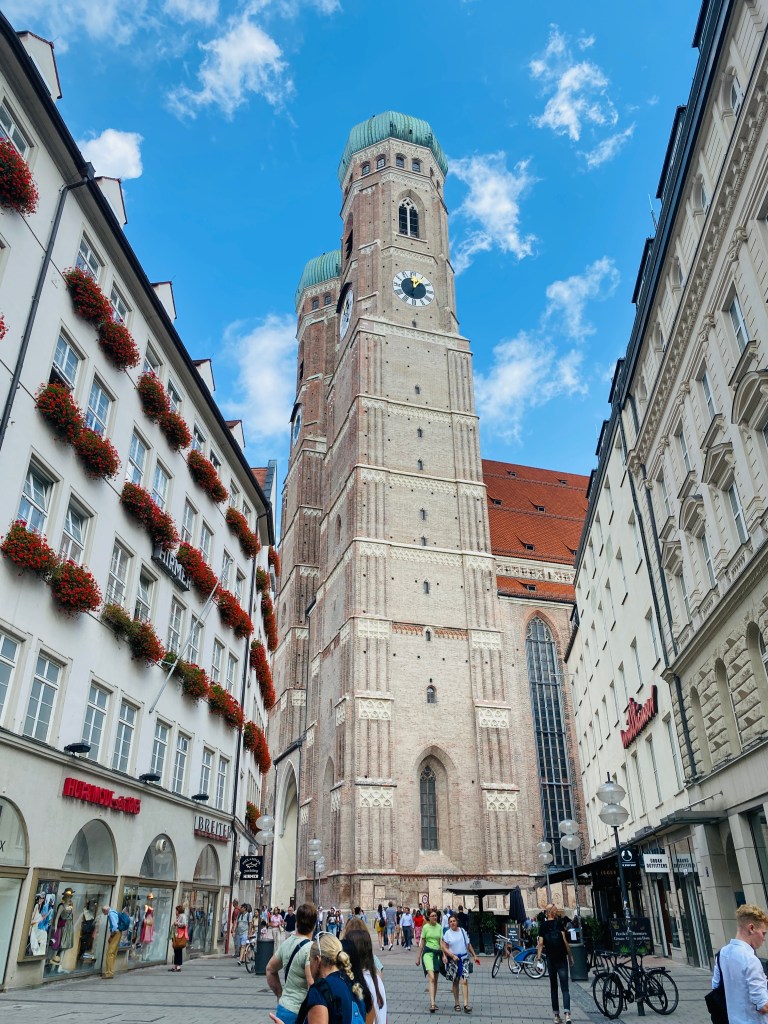
We had a lovely little explore around the town before heading back to the bus to Murnau, hopping straight onto the train back to Munich. With an hour to spare in Munich we did a quick walk to Marienplatz to see the clock on the New Town Hall do its midday performance. It is a re-enactment of the first Coopers dance which was held to boost the morale of citizens when the town was beset by the plague.
Picked up our big bags which we had stored at Eden Hotel Wolf, crossed the road to the station, and a first class train to Leipzig… train travel is so easy in Europe, and very comfortable
. A minor glitch with the trains saw our platform being changed within 30 minutes of departure – no notice to us. Then we found that both of our first class bookings had been changed because of train issues!
Arrived at Leipzig, and our hotel was across the road, plus a block away. Mind you, it was a very wide road, and a lot of cobblestones in the block! Staying at the Ibis Hotel for two nights.
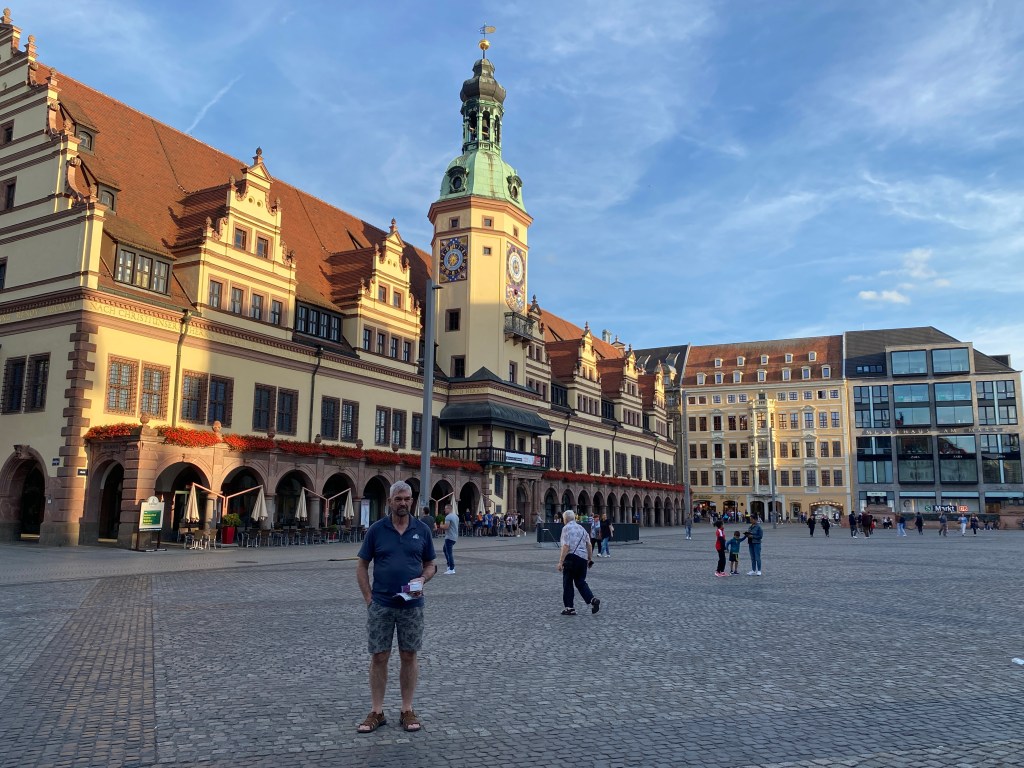
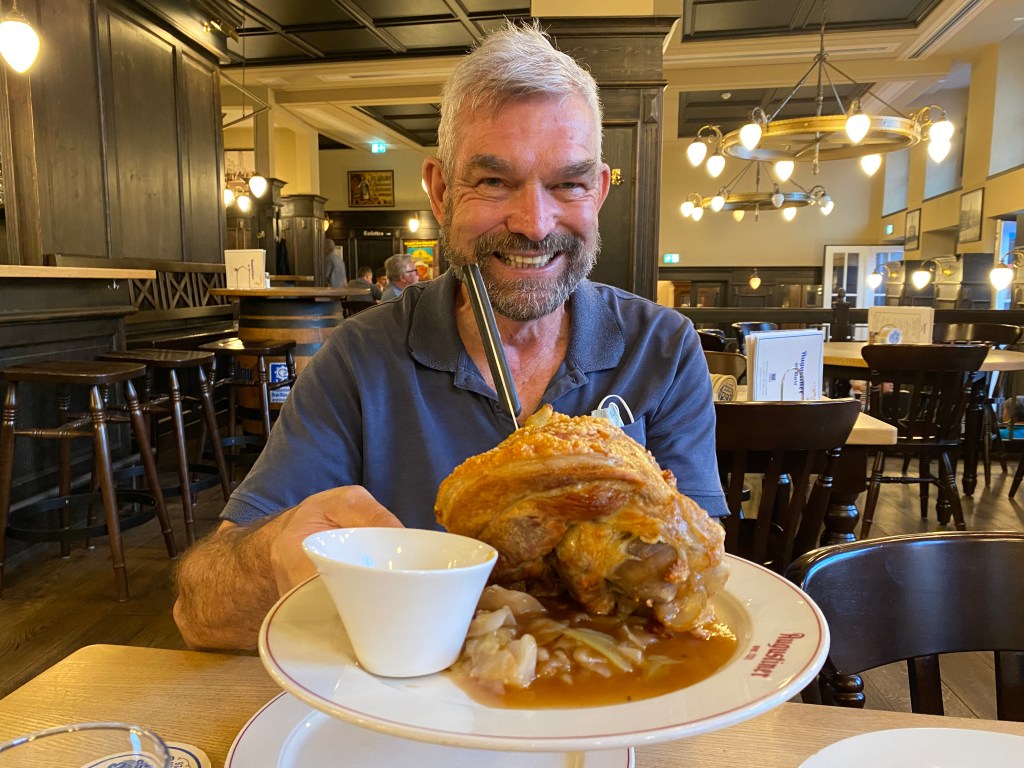
Once the luggage was deposited, we had a nice walk around the old town of Leipzig. Dinner at a beer house, where we shared a 1 kg pork knuckle- much to Frank’s disgust! He thought we should have one each! It was more than enough for the two of us, and very nice, I might add!
Back to our room to do a little domestic work… washing! It does have to be done unfortunately.
Day 7 Leipzig
A whole day in Leipzig… starting with a yummy breakfast at the restaurant next to where we are staying! Omelettes for 8.90 Euro each, and delicious!
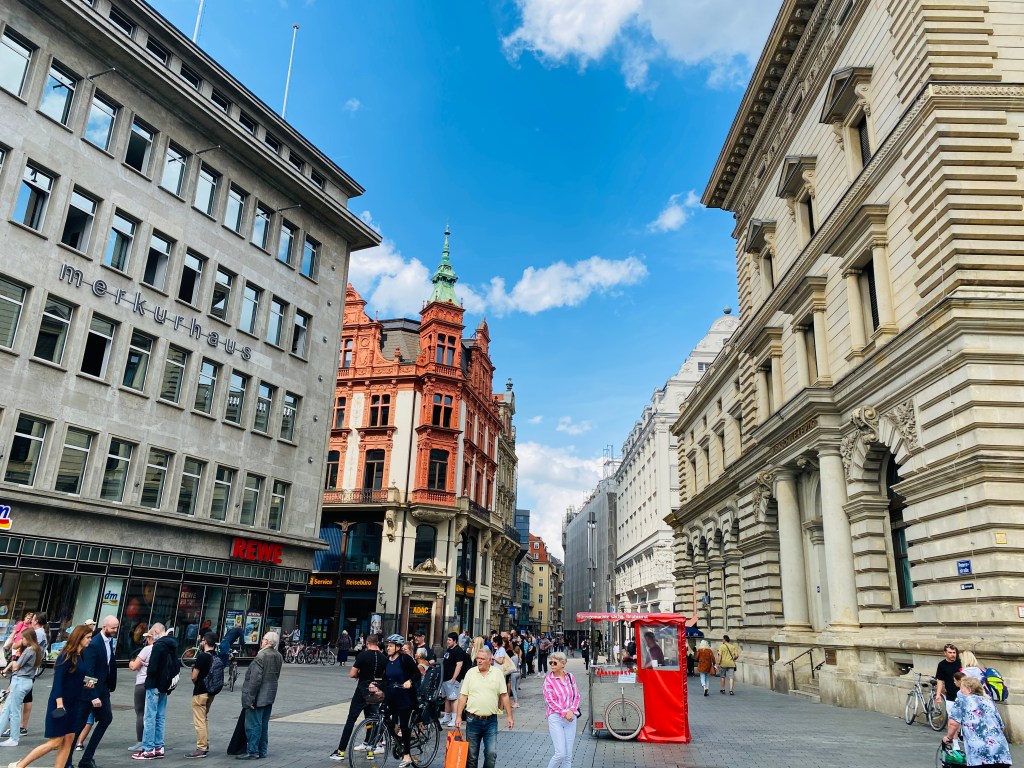
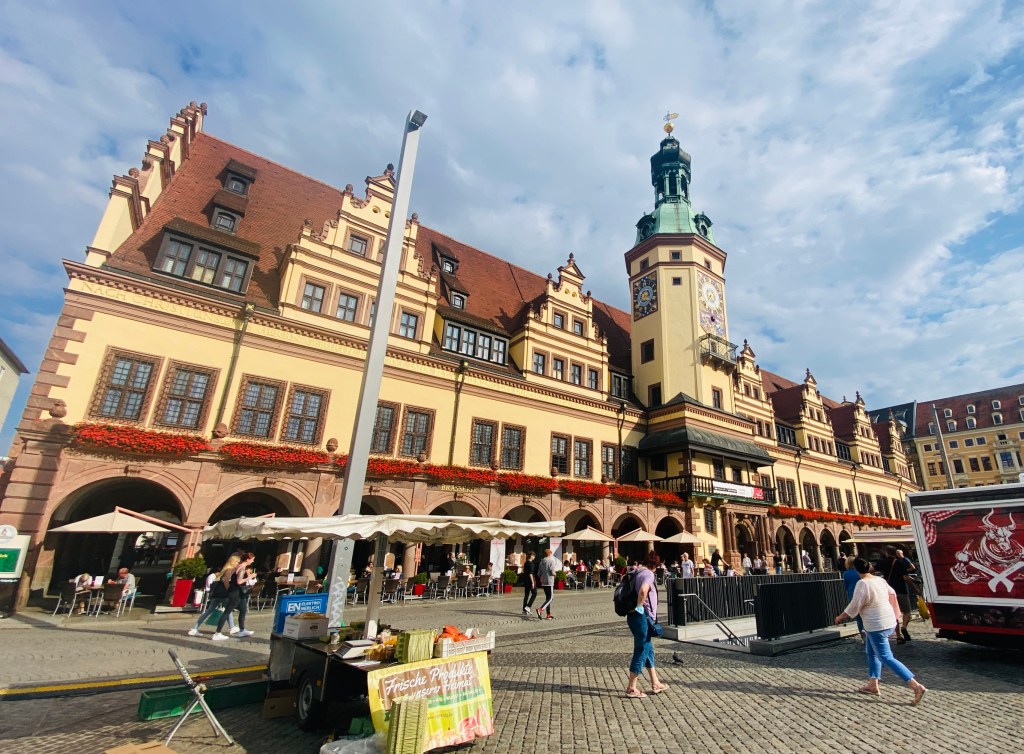
Hop on/ hop off bus today. Best known for its significant role in East German protests that led to the downfall of the GDR in the late 1980s, Leipzig is a vibrant city today. We took in many city sights such as the University, the Opera House, Augustusplatz, War Memorial, the Red Bull Arena and much more. Stopping at Augustusplatz, we then did our own walking tour of the old town. So much activity at the market square! We also went to St Thomas’ church which is where JS Bach was the choirmaster.




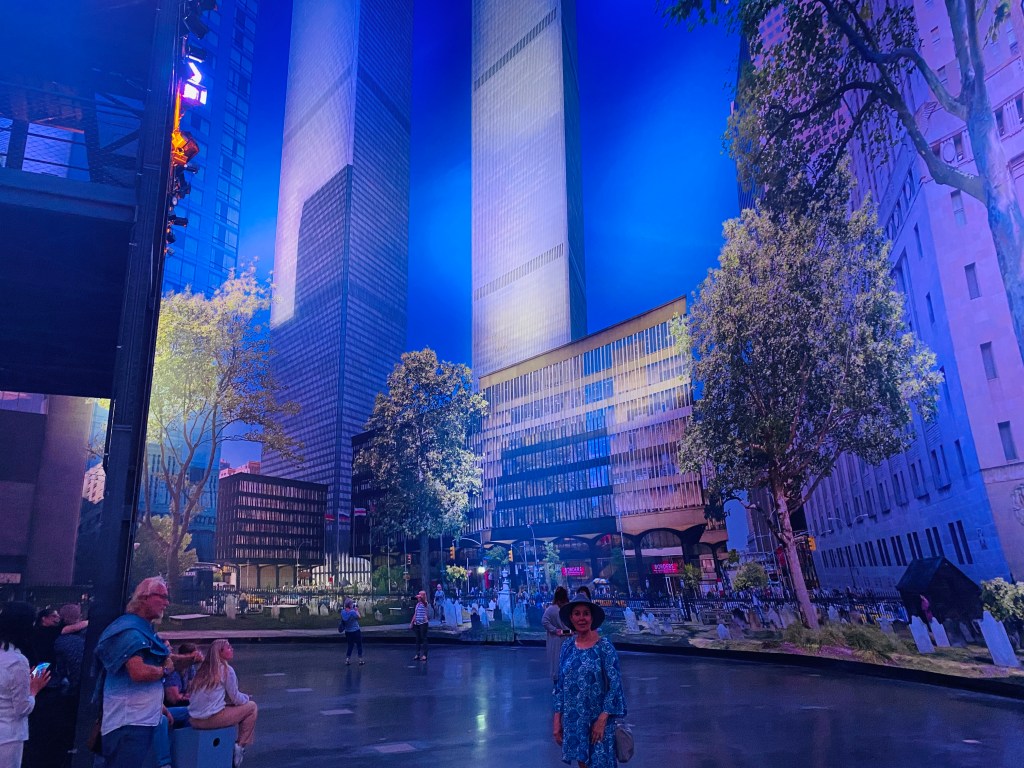
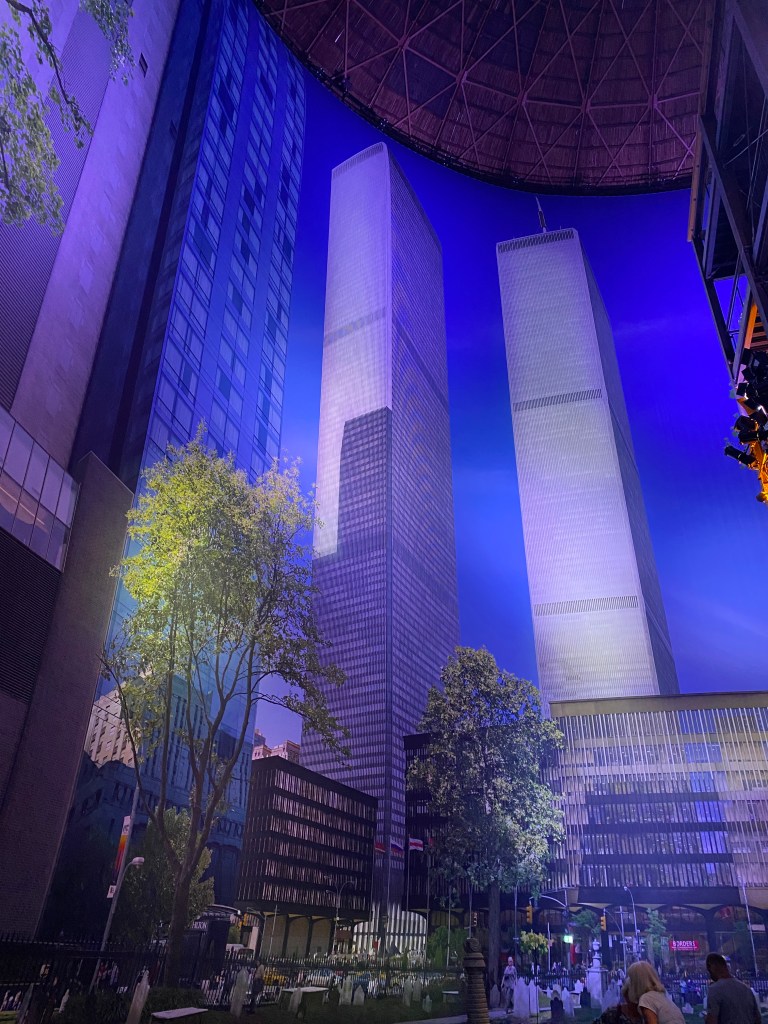
We did get off at the Panometer along the way (which is an old gasometer), and went to the current exhibition- War in peace times starting from 9/11. It was very interesting, and seen from another viewpoint. It showed the far-reaching global impact and allows for a complex consideration of subsequent events. The panoramic display is of The World Trade Centre seen 5 minutes before the attack – very thought provoking. The panoramic work of Yadegar Asisi is 360 degrees and a height of 32 metres.

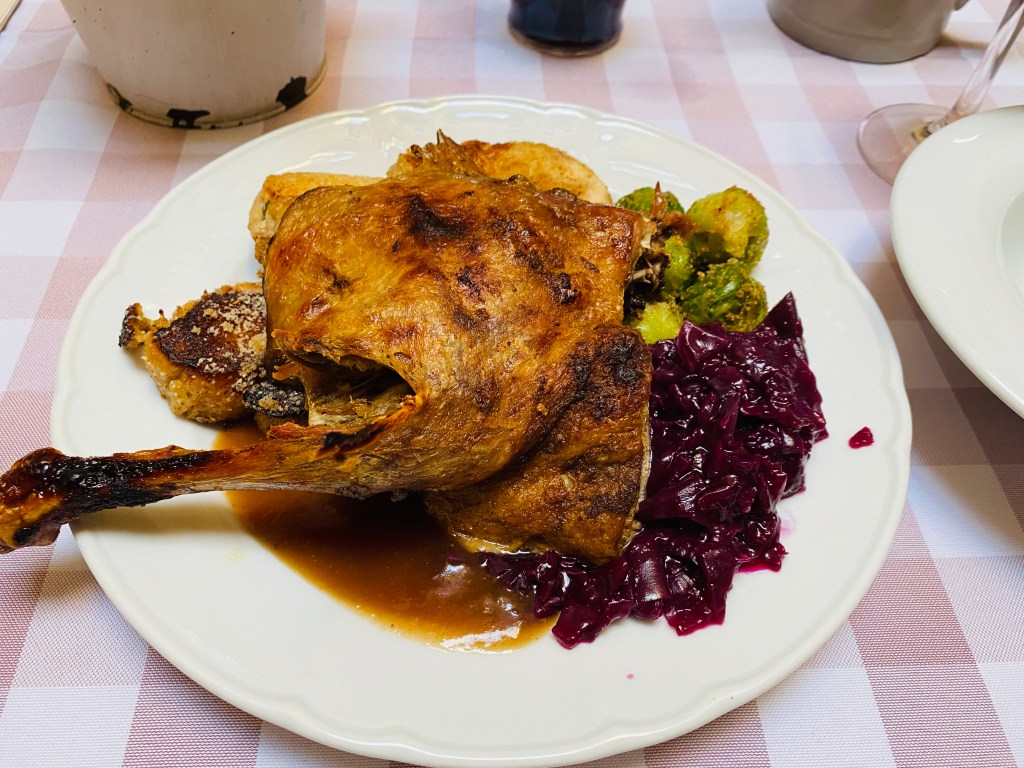
Thoroughly enjoyed our time in Leipzig. We stopped at a few lovely little restaurants along the way for some light refreshments, and had the most delicious dinner at the end of the day in a very nice restaurant in a 1700 Baroque building. Again, a small dispute over the size of the meal- we both ordered 1/4 duck – in the end I ate 1/2 of the 1/4, and guess who had the remainder! The carpaccio we had for entree was a little different to what we were familiar with. Had a lovely chat to the waiter who was from Croatia and spoke 6 languages- makes us feel very inadequate!
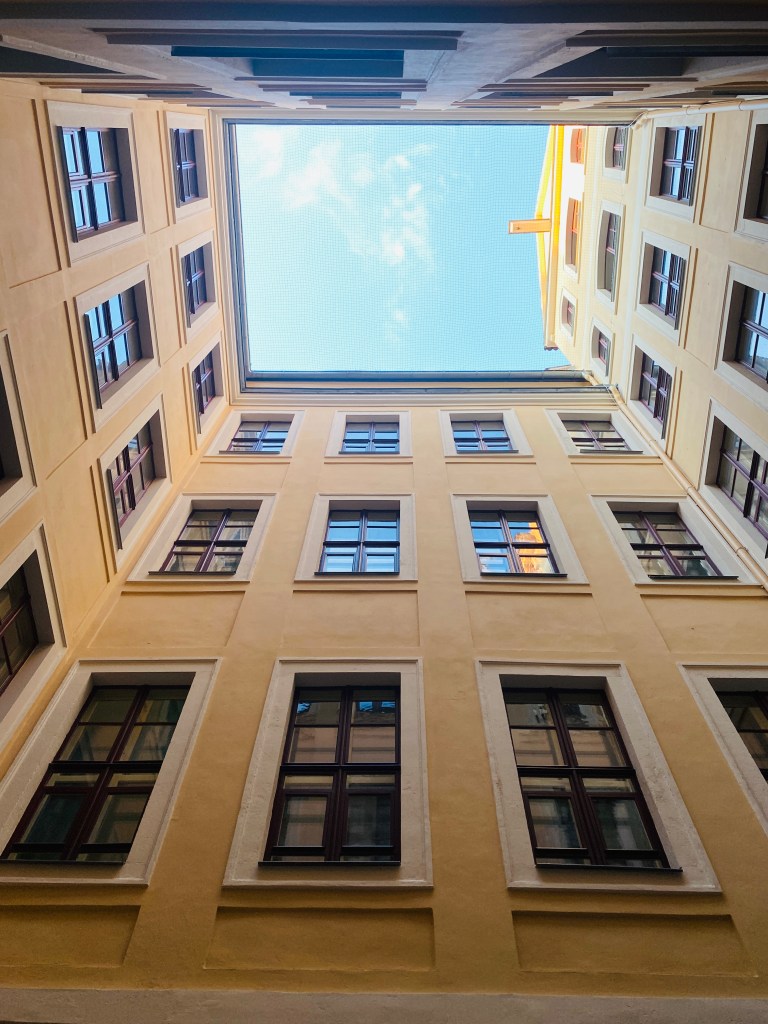
We leave Germany tomorrow… and what do I think of Germany??? They drink a lot, eat a lot, smoke a lot, some Germans are abrupt, most are very helpful, there are millions of bikes, the architecture is beautiful, the breads are amazing, as is the beer …. and will I come back…. for sure!
River Cruises Prague to Bucharest and Transylvania
Czech Republic
Day 8 Leipzig to Prague
All packed, so off to the train station – we had worked out our easy walking path to the station the day before, so all shots have been smooth sailing! But, ten minutes before the train departure, we thought it was strange the train wasn’t there. Luckily Frank checked- they had done a last-minute platform change, and of course we didn’t understand the announcements – if they had made any! So a mad dash and we get to the new platform to find the first class carriage was changed and our allocated seating wasn’t there. We found suitable seating, and had 1 1/2 hours to Dresden where we then changed trains to go to Prague. That presented another problem – the first class carriage was closed! So here we are running up and down the platform trying to work out where we were going to sit – we ended up in the dining car, along with our luggage, and all the other passengers who had first class tickets! It was 2 1/2 hours to Prague.
After all the frustrations of today’s trains, we then found the right way out of the station, and headed off to our hotel, the Majestic Hotel. We thought we could handle the 15 minute walk easily, but…. It was cobblestones all the way! And another fall by me on the way- this time a grazed shin! These cobblestones are dangerous! 15 minutes became 30 with the luggage!
Anyway, we made it! Checked in, a nice big room, and then some time to explore the local area. We had a drink at the tram bar on Wenceslas Square, doing a little people watching at the same time.

We then had a meet and greet with the Emerald cruise director, explaining our next couple of days in Prague. She took us on a short walk around the local area. Dinner was at our expense- we tried a traditional Czech restaurant close to our hotel- good choice! Czech goulash- delicious! Plus, a waiter who spoke excellent English, and who proved to be very entertaining!
Day 9 Prague
Population 1.5 million
1 AUD = 16.5 CZK

Prague, the capital city of the Czech Republic, is bisected by the Vltava River (also known as Moldau) – creatively called the Left and Right Banks! Nicknamed “the City of a Hundred Spires,” Prague offers a wealth of architectural, artistic and cultural treasures.
We started at the Prague Castle which dominates the Prague skyline. It is a castle complex built in the 9th century. It is the official office of the President of the Czech Republic. The castle was a seat of power for kings of Bohemia, Holy Roman emperors, and presidents of Czechoslovakia. Vladislav Hall was added in the 15th century. St Vitus is the huge cathedral inside the castle complex. The medieval gothic cathedral took nearly six centuries to complete- final construction phase ending in 1929. It was timely that we arrived at the same time the guards did – always love a bit of pomp and ceremony! Also time for an Apple strudel at the Lobkowicz Palace (in the same Palace region) while enjoying a beautiful view over Prague.


From the castle we walked down the stairs into the Lesser Prague area. We made a stop by the river and had a traditional Czech cheer – a shot of Becherovka while looking at the Charles Bridge – as you do at 11am! Apparently Becherovka is the cure for everything! Also had a visit from a local – a Nutria – which translates as a mouse beaver. I think it was a very large rat! Saw a few swimming along the river.


Had a lovely walk through the Lesser area, across the Charles Bridge, with Martina giving us a wonderful commentary of the history, buildings and the Czech way of life.
We walked across the pedestrian Charles Bridge, which links the Lesser Area to the Old Town – completed in 1402, the bridge’s towers and statues make it seem like an outdoor museum. We meandered our way through the ancient laneways to the Old Town Square.
The huge square is the thriving heart of old Prague. There are colourful Baroque buildings and Gothic churches. The Stare Mesto Town Hall has a medieval Astronomical Clock, which gives an animated hourly show. We had coffee at the Mozart cafe on the first floor of one of the buildings and watched the 35 second show from a great vantage point!

Our afternoon was spent at leisure exploring the old town. The buildings are of pleasing architectural form and proportional harmony, with close attention to ornamental detail. I just loved the architecture! We also did a small boat ride on the Moldau, with a beer of course, enjoying the charm of the buildings from the river.

A drink at one of the restaurants on the square enjoying people watching, completed our day. The square is a hive of activity, not only with tourists, but for the locals as well. Drinks are cheap – $10 for a beer and wine for us. Aperol Spritz still very popular here.
Dinner tonight – we tried the seafood restaurant next to our hotel – what a great choice! We picked out our salmon from the display counter, it was cooked in front of us, and served with beautiful fresh salad! There was a little communication problem to start with, but great end result!

Day 10 Prague
A free day. We started at the Museum we visited a great art exhibition at the Prague Gallery in the Old Town Square – Andy Warhol, Alfonse Mucha and Salvador Dali. It was excellent!


Next we walked across the Manesuv bridge and explored the Lesser Area. First we explored the Wallenstein Palace and the beautiful gardens there. This magnificent residence, somewhere between a palace and a fortress, was built in the first half of the 17th century for the Bohemian commander.
The Church of St Nicholas is the most famous Baroque church in Prague -it stands along with the former Jesuit college in the centre of the Lesser Town Square. We had a special treat while we were inside – a female visitor to the church decided to stand in front of the nave and sing a soprano version of Ave Maria, absolutely breath taking.


Time to rest our feet, we have been averaging 18000 steps a day for the past week. We tried the Czech fried cheese, Camembert (Nakladany Hermelin)- apparently this tradition started during Communist times when the queues to buy meat were so long that people thought to deep fry cheese instead. It was delicious – not exactly healthy – served with chips and a homemade sauce!
Back across the bridge so we could explore the Jewish Quarter. The first Jewish settlement in Prague was around the 10th settlement, and numbers quickly increased. Persecutions, fires and plundering were regular occurrences throughout the centuries made life difficult for the Jews. The period of Nazi occupation in Prague (1938-1945) was the darkest time for the Jewish community- it is estimated 90% of the Bohemian and Moravian Jews were killed during WWII. The group of buildings which make up the Ghetto together with the cemetery has now been transformed into a large open air museum. We went into the Klaus and Pinkas Synagogues, and also the cemetery. There are 12000 tombstones for more than 100000 people buried there. Because of the lack of space, they are all packed tightly together, stone upon stone in a picturesque fashion, giving the place a fascinating atmosphere. It is said, that in some parts of the cemetery there are 9 layers of burials. Very interesting.


Frank gave me a few minutes to browse the shops in the old town – he is always so generous when it comes to shopping time!
Then an early dinner – we found the most gorgeous restaurant in a little laneway – the Deer Restaurant. It was the most delightful setting – think chandeliers, outdoor garden with large maple tree, plus a pianist playing beautiful dinner music – then the most amazing fine dining food choices. The food was divine, and very inexpensive. A great find.
We then had tickets for a 7.30 classical recital at St Salvator Church which is the main church at Clementinum (at the entrance up the Old Town). Every church seems to offer a similar nightly concert – because the acoustics are so good. We had the Royal Czech Orchestra – there were 3 violinists, a cellist and a double bassist playing, plus a soprano singer. It was indeed beautiful listening to the ten compositions – included works from Mozart, Bach, Beethoven, Vivaldi and Handel.
On our walk home, we stopped at a local bar for a night cap and watched again the passing foot traffic. We have thoroughly enjoyed our Prague visit.


Day 11
Prague to Passau
Day 11 3rd September
Prague to Passau
Emerald cruise to Budapest
We left the hotel at 1030 to travel by bus to Passau – we had one pit stop on the way, and arrived in Passau at 1445. Martina told us more Czech stories on the way- loved the personal touch!
At 3pm we boarded the Emerald Sun – this is a very modern ship, only built in 2015. It has a capacity of 182, however it is only half full. Some benefits of travelling during a pandemic! Half of the passengers were Canadian, we are the only Aussies, the remainder are Brits and Americans.

By the time we unpacked and got settled in our cabins and explored the ship, it was time for our welcome brief, then dinner. So far so good.

Day 12 Passau 4th September
Population 52,000
First excursion today was a guided tour of Passau, taking in the sights such as the Town Hall, Art Alley (Hollgasse), the Wilderman Hotel, and ended up at St Stephen’s Cathedral and square. The border town of Passau goes back to Roman times and the town retains a medieval feel in its narrow alleys and archways. Passau sits on a peninsula between the rivers Danube and Inn, as well as Ilz, and at the point of the peninsula you can see the different coloured waters meet (the Inn is more glacial and therefore milky, whereas the Danube is clearer). After the guided walk we had some free time to wander through the town.

After lunch, we headed out again – this time to hike up to the fortress at the top of the hill, Veste Oberhaus. It was approximately 30 minutes walking up at least 300 stairs and some steep walking paths. The view at the top was worth the climb – a great view overlooking Passau, the city on three rivers. It was much quicker going down! We then had a walk down to the river’s edge taking in all the multi coloured buildings. It reminded me a little of Bergen. Apparently they are painted the colours on what they are .. eg doctors are one colour, butchers another.


Showers, and time for the Captain’s welcome drinks followed by another delicious meal – the eggplant rolls filled with cheese, served on a cucumber slice for entree was the standout, followed closely by the passion fruit sorbet! Meals served on board are traditional of the area.
Tonight was a fun night competition of famous voices and movies. We came a close second!
Day 13. 5th September
Linz to Cesky Krumlov back to Linz
Overnight we had moved to Linz, a big industrial city in Austria. We however were starting our time here with a day trip to Cesky Krumlov, the most enchanting town on the Vltava river in the Czech Republic.
Celtic tribes settled in Cesky Krumlov before Christ, next came German tribes, then Slavic, then Bohemians – a long colourful history. The Rozmbergs (Bohemia’s top noble family) ran the city from 1302 until 1602 – you can see their rose symbol all over the town. The 16th century was the town’s Golden Age, when Cesky Krumlov hosted artists, scientists, and alchemists from all over Europe. In 1588, the town became home to an important Jesuit college. In 1602, the Rozmbergs ran out of money to fund their lavish lifestyles, so they sold their territory to the Habsburgs, who ushered in a more Germanic period. After that, as many as 75 percent of the town’s people were German- until 1945, when most Germans were expelled.


We started our guided walk at the Cesky Krumlov castle, then walked down the hill through the new town (saw the flood level of 2002), across the bridge into the Old Town. Here there is a rich mix of Gothic, Renaissance and Baroque architecture. Alleys filled with artisans showcasing their wares gave us plenty to look at – handmade gingerbread (made with recipes from a century ago), jewellery stores with Czech garnet and Molvadite jewellery (once the Molvadite is gone – that’s it!), local potters, and so much more.
We stopped once for delicious coffee and pastries in a gorgeous Art Deco cafe, plus another time for a local beer and Aperol Spritz overlooking the river, but also looking up to the magnificent castle! Everything is absolute beautiful here!


Back to the ship, then out for a two hour walk around Linz. The Old Town has a lovely square, Hauptplatz. We walked to The New Cathedral (or Neuer Dom) which holds 20,000 people (not sure if that is seated), then a walk back to the ship, via a shop with a sale (there’s always a sale isn’t there!). Linz is a city that boasts several modern museums and the Lentos Art museum is one of such with a dazzling exterior that lights up in bright neon colours at night which we could see from the ship. Another dinner with amazing food and our amazing Lauren on board entertained us with her beautiful singing!


Day 14 6th September
We woke up in Melk today!
Melita is an Austrian town on the River Danube, west of Vienna. It’s known for the 11th-century Melk Benedictine Abbey, a vast monastery built high above the town. Gold statuary adorns its domed Abbey Church, and the huge library houses medieval manuscripts. We walked to the Abbey and enjoyed a tour of the treasures of the Abbey. We commented how well it was maintained. The gardens and garden pavilion were beautiful! The Main Hall in the pavilion’s center could be used as a prestigious dining hall!


Part of the Abbey is now a school for 900 students – I can’t imagine telling everyone I went to school in an Abbey- particularly one as palatial as this one was!
We explored the town of Melk after our tour of the Abbey – another medieval town, complete with Town Hall and main square. Very pretty.
Lunch on the ship today was traditional food from the area – Bratwurst, pork knuckle, Linz cake etc- all very nice!
After lunch, Frank joined the cycling group and cycled 36 kms from Melk to Durnstein, enjoying the castles, villages and vineyards along the Danube River.


I stayed on board listening to the history commentary of the gorgeous villages in this idyllic part of the Wachau Valley.

Once we arrived in Durnstein, I walked into the village exploring the little boutiques and laneways. Apricots are grown in this area, and the apricot liquor is very famous – of course I bought some to try, which was yummy!
Originally ruled by the Kuenring dynasty, Dürnstein is rich in history, and by virtue of its narrowalleyways as well as historic buildings and monuments it is known as the pearl of the Wachau.
There were a few tired bodies after the bike ride, so dinner and relaxation was very much appreciated.
Day 15 Vienna, Austria
Population 1.9 million
Language German
Currency Euro
Vienna, Austria’s capital, lies in the country’s east on the Danube River. Its artistic and intellectual legacy was shaped by residents including Mozart (though he was born in Salzburg), Beethoven and Sigmund Freud. The city is also known for its Imperial palaces, including Schönbrunn which unfortunately we didn’t get to see this visit.
Leaving the ship at 9am, we first did a guided bus trip driving along the Ringestrasse. The UNESCO world heritage listed historic centre was once a fortified Roman frontier city – we discovered some amazing architecture from across the last millennia.

Next we did a guided walking tour viewing famous sites such as the Opera House, St Stephen’s Cathedral, and the Hofburg Palace which was the Habsburgs’ summer residence. We even managed to see some of the horses from the Spanish Riding school which reside here. Hofburg Palace is In the MuseumsQuartier district that houses many museums.


We needed a coffee by late morning so we stopped at a gorgeous coffee shop- Demel. It is a 1888 cake store/ coffee shop serving specialties such as cream cakes, scones & strudels, and of course the famous Sachertorte. I had the Kaiserschmarrn, which is like a thick pancake served with plum compote – both were divine. Mind you, they would want to be for the price… the coffee alone was 6.50 Euros (almost $10)! I be always remember Vienna as being expensive!

The afternoon was free, so we went to the Leopold Museum in the Museums Quartier. The Leopold Museum is home to 44 Egon Schiele paintings and various works by Gustav Klimt – it is very ironic that these two great artists both died in 1918. Afterwards it was worth heading to the courtyard to hang out with locals on one of the eye-catching geometric blocks.


We also went into Mozart’s house, now a museum and saw where he spent his last few years working. Interestingly, he died very young at the age of 35, just before completing his famous Requiem.

We were on the last shuttle bus back to the bus, and the only ones on the bus! We are the stayers! Frank and I had both been to Vienna many years earlier, but we both enjoyed rediscovering the classical charms of Vienna. Our legs were very tired by the end of the day!
Dinner…. Of course Weiner Schnitzel!
Day 16 Bratislava, Slovakia
Population 500,000
Currency Euro
Bratislava, the capital of Slovakia, is set along the Danube River by the border with Austria and Hungary. It’s surrounded by vineyards and the Little Carpathian mountains, crisscrossed with forested hiking and cycling trails. Bratislava was the capital of Hungary from 1536 to 1784. Slovakian became independent after breaking away from Czechoslovakia in 1993.
Our guided tour started with a guided walk up to Bratislava Castle – this striking landmark was most recently rebuilt in a Renaissance style, but still retains some of its original features. The first castle was built in 907, then the current one was begun in 1430 – it is now a museum. We walked through the pedestrian only (plus tram cars), through the Old Town, seeing St Martin’s Cathedral (the Horner coronation church of the rulers of Hungary), Michael’s Gate, the Town hall and square, plus beautiful alleyways and of course, cobblestones. We finished at a Slovakian hotel where we tried the Slovakian sturm wine (quite sweet but nice in small amounts) and traditional crescent shaped pastries with walnuts in them.

We had a few hours to explore ourselves. Of note was the coffee we had in a very cool spot (it was 28 degrees today) behind the Town Hall. The coffee was only 2,10 euro – one third of what we paid yesterday in Vienna!
Dasha, our guide, was CNN most entertaining, and had an amazing ability to walk backwards on the cobblestones for 95% of the walk- a marvellous feat!
The evening’s entertainment was a visit by a visiting musical group – the Aphrodites – who played and sang for us. Their harmony was absolutely beautiful. The ladies in red were indeed very talented.
Day 17 Budapest, Hungary
The city of love!!! Once the Roman city of Aquincum, Budapest is a true historic marvel with bathhouses and homes with heated floors due up the surrounding hot springs. The UNESCO World Heritage listed city offers Romanesque, Barogue and Classical architecture.

Bestriding the Danube, Hungary’s capital is two cities- Buda, with its medieval streets and imperial palaces, rises on the west side of the river, and Pest, the commercial and political hub of modern Hungary, lines the east. Together the make up the most enchanting city.

This morning we had a city tour with Adam, a very lively Hungarian who had many tales to entertain us with. We disembarked on the Buda side, drove across Margaret Bridge, along Andrassey Street (Budapest’s Champs Élysées) to Vajdahunyad Castle and Heroes Square. The square was laid out in the 1890’s and was the focal point of Hungary’s Millenium celebrations in 1896. In the centre is the Millennium Monument flanked by two colonnades. The riders on horseback represent the seven chieftains of the seven Magyar tribes that settled in Hungary.

From here we got dropped off close to the Parliament Building. It is one of Budapest’s defining landmarks and was designed by Imrie Steindl. Has been renovated recently, replacing every sandstone block one by one.
We then walked along the many streets with Adam giving us some extensive history as we went. We ended up at St Stephen’s Cathedral, another magnificent building. It was built between 1851 and 1905 in the form of a Greek cross. The dome is 96 metres high representing the year 1896 – the 1000th anniversary of the Magyars in Hungary.

We had free time in the afternoon so we went to the Gellert Hotel and Baths Complex which was not far from where we were berthed. Inside the complex are five thermal pools, two swimming pools, steam rooms, private baths. The thermal pools ranged from 36 to 40 degrees. Adam had told us in his stories, if they are not well they can get a doctor’s certificate to have the day off and use the baths – so good are the healing properties of the water! We did not notice any magical healing powers, but it was certainly relaxing. We also noticed that the reputation of Budapest being the city of love was alive and well – but that could be a story for another day!


A little walk around the local area, which was mainly University areas, also proved interesting.
A traditional Hungarian goulash for dinner followed by a traditional Hungarian folklore show was the order of the evening. We said goodbye to our newly made friends as we were all going our separate ways in the morning.

Day 18 Budapest, Hungary
Well we had a frustrating start to the day – after farewelling the Emerald Sun, we made our way to the Intercontinental Hotel which was on our travel documents, only to find we were not booked in there. We eventually sorted it out with the Avalon guide who was there (this was the first night of our next cruise), and had to get another taxi to the Corinthia Hotel which is where our cruise group was starting from. Then we had to stand in a queue for an hour to check in – things were a little tense for a short while, but all sorted out in the end!


So we had the day to explore Budapest! So we walked, and walked, and managed the transport system! Our expedition started with the Opera House. This Neo-Renaissance masterpiece was built in 1884. I thought it was absolutely gorgeous. Next was Vaci Street – one of the city’s best known streets (it offers shopping, restaurants, St Michael’s Church, and many souvenir shops), ending up at the Central Market Hall where you can buy the famous Hungarian paprika, to horse meat. Also Aldi is in there! We went in to check it out, – the same female voice we have, tells you the checkout is closing! Lunch break was at a lovely Italian restaurant overlooking the Danube.

After we had fuelled up, we walked along the river to the very moving Jewish memorial – 60 pairs of bronze shoes on the river bank, symbolising the atrocities which occurred during the years 1944-45.
Another walk around the Parliament Building – we were in awe of how beautiful it is.

A tram, then bus got us to the other end of Margaret Island (named after Princess Margrit, daughter of King Bela IV), an island in the middle of the Danube River- it was once three islands, until they were joined together to prevent flooding. It is now a tranquil oasis with parks, playgrounds, pools, an old water tower, convent ruins, and more. We enjoyed the coolness of the peacefulness of the island, before heading back to our hotel for a briefing by the cruise director of the next cruise.

We then set off to go the castle on the Buda side of the river, because Frank wanted to get a nice photo of the Parliament House from there. Well, what a night! Three trams, one train, three buses later we got there!!!!! Lucky you don’t have have your wait any more than a couple of minutes for any connection! We certainly got exceptional value for our 24 hour transport card (for $10)!
Complain as I might, I do have to say, the view was absolutely breathtaking from the turrets Fisherman’s Bastion on Castle Hill!! So glad we did go there at night. No wonder it is the city of love!
Two buses and two trams, and we were back to our hotel. We enjoyed some tomato soup at 10pm before deciding to call it a day. 25000 steps for the day… we were knackered!!


Avalon River Cruise
Day 19 Budapest, Hungary
Out for our last adventure in the beautiful city of Budapest. This morning we thought we’d go back to Castle Hill in the daylight. Two trams and we were there in no time.
A UNESCO World Heritage site, medieval Buda grew up around the 13th Century castle which was erected on a hill to protect it. The Turks however did attack it, then the Hapsburg restored it in the 19th century. It was badly attacked again in WW11, under communist rule they destroyed a lot of what could have been salvaged, and now they are rebuilding the place to its former glory. It now houses several museums and the National Gallery. We saw the changing of the guards at Royal Palace. It was all very grand.
Fisherman’s Bastion was just as spectacular by day as it was by night! It was built as a monument to the Guild of Fishermen in 1895. The views are amazing! Nearby, standing on the site of a 13th century structure is Matyas Church – it was rebuilt in 1470. An interesting note is that the Hungarians were not allowed to go to church during the Middle Ages, and privileges taken away if they were seen going to church during the Communist rule. We enjoyed a coffee in the Panorama cafe enjoying the amazing view.

Once we finished taking in all the magnificence, we walked down to the river to find the tram not going as there was a marathon on and roads were closed. A little bit of ingenious planning by Frank, plus a walk to another tram line, and we managed to get back to our hotel to pick up our bags!

From there it was another two trams down to the river to board our next ship – Avalon Illumination. The boarding process was straight forward. We have a very nice cabin with full size sliding windows. After we unpacked we had the regulatory safety briefing, then an explanation re excursions etc. again our ship is only half full with 87 passengers on board.

After dinner, we set sail, first doing a river cruise with commentary, through the full length of Budapest along the river. Again we saw the castle, many bridges, churches, Parliament House plus so much more, all magnificently lit up. It truly is spectacular. I was sorry to say farewell to this beautiful city of love!
Day 20 Mohacs, Hungary
Even though we had just arrived in Mohacs, we took a day trip to the city of Pecs, a 40 minute drive away. Pecs is an ancient city founded by the Roman’s- it is now called Hungary’s “cultural pearl”.
From the 15th century circular Barbican defensive bastion, we walked to the Saints Peter and Paul Cathedral whose foundations date back to the 4th century. Inside we enjoyed an organ concert- 6000 pipes on the organ. The organ was made in Pecs.

We then went to Cella Septichora, the archeological ruins of an ancient Christian burial site. Inside is a 2000 year old sarcophagus- it was accidentally discovered when they were replacing a fountain!
We continued downtown to Szechenyi Ter, the main square where we had some free time to wander around and enjoy the lovely Baroque buildings. The domed Mosque was built in the 16th century when the city was under Ottoman rule, and is now a Catholic Church. Hungary became independent in 1989.

Pecs was famous for its porcelain making – many of the decorative roof tiles are made of porcelain. Also well known for its universities, and students come from afar to study here.
Back to Mohacs to where our ship was docked. We went for a quick walk to the main area – not a lot happening! We did walk up to the War Memorial, then back to the ship for lunch.
Took a while to clear customs at the Croatian border- we were stopped for hours and each had present for a face check. Luckily it was afternoon tea time so we could partake some of the many sweets on offer!
Not long afterwards was dinner… never any shortage of food or wine on this trip!
Day 21 Morning
Ilok, Croatia
Currency Kunu
Population Croatia 3.8 million
We docked in Ilok this morning – the elegant Croatian town where east meets west above the Danube, amid the sloping vineyards. At 9am we entered the winery for some wine tasting – yes that is early for wine tasting! We sat at the most gorgeous table made of heavy wood for our sampling – it was a setting fit for a king! We heard all about the 1000 year old wine making tradition of this winery. The three wines they served were very nice. Of note, this winery served wine at the coronation of Queen Elizabeth- so there’s a wrap. We also went into the wine cellars, half of which was built in 1450! There are archival bottles in the cellar dating back to 1947 – the corks get changed every 15 years.


From there we walked to the Odescalchi Castle (which is now a museum), saw the Ilok Fortress walls (which are currently being renovated) and the Catholic Church was has been very nicely renovating. A quaint little town with a long history.

Back to the ship to lunch and we move onto our next port – it took a while to get going because of passport checks. Apparently as of 1st January 2023, Croatia will become part of the European Union (Schengen) so the passport checks won’t be so slow, and they will also use the Euro.
Day 21 Afternoon
Novi Sad, Serbia
Currency Dinar
Another delay getting off due to passport checks – this time we have to carry the passports with us.
Novi Sad is the second largest city in Serbia, population 160,000. It is in northern Serbia, on the Danube.
We first went on a drive by of the city. Standing on top of a riverside bluff, is the Petrovaradin Fortress which dates back to the 17th and 18th centuries, with an iconic clock tower and a network of tunnels. We stopped to look across at the fortress and see the monument to the Jews killed in WW11.

Then we had a walk through the old quarter, where we admired the Austrian- Hungarian buildings. We saw the Gothic Revival Name of Mary Church and the neo-Renaissance City Hall, also Liberty Square, and Bishop Palace. Novi Sad was given the title of European Capital of Culture 2022.

Our guide gave us great insight into the colourful history of Serbia over the years. Most Serbs speak at least 6 local languages, as well as French, English and German. They use both the Cyrillic and Latin alphabet.
After dinner this evening, we enjoyed entertainment from a very energetic Serbian folk dance group. They definitely have to be very fit with some of the moves, or should I say, gymnastics, they do.


Day 22 Belgrade, Serbia
Currency Dinar
Belgrade is the capital of the southeast European country of Serbia. Current Serbia originated in 2006. Its most significant landmark is the Beogradska Tvrđava, an imposing fortress at the confluence of the Danube and the Sava rivers. The fort is a testament to the city’s strategic importance to the Roman, Byzantine, Ottoman, Serbian and Austrian empires . We enjoyed a guided sightseeing tour of Belgrade in the morning, starting by walking through the vast Kalemegdon Park which is part of the fortress area. Belgrade is located at the confluence of the Sava and Danube Rivers. At the top of the fortress we could see where these rivers meet.

I can’t begin to summarise the history of Belgrade that our guide gave us, but because of its fatally strategic position, the city has been battled over in 115 wars and razed 44 times, been bombed five times and besieged many times
Had a drive around the city where our guide pointed out various points of interest including Parliament House and the Opera House.
Our next stop was Saint Sava Church- (the big and the small). The larger church was only built in 1935. It was planned as the bishopric seat and main cathedral of the Serbian Orthodox Church. . The church is built on the site where the Turks apparently burnt relics of St Sava. Work on the church interior (frequently interrupted by wars) continues today as the cupola is being adorned with a 1248-sq-metre mosaic, one of the world’s largest on a curved surface. The gold-ceilinged crypt and its stunning ornate chandeliers, Murano glass mosaics and vibrant frescoes are simply stunning!

Back to the ship for lunch, and a rest. It was a hot day – 32 degrees, so needed to have a little rest before going out in the heat again. This time we walked to the fortress from the ship so had to navigate some road works, and a steep climb to the fortress. (Pity we didn’t realise we could have walked straight along the boardwalk!!!) Great views from the top all over the city. They’ve done a great job of rebuilding the fortress.

We then walked along the main street of the Old Town. This pedestrian street is located in the centre of Belgrade, connecting Trg Republike to Kalemegdan Park and the famous Belgrade Fortess. The street itself contains some nice architecture, even the lampposts contribute to the atmosphere. Good shopping, and lots of local musicians busking, adding to the atmosphere. We managed to find some narrow uneven steps which led us back down to the port to our ship.Back in time to listen to the colourful history, by a visiting lecturer, of Yugoslavia’s history and Tito’s reign. You really need a few days to take it all in.

In the evening we did the optional tour which was a Bohemian dinner in Skardarlija. Known as the Gypsy Quarter in the 1830’s, and then as a haven for poets, artists and actors, the Bohemian Skardarlija neighbourhood is positively humming with Old World atmosphere. This is Belgrade’s Montmartre, where street musicians in traditional costume weave a tapestry of sound while we enjoyed traditional Balkan cuisine – antipasto plate first, followed by grilled meats(of all varieties) and salad, and an Apple strudel type dessert, all enjoyed with a shot of their plum brandy and local wine. There was a lot of food, mainly meat!

Day 23
Morning : Golubac Fortress, Defender of the Iron Gates, Serbia
Our morning adventure today was going to the Golubac Fortress – this fortress was first mentioned in historical sources in 1335, as a fortification with Hungarian military crew. Although it was founded well before this year, the exact period and the name of its creator remain unknown.
The Golubac Fortress was built at the very entrance to the Iron Gates, at the point where the Danube is the widest and then runs into the gorge of the Karpathian mountains. The Fortress was an important medieval military fortification erected at an exceptional
strategic point. It enabled an easy control of all the land and waterway routes that connected the east and the west. This position was the reason why the bordering powers, Hungary and Serbia, and after them the Ottoman Empire, fought to capture the Golubac Fortress throughout the 14th and 15th centuries, in order to gain control and power over the Danube border.The fortress was amazing – we thoroughly enjoyed the visit. It was so well maintained, and our guide gave us such insight into the history. It was tough going up the very front tower – I definitely am not a fan of those see-through stairs!

Afternoon : Donji Milanovac – excursion to Lepenski Vir
We docked at Donji Milanovac and had a 15 minute bus ride to Lepenski Vir – an archaeological site of the Mesolithic Iron Gates culture of the Balkans. The latest radiocarbon and AMS data suggests that the chronology of Lepenski Vir is compressed between 9500/7200–6000 BC.
The site was discovered in 1960, on the lot owned by the local farmer, Manojlo Milošević.The most abundant traces of prehistoric habitation at Lepenski Vir are connected with the Mesolithic and Neolithic periods, but there are also signs of occupation dated to the Copper Age, Bronze Age, Iron Age, Roman and medieval periods. The most prominent phase at L’epenski Vir is associated with the construction of buildings with trapezoidal bases, dated to around 8000 years ago. Seeing the video of the excavation was fascinating, as was the layout of the buildings. It was fascinating to see the skeletons and artifacts discovered all that time ago.

Before dinner we sailed through the Iron Gates Gorge – a natural border between Serbia and Romania.

After dinner we went through a couple of locks, each time dropping 18 metres. A little dancing before bed, then off to the land of mod!
Day 24 Vidin, Bulgaria
From where we docked at Vidin, Bulgaria’s westernmost port on the Danube, we drove almost an hour to Belogradchik. In this area there are natural formations, famous as “Belogradchik rocks” – they cover a territory of 50 square kms. We climbed to the top of the rocks and enjoyed a fabulous view of the town below and the surrounding countryside. We then drove back to Vidin.

Vidin is at least 2000 years old. It emerged at the place of an old Celtic settlement known as Dunonia. The settlement evolved into an Roman fortified town called Bononia. The town grew into one of the important centres of the province of Upper Moesia, encompassing the territory of modern north-western Bulgaria and eastern Serbia. We went to see the main landmark Baba Vida fortress which was built in the period from 10th to 14th century. It consists of two concentric curtain walls and about nine towers of which three are preserved to their full medieval height, including the original battlements, and is said to be the only entirely preserved medieval castle in the country.

Vidin is now one of the poorest cities in the EU. Many buildings are in disrepair or deserted. Agriculture is the main industry. Many people have moved away for better opportunities. There are no Universities here so there is an older population here. Goods are inexpensive though – I managed to buy a beautiful pair of hand crafted earrings (silver with pearl and obsidian) in the local art shop.
We set sail around 2pm, and had a very interesting talk from our cruise director, on “Communist Life” – he grew up in communist Romania. He tells of a life queueing for food (that may have run out by the time you got to the end of the queue), electricity for only a few hours a day, one radio/TV station with only communist propaganda, some education opportunities with no job prospects in the chosen field, and the horrific days of the Revolution. Life was so much better after Communism ended.
Tonight was the farewell dinner as we are leaving the ship a day earlier because of low water levels. The 5 course dinner was spectacular – I had the salmon gravalax (it was to die for!), fig and beetroot salad, lobster, an eggplant dish, and a dessert combination. It was amazing! Some after dinner music completed a wonderful night.

Day 25 Bucharest, Romania
Currency: Lei
Population 1.8 million
We said our fond farewells to our lovely crew, then boarded a bus for the 2 and 1/2 hour drive to Bucharest. We travelled through mainly rural areas and some Gypsy towns. Crops seen were corn, barley, canola, sunflowers, and even horse and cart transport.
On the outskirts of Bucharest are streets and streets of old Communist apartment buildings – all dilapidated and run down, many deserted. We would see many more buildings in similar states for the remainder of our time here.

We stopped at the Old Town for a traditional Romanian lunch – salad first, roast pork and gravy with potatoes, and a type of apple strudel for dessert. We then checked into our hotel – the Athenee Hilton Palace.
The Village Museum formally National Museum of the Village “Dimitrie Gusti” is an open-air ethnographic museum located in the King Michael I Park, showcasing traditional Romanian village life. The museum contains 272 authentic peasant farms and houses from all over Romania. We found it really interesting. We even saw a ceremony at the church there where hunting animals were blessed – dogs, owls, eagles etc. The birds were hooded.

Dinner was a buffet at our hotel – nothing out of the ordinary!
ay 26 Bucharest
Today was a city bus tour. Bucharest became the capital of Romania in 1862 and is the centre of Romanian media, culture, and art. Its architecture is a mix of historical, interbellum, communist-era and modern. In the period between the two World Wars, the city’s elegant architecture and the sophistication of its elite earned Bucharest the nickname of “Little Paris”. Although buildings and districts in the historic city centre were heavily damaged or destroyed by war, earthquakes, and above all Nicolae Ceaușescu’s program of systematization, many survived. In recent years, the city has been experiencing an economic and cultural boom.
The city centre is a mixture of medieval, neoclassical and art nouveau buildings, as well as ‘neo-Romanian’ buildings dating from the beginning of the 20th century and a collection of modern buildings from the 1920s and 1930s.
One building of note is the Palace of the Parliament which is the seat of the Parliament of Romania. It is the second largest administrative building in the world, after The Pentagon in the United States. After the earthquake of 4 March 1977, Nicolae Ceaușescu started a reconstruction plan of Bucharest, and the People’s House was the center of this project. We did a drive around the building – it is huge! The building even has eight underground levels, the last one being an antiatomic bunker, linked to the main state institutions by 20 km of catacombs. Nicolae Ceaușescu feared a nuclear war. There is no air conditioning as he feared someone would put poison into the system!

The guides gave us great insight into the days of Communism – queues, food rations, electricity rations, all had similar stories. The decade after the revolution wasn’t that great either, but things are starting to look better for them.
We took in sights such as Heroes Memorial, Triumphal Arch (copy of the Arch de Triumphe), Victory Avenue, Revolution Square, concert hall, churches, large fountain square and much more.

We then did a walking tour around the pedestrian area of the Old Town. Lots of action here. We enjoyed some lunch, then walked back to our hotel.
At 5pm we set off on a “Bites and Highlights tour of Bucharest” – this was a food focused walking tour, taking in quaint side streets where specialty shops, old style grocery stores and street vendors offered their wares to sample. We also went to a book store that had every gift choice you could possibly think of! Traditional Romanian food we enjoyed was roasted eggplant salad, naked sausages, cabbage rolls, and the one I couldn’t bring myself to try was tripe soup!

Back to the hotel where we enjoyed a last wine, or two, with our newly made friends – Ana, Ronet and Jacob. And just like that, the cruise was over!
Day 27 Bucharest
Today was our only free day for the holiday…. and I wanted to go shopping. We had to move hotels first… it was only a 10 minute walk – with no cobblestones! So no problem! We had a suite in this hotel – kitchen, lounge, bedroom etc. We could make ourselves very comfortable here! It was the day of the Queen’s funeral, so with misty eyes, we watched a few minutes of that – a fitting end to a great presence.
We decided to go by bus to the shopping centre recommended- we were advised that the local centres were “bankrupt” and not worth visiting. We did check those out later that day, and they were not wrong! We bought 24 hour bus tickets – 8 Lei each (less than $8), so very cheap!
Went to Afi Palace – a very modern shopping centre, with the big names eg H & M, Zara, C & A, Nike etc, plus lots of other stores. Complete with a cinema complex, food court and supermarket, it was very much like any of our centres! Frank found a really nice light weight jacket which he bought. It was made in Turkey and suitable for their warm climate. Lucky he didn’t need anything!
A bit of a wait for the return bus, and a scenic trip back, and then a little more time exploring the Old Town which was very close to our new hotel. It was me who did the shopping here – I found a couple of dresses which will give me some happy memories of Bucharest.
We found a nice restaurant in the Old Town for dinner – there were a hundred I’m sure to choose from, many of them offering traditional Romanian food. It is quite inexpensive to eat and drink here, and lots of atmosphere. We opted for a delicious cheese board and salmon for dinner tonight! Frank enjoyed the local beer, Ciuc and Bubor, I enjoyed the local wine. One thing I will say, we won’t miss the smokers while you eat in a restaurant!
Day 28 Transylvania
A cool change …. temperature 7-12 degrees
Early pickup from near the hotel to go to Transylvania…7.30am. The mornings are getting cool. We had a early breakfast on our hotel in the pink restaurant – very retro, but with a great view to the Peoples’ Parliament.
Transylvania is the largest region in Romania and has a very complex history. Alex was our guide. It was a 3 hour drive through the Bucharest traffic, then up over the Carpathian Mountains. There was some very picturesque scenery, with the autumn leaves just starting to change. We even caught sight of a newly snow capped park. Apparently there are a lot of brown bears (60% of Europe’s bears are here), and lynx living in the mountains.
We reached Sinaia and headed to Peleș Castle. It is a Neo-Renaissance castle constructed between 1873 and 1914 for King Carol I. It was the first European castle to have electricity and central heating! The stain glass roof of the foyer opens mechanically and there is a small elevator for the royal family. The inlaid timber work is amazing.


Next onto the old city of Brașov which features Saxon walls and bastions, as well as an expansive Council Square, ringed by colorful baroque buildings, and the towering Gothic Black Church. We had a lunch break there plus did a walking tour of the old town.

Last for the day was Bran Castle, not far from Brașov. It is a fortress built between 1377 and 1388 atop a strategic site overlooking a heavily trafficked mountain pass between Transylvania and Wallachia, the land over which Vlad the Impaler ruled in the 15th century Although many castles of the time belonged to members of nobility, it has been established that the castle was built almost exclusively for fortification.

Although there is no evidence that Bram Stoker knew about Bran’s existence, the castle is often referred to as the home of his infamous character, Count Dracula.Hence the name of Dracula’s Castle.
The three hour drive back turned into a 4 hour drive because of heavy traffic! Back at 8pm! We had a quick meal at the Old Town before we went back to pack our bags ready for homebound journey in the morning.
Day 29
All good things have to come to an end! So it was a very sad moment when the alarm went off at 2am signalling the start of our very long flight home!
We had a 6.30am flight to Frankfurt (2 1/2 hours), then 12 hours to Singapore, then another 8 to Brisbane. It’s never fun. It was a wonderful holiday… one that will be long remembered.
 Glammy Goes Global