
Day 8
Thursday 18th September
Nukus
10-24 degrees
We are now officially in Karakalpakstan, officially the Republic of Karakalpakstan, is an autonomous republic of Uzbekistan. It spans the northwestern portion of Uzbekistan. While being part of Uzbekistan, Karakalpakstan is the designated homeland of the Karakalpak people, a distinct ethnic group with unique arts, cultures, and customs. They speak their own language, which is much closer to Kazakh than Uzbek. Karakalpaks, like Kazakhs, are traditionally nomadic, whereas Uzbeks are not.
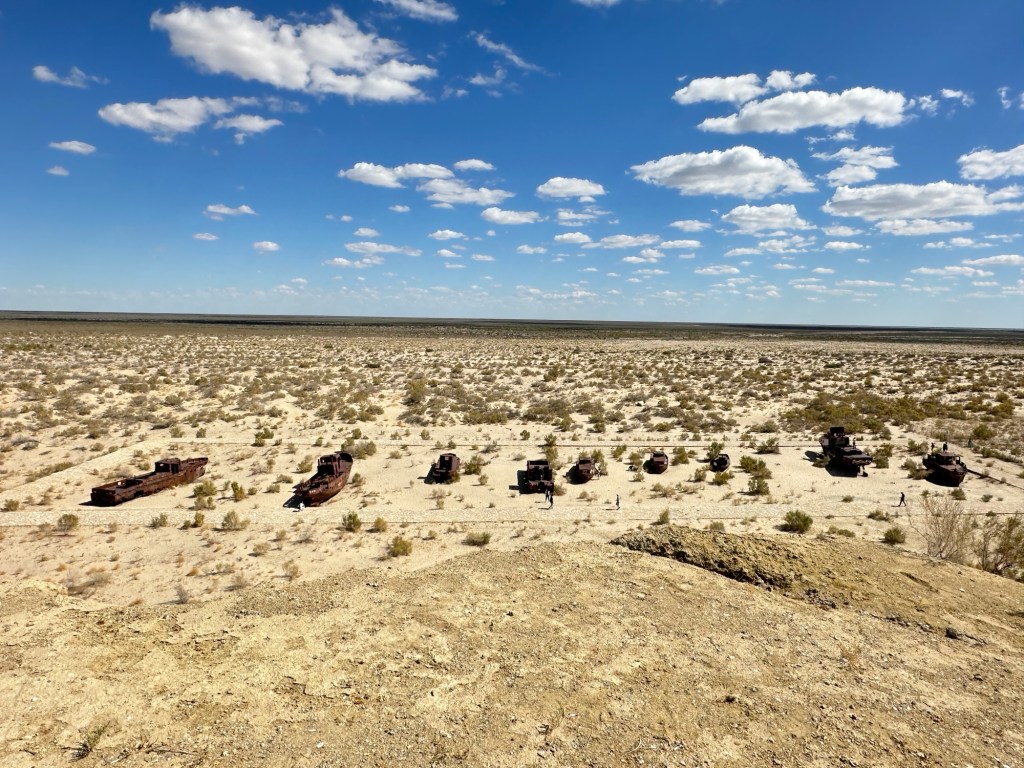
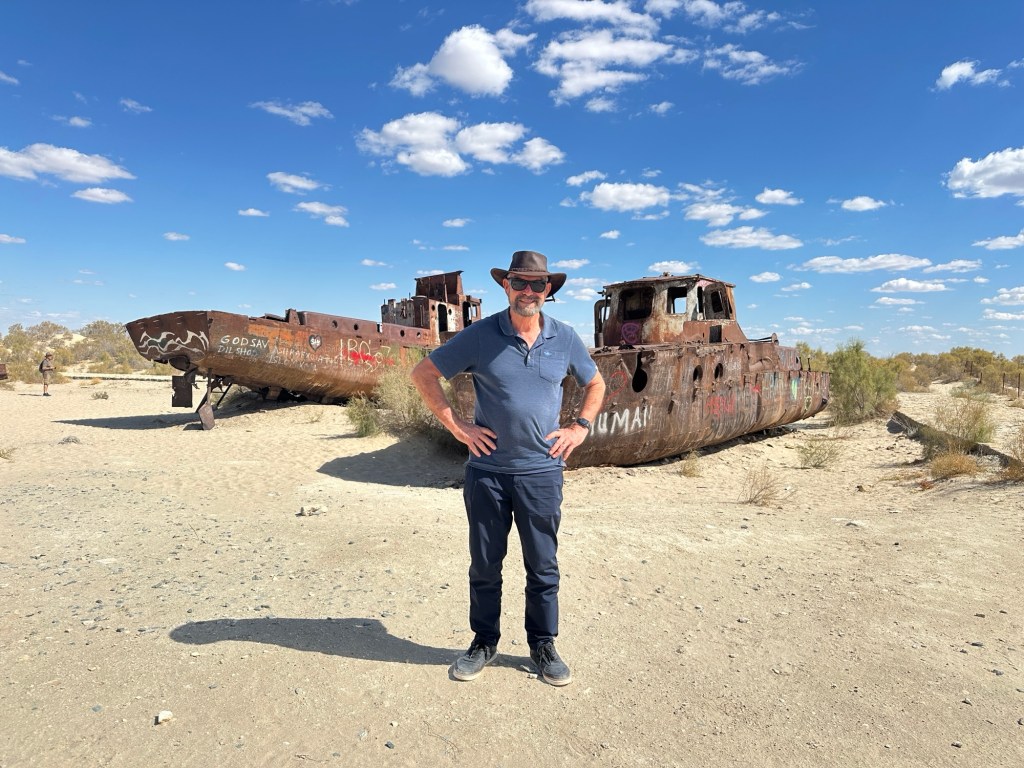
After breakfast we met our local guide, Nilu, and our driver. We had a three hour drive to Muynak to visit to the Ships’ cemetery – the white, salt caked former shores of the Aral Sea where the much-photographed fishing trawlers beached and are now rusting in the sand. A film in the Muynak State Local History Museum gave us an interesting insight of what this once thriving fishing community used to look like.
The Aral Sea disaster dates back to the early 1960s. It had been the fourth-largest inland sea in the world, fed by the Amu Darya and Syr Darya rivers. Soviet planners, keen to expand Central Asia’s cotton production, ordered the building of canals across Uzbekistan and Turkmenistan, diverting the rivers’ water into the fields. Cotton output boomed, but the Aral Sea began shrinking. The dying sea lost half its area and 75 percent of its volume within a single generation.
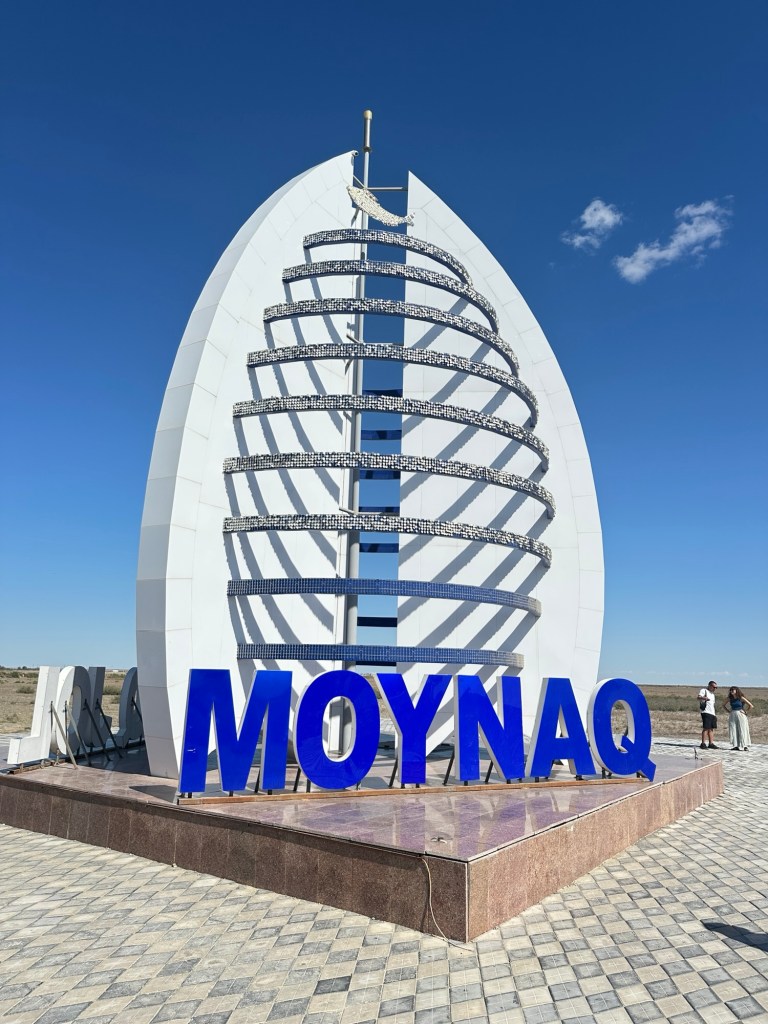
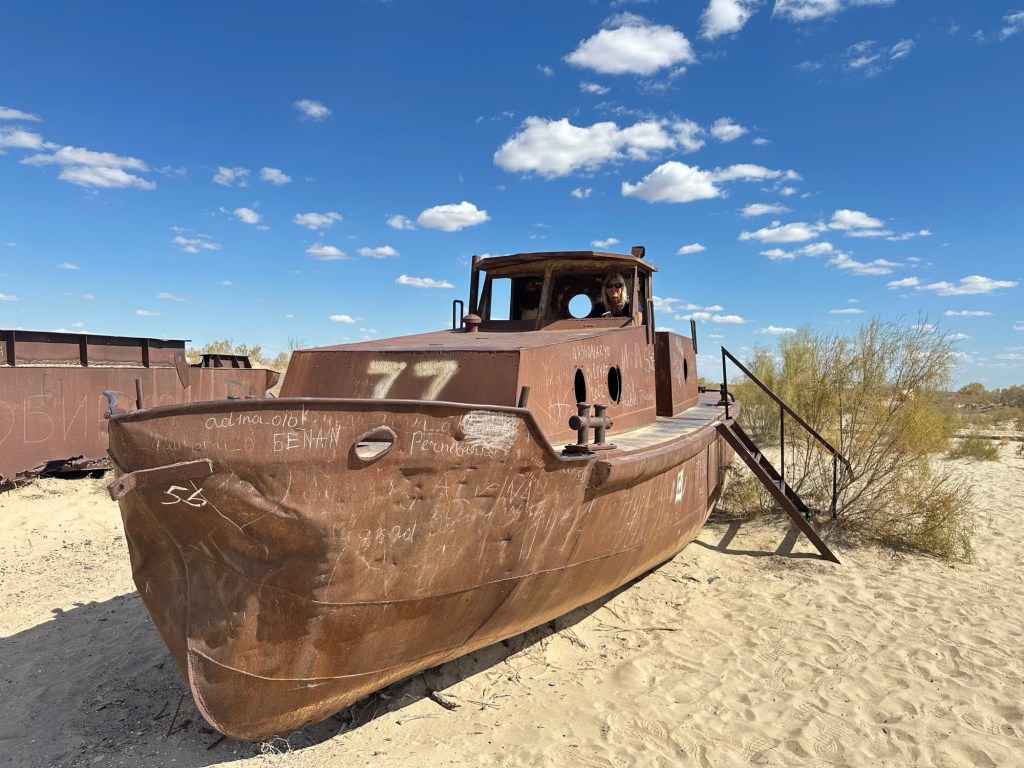
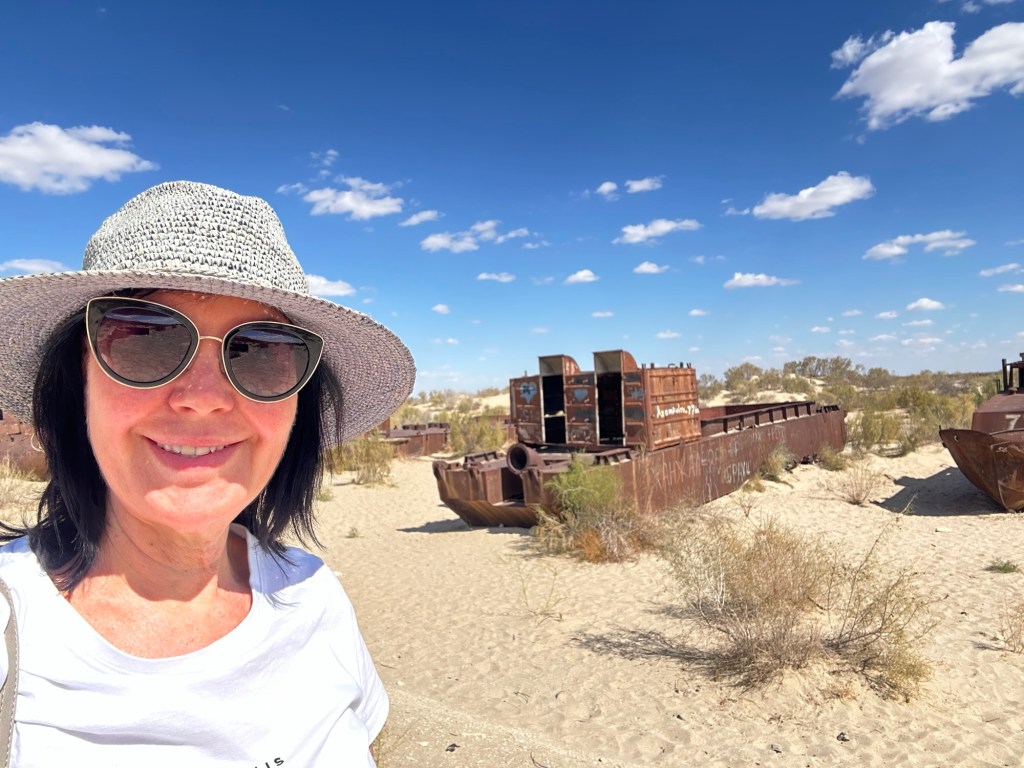
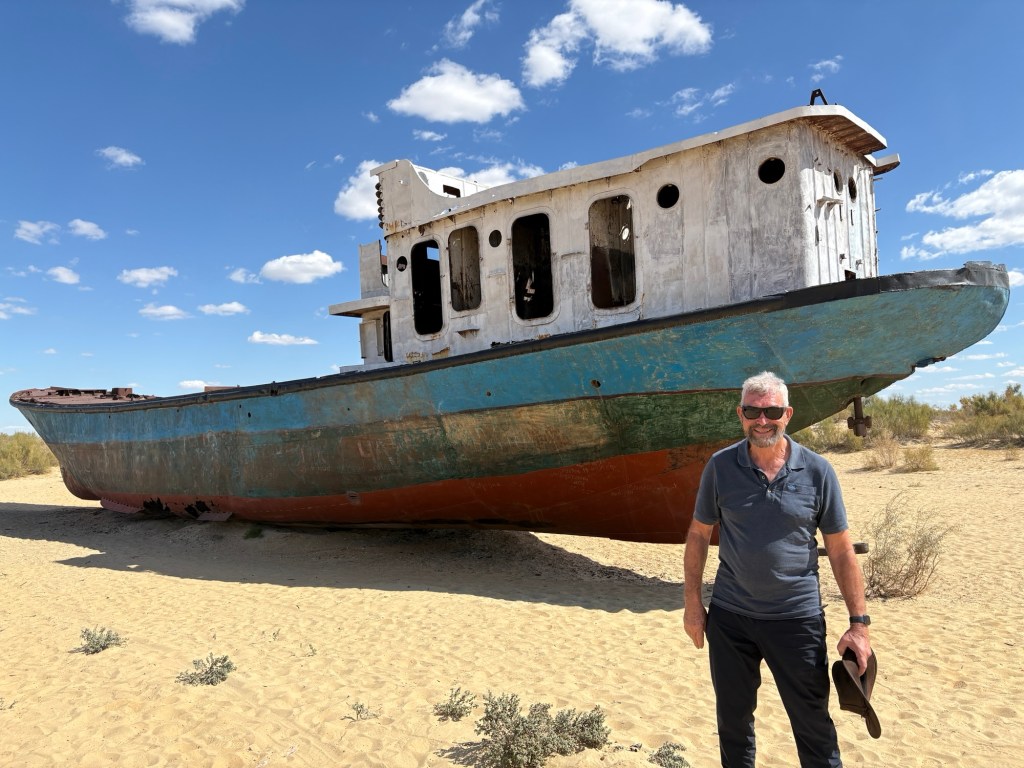
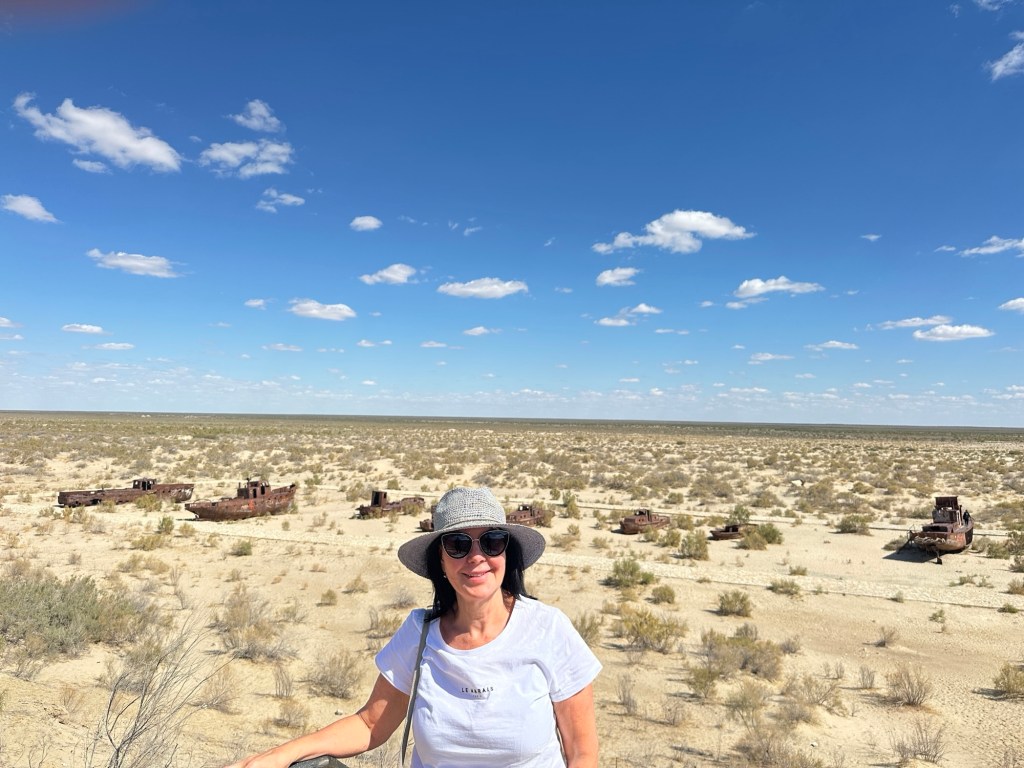
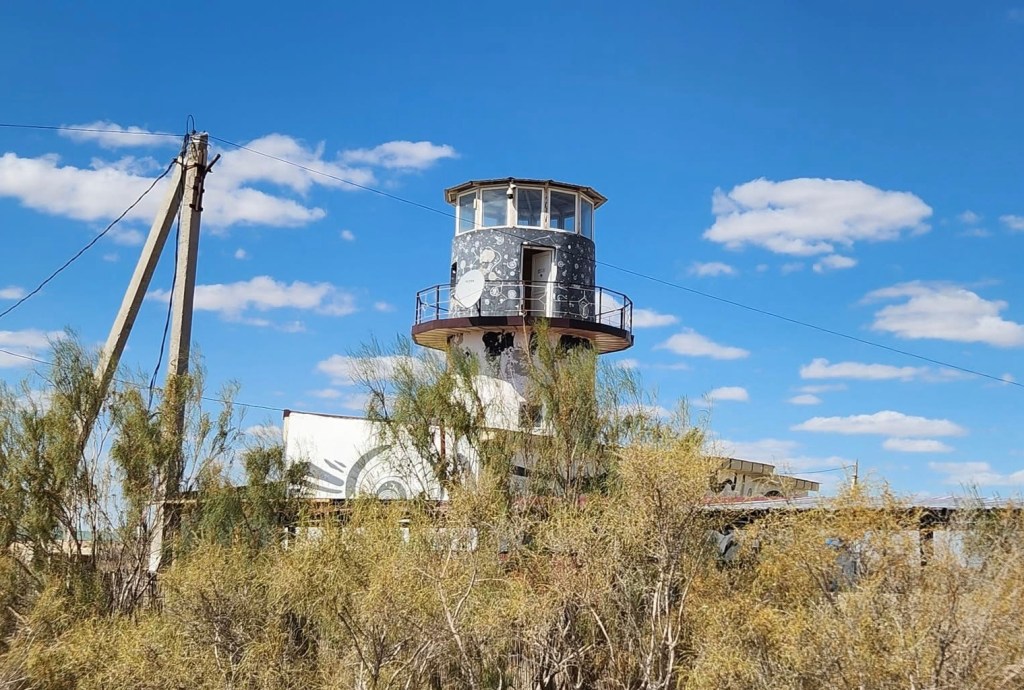
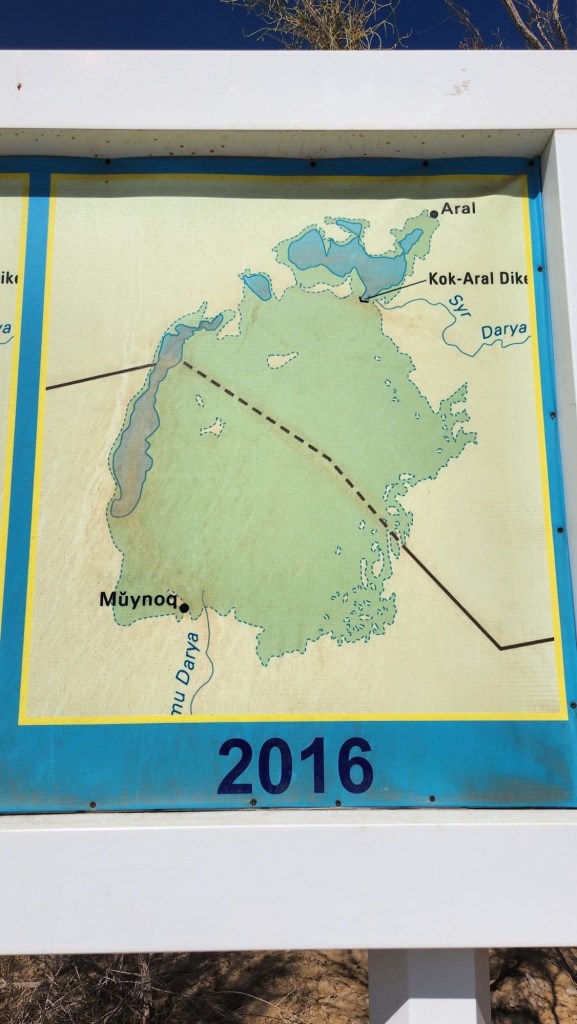
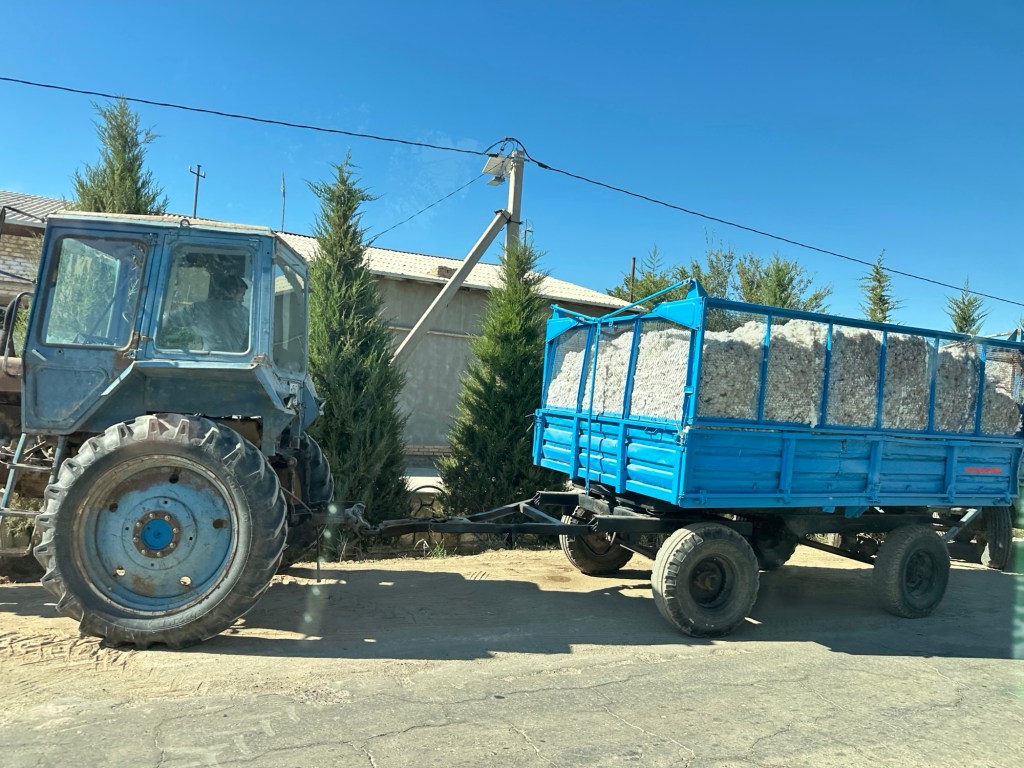
Next, lunch at a local cafe – pilaf with meat and vegetables, before making the three hour return trip to Nukus. More rough roads, but no where near as bad as we’d had the previous two days. Many cotton fields here.
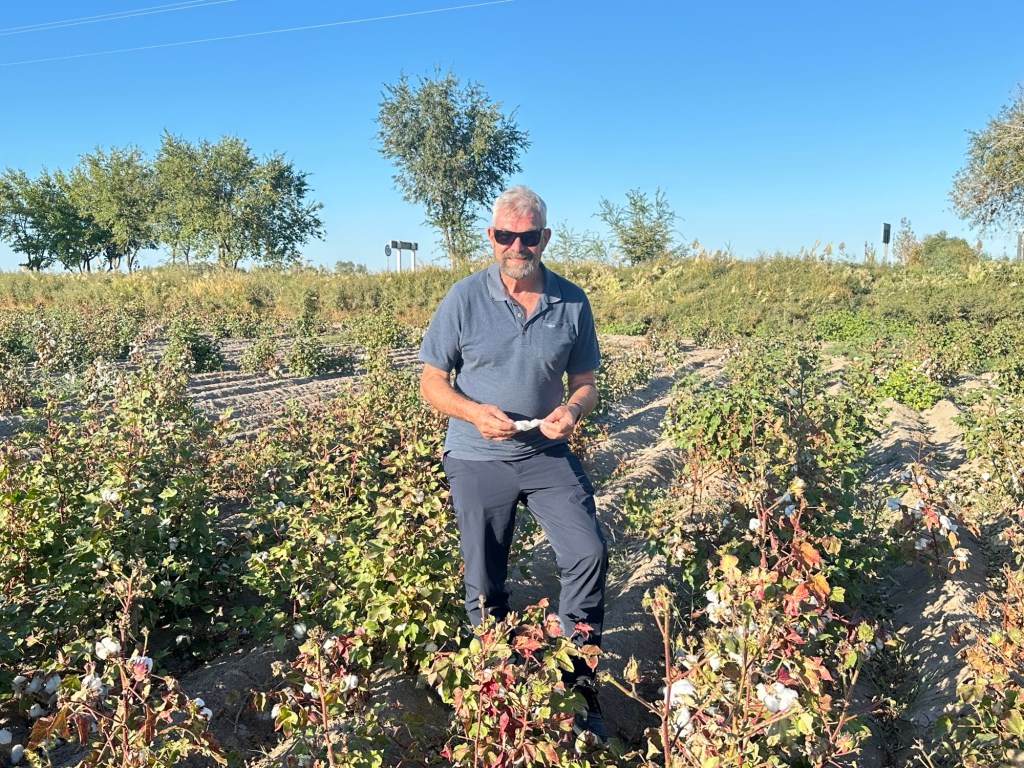
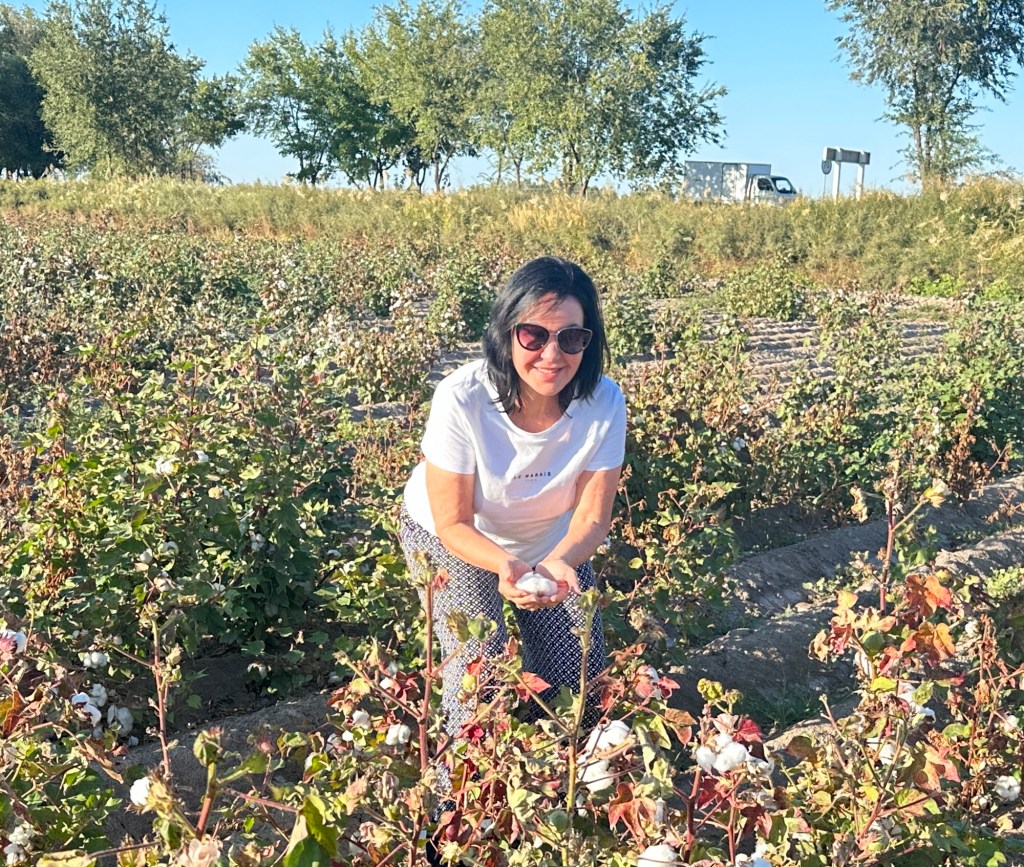
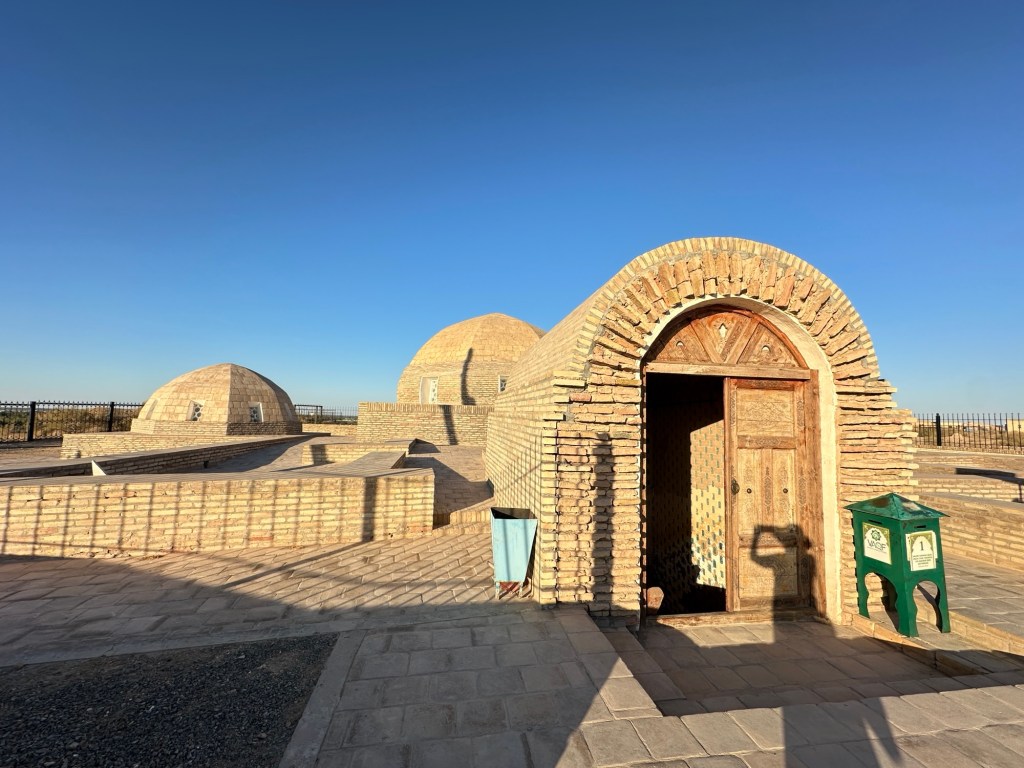
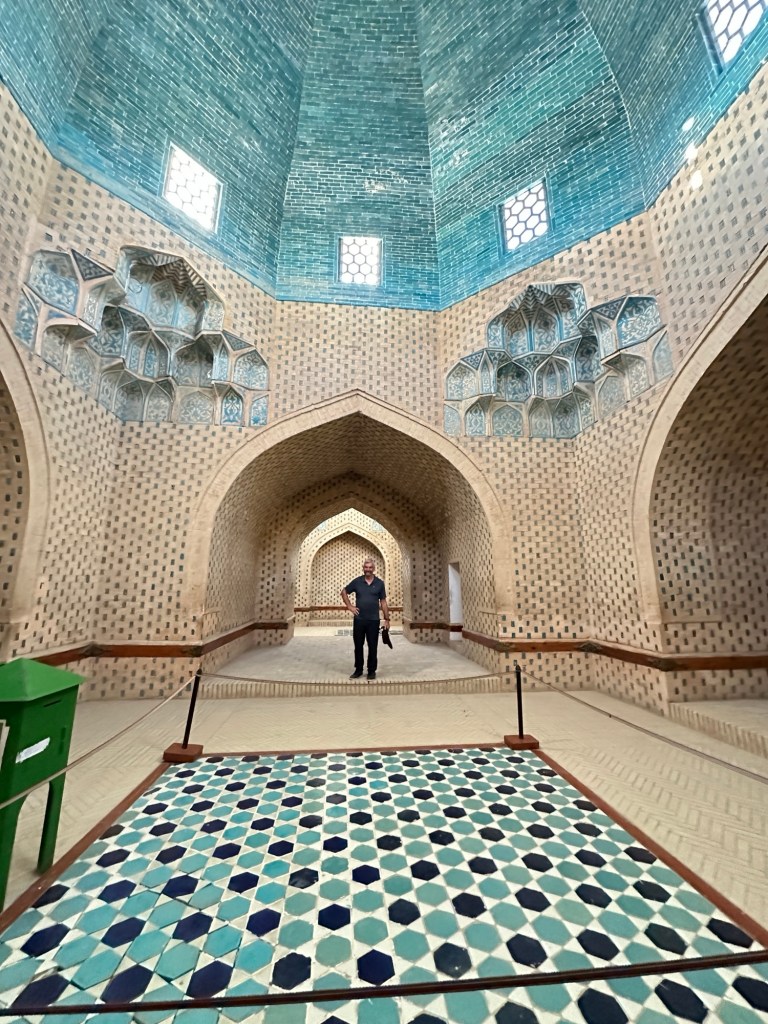
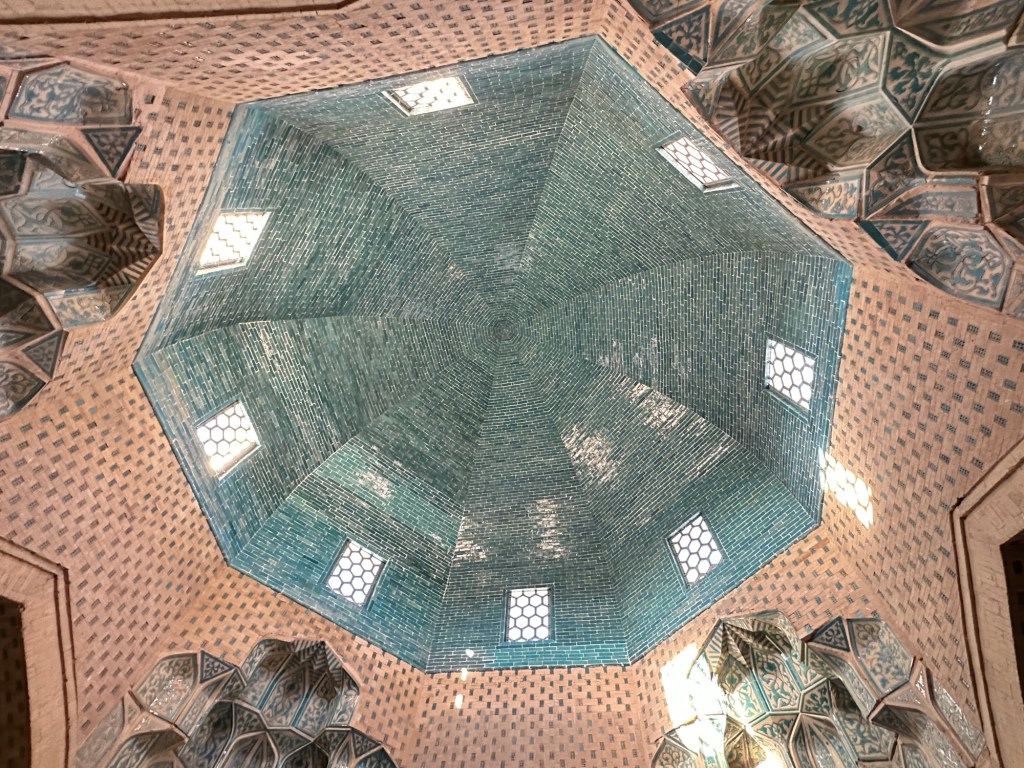
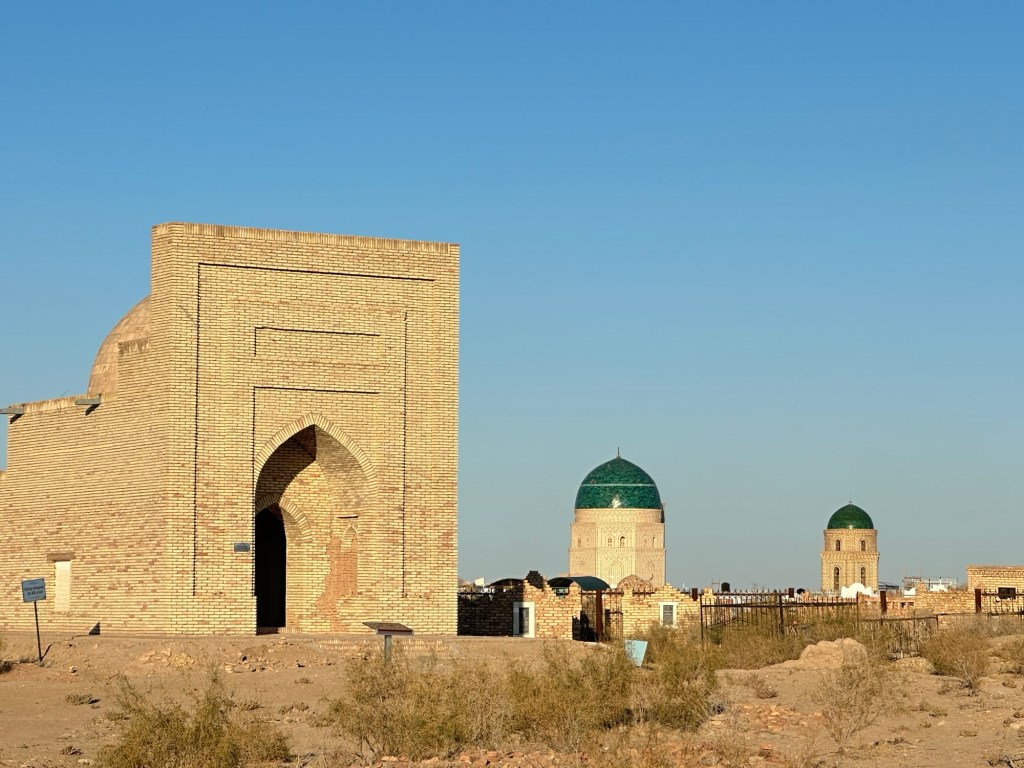
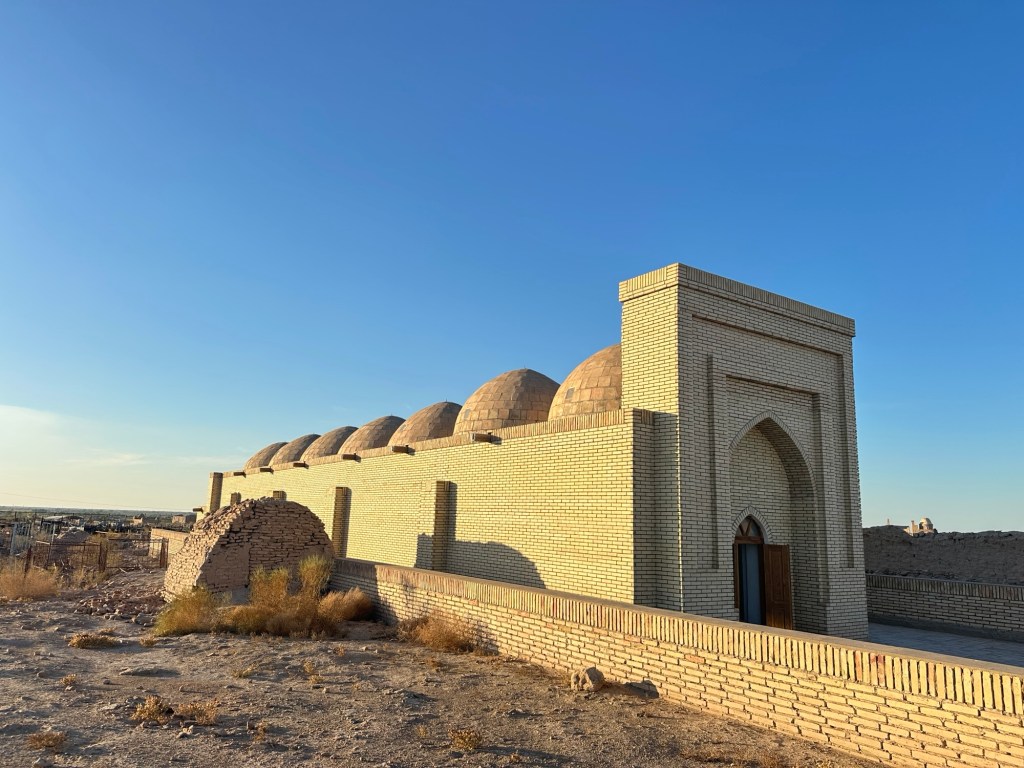
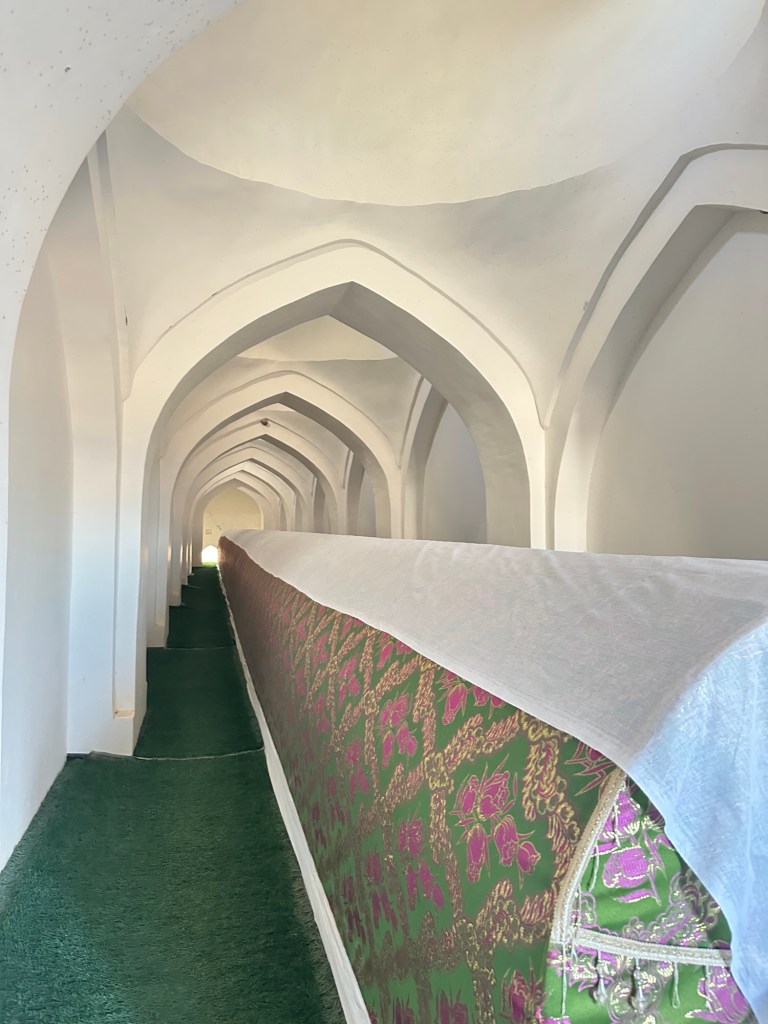
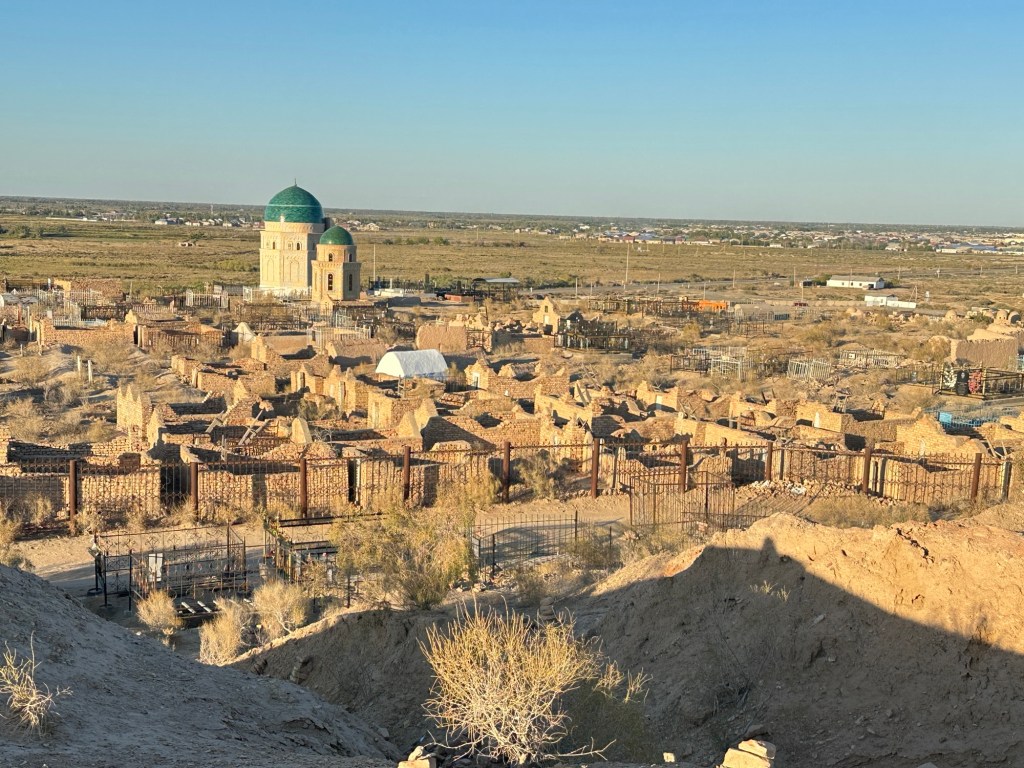
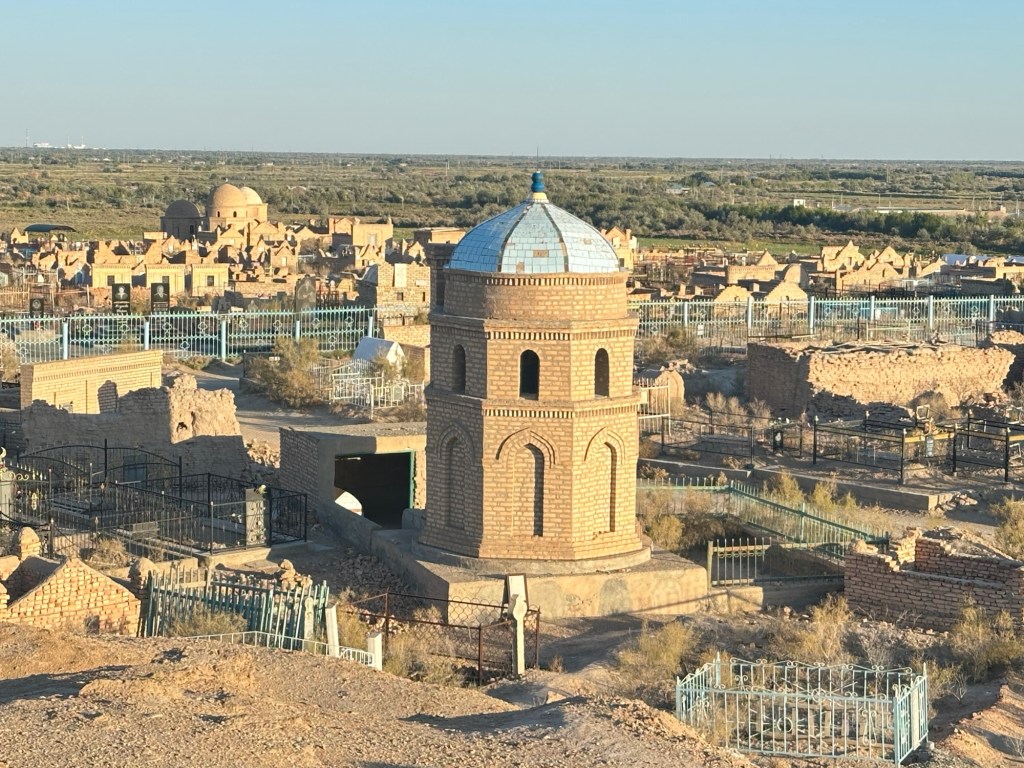
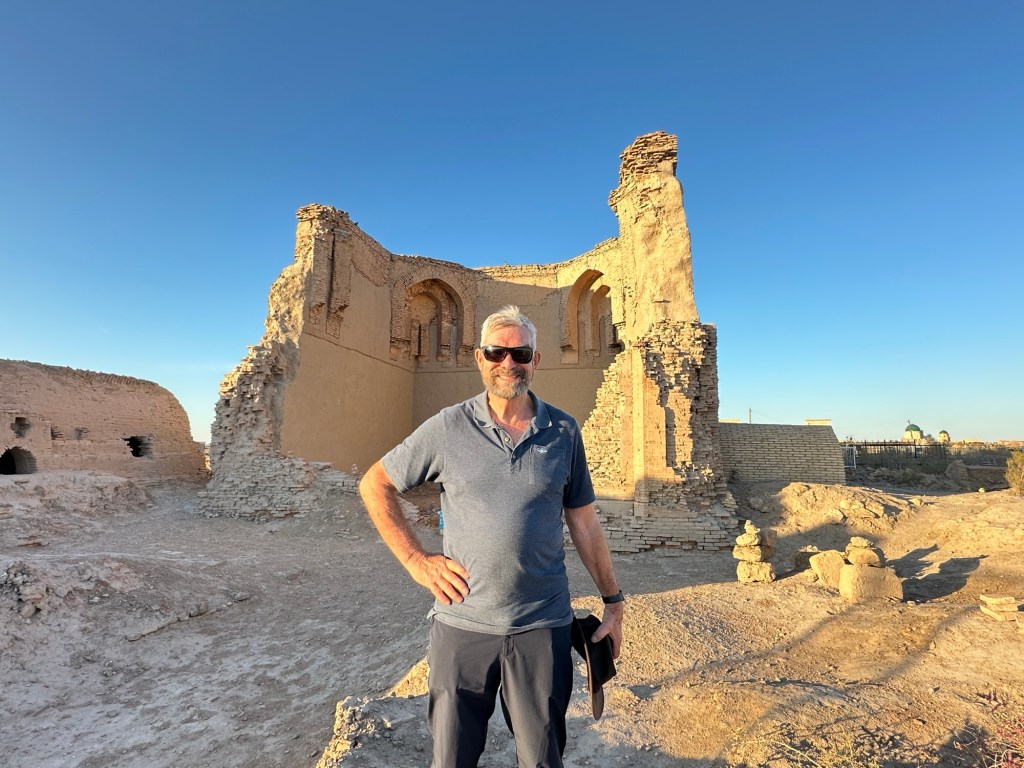
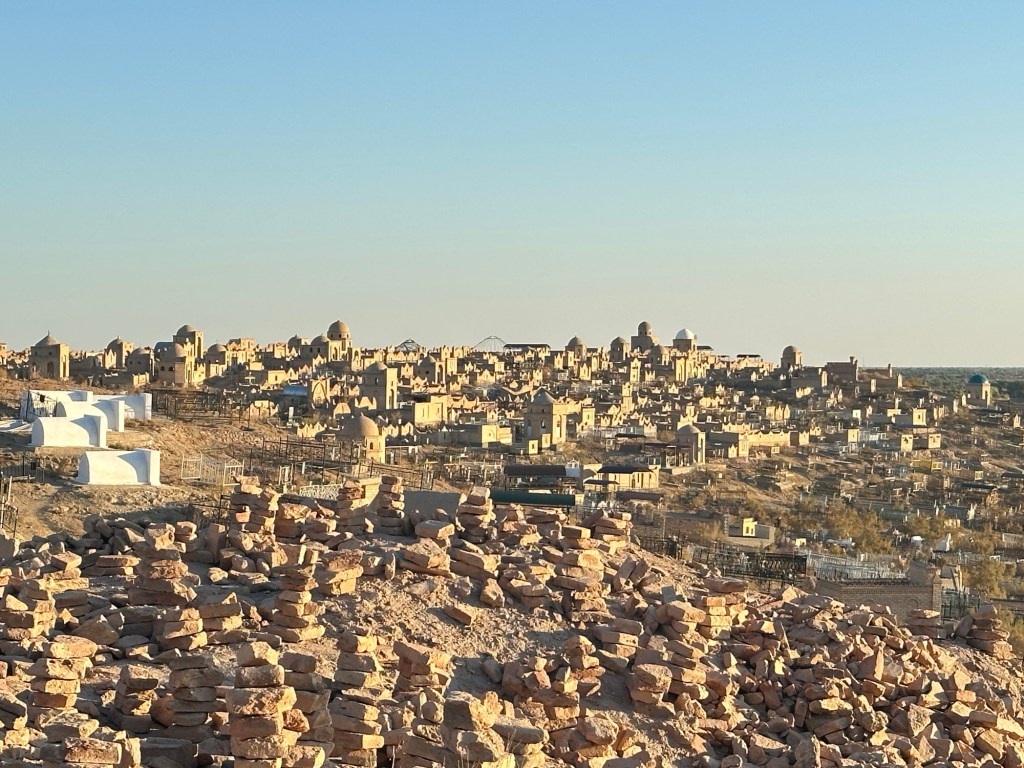
We had a stop at Mizdakhan necropolis – a historical and sacred complex. Mizdarkhan was a fortress city beginning in the 4th century BC. About 1700 years later it was attacked by Timur, trade was reduced and the local river changed paths so it was abandoned. Since then, it has been used as a necropolis. There are both Zororastrian and Islamic symbols and relics here, indicating that both religions shared the space.
A very full day, so dinner again at the restaurant we went to the night before, before falling into bed.
Day 9
Friday 19th September
Nukus to Khiva
14-26 degrees, sunny
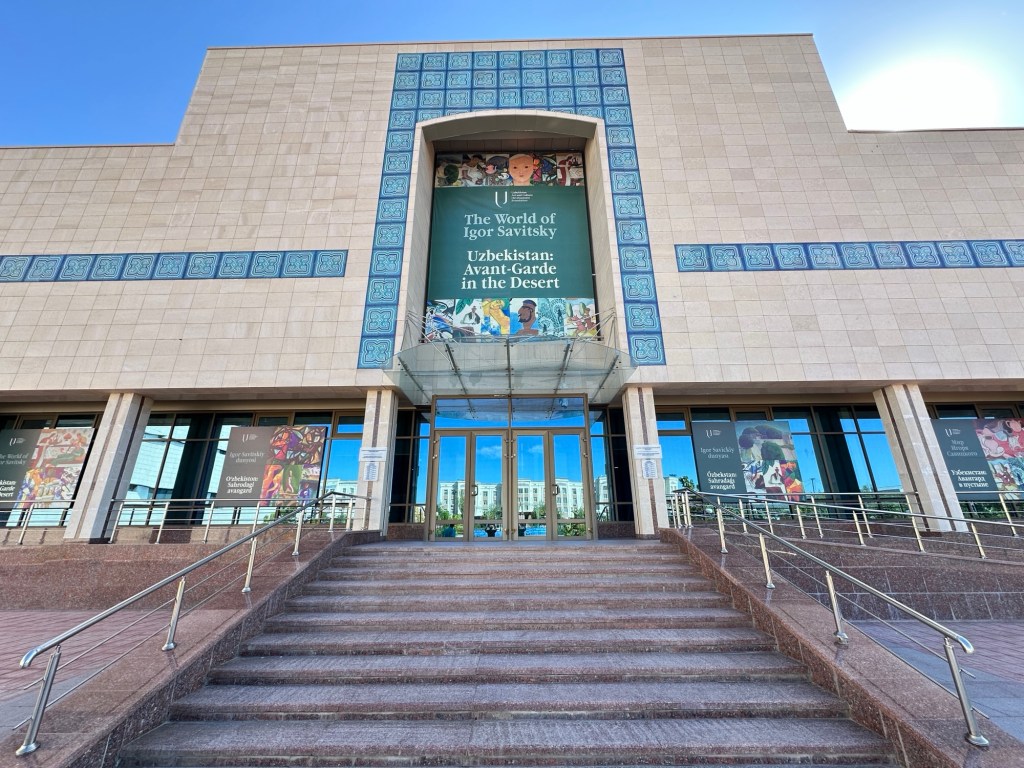
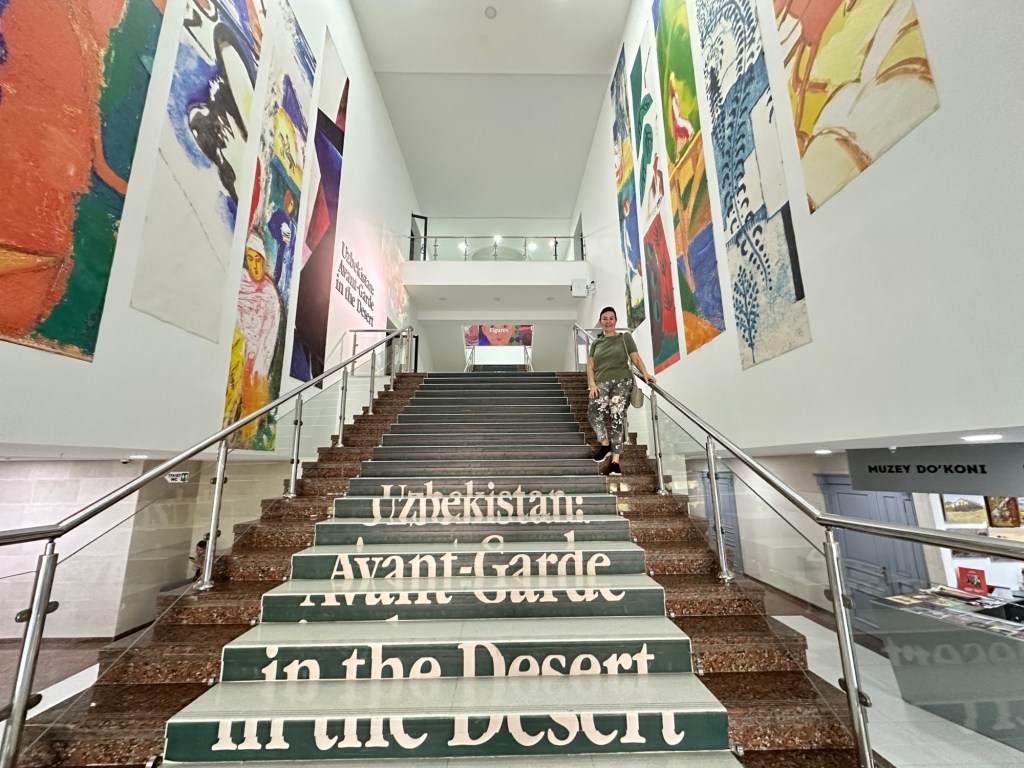
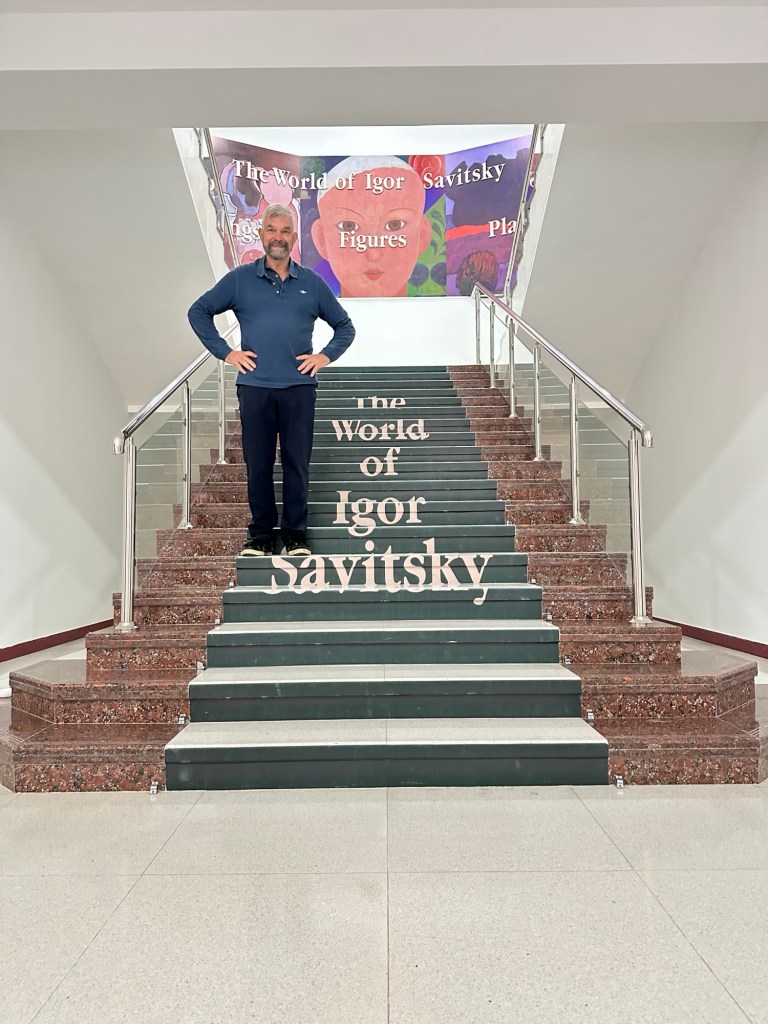
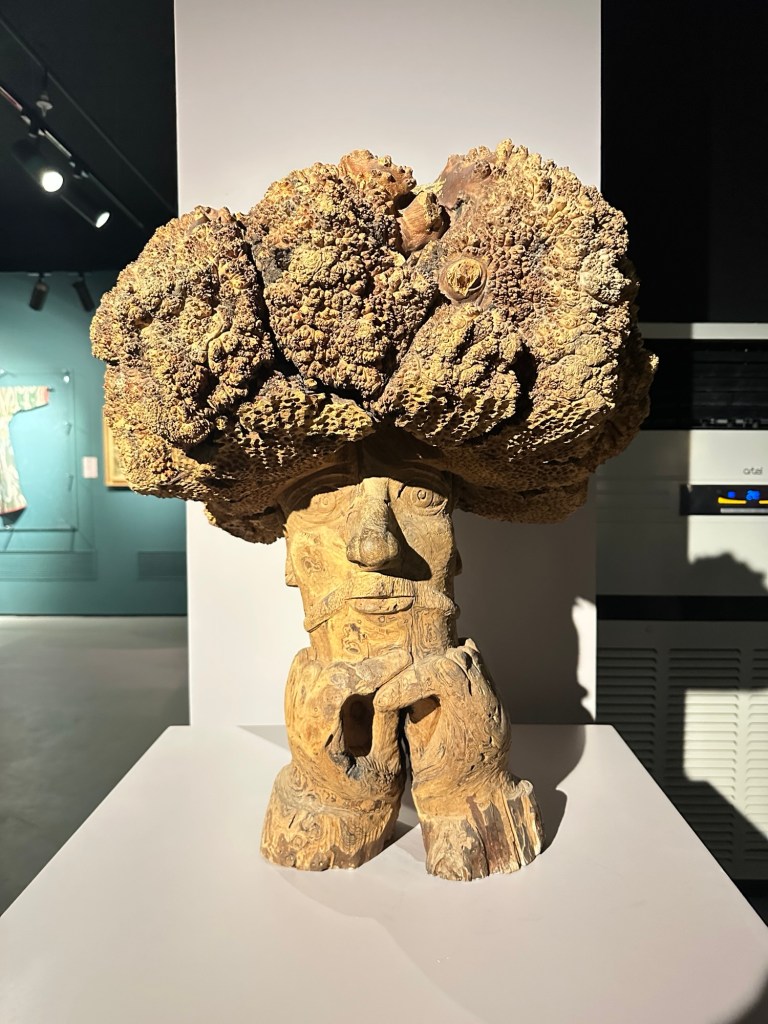
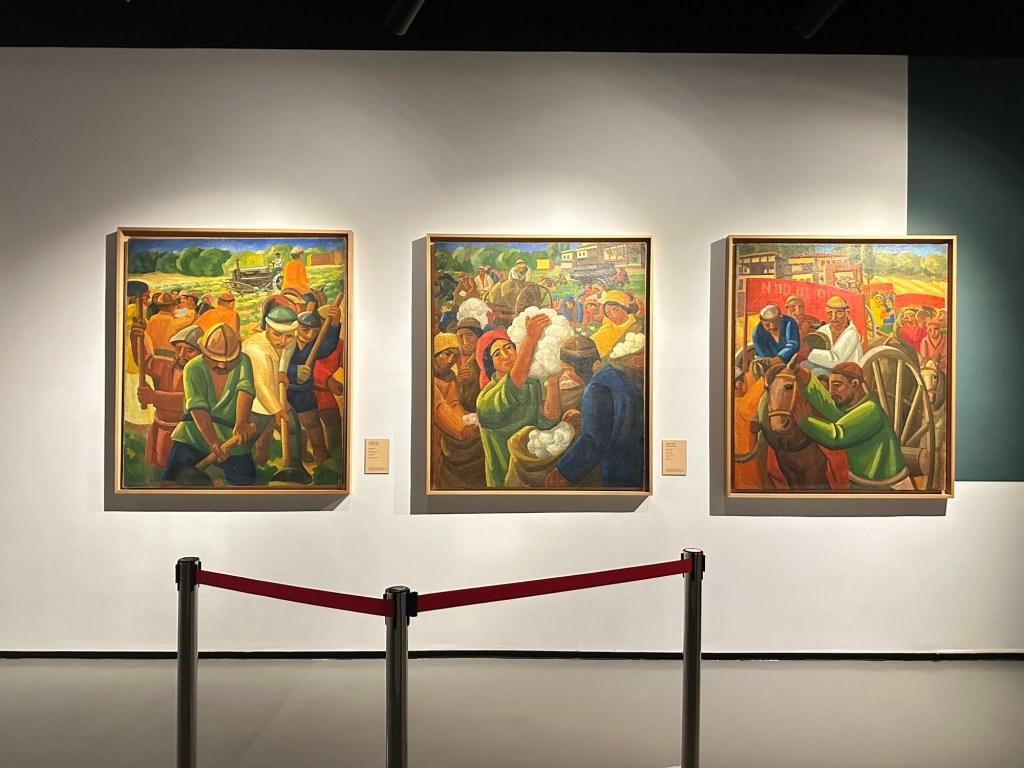
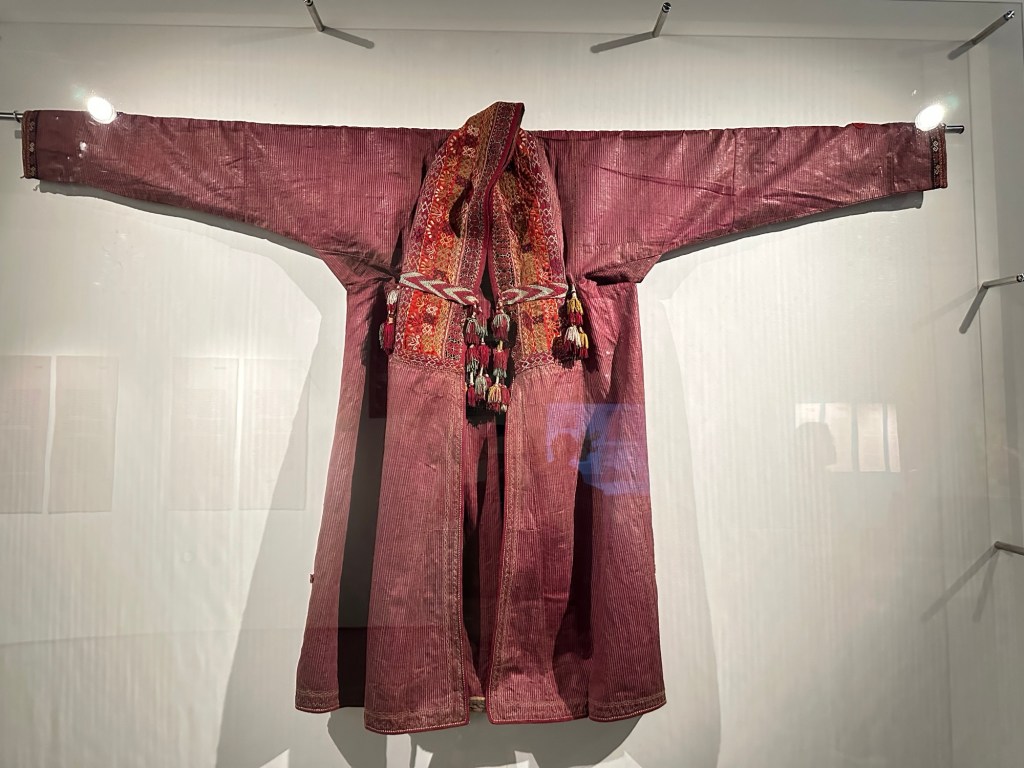
A different guide today, Marat. We visited the Savitsky Karakalpakstan Art Museum. The Avant Garde collection exhibits the works of a whirlwind galaxy of artists who, with their art, defined the fascinating style of Central Asia in the first half of the 20th century. There is a definite political undertone in the works, with subject material restricted under Communist rule from the late thirties.
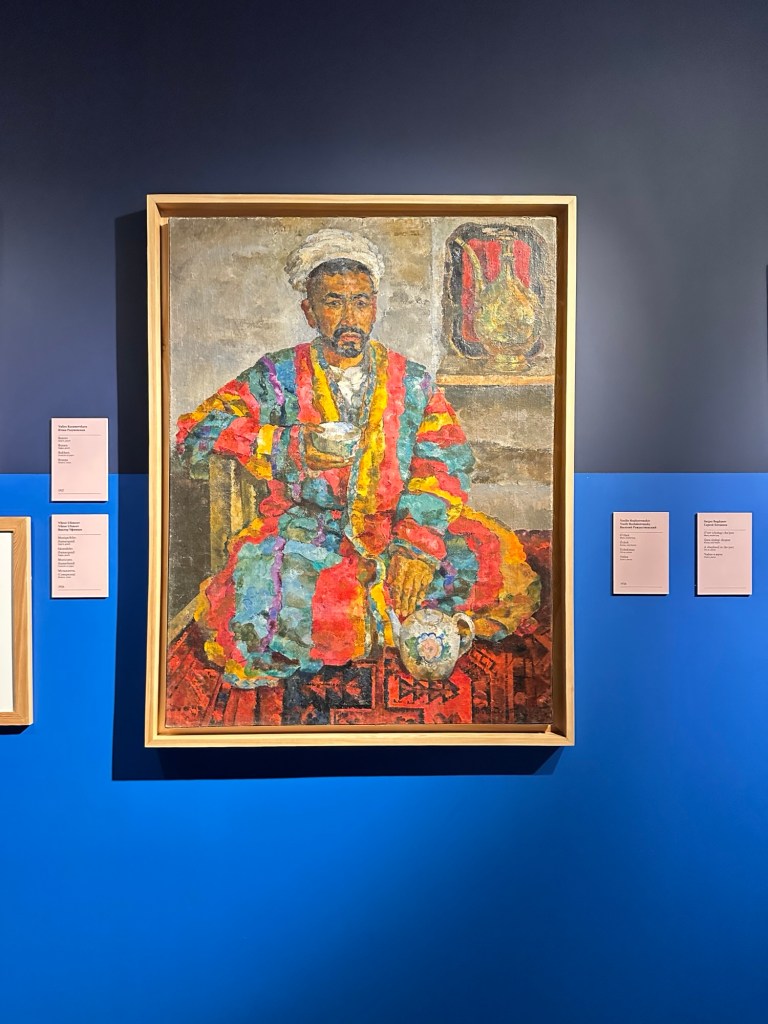
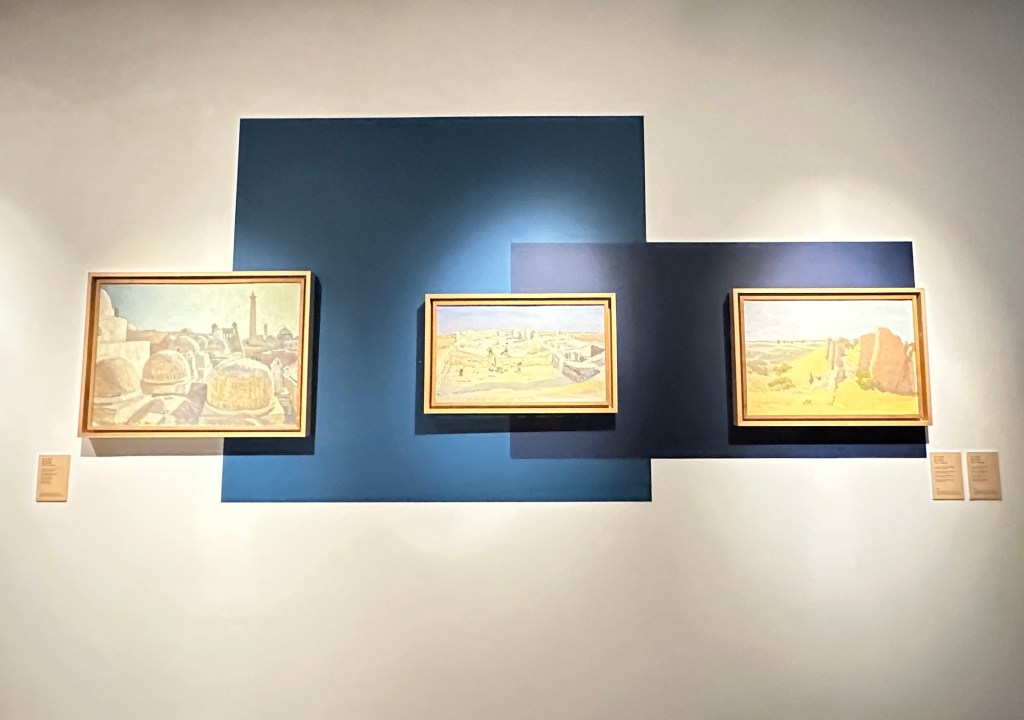
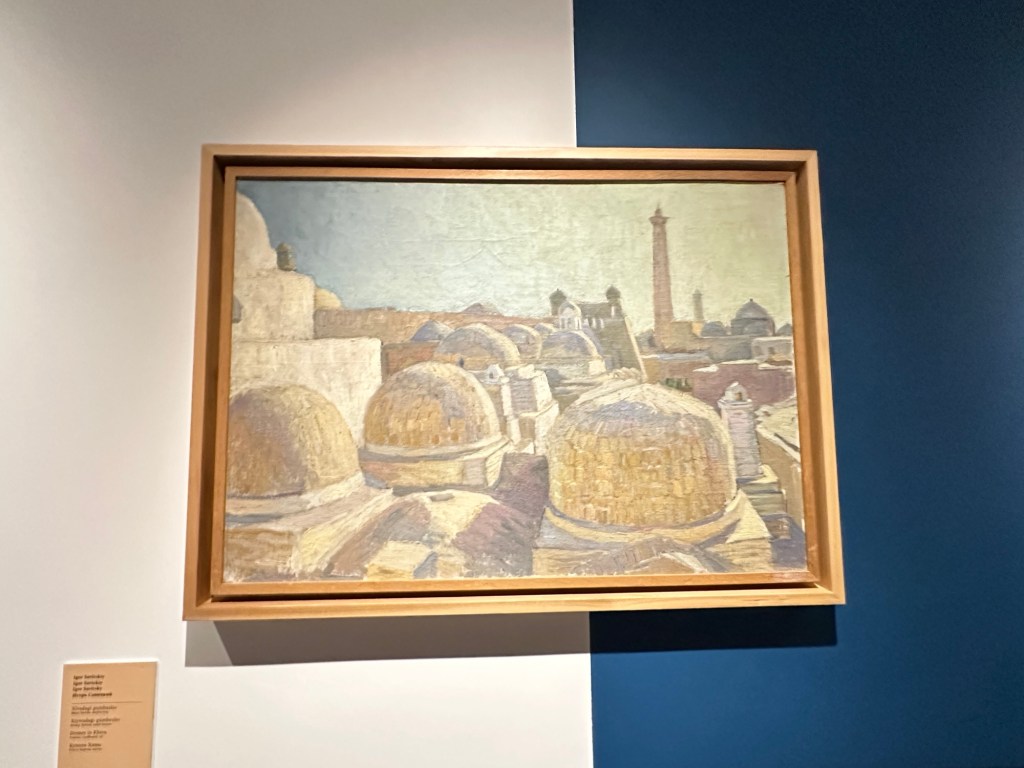
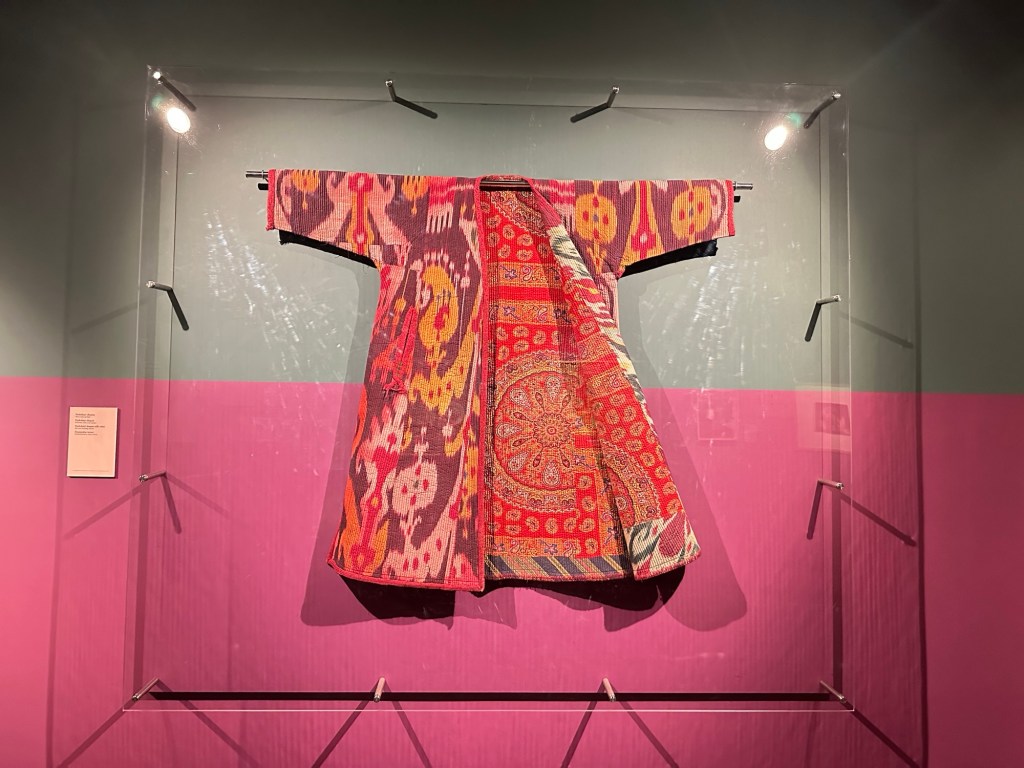
On the road again, this time to Khiva. We made a stop at the ancient Khorezm monument, Chilpik Kala, or Silence Tower, Ist Century BC-4th Century AD. According to Zoroastrianism tradition, deceased people were brought here to clean the bones from the soft layer. The body of a deceased people was exposed to the birds and to the sun until the bones had been completely cleansed. The remains of the deceased (bones) were placed in ceramic or stone ossuary containers and buried. This method of burial was associated with Zoroastrian philosophy, the purpose of which was not to pollute the earth with the remains of the deceased.
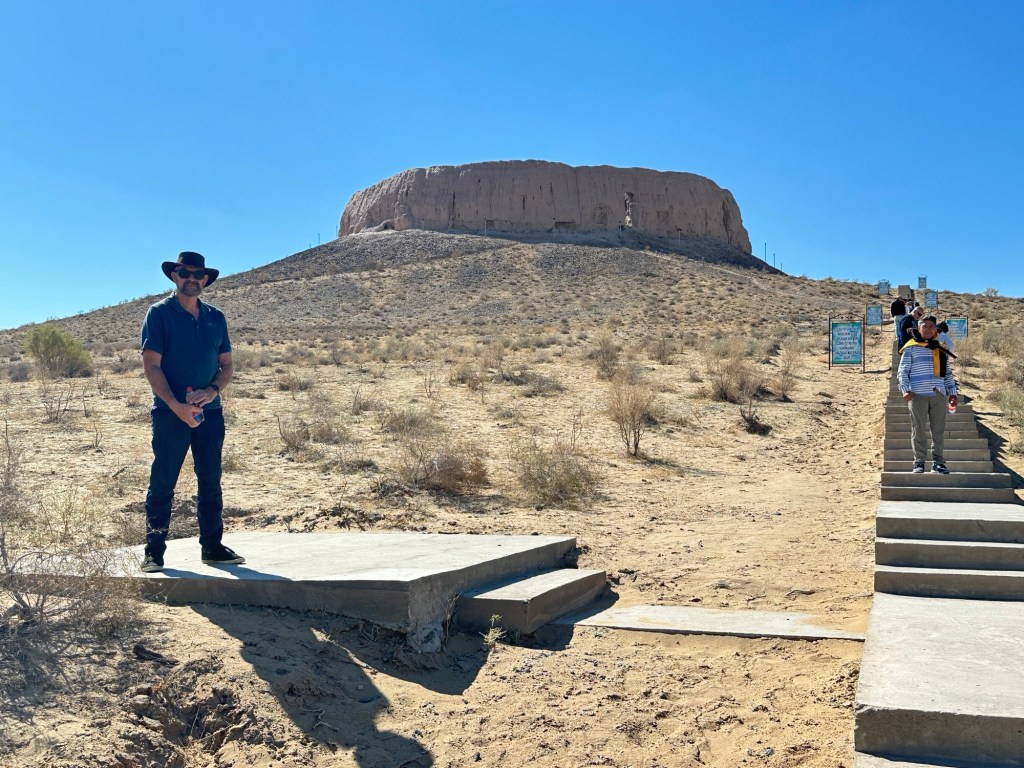
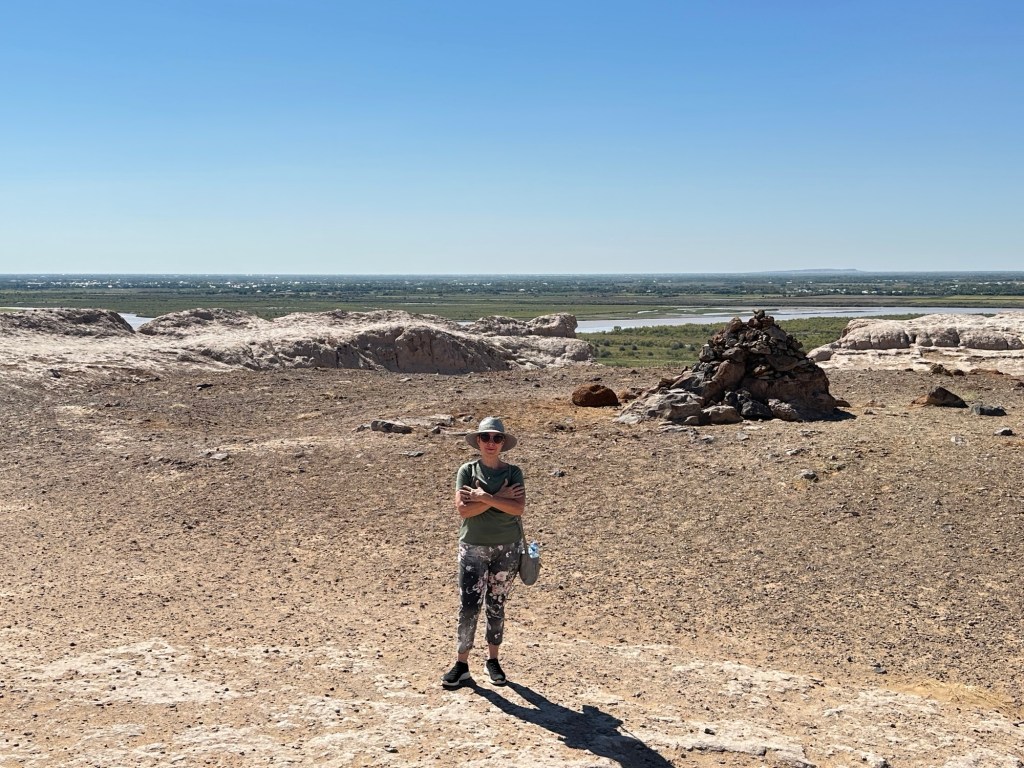
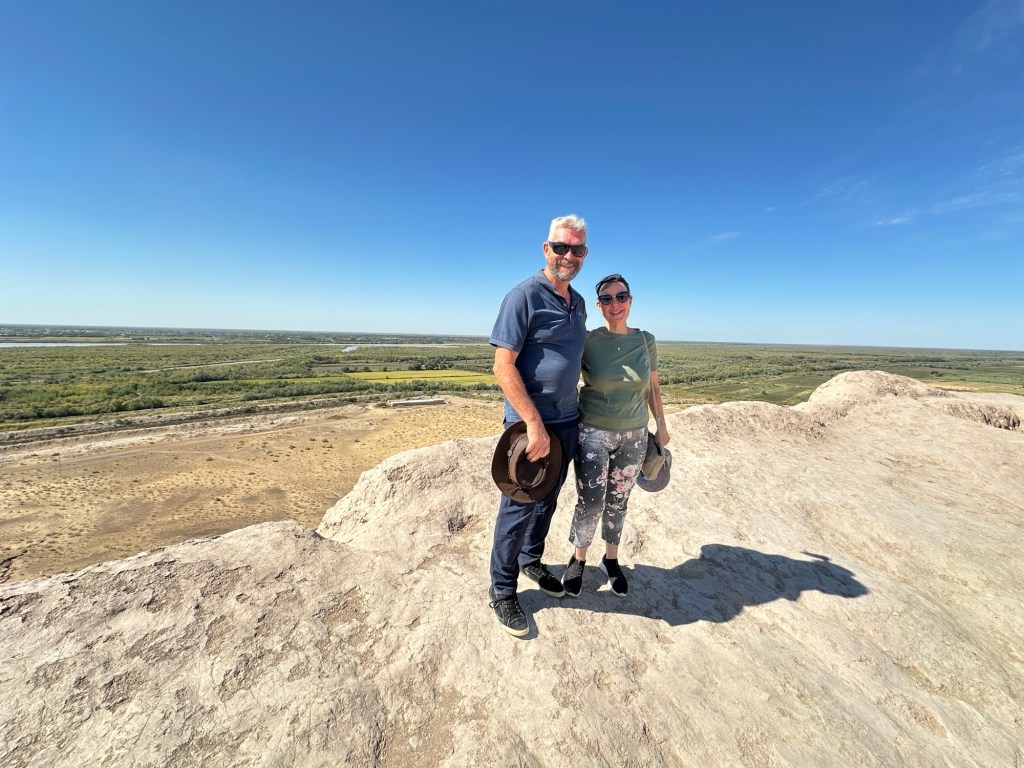
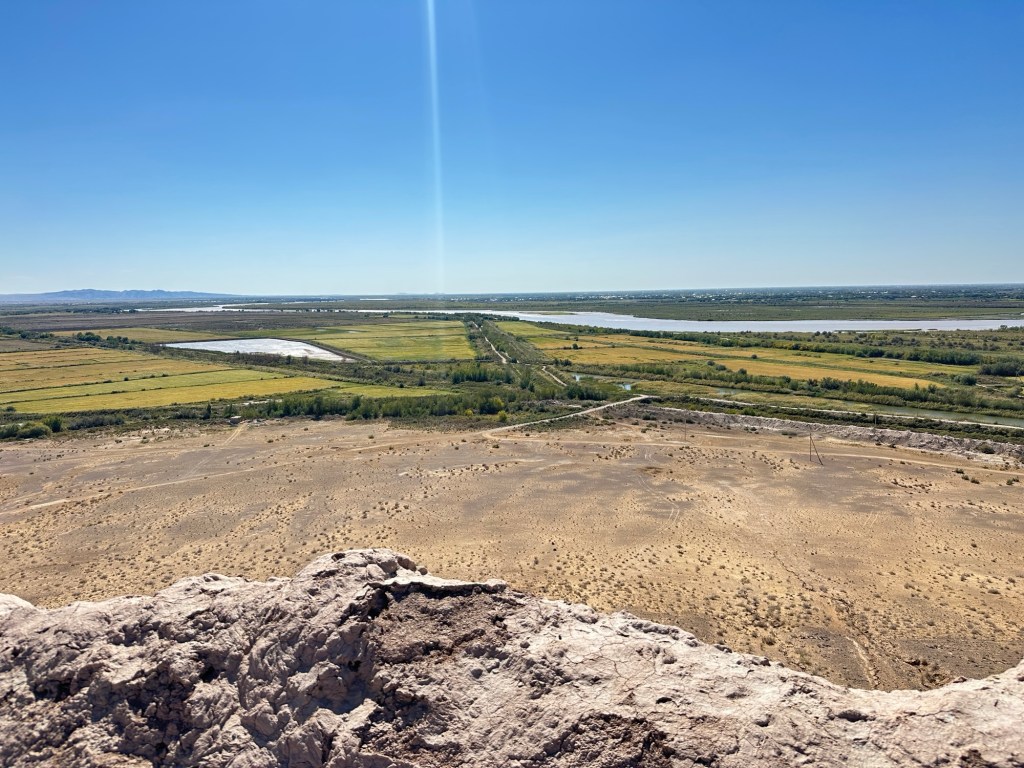
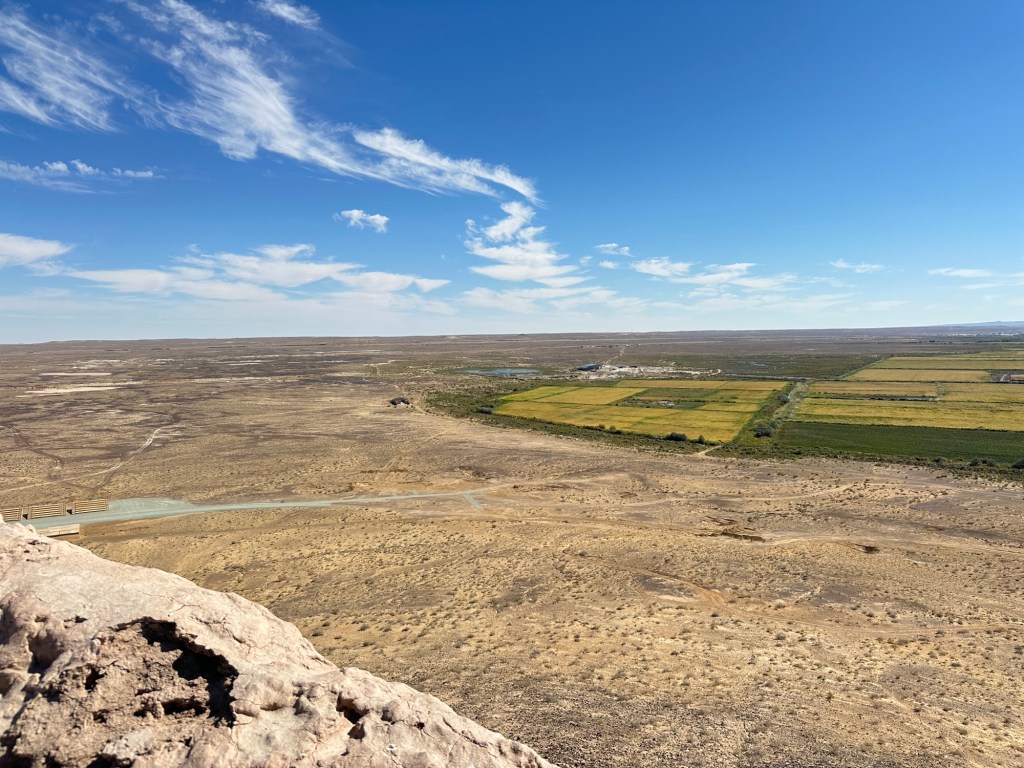
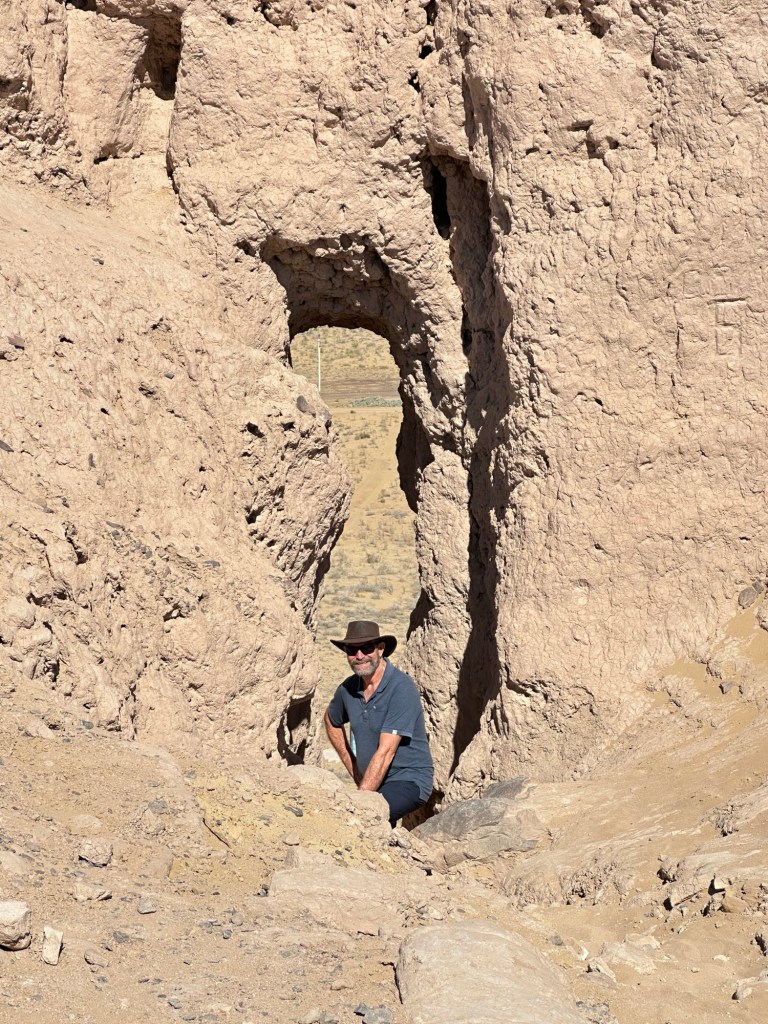
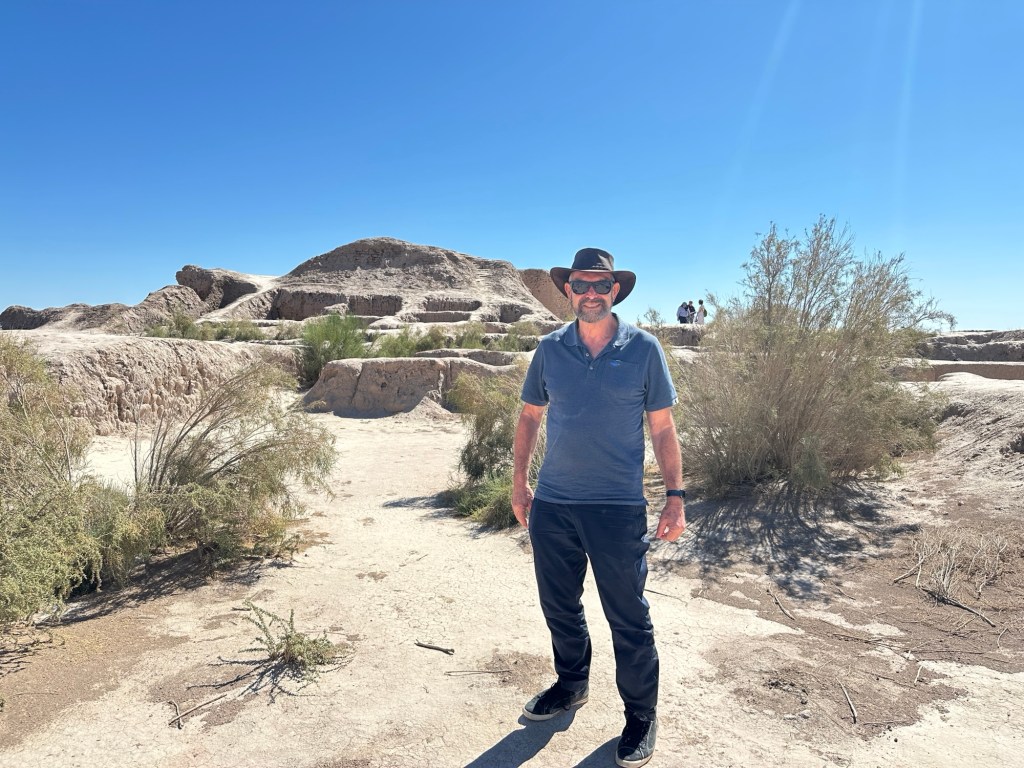
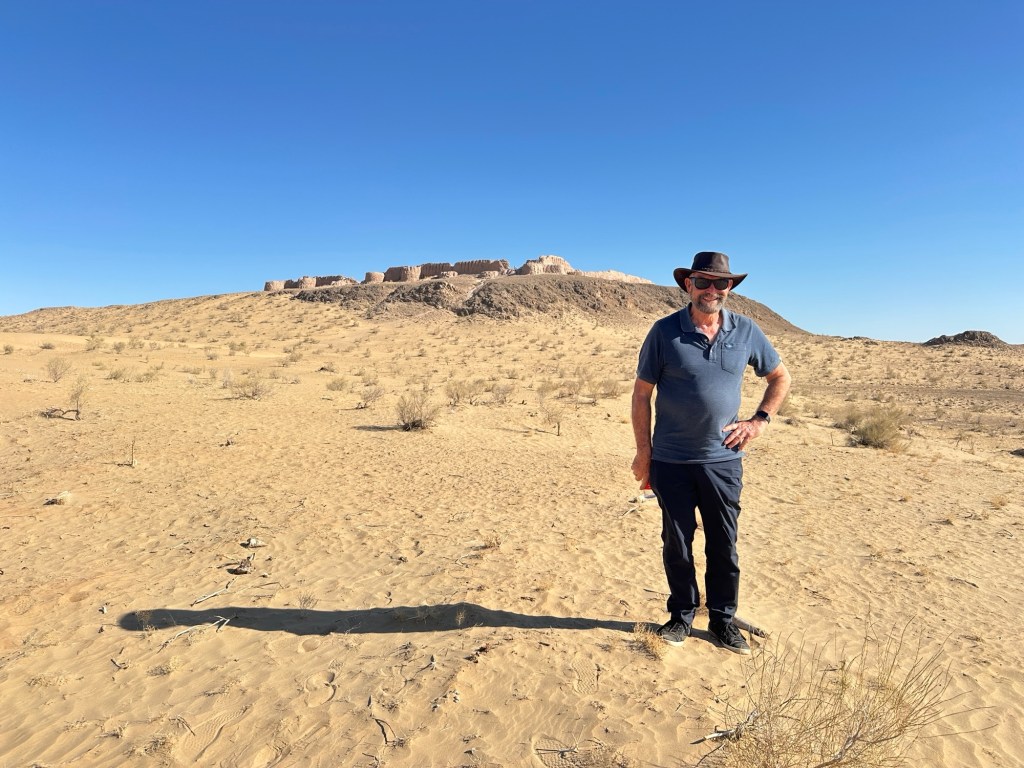
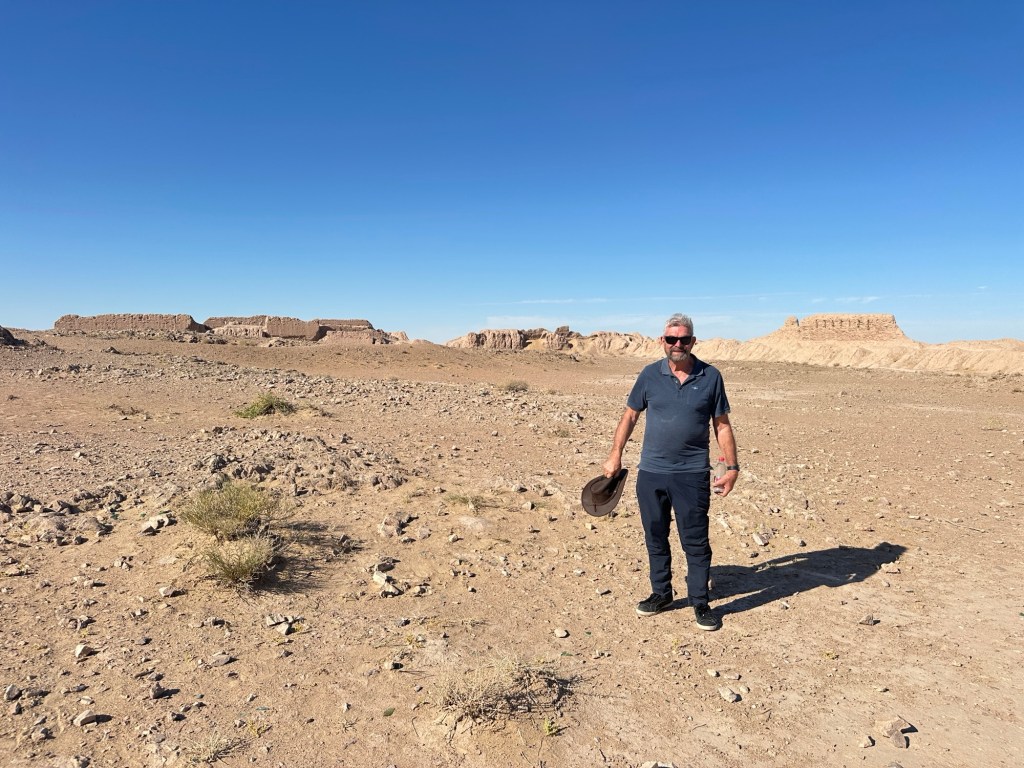
Two other archeological sites – Toprak Kala 1st Century BC- 4th Century AD, the region’s biggest city until the destruction of irrigation canals left it marooned in the desert sands. We walked around the ruins of the palace.
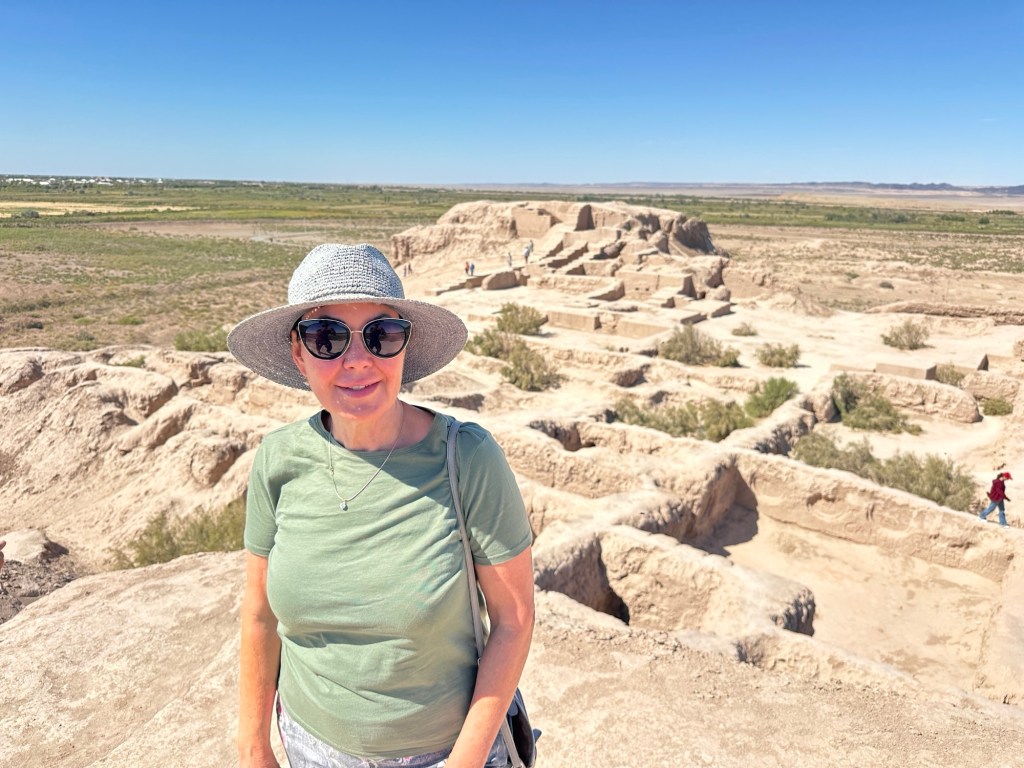
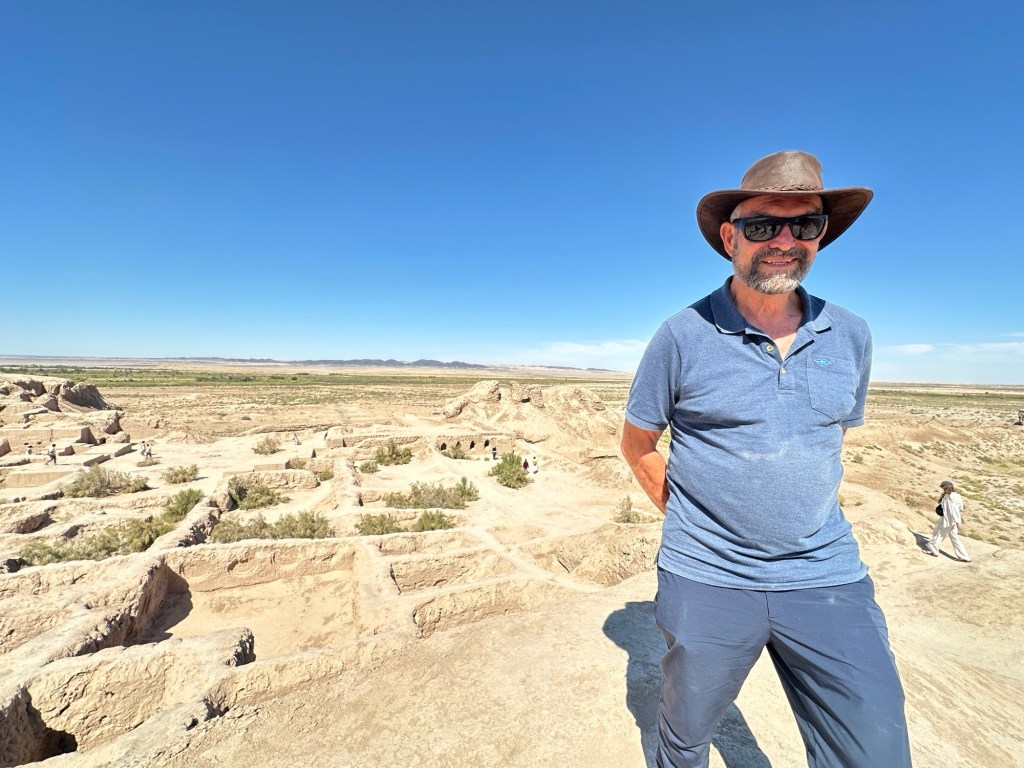
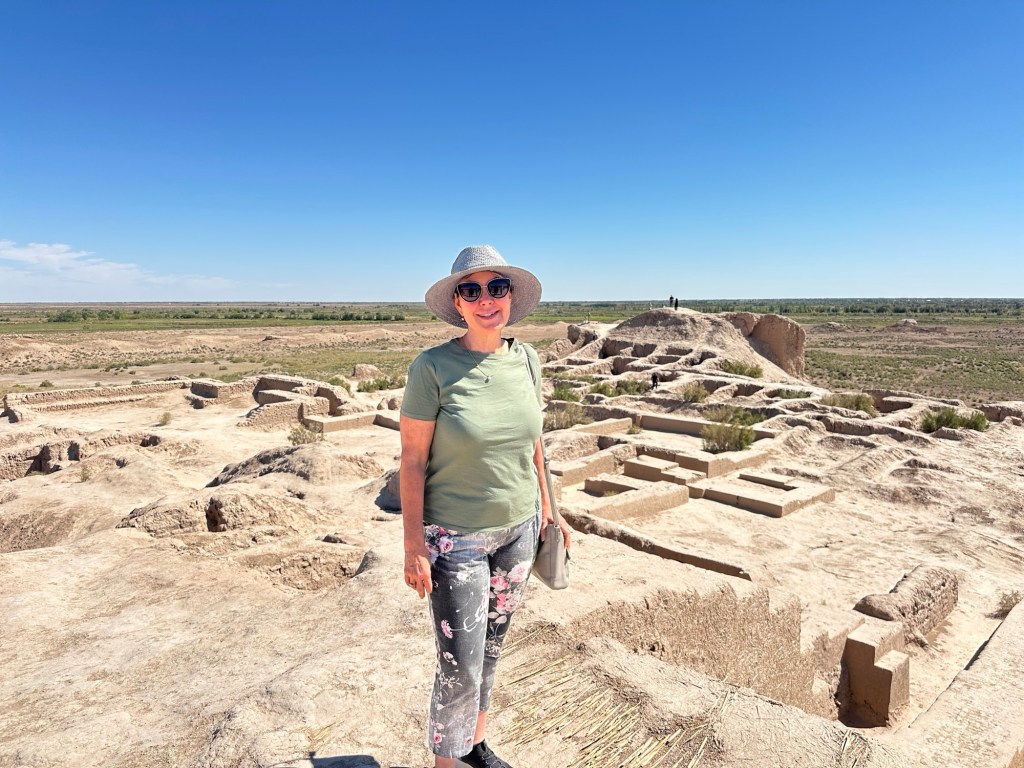
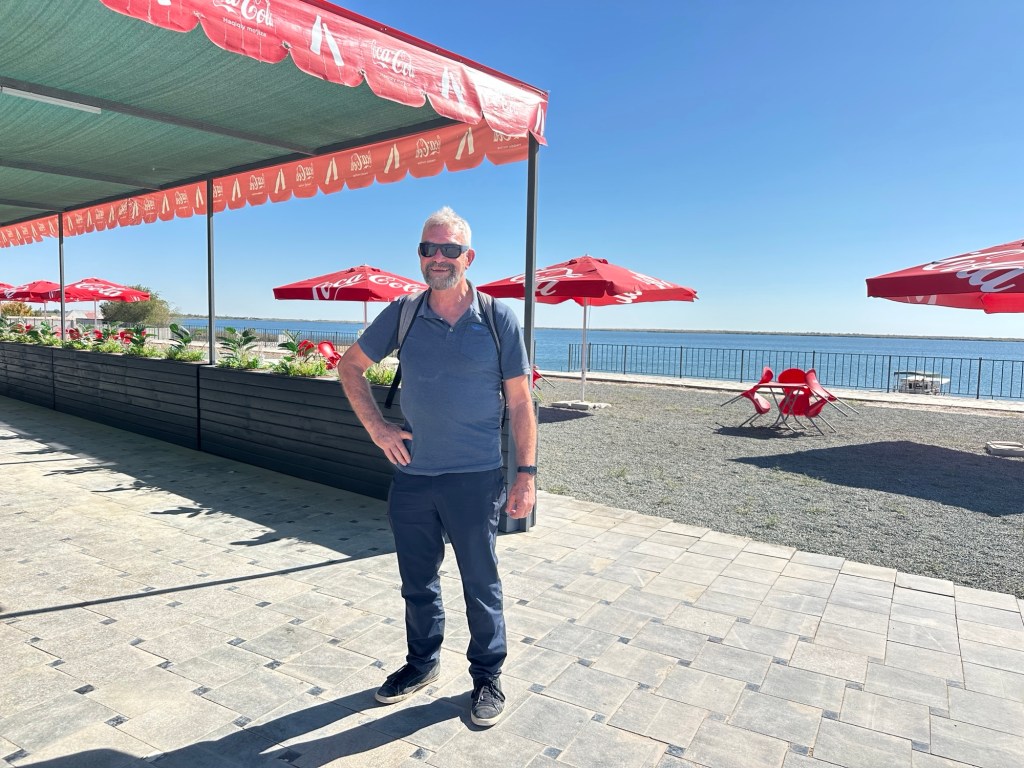
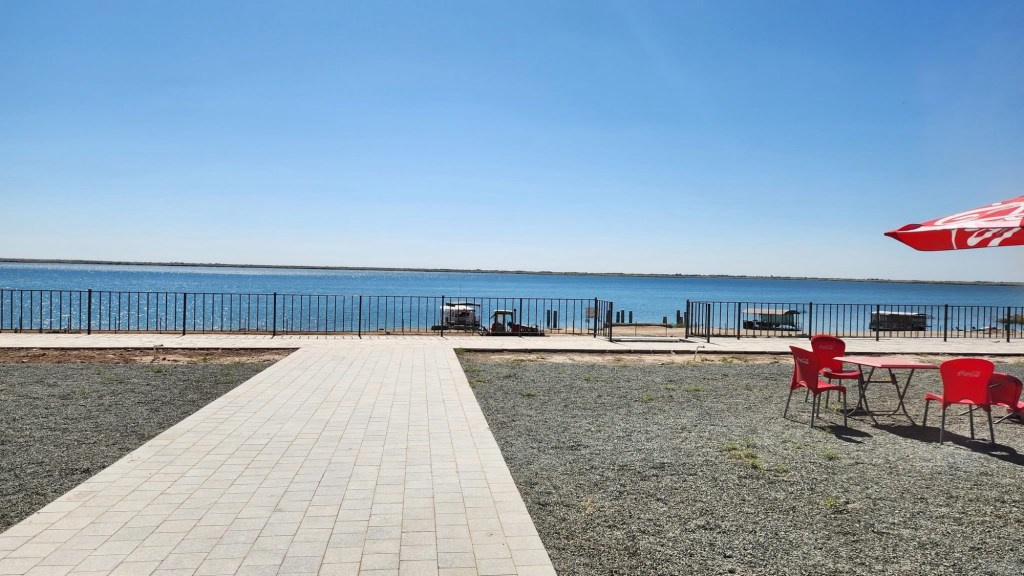
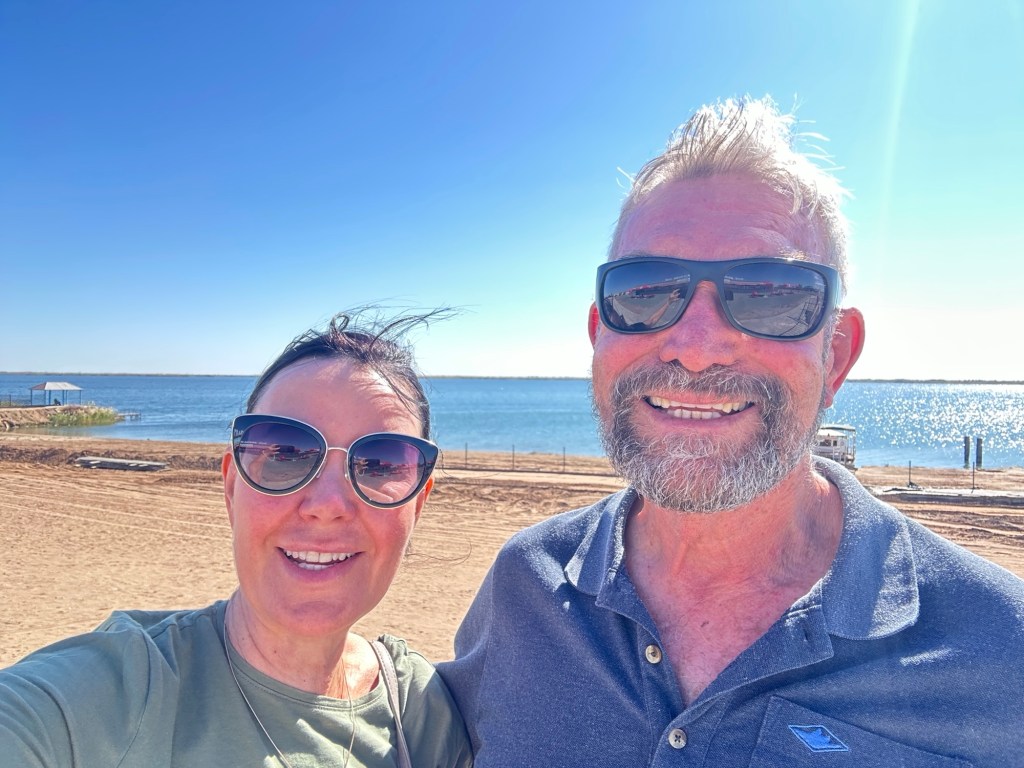
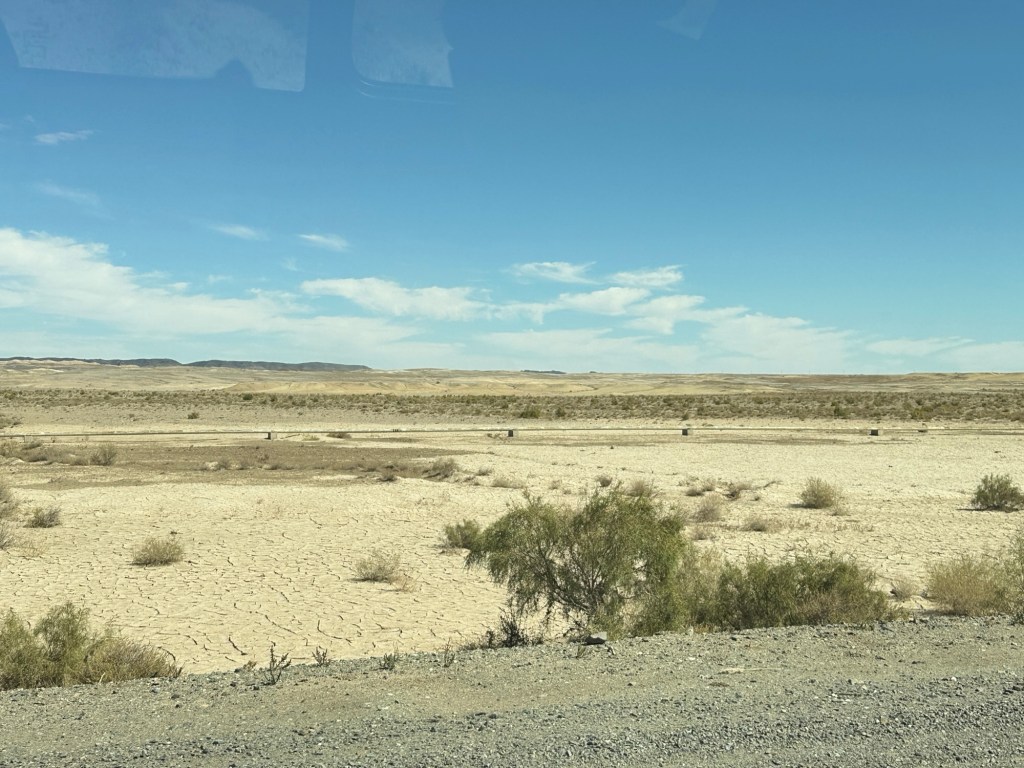
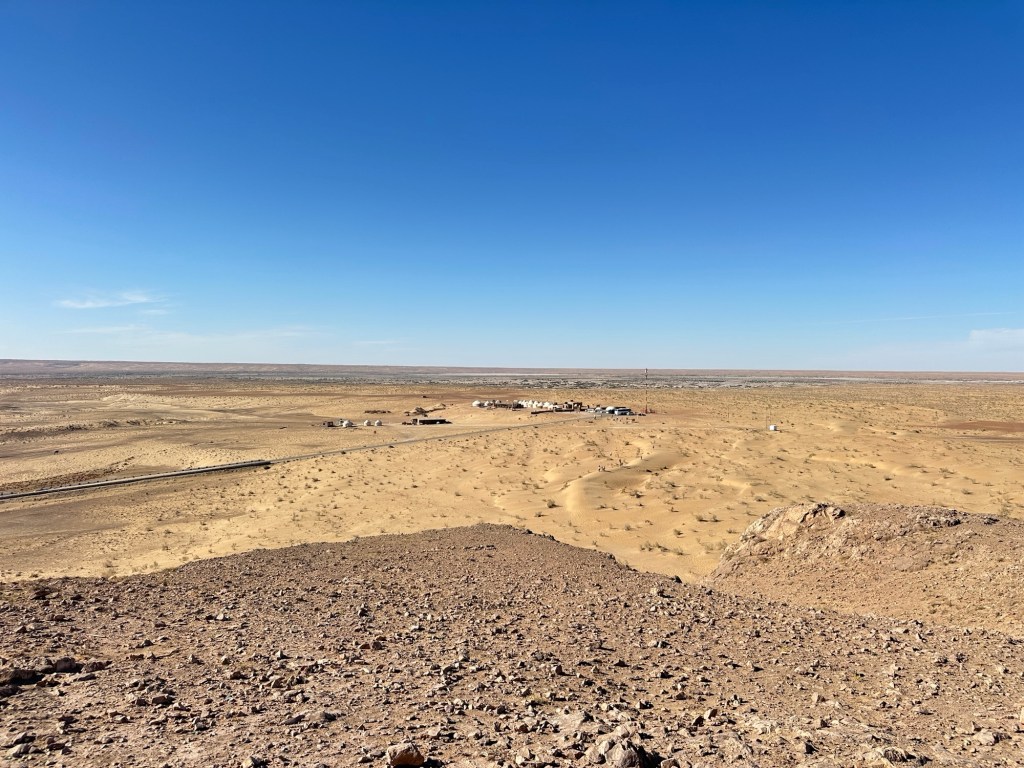
A lunch stop, beside a lake – which appeared out of nowhere, then Ayazkala 1st-4th Century AD, which was once a garrison. All three sites involved steep climbs up slippery sandy and rocky terrains – not for the faint hearted.
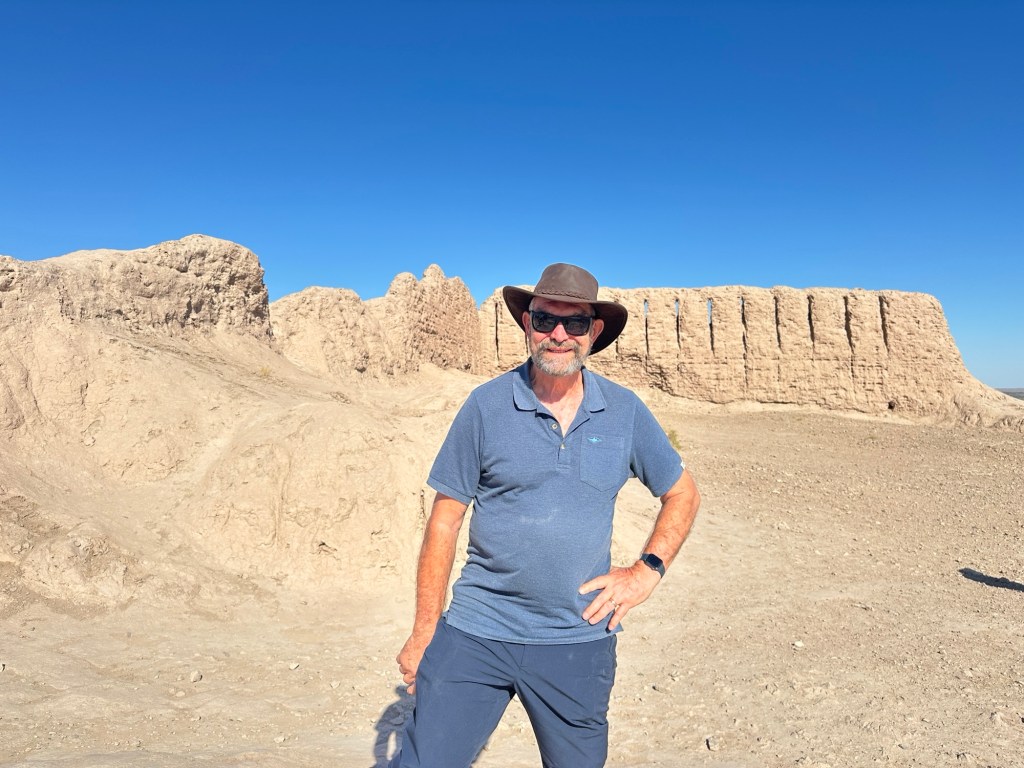
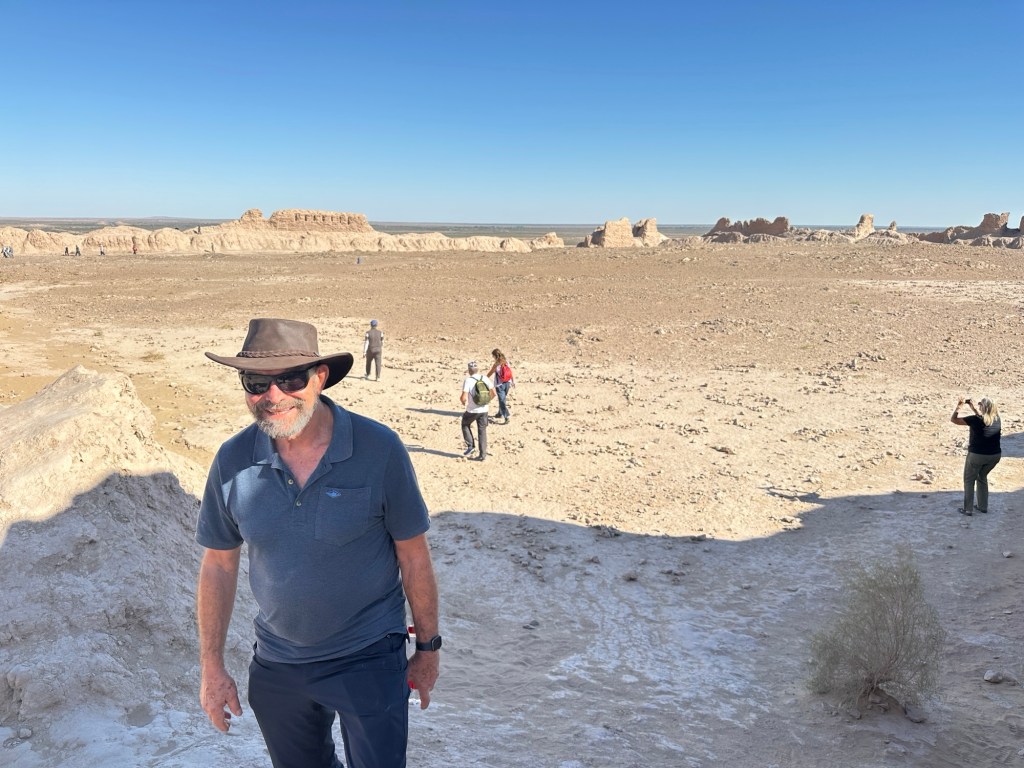
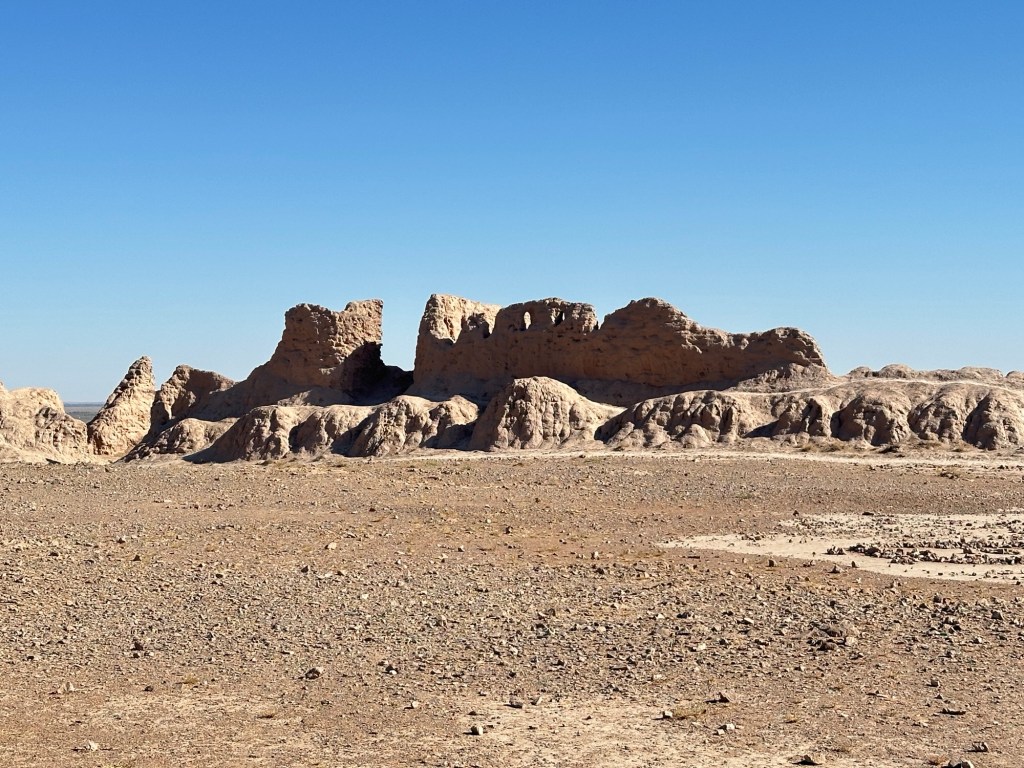
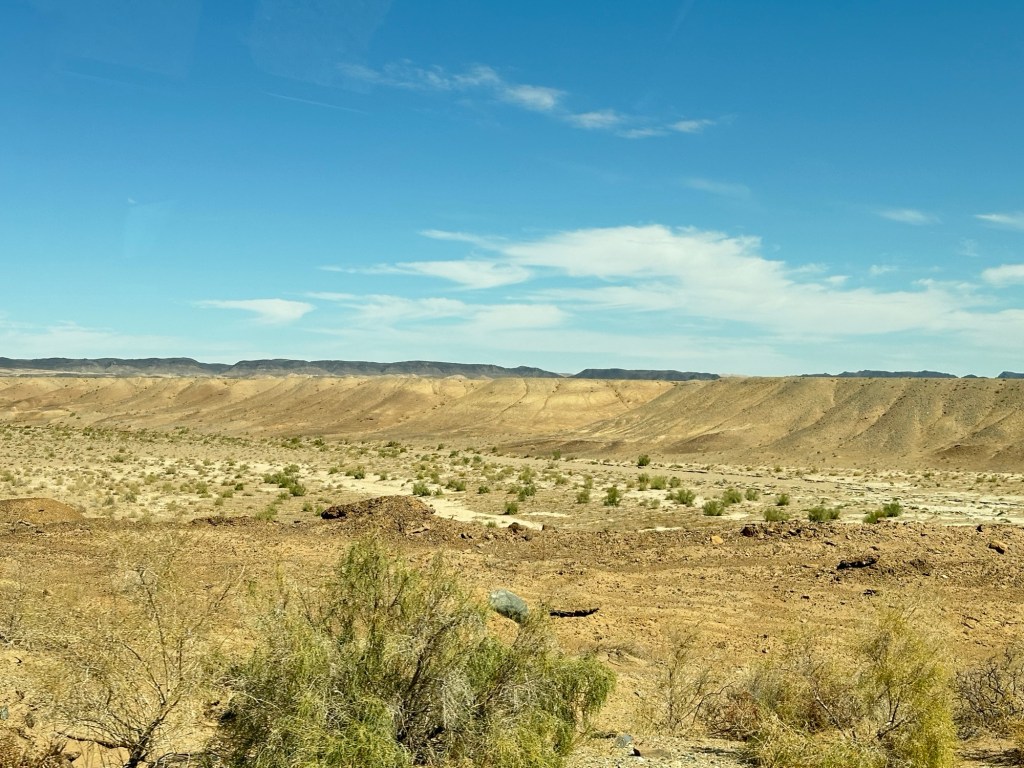
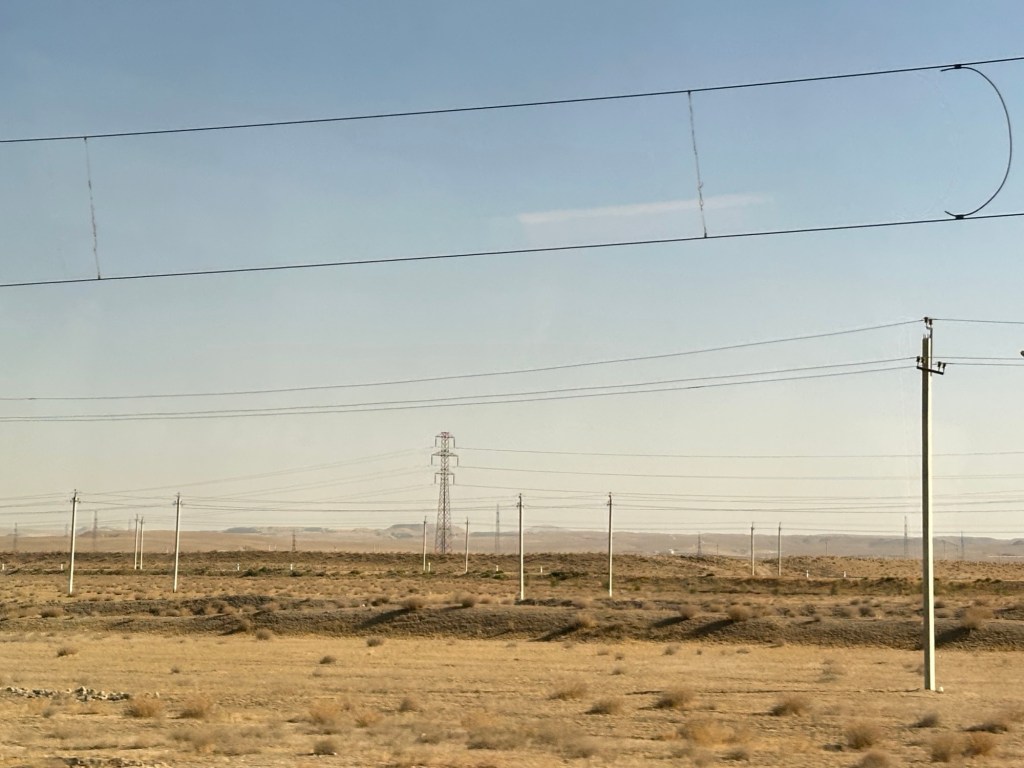
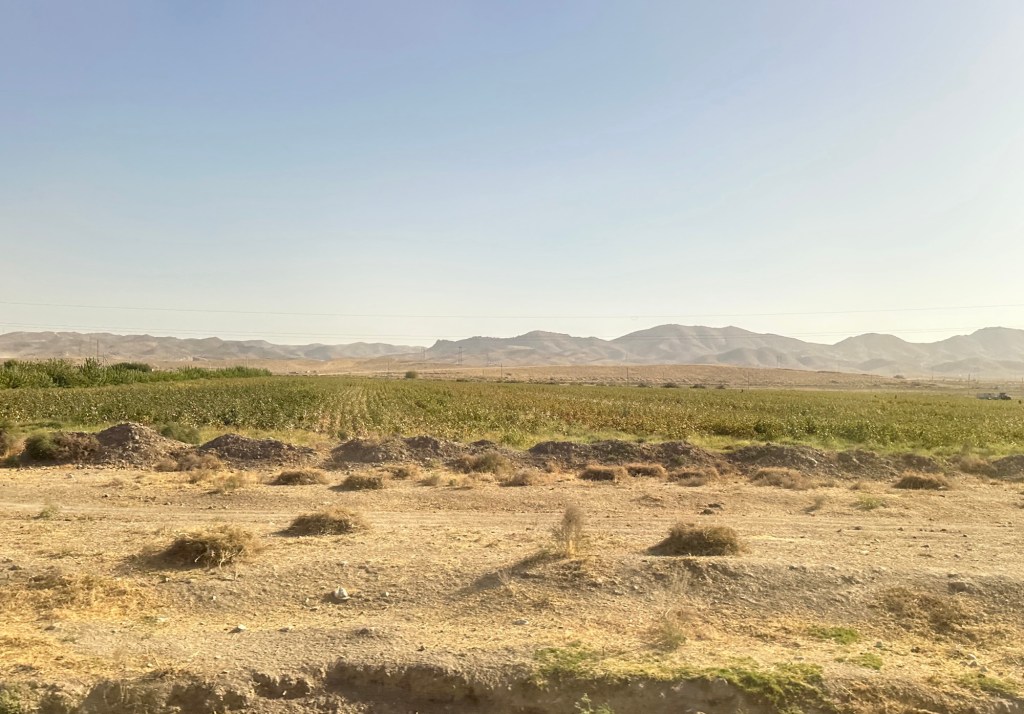
Continued onto Khiva – a total of 5 hours driving on some good, and some not so good, roads, through the desert, which then turned into more agricultural areas, with fields of cotton, fruit trees, corn and small crops, as we passed from Karalkapakstan to Uzbekistan.
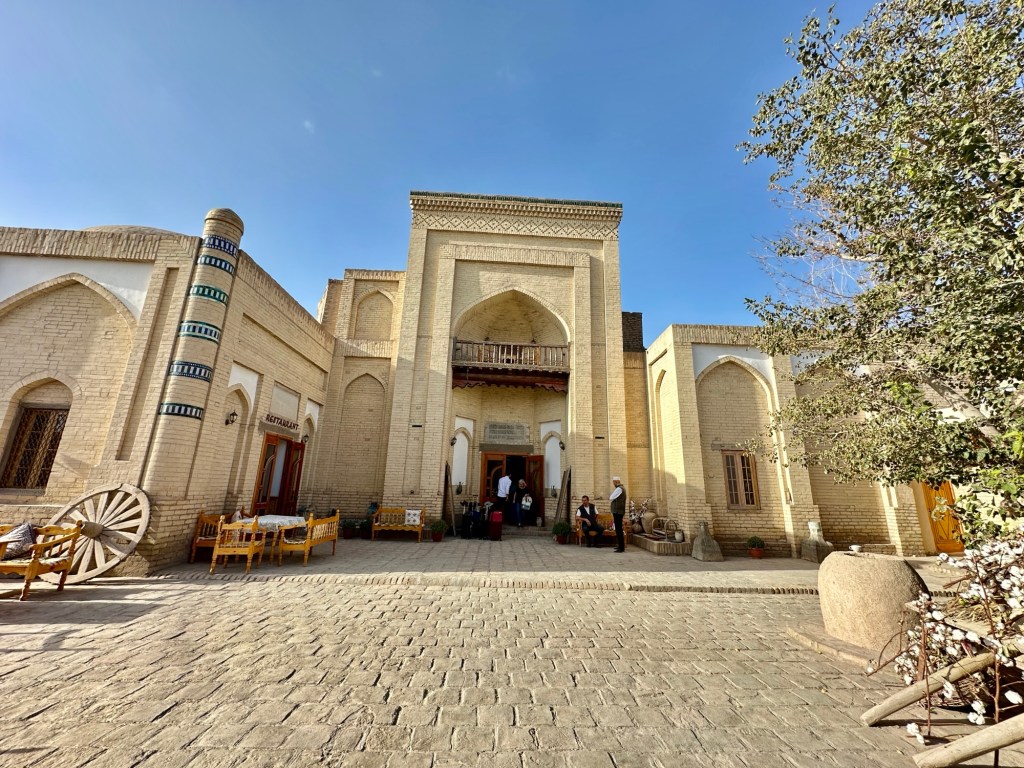
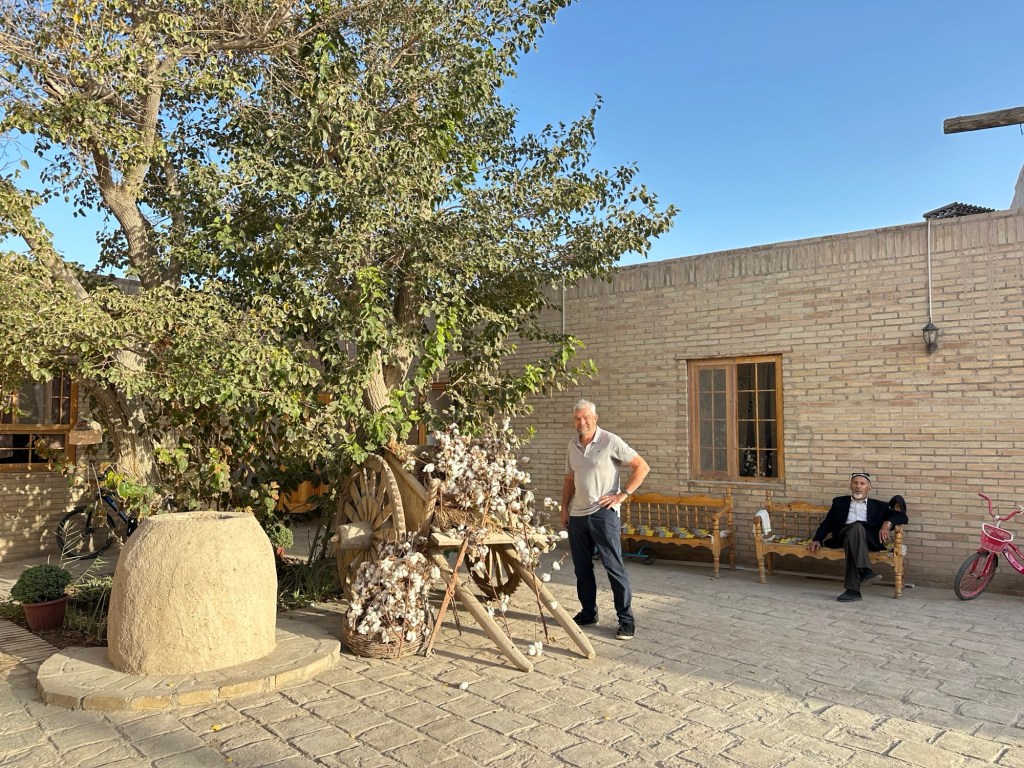
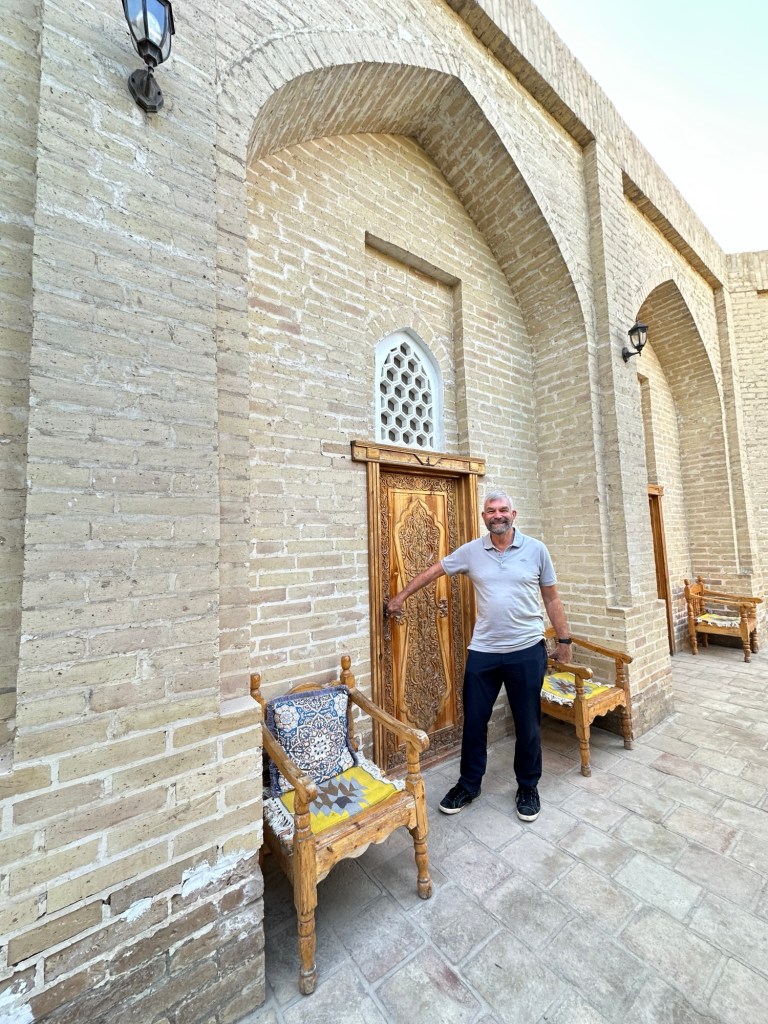
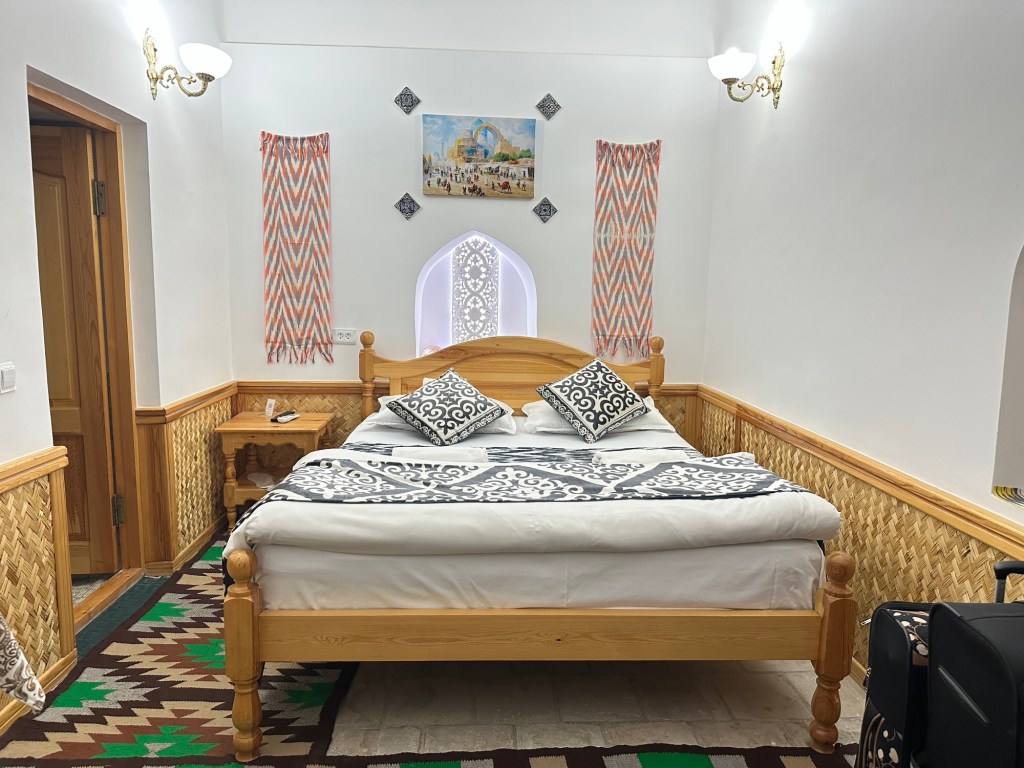
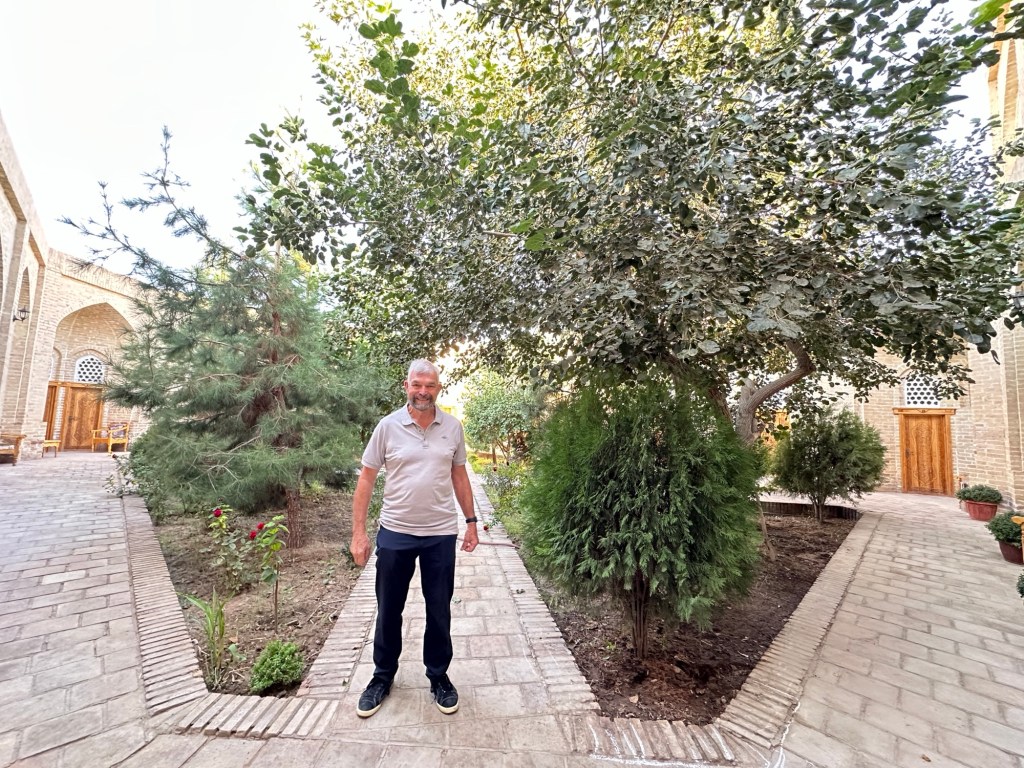
We checked into our very small room the Polvon Qori Boutique Hotel at 6pm, then headed out by foot to look for somewhere to eat. Nothing nearby, and as we had had a big lunch we thought we’d just have a quiet night in. Another night with no alcohol (our third, the restaurant where we ate the previous two nights didn’t sell alcohol)! We’ll come home teetotallers at this rate!
Day 10
Saturday 20th September
Khiva
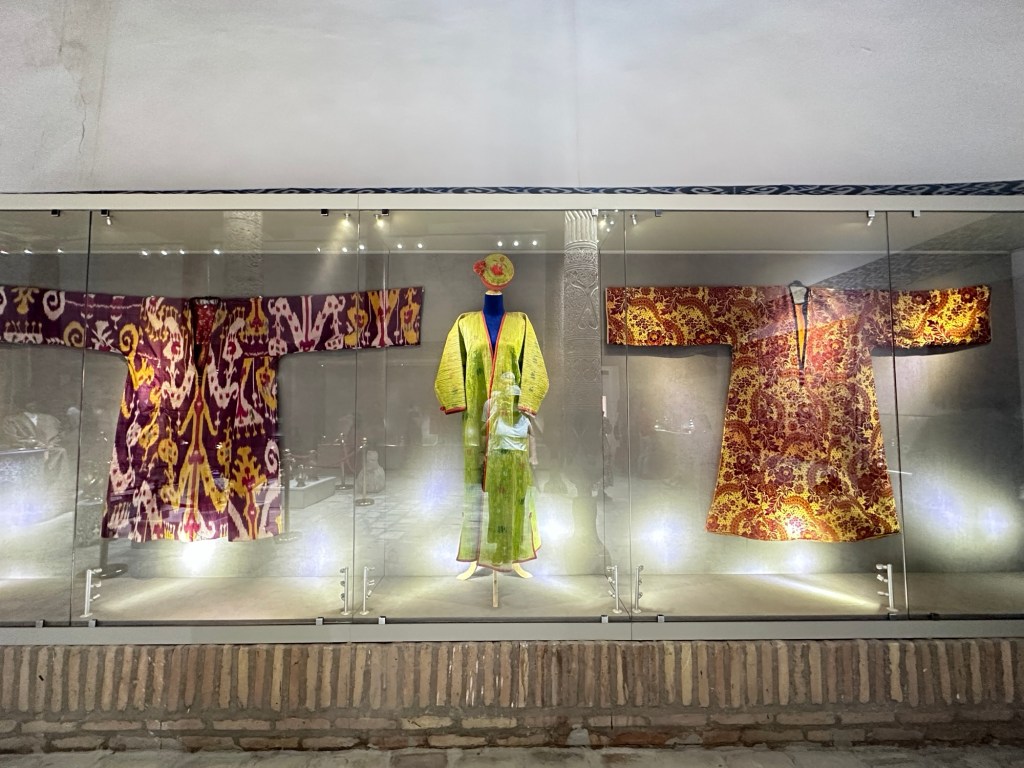
The Emir’s Summer Palace was next. Built by the Russians in 1911, the kitschy half-European, half-Oriental palace was home to the last emir of Bukhara, Alim Khan, until he fled to Afghanistan in 1920. The first Congress of the Bukharan Soviet was held in the palace that same year, heralding the dramatic political changes to come. The wedding-cake-like complex leads into an inner courtyard of reception halls, where the Museums of Applied Arts, National Costume and Needlework are housed. The last museum is housed in the former palace harem, where a voyeuristic emir would watch his concubines bathing, before throwing an apple to his passing favourite.
15-28 degrees, sunny
There is archaeological evidence to show that Khiva has existed since the 6th Century CE. It became a significant trading post on the Silk Road and rose to even more prominence within the region in the 1600s when it became the capital of the Khanate (kingdom of the Khan rulers). It is now the most architecturally intact and tightly packed of Uzbekistan’s Silk Road cities. Today we had local guide Husain, take us on a walking tour of this World Heritage Site. And yes, it was only a 5 minute walk from our hotel to the East Gate Entrance. If only we’d known last night!
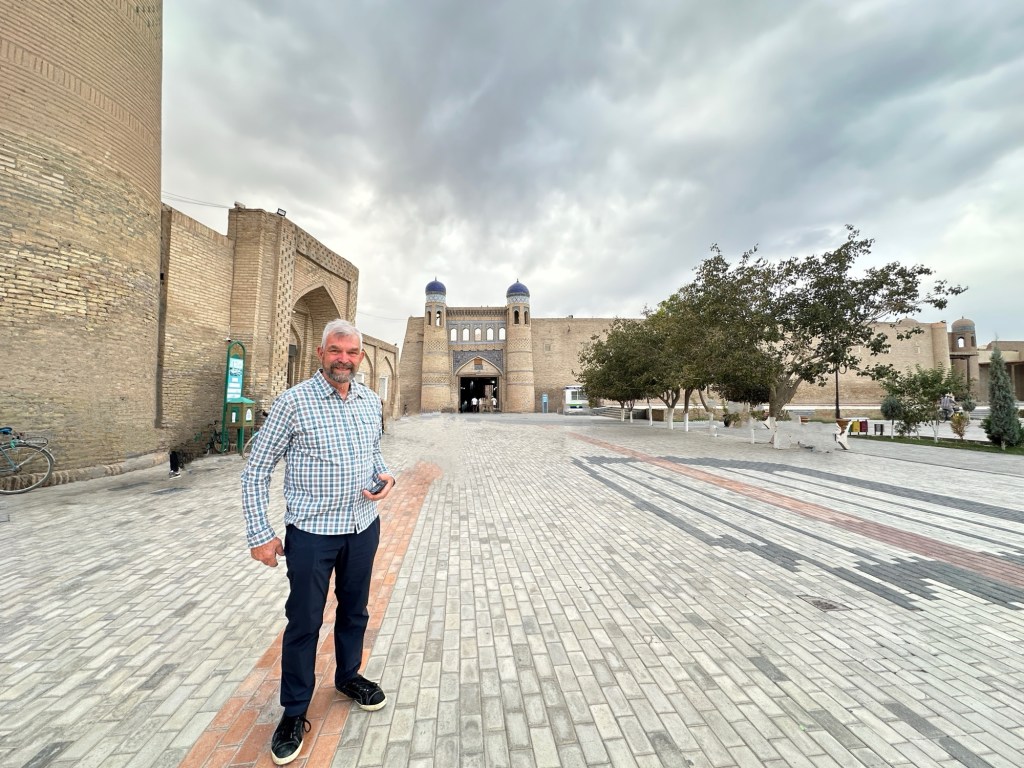
The walled fortress known as Itchan Kala, is home to more than 60 cultural sites, medieval mosques and opulent palaces, as well as numerous museums, souvenir shops and craft studios.
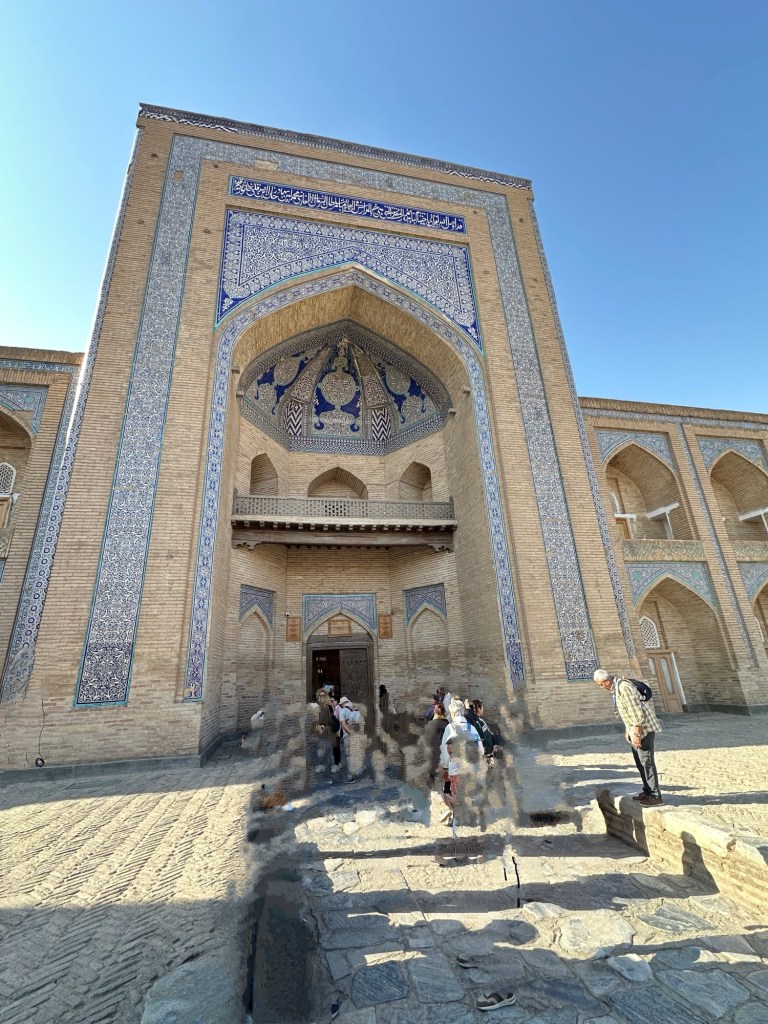
Our first stop inside the citadel was to visit the Mohammed Amin Khan Madrassa (Islamic school). Once housing the madrassa’s students, it is now home to the Orient Star Hotel. Some beautiful tiling on the walls surrounding the courtyards – but we couldn’t believe the number of tourists wandering around the working hotels corridors and rooms.
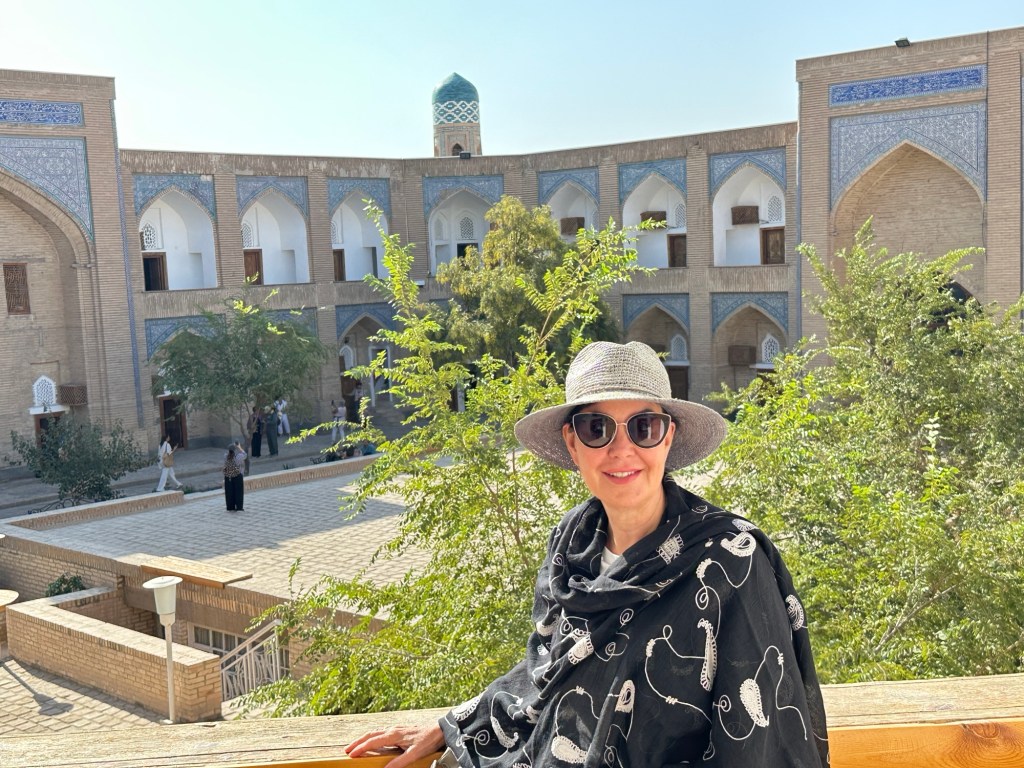
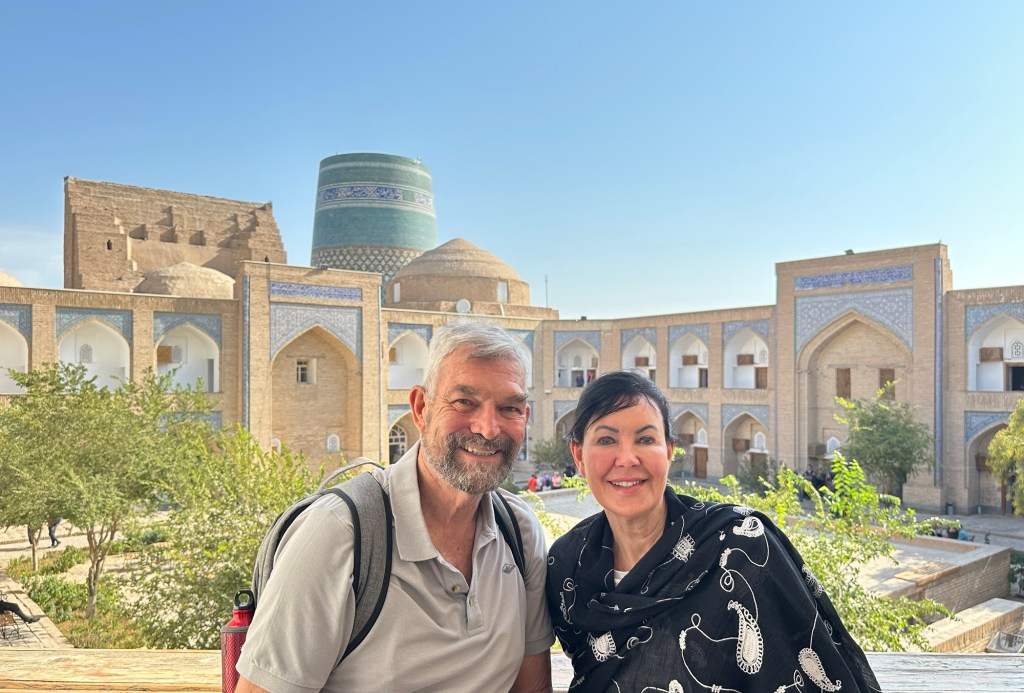
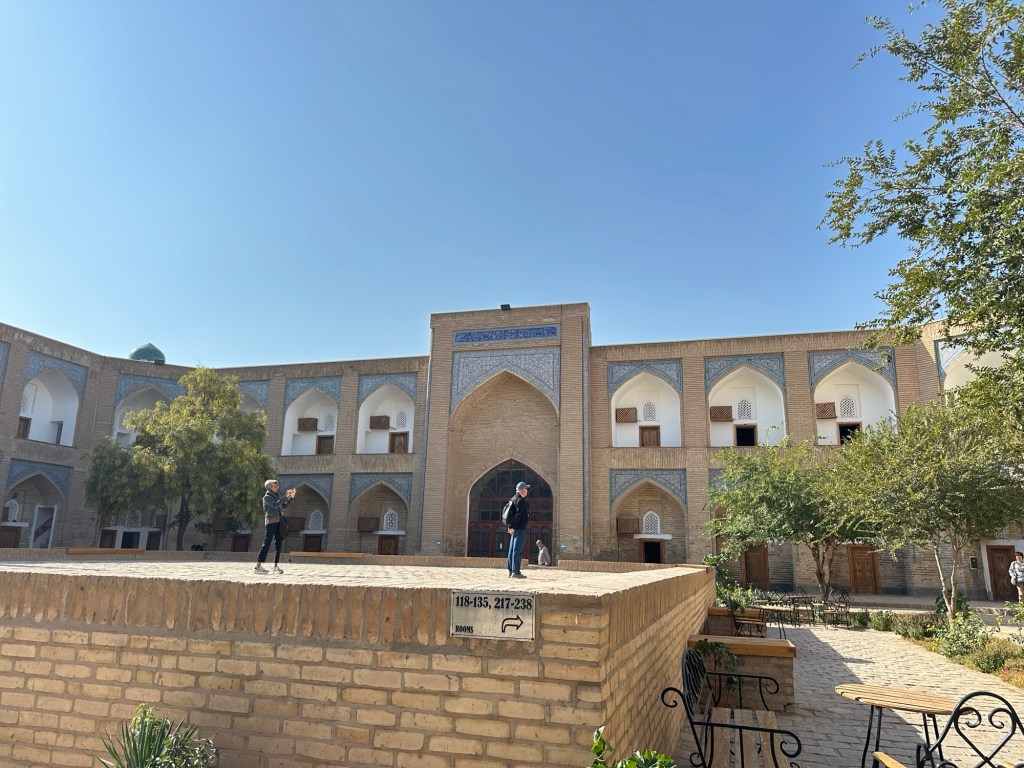
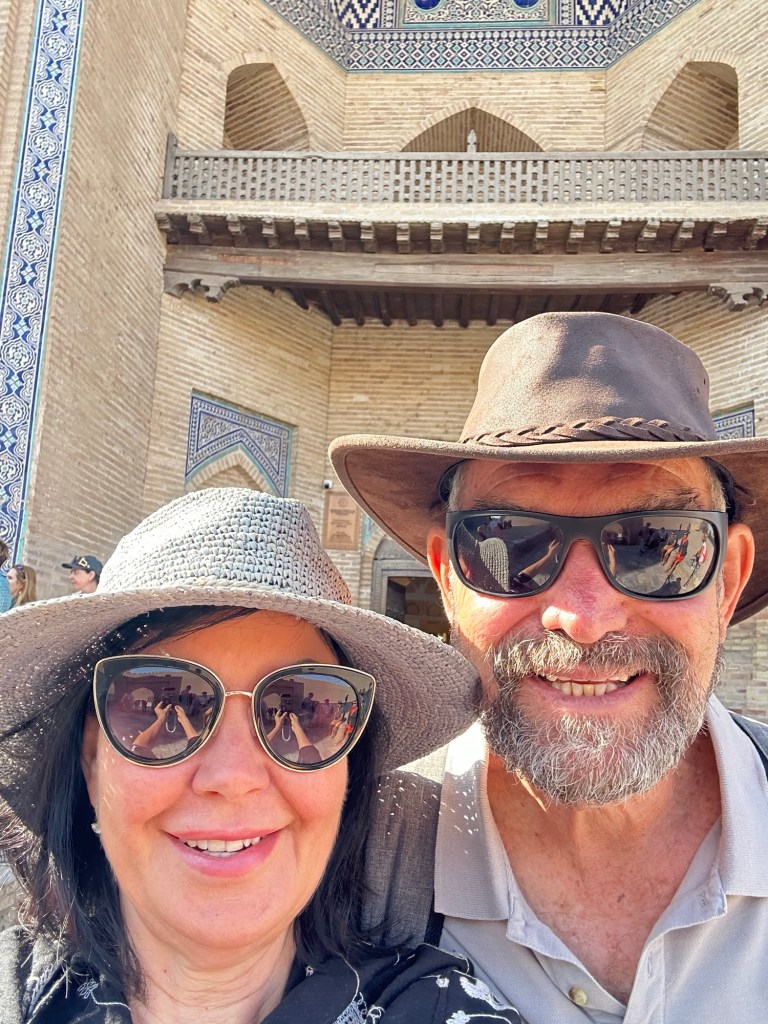
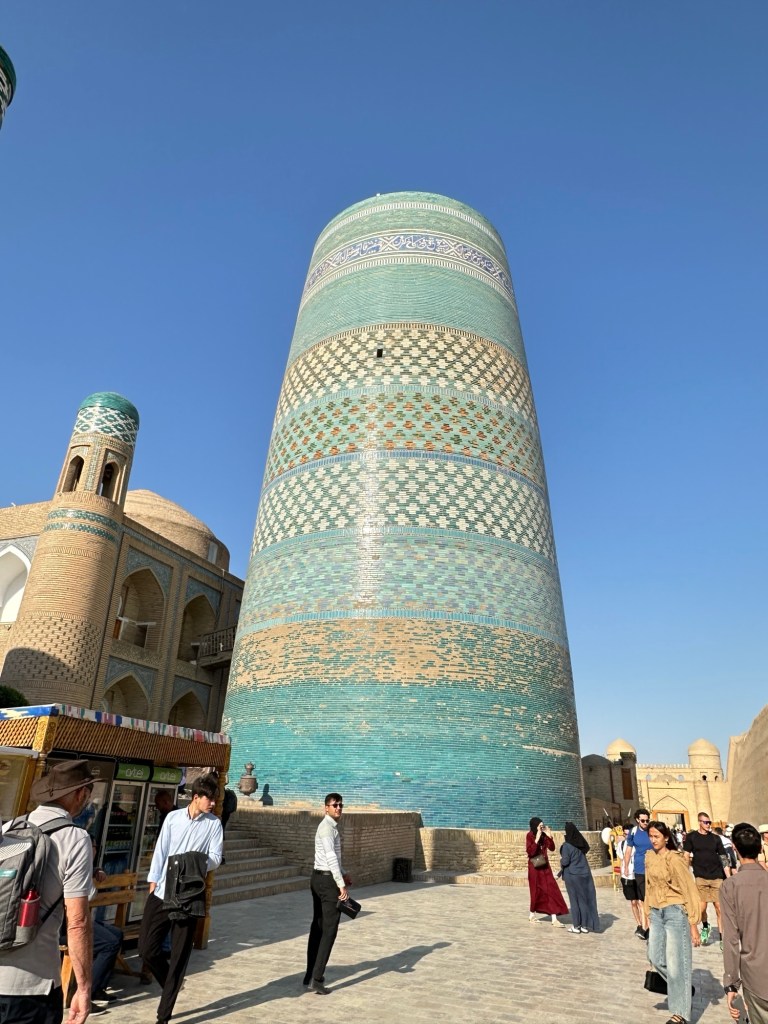
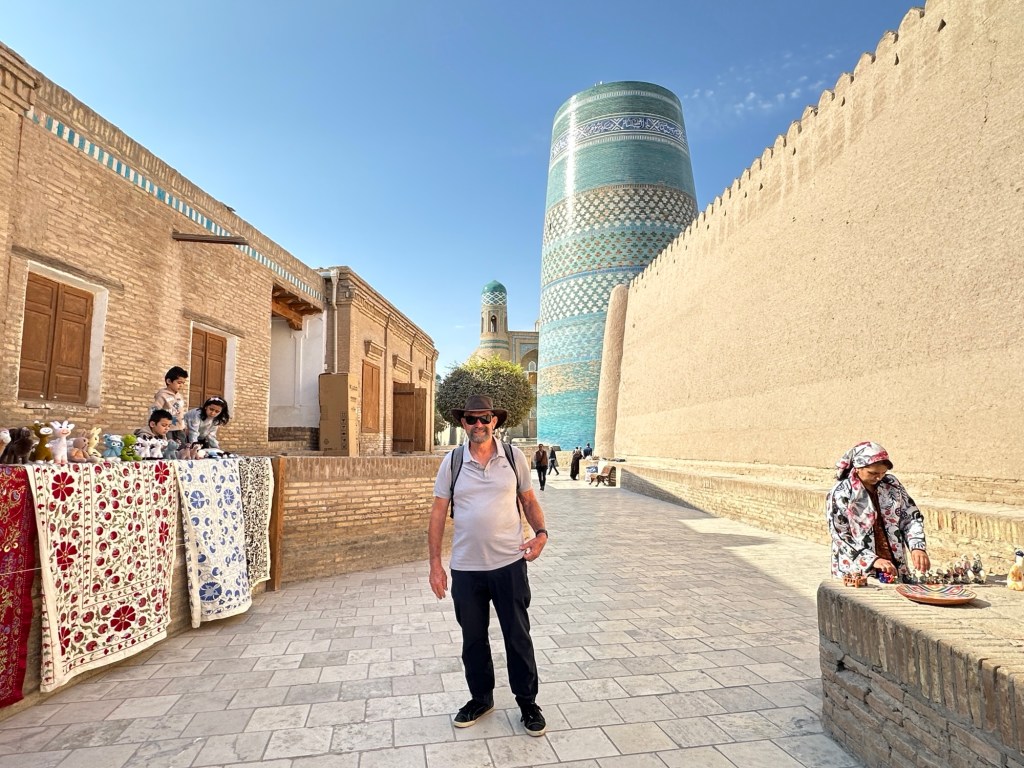
Next to the hotel was the green stub of the Kalta Minaret. It was commissioned by Amin Khan in 1851 to be the world’s tallest minaret, but abandoned as the khan was murdered three years later . I’m consequently, it is rather squat in appearance, but even so, it is an miconic and beautiful sight.
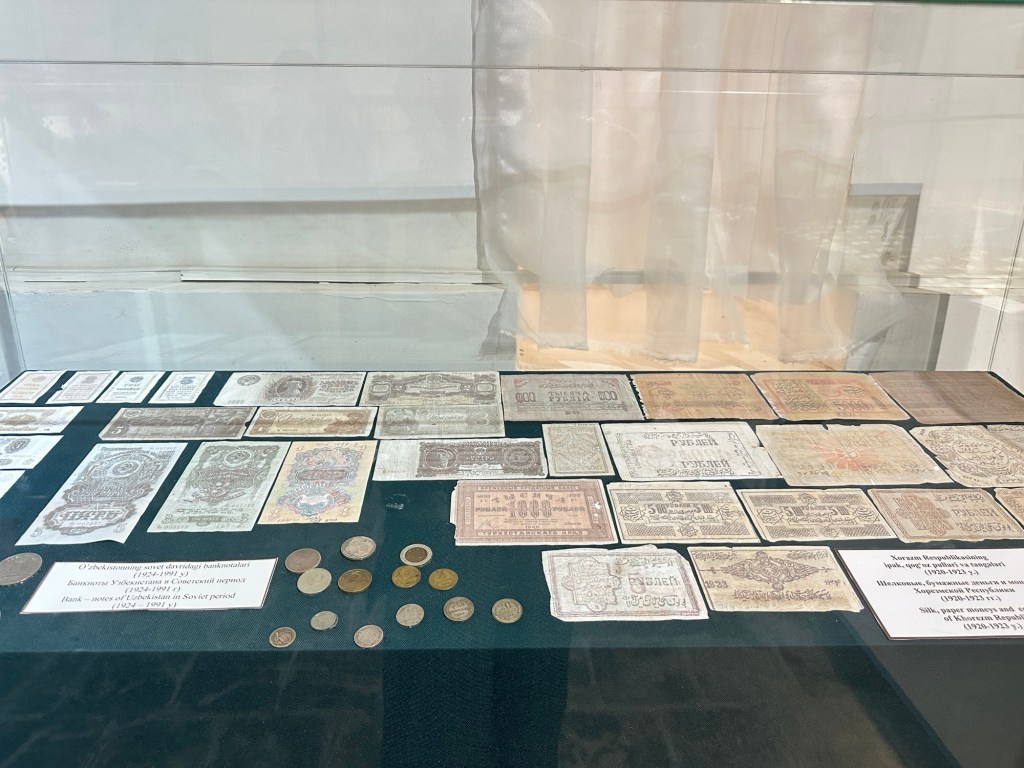
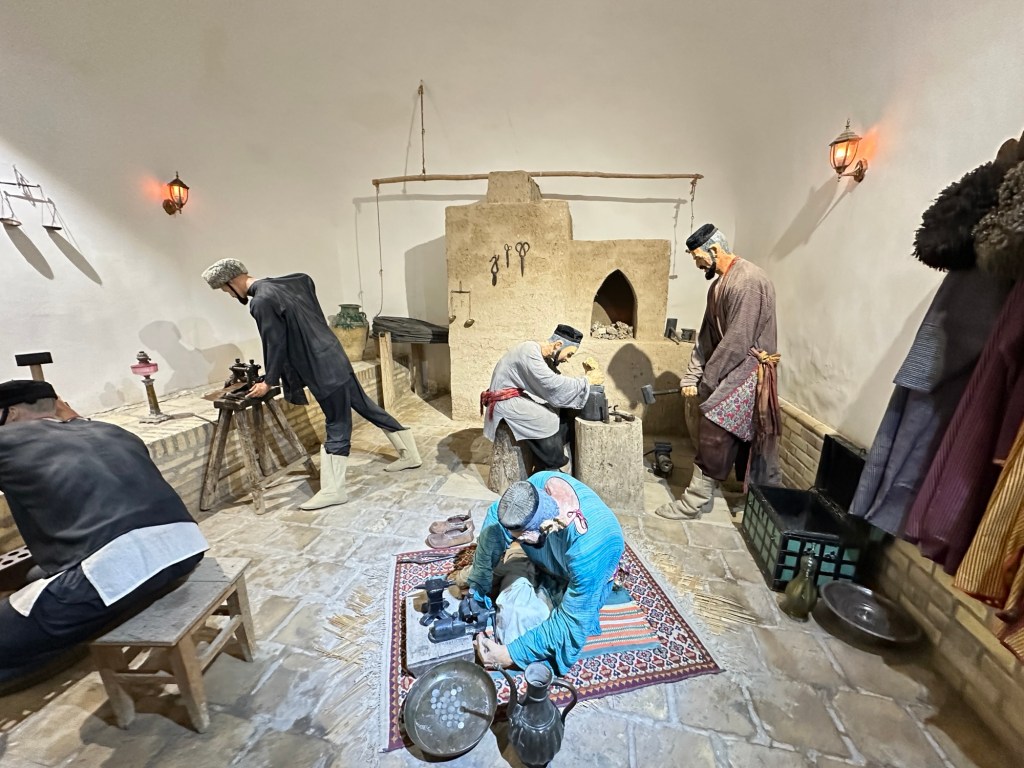
The Kukhna Ark complex is notable for its ice blue tile work and jeans that face north to catch the summer breezes. This part of the fortress contains royal rooms, a summer mosque, mint, harem and a throne room.
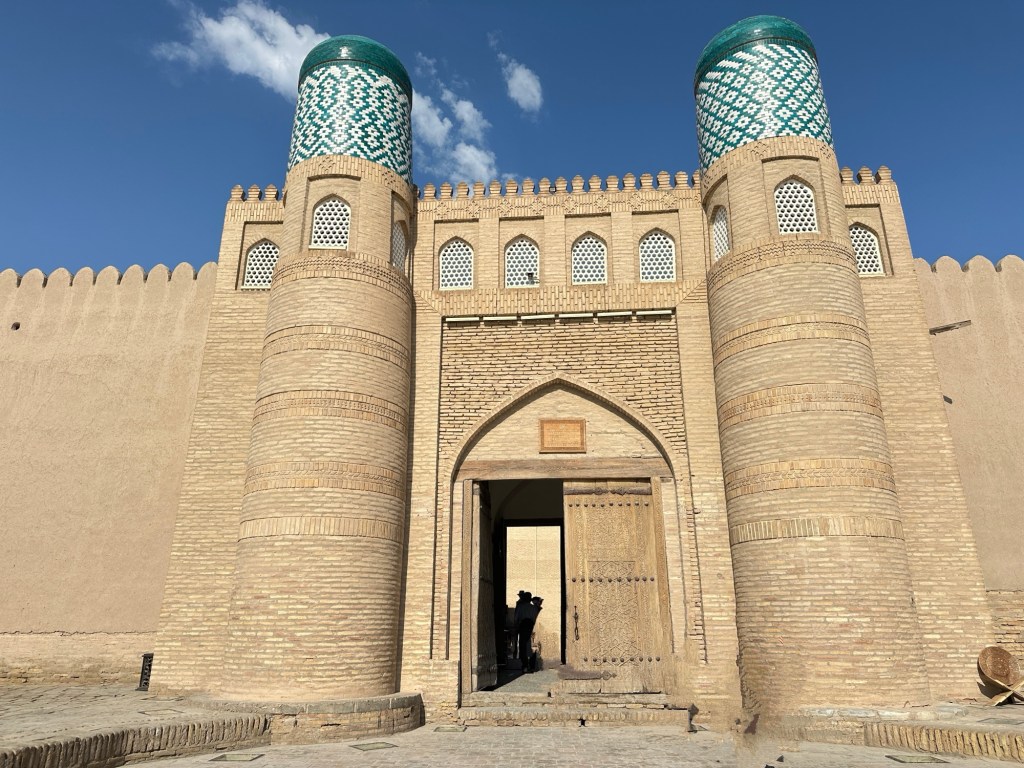
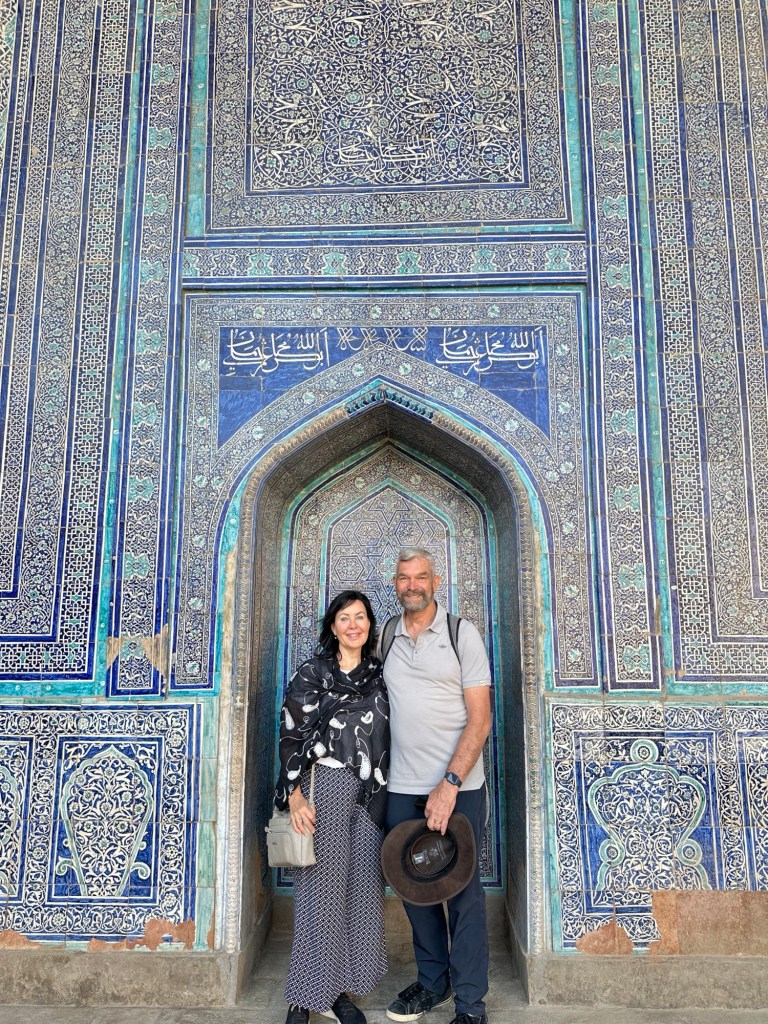
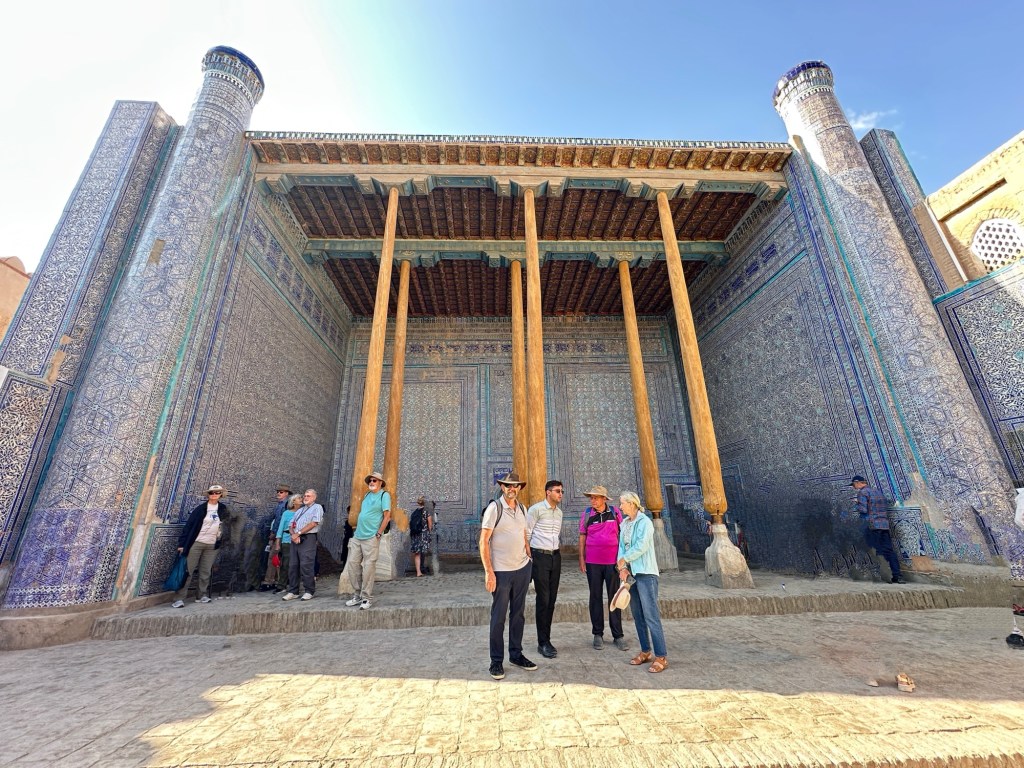
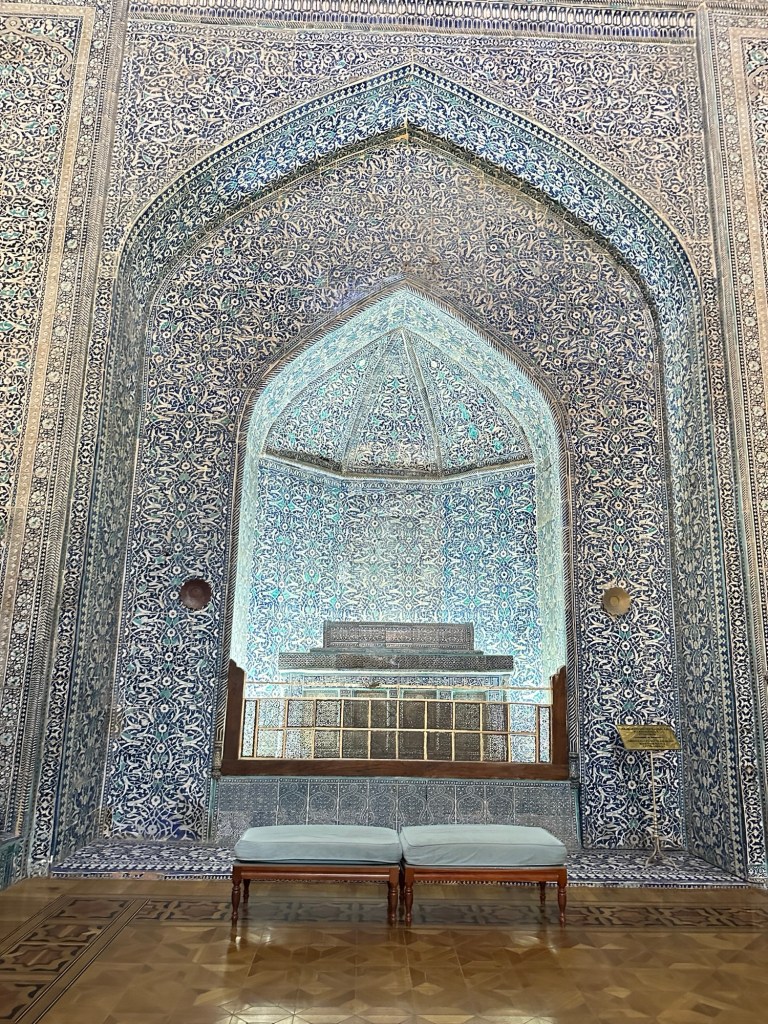
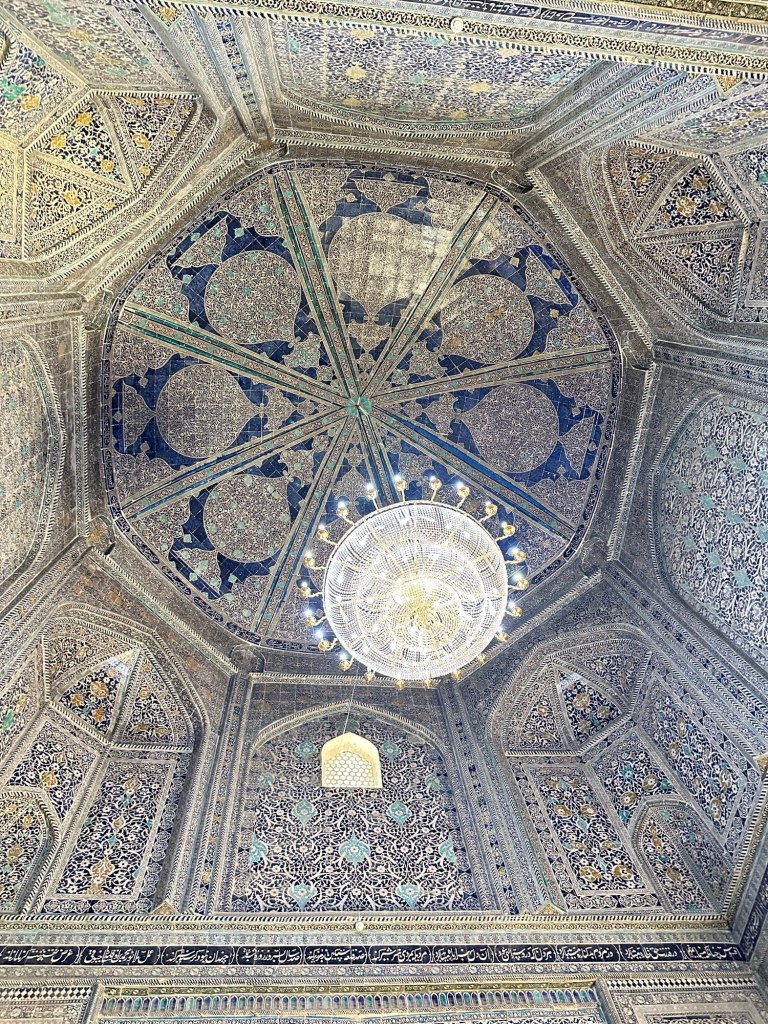
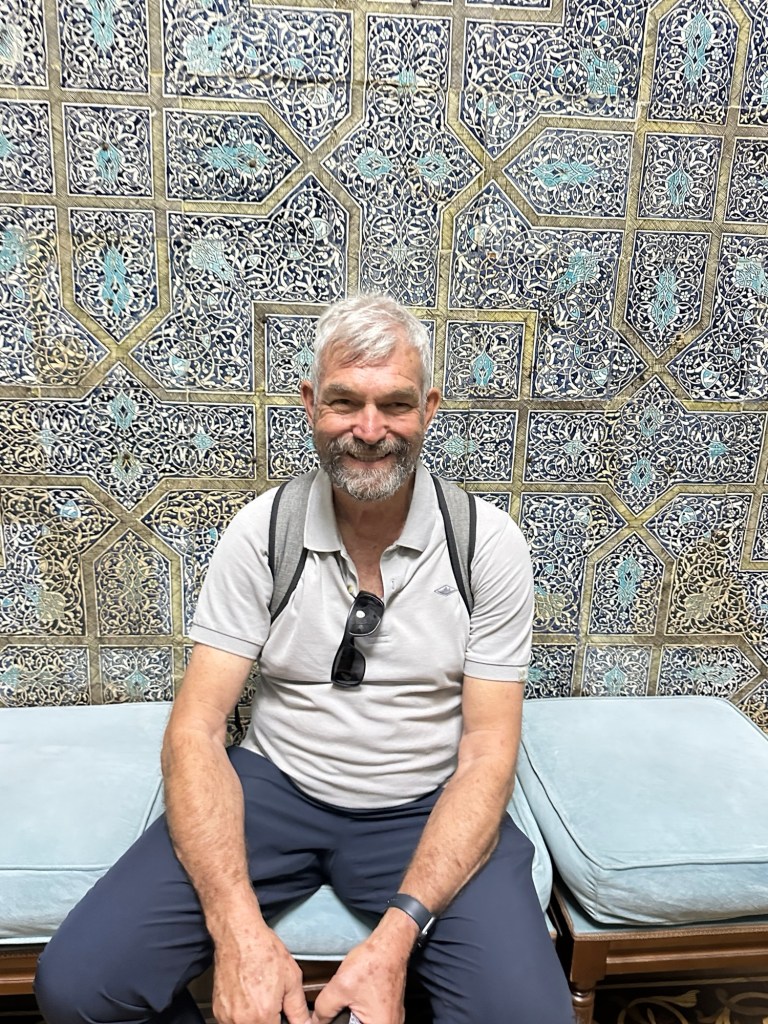
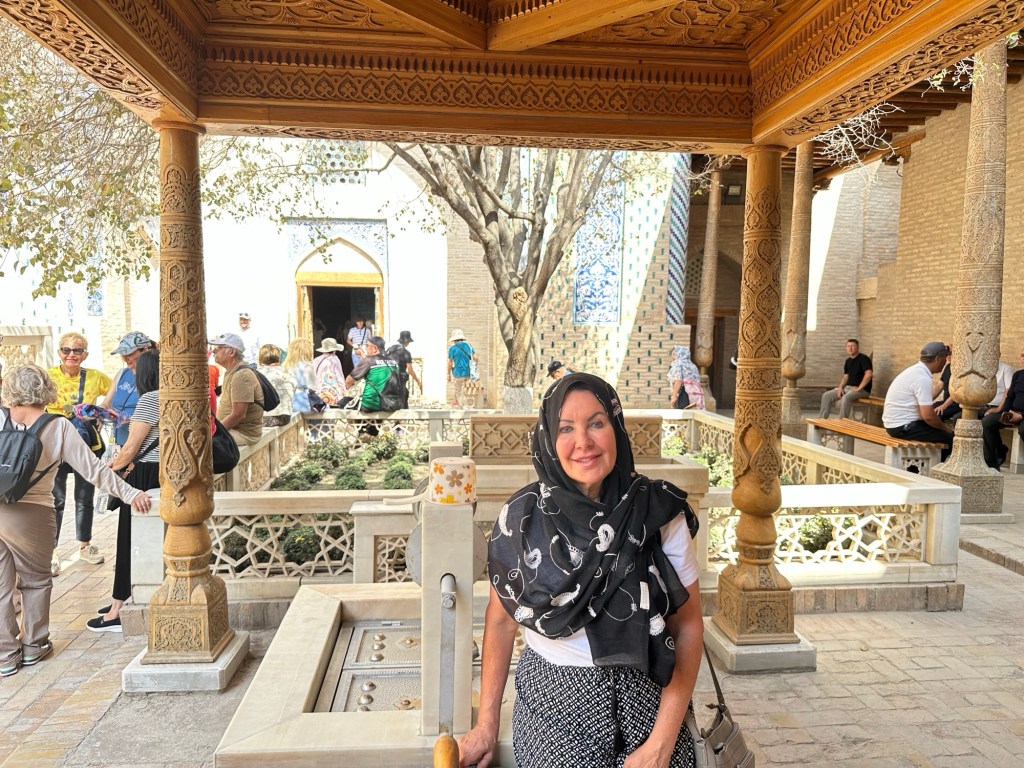
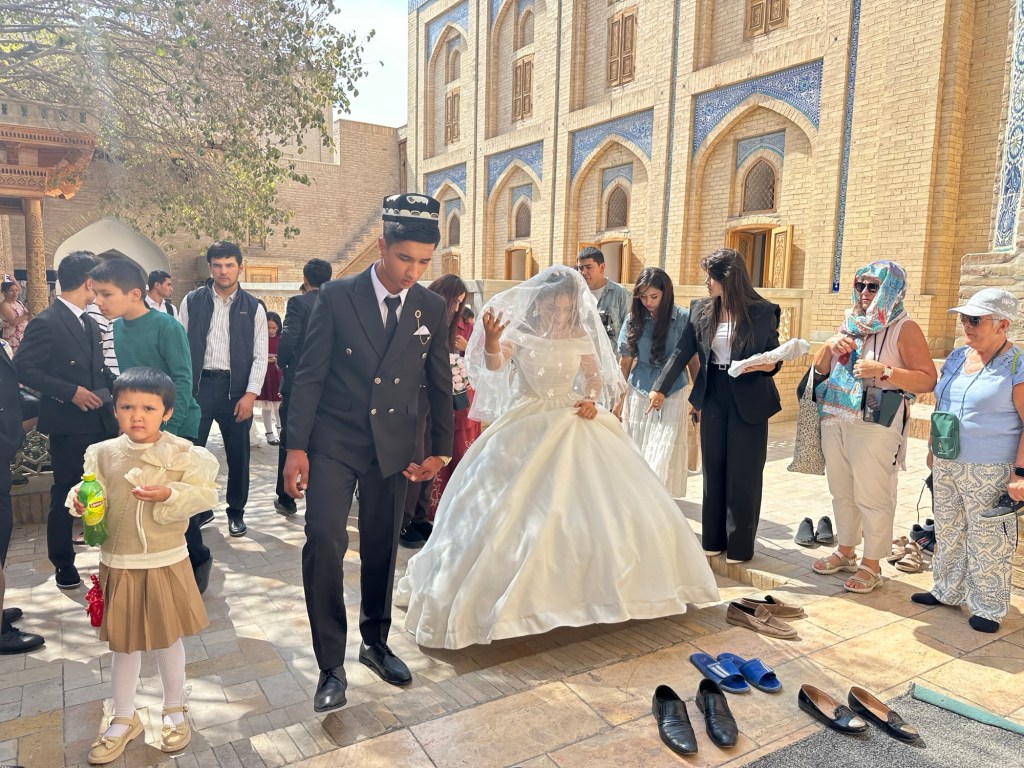
The Pakhlavan Mahmud Mausoleum commemorates the power, wrestler and patron saint of Khiva who died here in 1325. The 19th century tomb contains some of the city’s best tilework and the largest cupola in Khiva. It was stunning. We saw a bridal couple enter – they traditionally come for blessings.
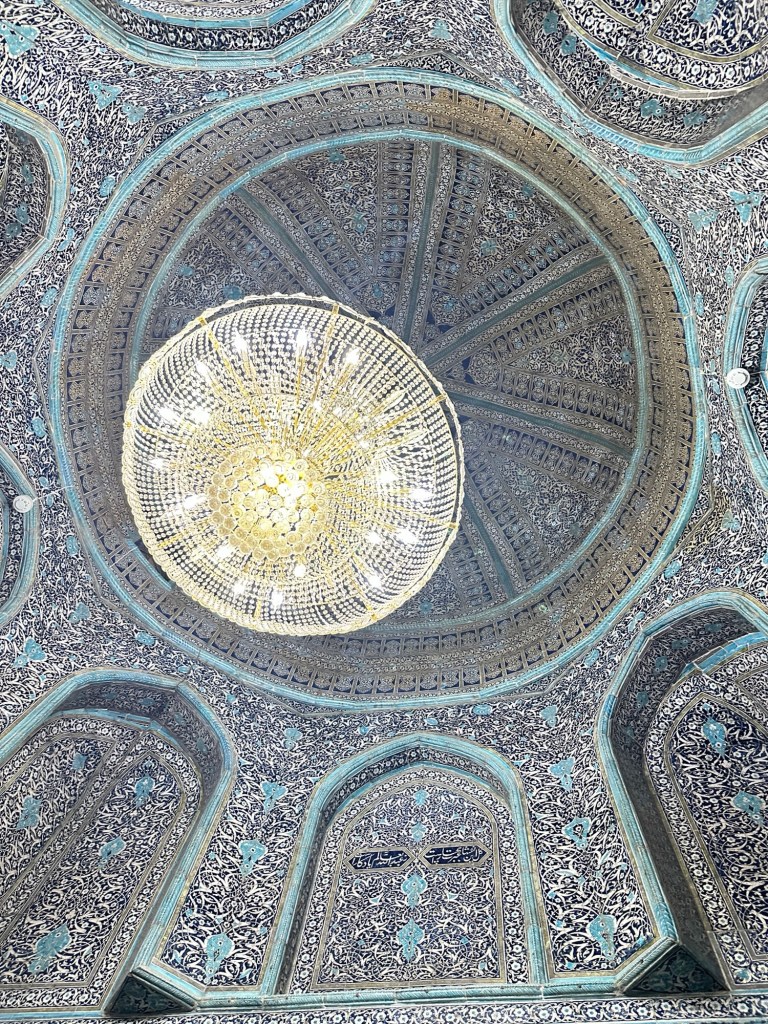
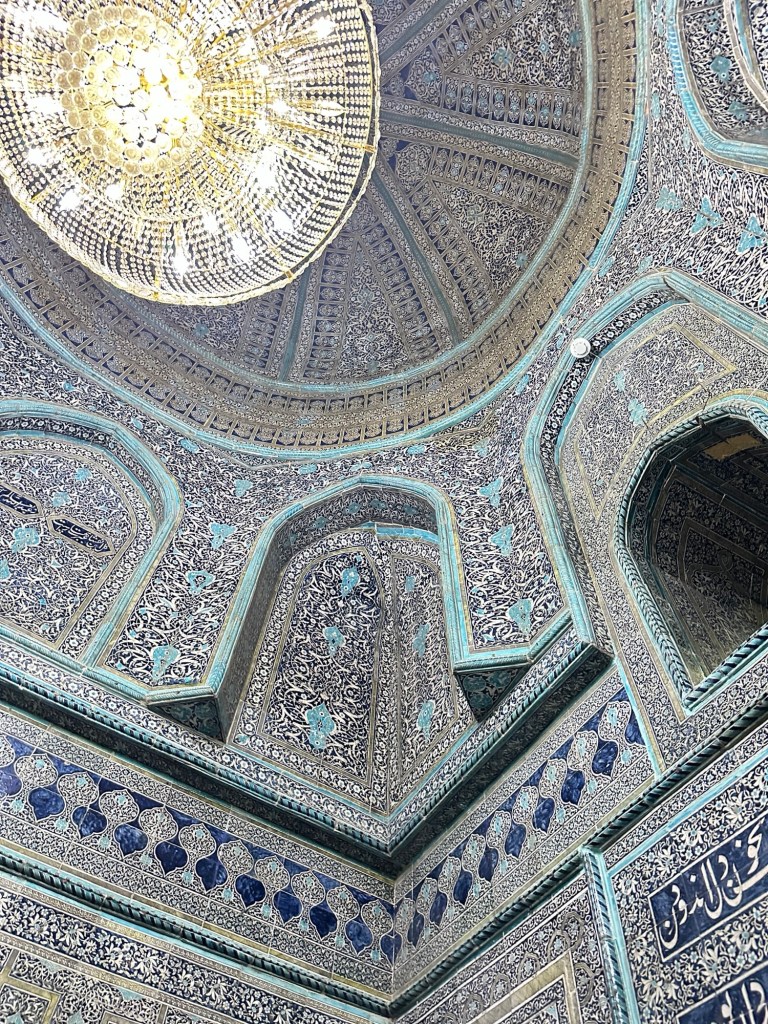
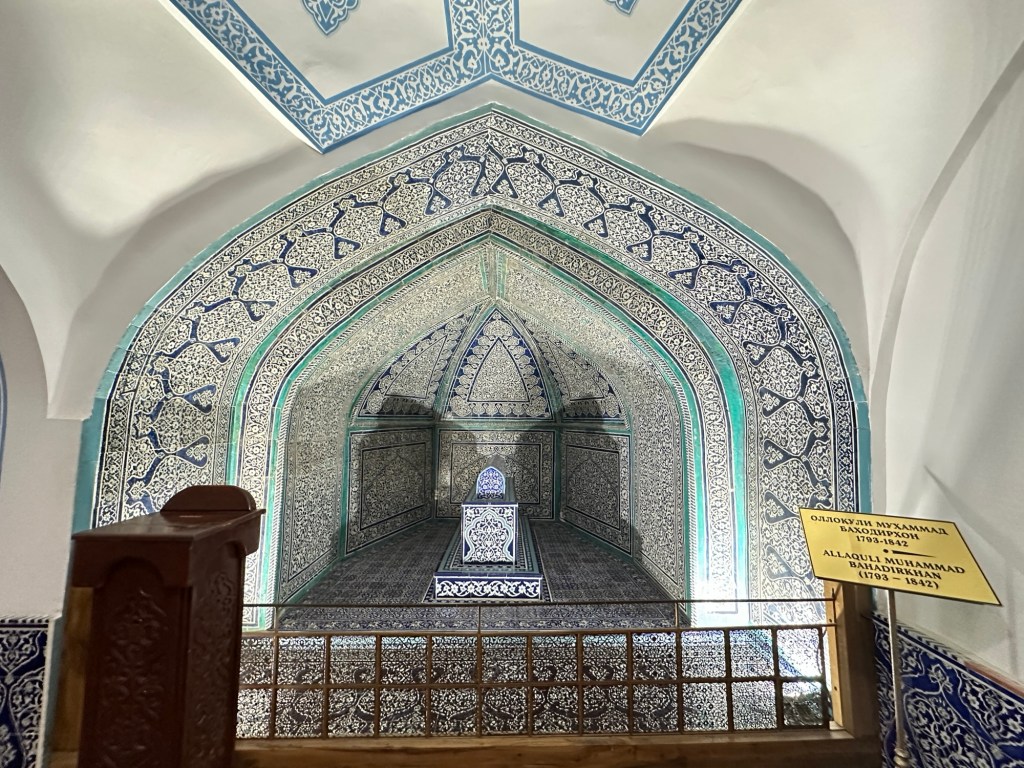
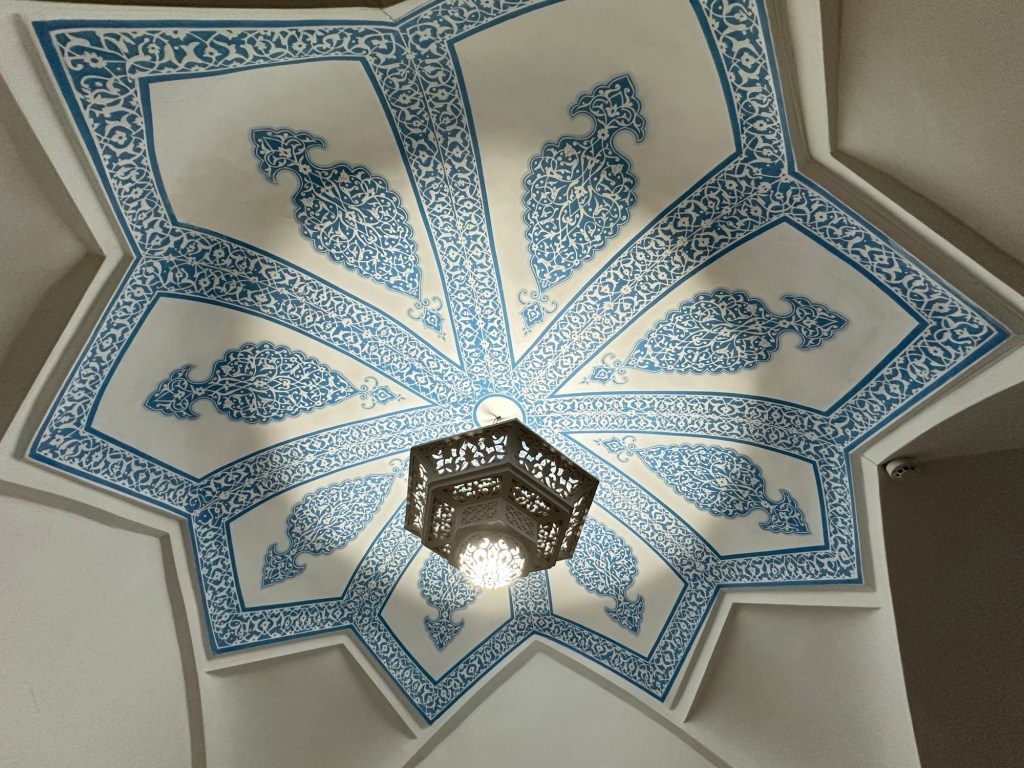
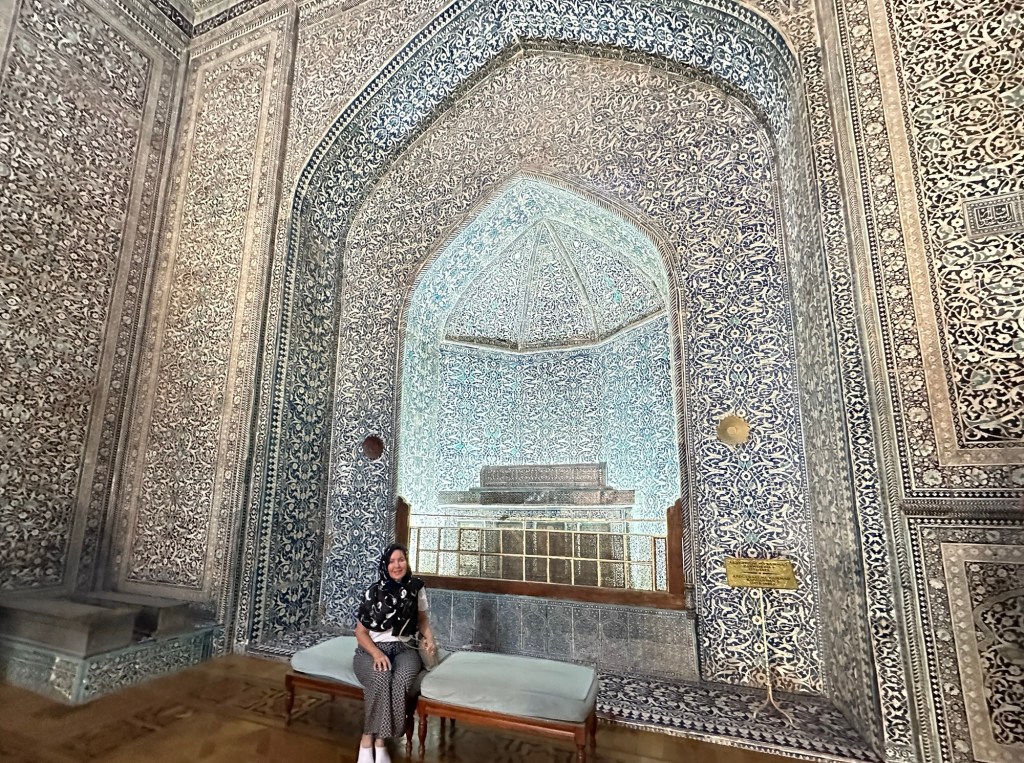
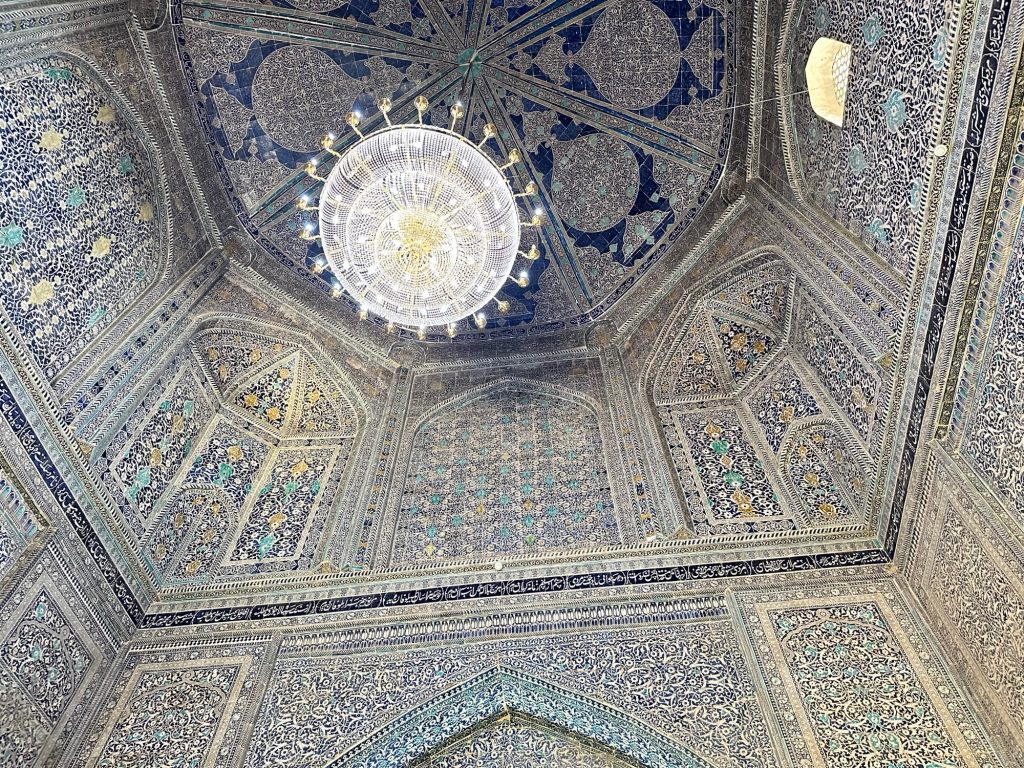
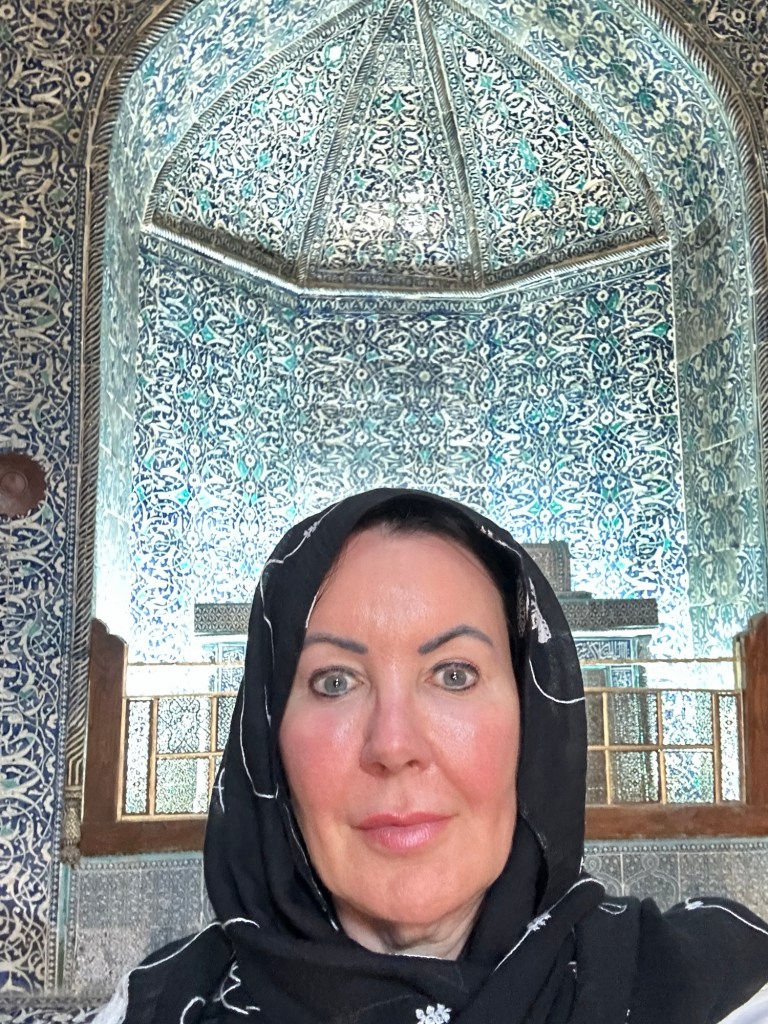
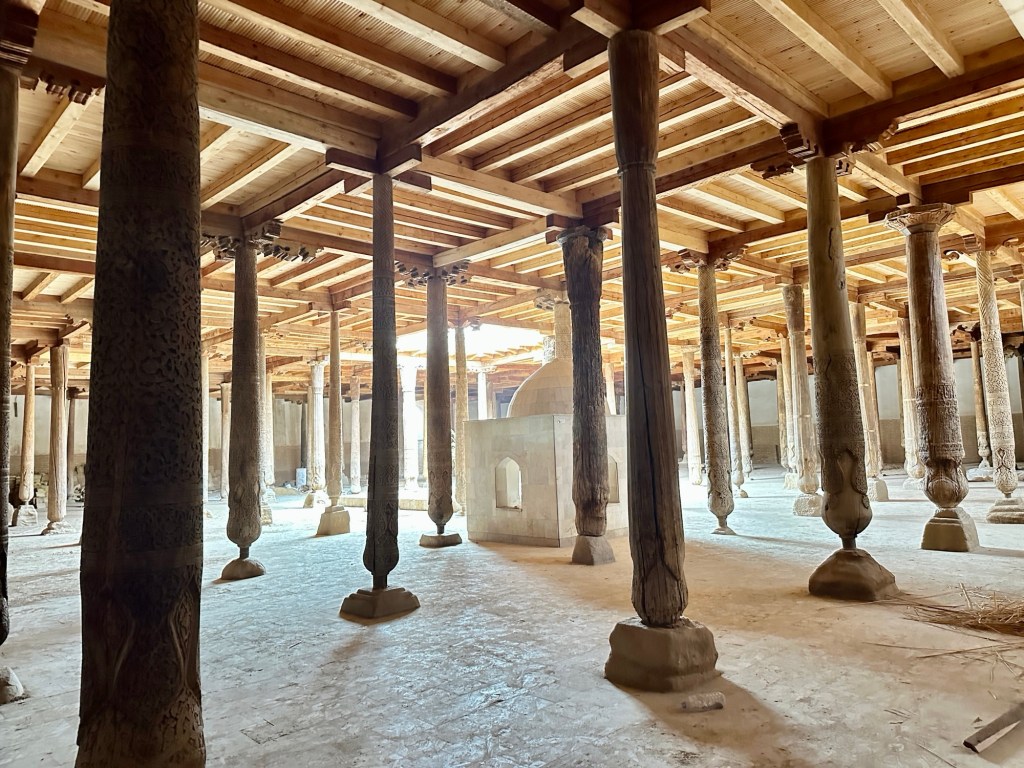
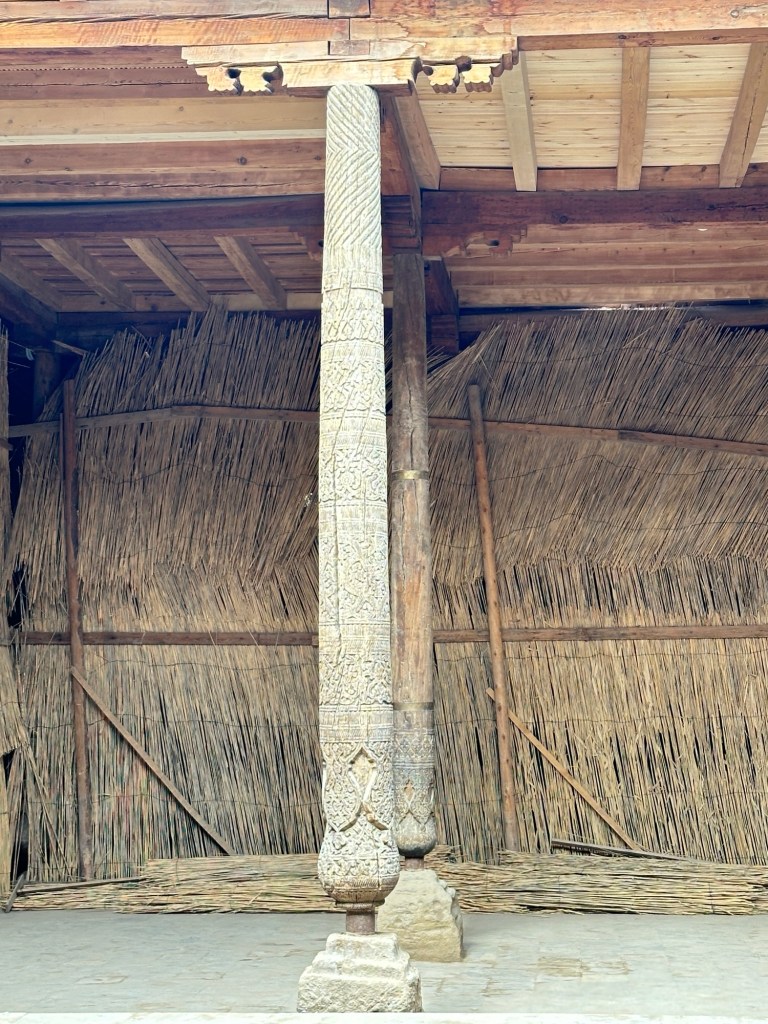
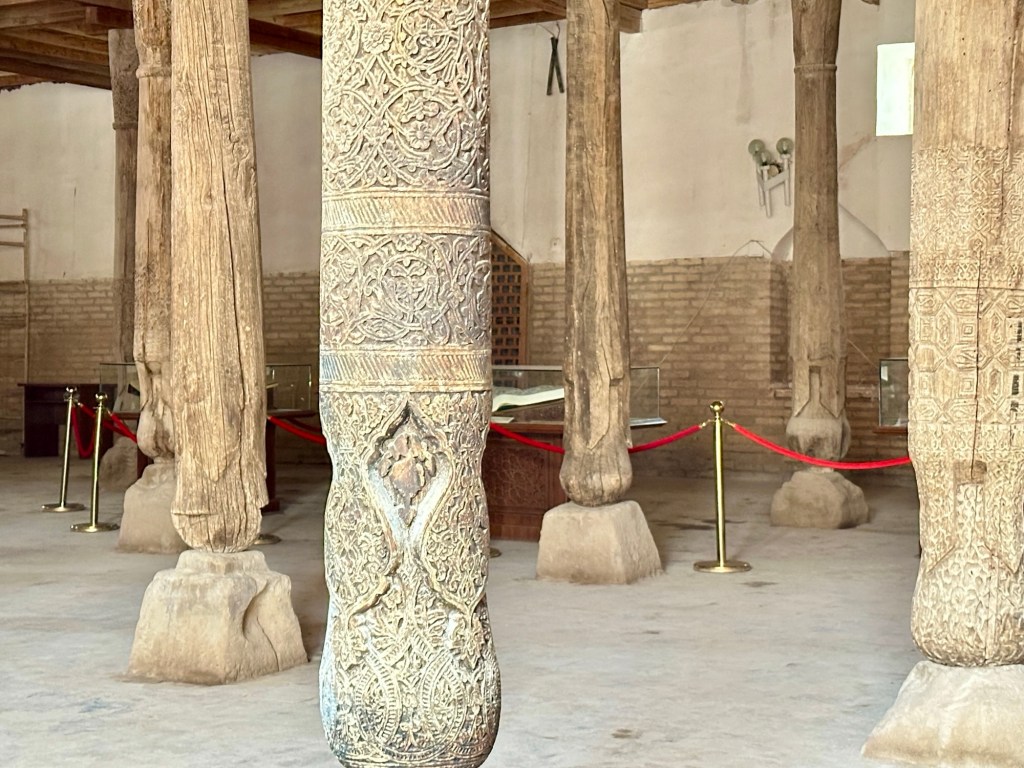
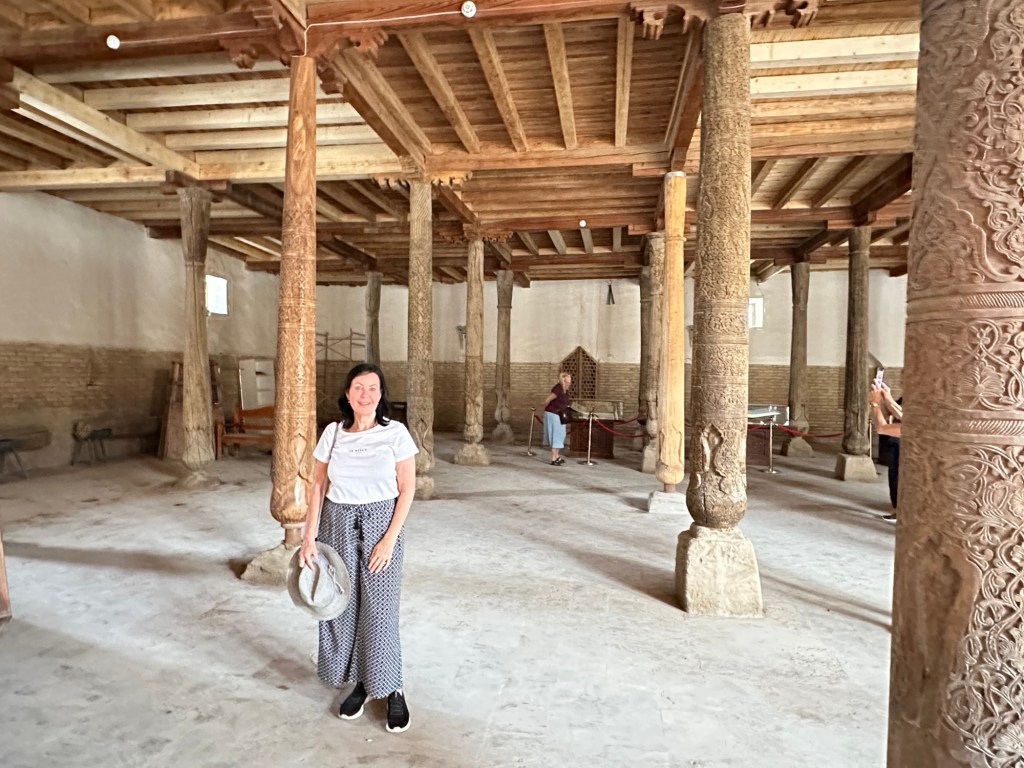
Juma Mosque, built 1788, supported by a dense forest of 213 wooden pillars that are cleverly arranged to allow the entire congregation a view of the mihrab (niche pointing the direction to Mecca).
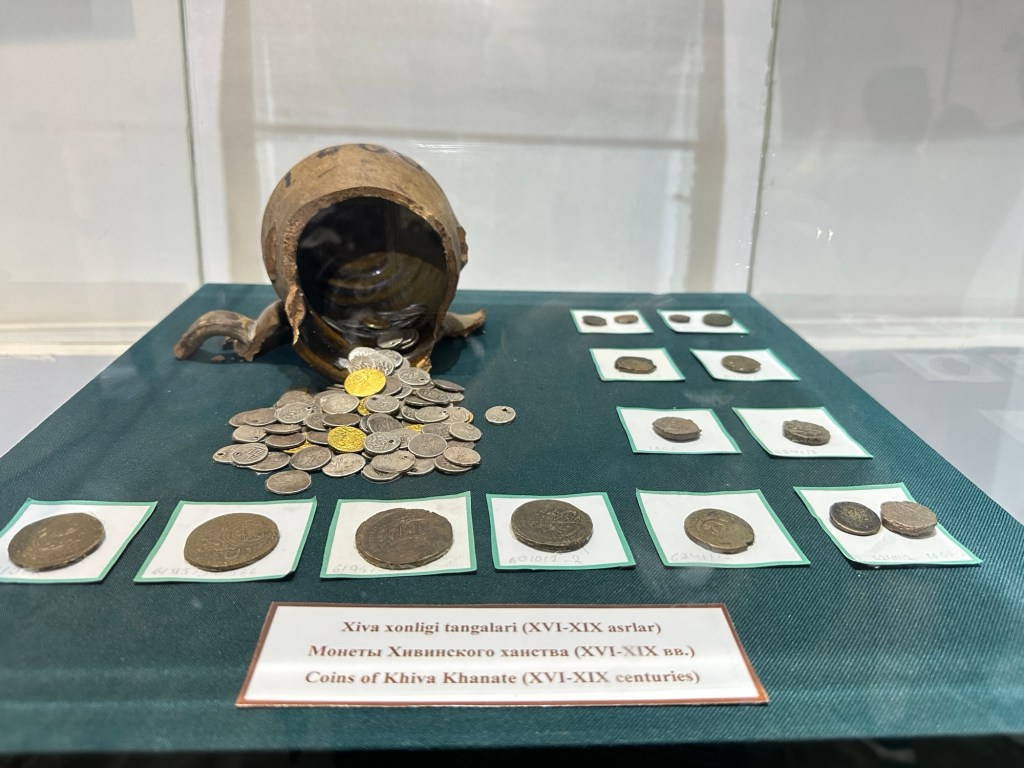
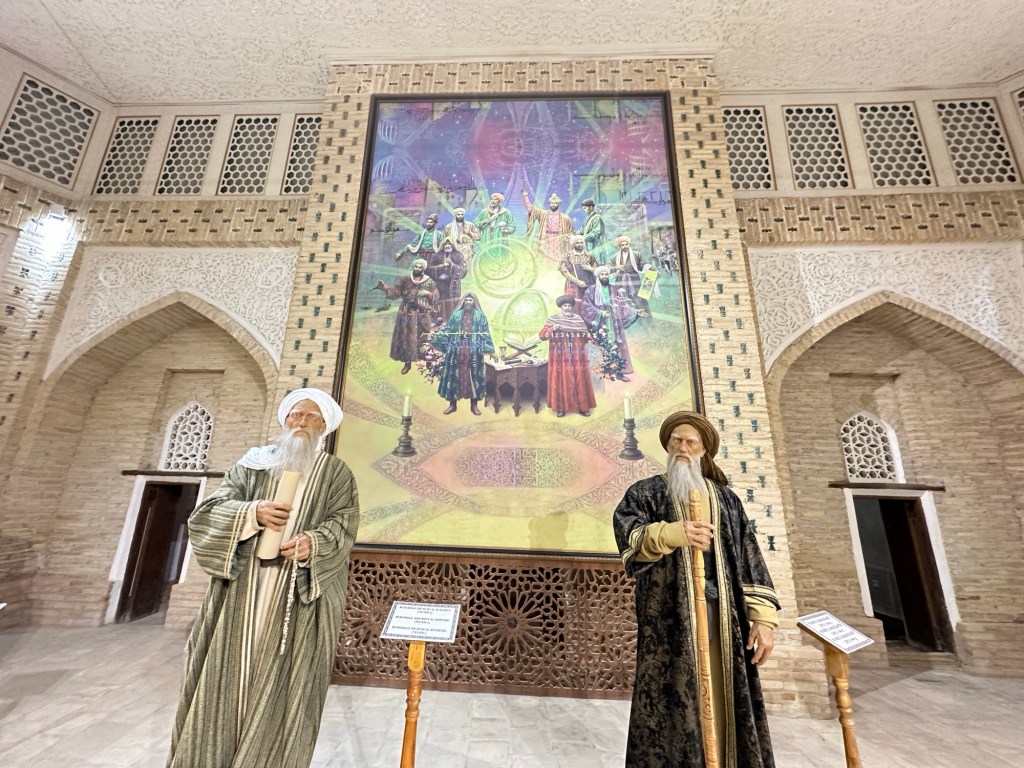
In a museum inside the Kunya-Ark citadel, exhibits explained how concepts like algebra and algorithm have roots in this part of the world, and particularly in the work of Khiva-born mathematician Muhammad ibn Musa al-Khwarizmi.
The 19th century Tash Hauli Palace , home to the court of Allah Kuli Khan had more stunning blue tiles. A secret corridor connects the fabulously decorated inner harem to the reception courts and law courts. The left side housed the Khan and his four wives, the right side housed his 40 concubines and their children.
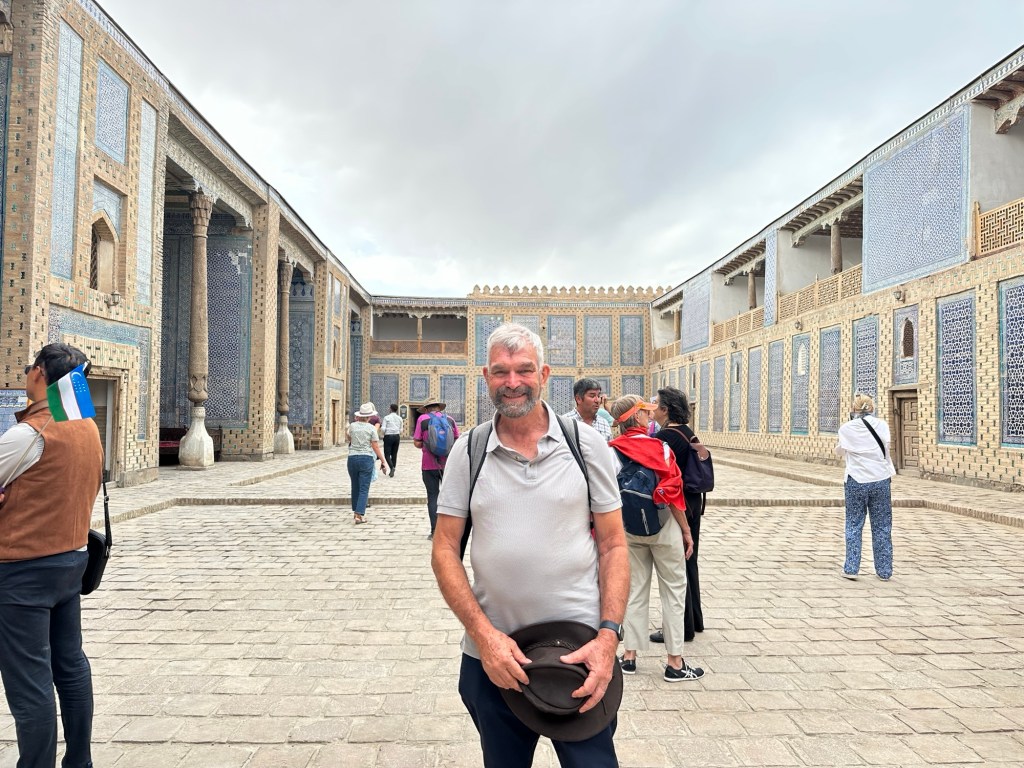
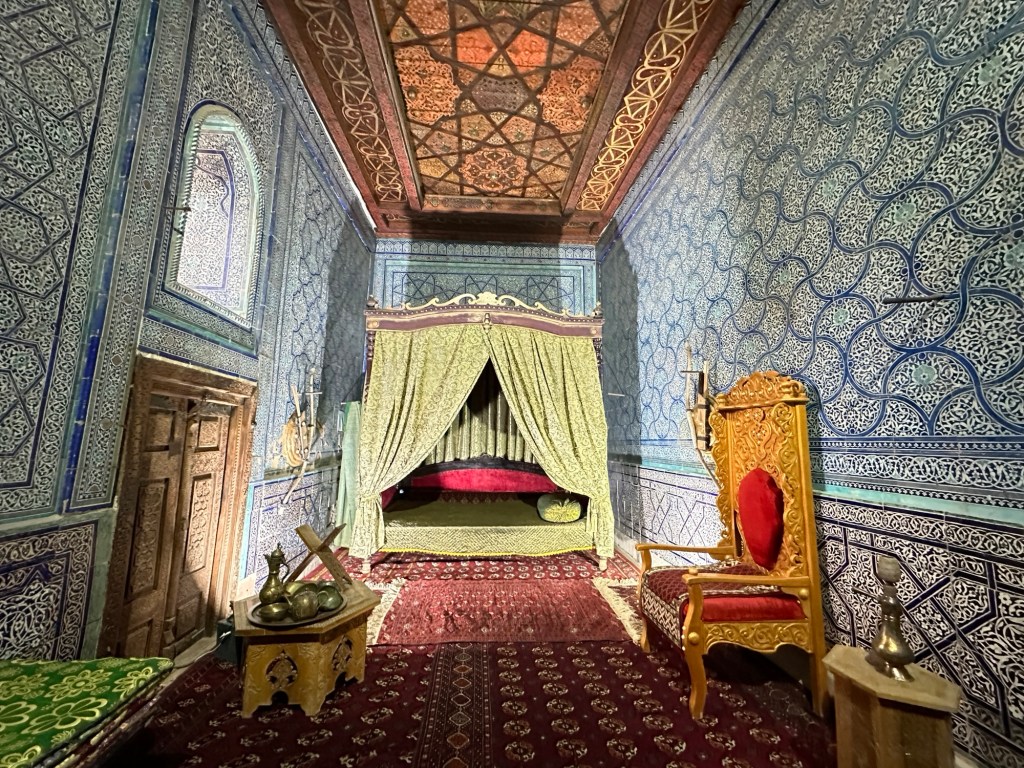
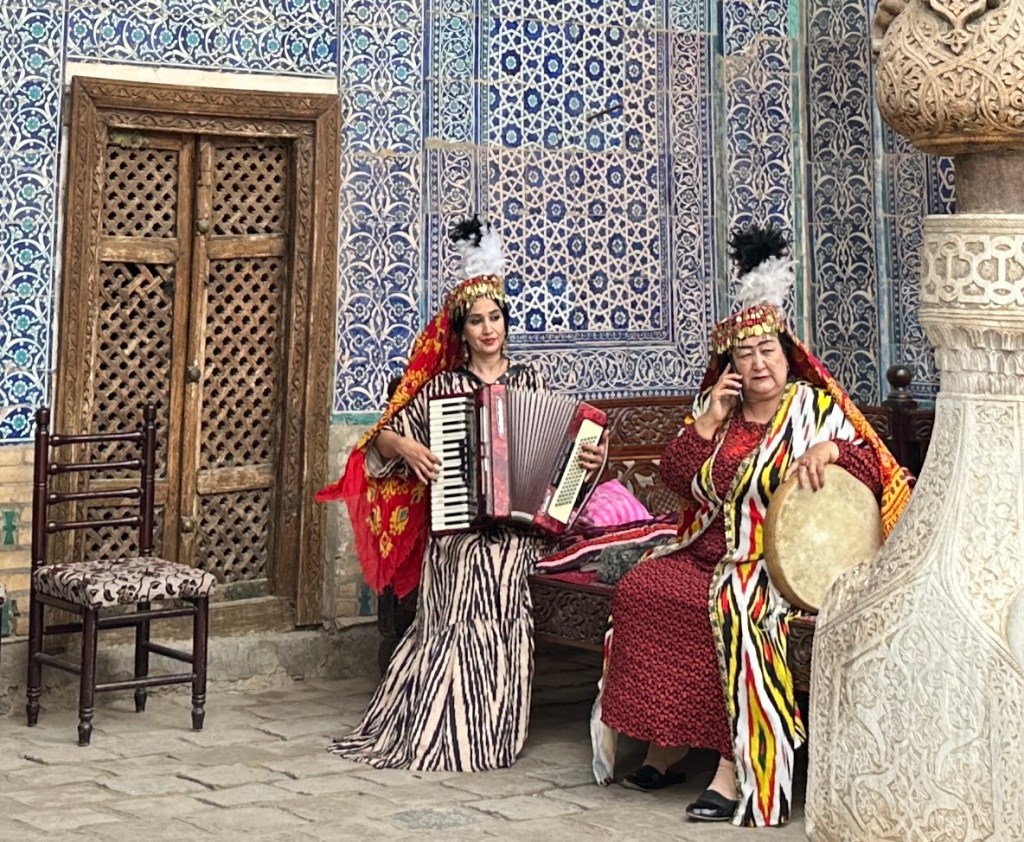
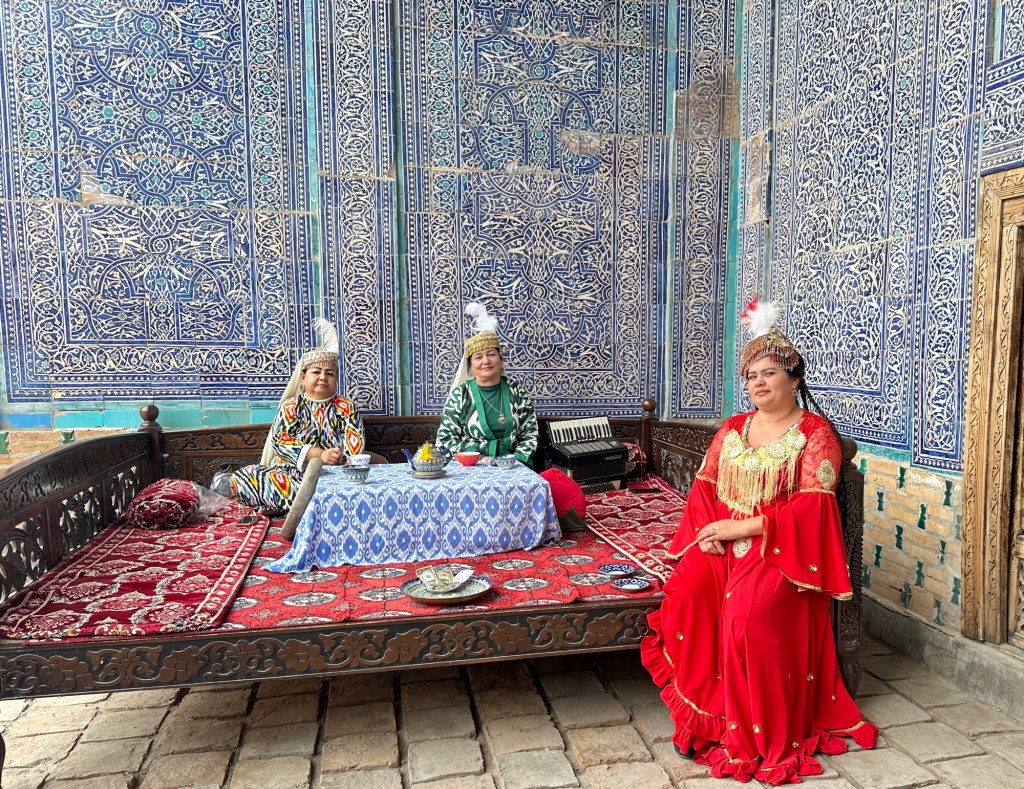
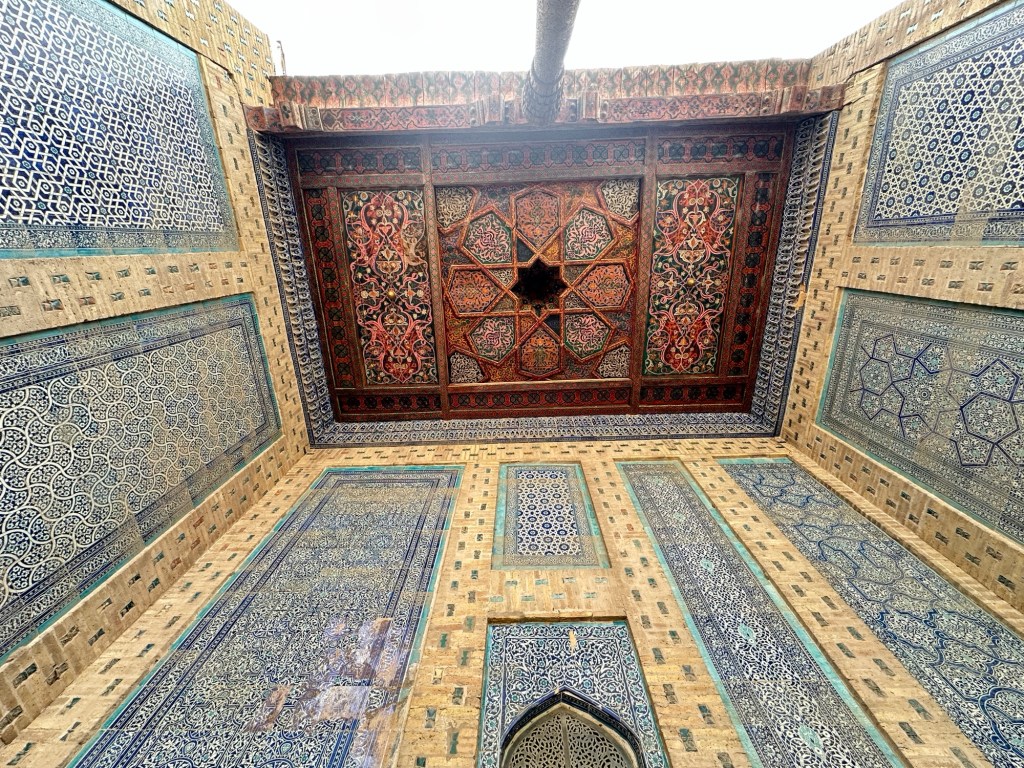
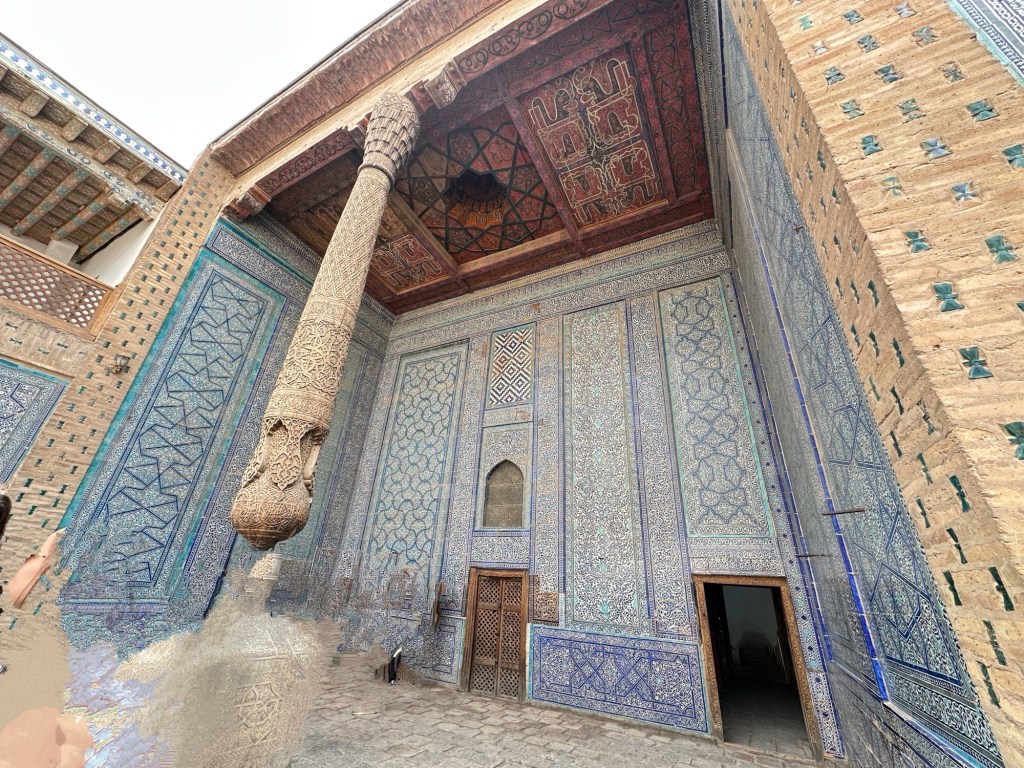
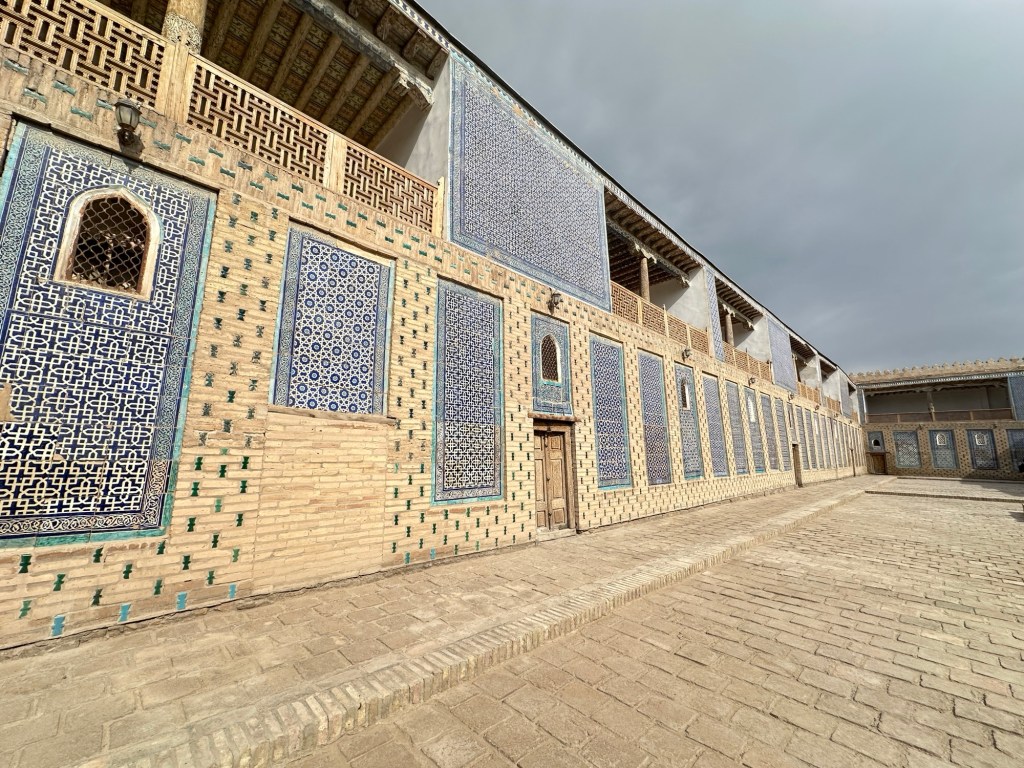
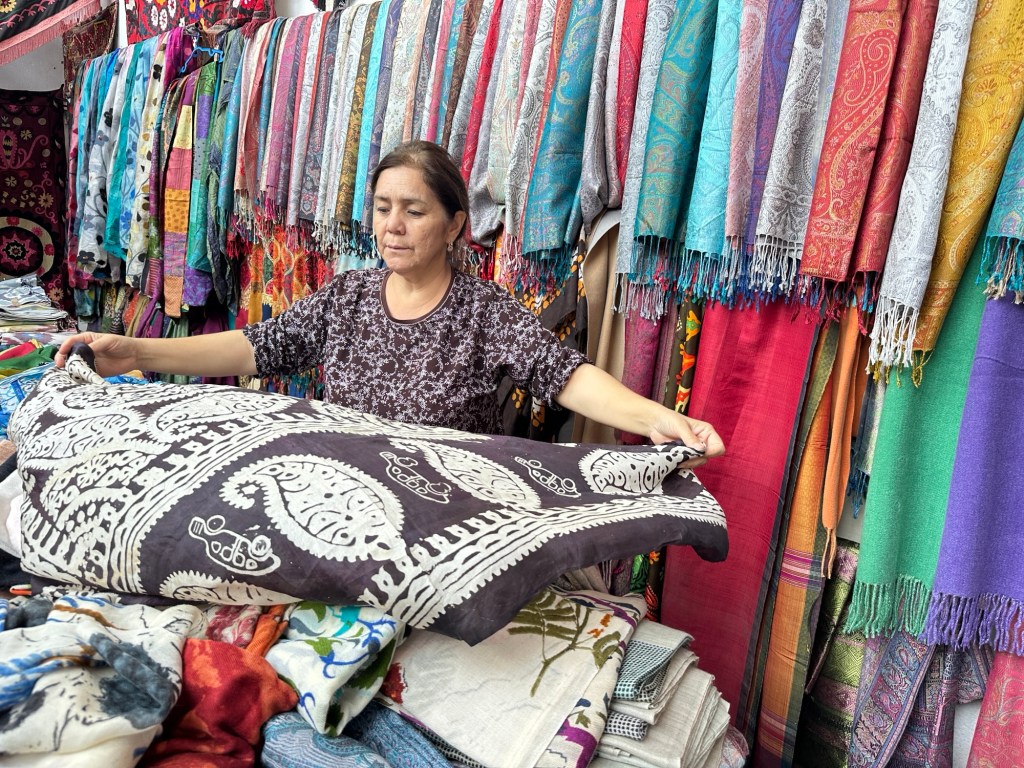
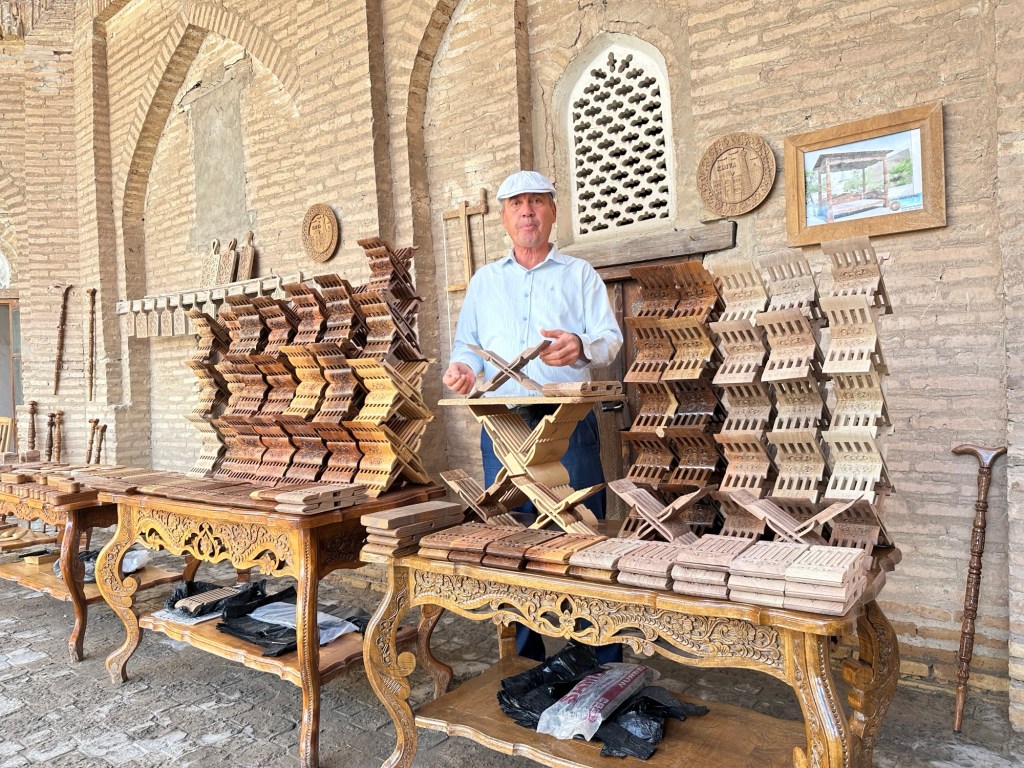
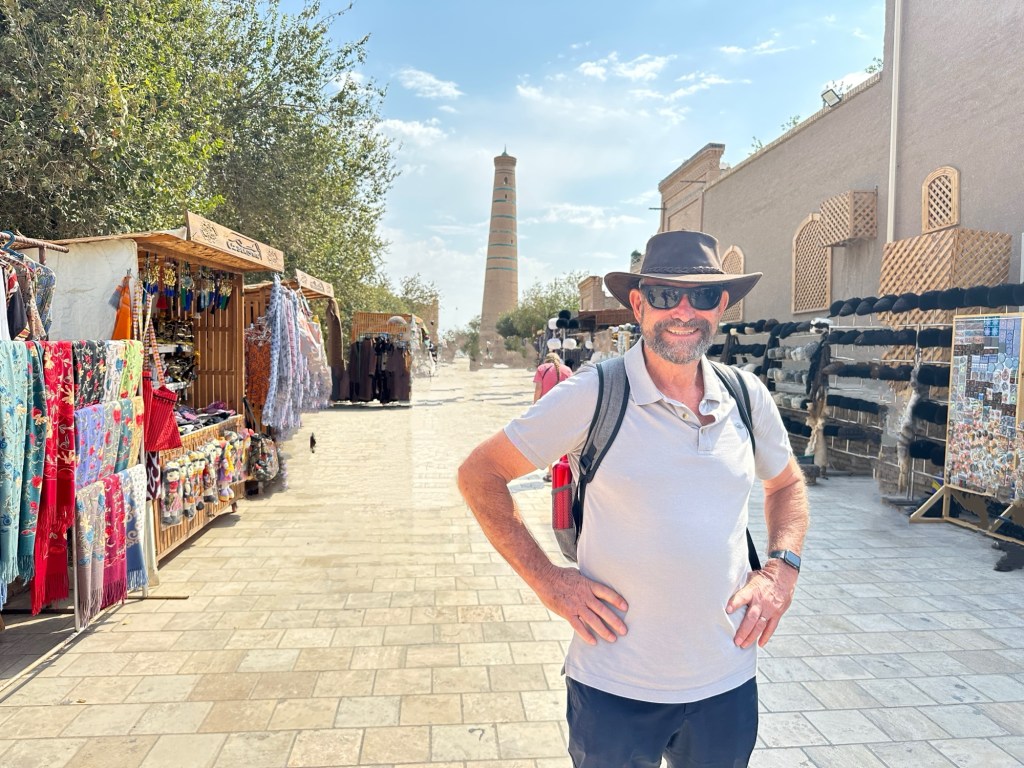
Another former madrassa, most likely built with the sweat of Persian slaves, had been repurposed into craft workshops – wood carvers, carpet weavers, textile producers, and souvenir markets. There were many stalls with merchandise for sale, and all at very reasonable prices. I didn’t know where to look! I felt a little like Alice in Wonderland, wandering through the labyrinth of tiny lanes that suddenly open into wide squares, and coming across craftsmen and traders selling their wares. I must say, whenever I stopped to look, admire or just take photos, there was no irritation among the vendors; there was no hard-sell, no aggression. It had been a fascinating day – with information overload.
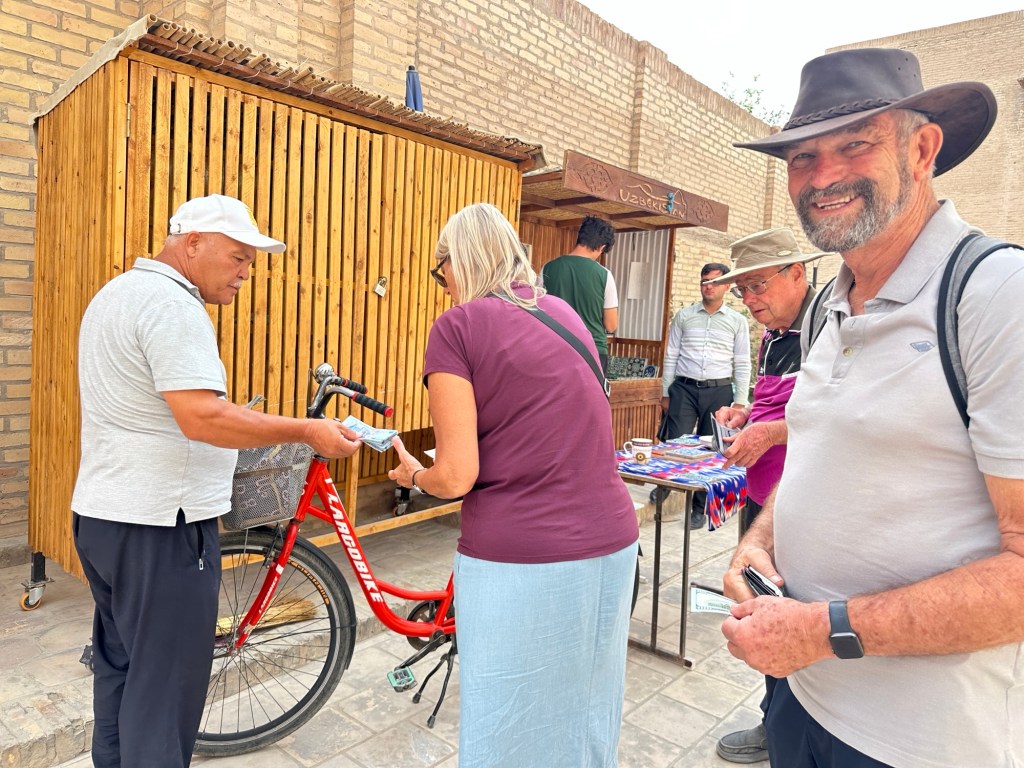
One amusing incident, our guide had organised his friend to come to us to change some money. The gentleman arrived on his bicycle, stopped, took out his bag of money, and our deals were made. As simple as that. Mobile banking on a different level!
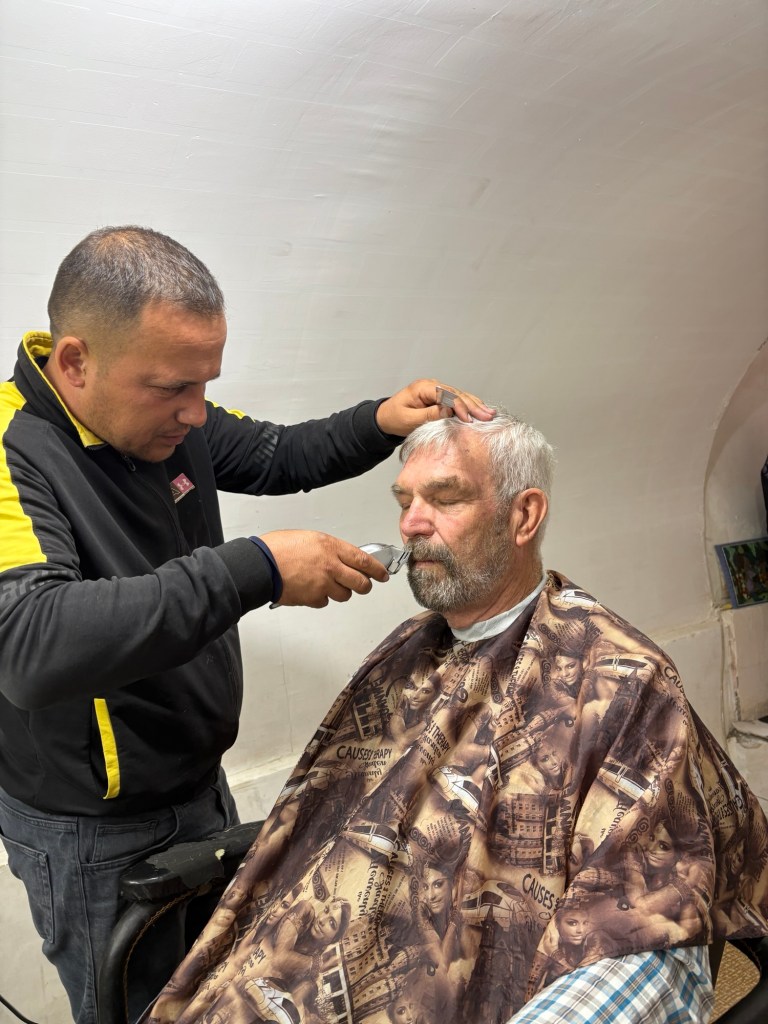
A short break back out the hotel to refresh ourselves, then back to the citadel for some serious shopping. I managed to buy a dress, jacket and scarf made of silk with camel hair felted on it, whilst Frank found a traditional man’s hat, and also had a beard trim at the barber’s which he was very chuffed with.
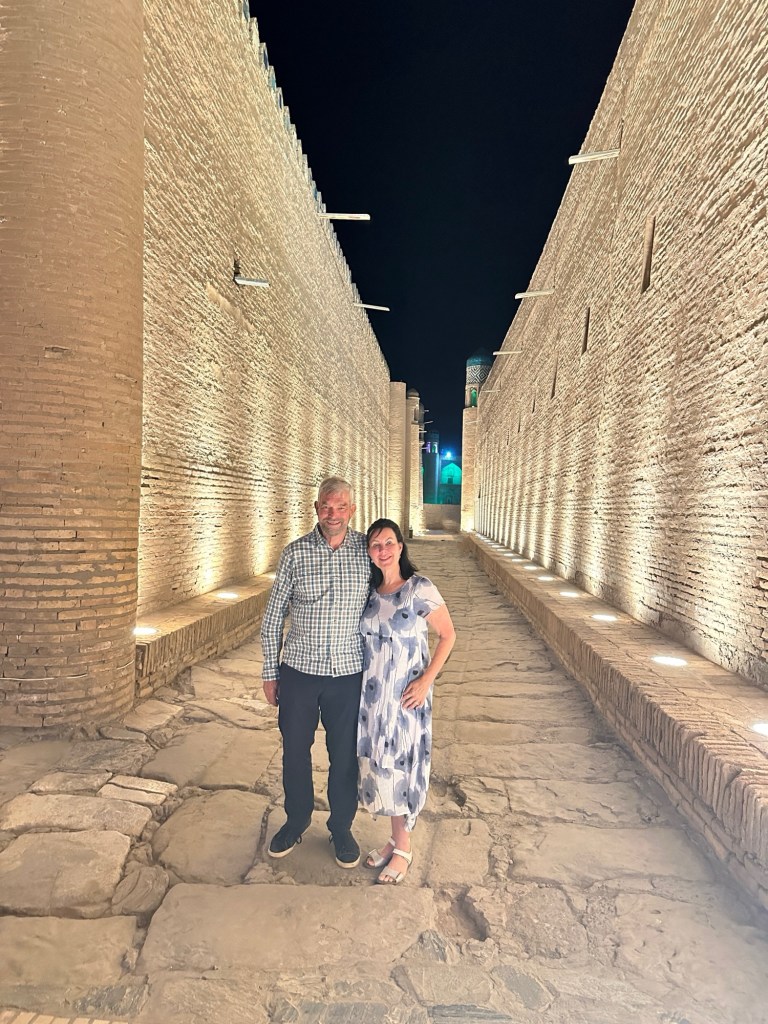
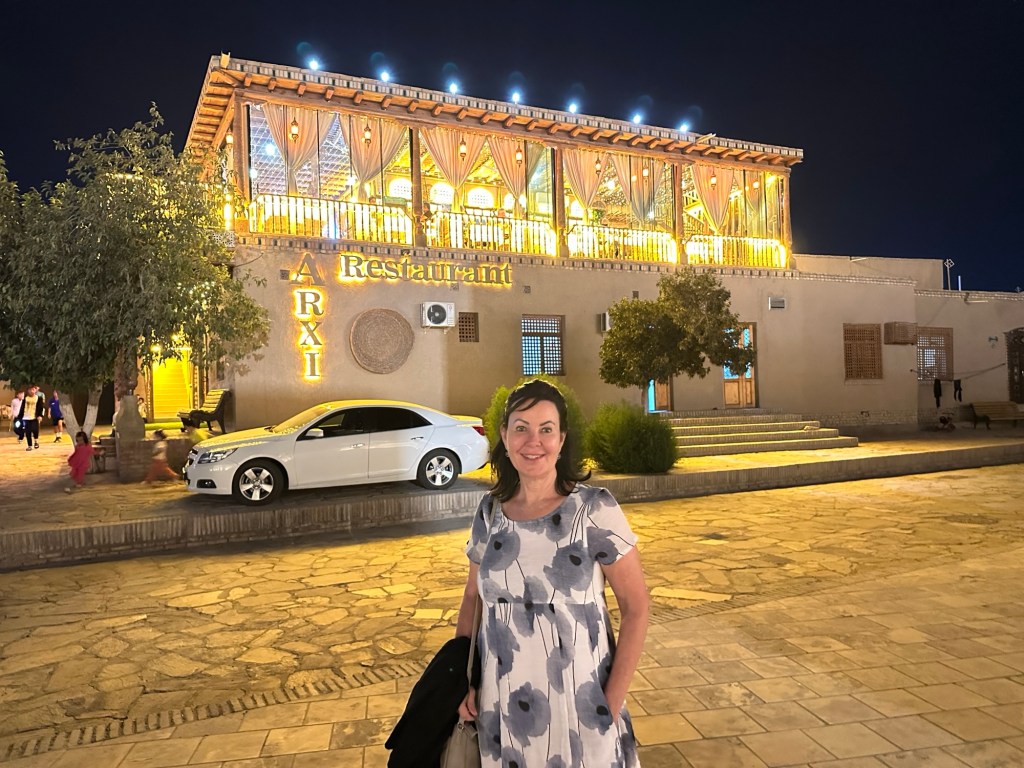
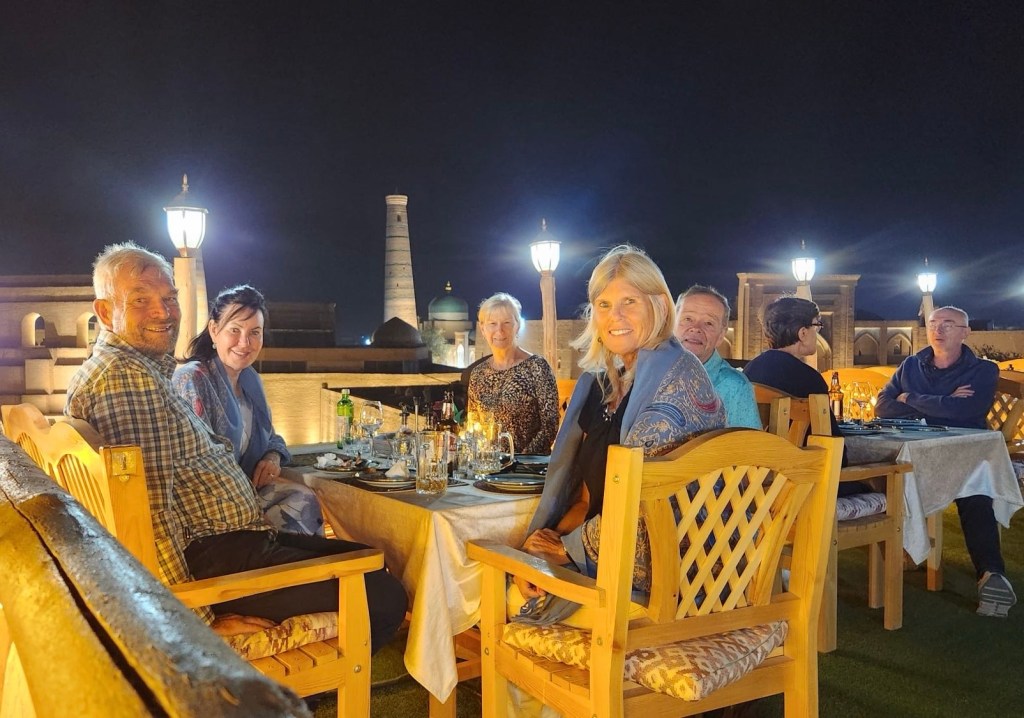
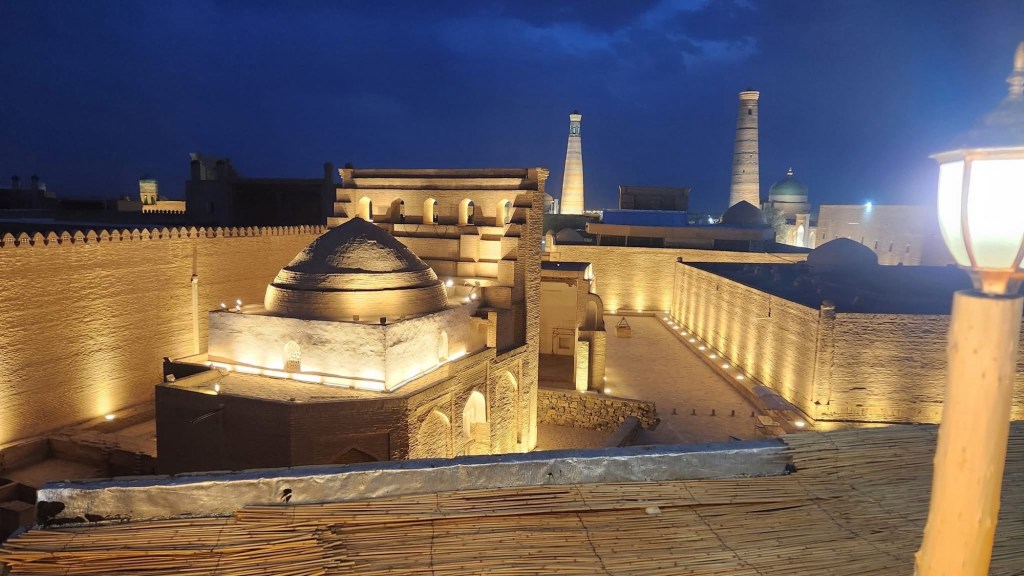
Dinner on the rooftop of the Axri Restaurant at sunset was a fitting finish to the day. As the sun set, the city walls unveiled a final gift – a panoramic view of the ancient skyline, bathed in a golden hue. It was beautiful.
Day 11
Sunday 21st September
Khiva to Bukhara
17-28 degrees, sunny
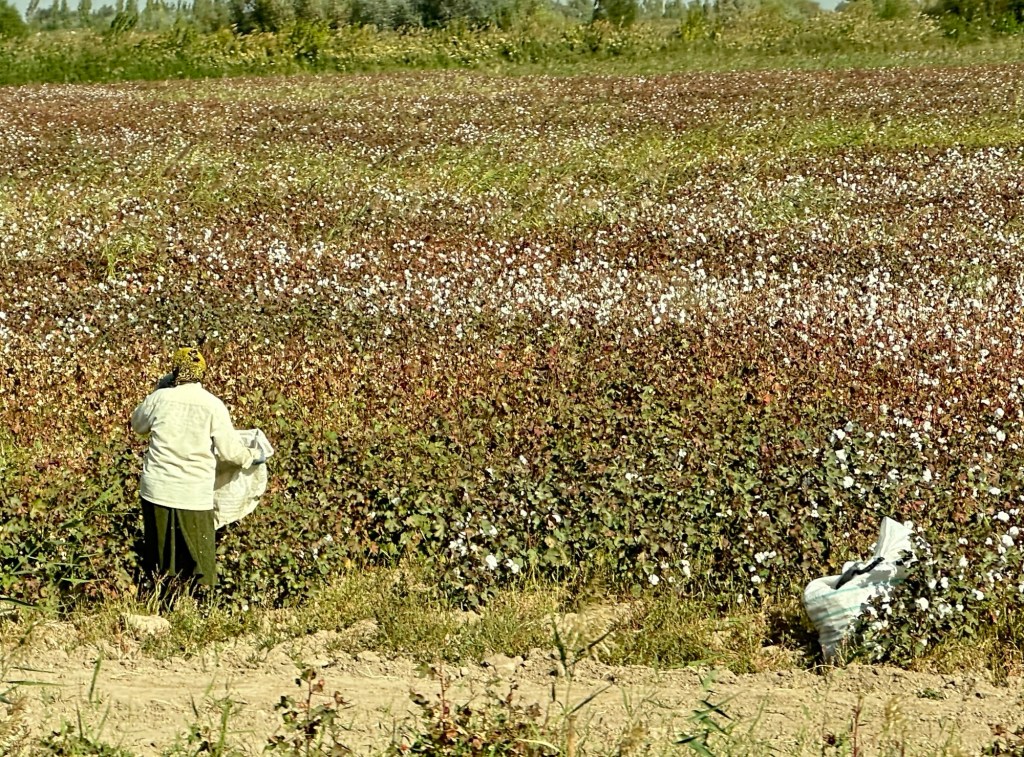
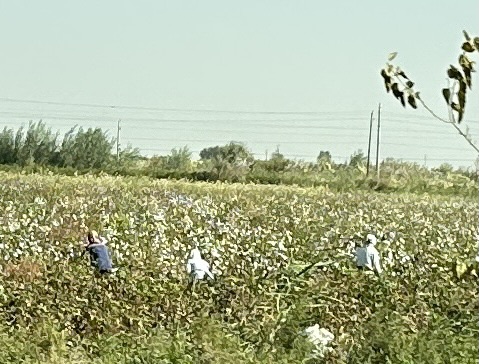
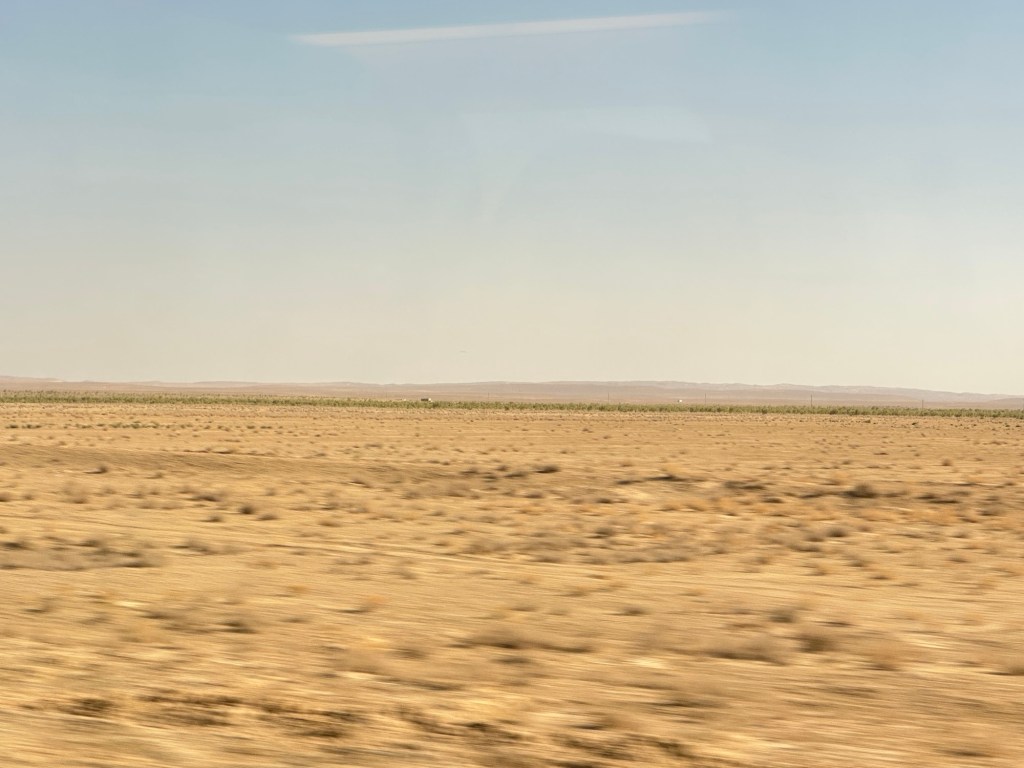
Travel day today – a 460 kms long drive through the Kyzylkum desert. We had villages and farmlands up until we crossed the Amu Darya River, then the nothingness of the very arid desert, more villages and farmlands as we got closer to Bukhara. We had a lunch stop at a restaurant, with all the other bus groups, in the middle of the desert – the most efficiently run food service I’ve ever seen! Toilets however, not as efficient… or clean!

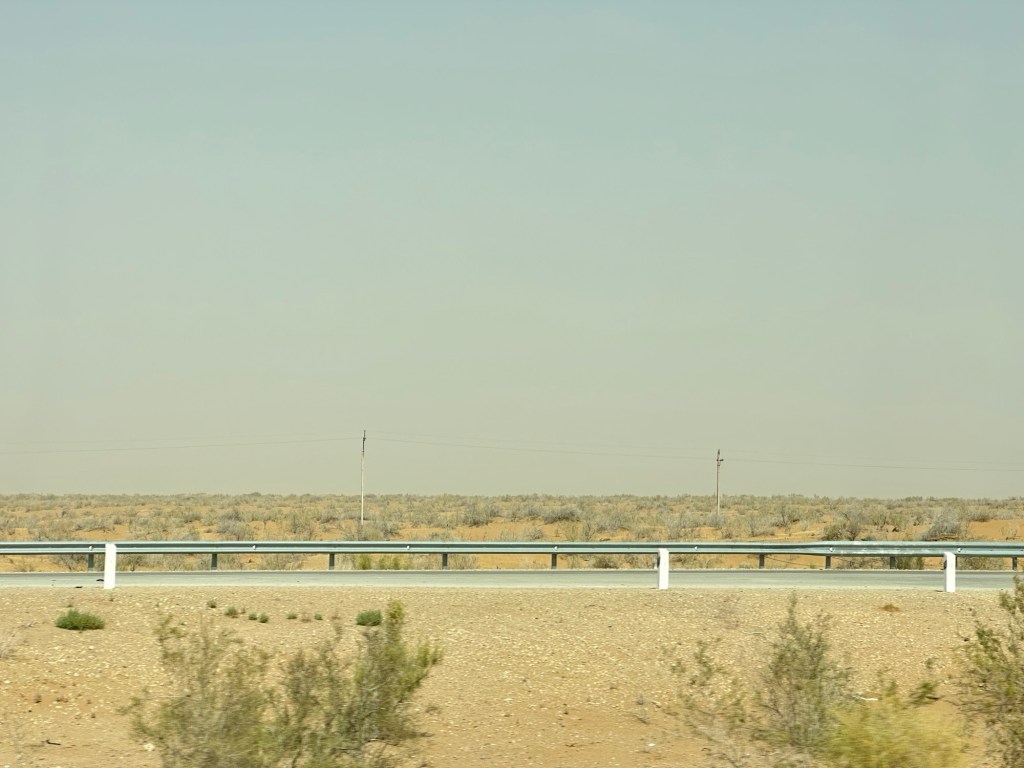
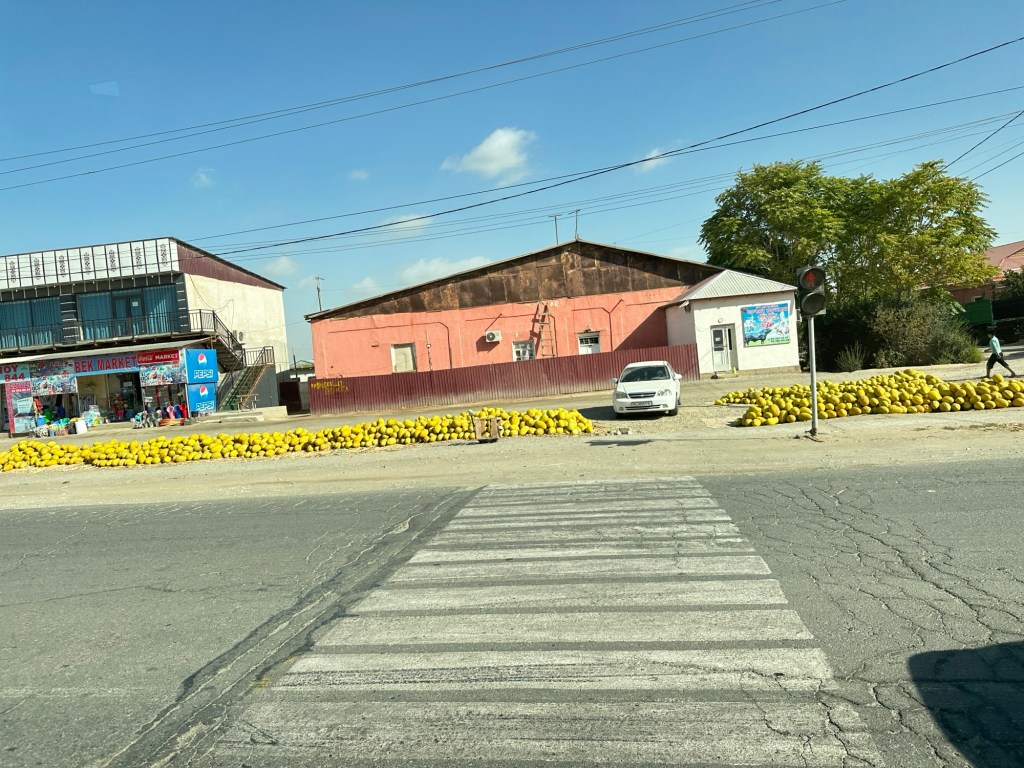
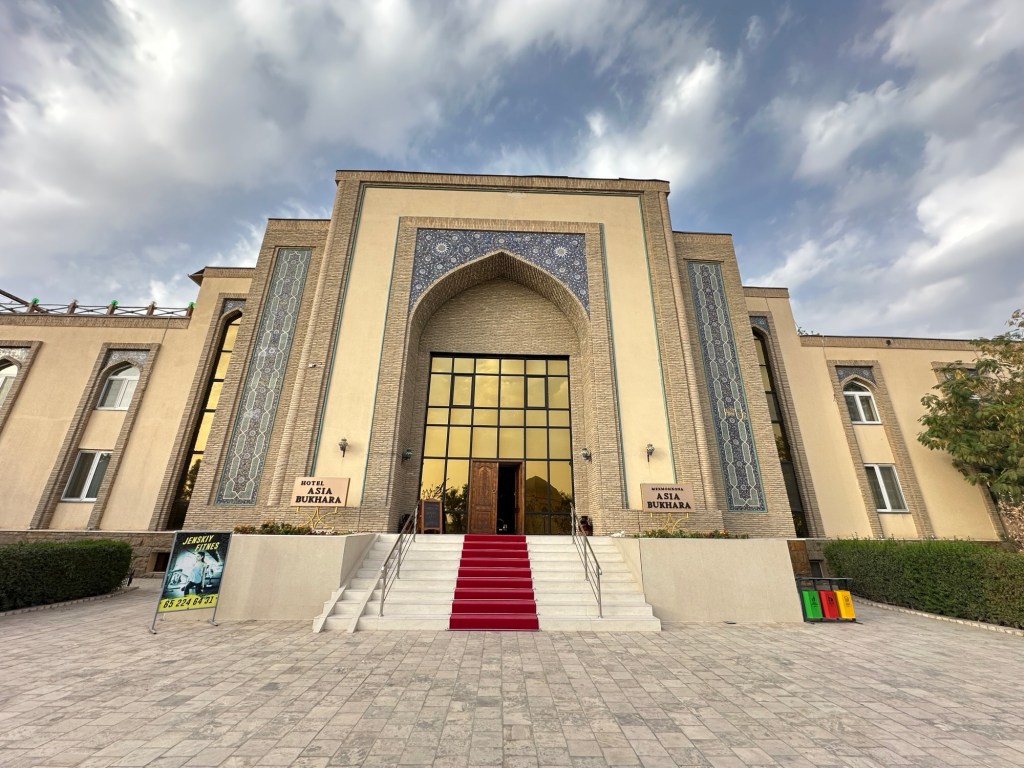
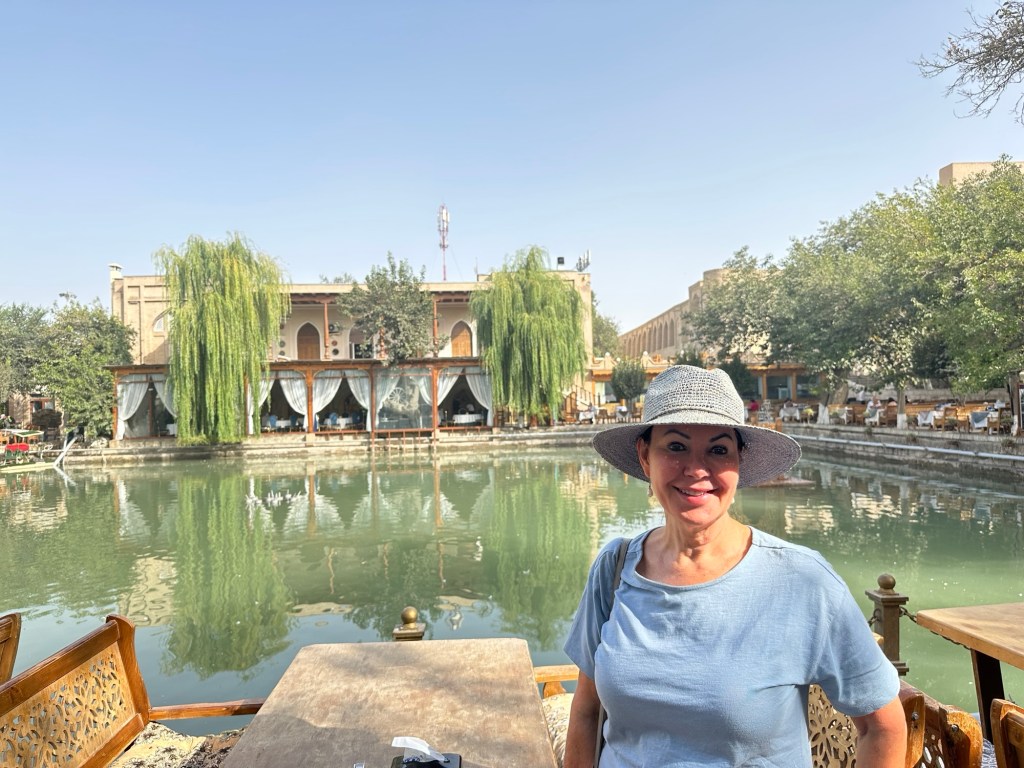
Arriving at the four star Asia Hotel in Bukhara just before 4pm gave us enough time to walk around the Lyab-i-Hauz district of the town before dinner. We then ventured out for dinner at a local restaurant overlooking one of Bukhara’s ponds which dates back to 1620. This is one of about 200 ponds that used to supply the city with drinking water (as well as many of its infectious diseases). Only a few remain. The traditional architecture and ancient mulberry trees provide a lovely shady area to sit and eat.
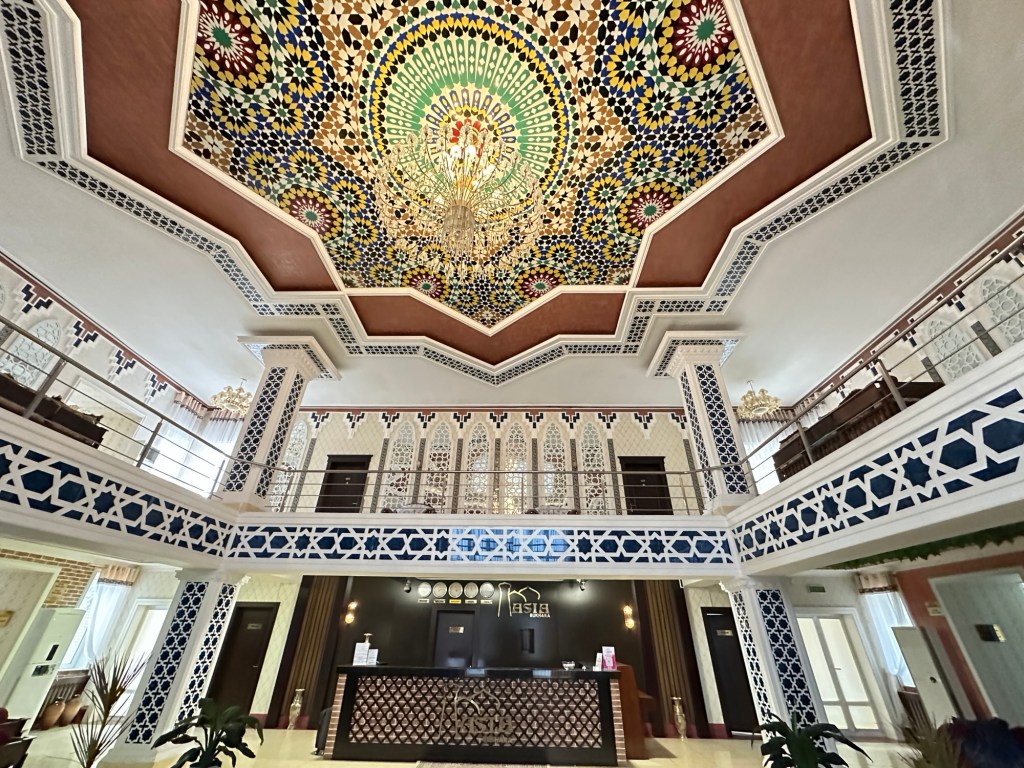
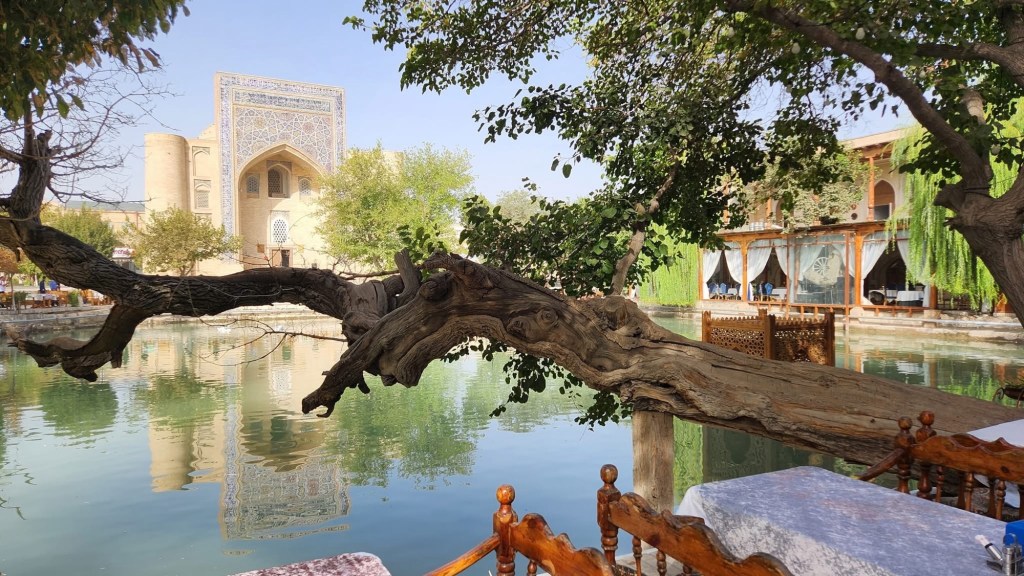
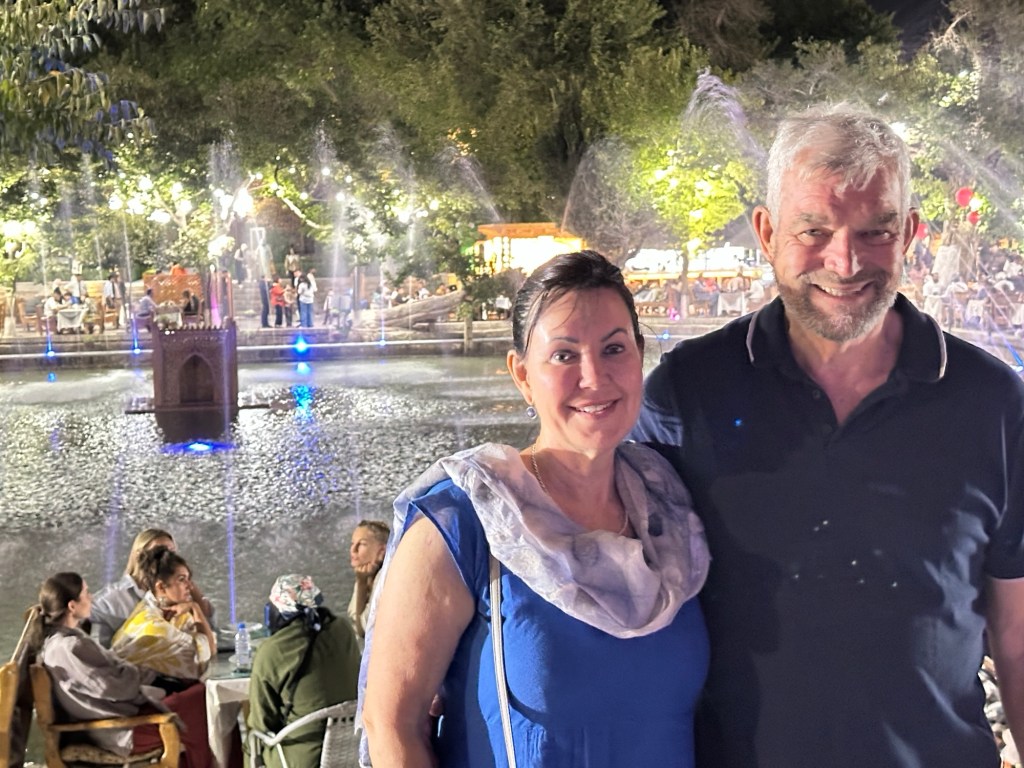
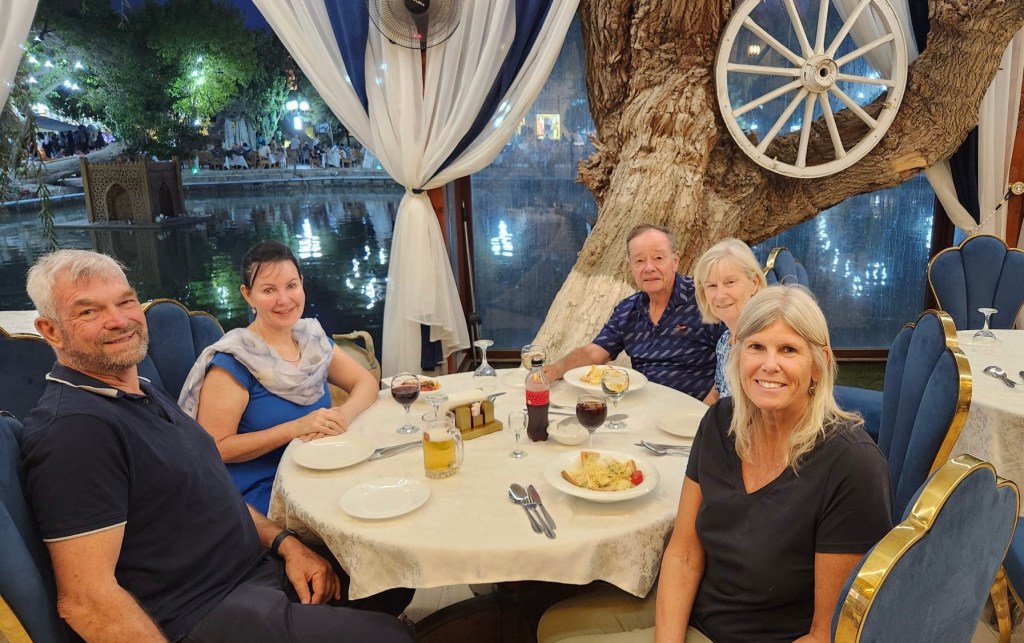
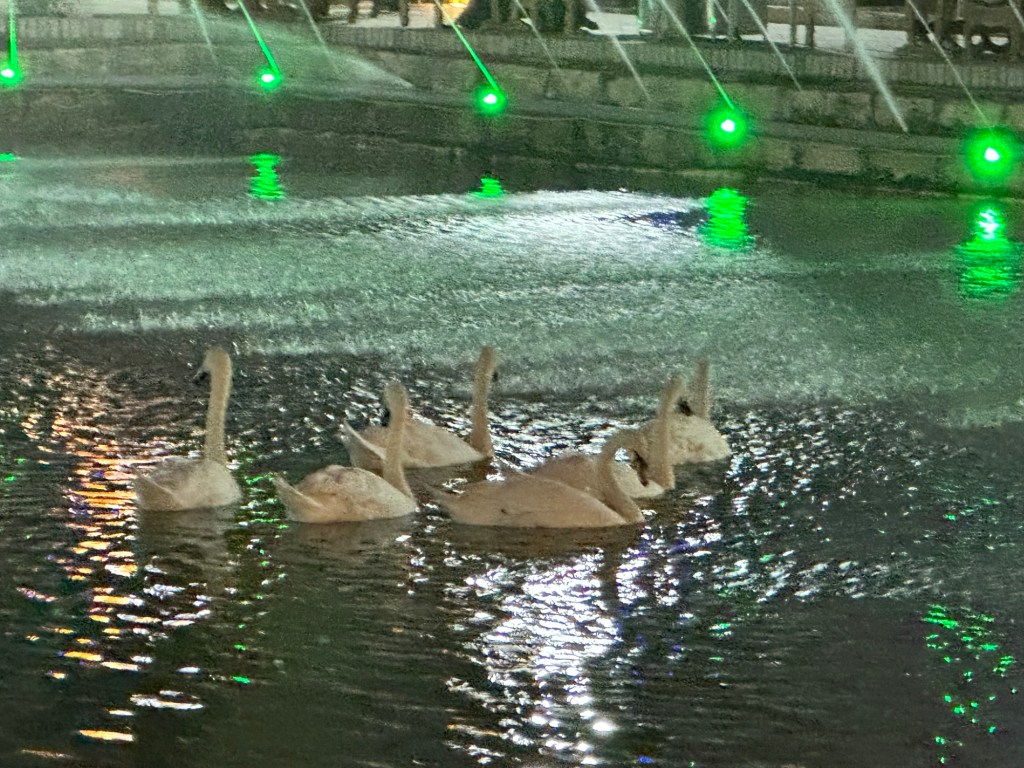
The city centre was a hive of activity. Food is very cheap in Uzbekistan- tonight our bill for five people, which included a main meal and a drink each, was $75 AUD.
Still early, Frank and I wandered further afield, eventually finding a little streetside bar where we could enjoy a drink and do some people watching – it was lovely to watch the families stroll along the street, the children enjoying ice creams and the coolness of the night air.
Day 12
Monday 22nd September
Bukhara
14-27 degrees, sunny
Bukhara, another ancient city, was a prominent stop on the Silk Road trade route between the East and the West. It was also a major medieval center for Islamic theology and culture. It still contains hundreds of well-preserved mosques, madrassas, bazaars and caravanserais, dating largely from the 9th to the 17th centuries. The city was largely destroyed by the Mongols in 1220, then again by the Soviets in the 1920s.
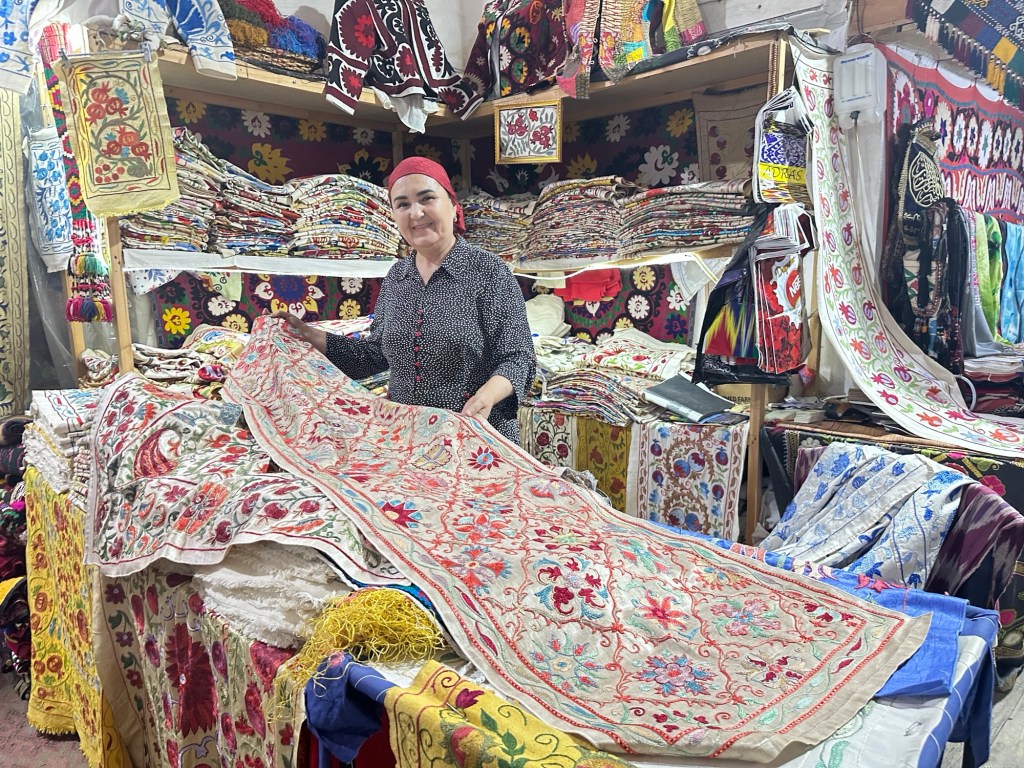
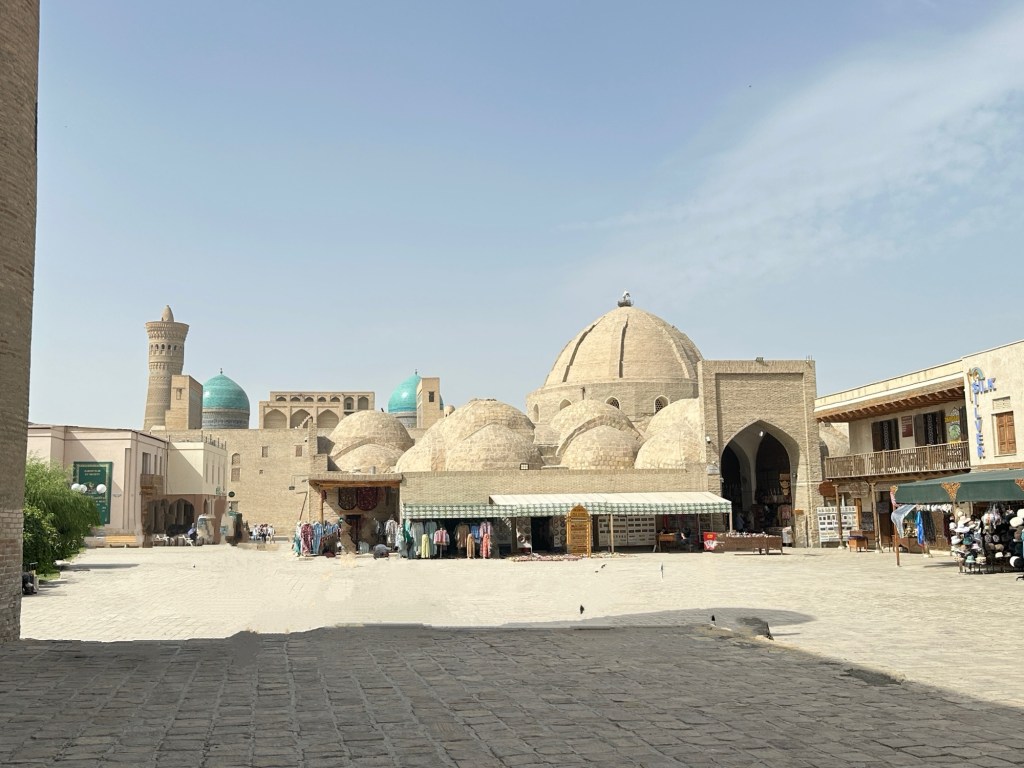
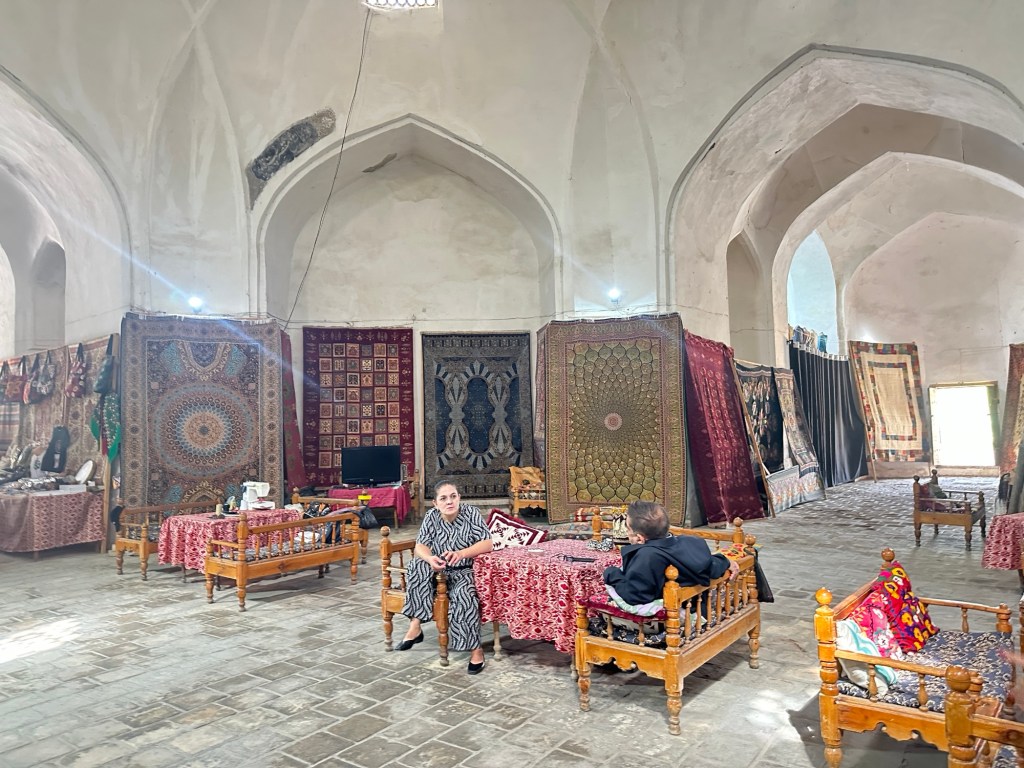
Today was a walking tour of Bukhara starting at one of the Trading Domes, originally a madrassa. We watched some of the many craftsmen at work. The cool, domed, covered bazaars seem to be everywhere selling crafts from silk garments, embroidered tablecloths, hand made knives and scissors, chess sets, art, carpets, jewellery…..you name it, it’s there!
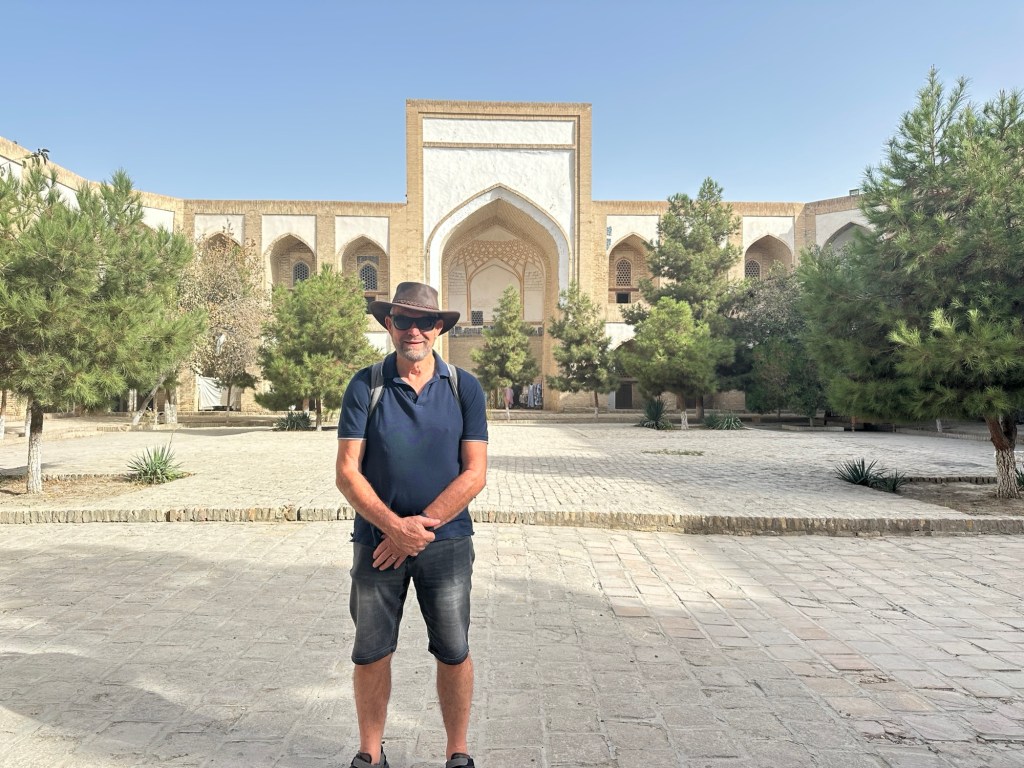
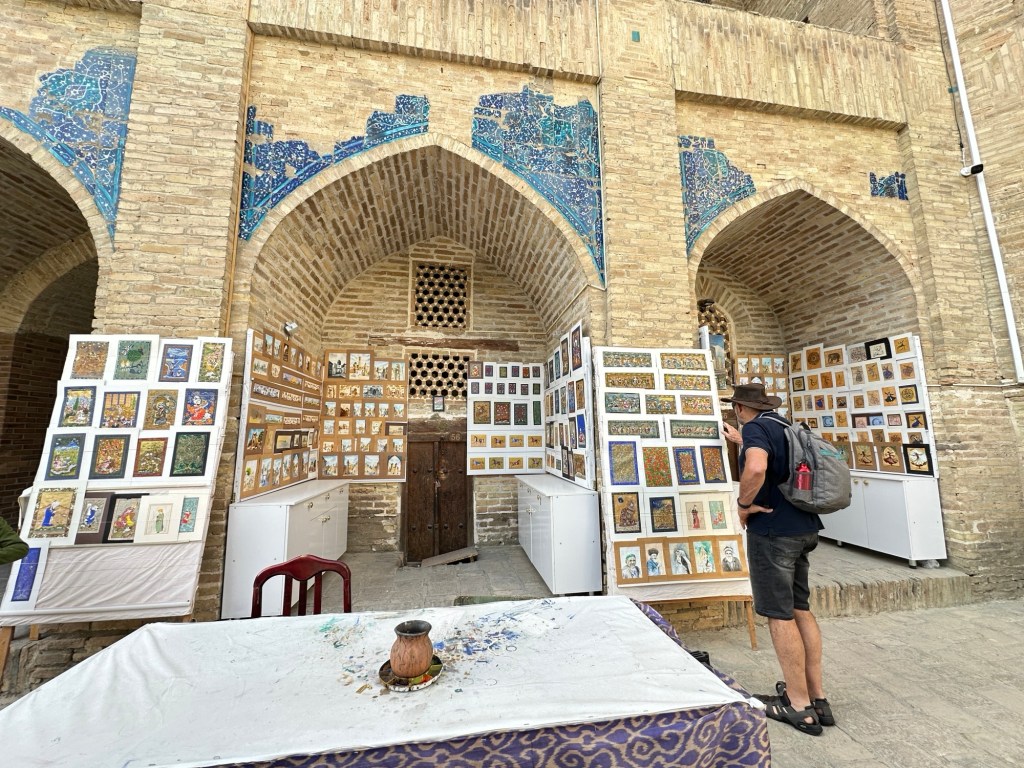
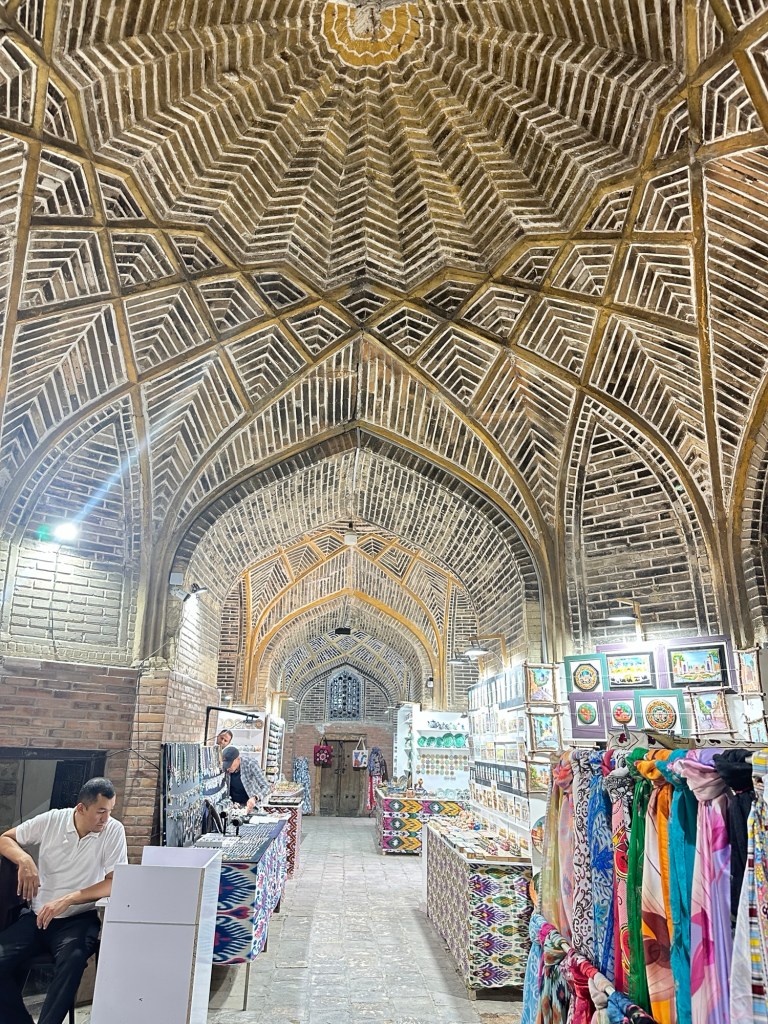
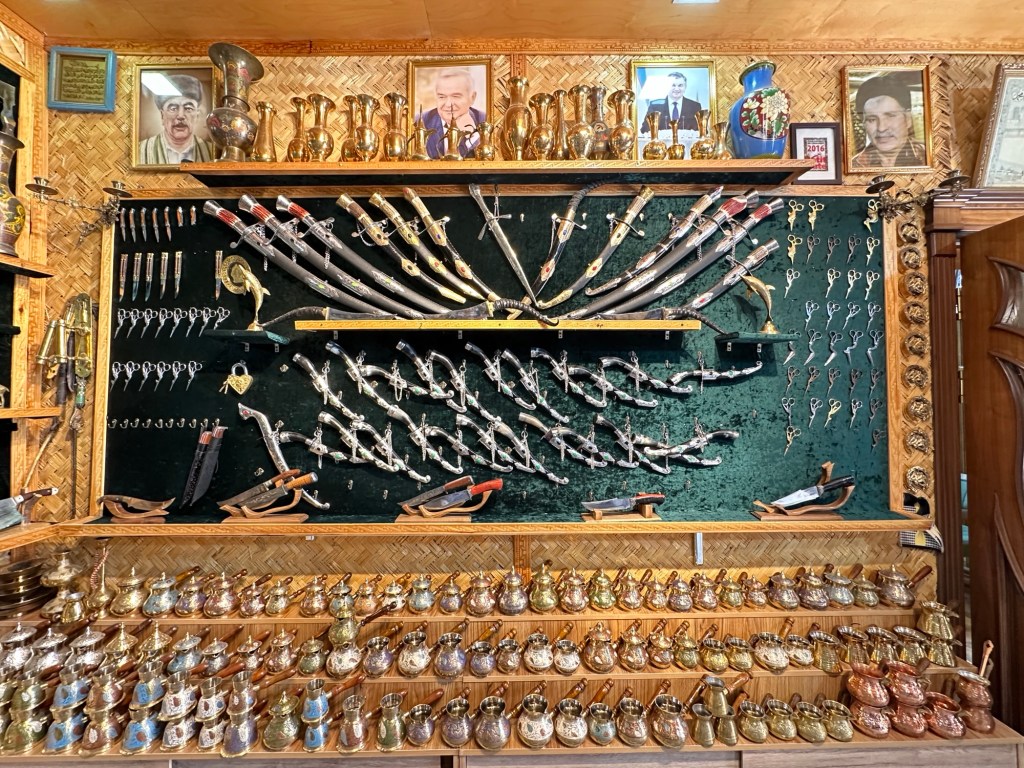
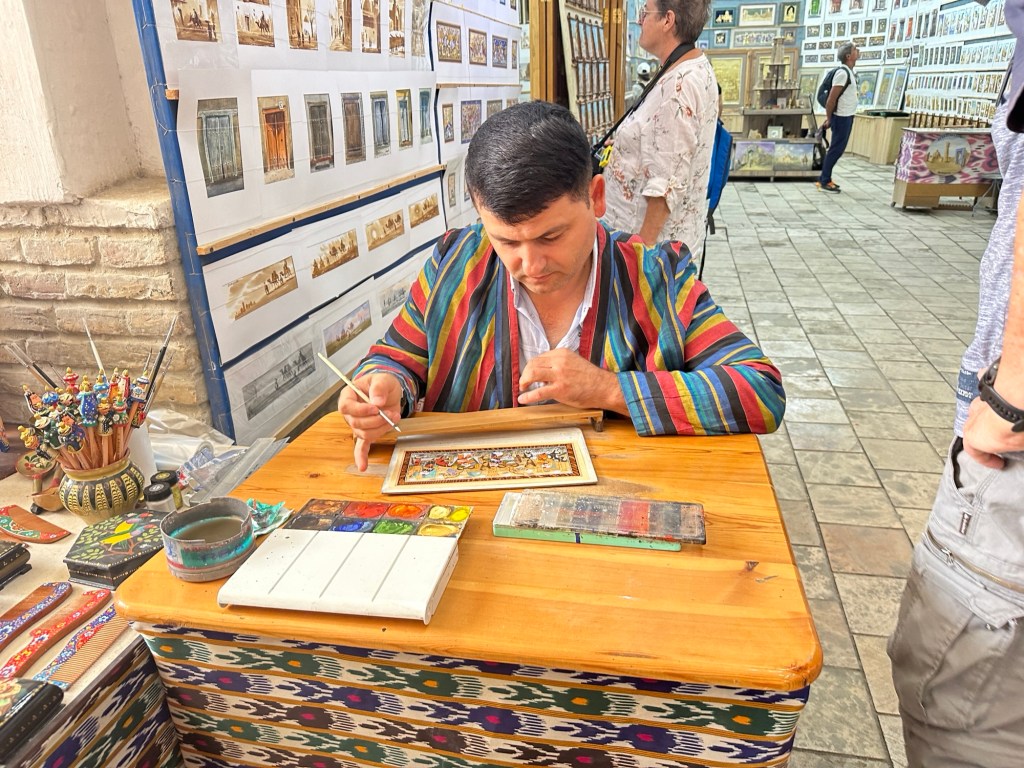
Onto Divanbegi Madrassa which was originally built as a caravanserai, nmlbut when the khan mistakenly inaugurated it as a Madrassa it had to be hastily converted (once the words were uttered, the edicts of the Khan could never be rescinded).
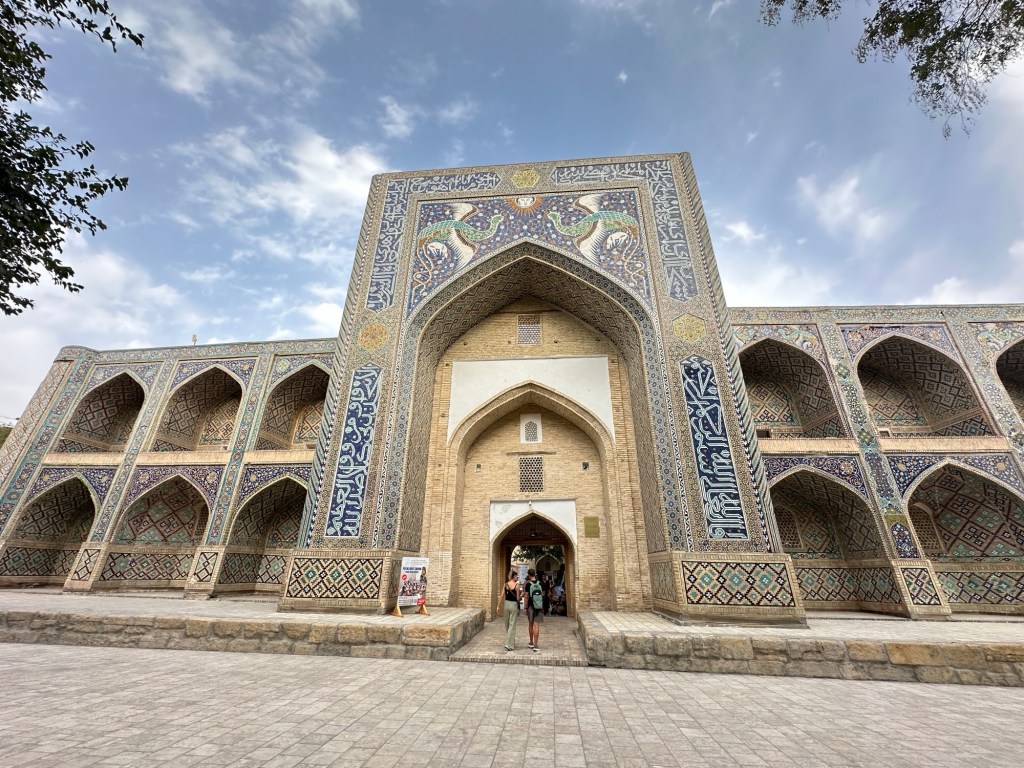
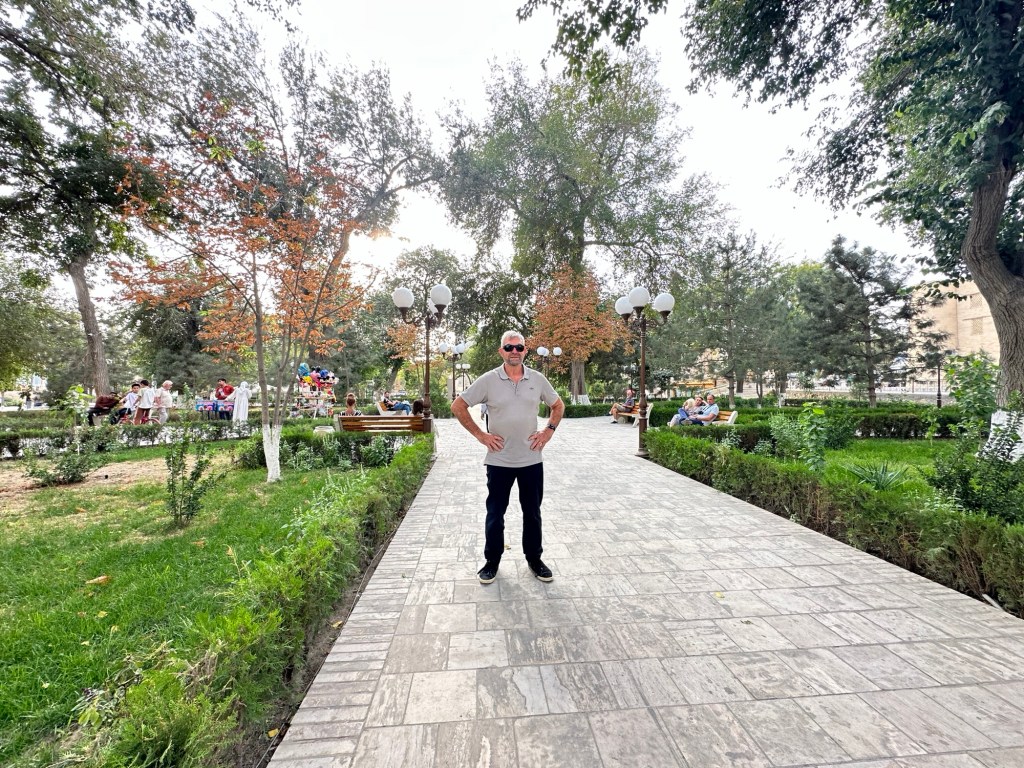
Nearby was Divanbegi Khanaka, a mosque and hostel for visiting Sufis.
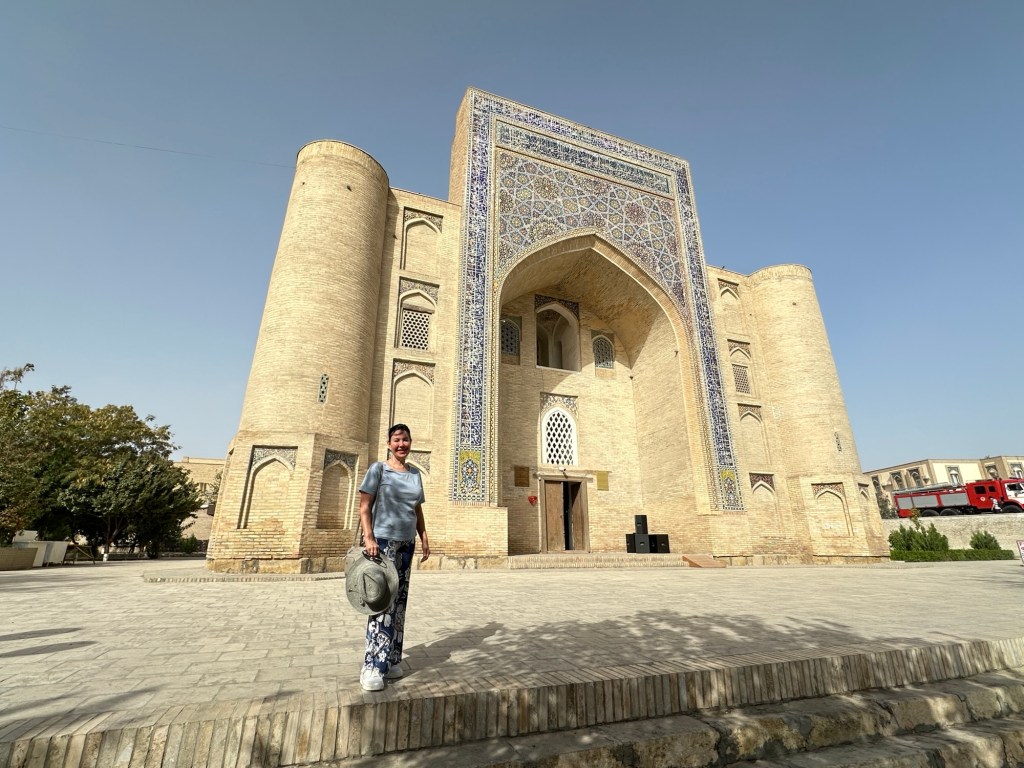
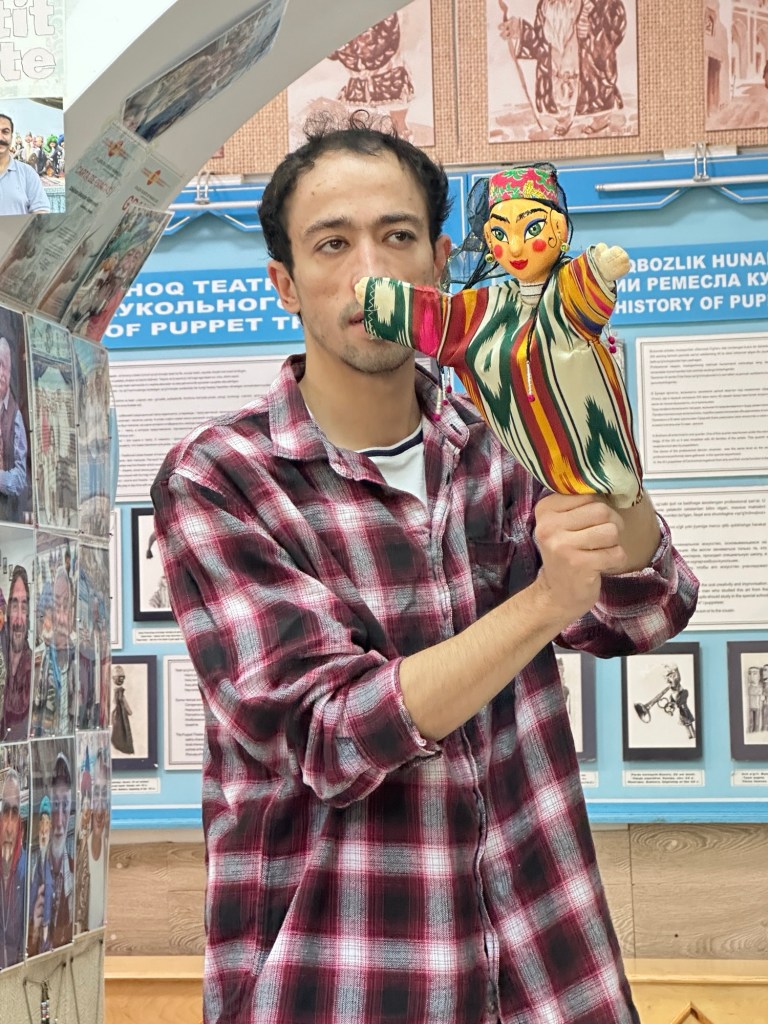
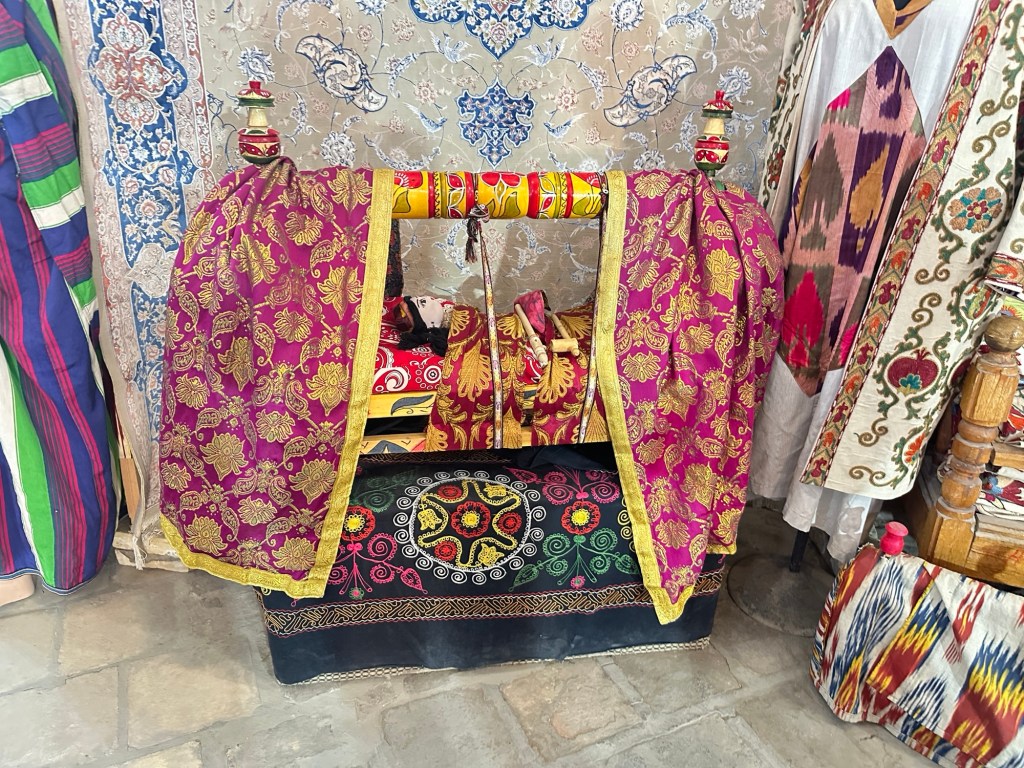
Time to stop at a puppet making workshop for demonstration on how the puppets are made. This is a third generation concern.
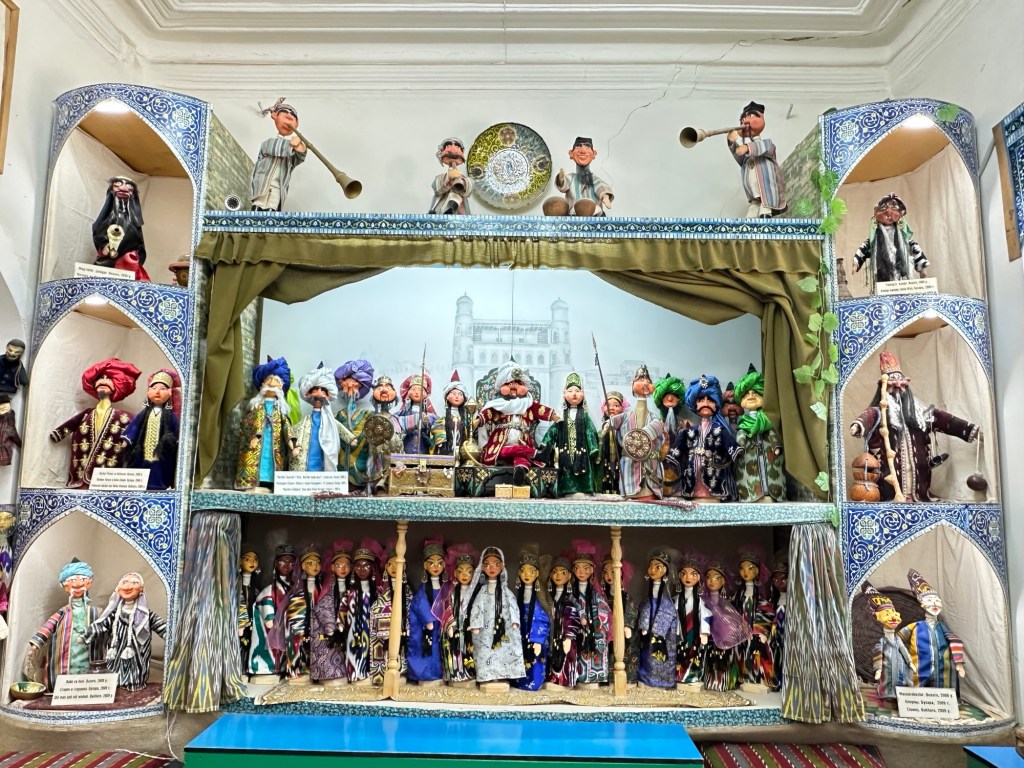
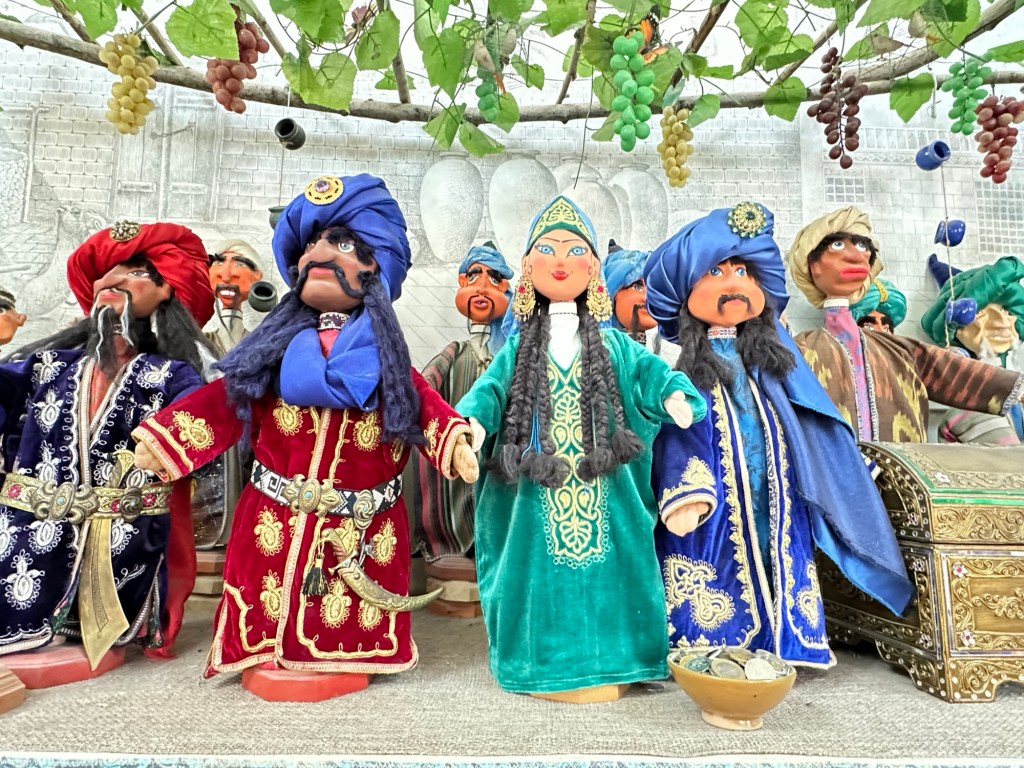
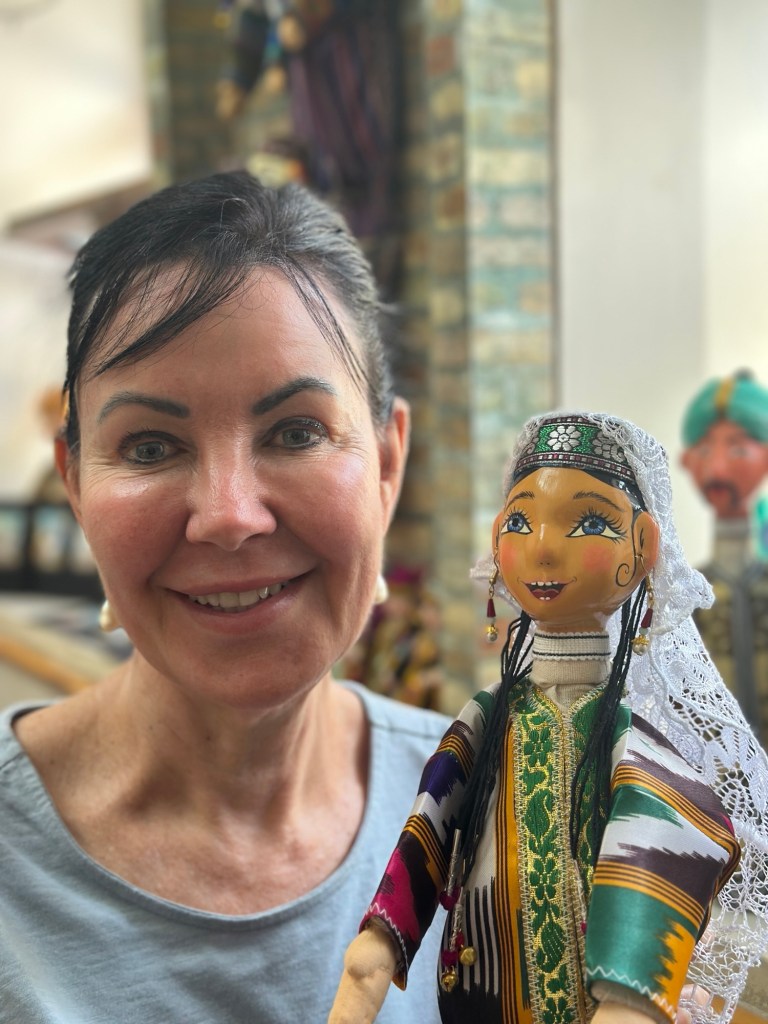
Next Magoki Atori mosque, a Zoroastrian temple was originally built on this site. It was later a mosque shared by Muslims and the sizeable Jewish population who had no synagogue. Now, a carpet museum.
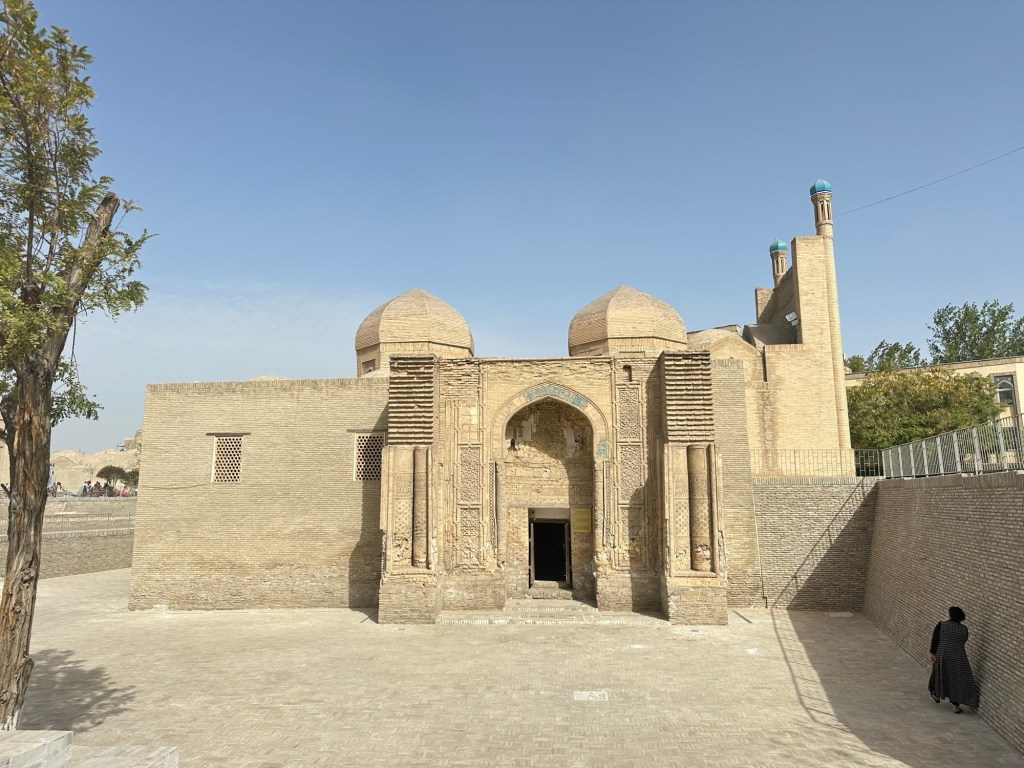
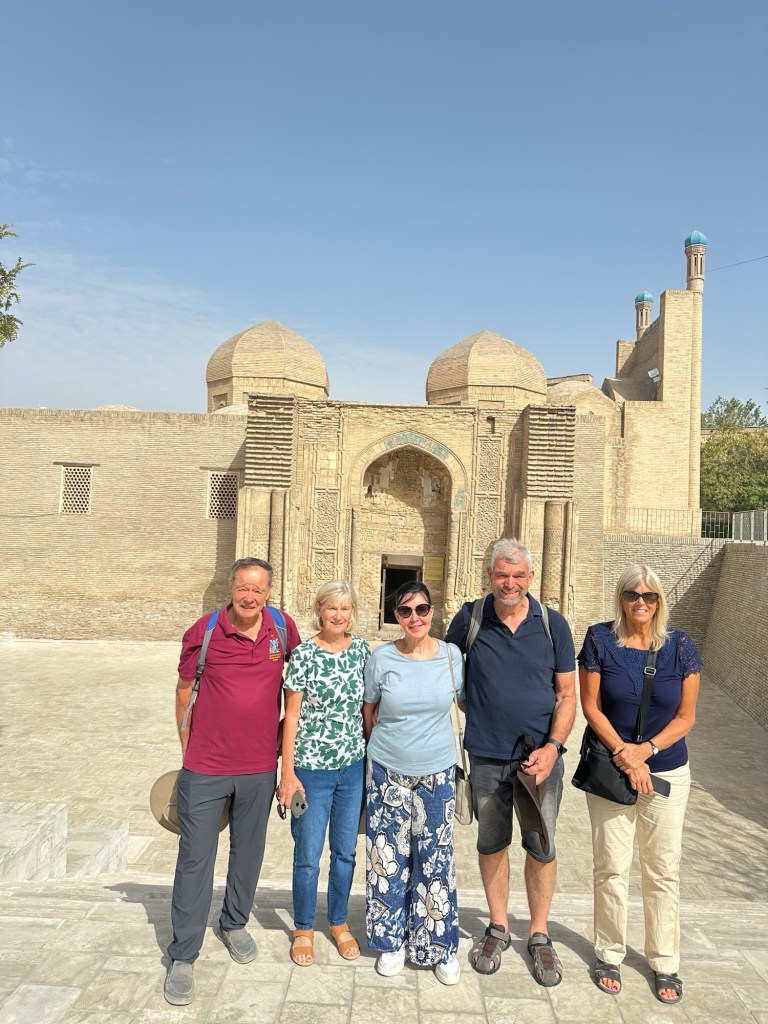
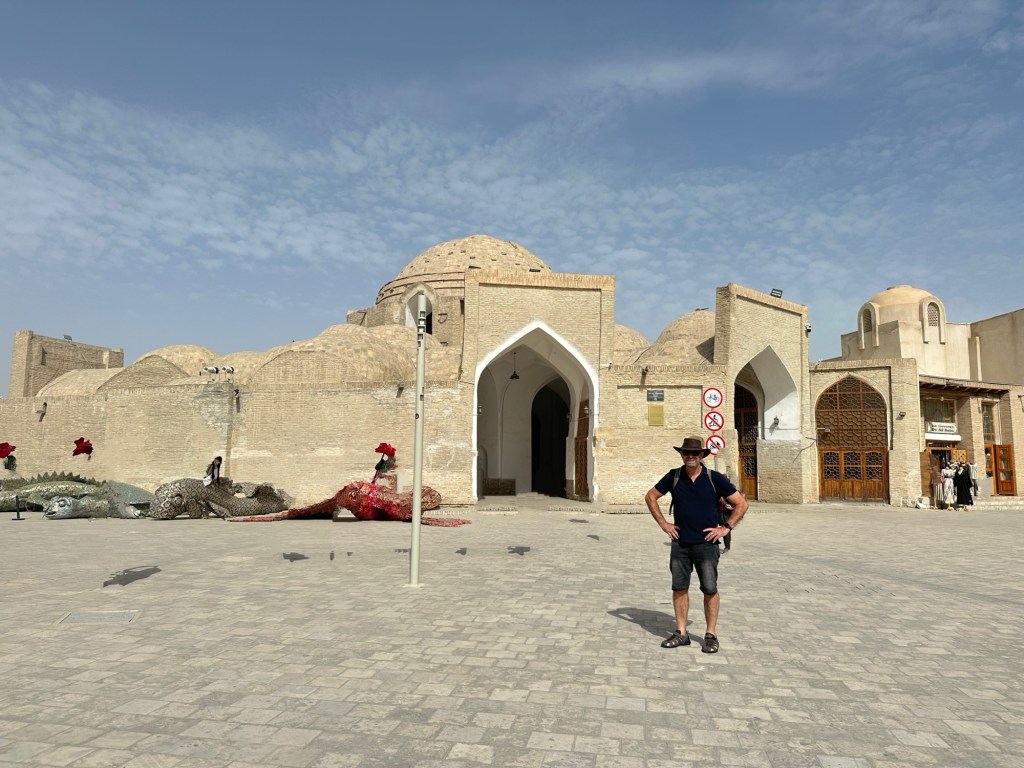
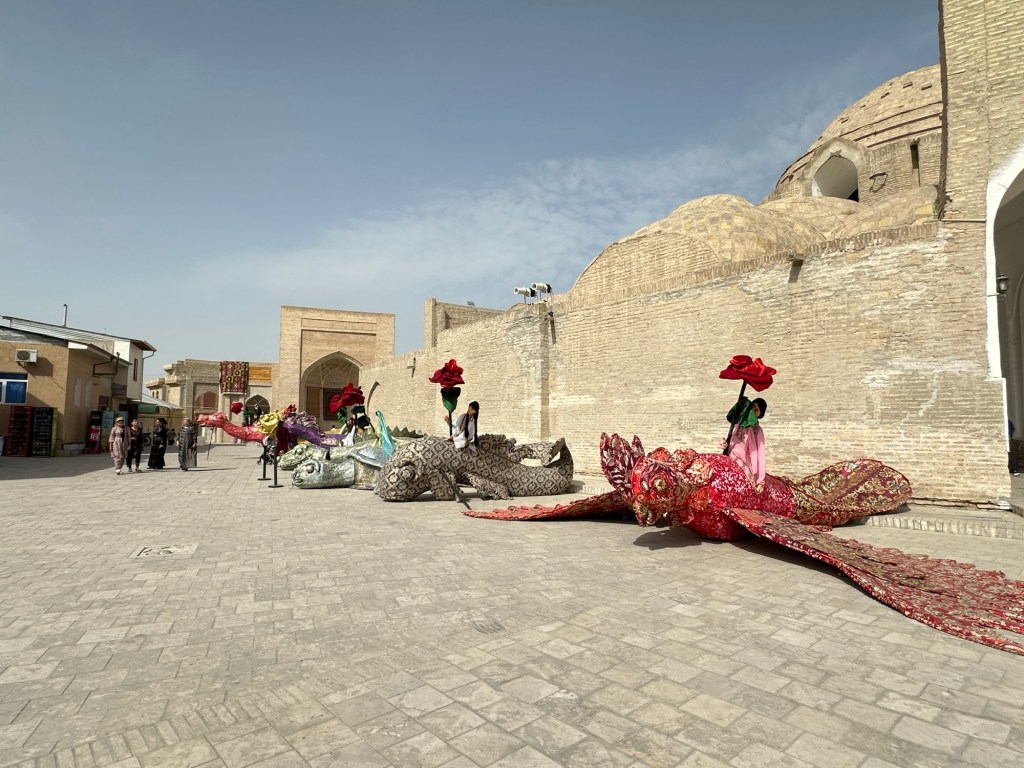
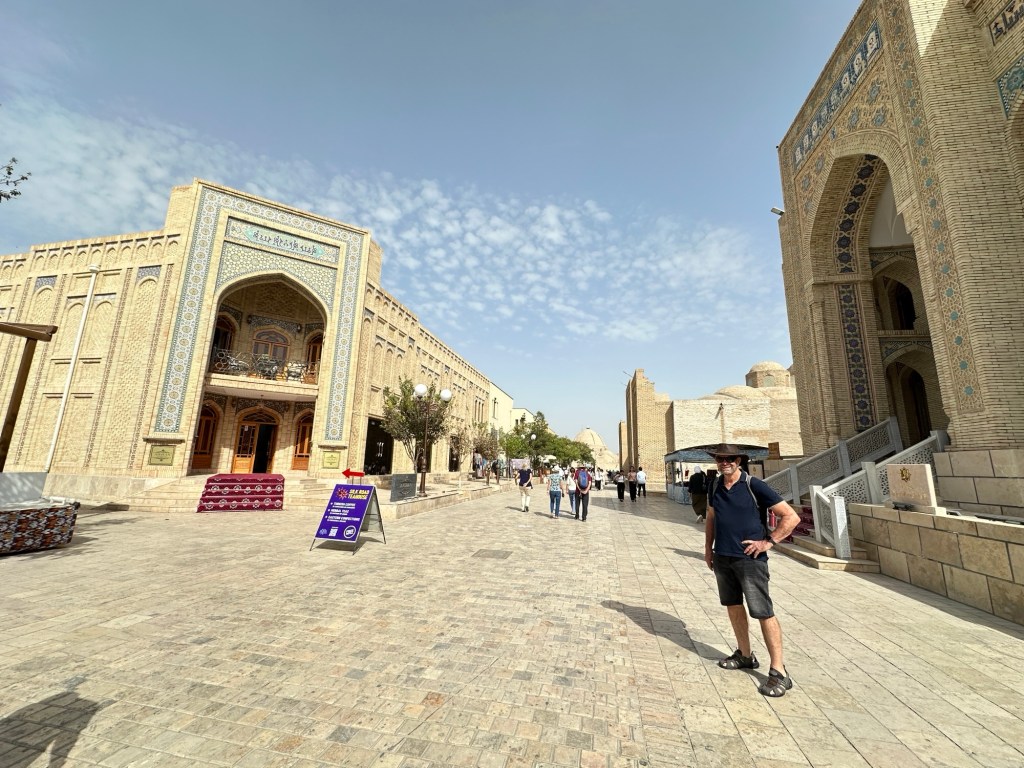
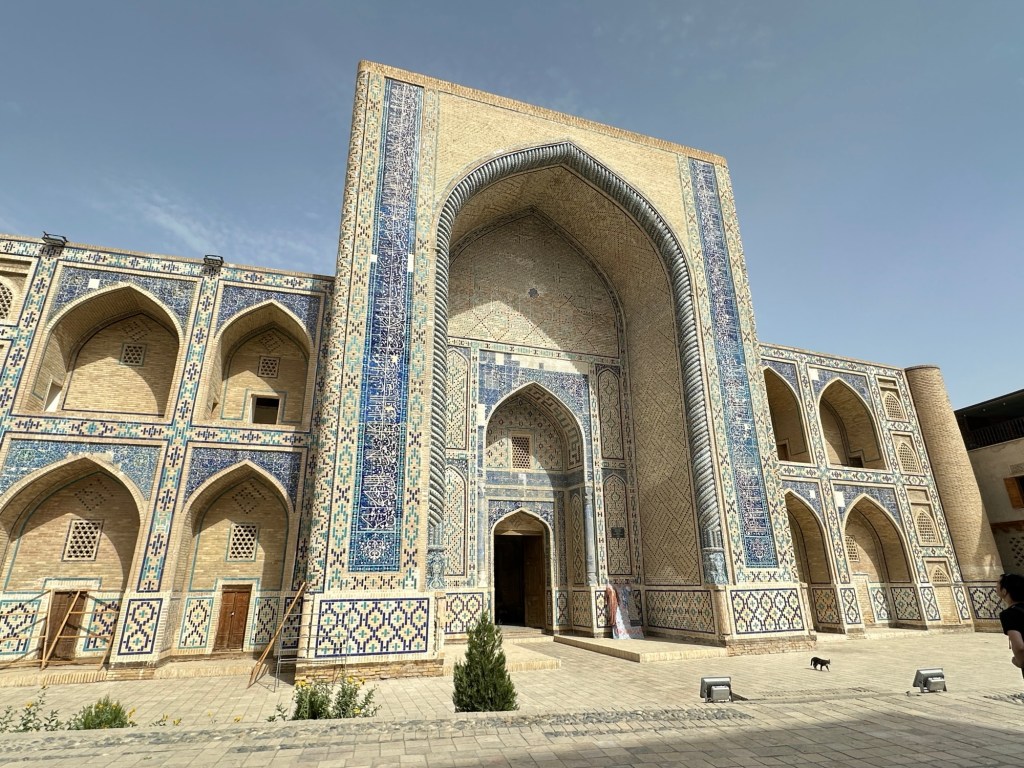
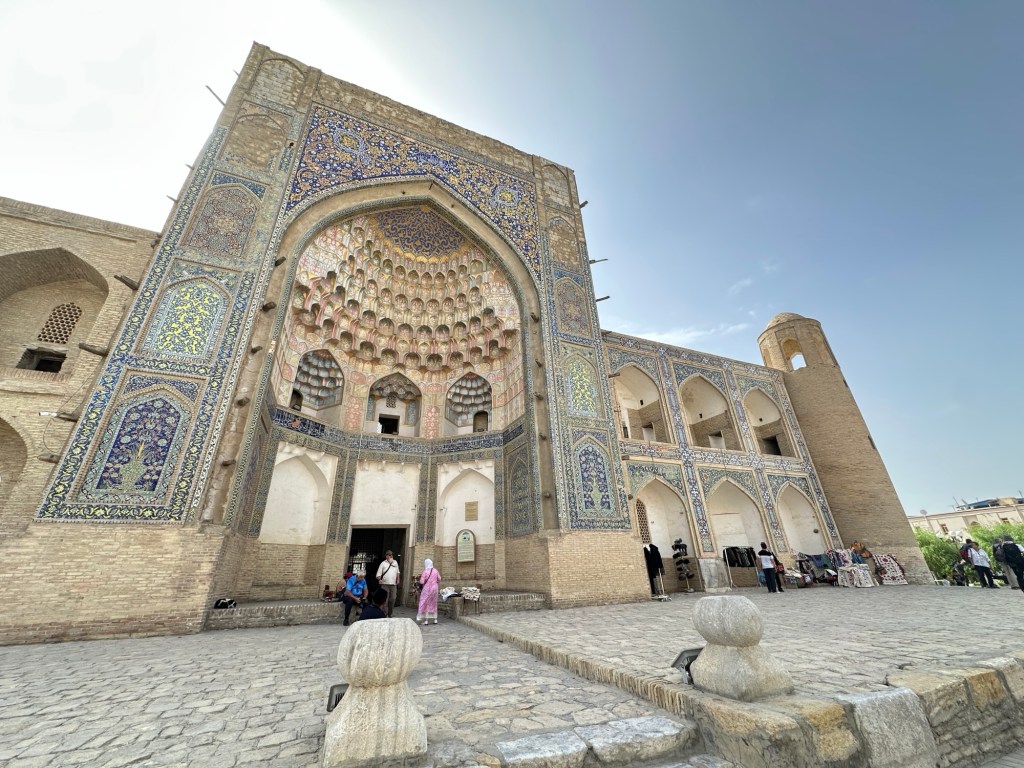
More mosques, more madrassas—so many that I’ve lost track of their names. Everywhere we turn, walls shimmer with intricate tiles and mosaics, each one more dazzling than the last. It’s like wandering through a living kaleidoscope of blue and turquoise.
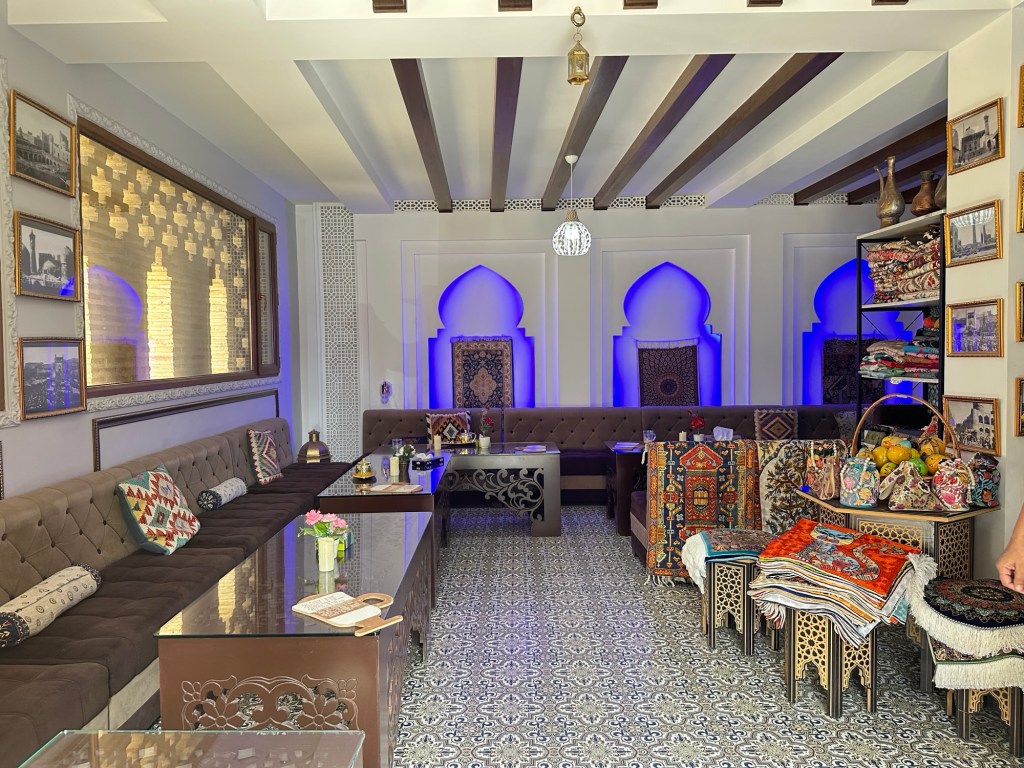
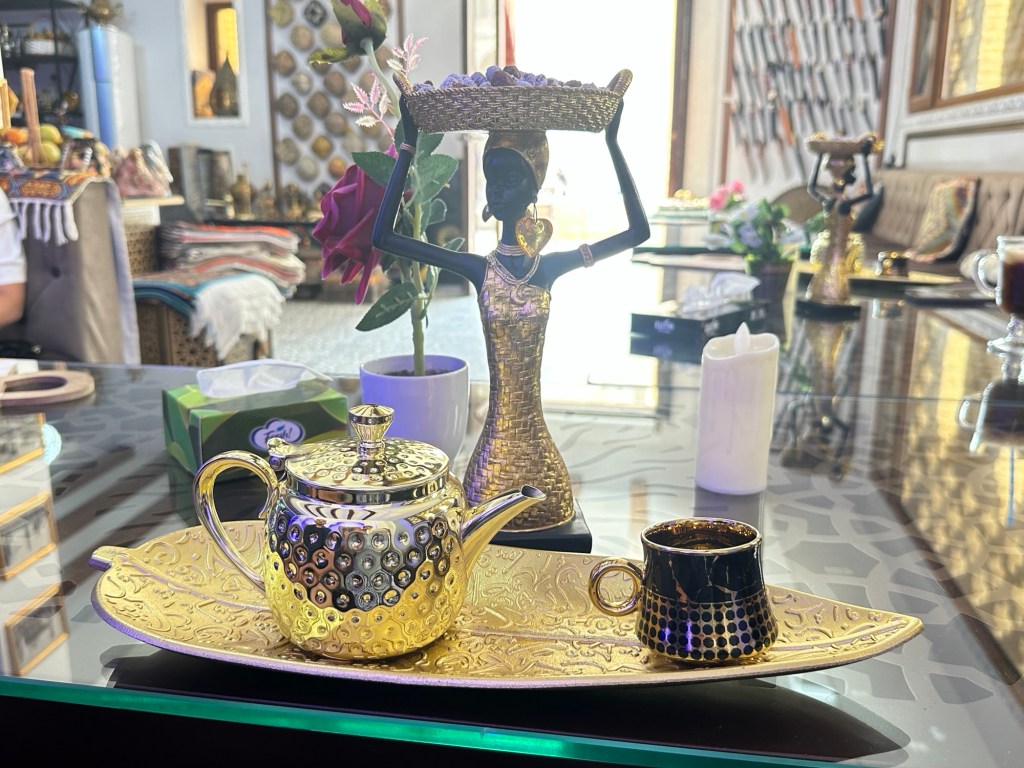
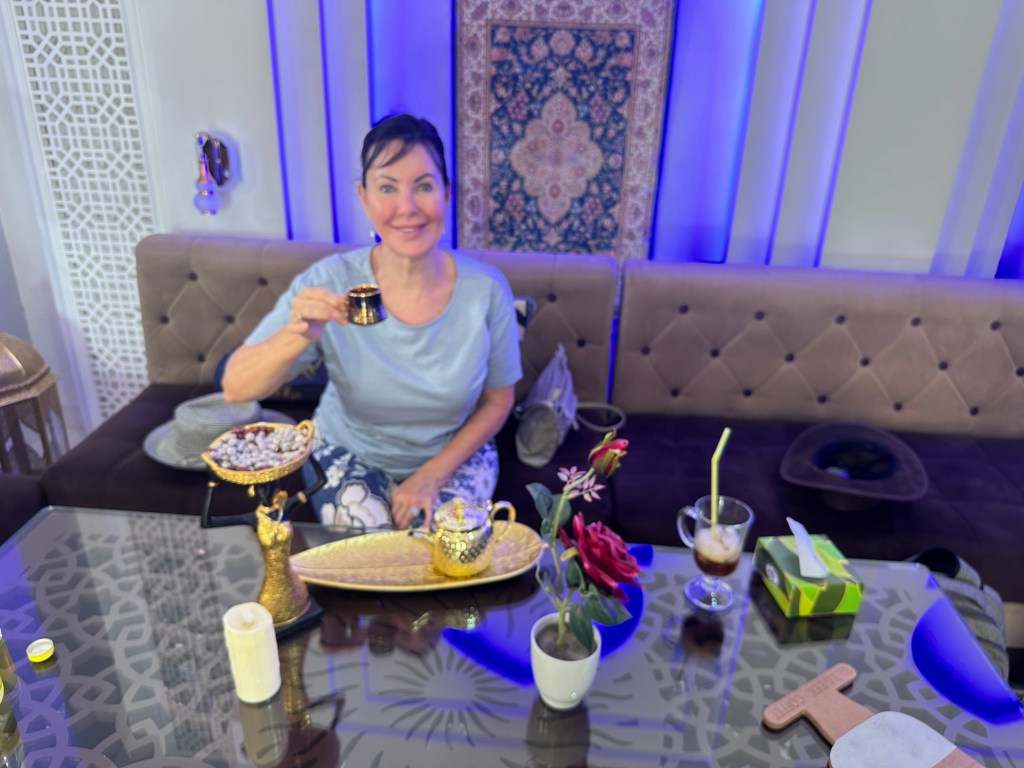
We paused for a welcome tea break. The tea arrived in those irresistibly dainty teapots they seem to serve everywhere here. The fragrant brew poured into tiny cups felt like a warm little ceremony, turning an ordinary stop into a small delight.

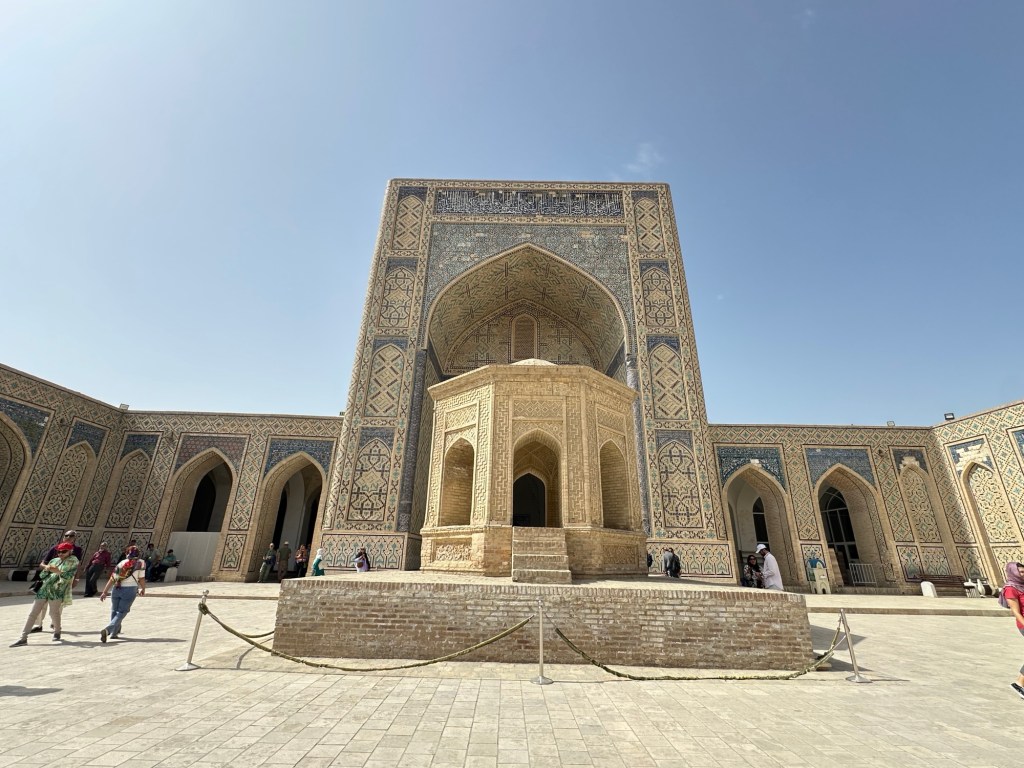
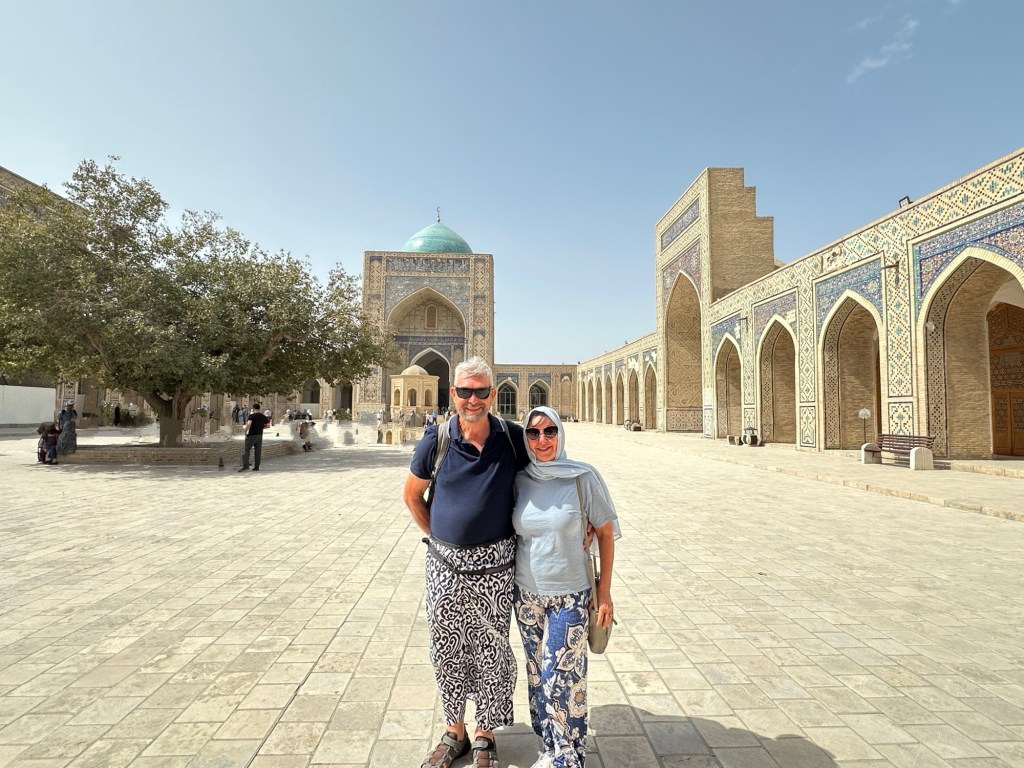
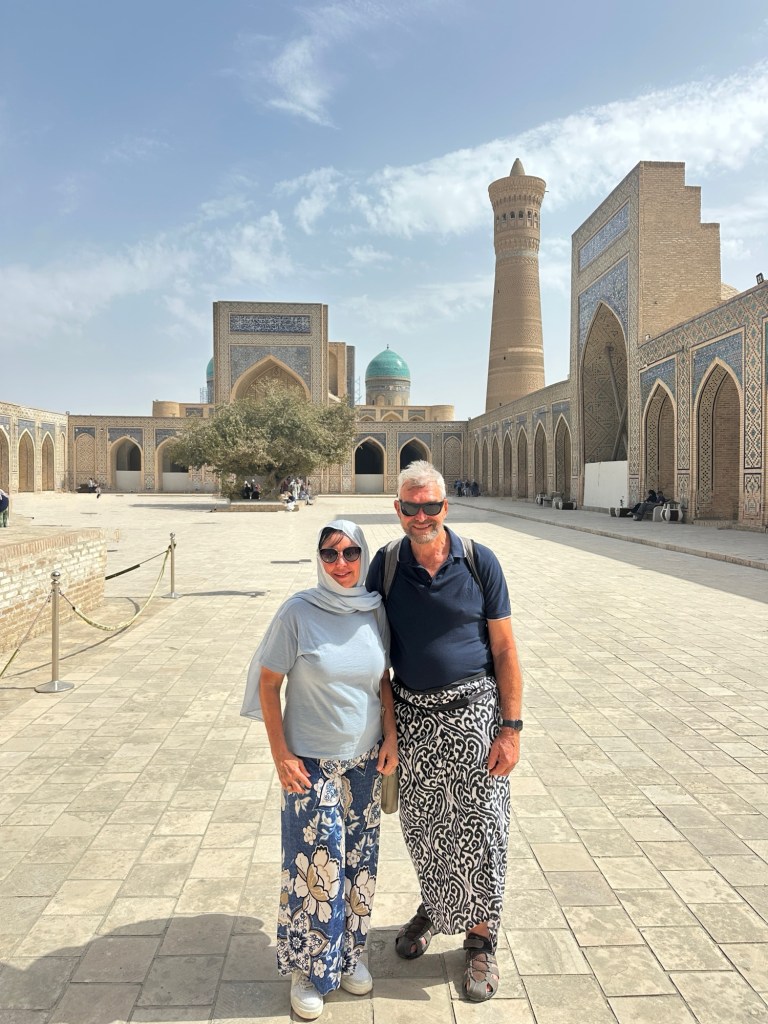
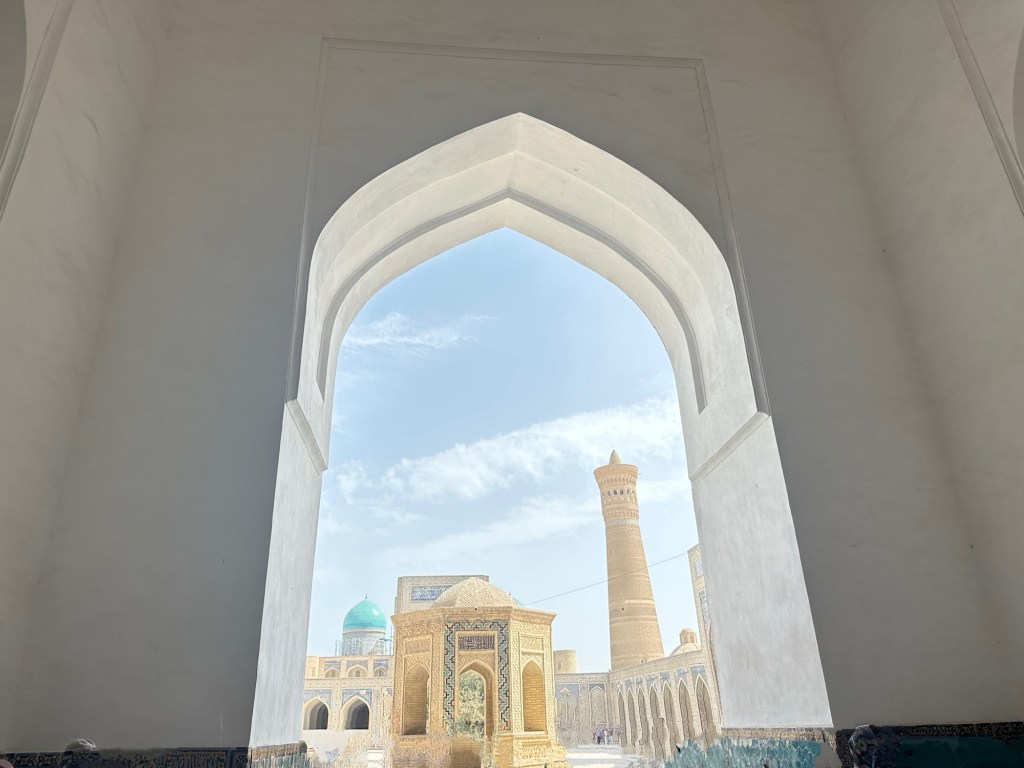
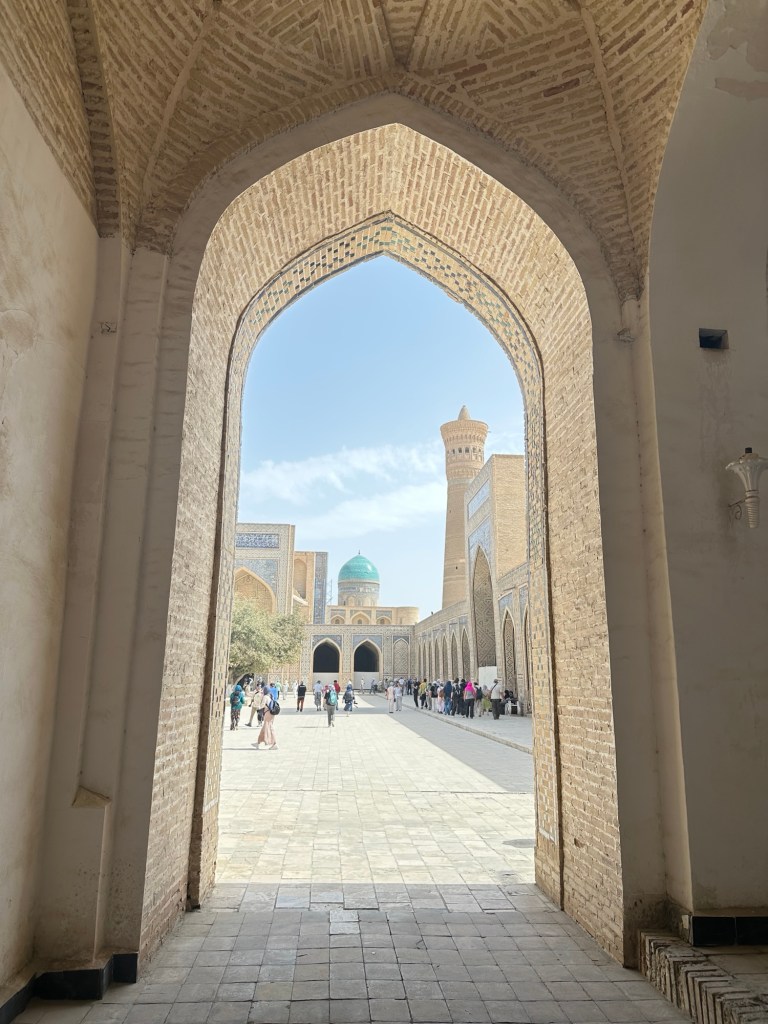
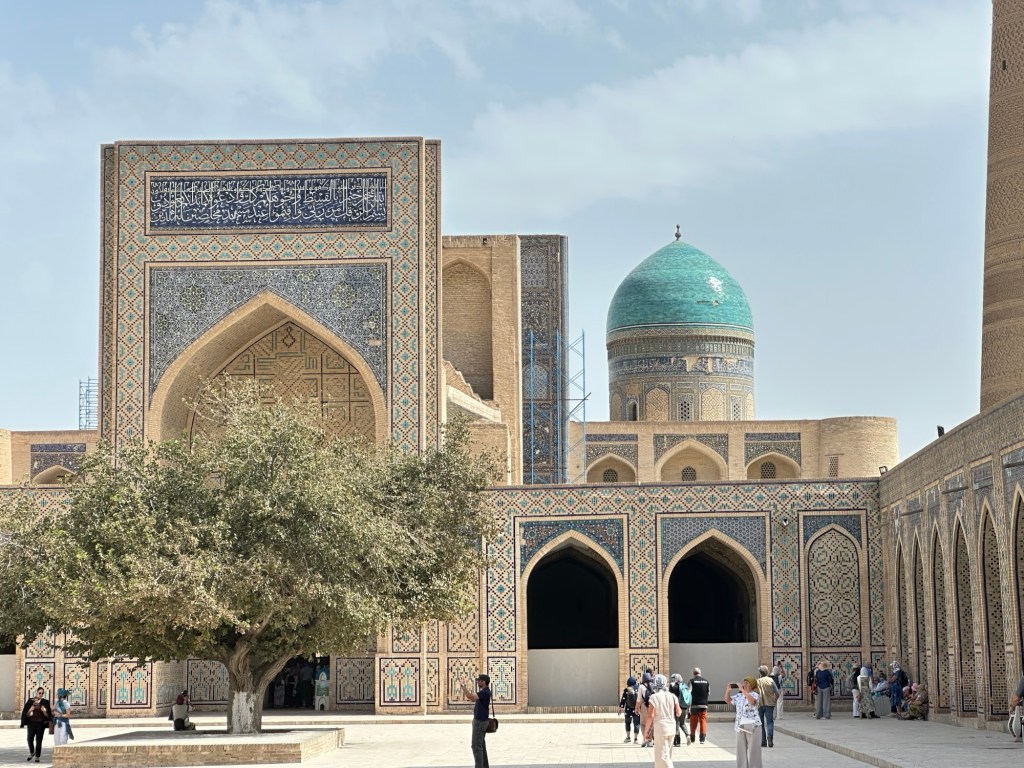
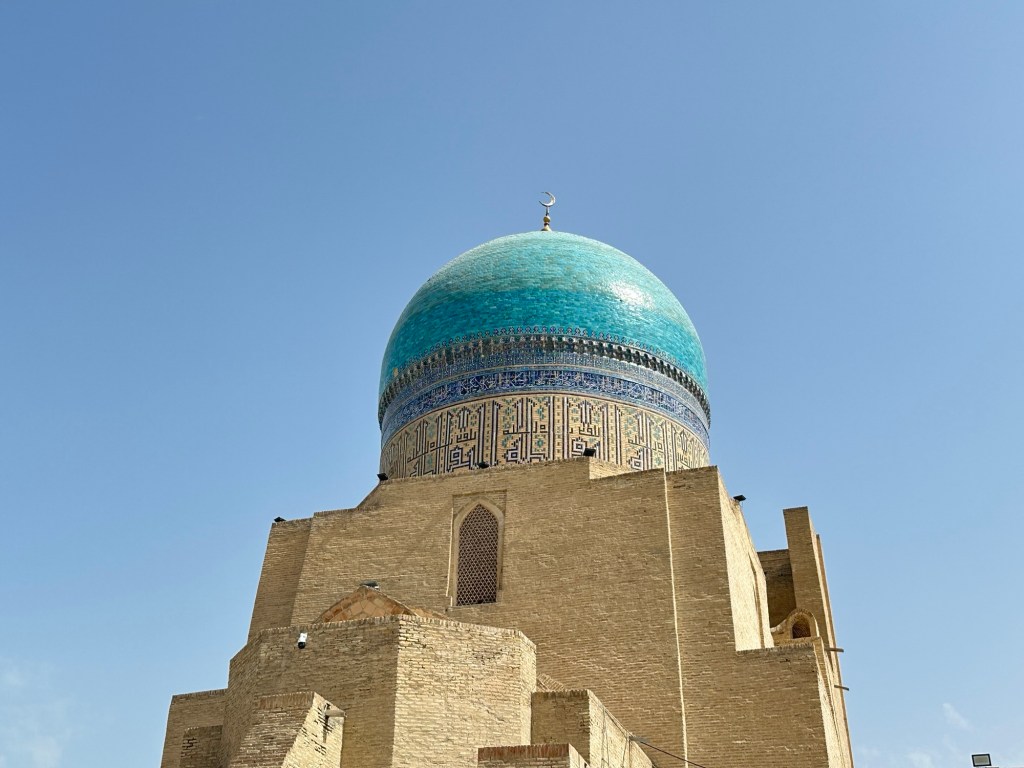
We come to the Mir-i- Arab Madrassa, still a working site, with its twin turquoise domes. Also, the Kalon Minaret which was built in 1127, and probably Central Asia’s tallest building at the time. Even Genghis Khan was awestruck with this building, and ordered it to be spared from Mongol destruction. It is the only building of this period to survive in Bukhara. The minaret was nicknamed the “Tower of Death” in the 19th century when criminals were tied in sacks and hurled off the skylight by orders of the Emir.
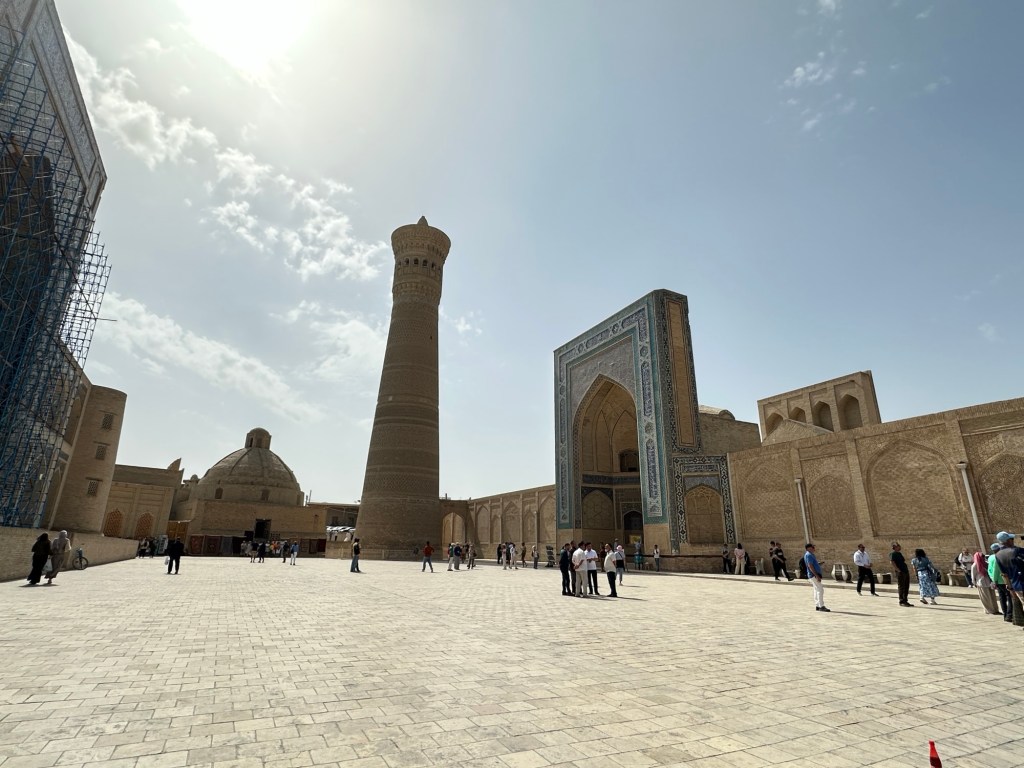
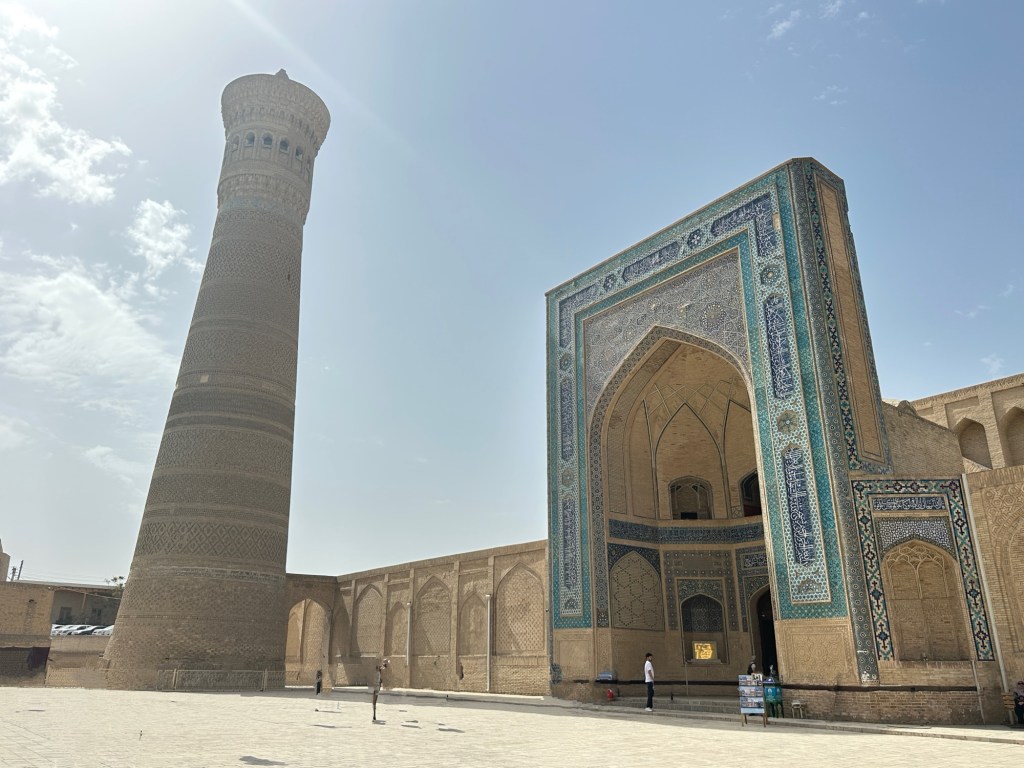
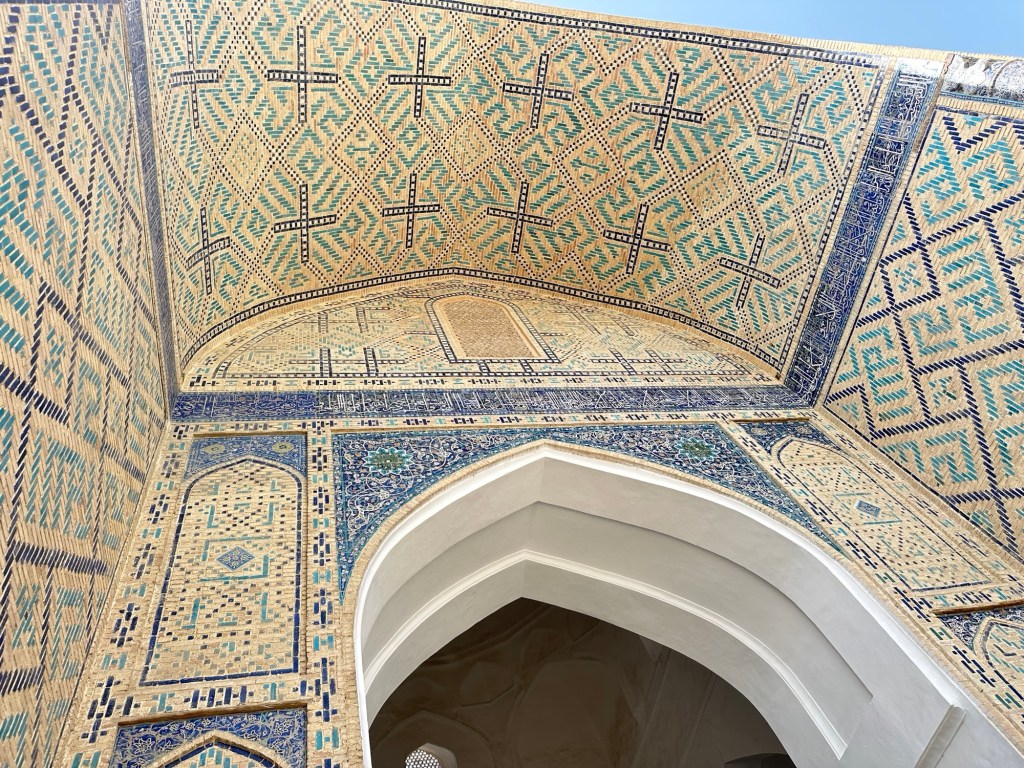
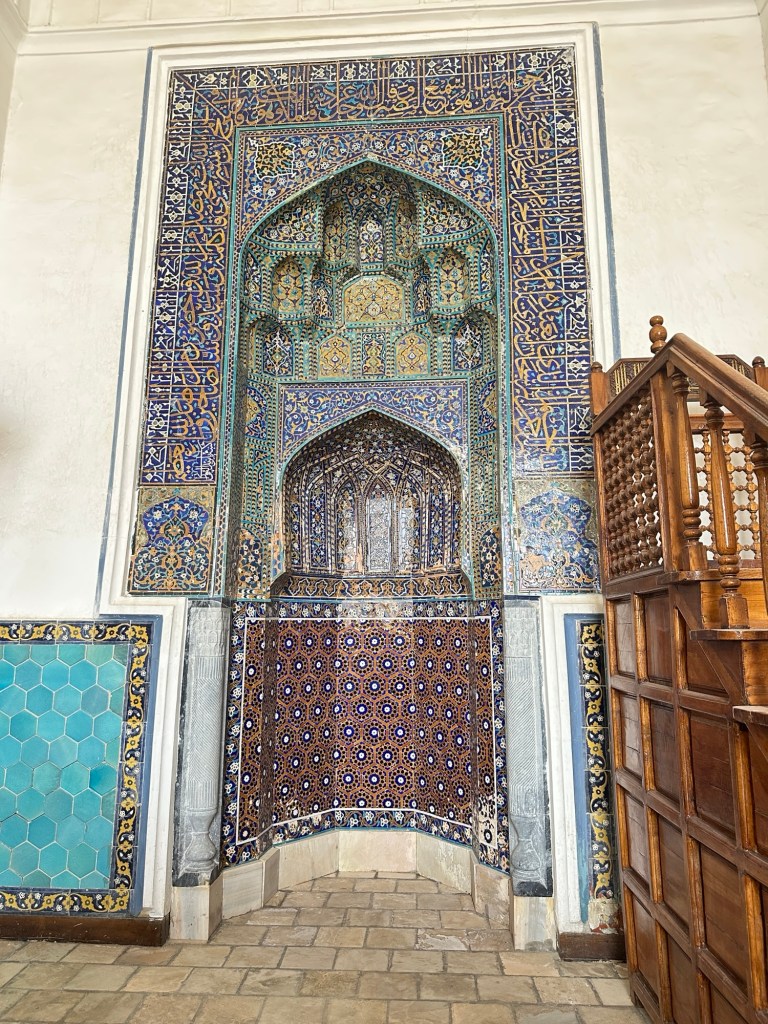
Next to the Minaret is Kalon Mosque, built for 10000 worshippers, which was for centuries Bukhara’s main Friday mosque. The tile work here is stunning.
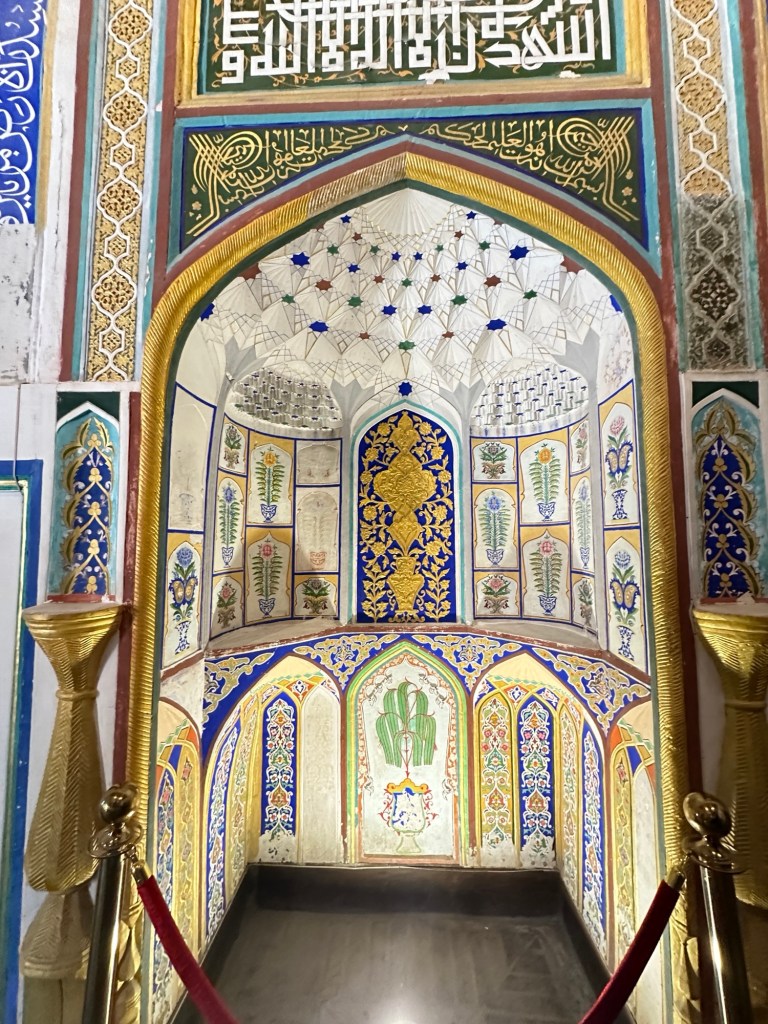
The heart of Bukhara is the 2000 year old fortress, Ark. It became home to the emirs of Bukhara evolving into a complex warren of chambers, mosques, reception rooms, servant’s quarters, mint, jail and armoury. It was destroyed and rebuilt many times over the years- only 30% remains. Great views over the city from the top.


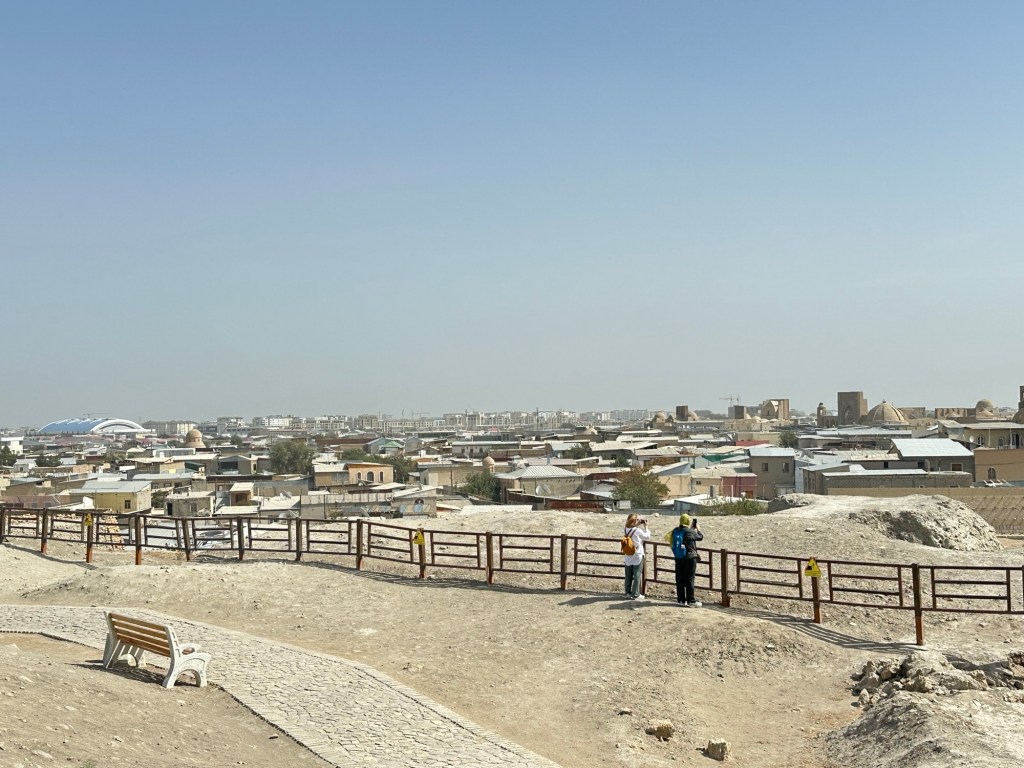
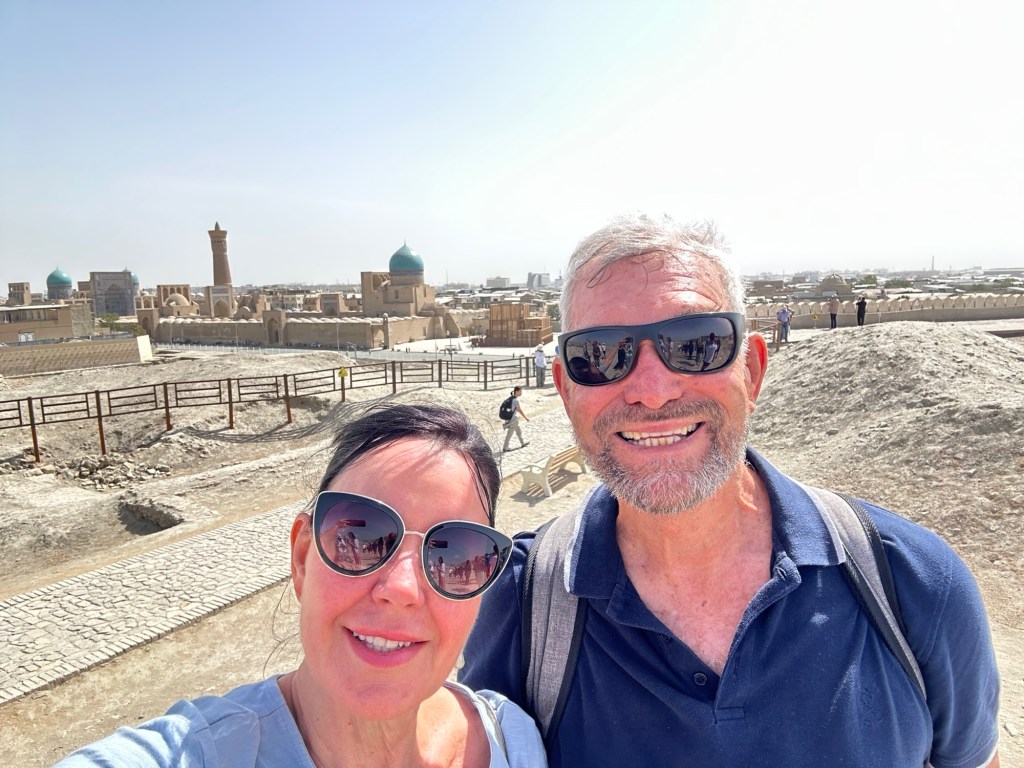
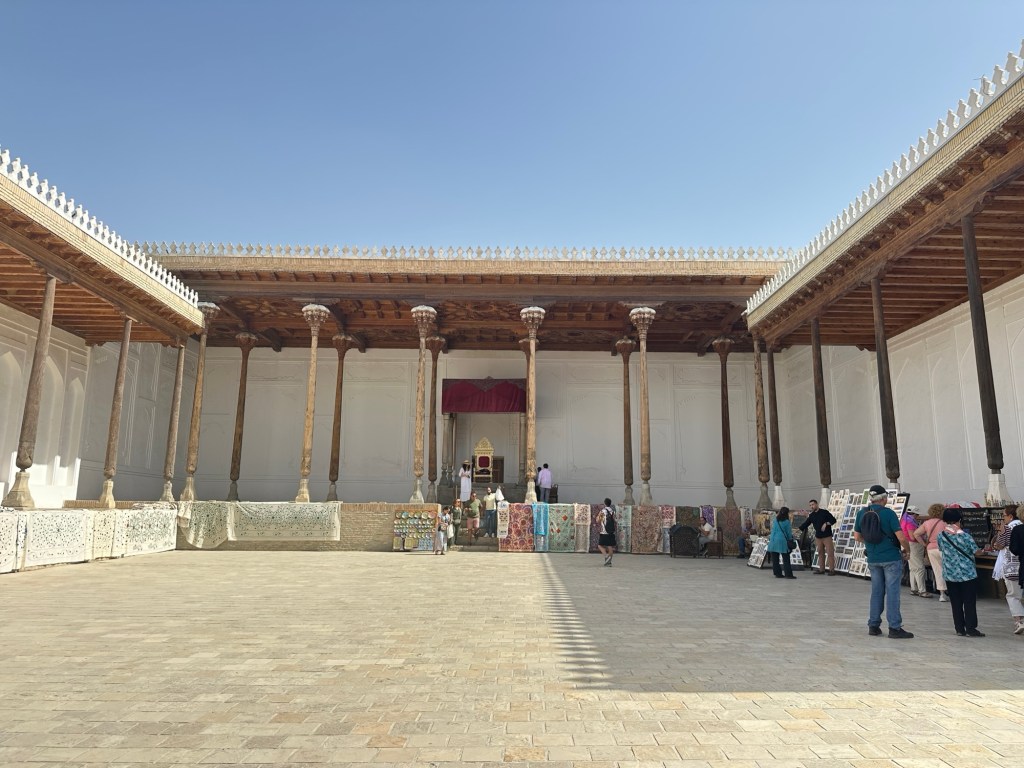
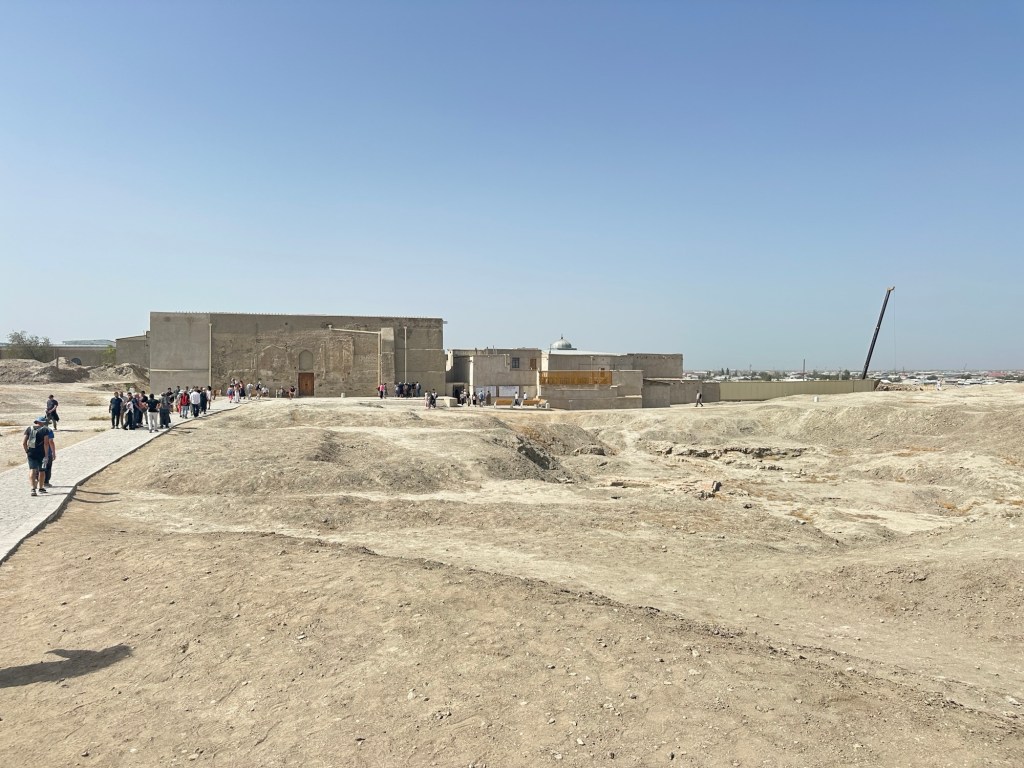
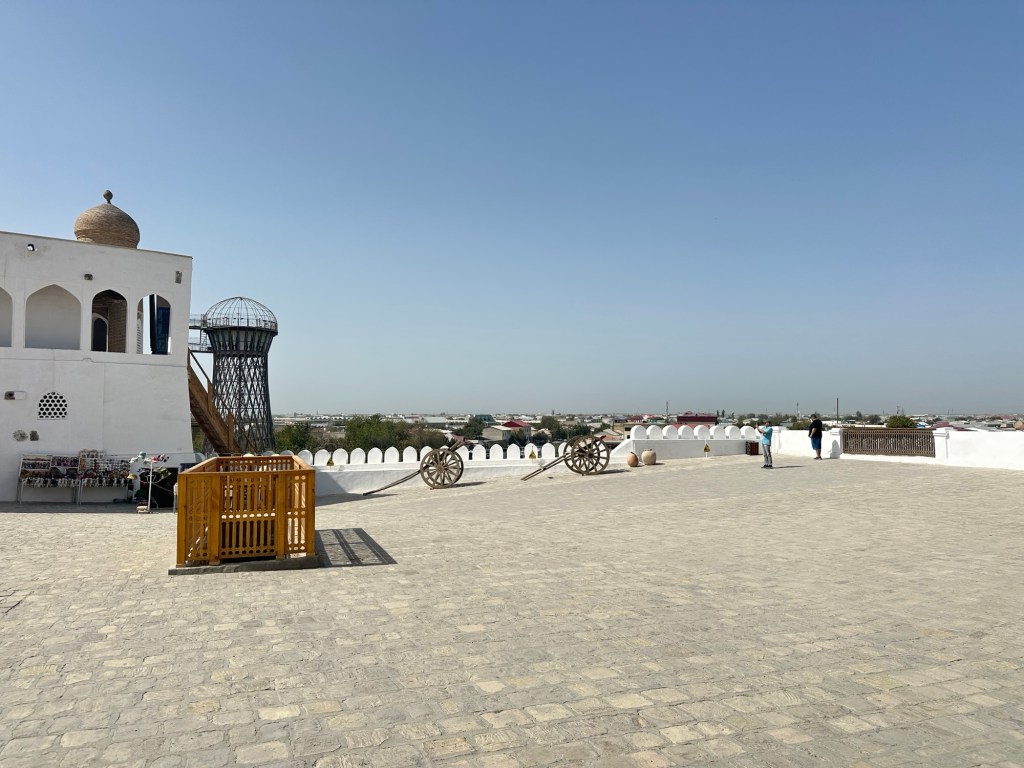
Outside the Ark, at the foot of the 19metre baked brick walls is Registan Square which was home to the city’s slave market, parade ground, and flogging and execution ground.
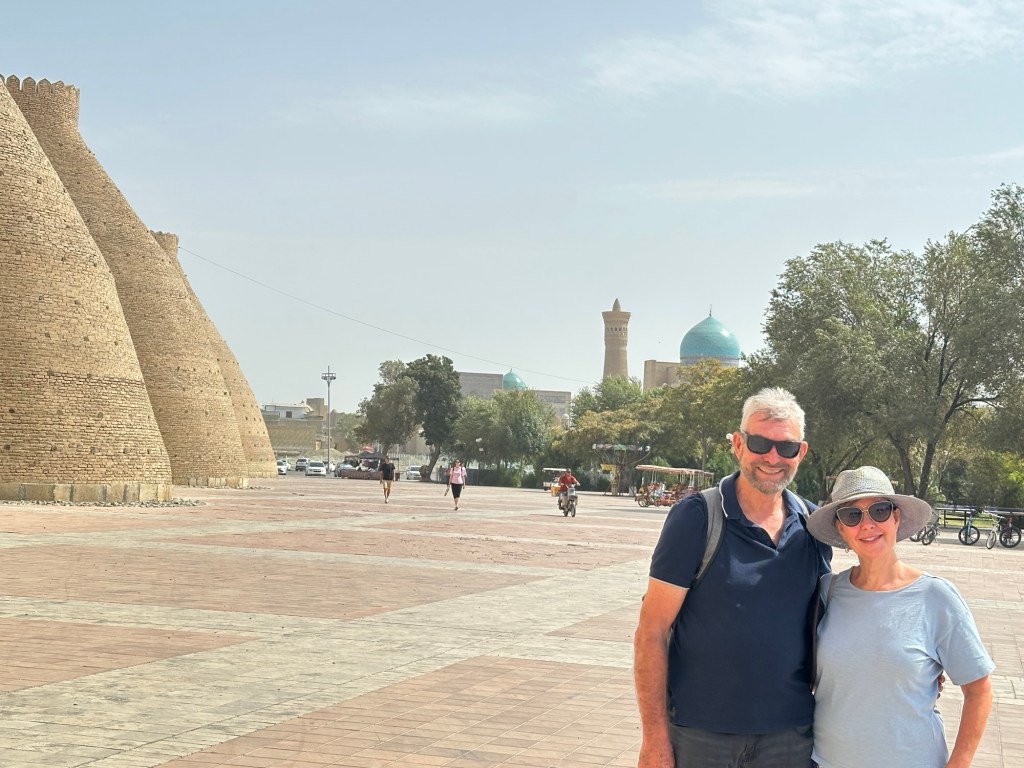
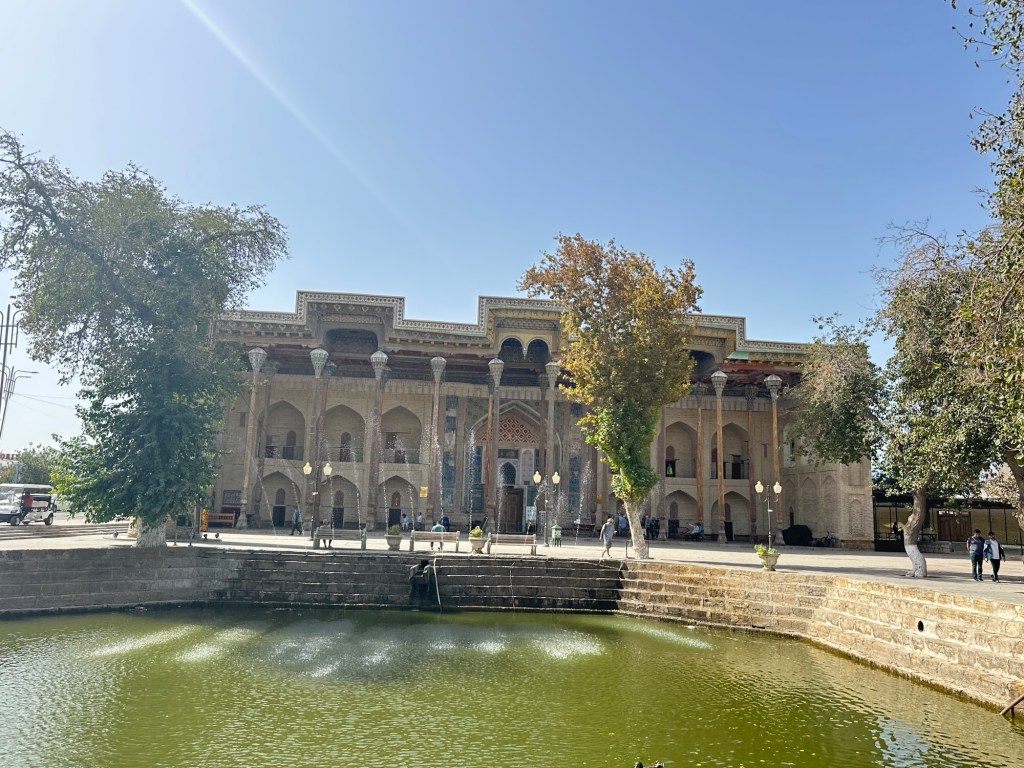
Bolo Hauz mosque, the only surviving structure from Registan, includes a mosque with 20 pillars (40 reflected in the pond). It was built in 1712 by order of Emir’s wife.
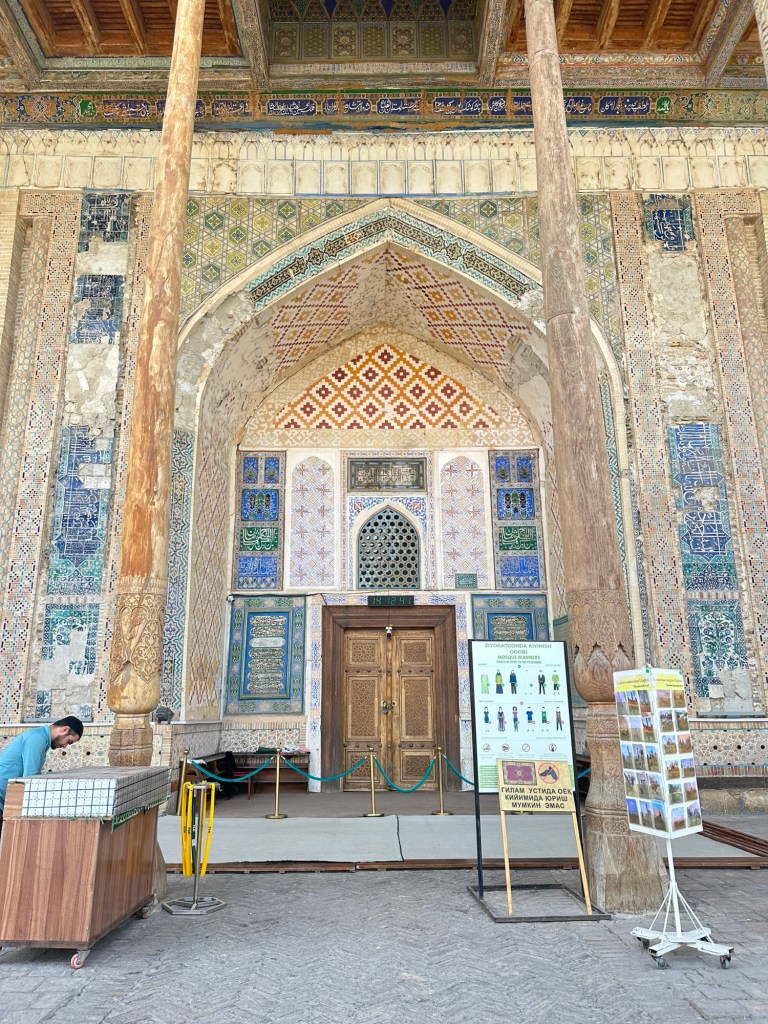
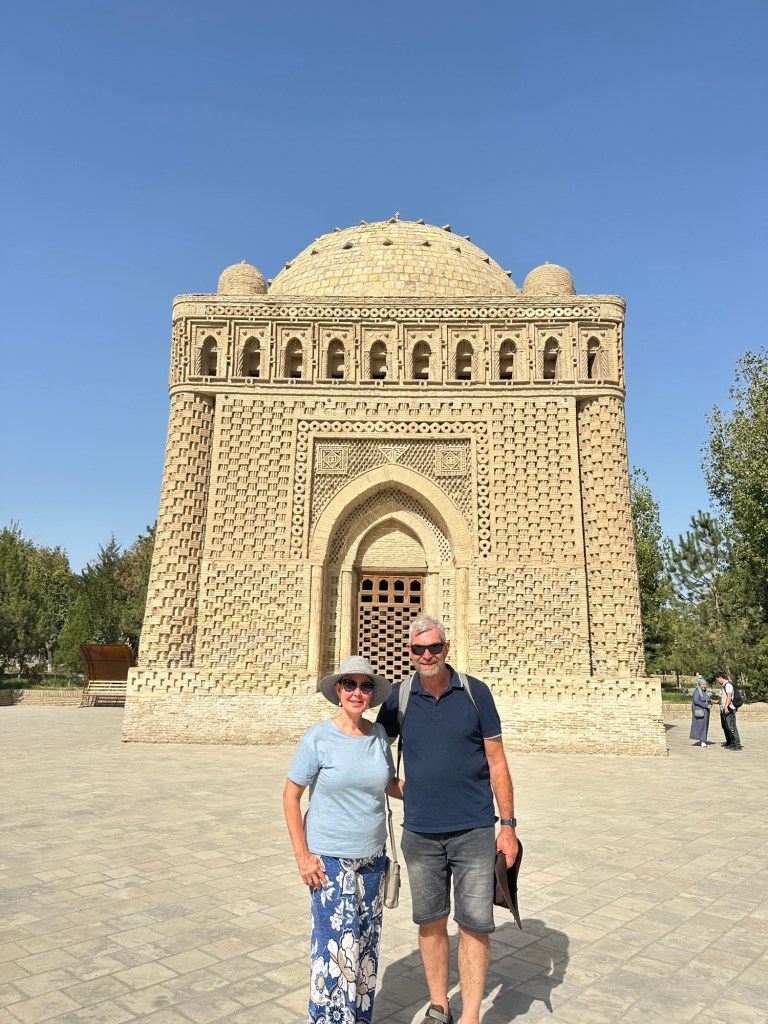
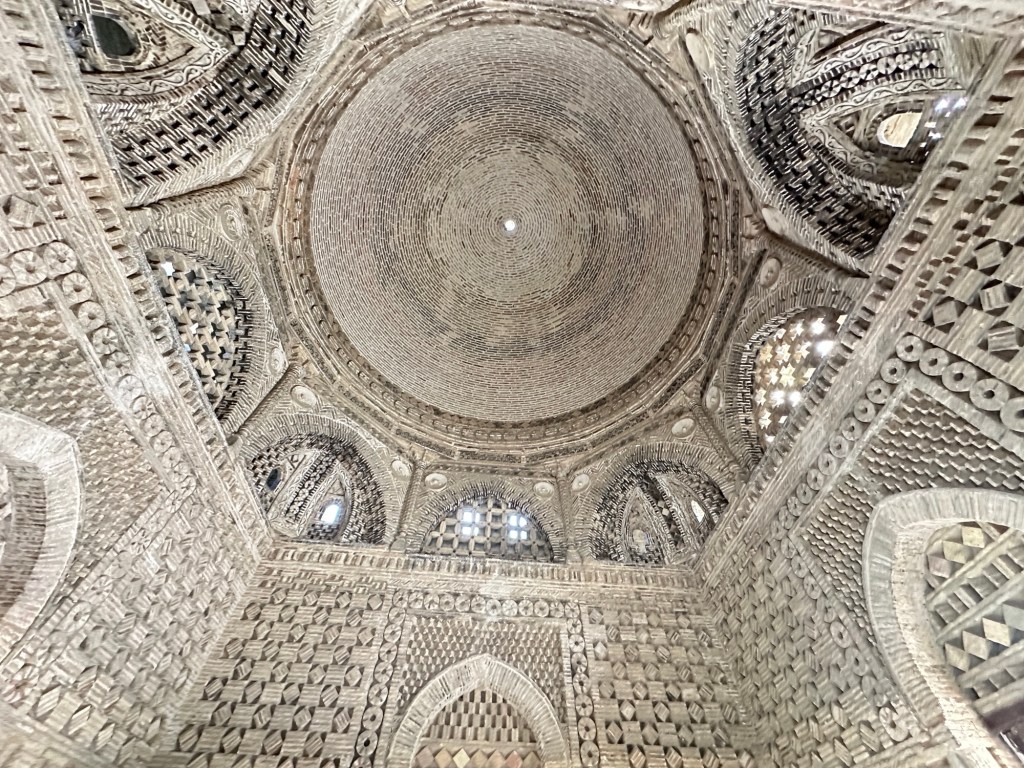
Ismail Samani (second Emir of the Saminid Dynasty) mausoleum, final resting place of 3 members of the Samanid dynasty. This is one of the oldest standing buildings in Central Asia. It was buried in sand to save it from Genghis Khan and wasn’t rediscovered until after the Soviet takeover in the 1920s.
Last stop was the Bazaar- we didn’t stay here long as we were all beginning to flag. I’m sure you could spend four days inside this bazaar and still not see it all. We did buy a replacement suitcase for $25 US though.
Our driver picked us up and took us back to the hotel – a short break to refresh, then out to the Folk Show and Fashion Parade at the Divanbegi Madrassa for an entertaining hour of folk dancing. In between dancers we were treated to some gorgeous garments modelled by four striking waif like girls. I had to hold myself back from buying any more clothes!
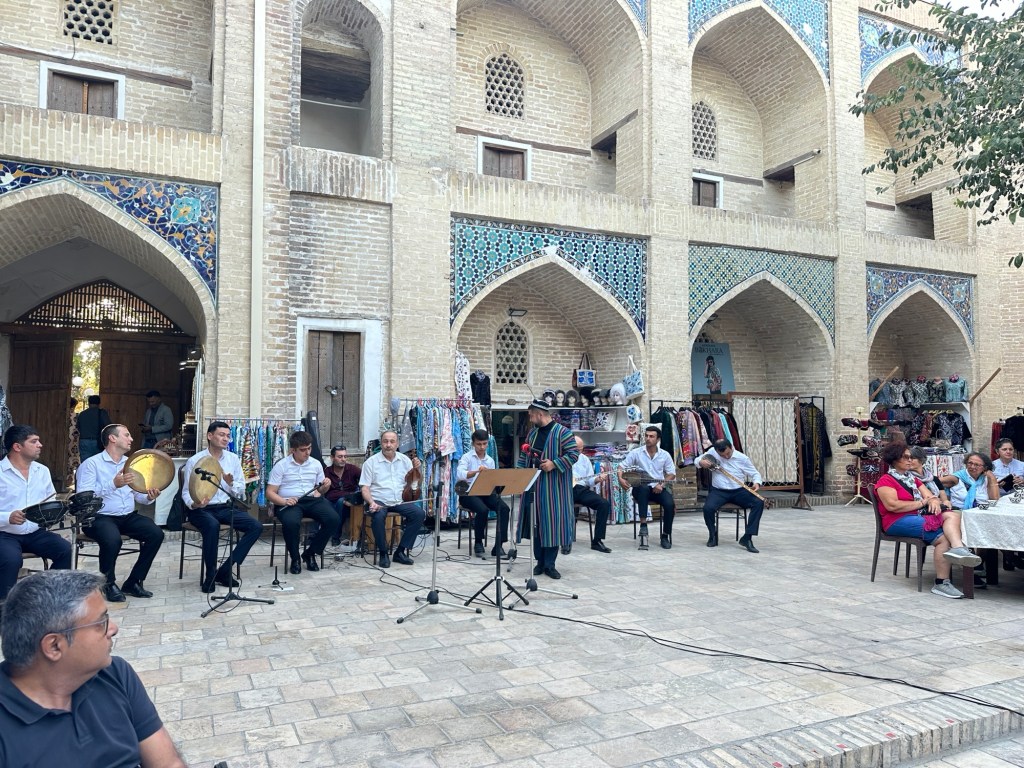
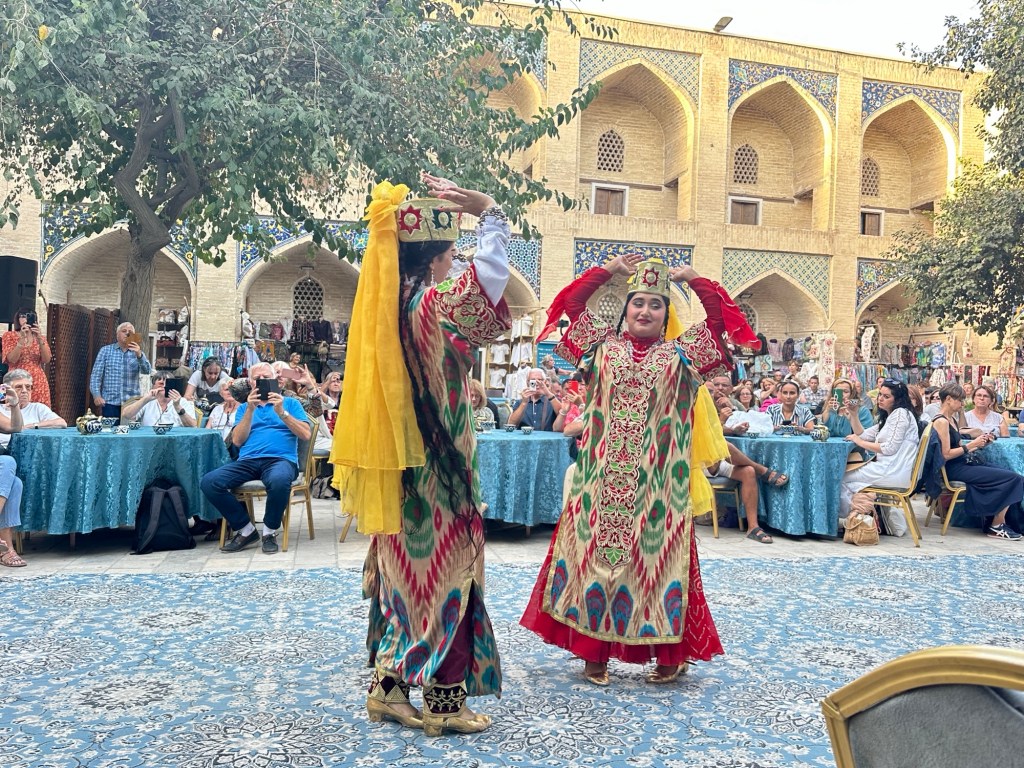
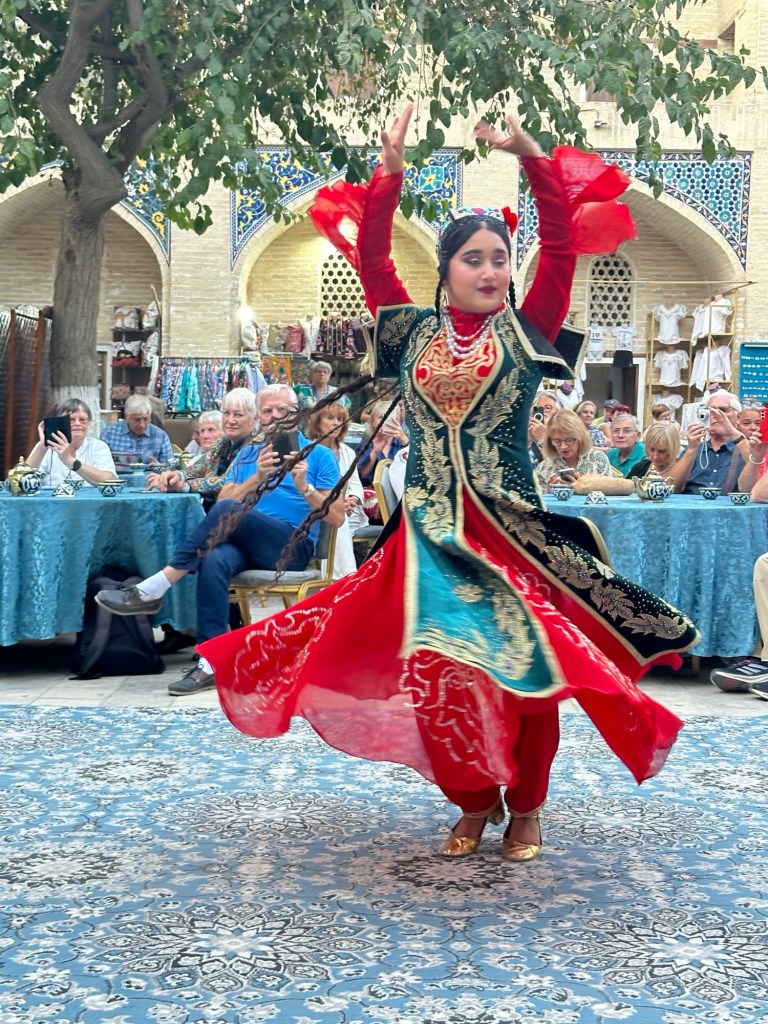
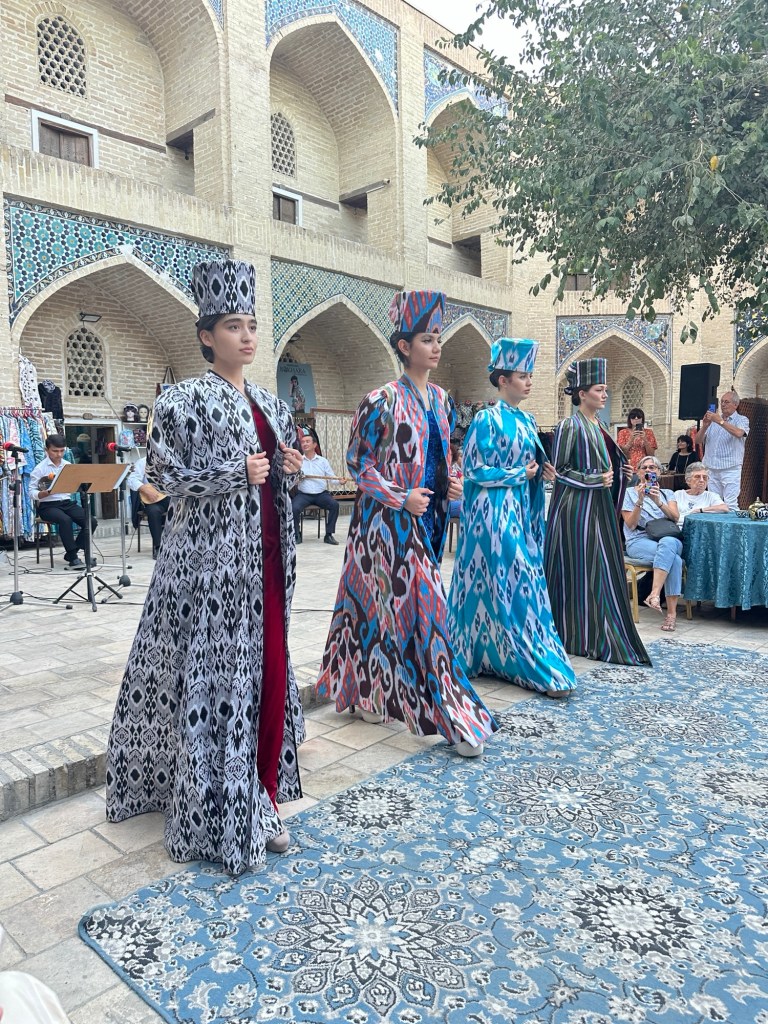
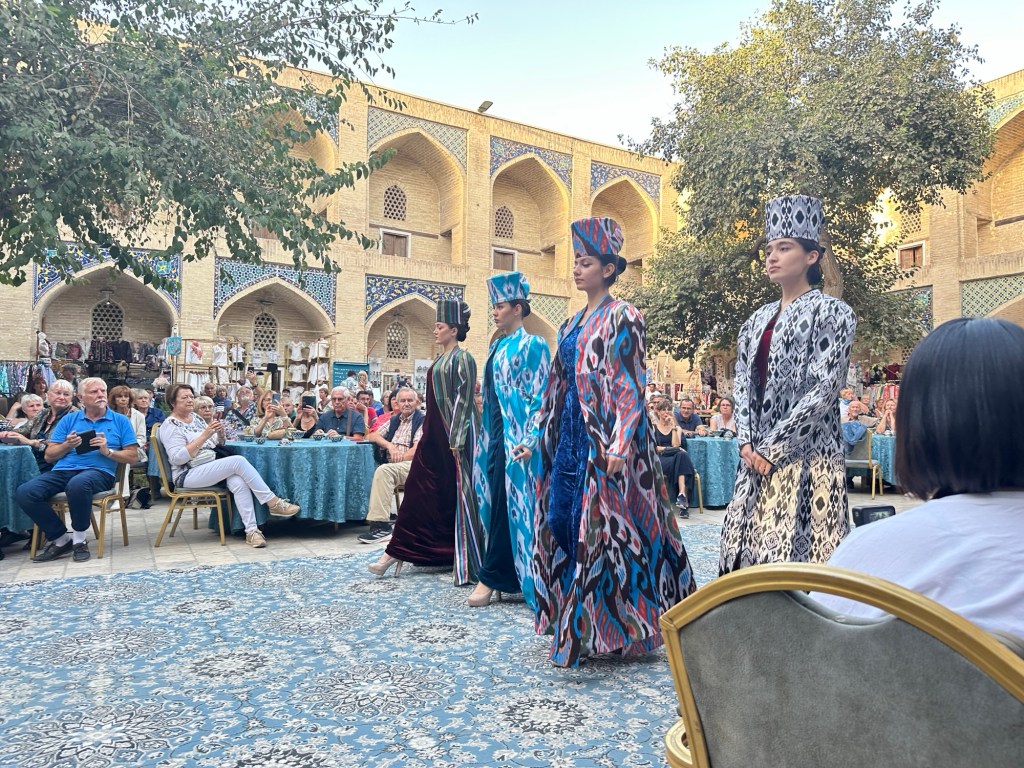
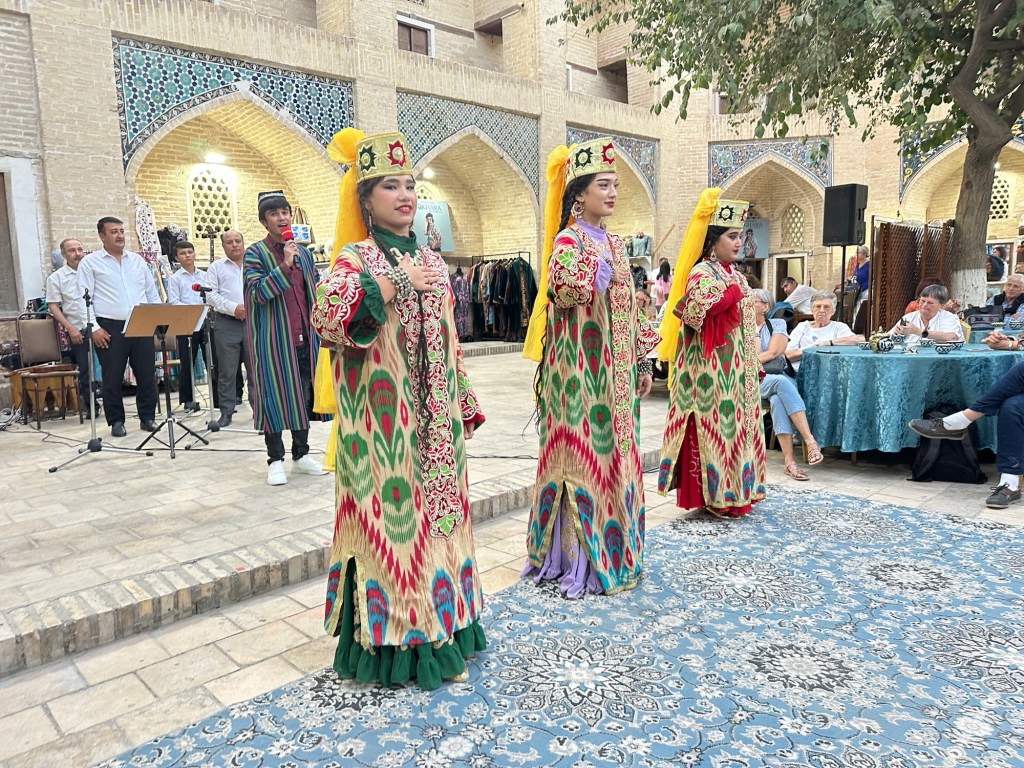
More wandering around after the show, followed by dinner at a local restaurant. Getting a nice glass of wine here has proven to be difficult- we had three tastes of “red” wine, only to go back to another margarita and beer! Can’t say I recommend local Uzbek wine to date – still some room for improvement.
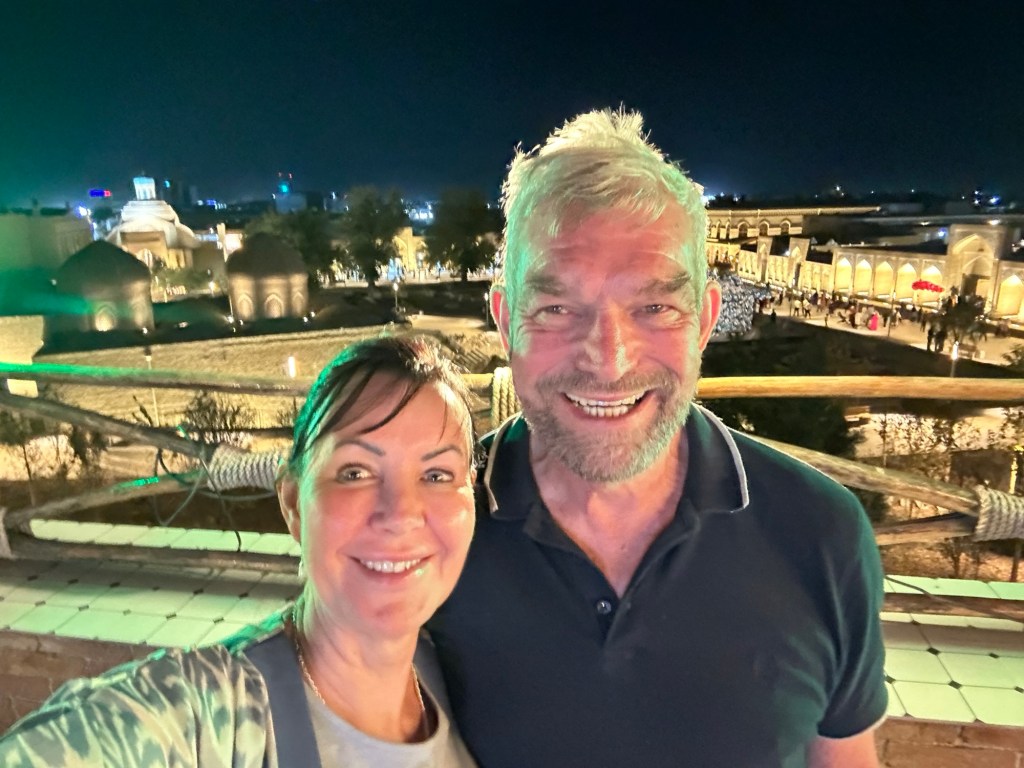
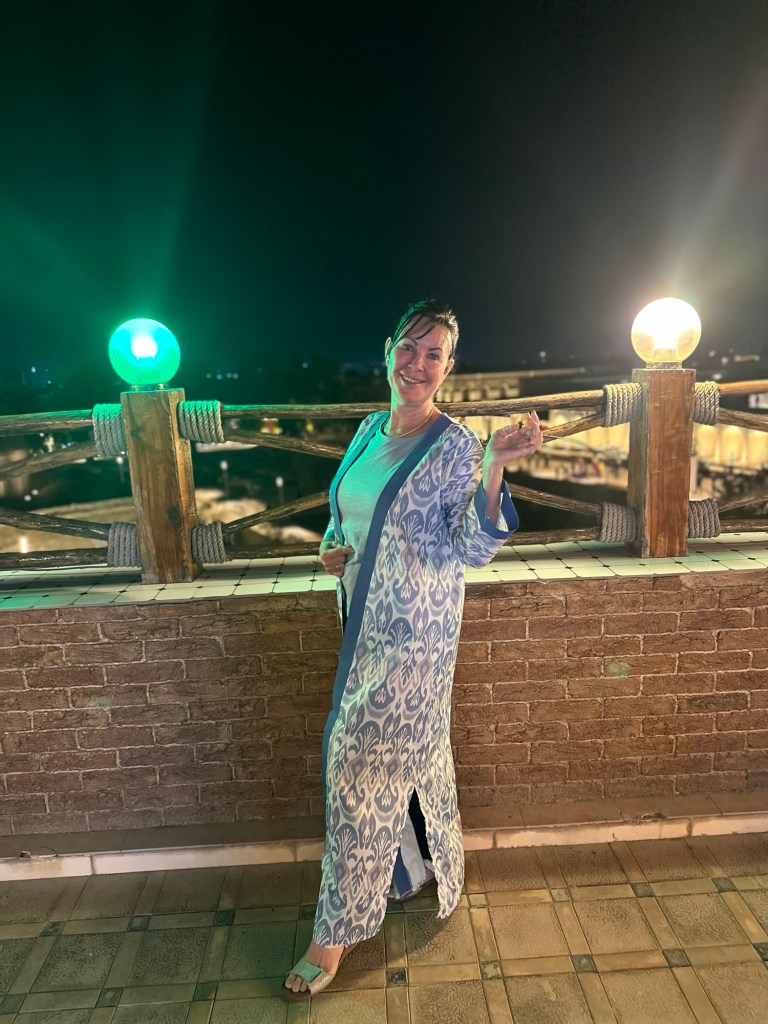
Back at the hotel we thought we’d try the rooftop bar- whilst it had a lovely view of the city by night, they didn’t serve wine!

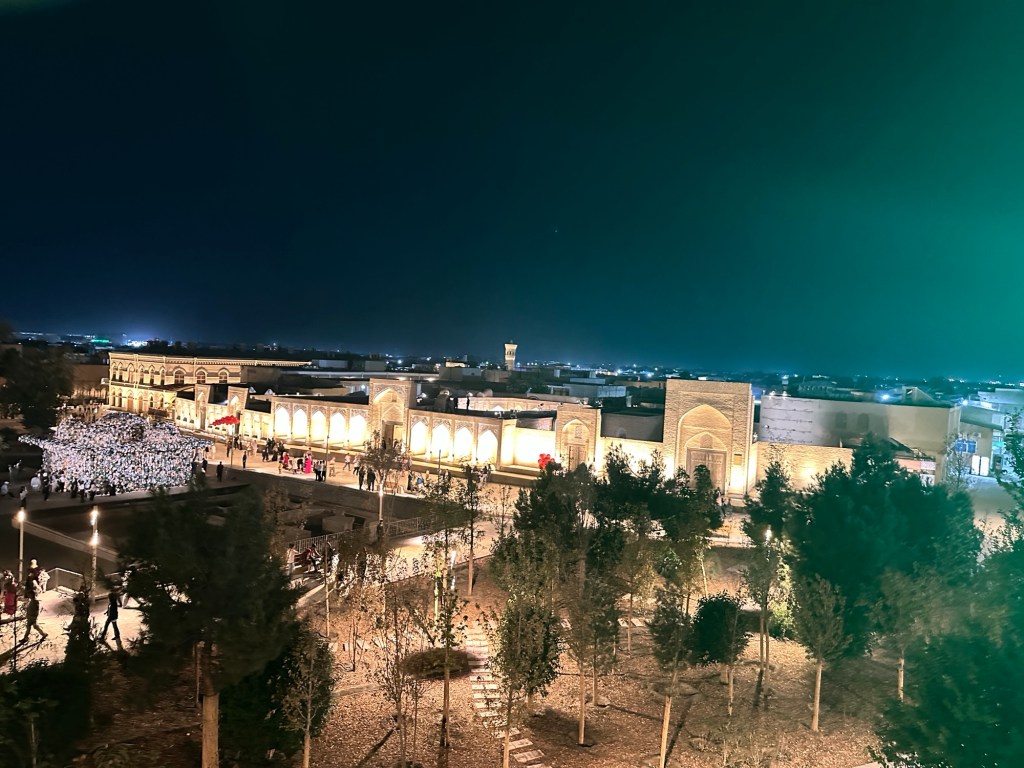
Day 13
Tuesday 23rd September
Bukhara to Samarkand
14- 27 degrees, sunny
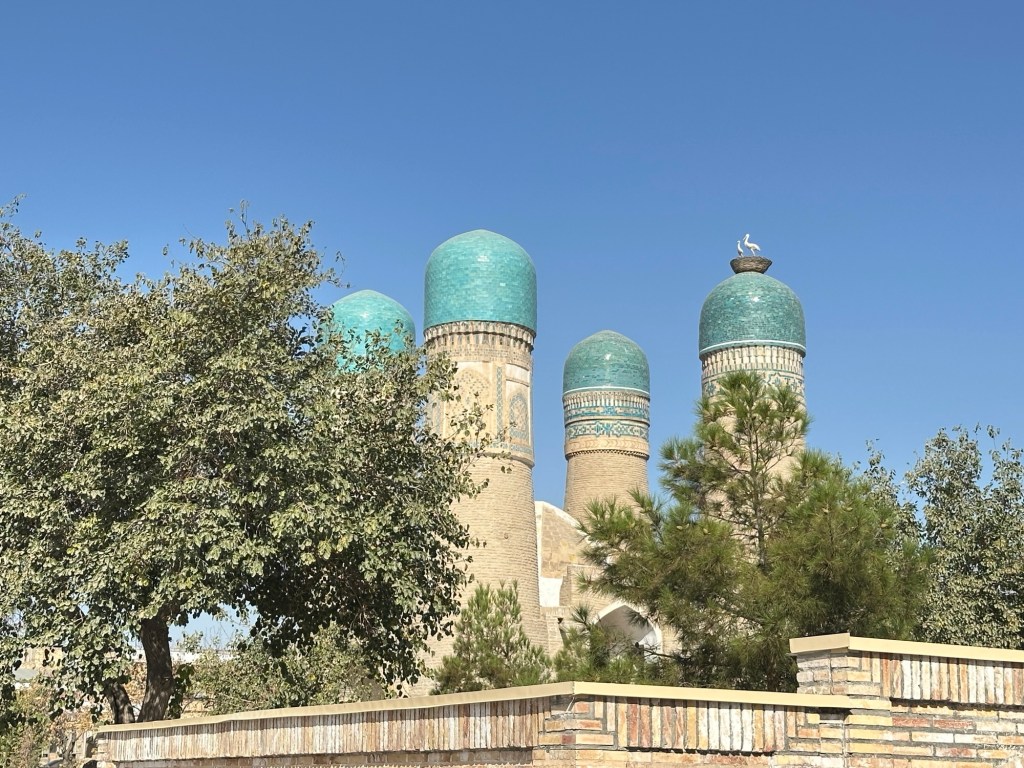
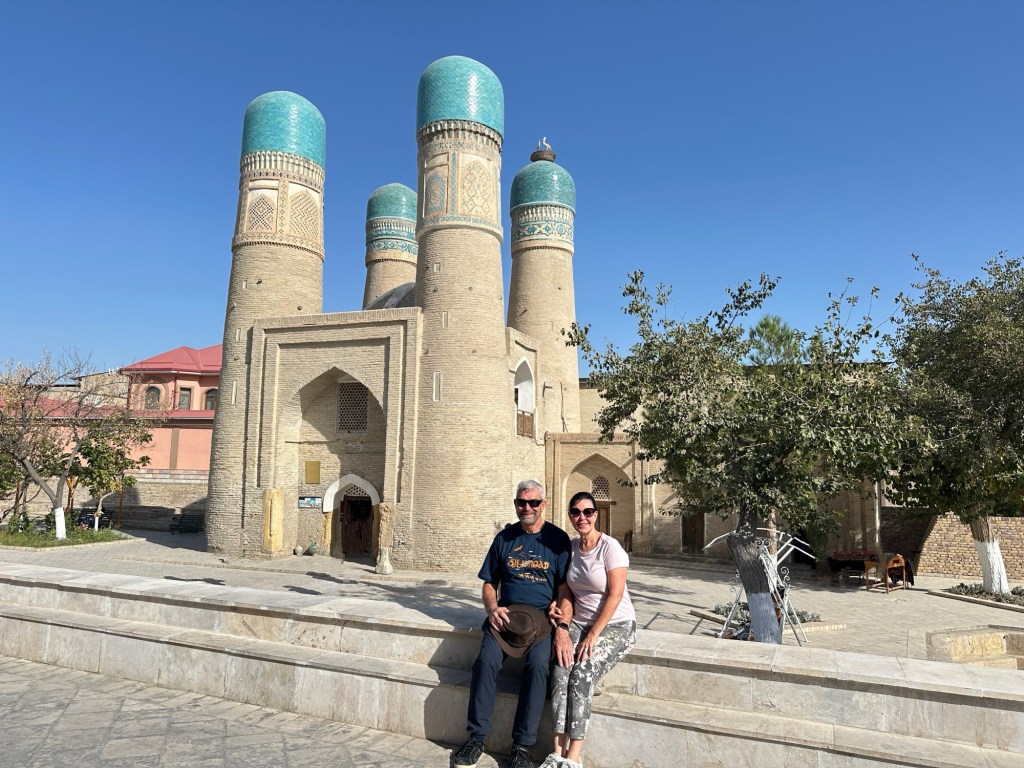
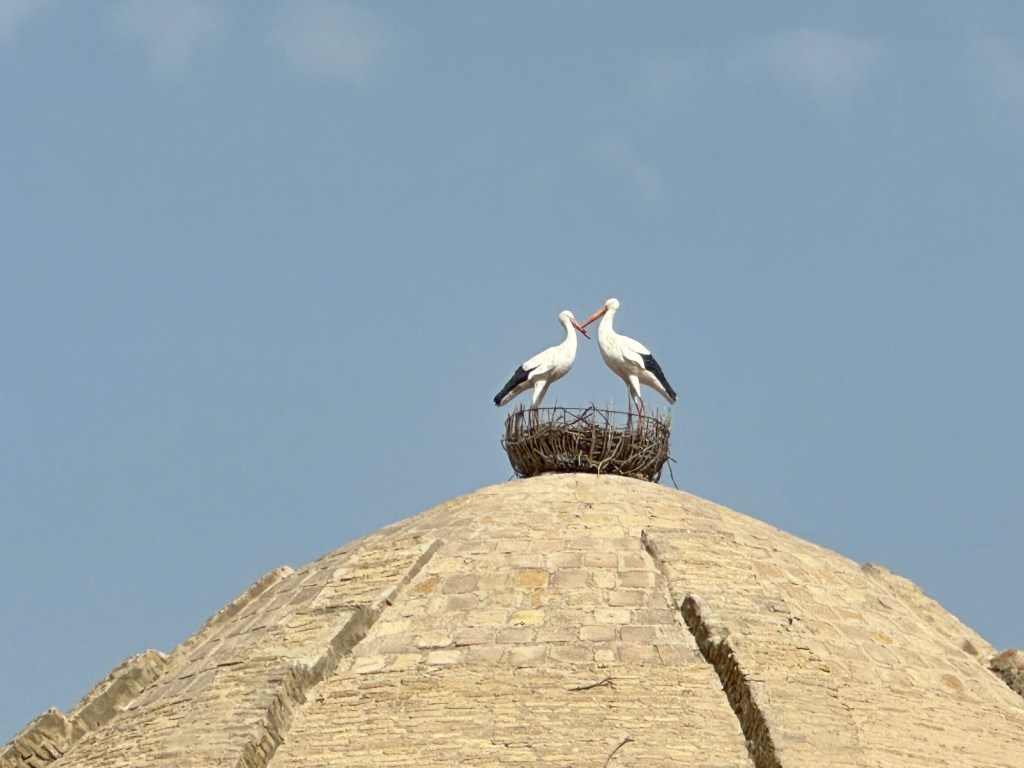
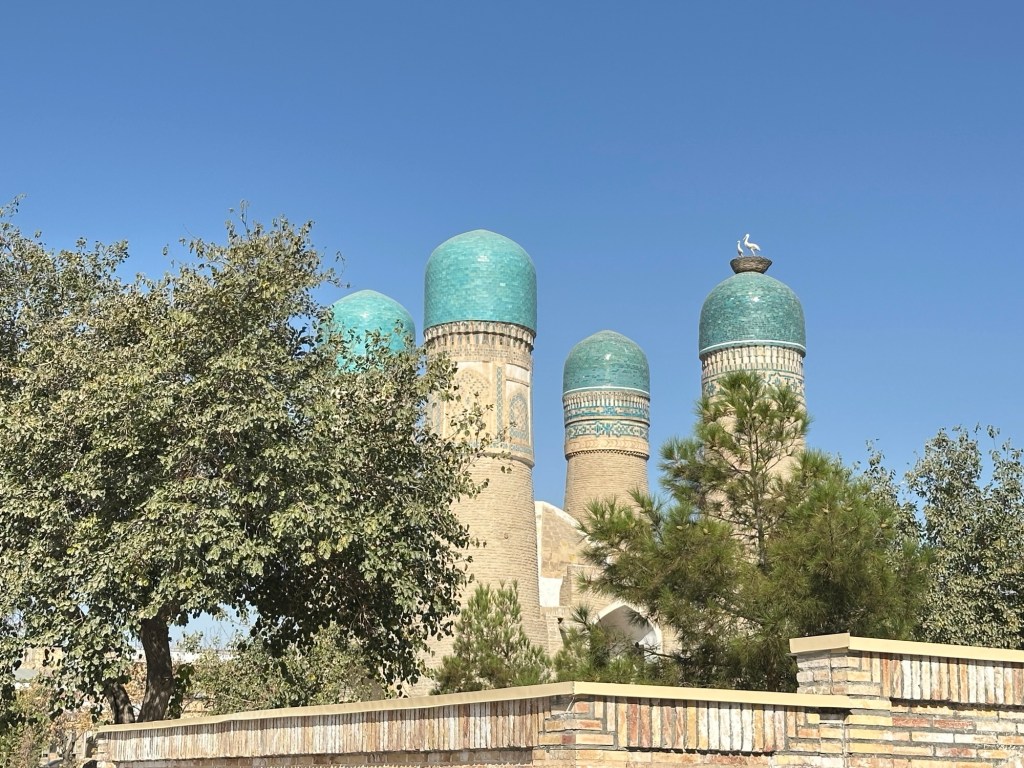
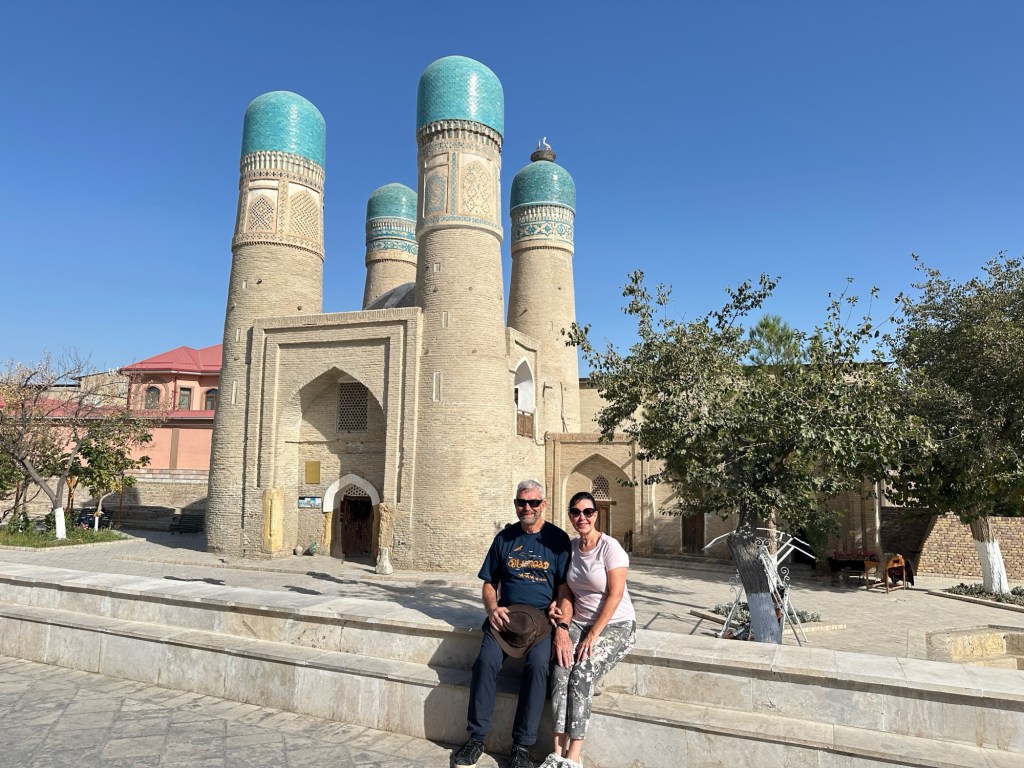
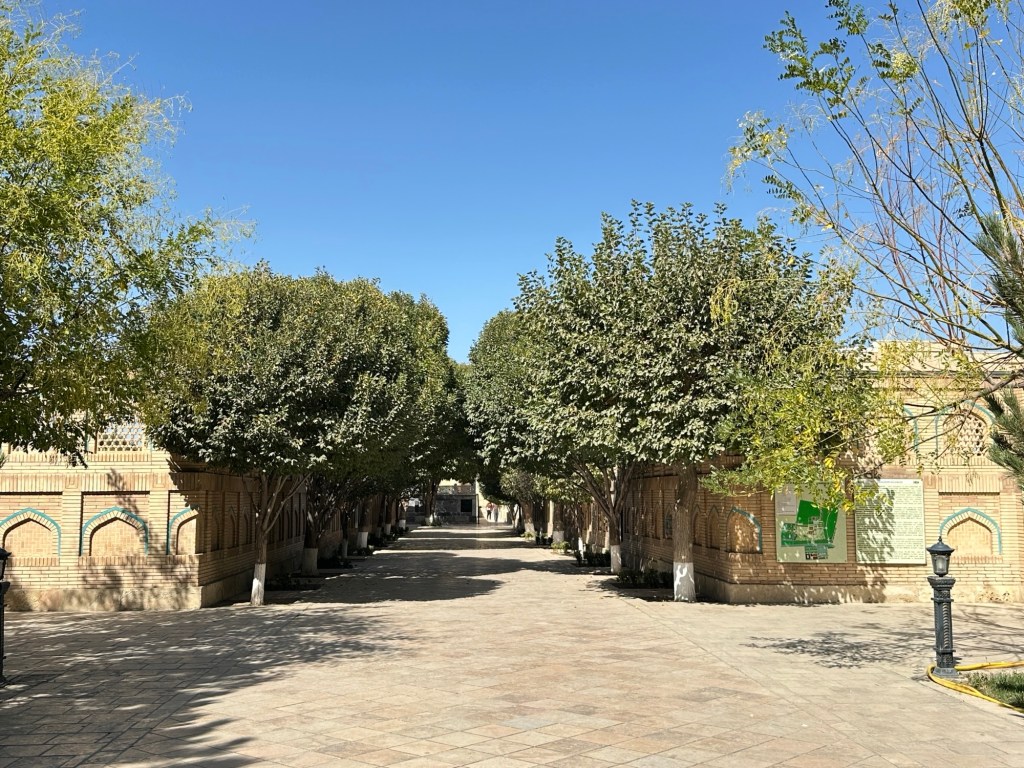
More sight seeing of Bukhara today , this time by car. First stop, Khalifa Niyazkul Madrasah, also known as Chor-Minor, which was opened in1807. This architectural oddity, which resembles an upside-down chair, is actually the gatehouse of a destroyed madrassa. The blue domes of the eponymous four minarets (chor minor) were once topped by storks’ nests and fell into disrepair but have since been restored by Unesco. The architecture of this building was influenced by a similar looking building in Hyderabad in India.
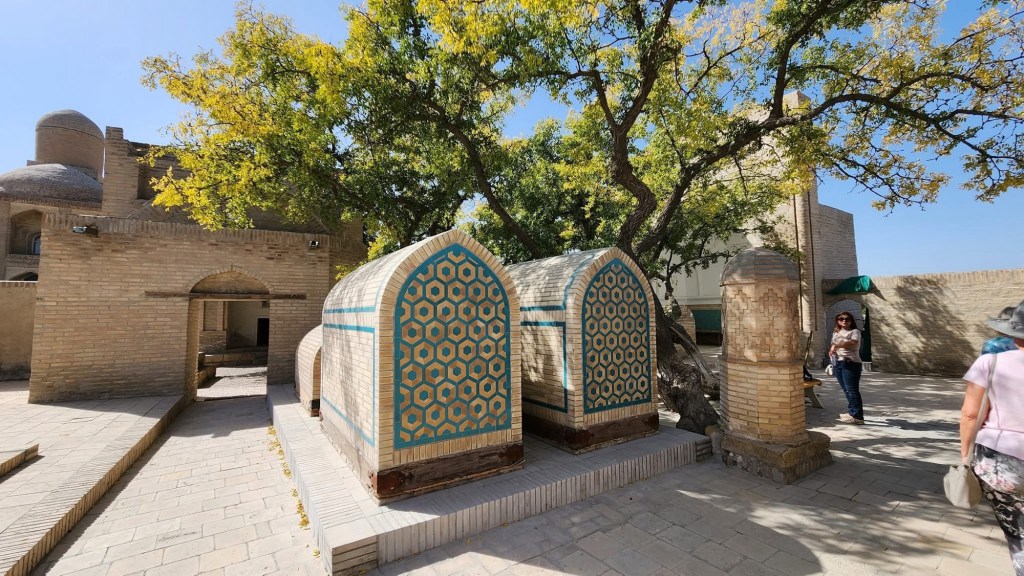
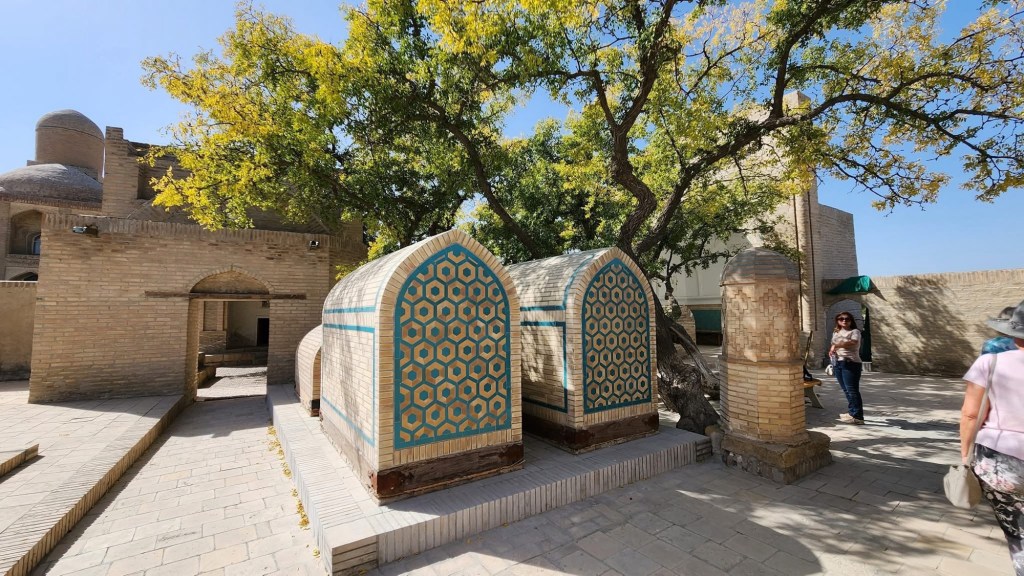
Next a Sufic site, Chor Bakr whose street of tombs is centred around the graves of Sayid Abu Bakr and three brothers. The term sayid denotes a direct descendant of the Prophet Muhammad, and the sanctity this brought the complex made it the preferred burial place of the Bukharan aristocracy. The quiet complex of mosque, pilgrim accommodation, chillakhanas (meditation rooms) and takharatkhanas (place for ablutions) remains a pilgrimage site and its gardens are a tranquil spot for picnics. It is the second most important pilgrimage site after Mecca.
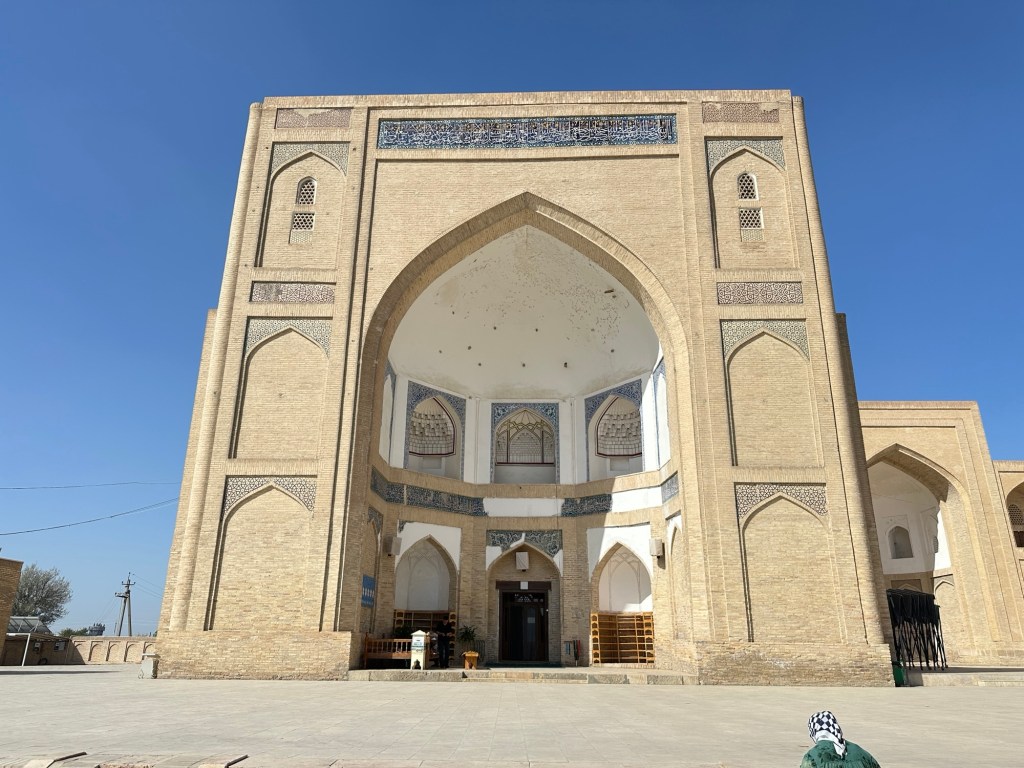
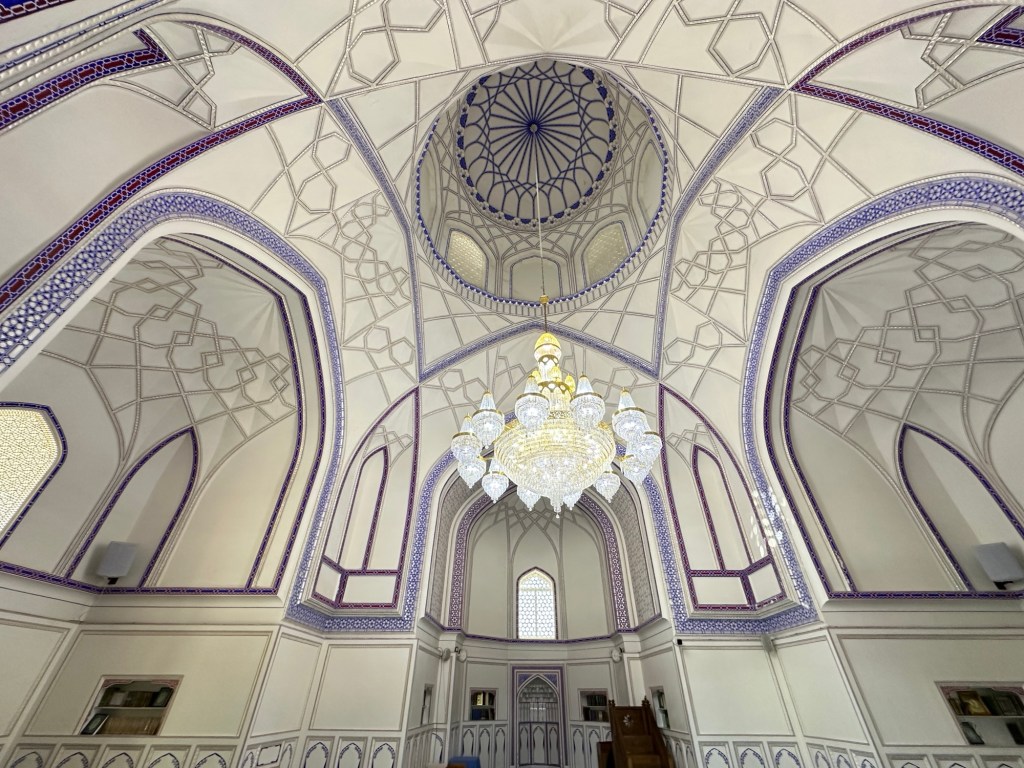
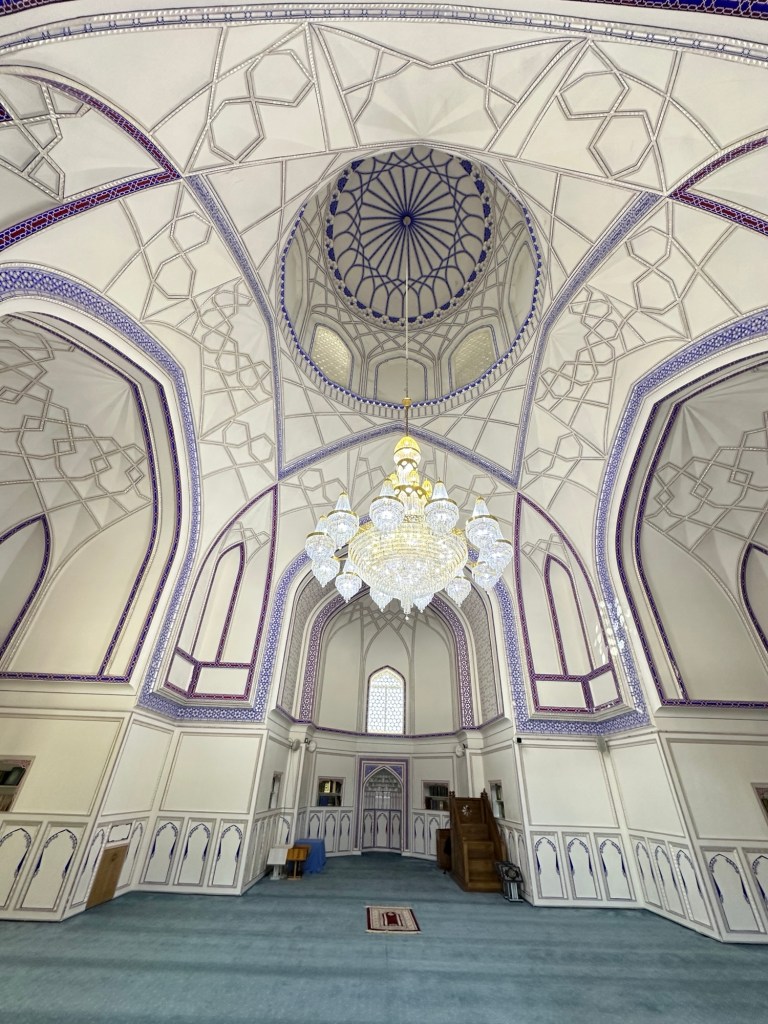
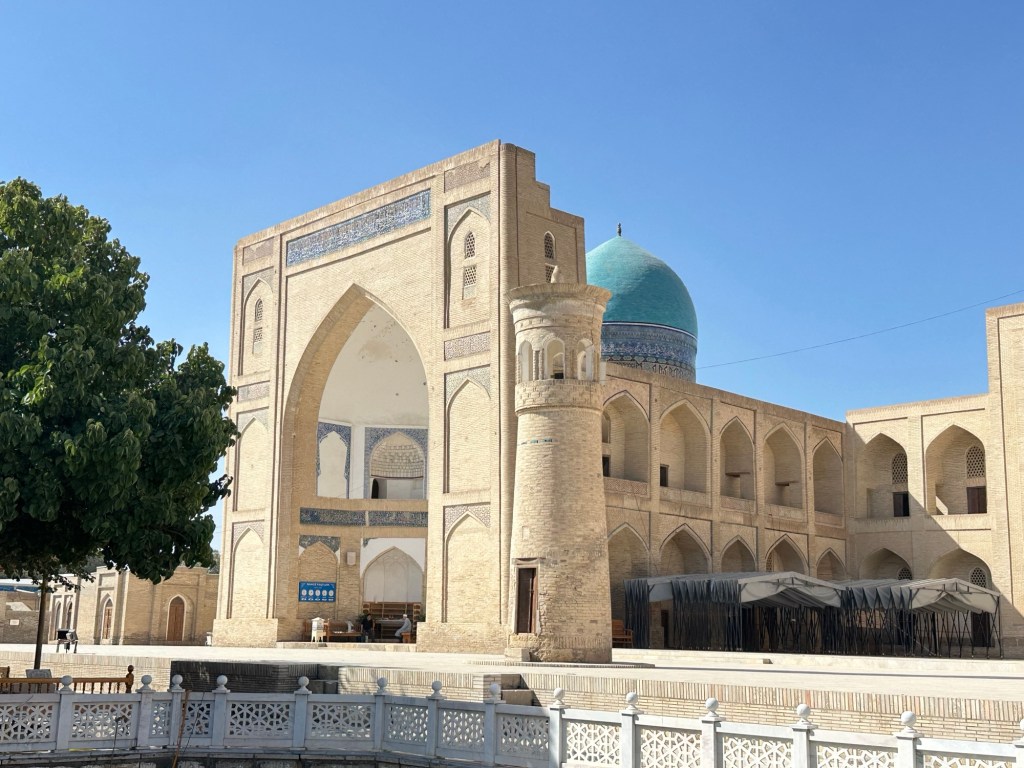
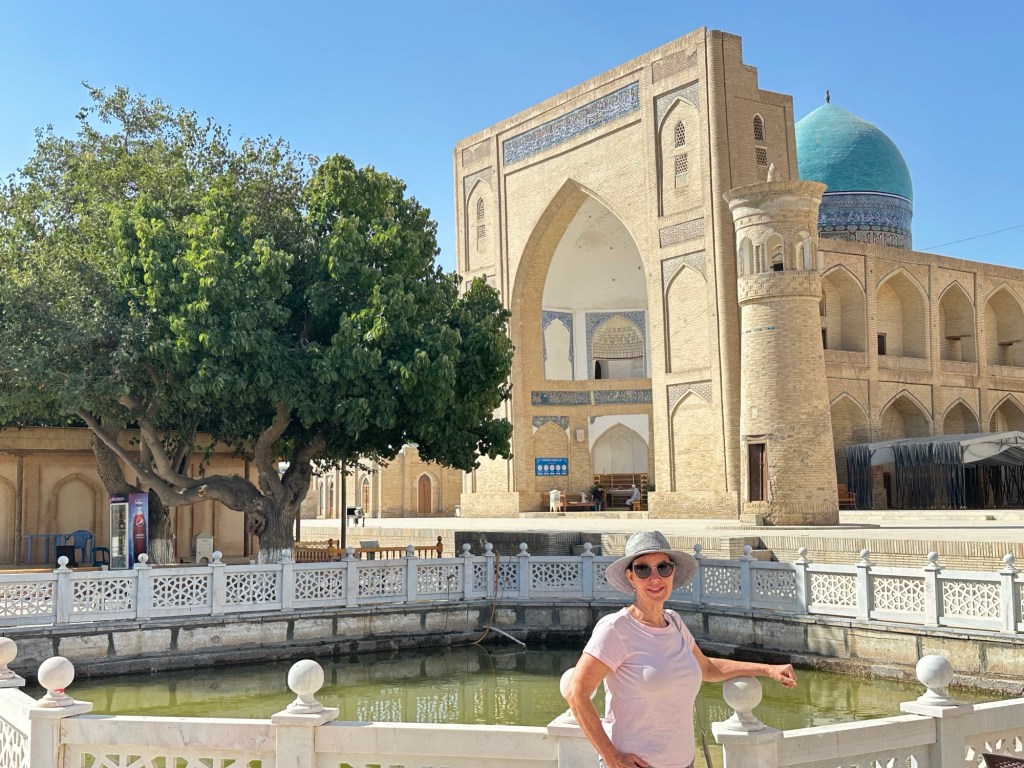
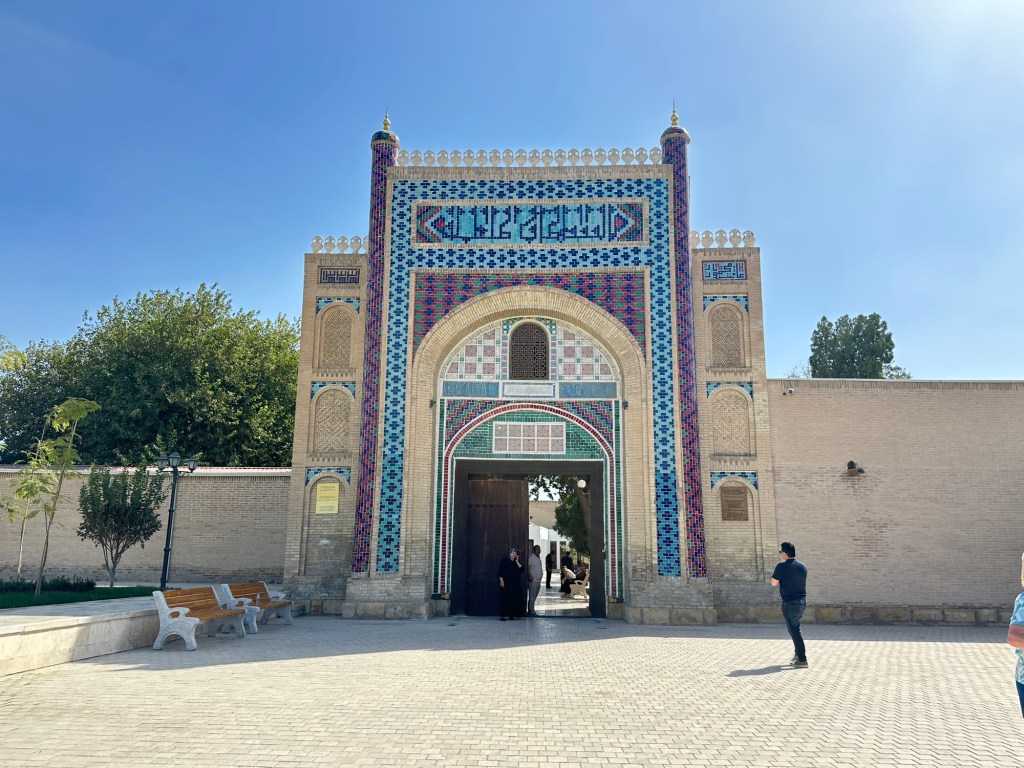
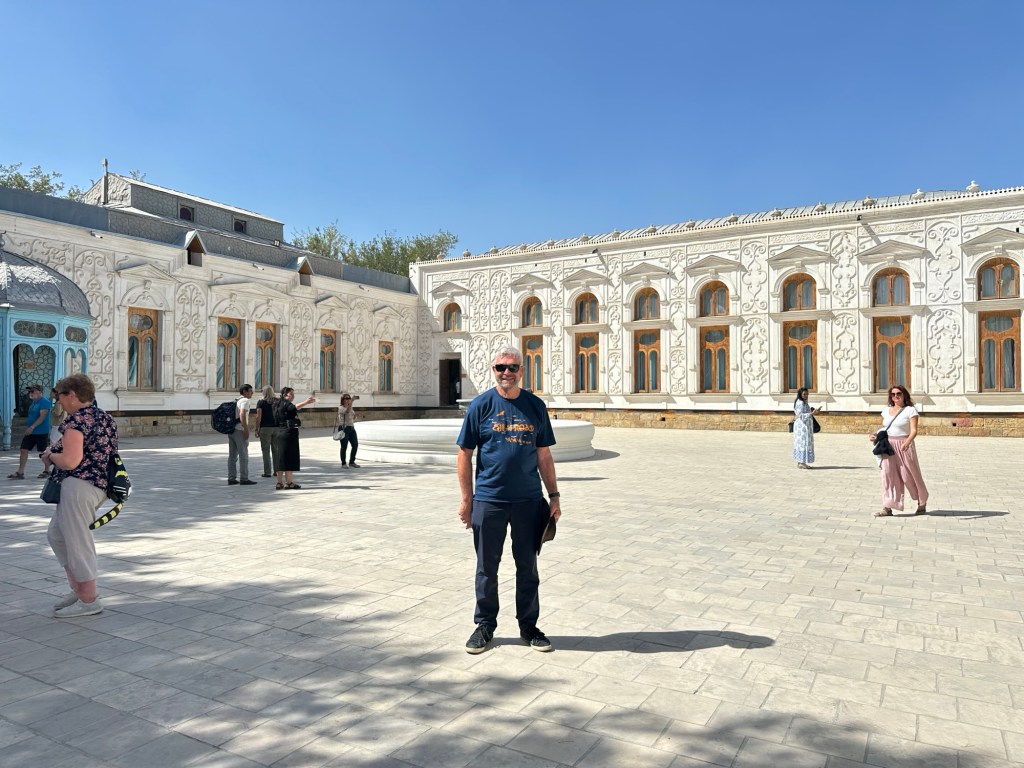
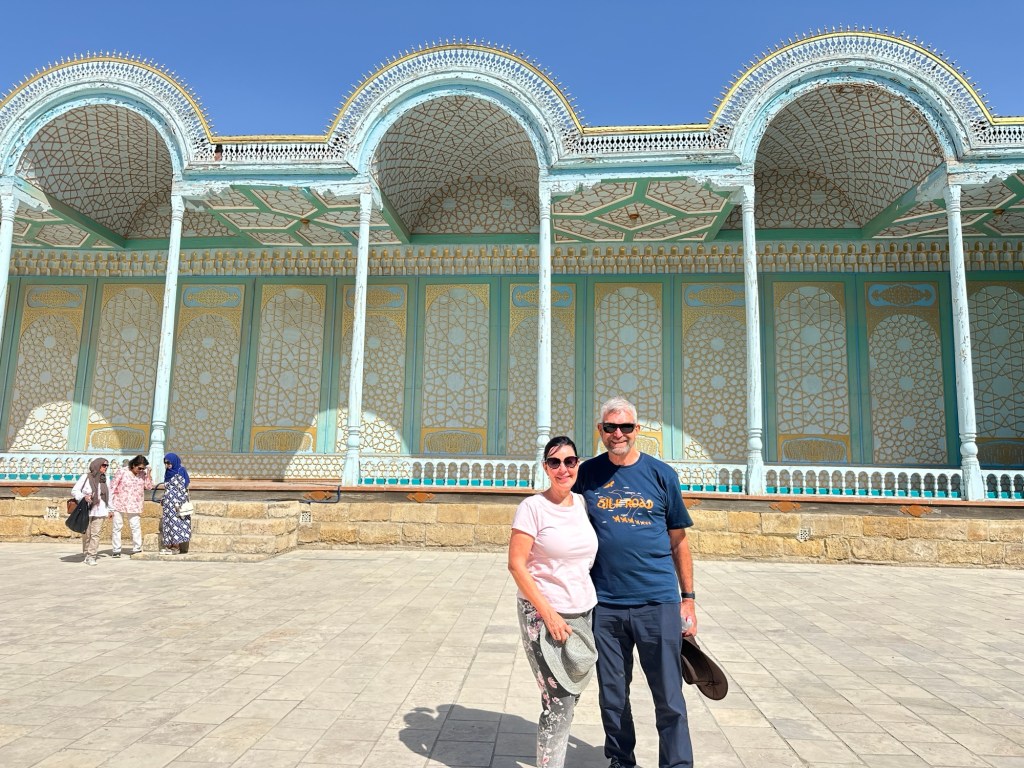
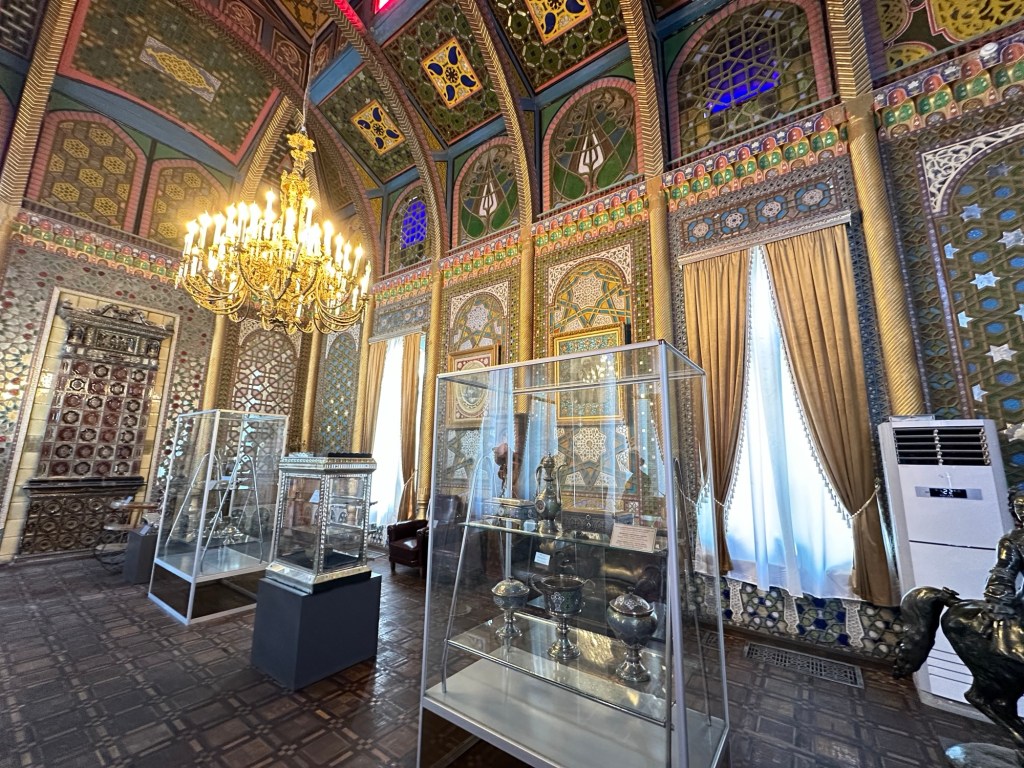
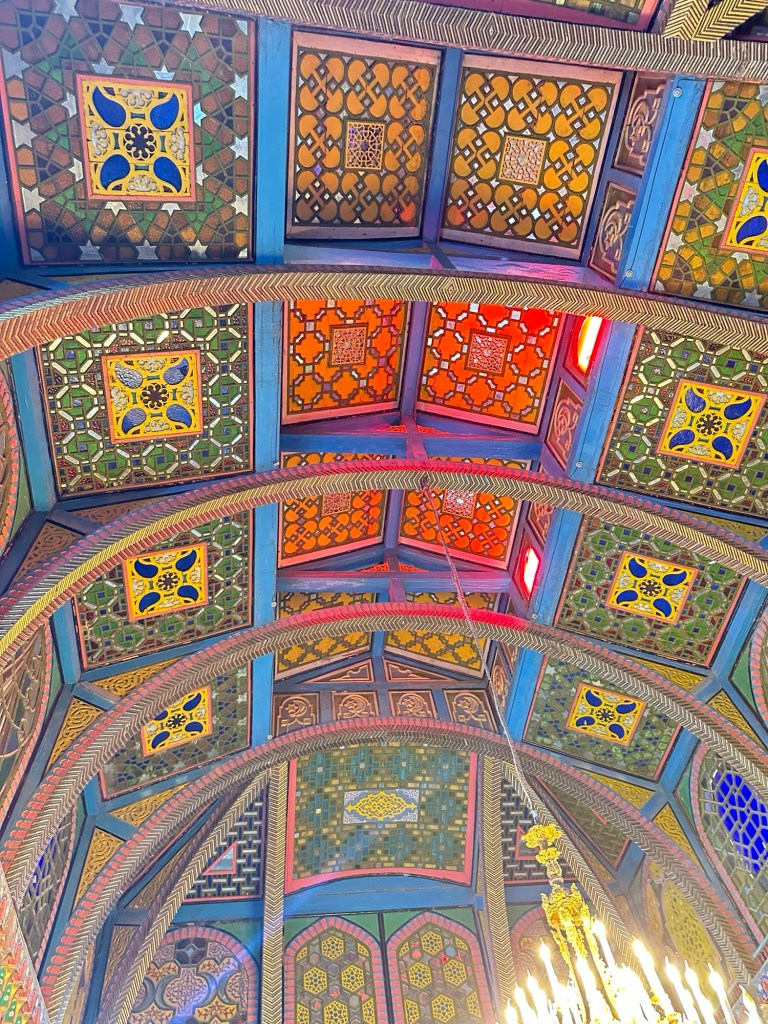
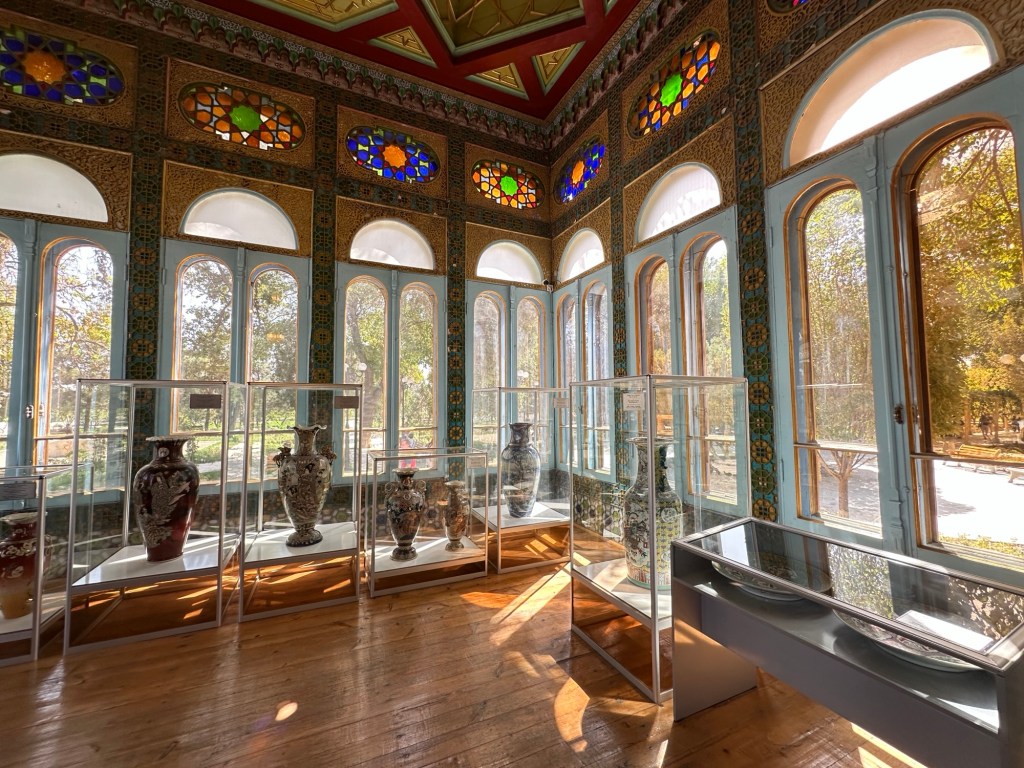
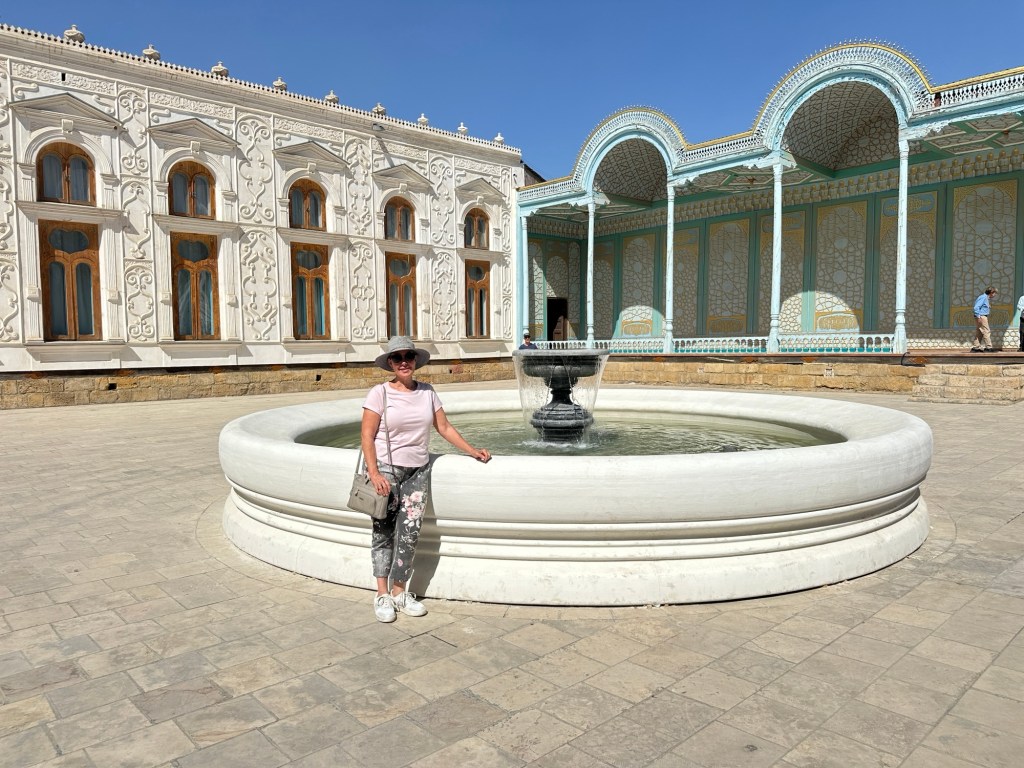
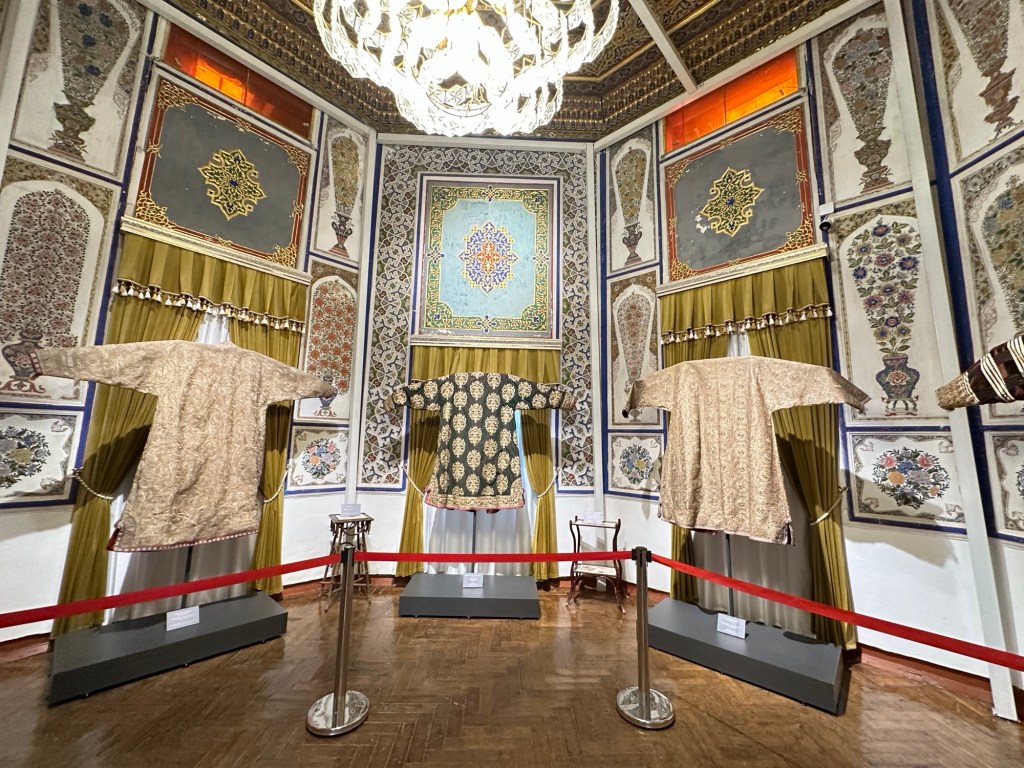
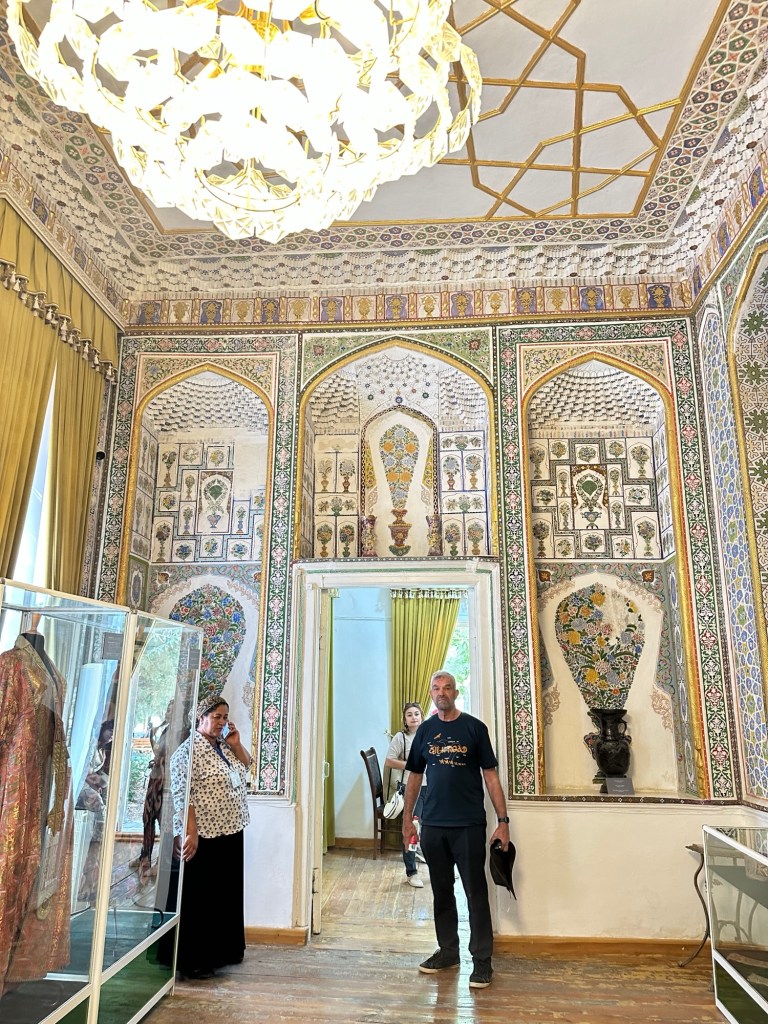
The Emir’s Summer Palace was next. Built by the Russians in 1911, the kitschy half-European, half-Oriental palace was home to the last emir of Bukhara, Alim Khan, until he fled to Afghanistan in 1920. The first Congress of the Bukharan Soviet was held in the palace that same year, heralding the dramatic political changes to come. The wedding-cake-like complex leads into an inner courtyard of reception halls, where the Museums of Applied Arts, National Costume and Needlework are housed. The last museum is housed in the former palace harem, where a voyeuristic emir would watch his concubines bathing, before throwing an apple to his passing favourite.
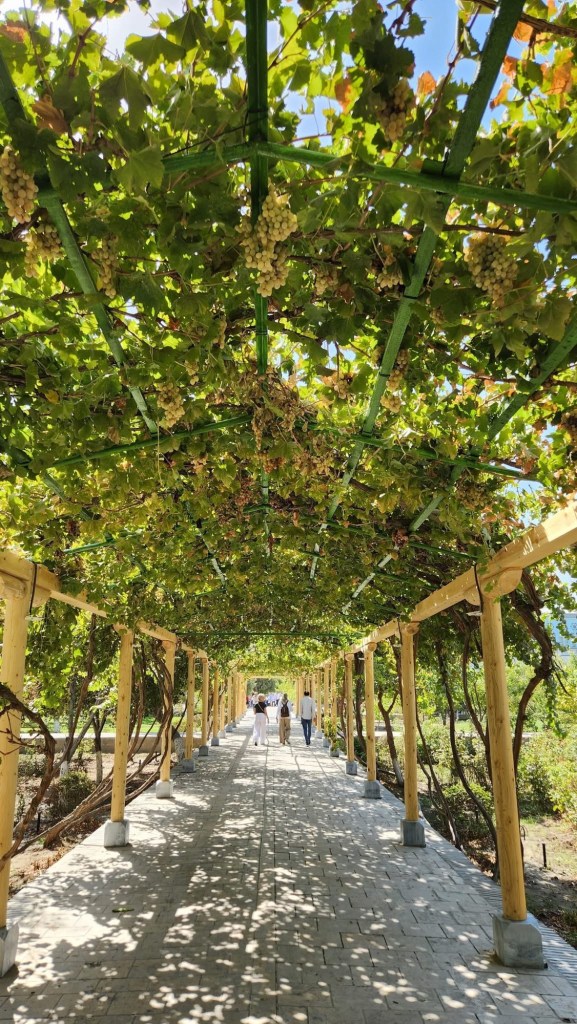
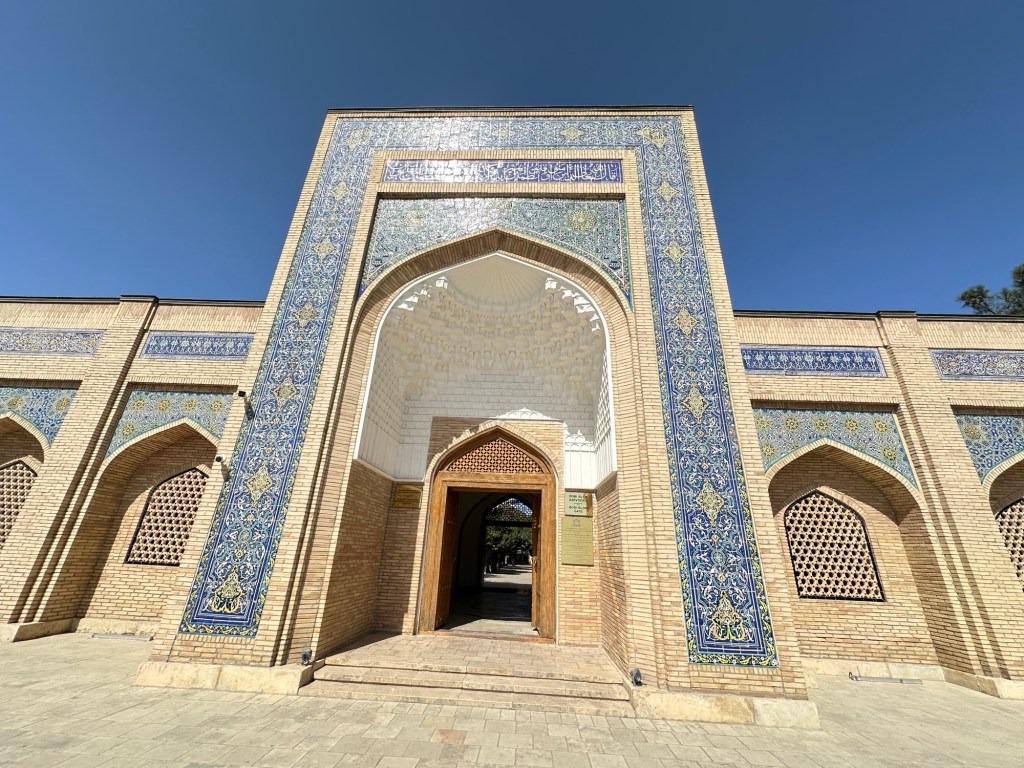
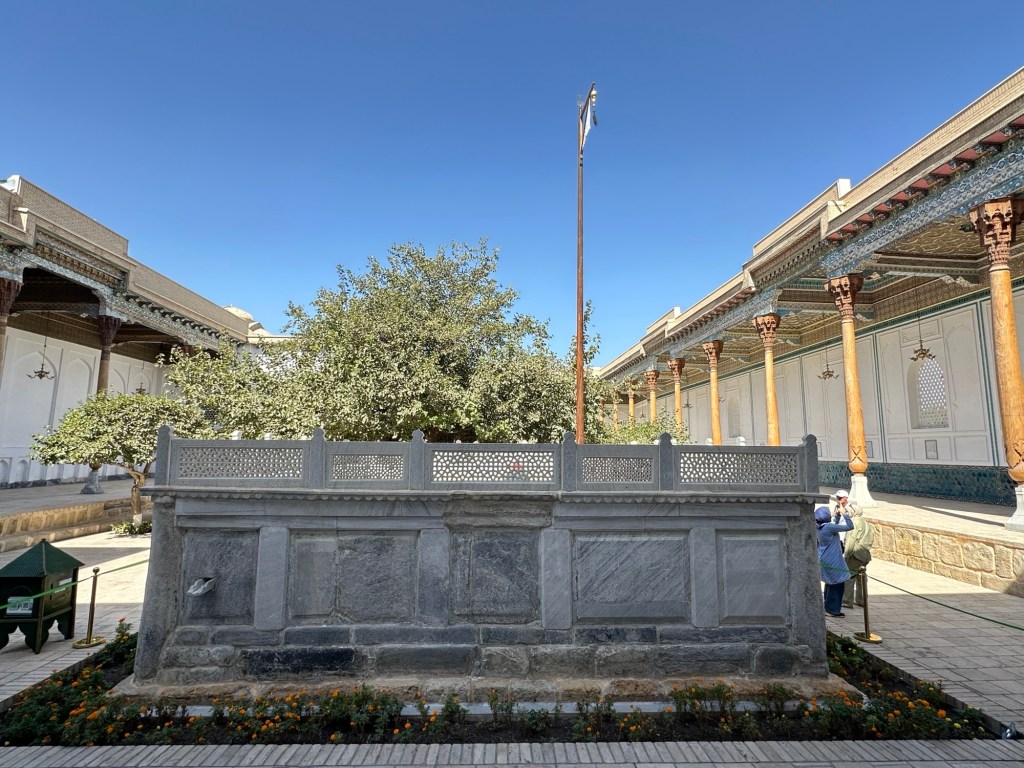
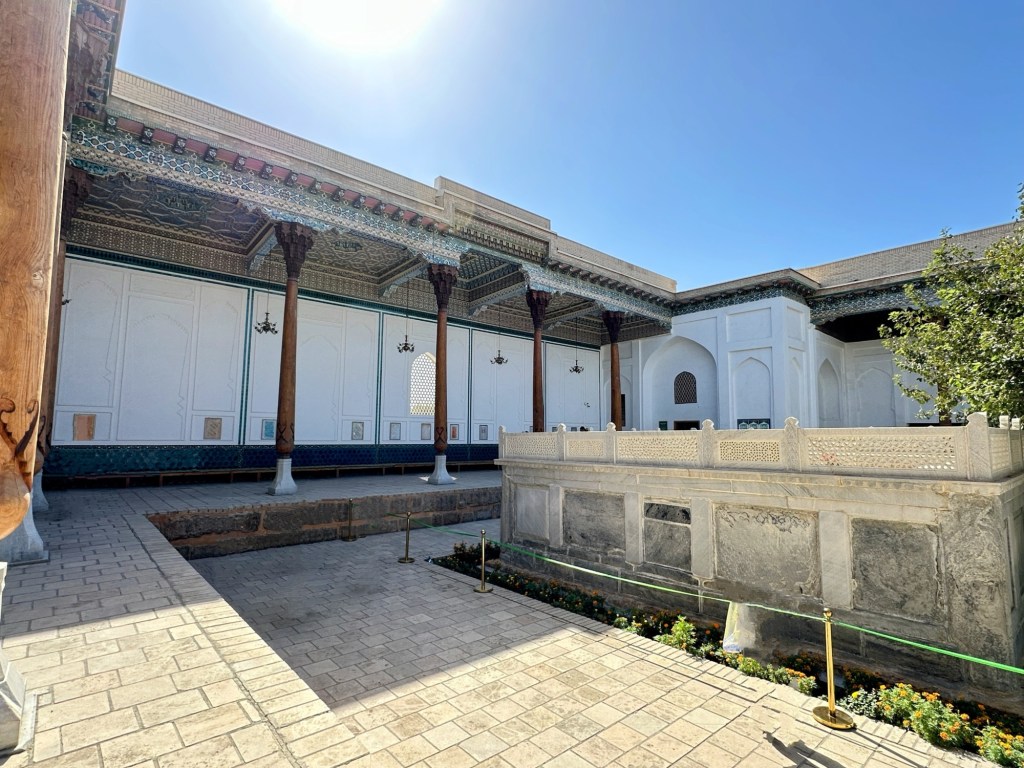
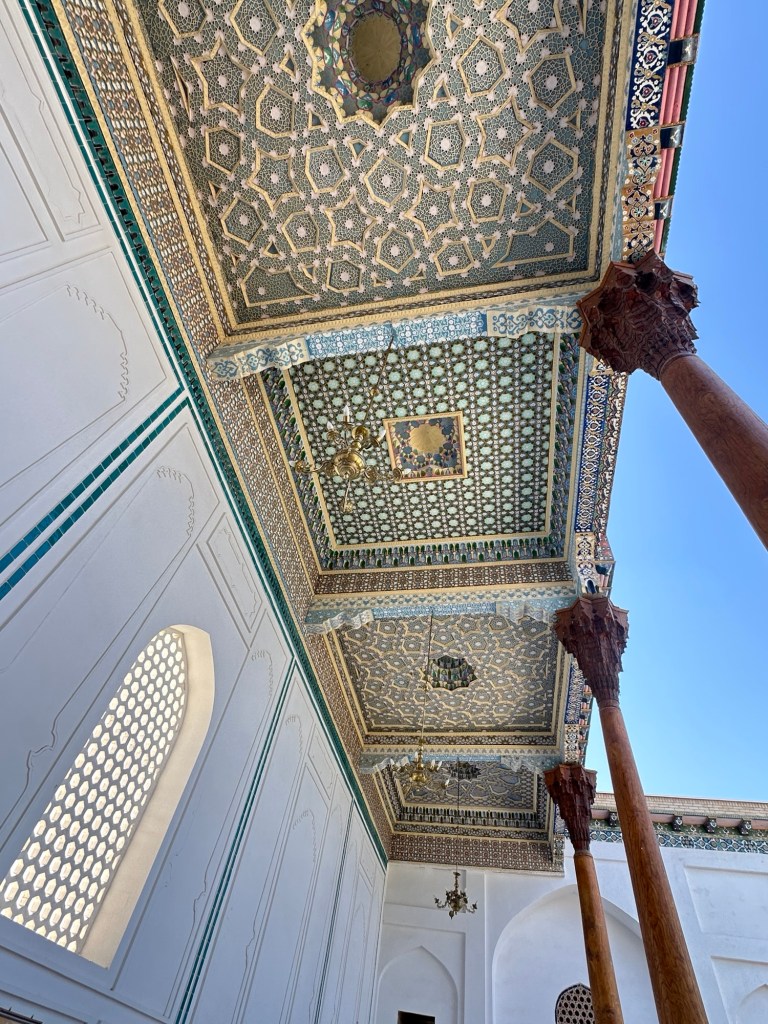
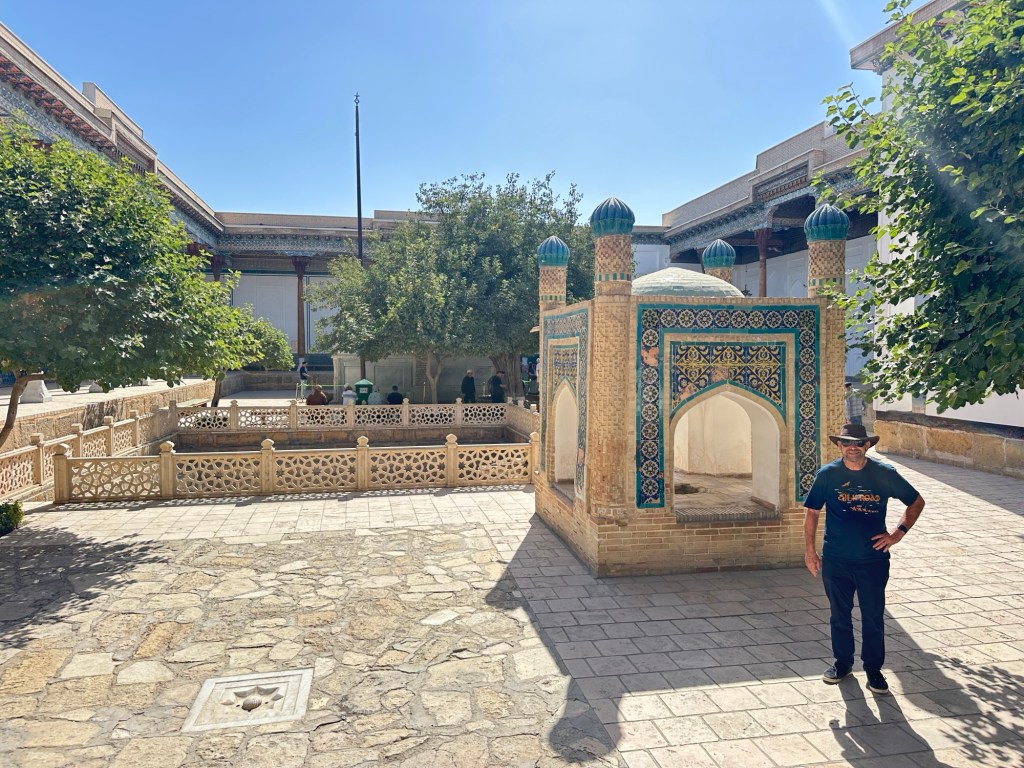
Our last stop in Bukhara was Bakhauddin Naqshbandi complex, which is centred around the tomb of the 14th-century sufi who is Bukhara’s spiritual protector. With its “wishing trees”, holy stones and sacrificial offerings, the site offers a glimpse into Central Asia’s brand of Sufi Islam. Apart from the tomb, the complex includes two mosques, a huge khanqah (spiritual retreat) built in 1544 and the tombs of two khans, Abdul Aziz and Abdullah II. This is the second most important pilgrimage after Mecca.
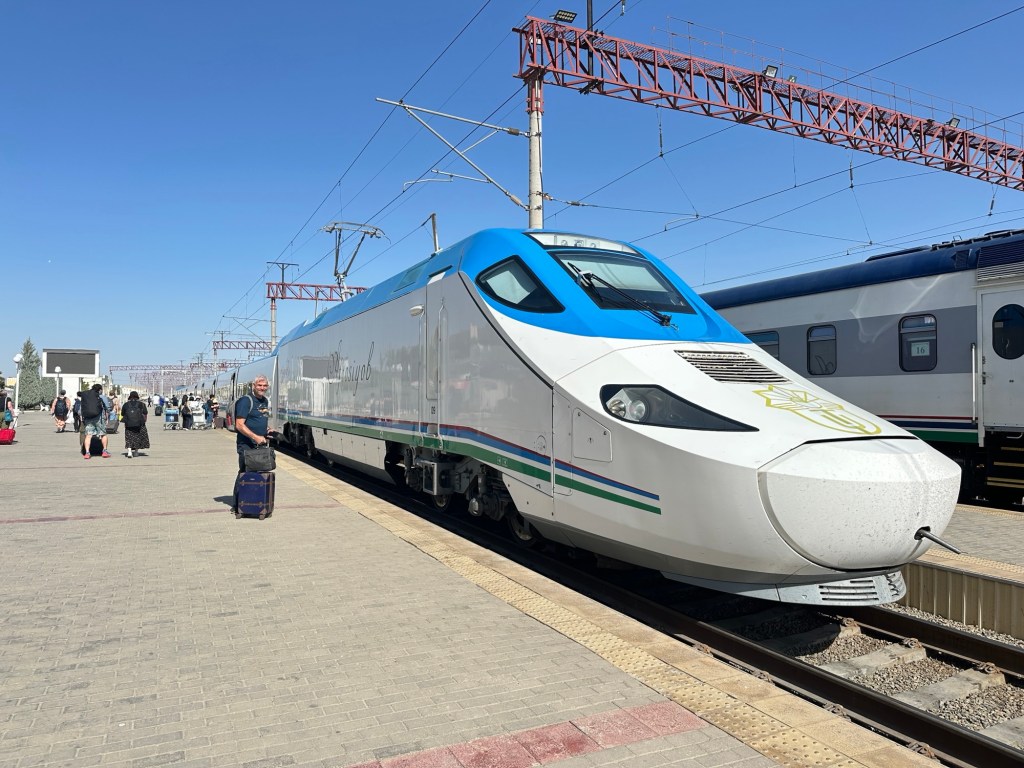
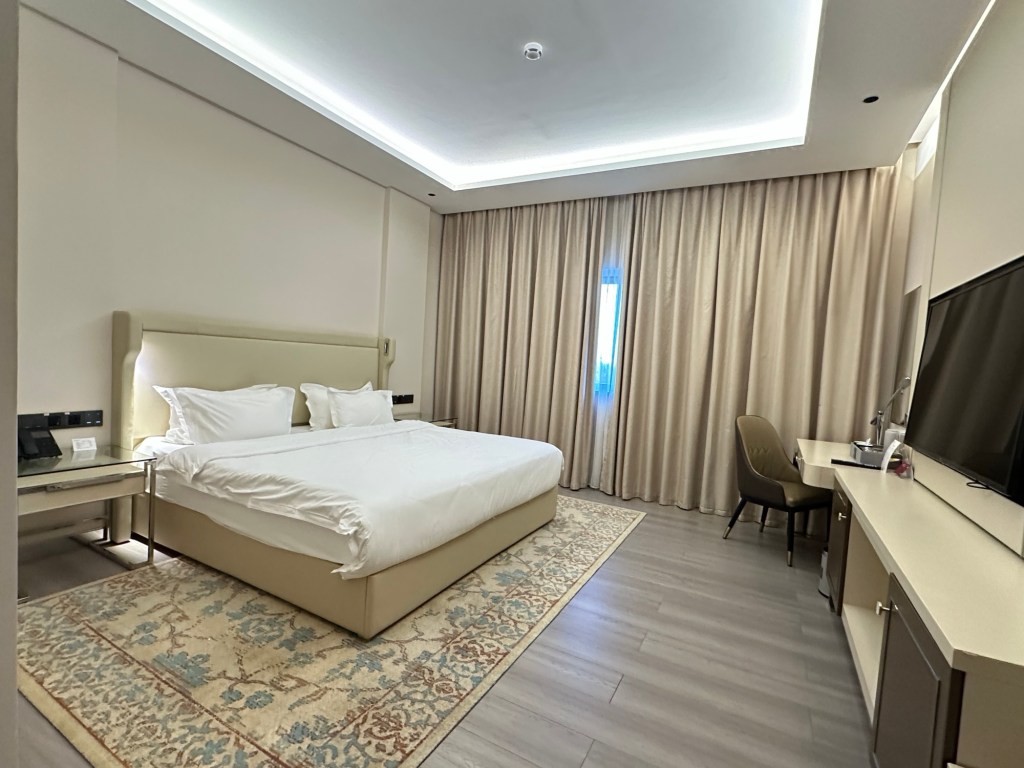
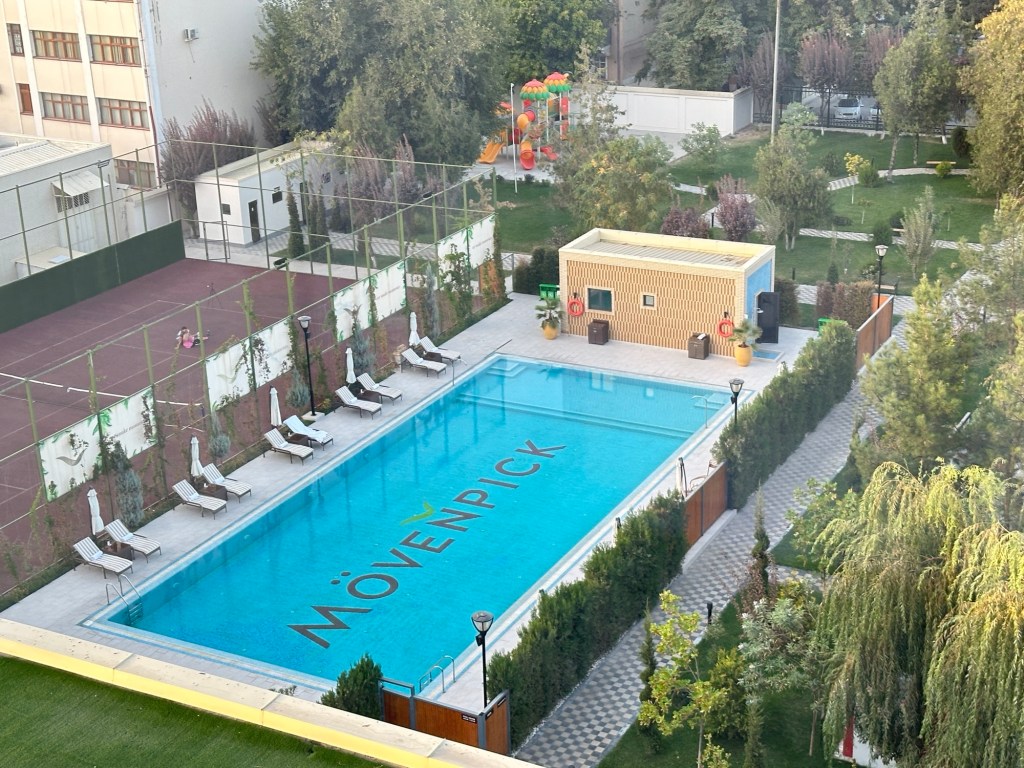
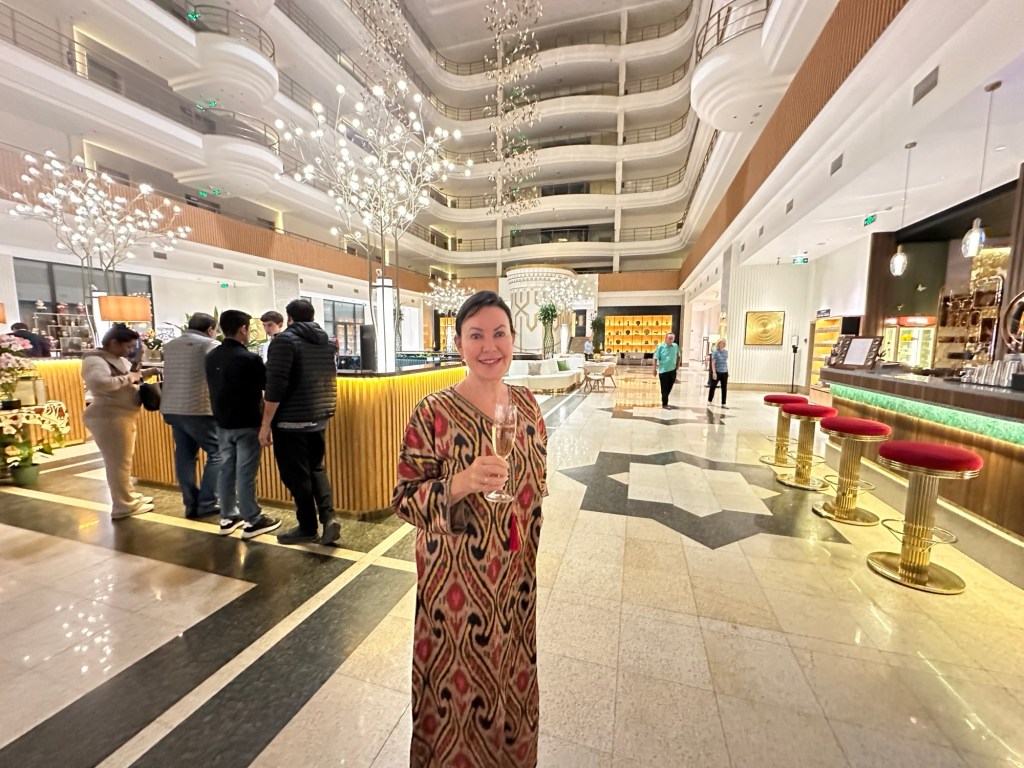
Time for our fast train ride to Samarkand – an almost two hour comfortable ride. Not quite like the bullet train they advertise it as, but very pleasant non the less. Bag storage space was at a premium however – lucky our driver took our bags with him as he drove to Samarkand. The drive to the Movenpick Hotel from the train station at peak hour was interesting – the traffic was horrendous! That mixed with school pick up time made the journey very exciting!
Decided to have a “night in” tonight – the hotel was extremely comfortable. Baked salmon with caviar sauce was just delicious! Bonus, we could actually pay by credit card! Two salmon main meals plus two glasses of wine for $50… and that’s hotel prices!
Day 14
Wednesday 24th September
Samarkand
13-26 degrees, sunny, windy
Founded in around 700 BC, Samarkand is one of the oldest continuously inhabited cities in the world, a crossroads of cultures and a hub of learning and trading – especially during the heyday of the ancient Silk Road, which passed through the city. Our local guide today was Fera, who was very keen to share Samarkand’s highlights with us.
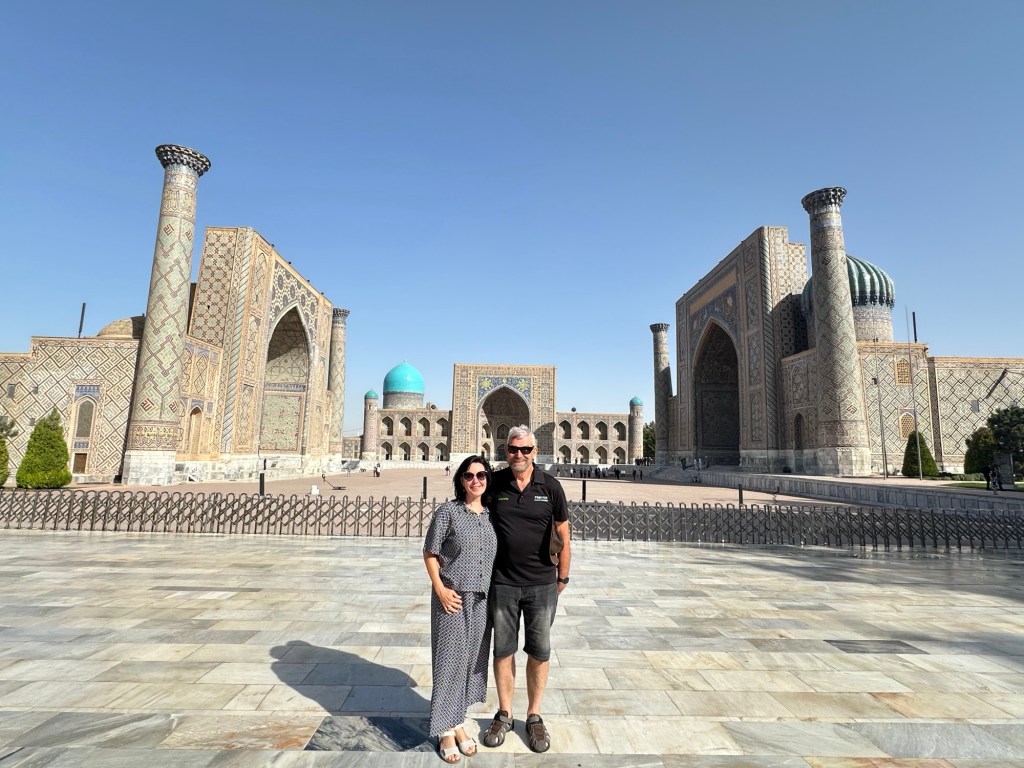
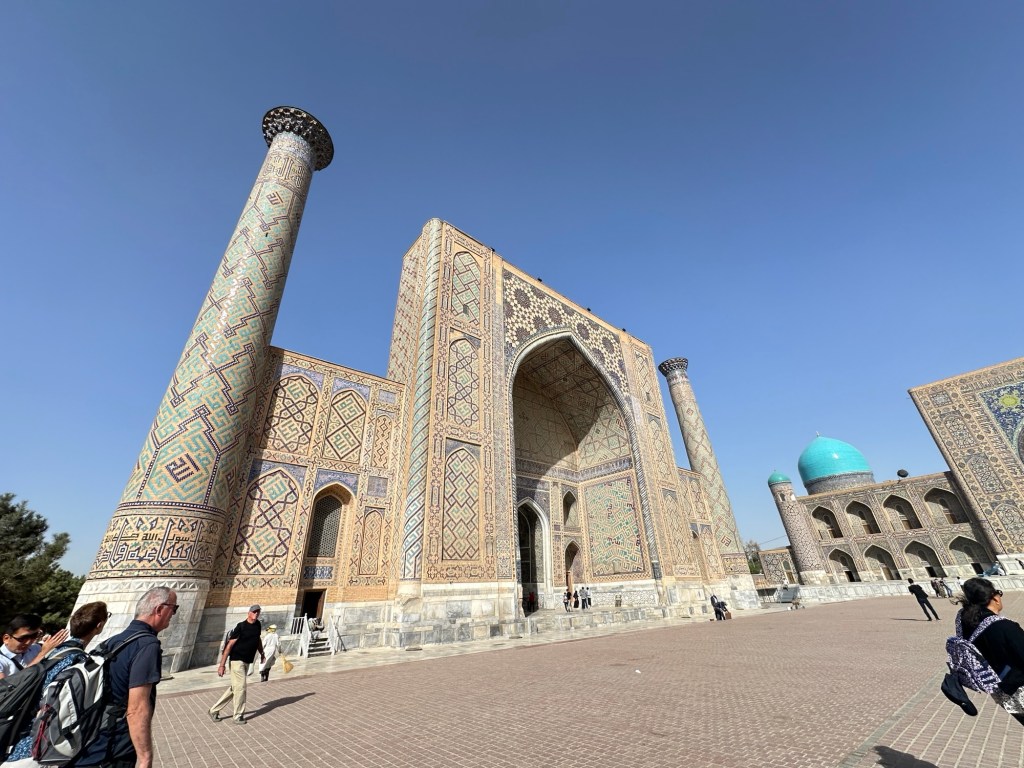
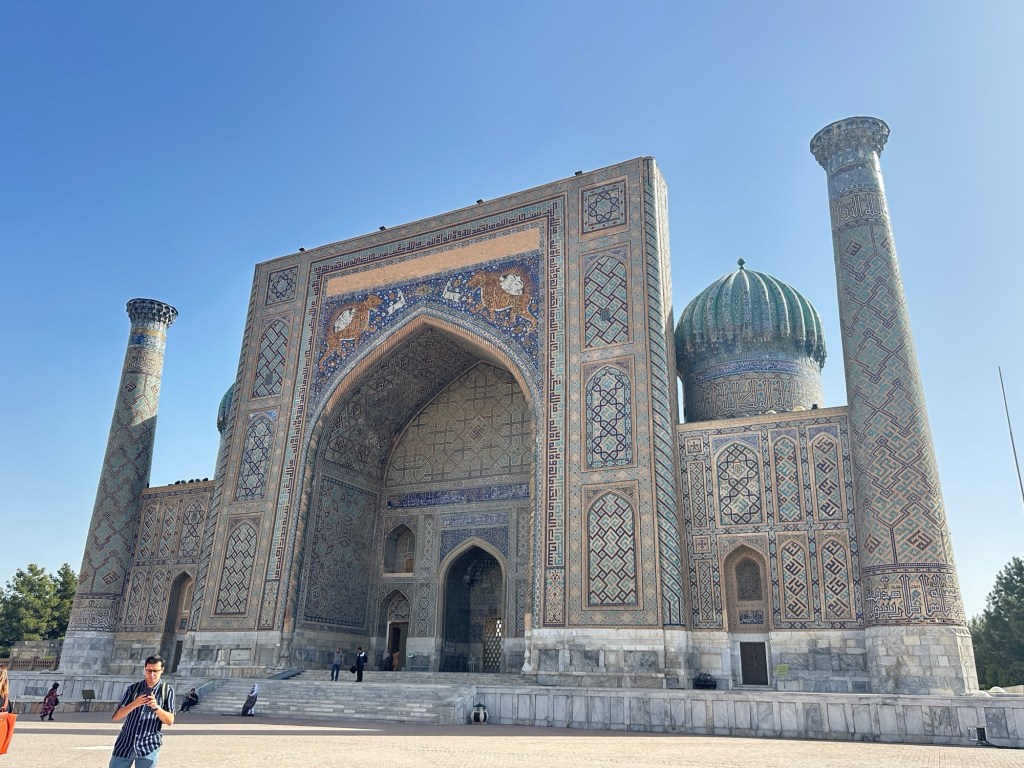
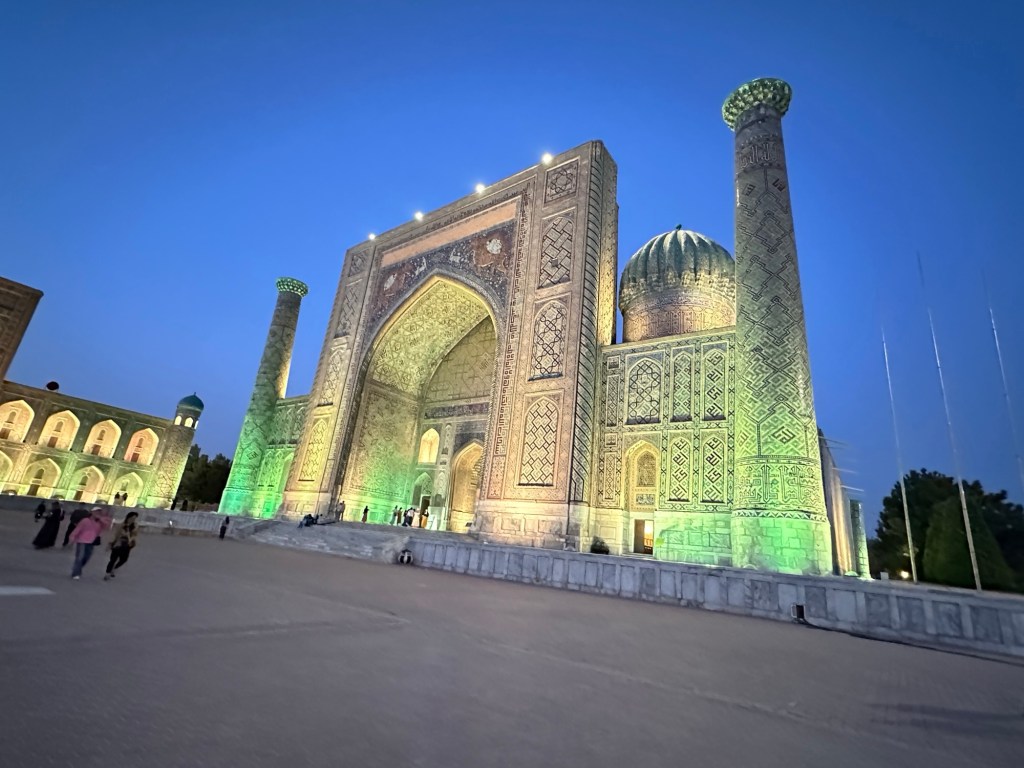
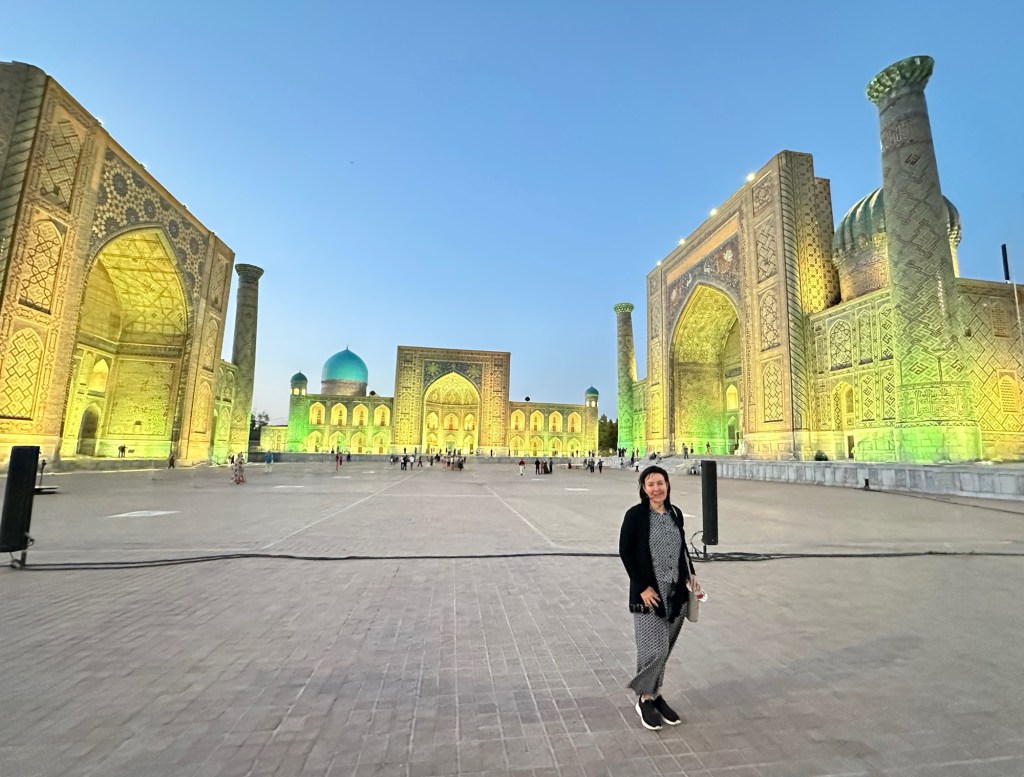
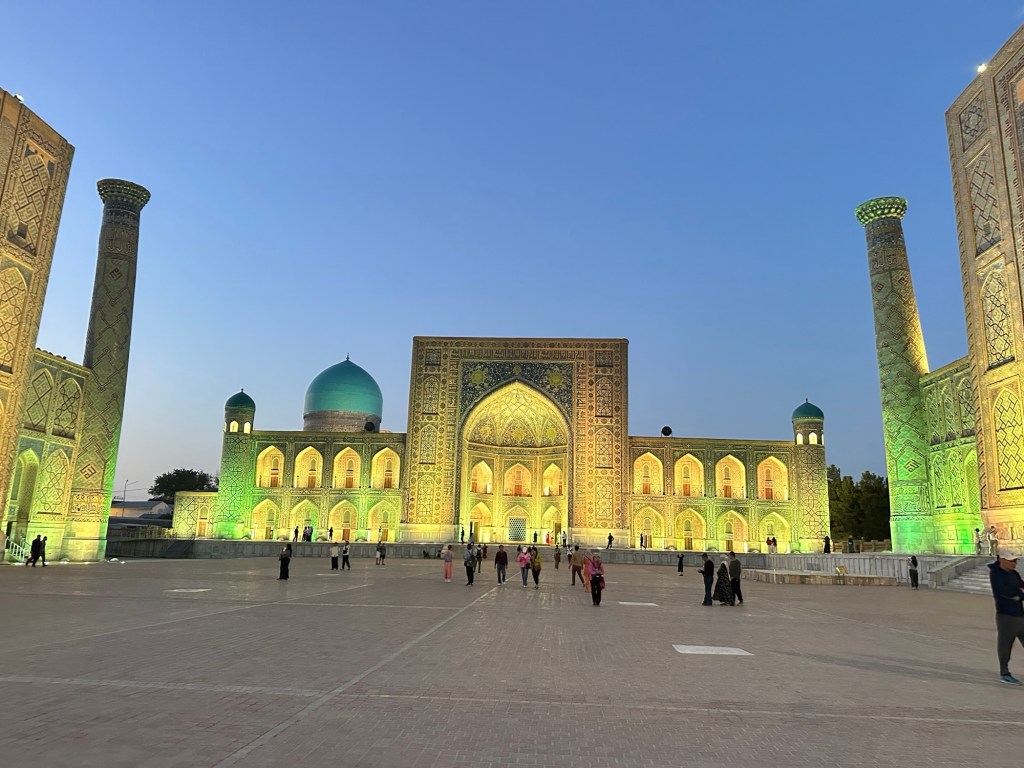
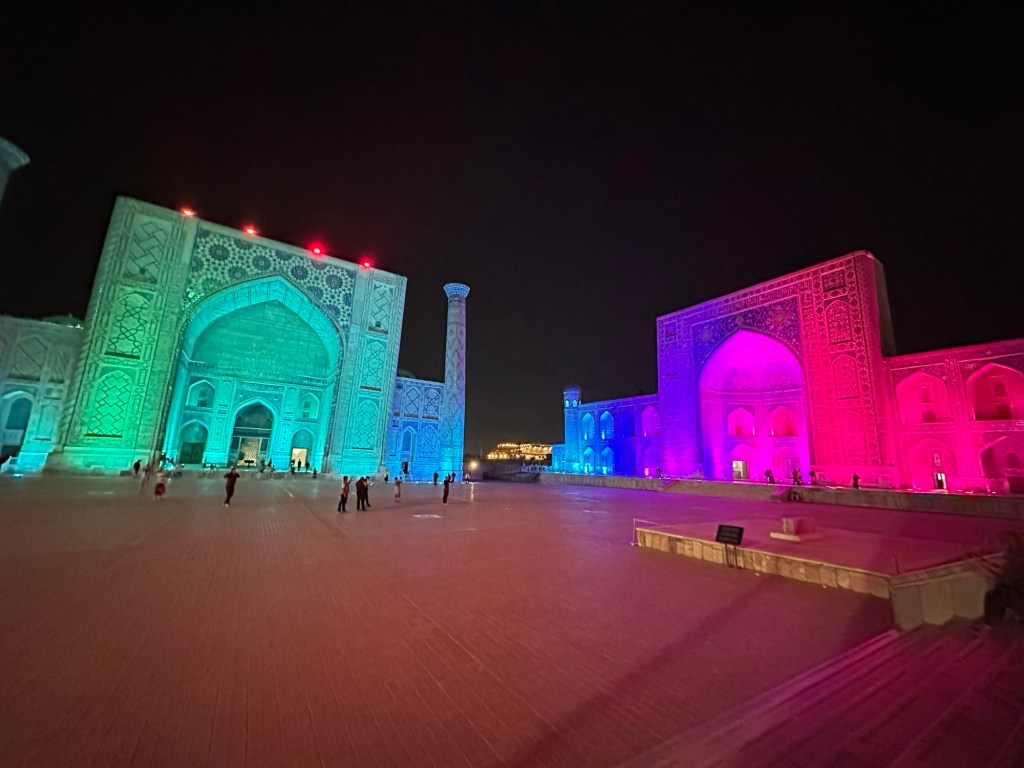
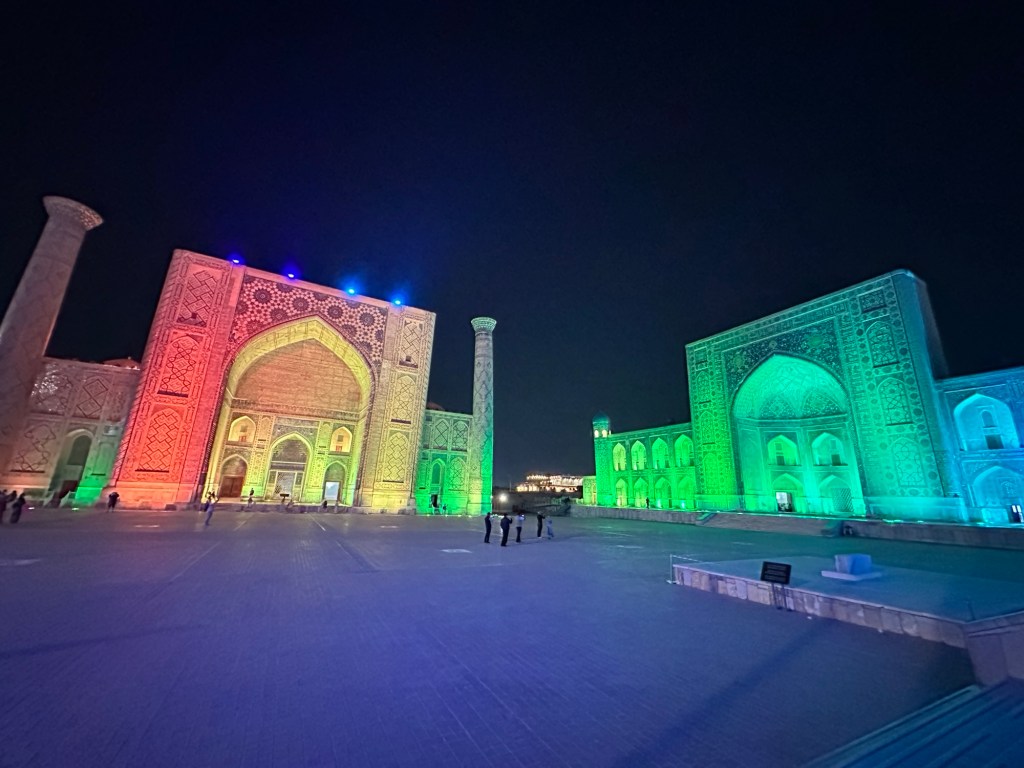
First stop was Registan Square (it means sandy place) which has to be the single most dramatic architectural ensemble in Central Asia. Three towering madrassas, saturated from head to toe in mesmerising tilework, rise around a central plaza. The Registan was originally a market area, where the six roads of the city met in a trade crossroads. It was later used for military parades and public executions, while the Bolsheviks used it for political rallies, trials and veil burnings.
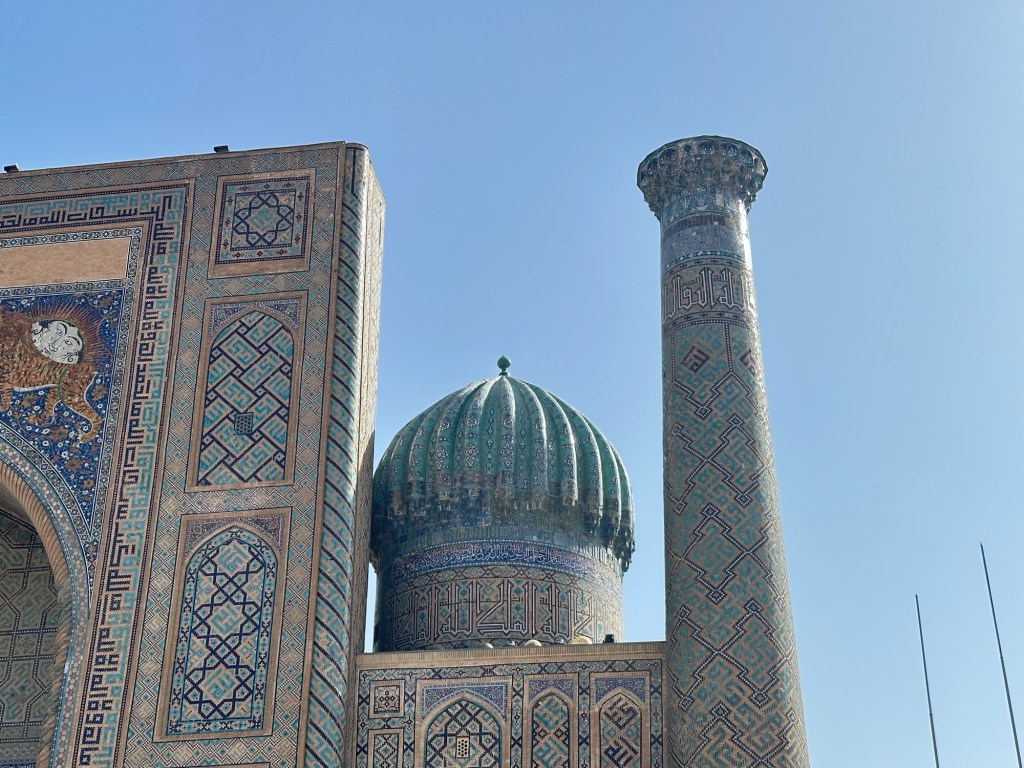
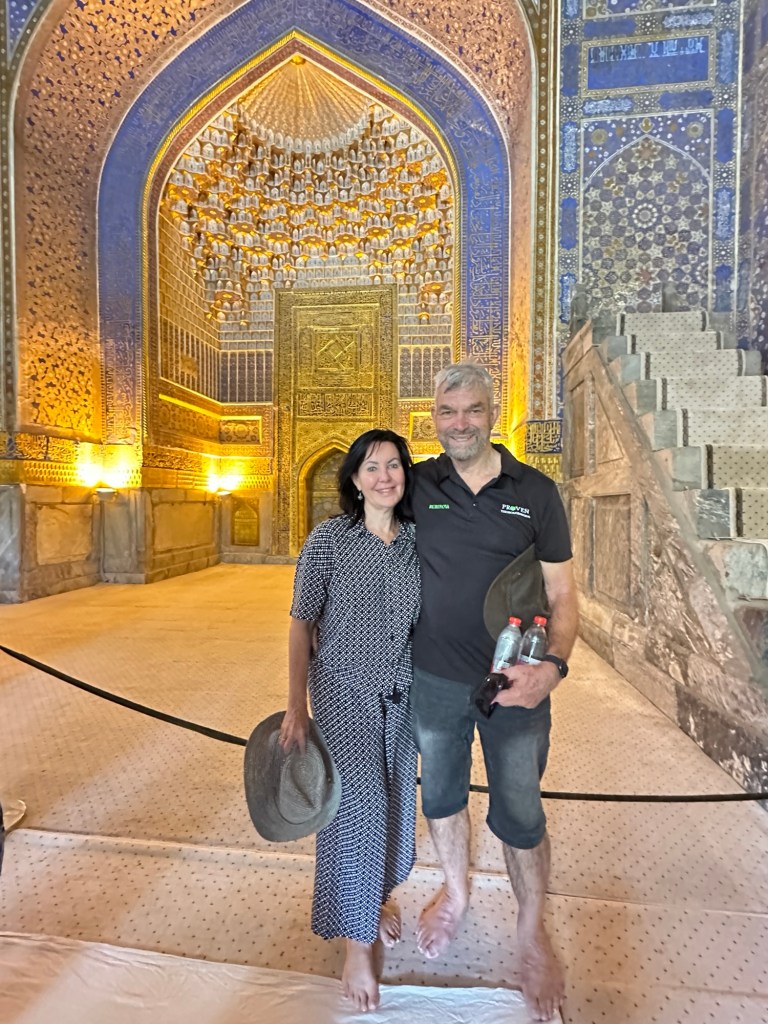
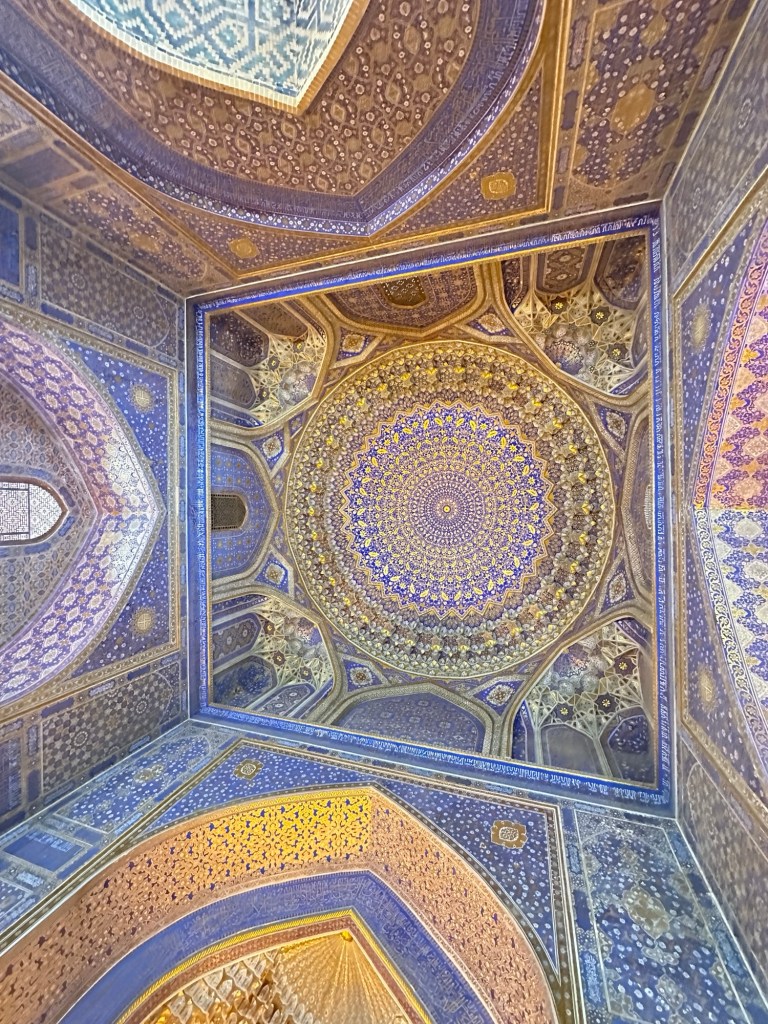
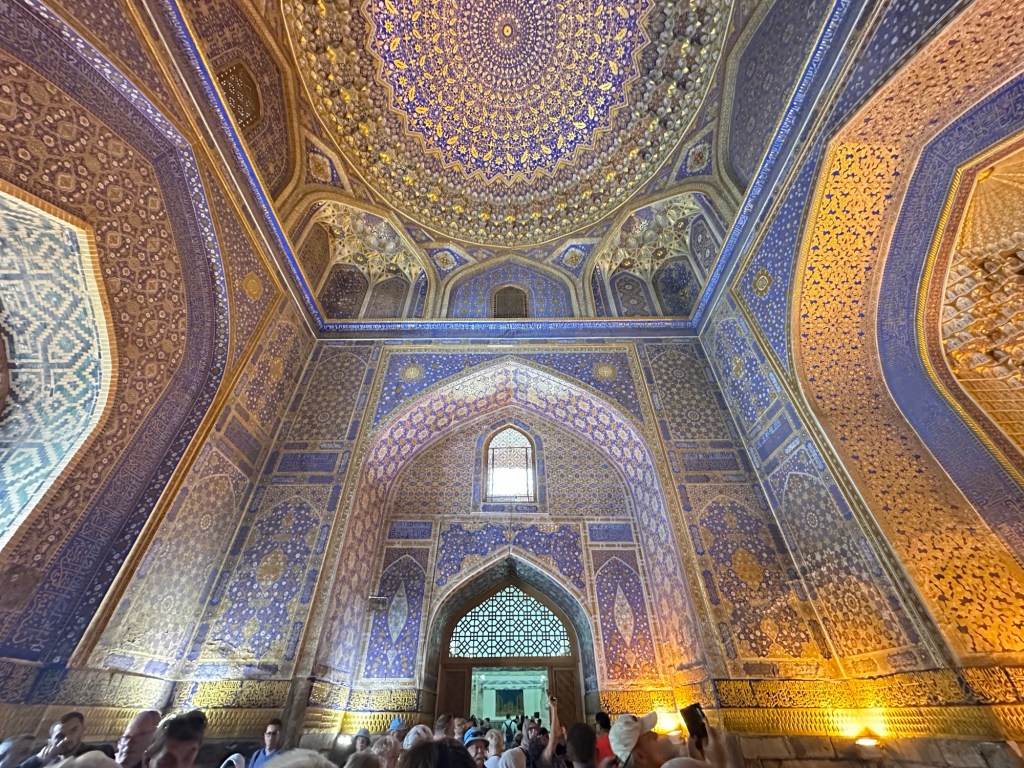
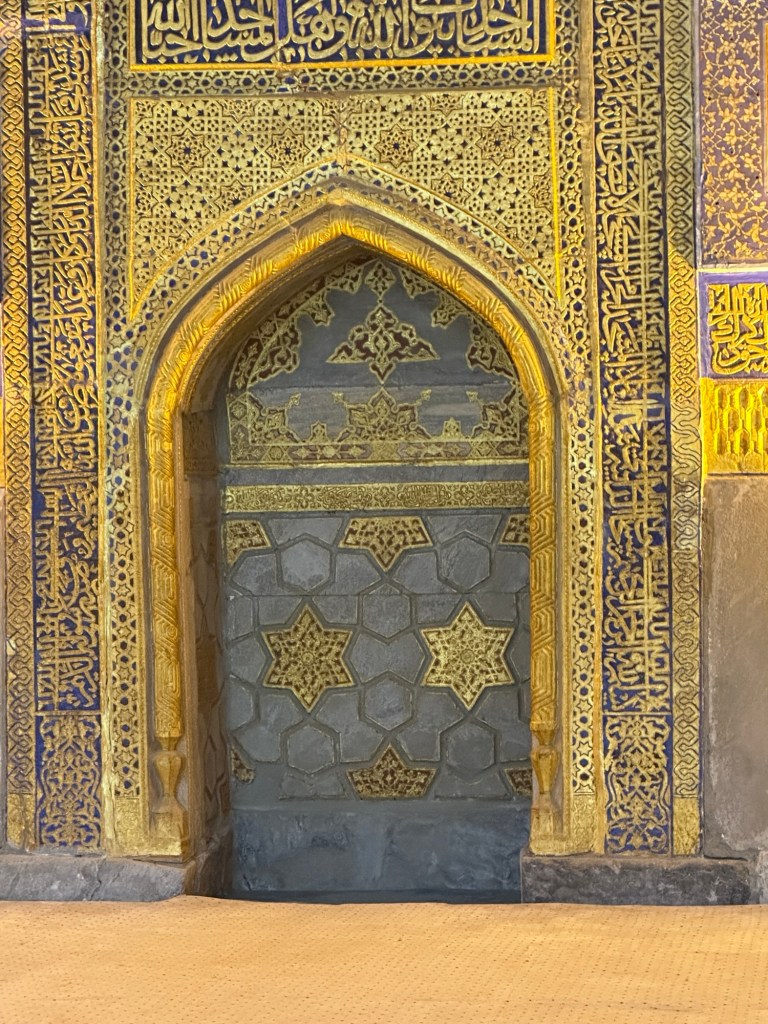
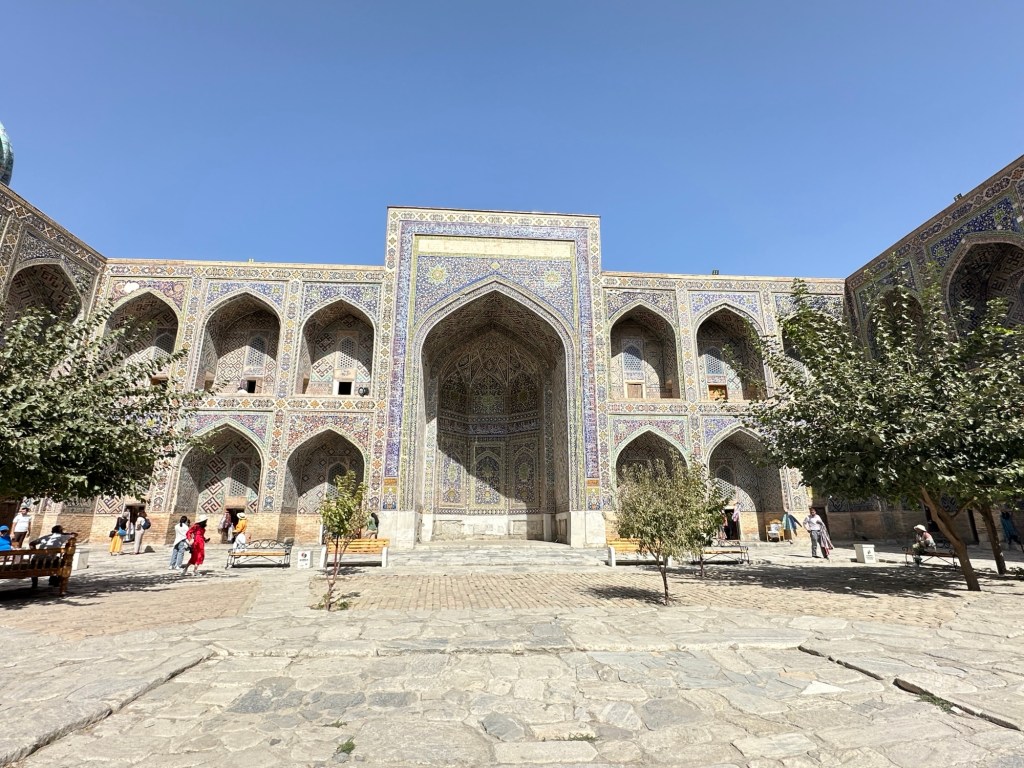
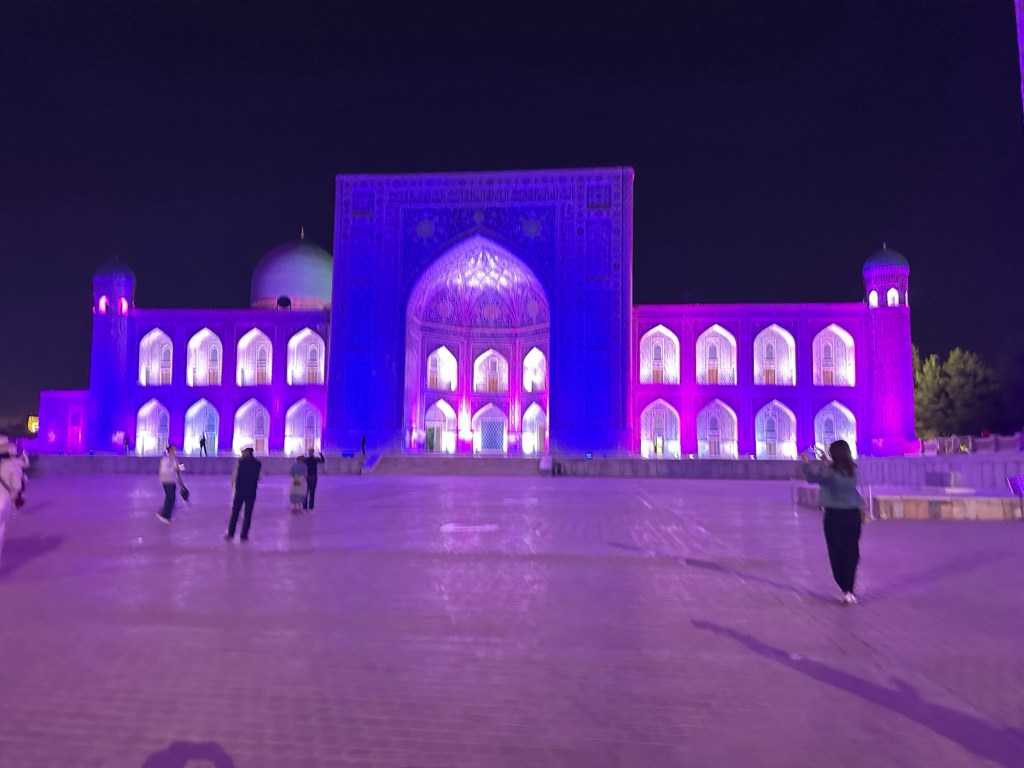
The three madrasahs, or schools, are of different periods: the Ulugh Beg Madrasah (1417-1420), the Sher-Dor Madrasah (1619-1636), and the Tilya-Kori Madrasah (1646-1660). Today all three are used for tourism and educational purposes rather than actual schools. The mosque inside Registan Square was absolutely stunning, extravagantly decorated with 24 carat gold.
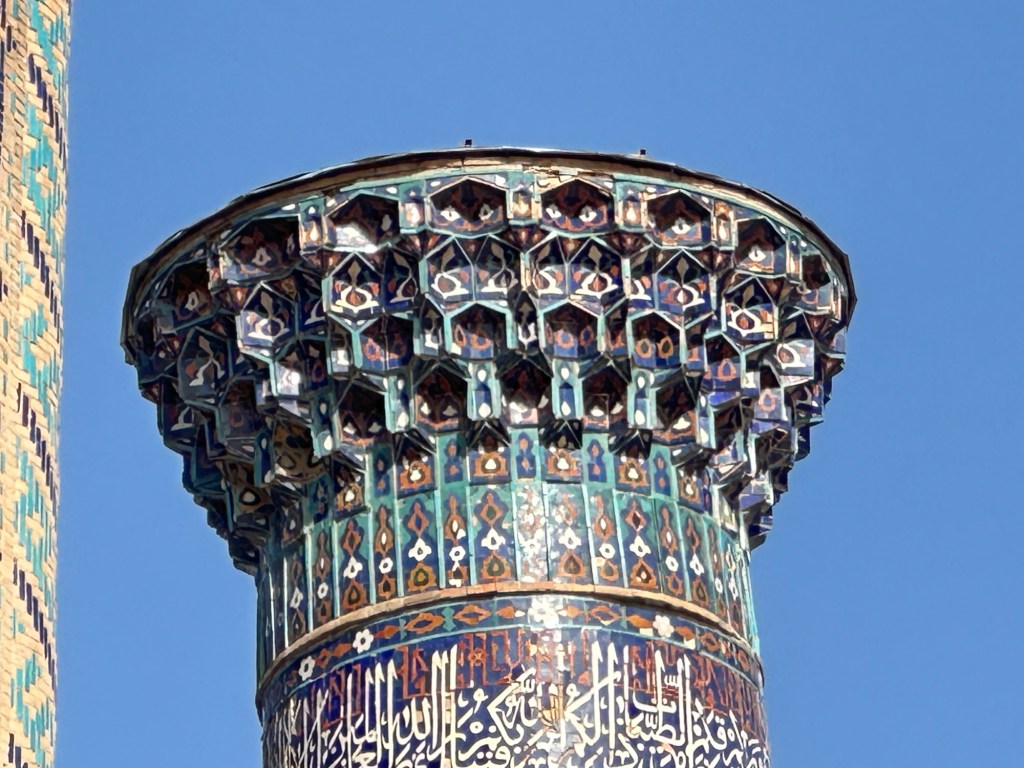
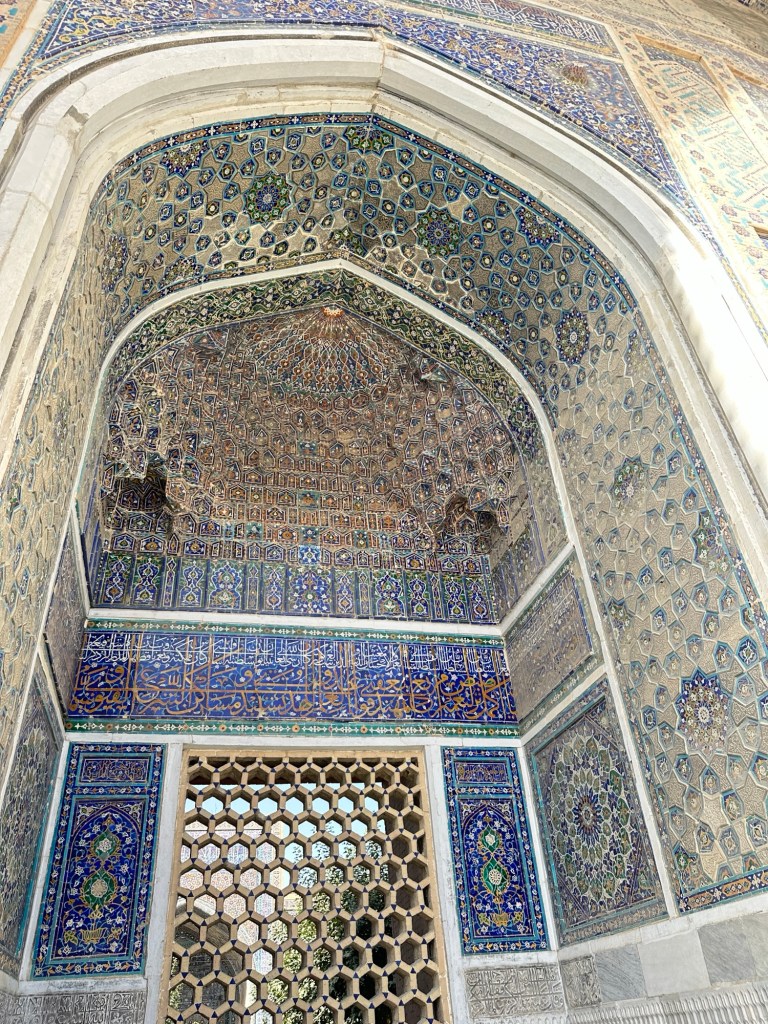
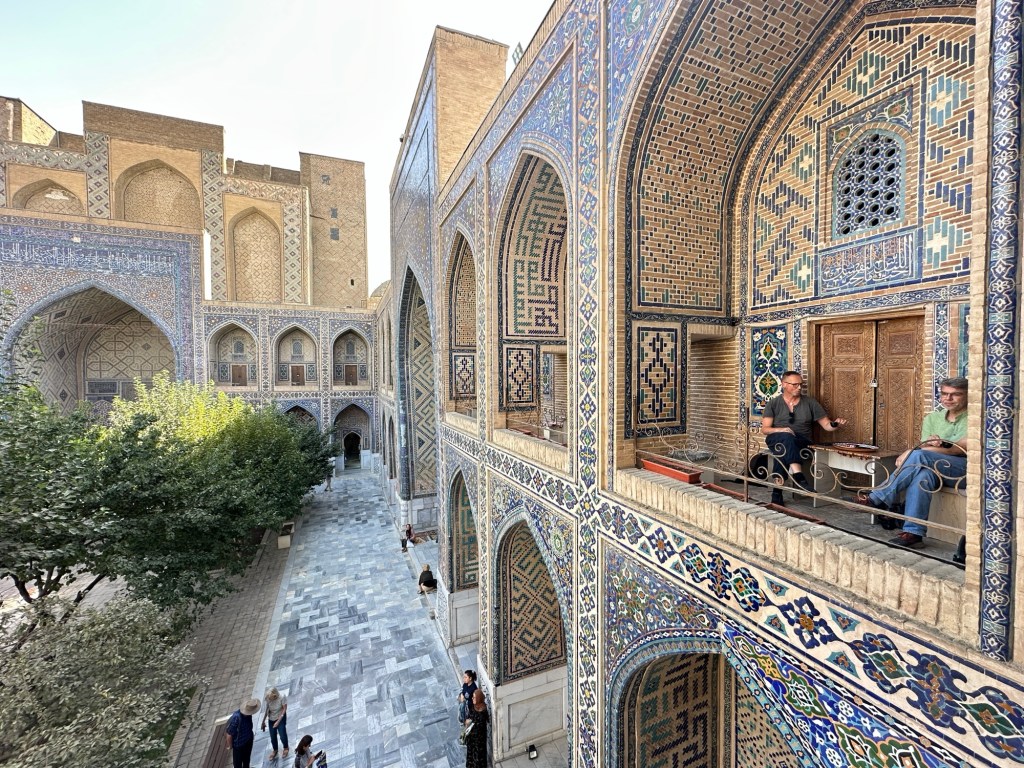
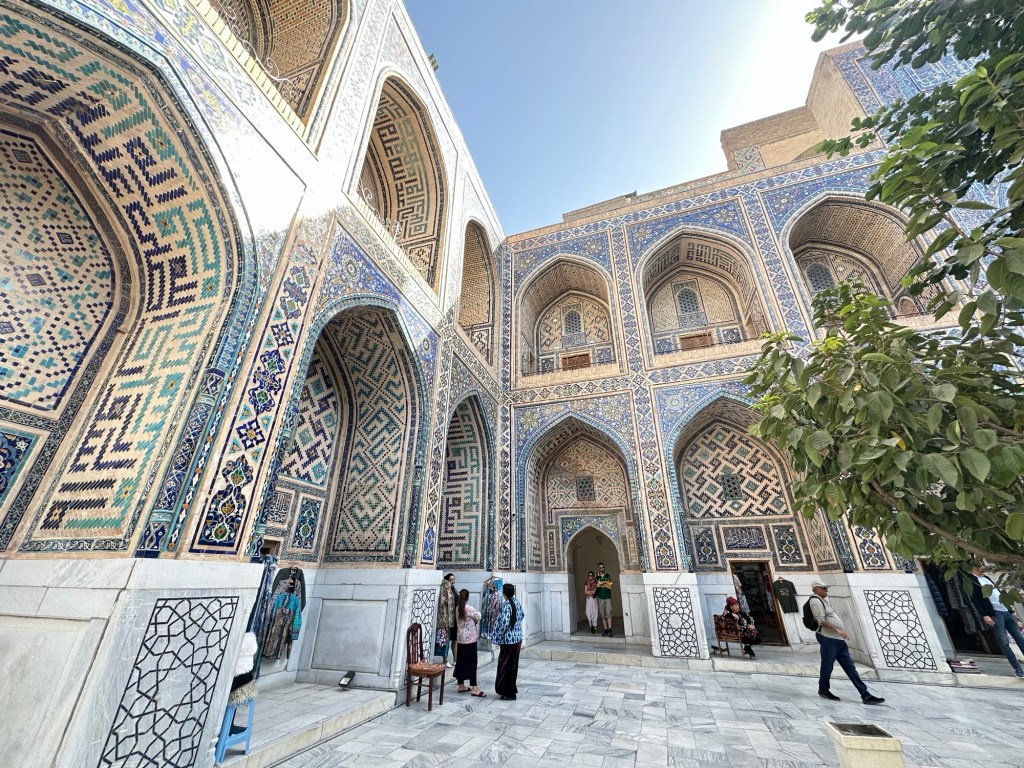
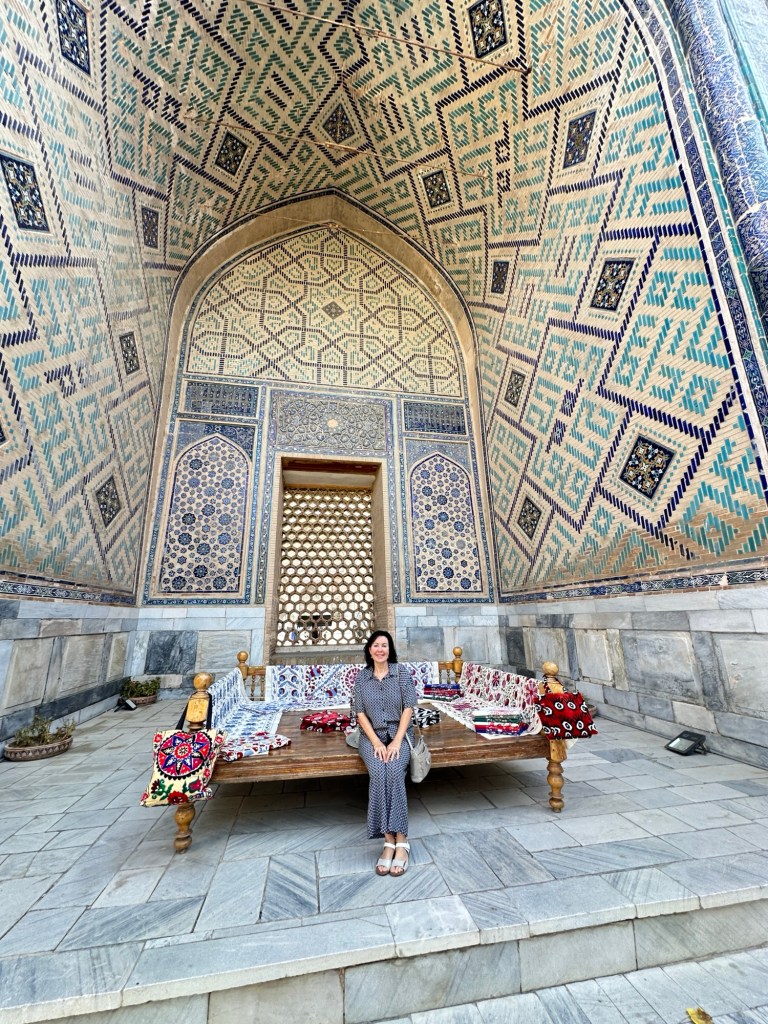
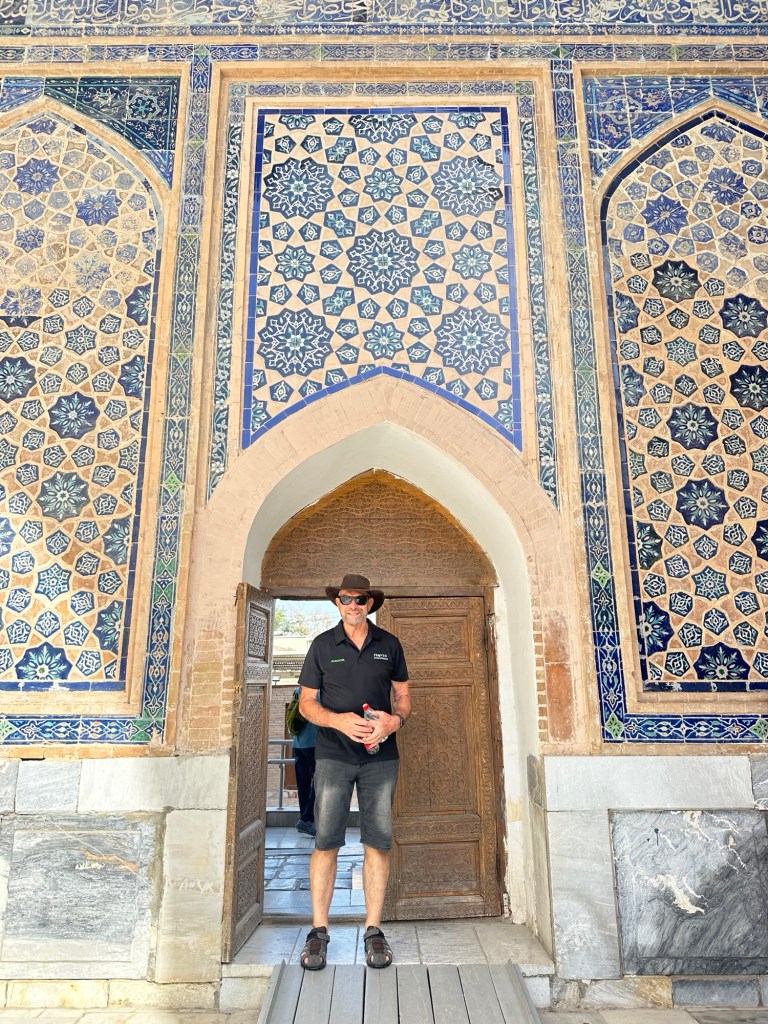
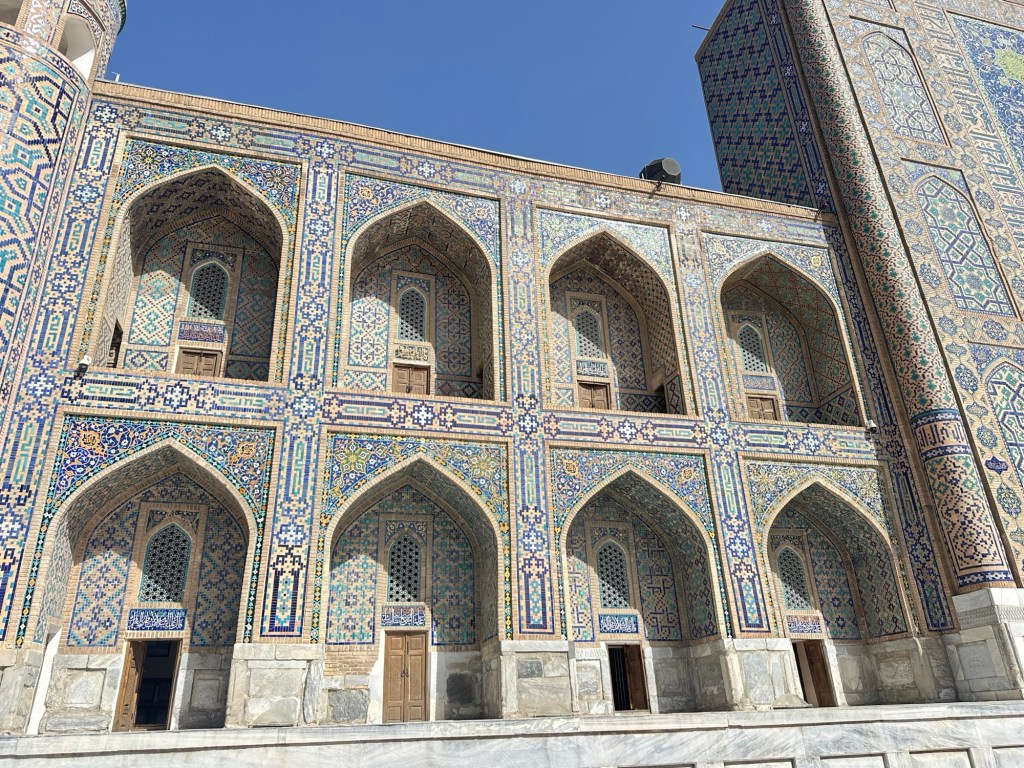
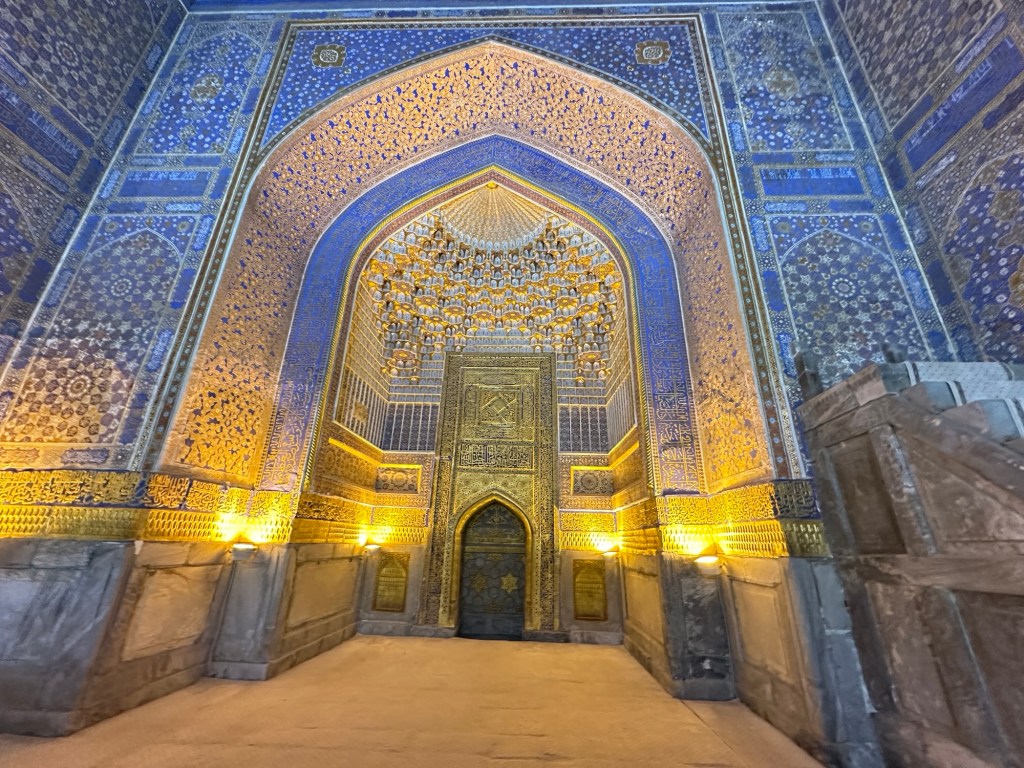
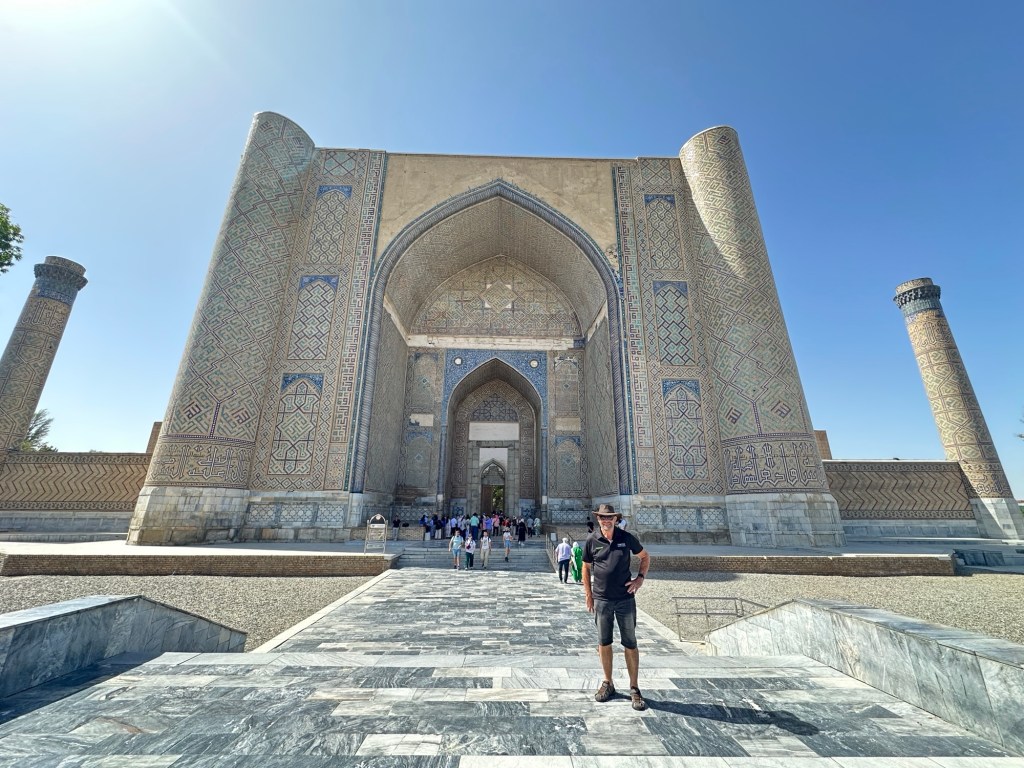
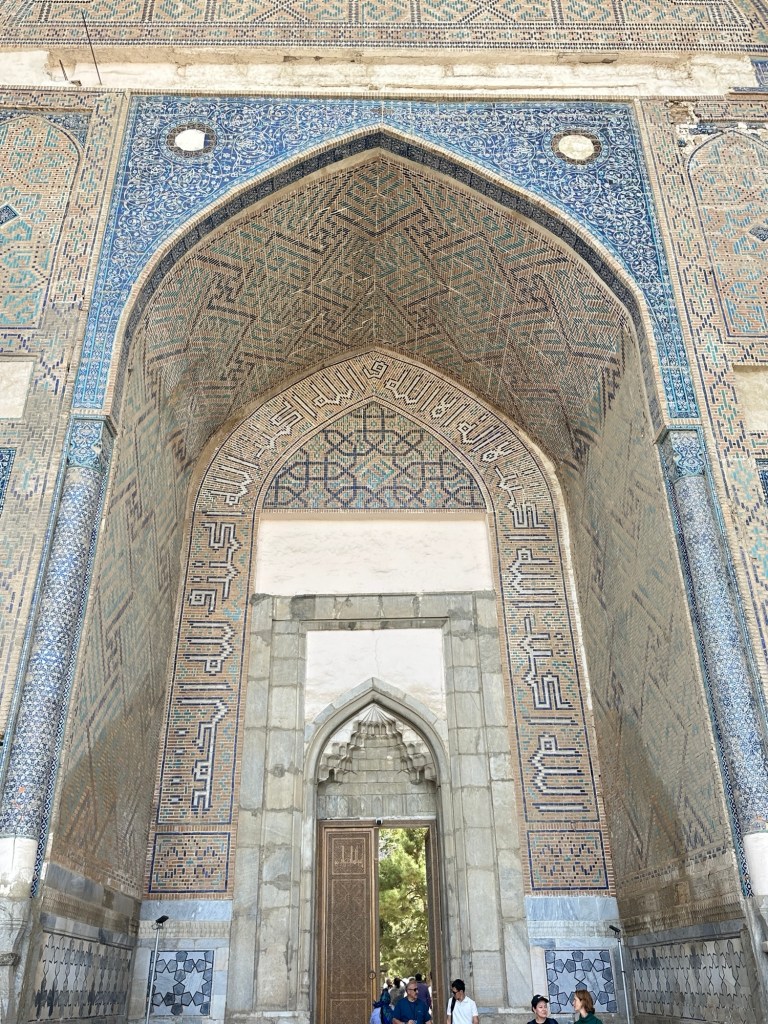
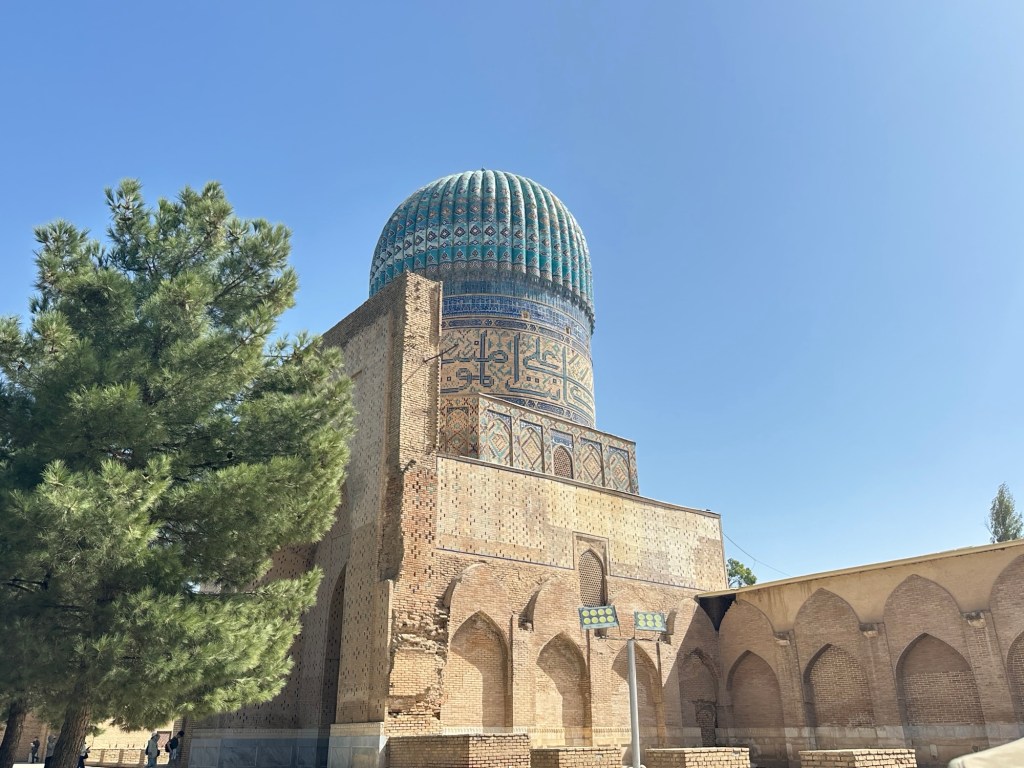
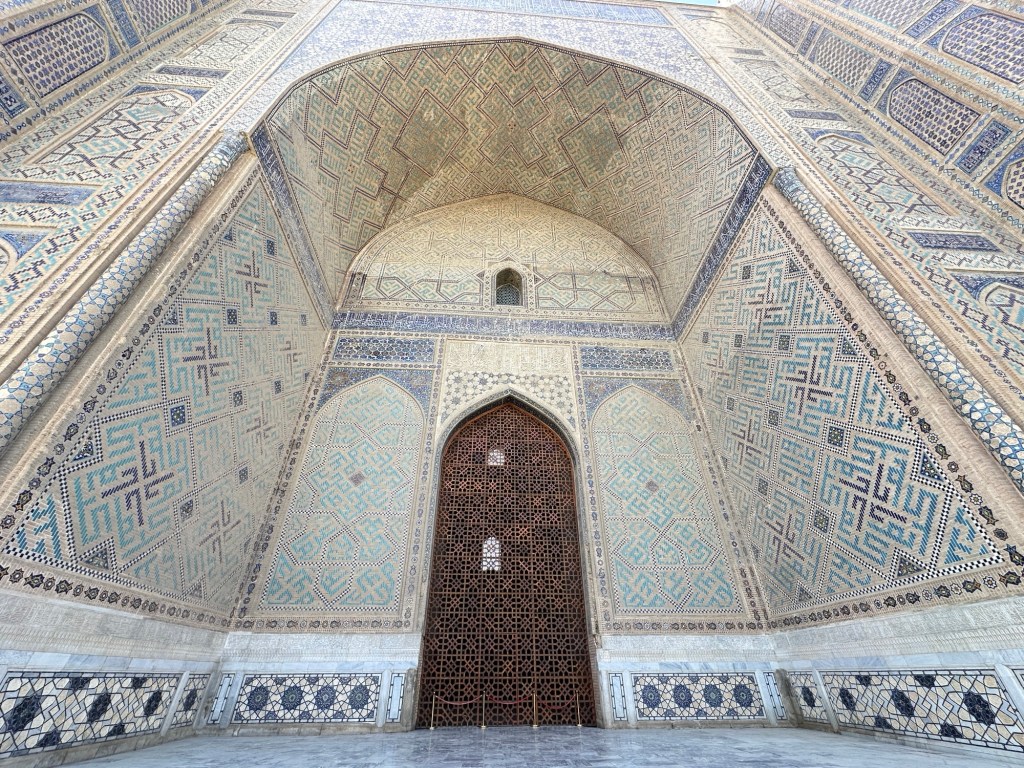
Bibi Khanum Mosque was commissioned by Timur’s favorite wife (of twelve) in honor of his homecoming after a long pillaging trip. Built with the labour of 95 imported Indian elephants, the huge 35 metre entry arch was flanked by 50 metre minarets that led into a court paved with marble and flanked with mosques. Today it remains one of the largest mosques in Central Asia, and can welcome some 10,000 worshippers at a time. A number of local women still come here to pray, although it is now considered a museum rather than a place of worship.
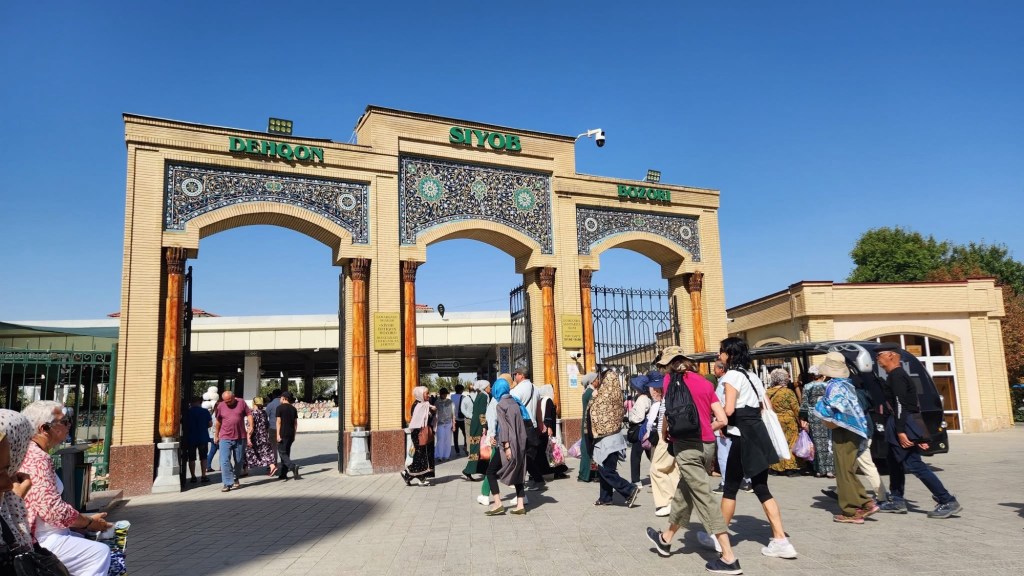
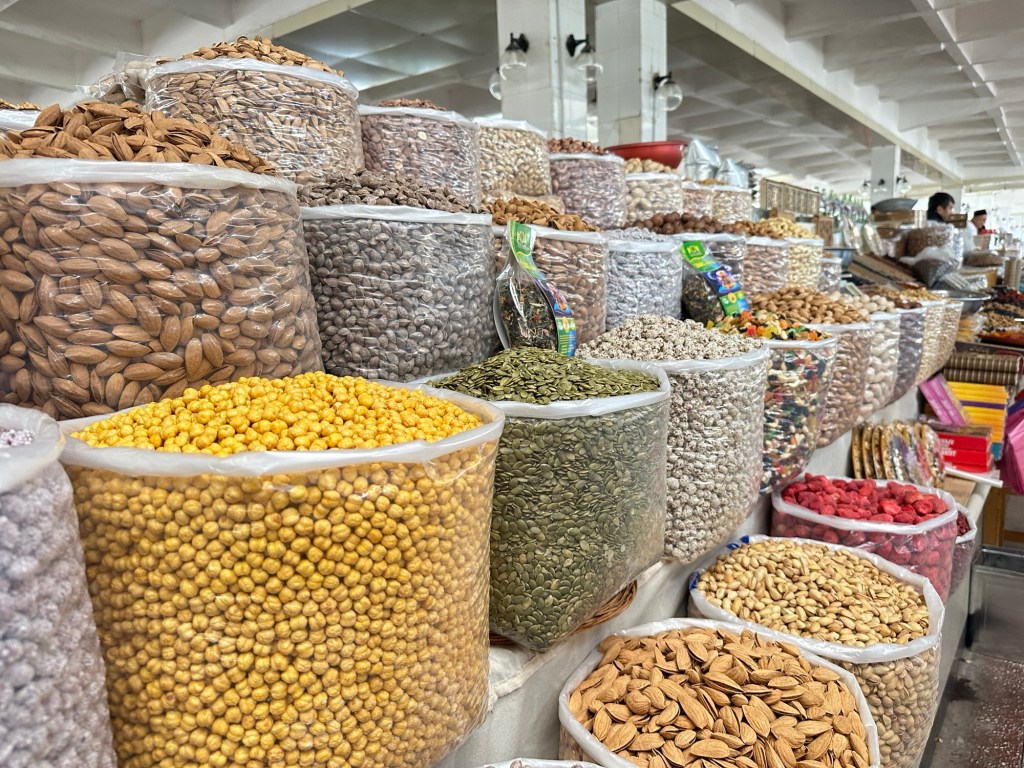
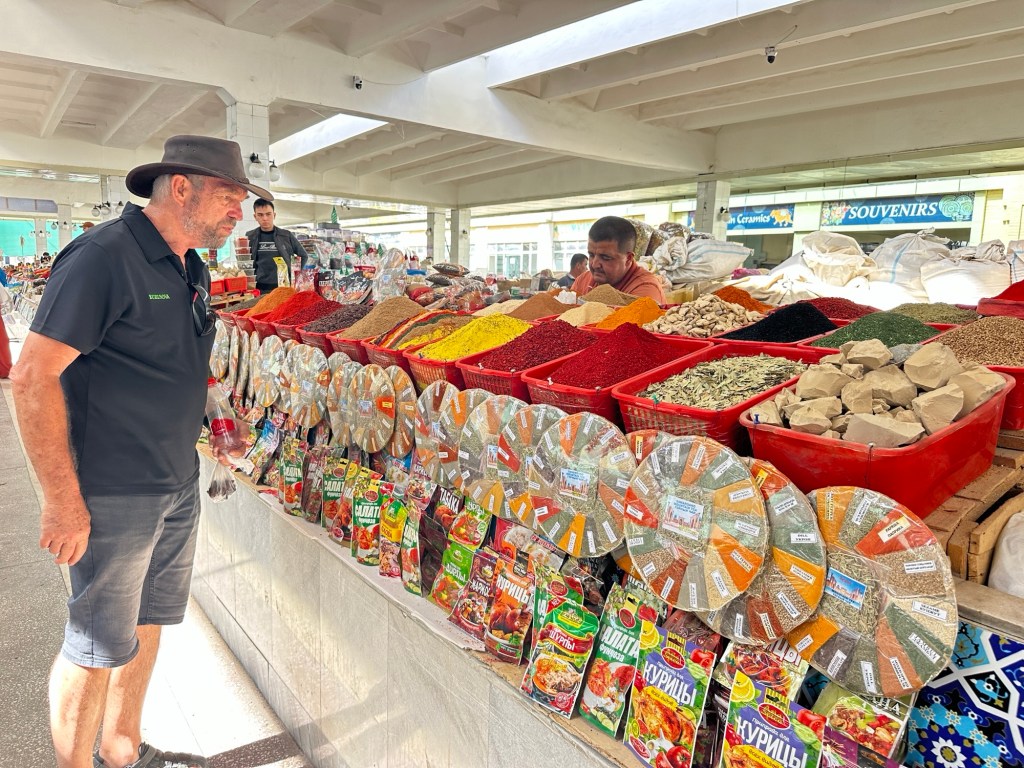
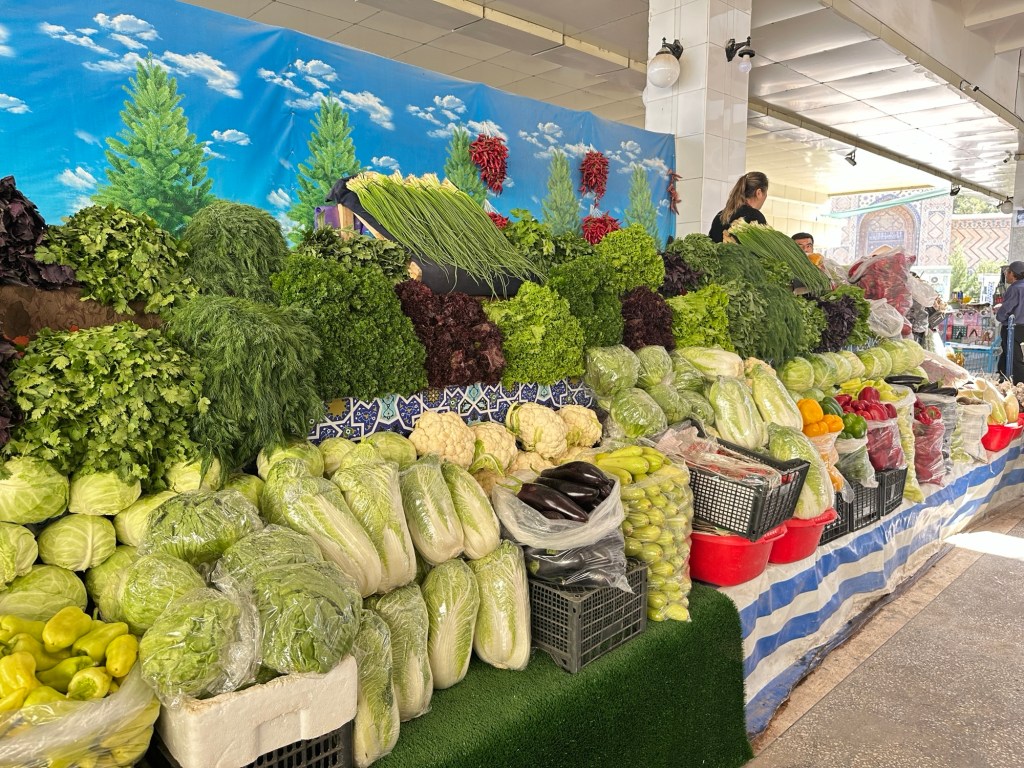
Next to the mosque was the main Siab Bazaar, groaning with fresh and dried fruit, nuts, spices, grains, and a variety of sweets including halva. We had lunch just sampling all the delicious fresh produce.
Few individuals shaped Central Asia as much as Timur, a merciless leader who conquered lands from India to Baghdad, and remains a great Uzbek hero. Our next stop was to Amir Timur’s final resting place,
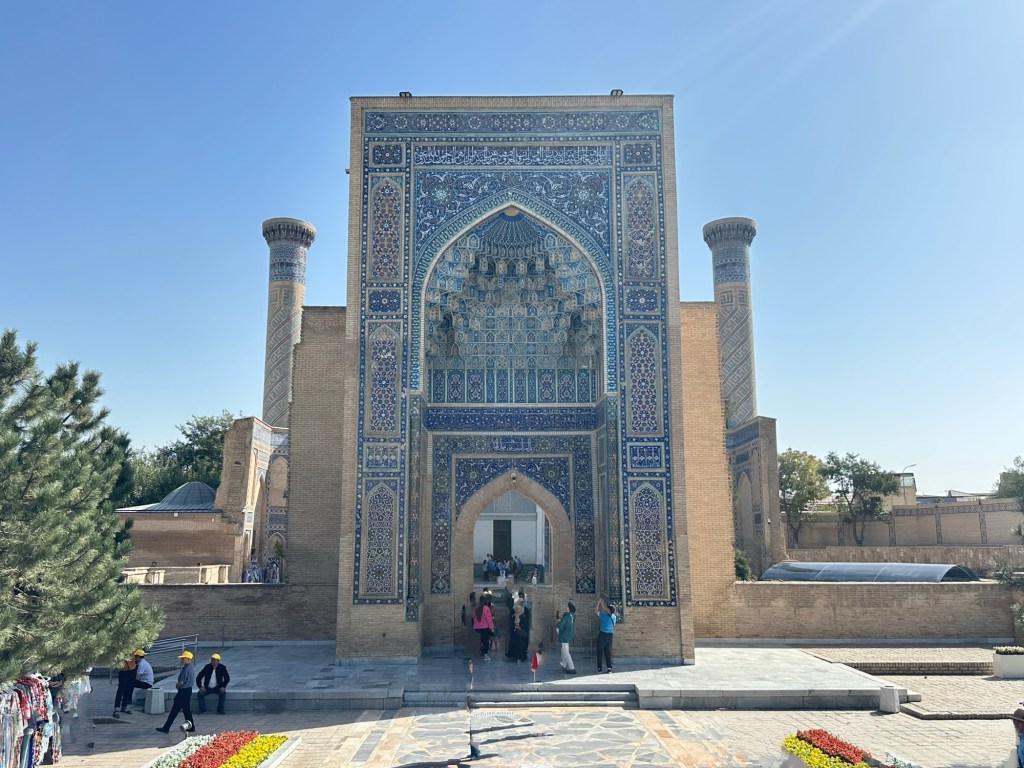
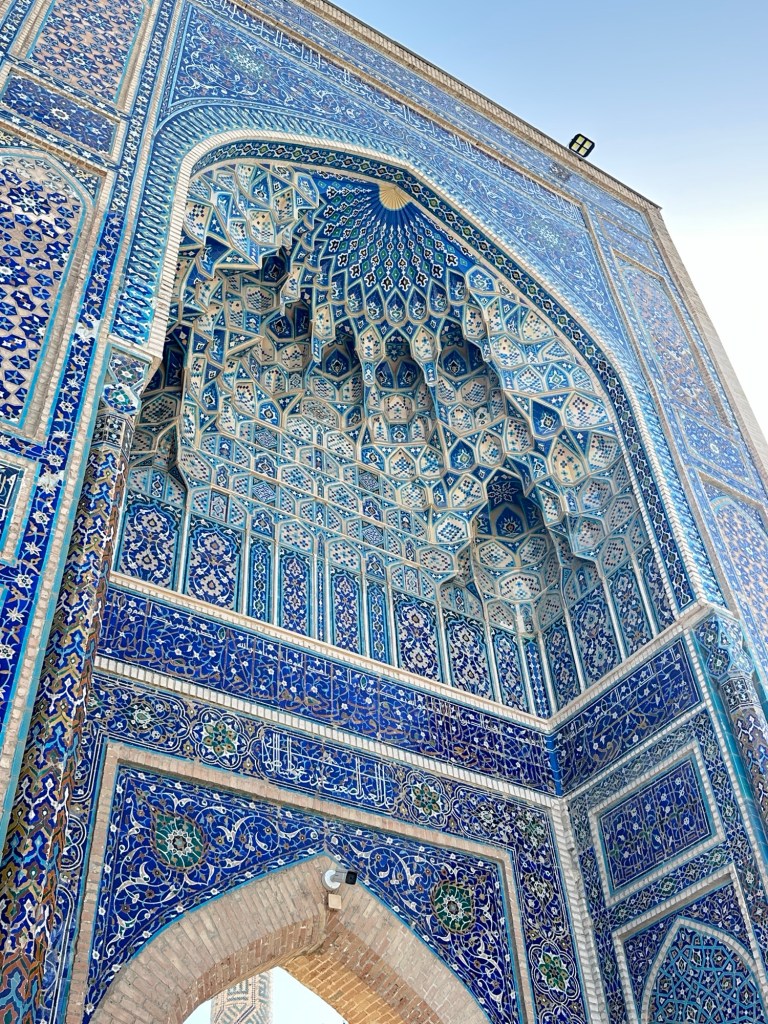
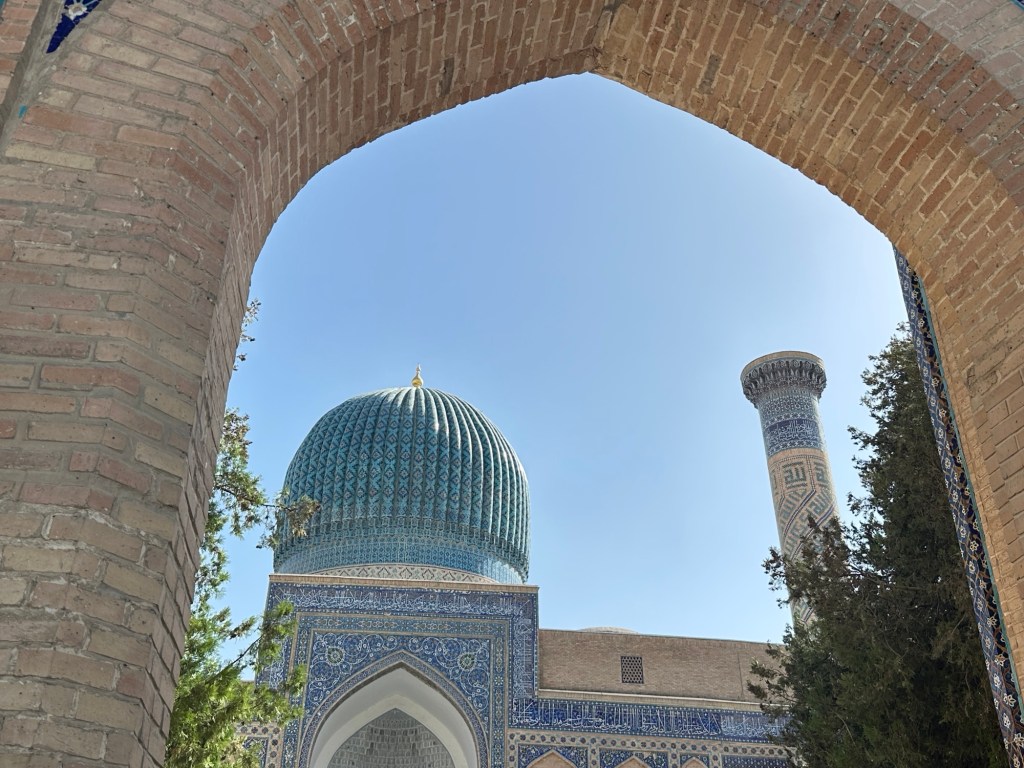
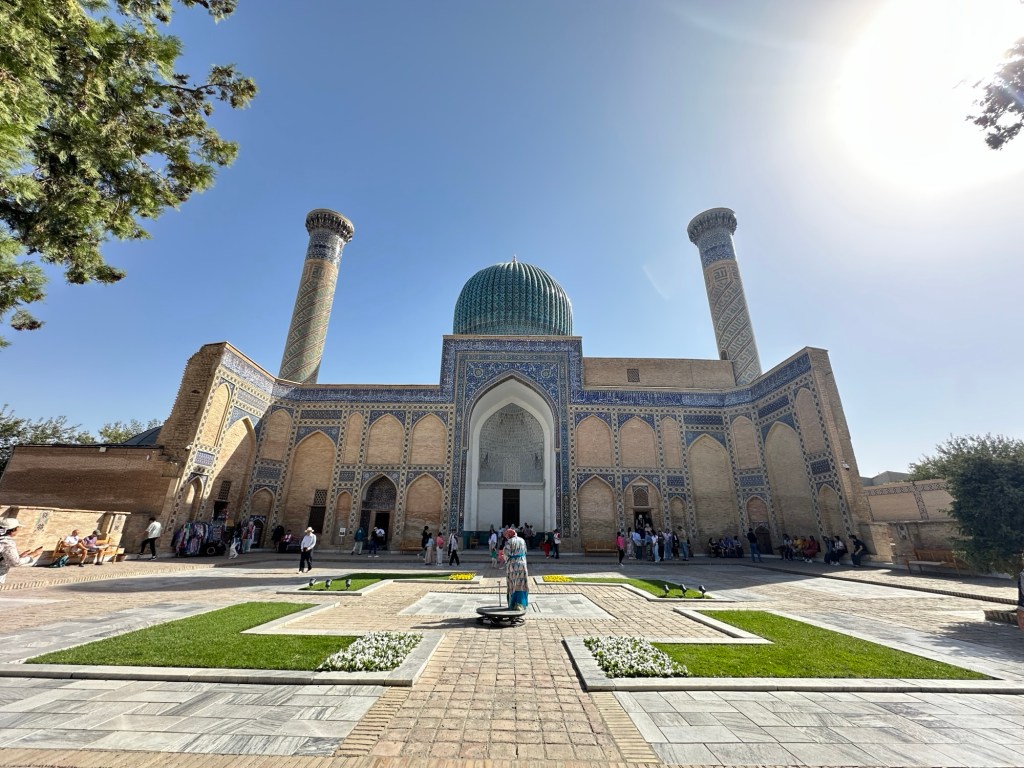
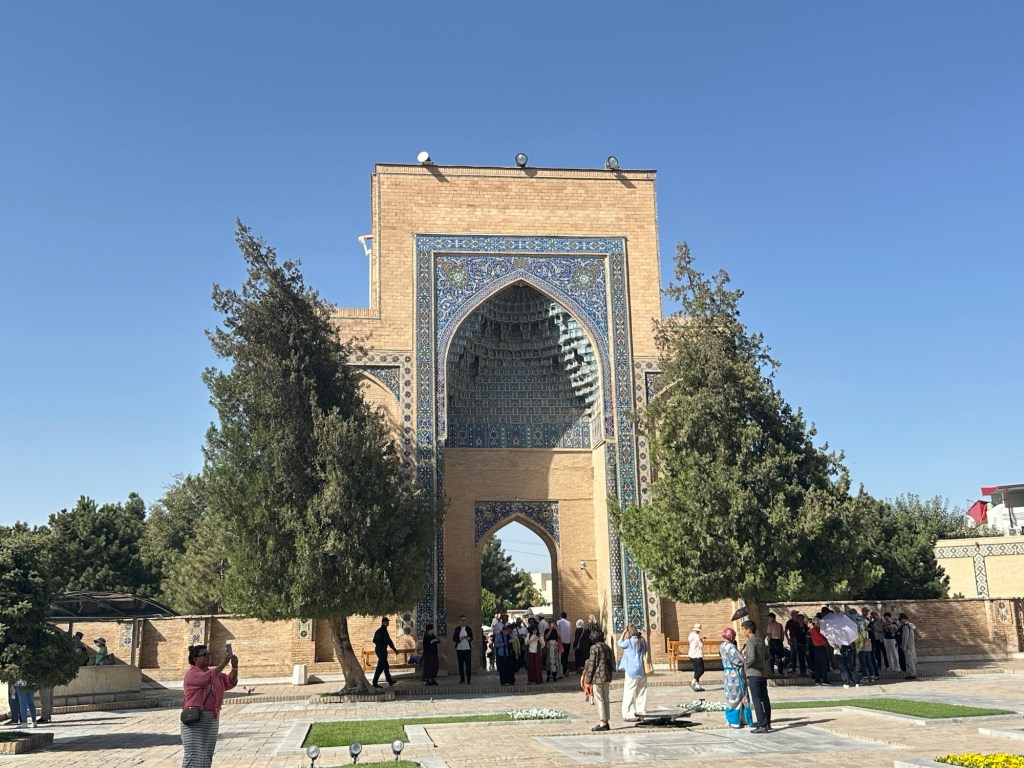
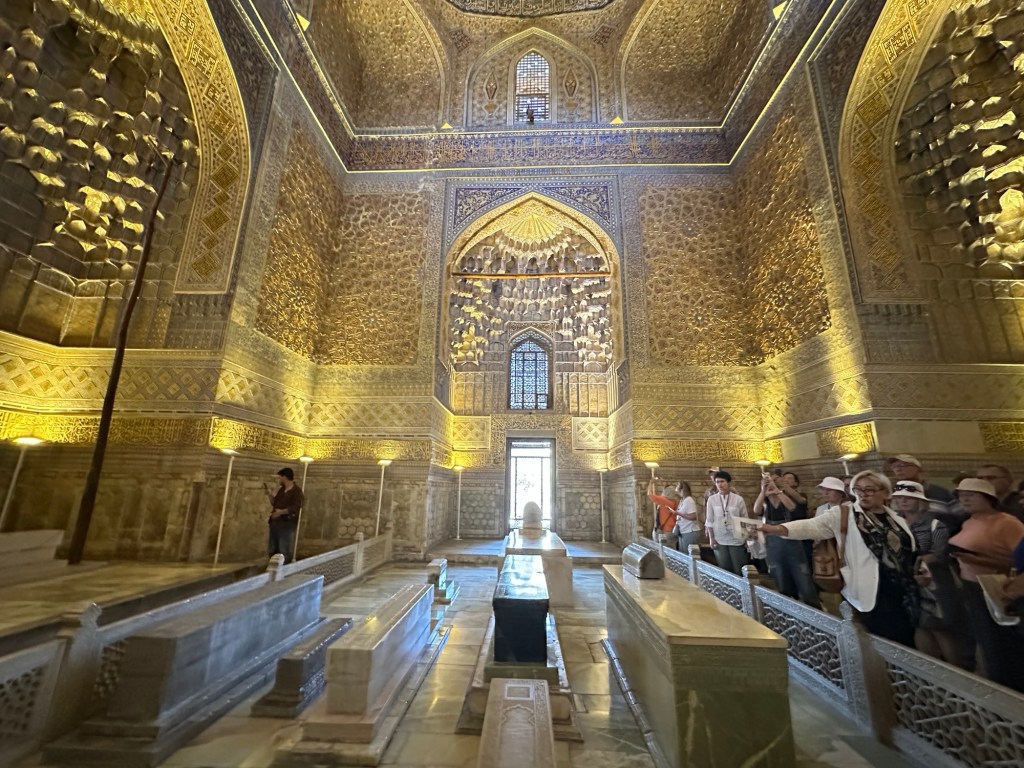
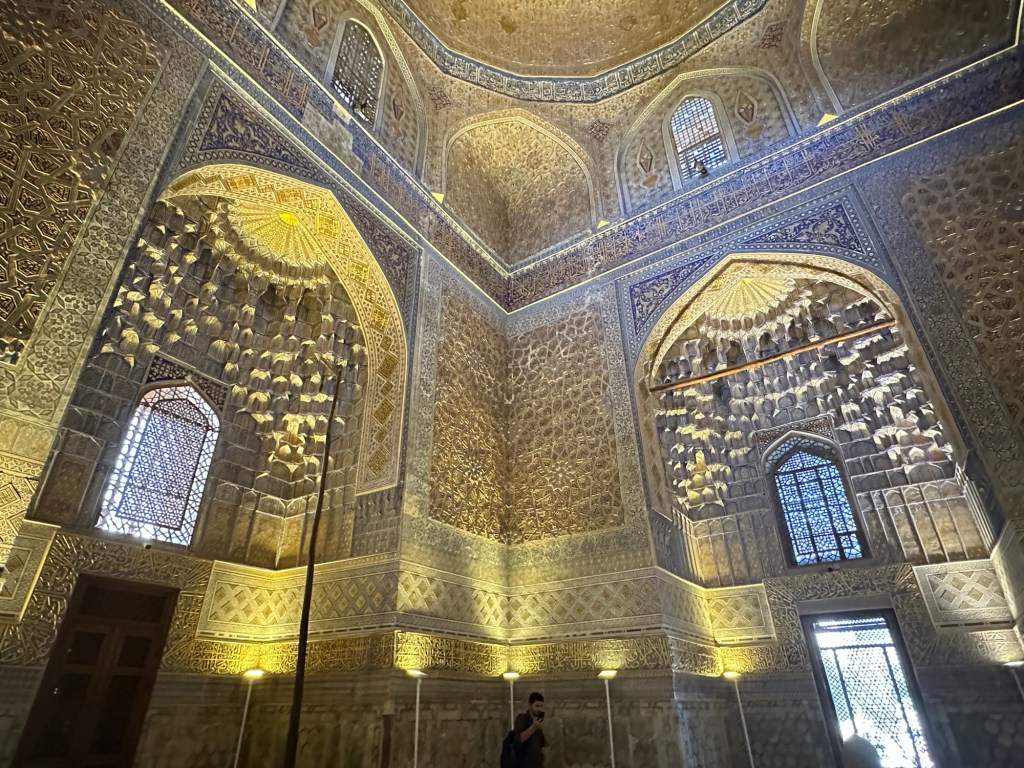
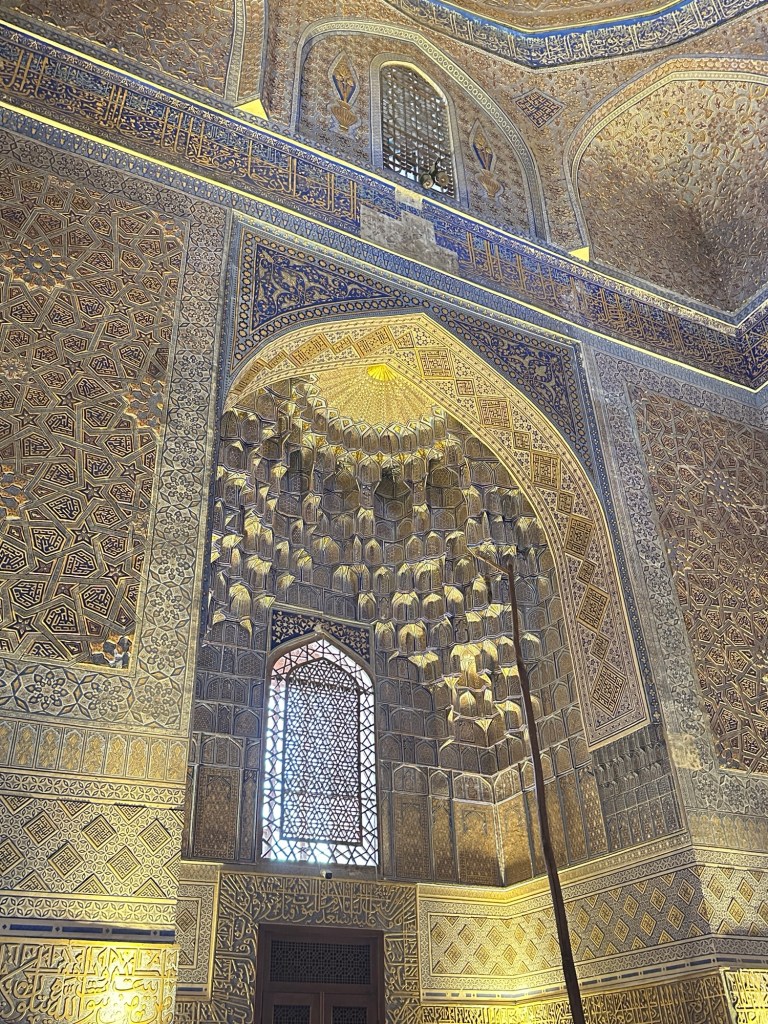
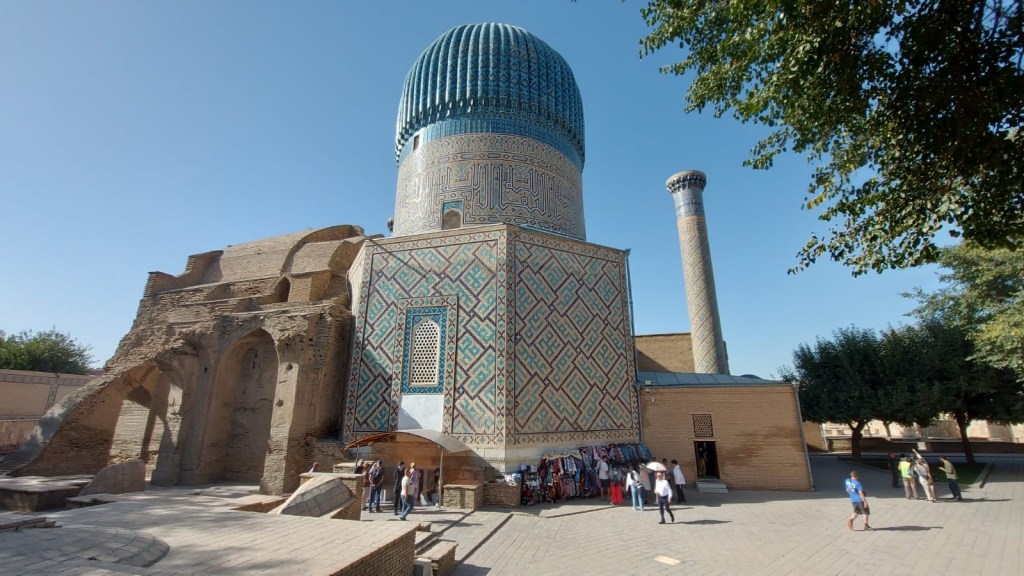
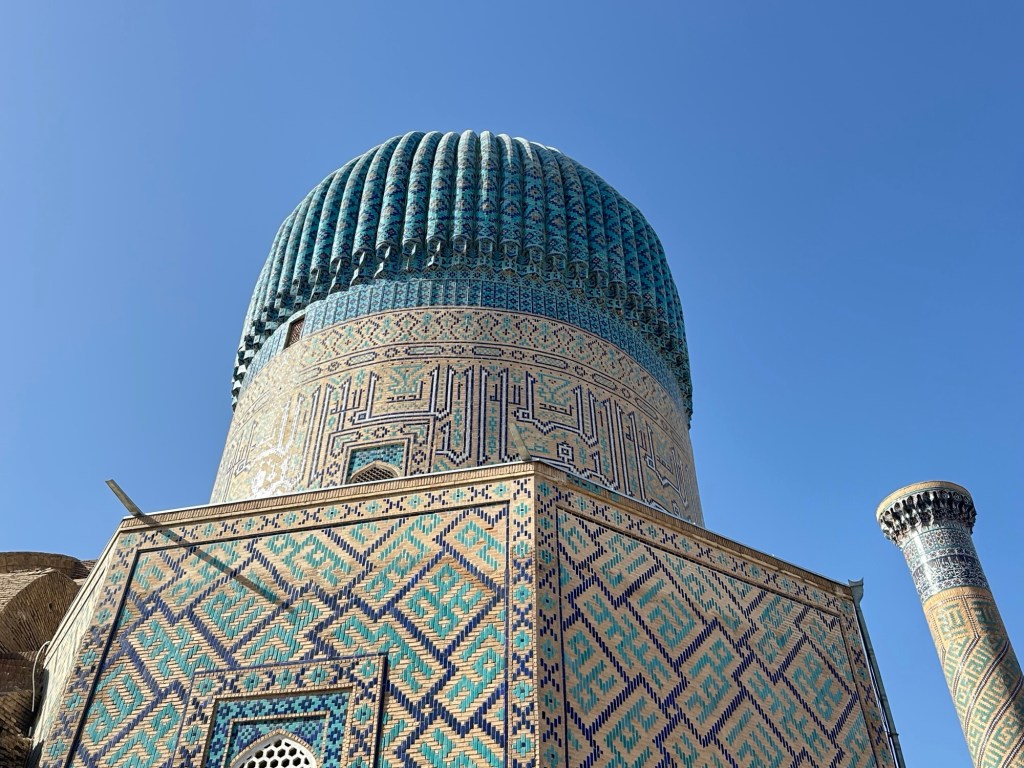
Gur-e-Amir – or Amir Temur Mausoleum, which is a celebration of his life in gold and turquoise. It was completed in 1404 and Timur was interred there after his 1405 death.
The mausoleum was originally planned for Timur’s favourite grandson, Muhammad Sultan (Timur had wanted to be buried in Shakhrisabz), but Samarkand was deemed a more fitting resting place. The exterior of the building is dominated by a fine entrance portal and the hallmark ribbed turquoise dome that floats like a giant balloon above the central octagonal chamber. Timur is buried at the foot of his spiritual adviser, Mir Sayid Barakah, and surrounded by many of his family. His body lies under a tombstone that was, at the time, the world’s largest slab of jade.
By this time we had brain overload, so it was back to the hotel for a short break. Refreshed, we then walked 15 minutes back to Registan for a light dinner of crunchy eggplant salad and lamb shaslick – the flavours are simply divine.
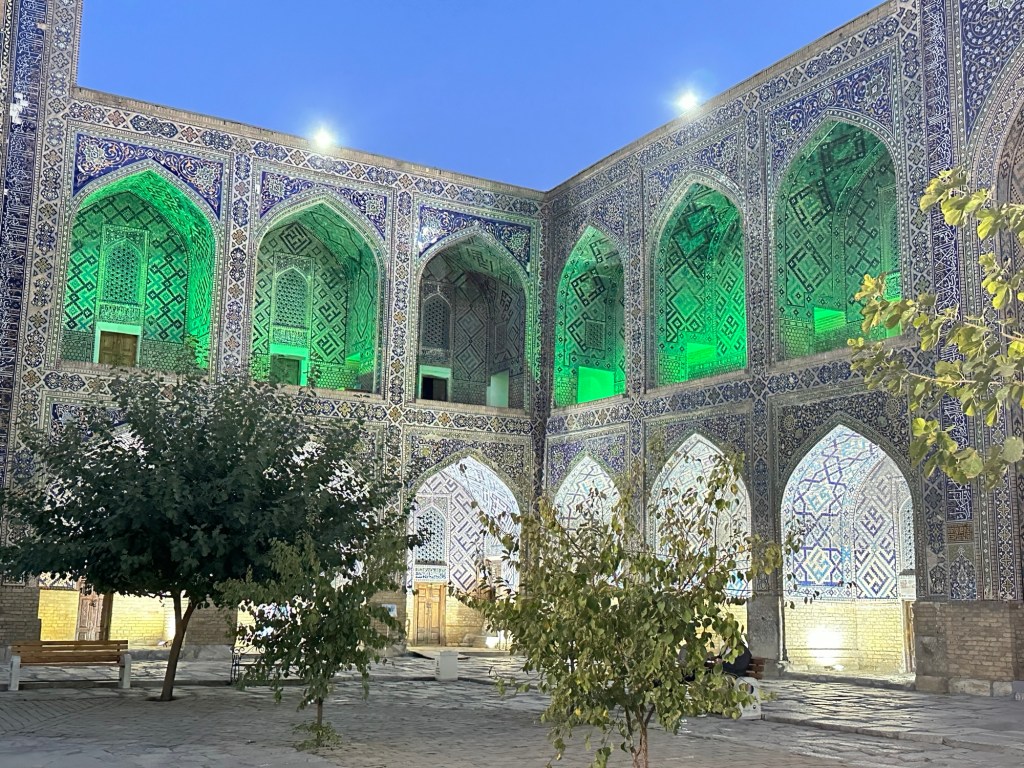
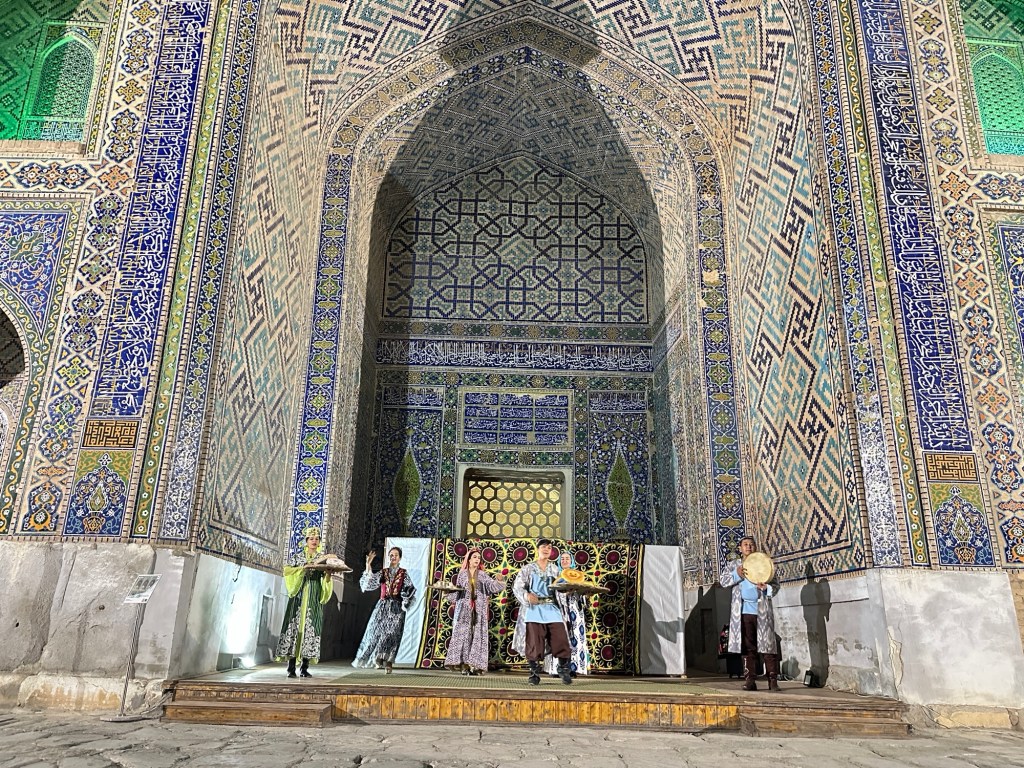
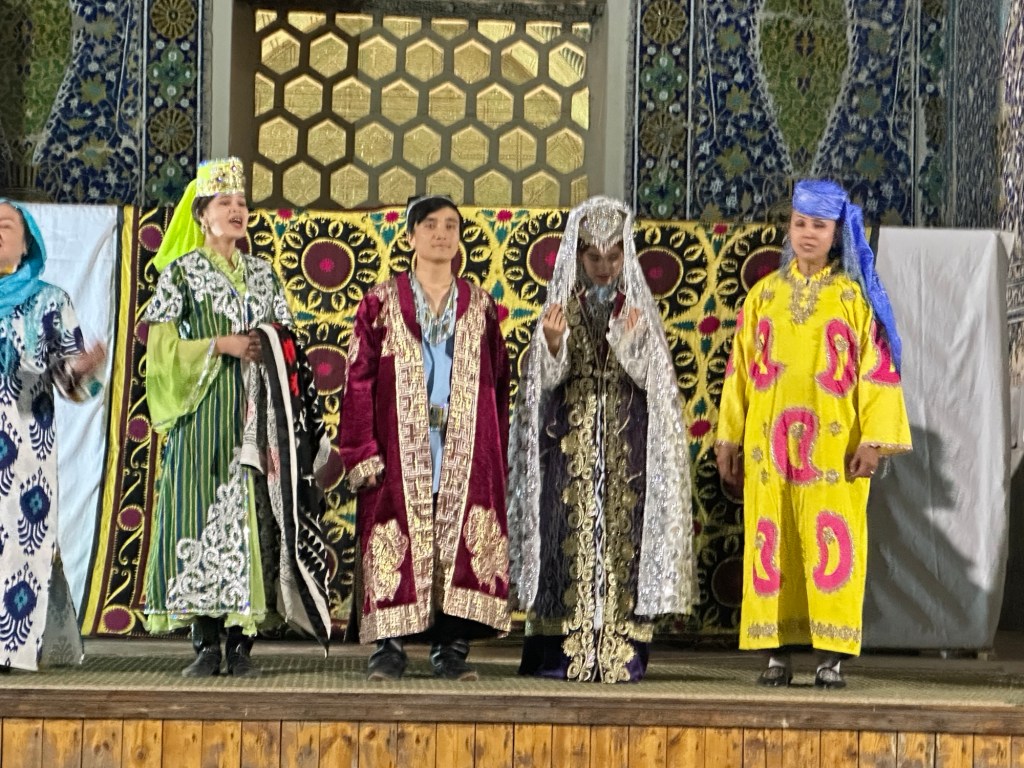
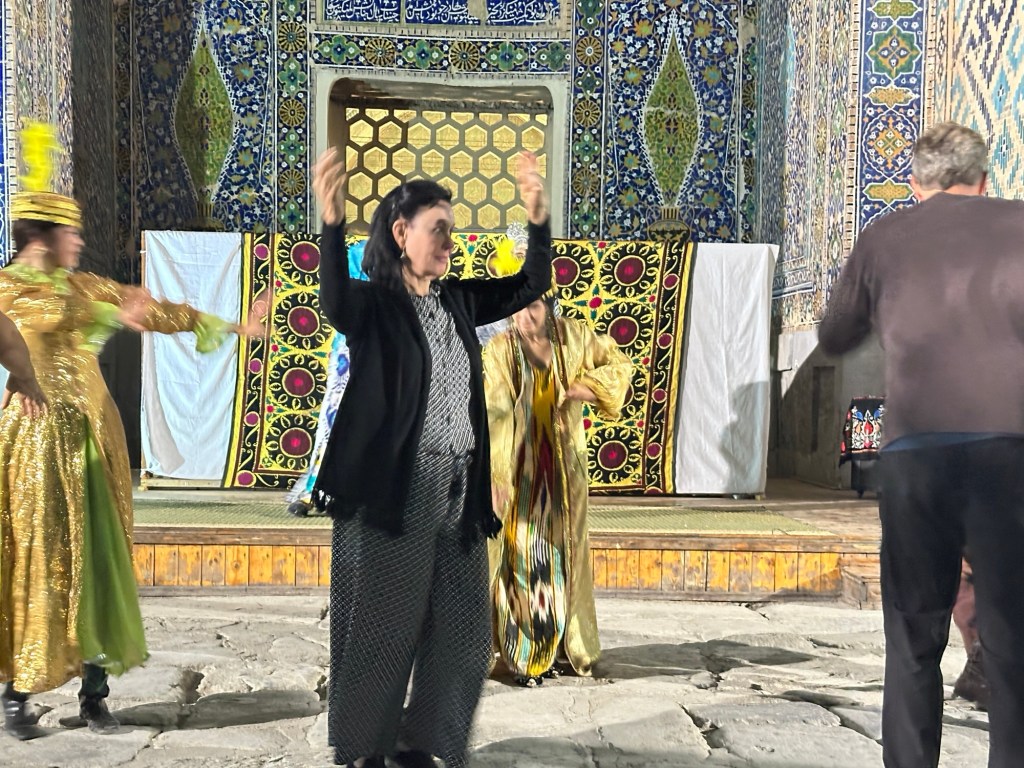
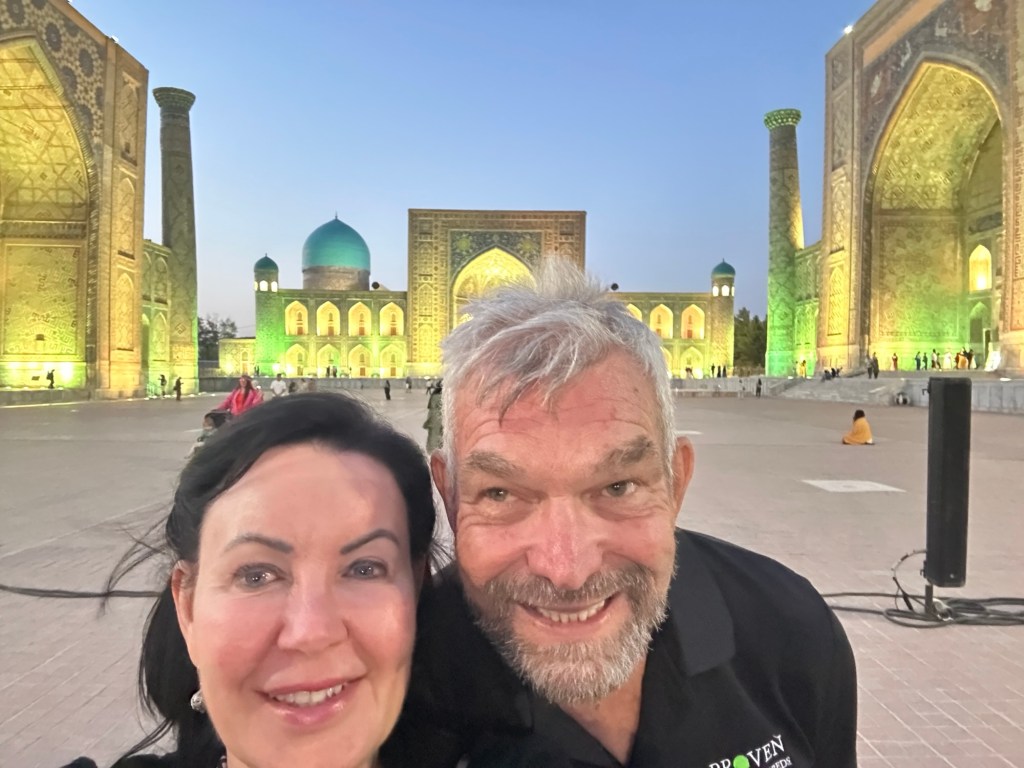
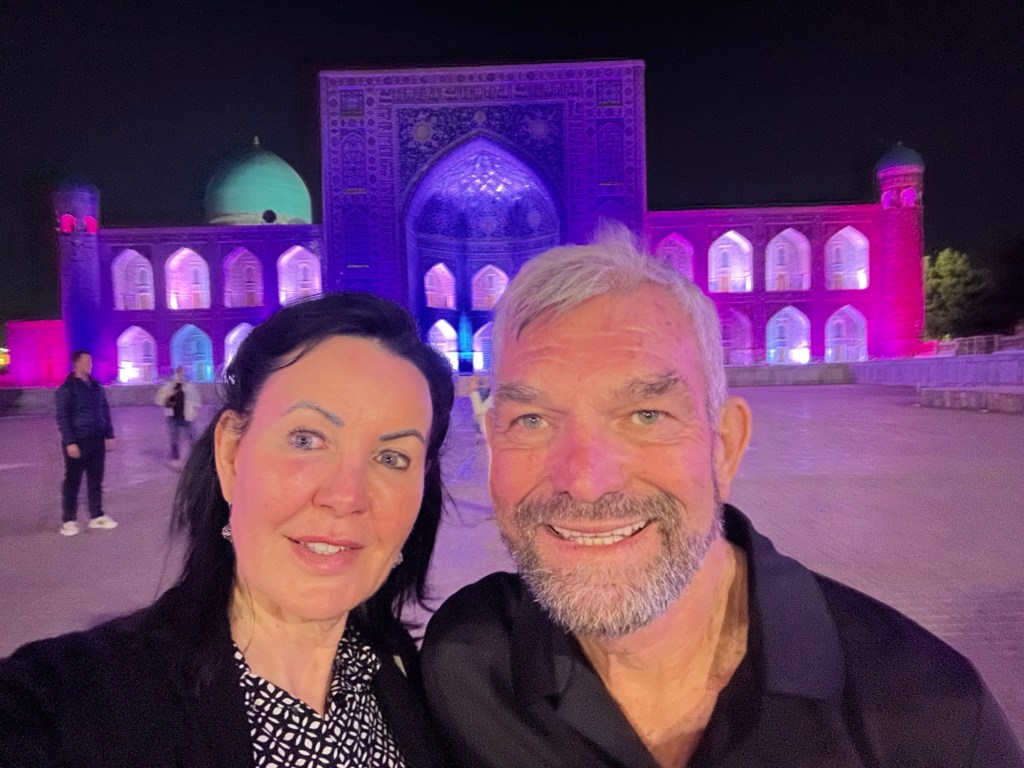
Frank and I had decided to go to the Folklore show at one of the madrassas – it was an amateur performance but quite entertaining. It finished just in time for the evening sound and light show – the buildings looked spectacular all lit up.
Day 15
Thursday 25th September
Samarkand to Shahrizabz to Samarkand
13-27 degrees, sunny
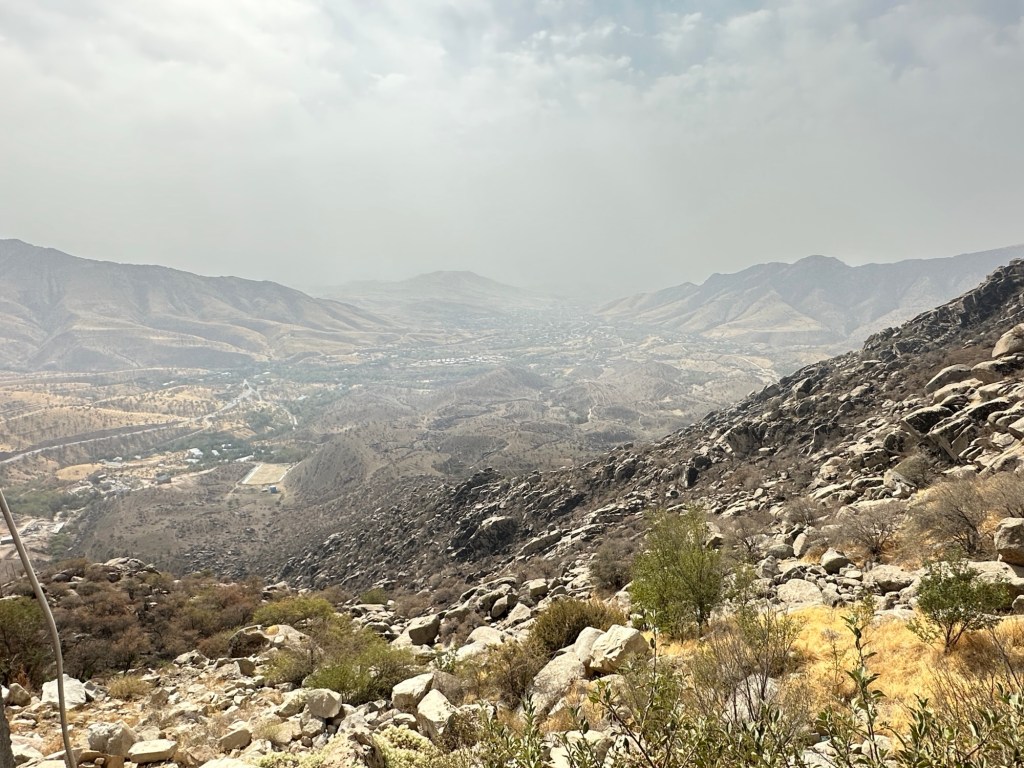
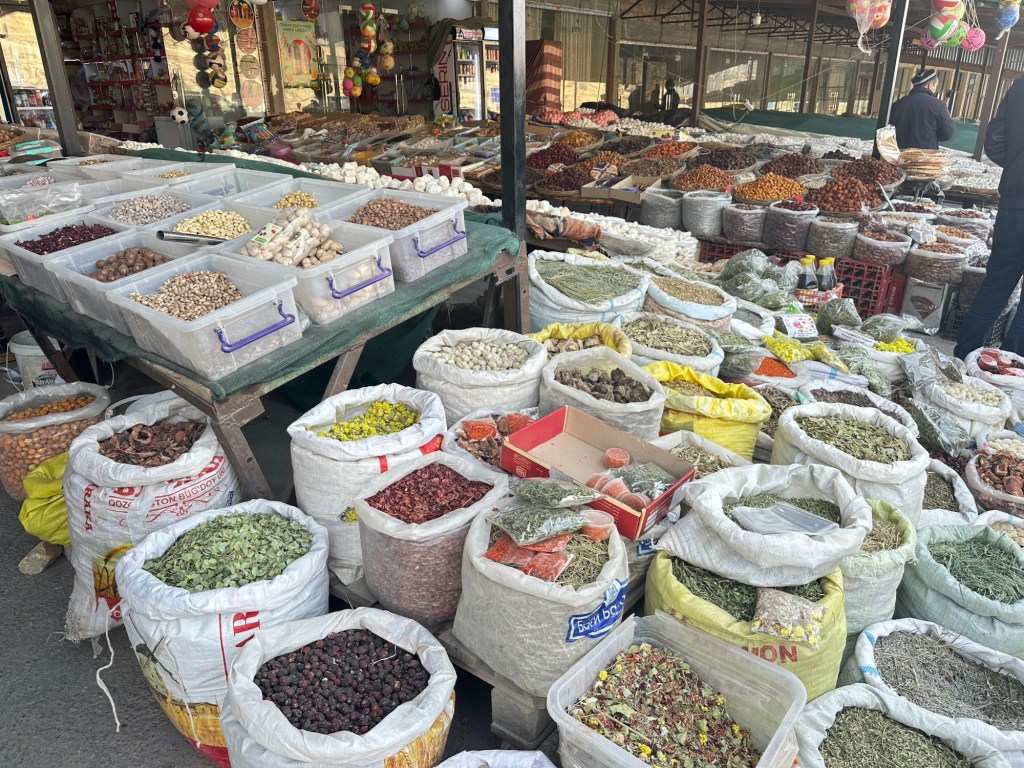
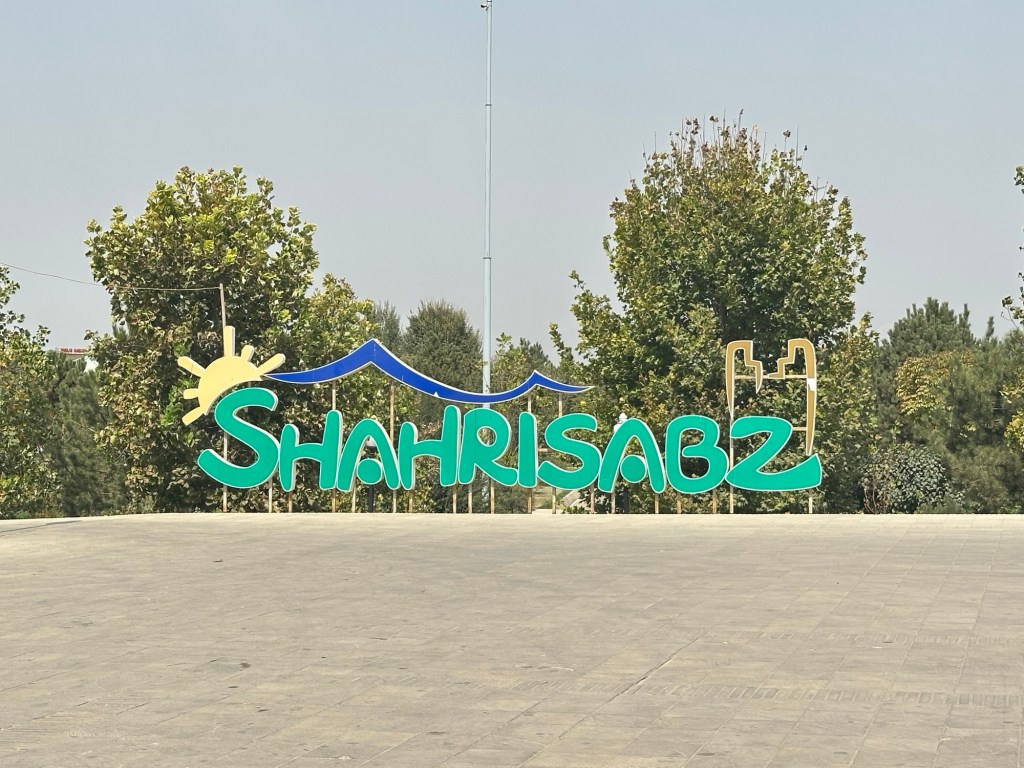
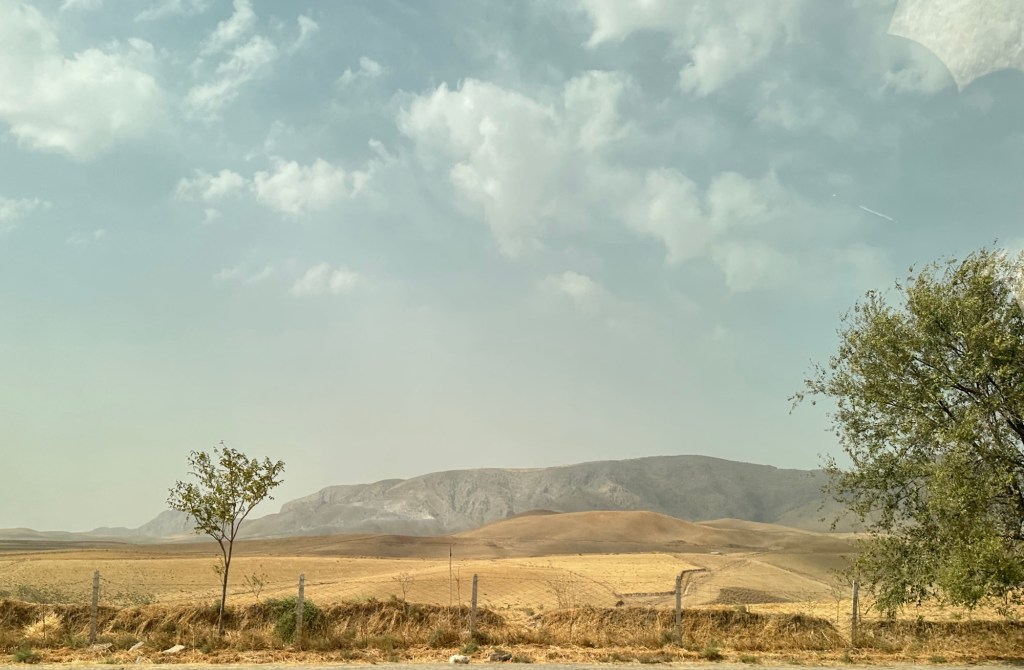
Today was a day trip to the town of Shahrisabz 80km south of Samarkand over the Takhtakaracha Pass. It is most famous as the hometown of Timur, who was born nearby in April 1336. The mountain pass was quite spectacular, however it was quite hazy so the views weren’t as good as they could be. Also a stop at a bazaar .
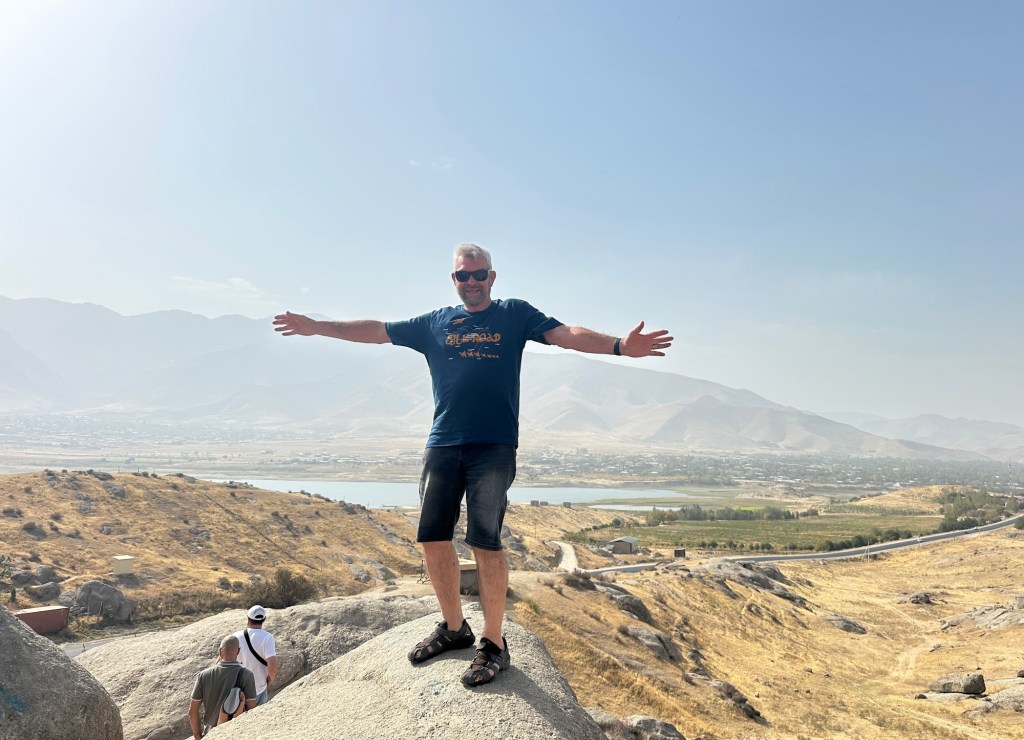
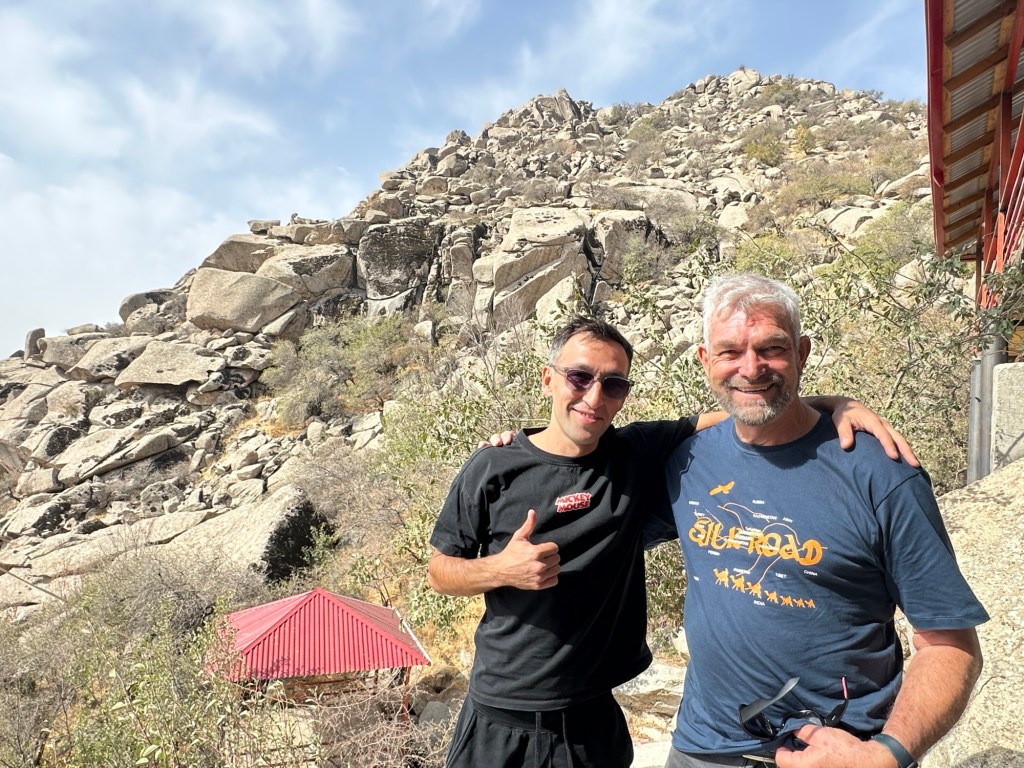

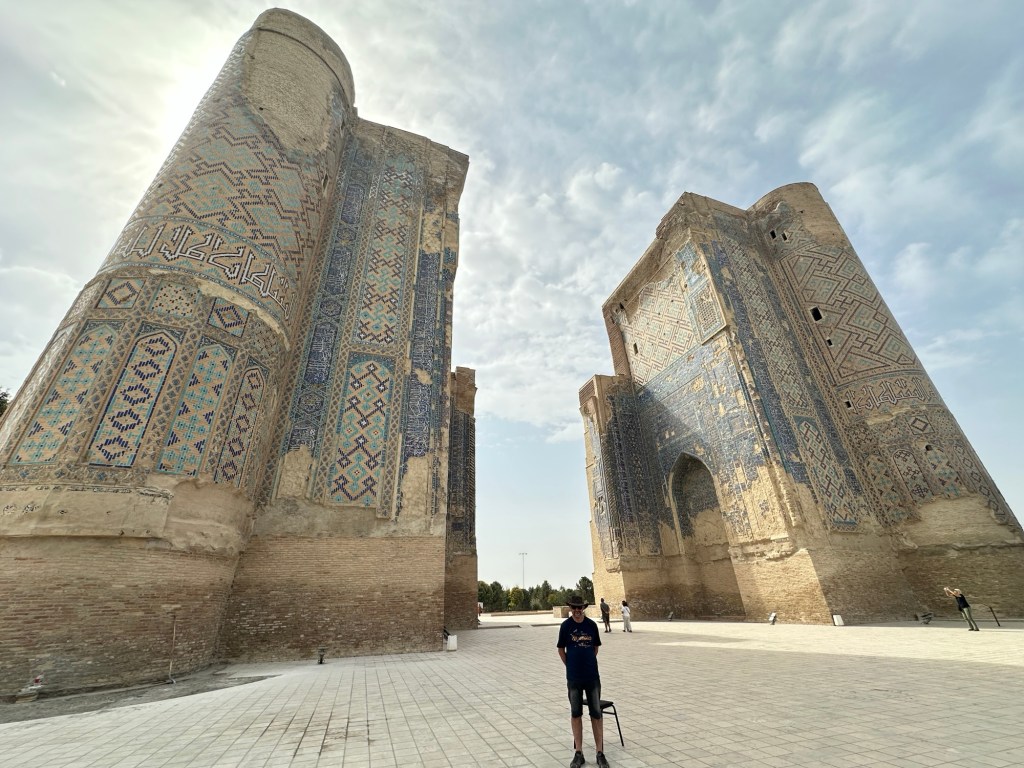
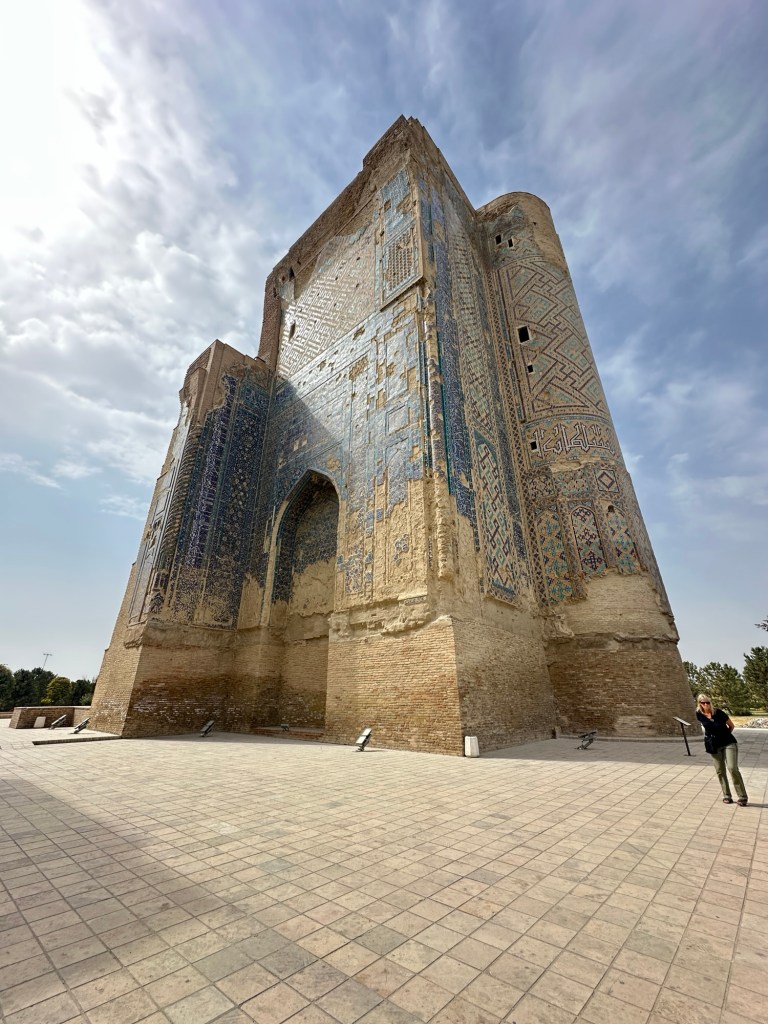
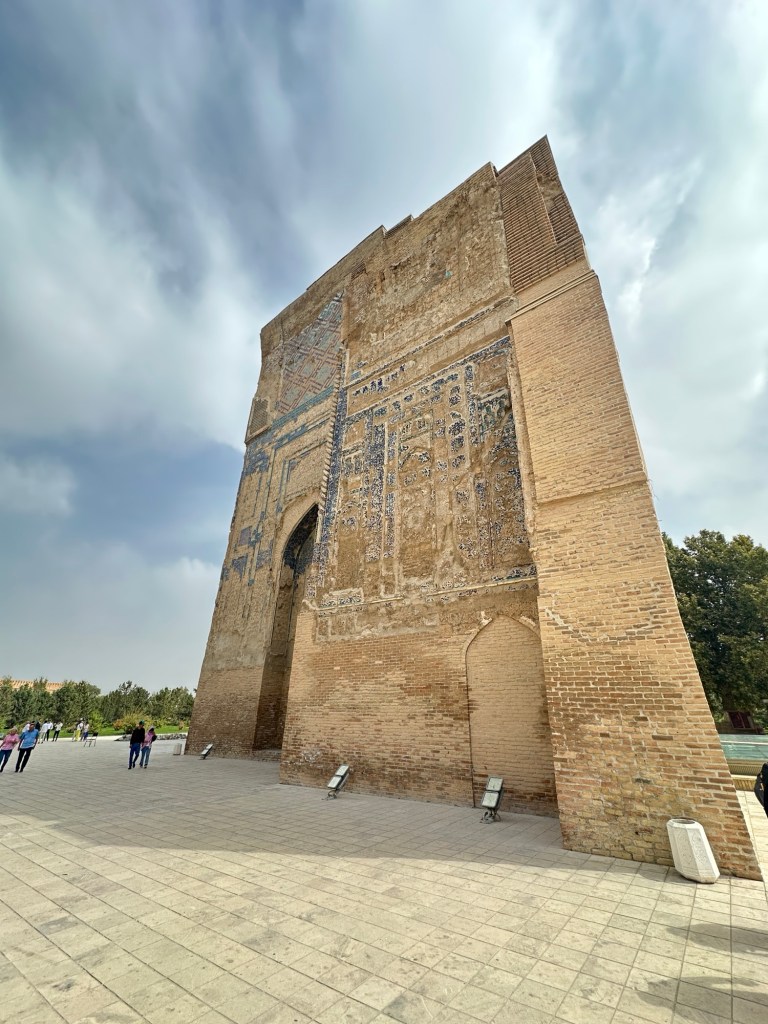
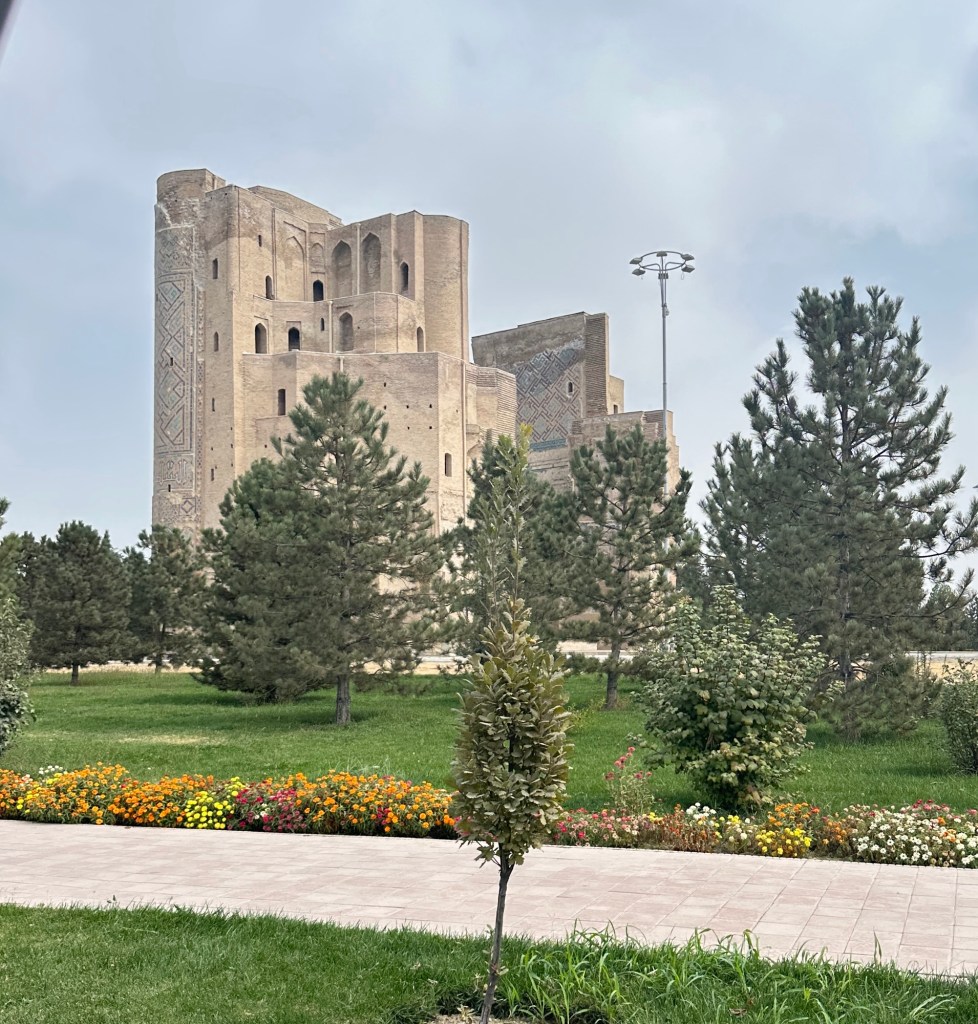
The main sight in Shahrisabz is the huge ruined complex of the Ak Serai, Timur’s “White Palace”. Built by slave artisans brought here from Khwarezm, the site was planned as a summer residence to complement Samarkand’s Kok Serai, or Blue Palace. The restorers have again been hard at work here, trying to recreate the huge 65metre entry towers that once supported Central Asia’s largest portal. The incredible palace once had blue-tiled walls, golden ceilings and lush surrounding gardens of waterfalls and silk tents that were the site of epic feasts of wine and horseflesh. Apparently there was even a pool!
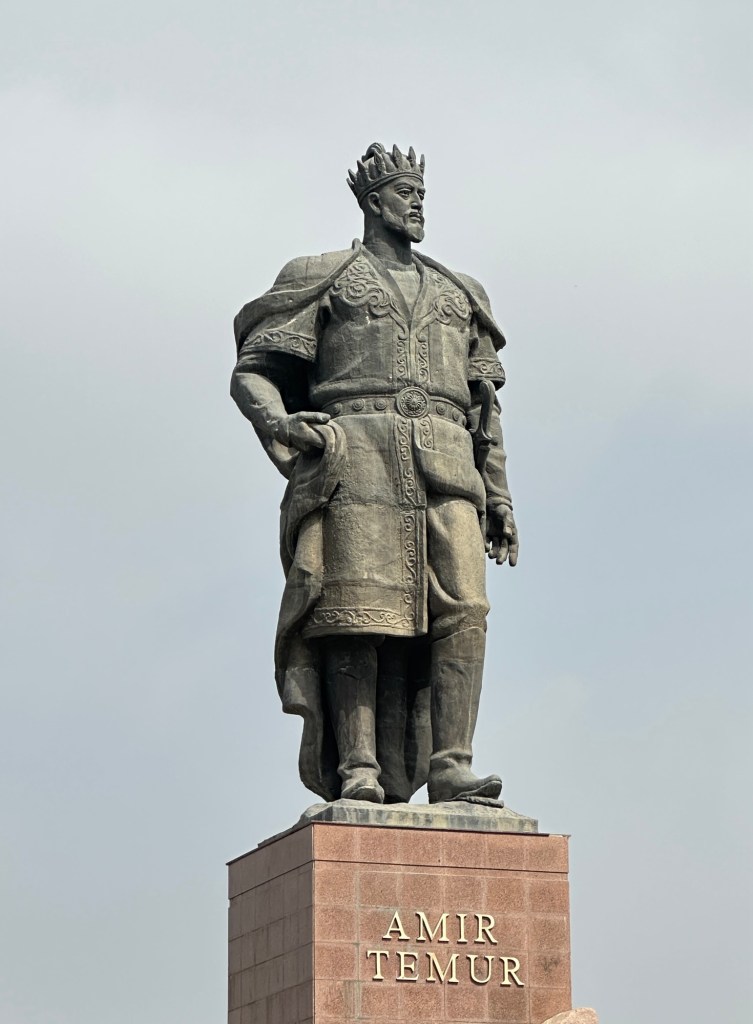
A large statue of Timur dominates this newly pedestrianised and landscaped complex. Nearby was the intended crypt of Timur, discovered in 1943 when a schoolboy fell down the entrance. The empty underground marble casket remains there, however Timur’s body is in Samarkand.
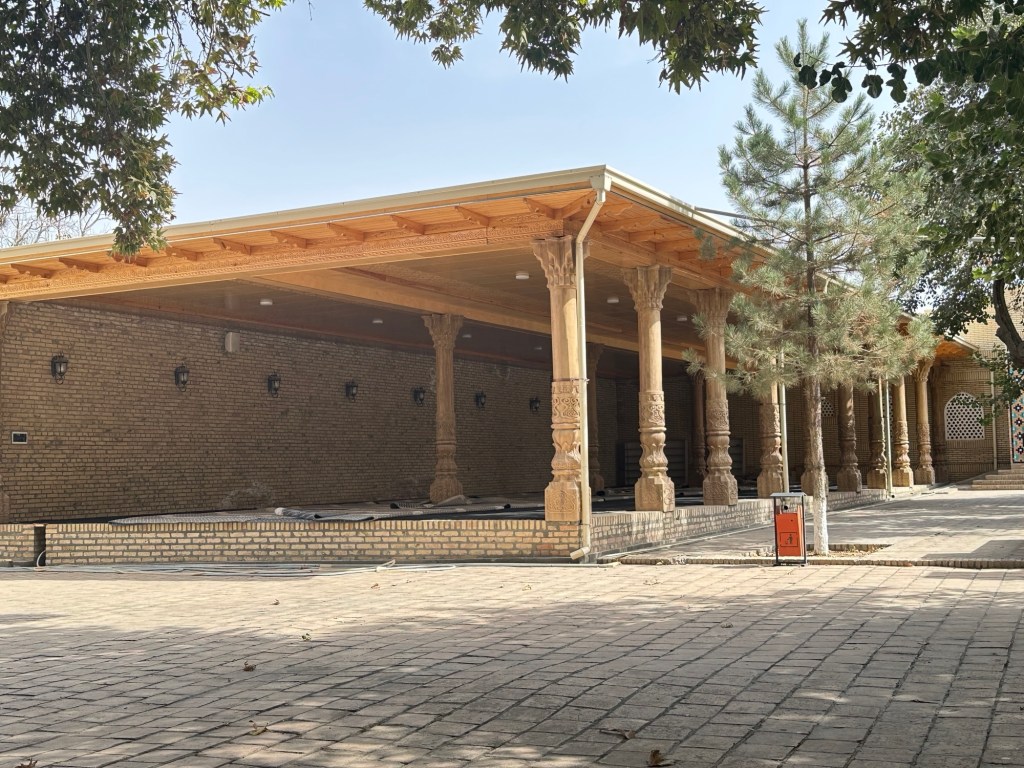
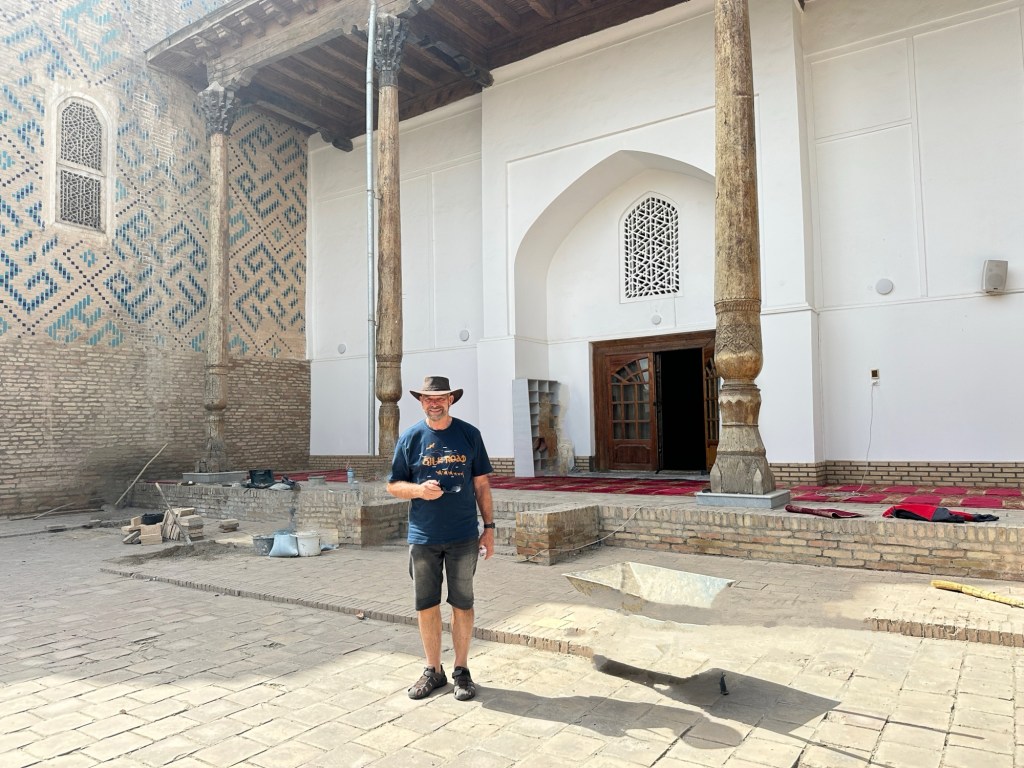
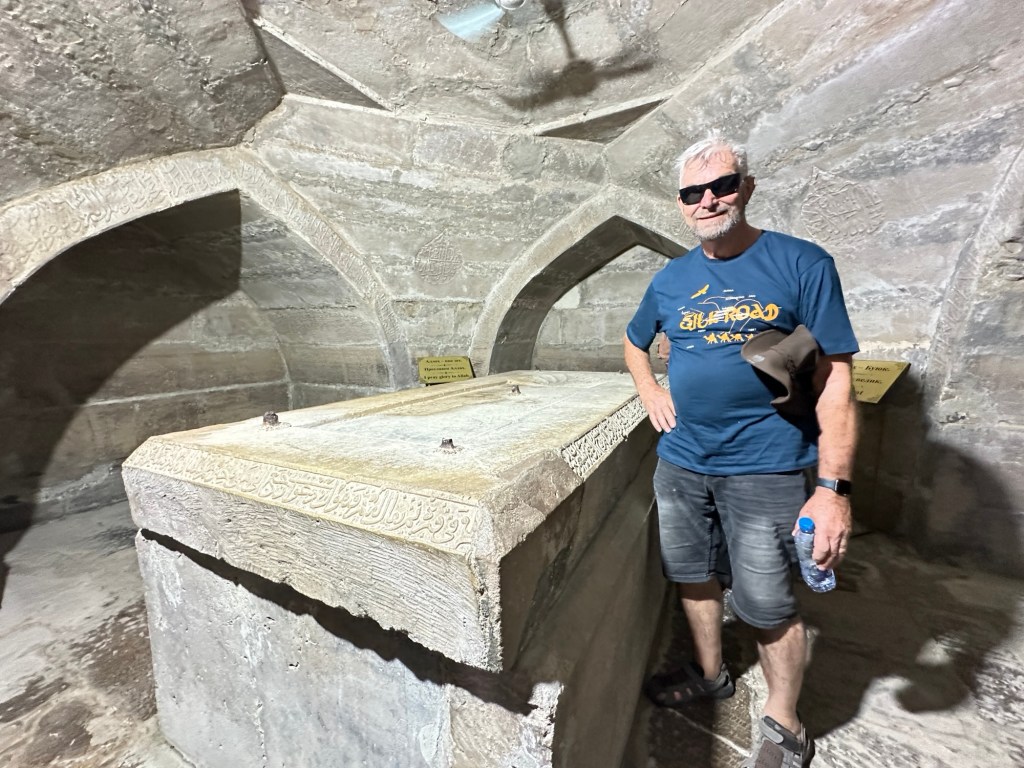
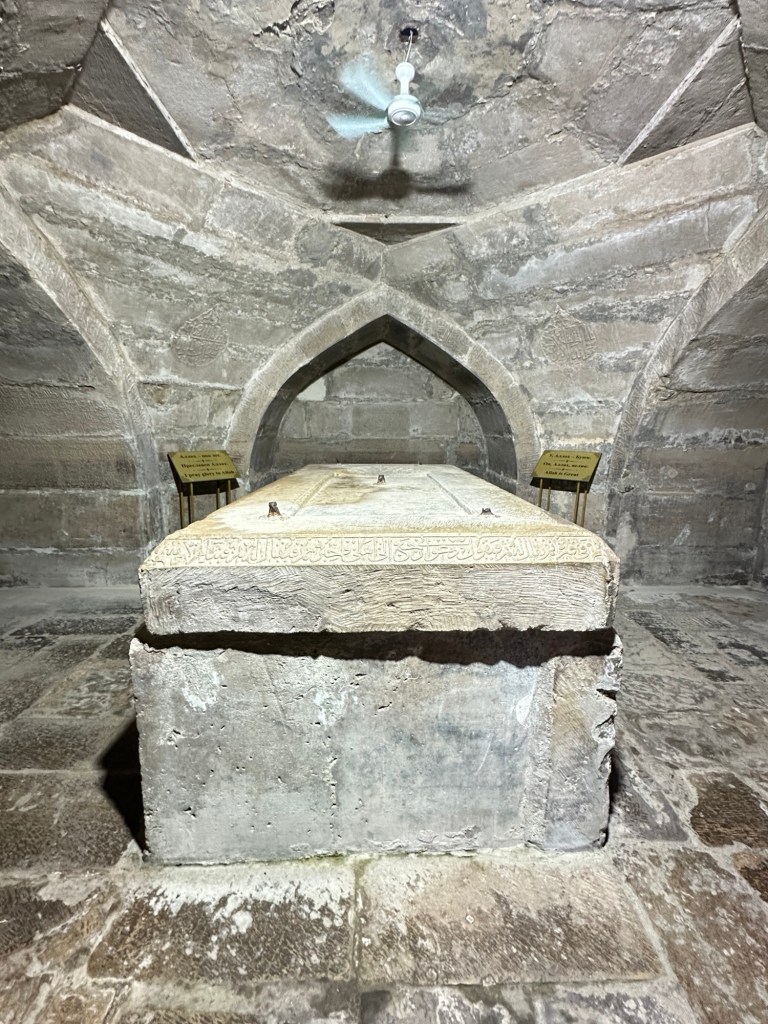
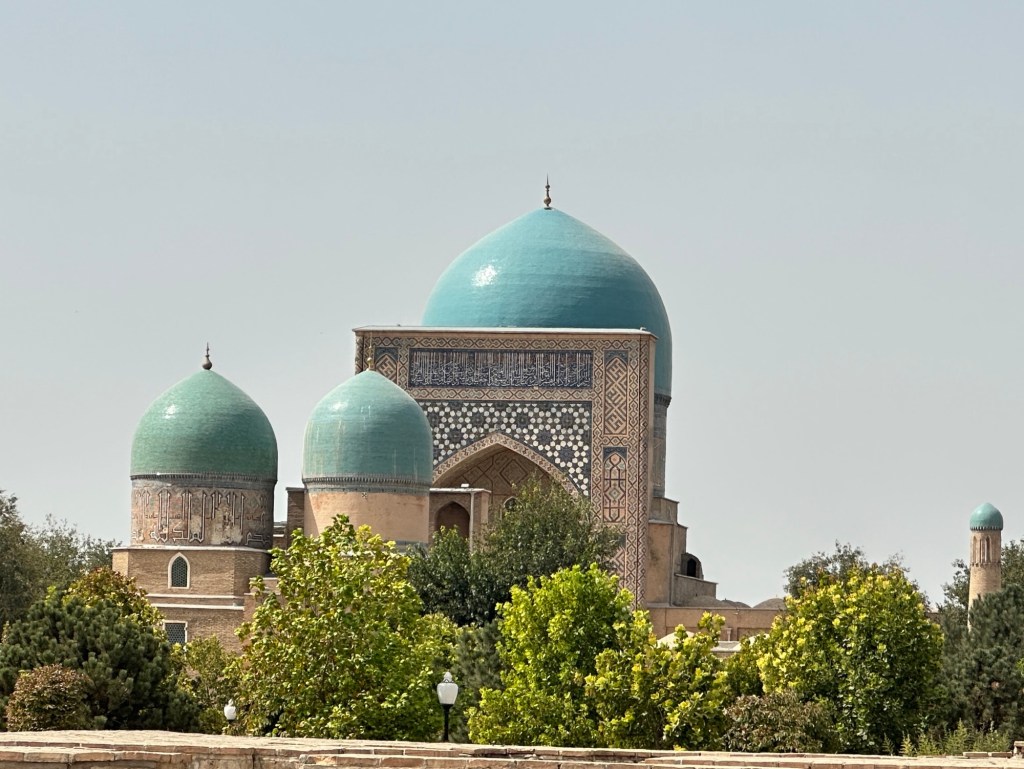
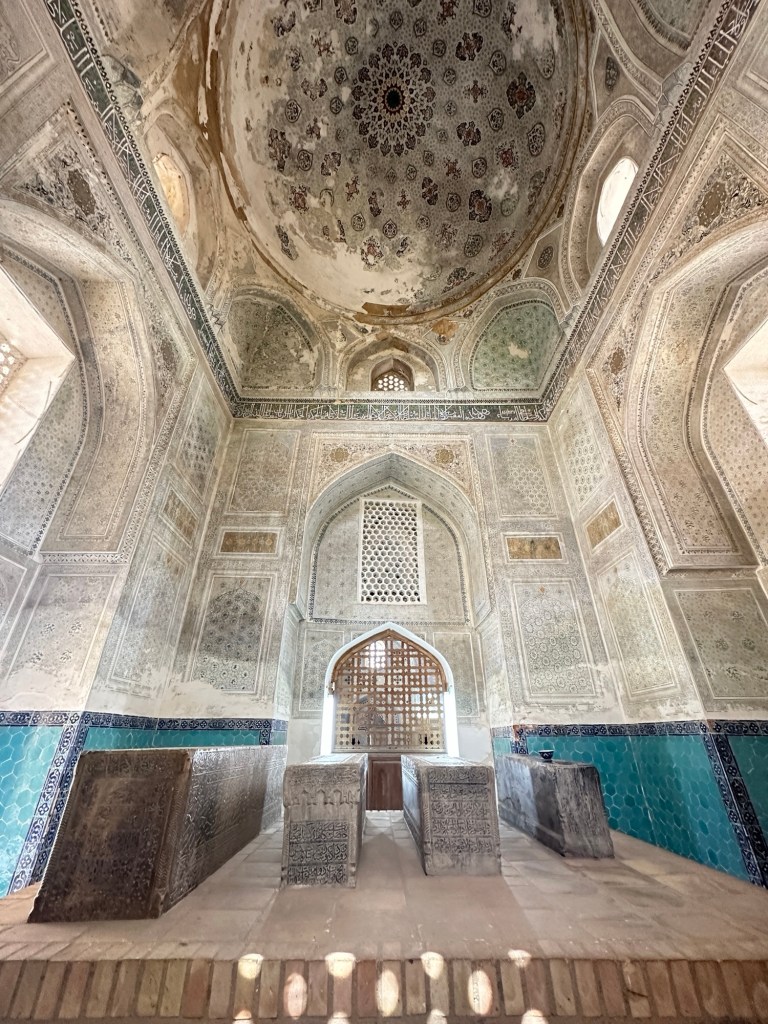
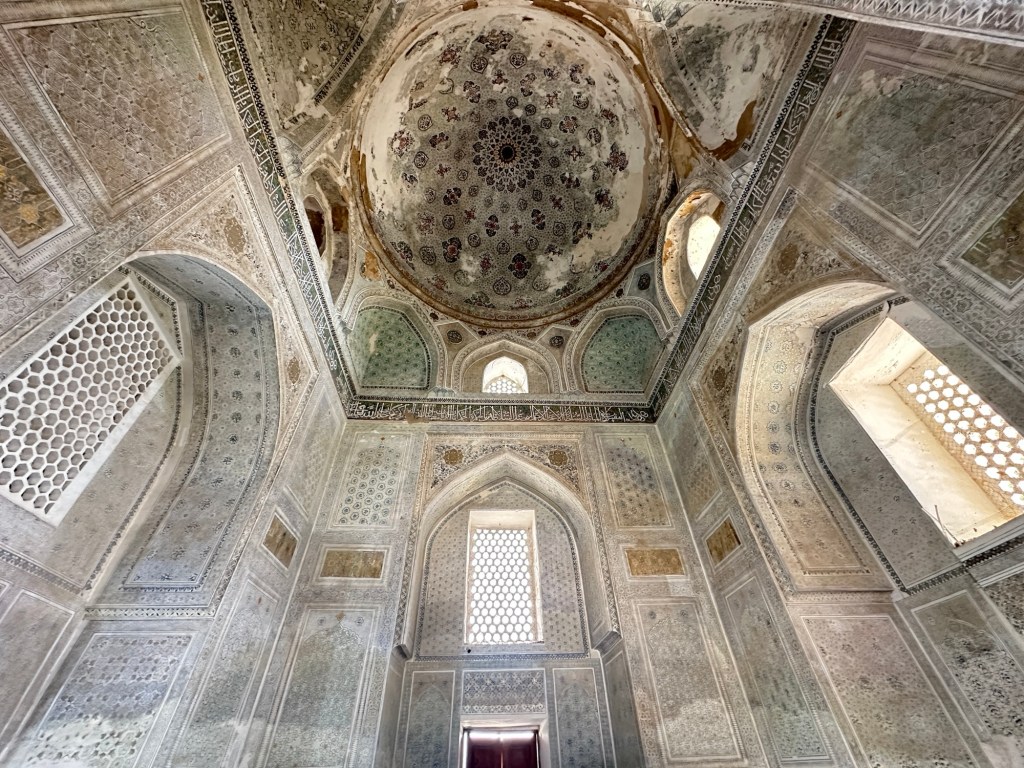
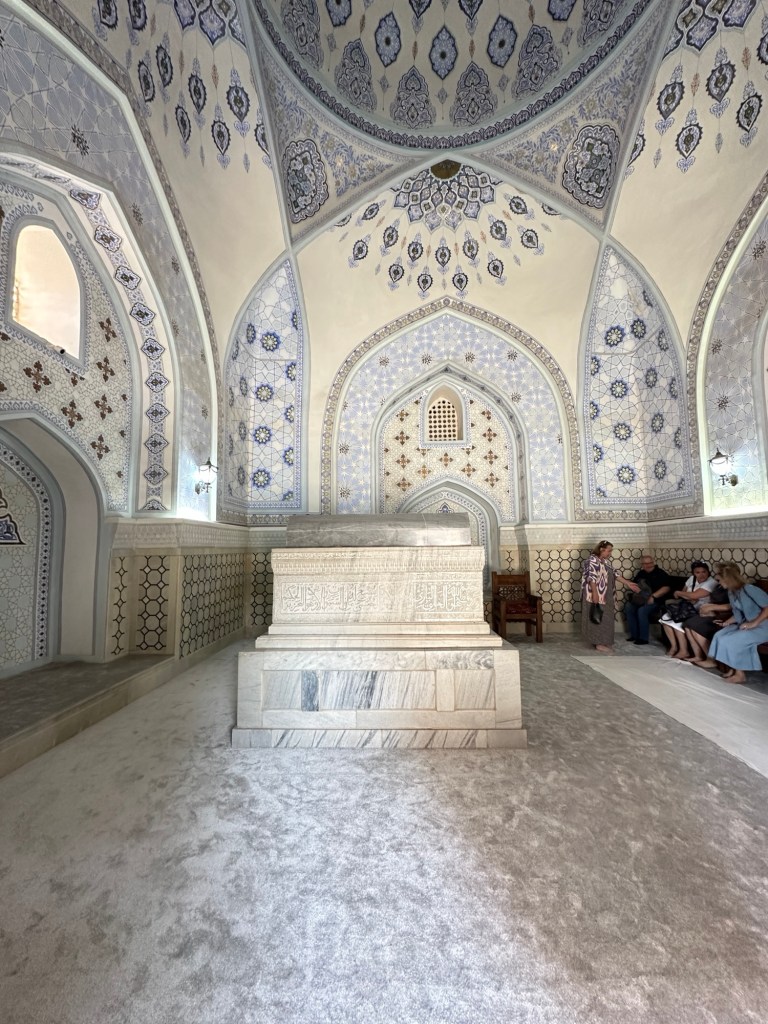
A short walk away was the Dorut-Tilovat Complex. The impressive blue dome in the south of the complex belongs to the Kok Gumbaz Mosque (1435–6), built by Ulug Beg as part of the complex. Timur’s father Taraghay and his spiritual adviser Shamsaddin Kulyal are both buried in the nearby Timurid mausoleum.
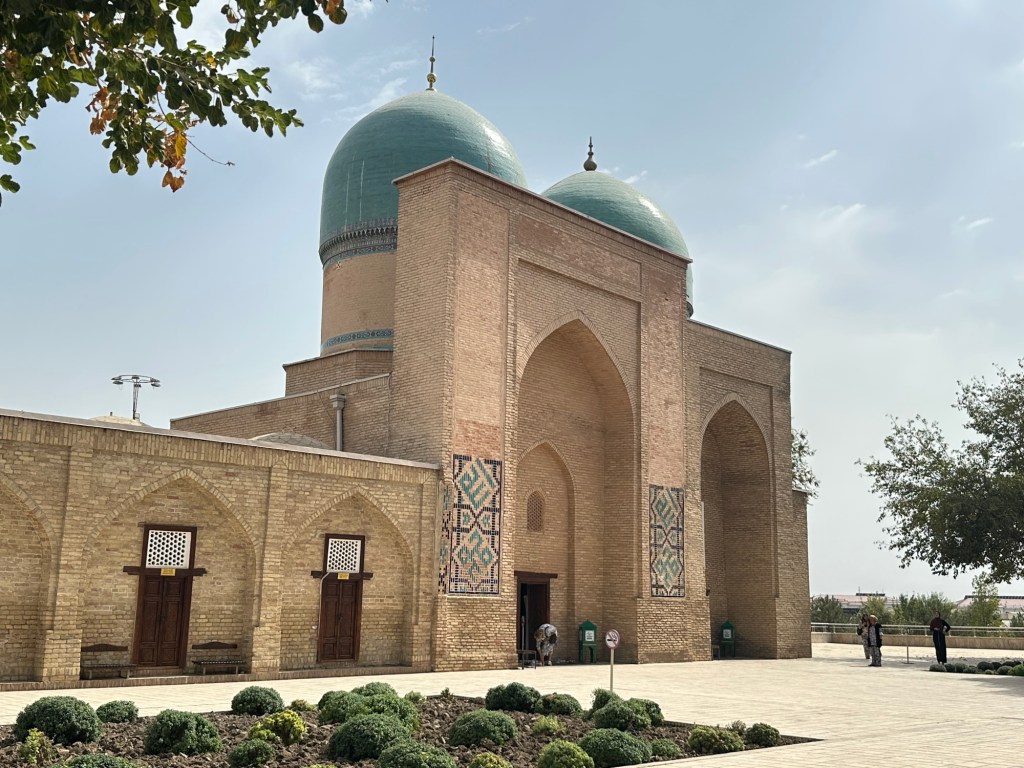
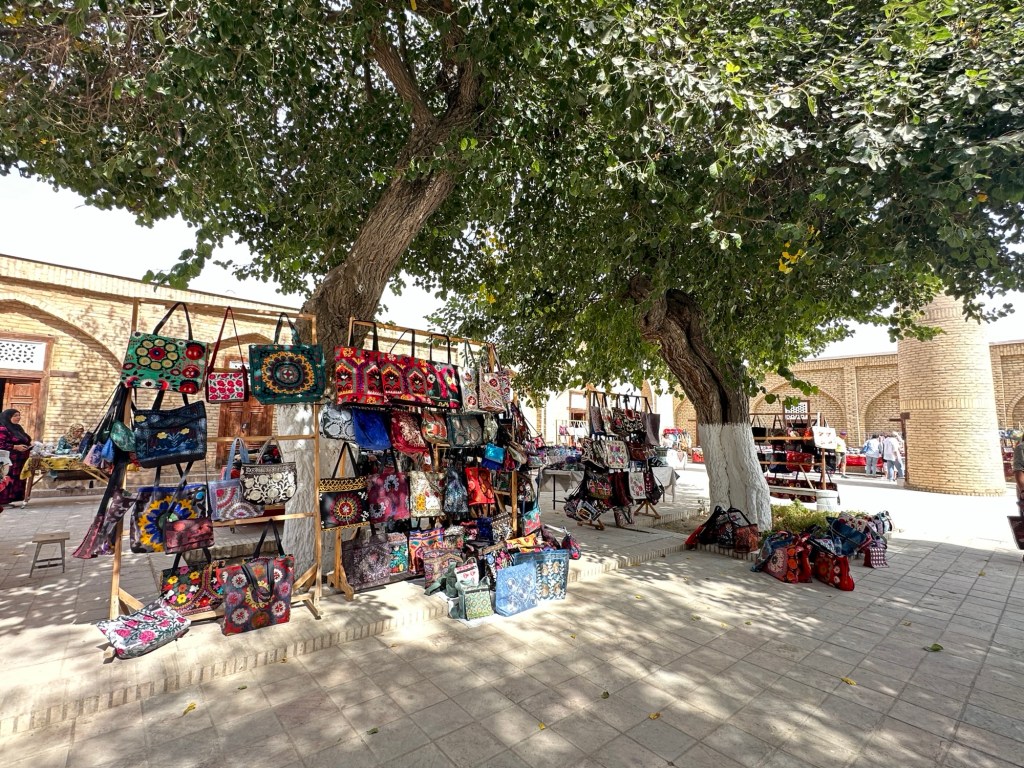
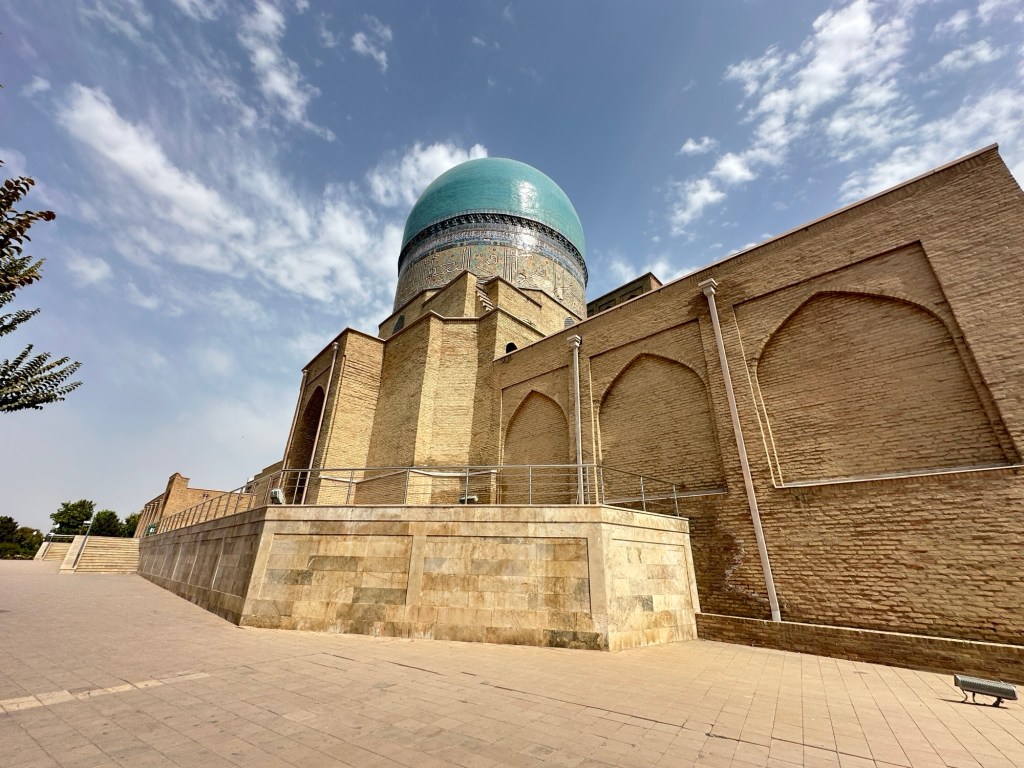
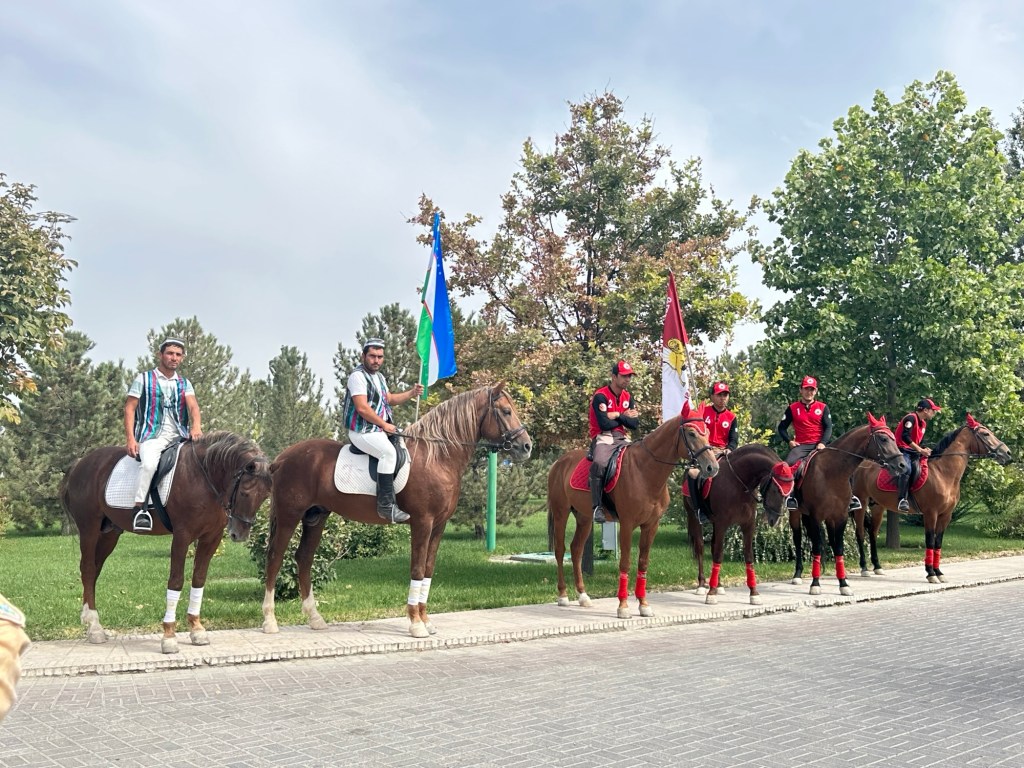
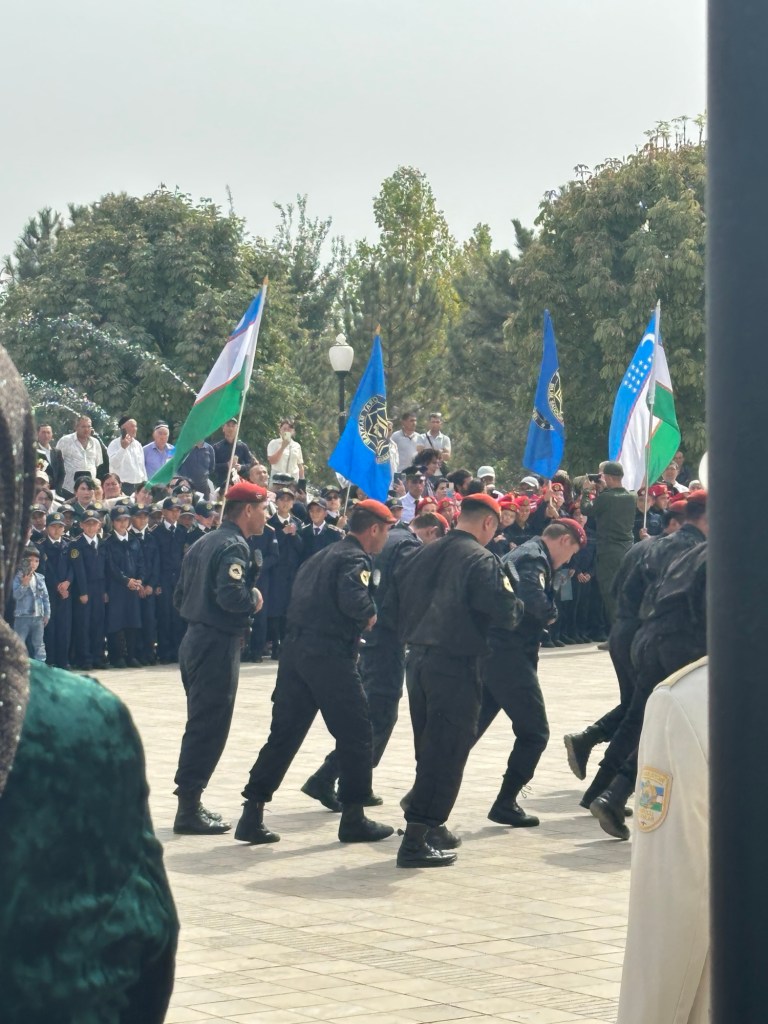
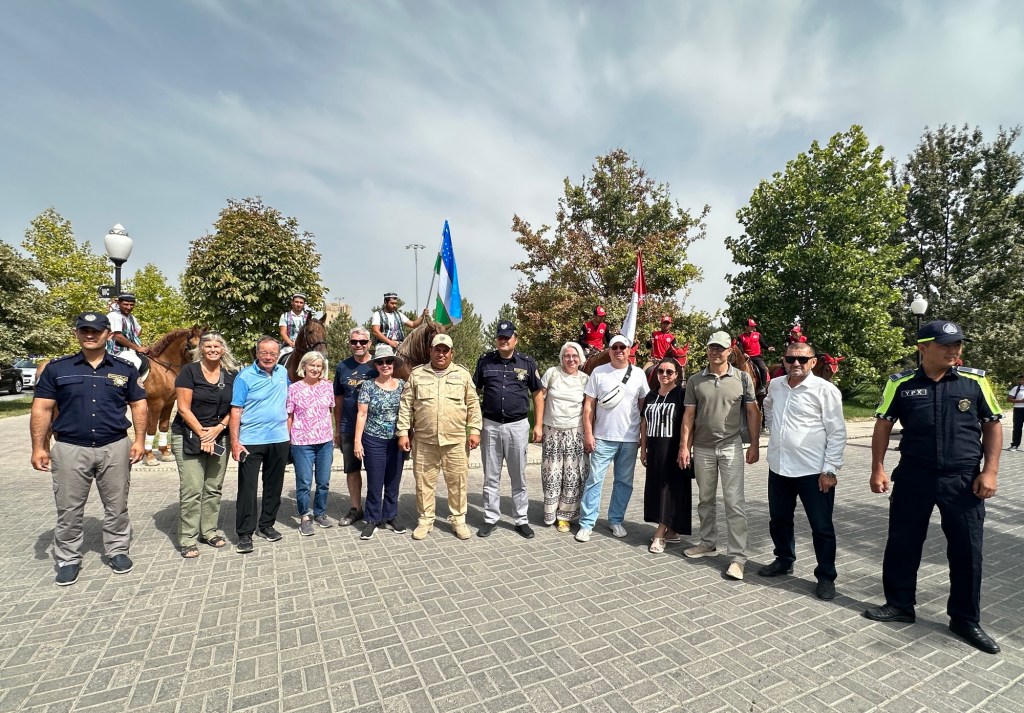
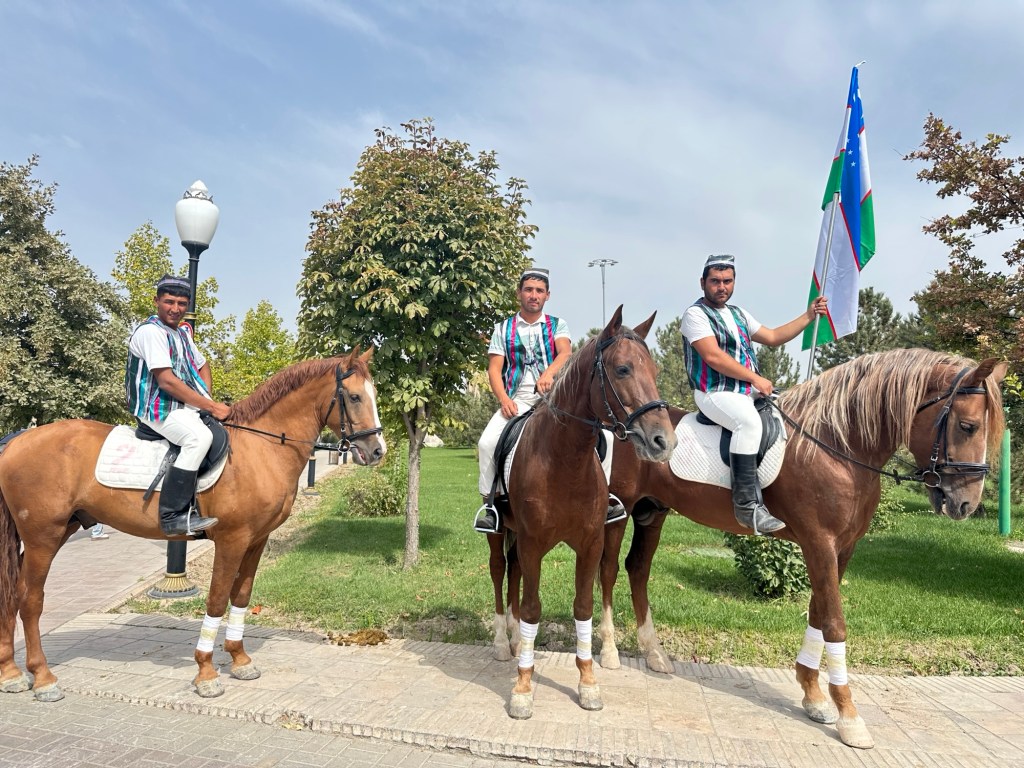
During the day we somehow managed to get in the middle of a military display – we thought we were in trouble for taking photos, but turns out they wanted us to be in their photos! Lots of animation involved, it certainly was a talking point for the day.
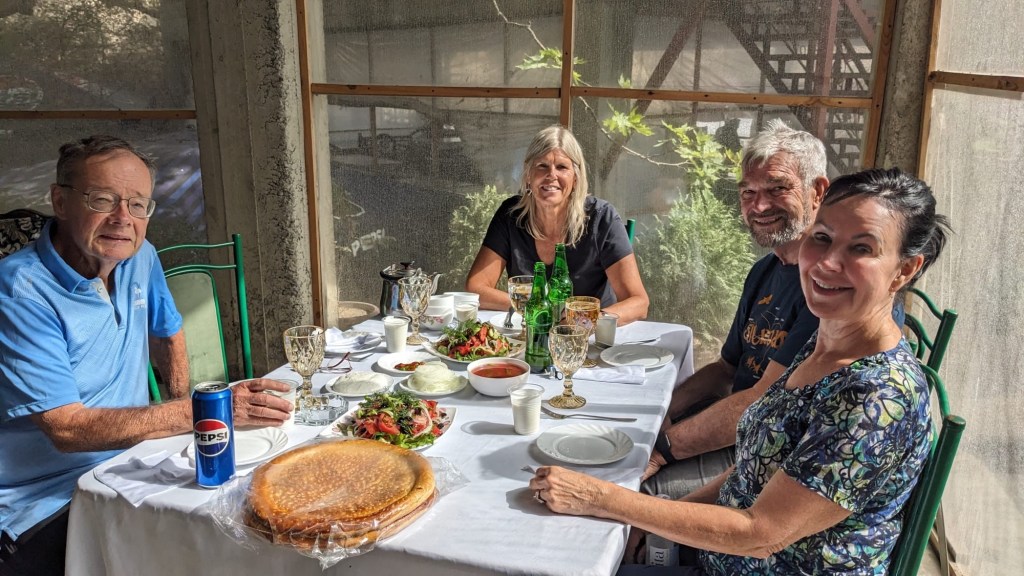
A late lunch stop on the top of the mountains on the way back- a spectacular stopping point. More lamb shaslick, salad, labneh and bread. Yum!
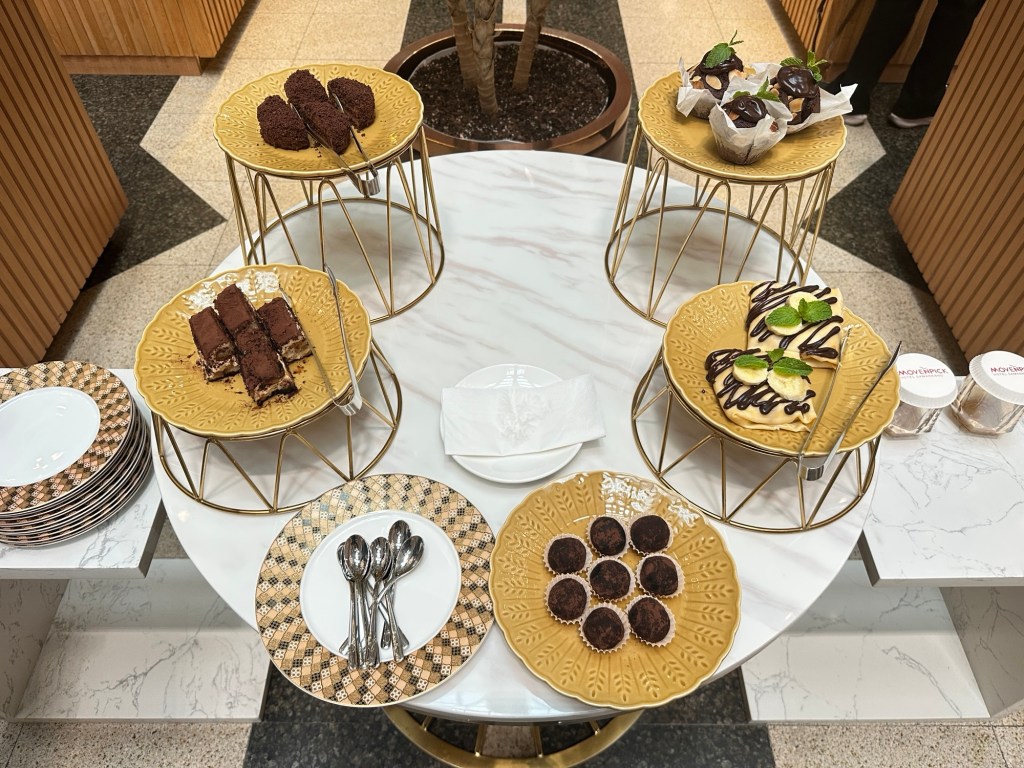
Back in time for the 5pm Movenpick chocolate happy hour – a nice feast of chocolate and other sweeties. A walk around the hotel’s neighbourhood helped work up an appetite for dinner. I had saved myself for the salmon and caviar again. It didn’t disappoint.
Day 16
Friday 26th September
Samarkand to Tashkent
14-27 degrees, sunny
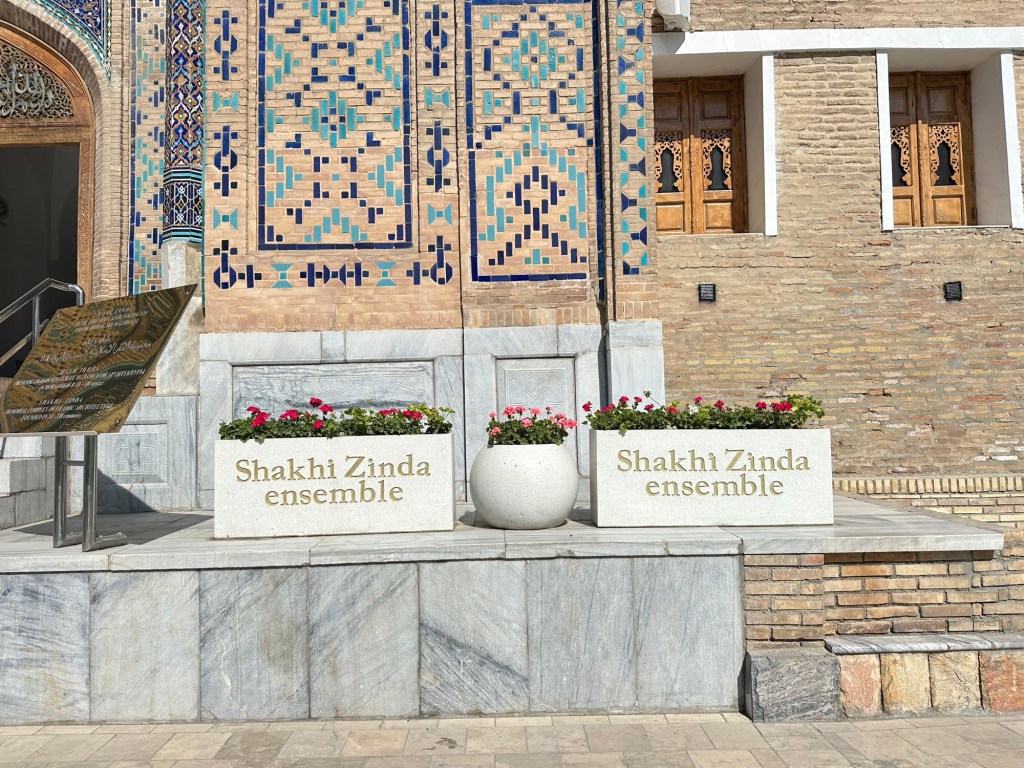
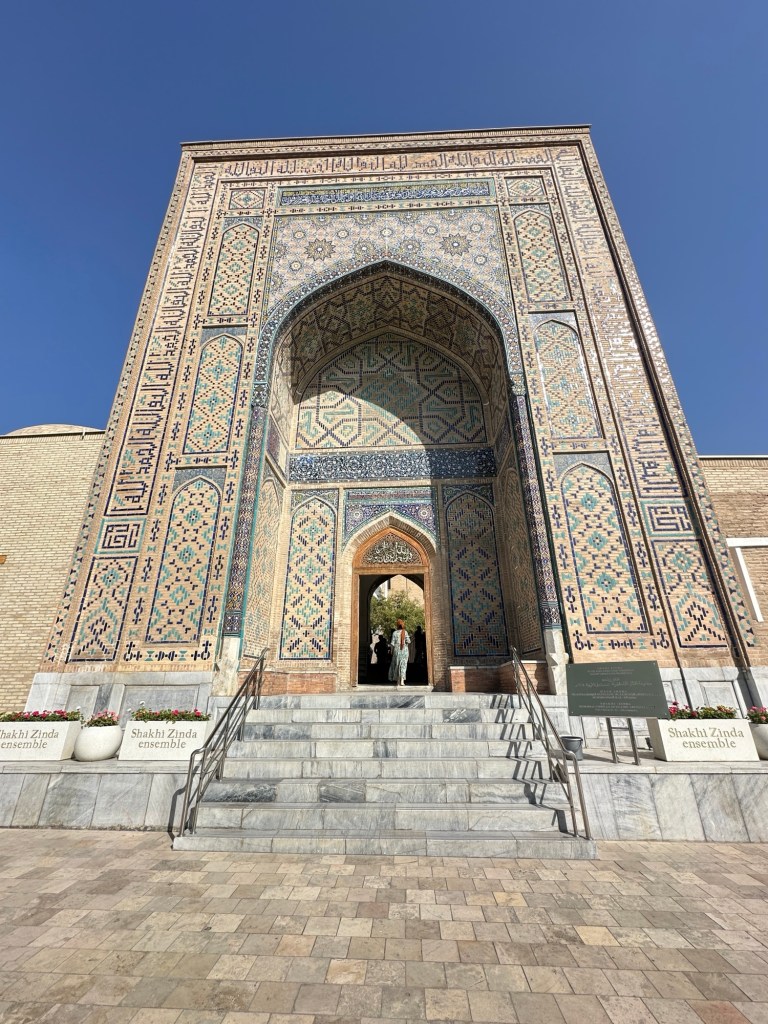
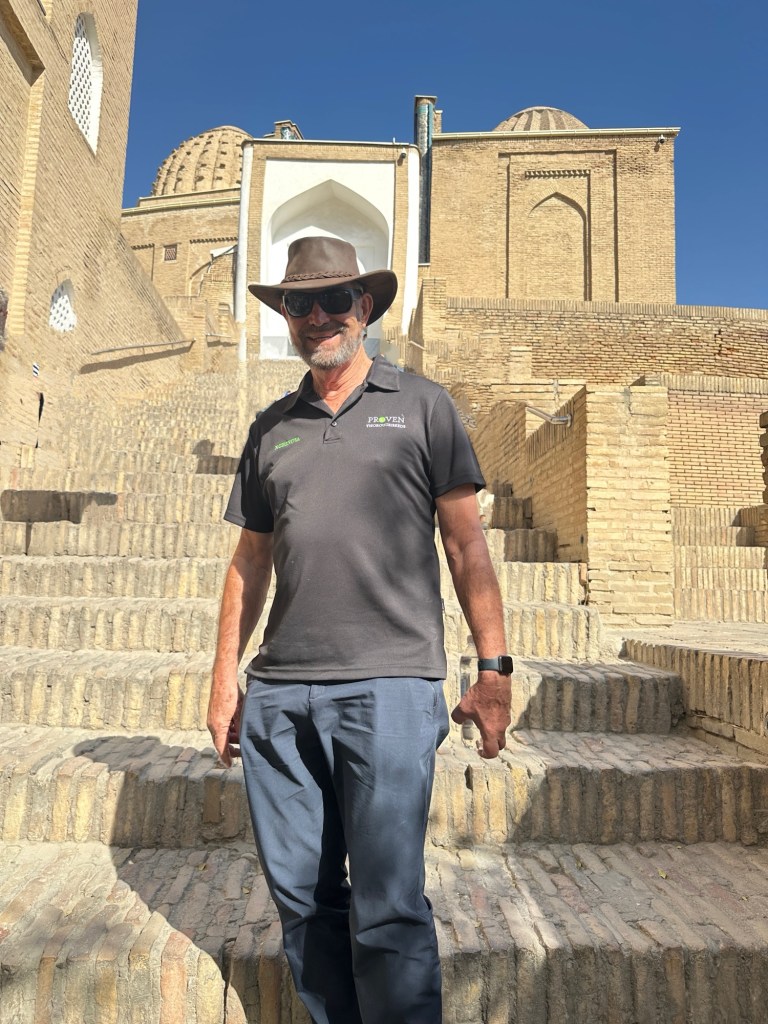
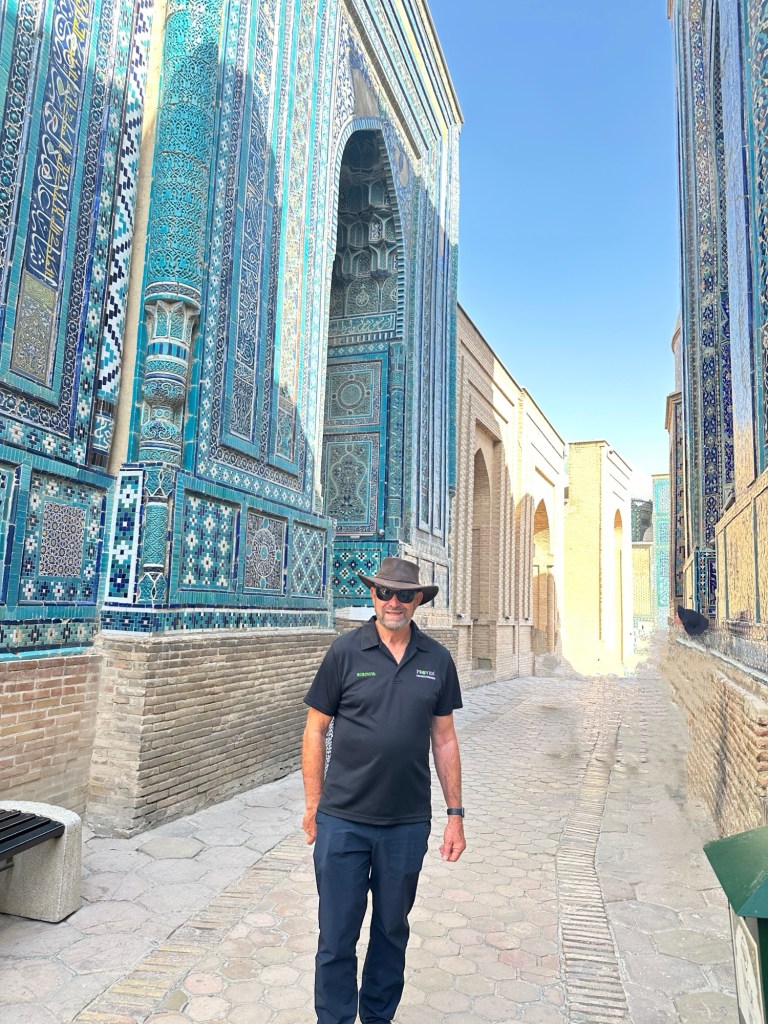
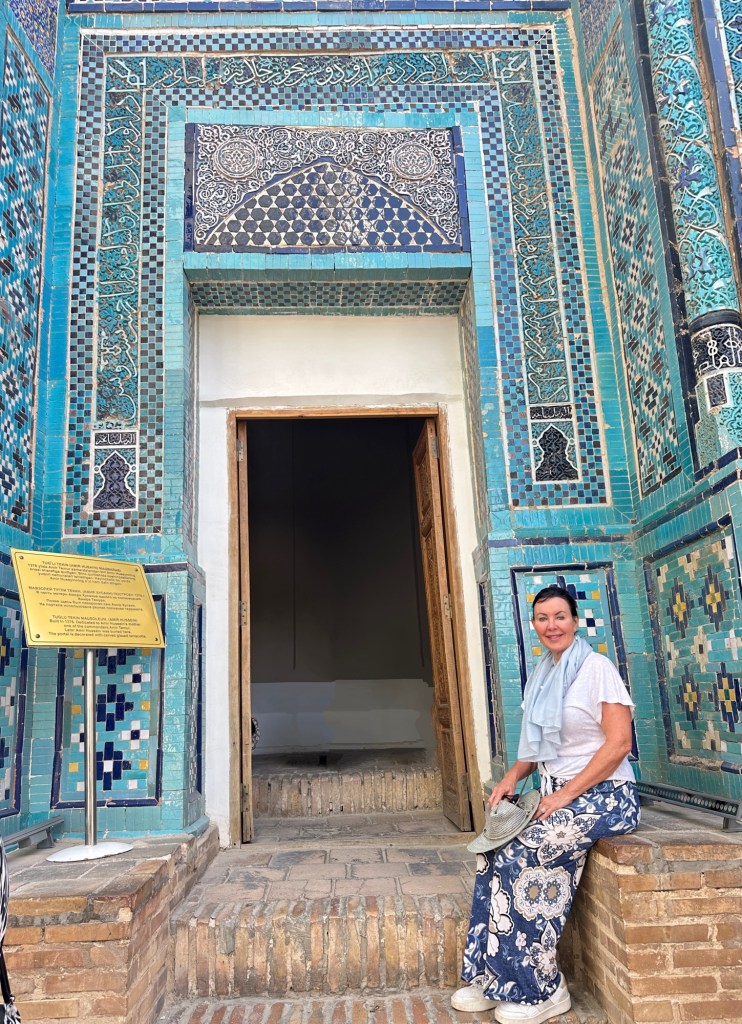
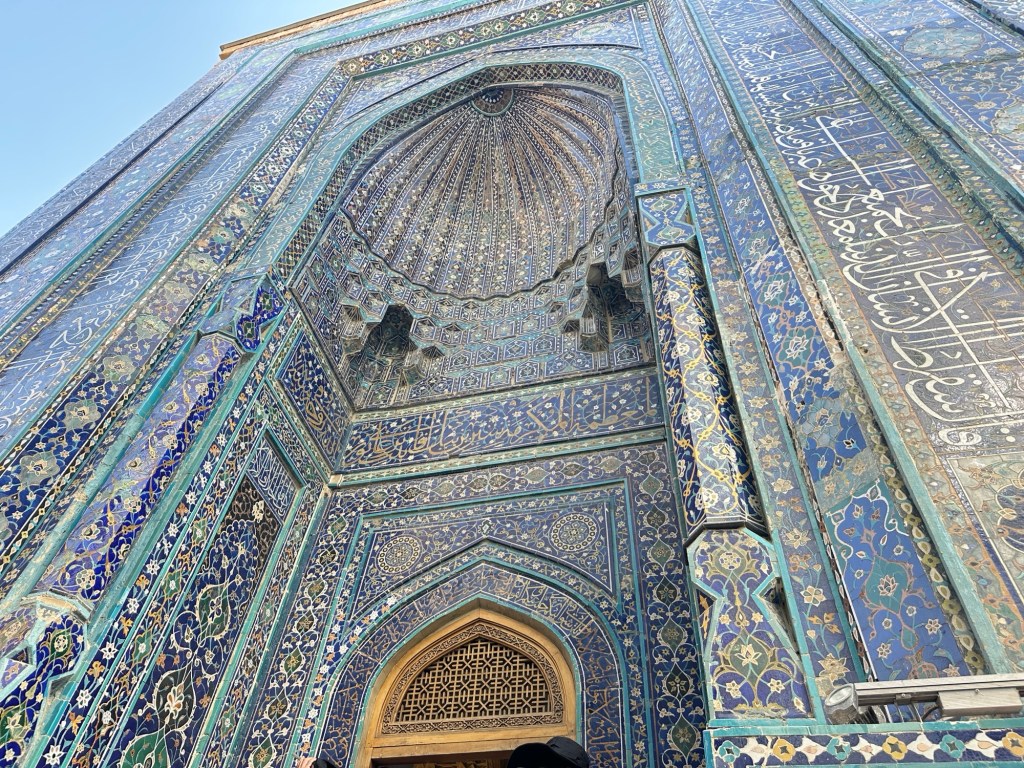
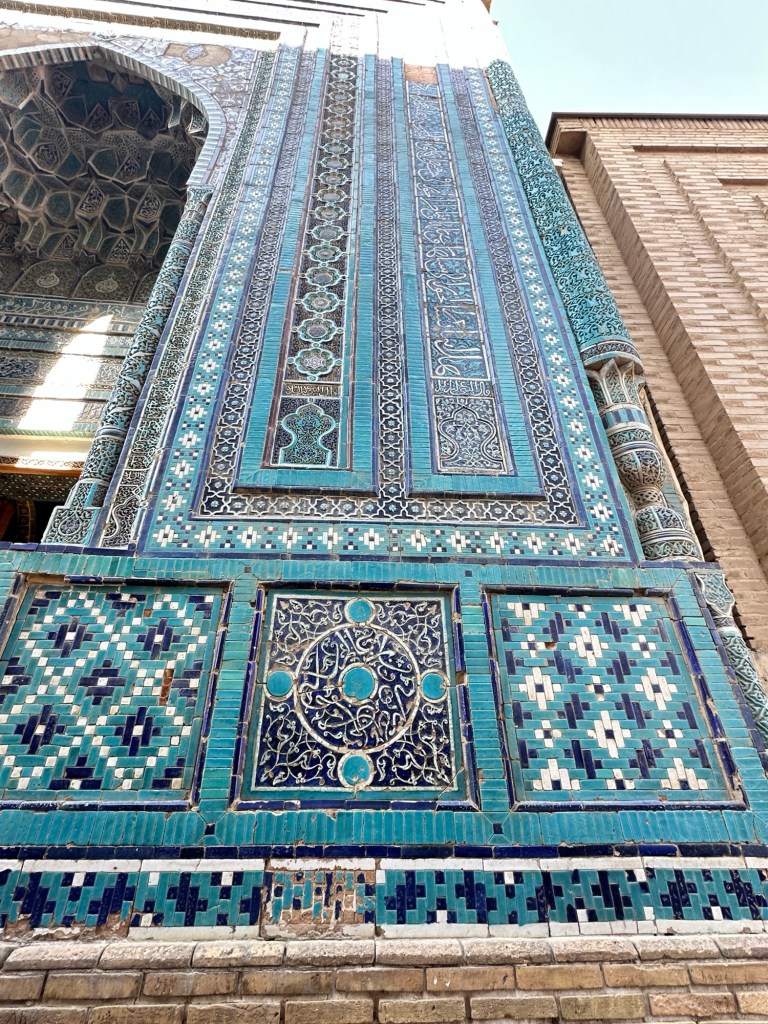
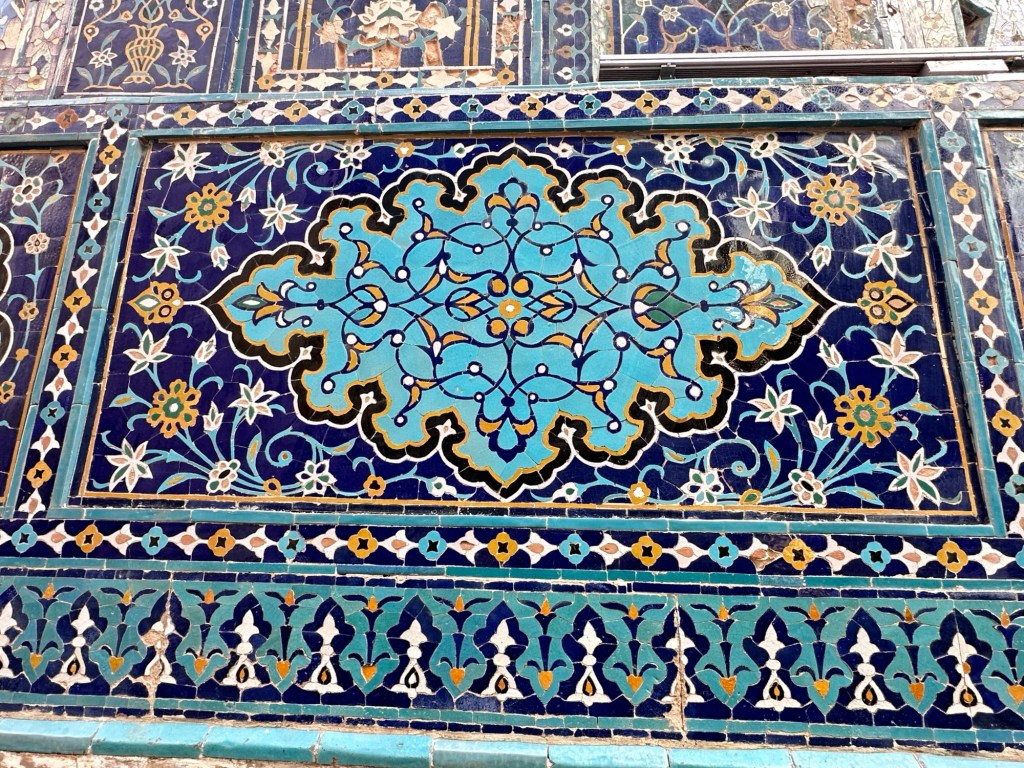
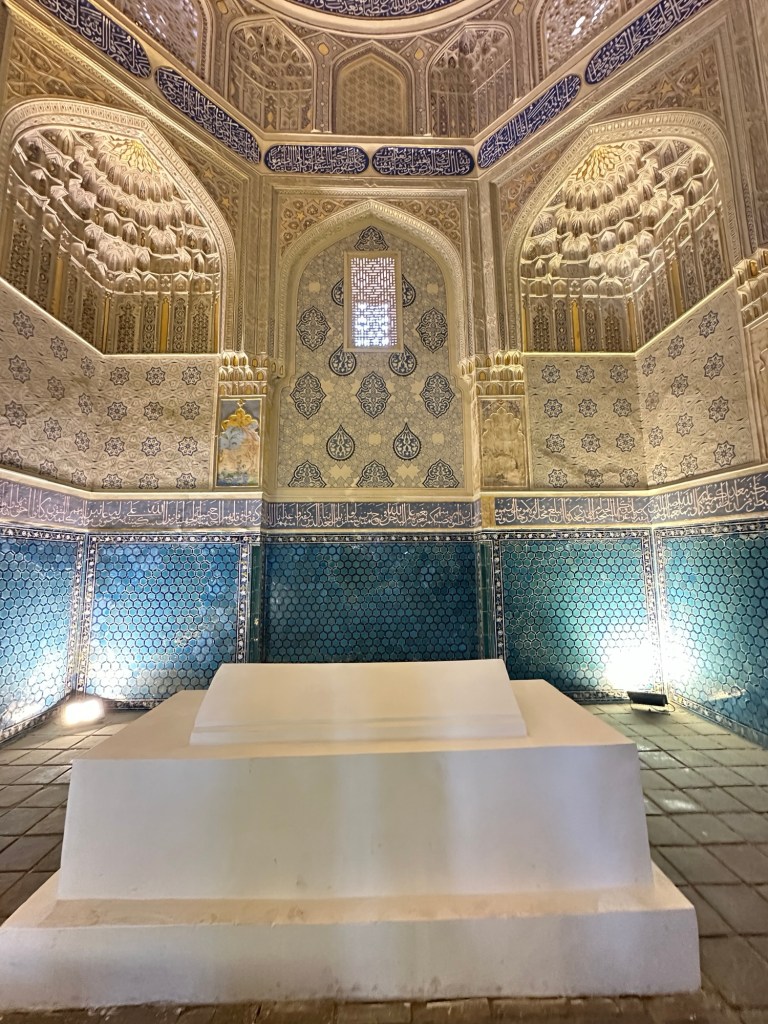
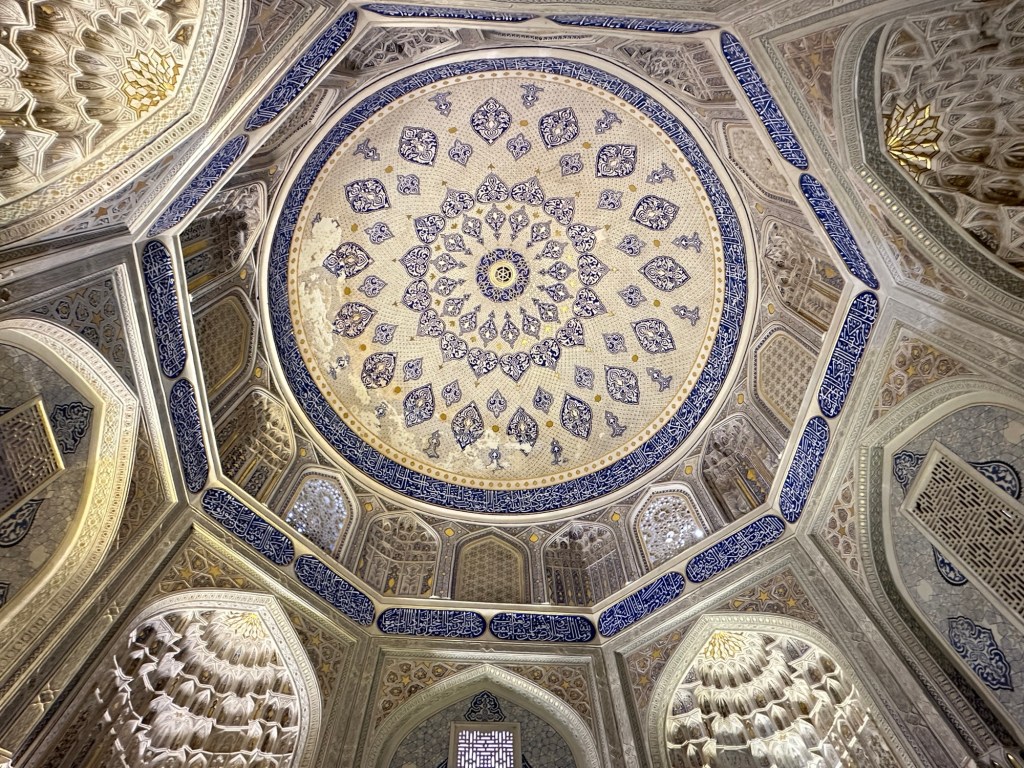
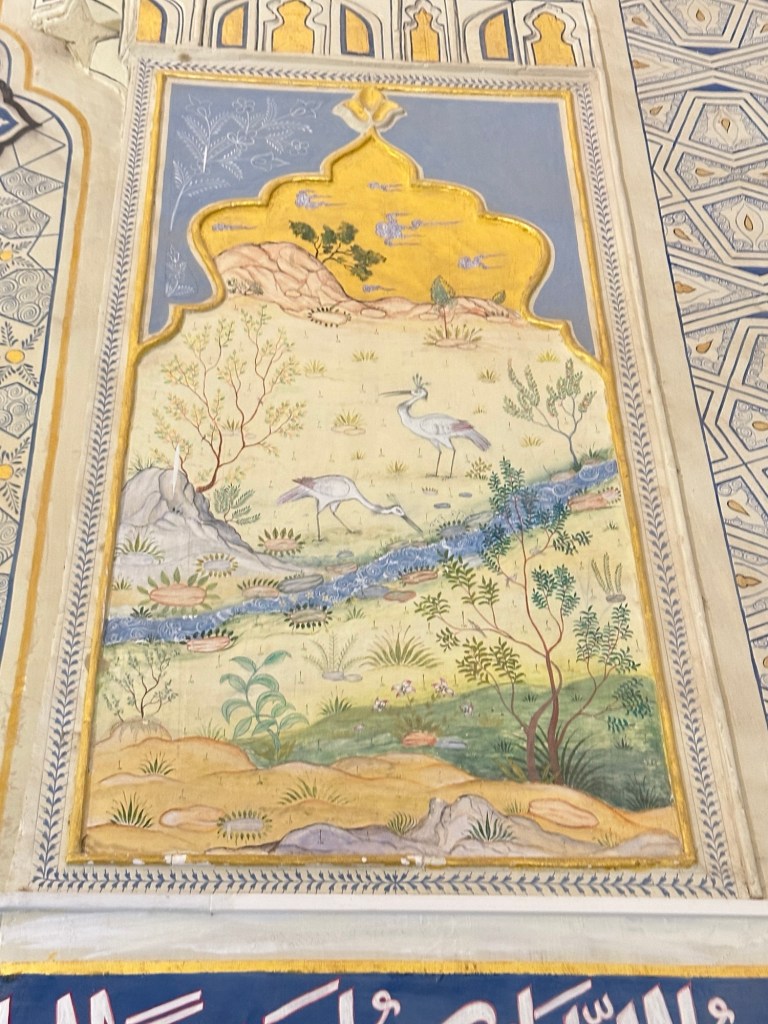
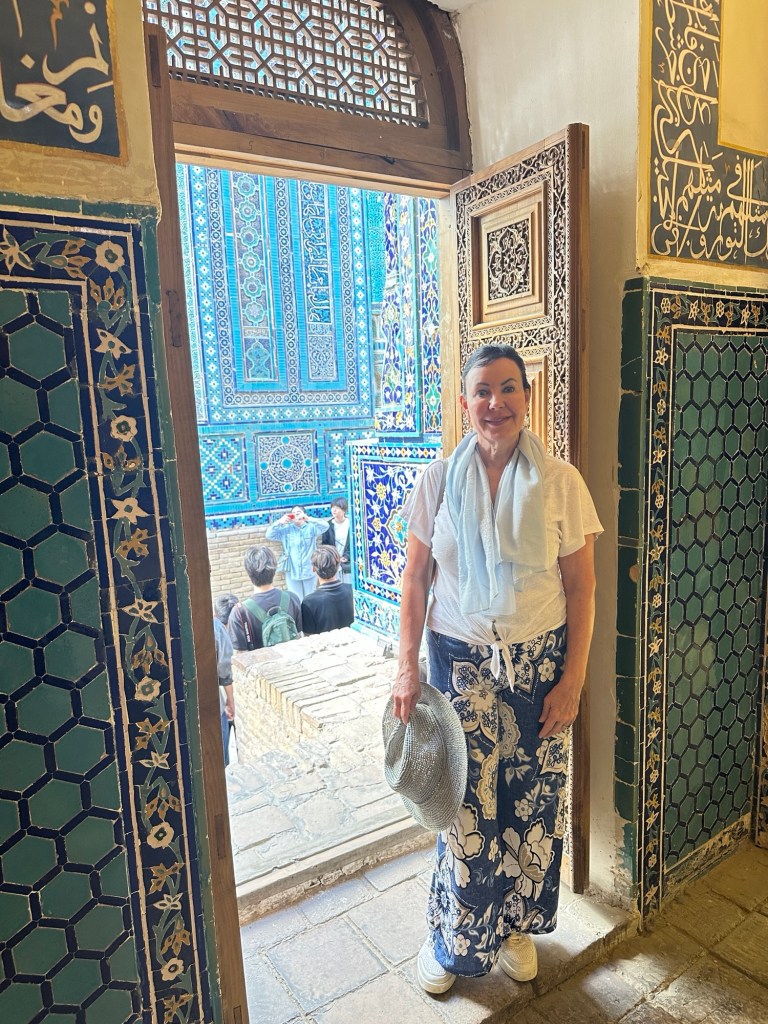
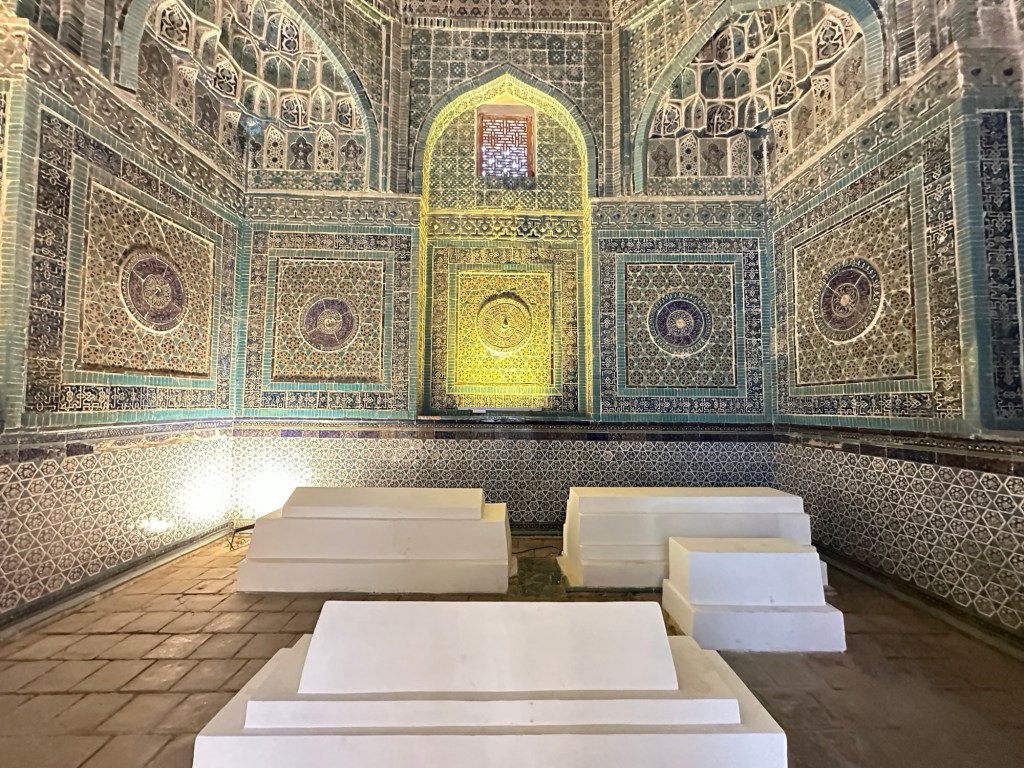
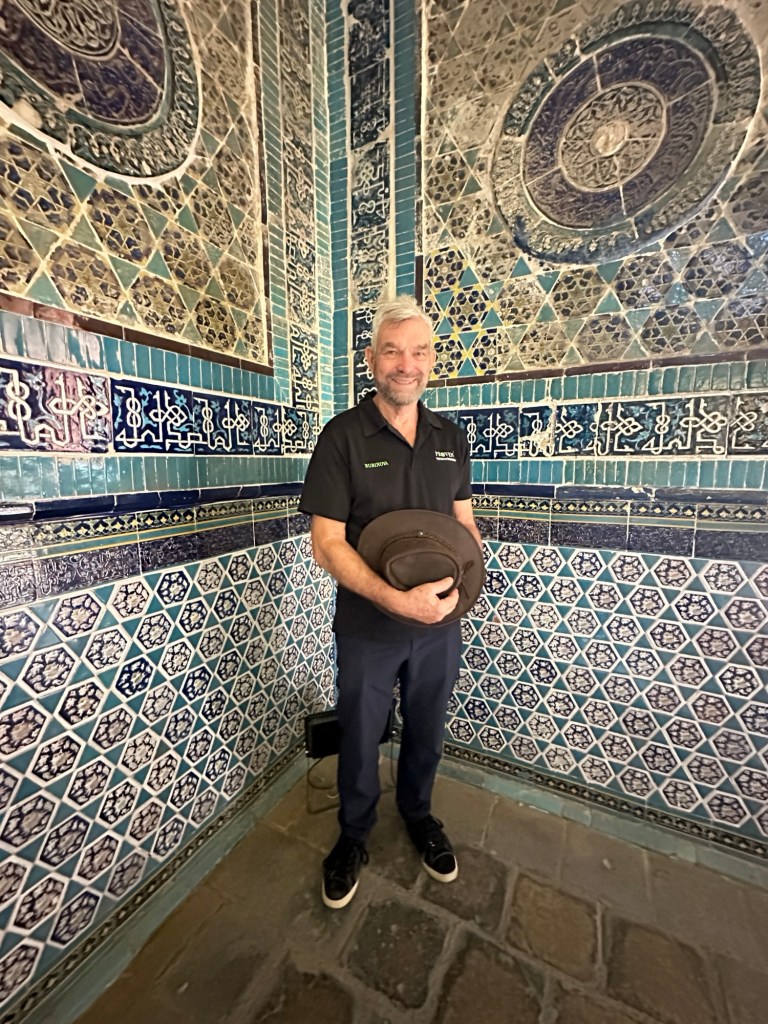
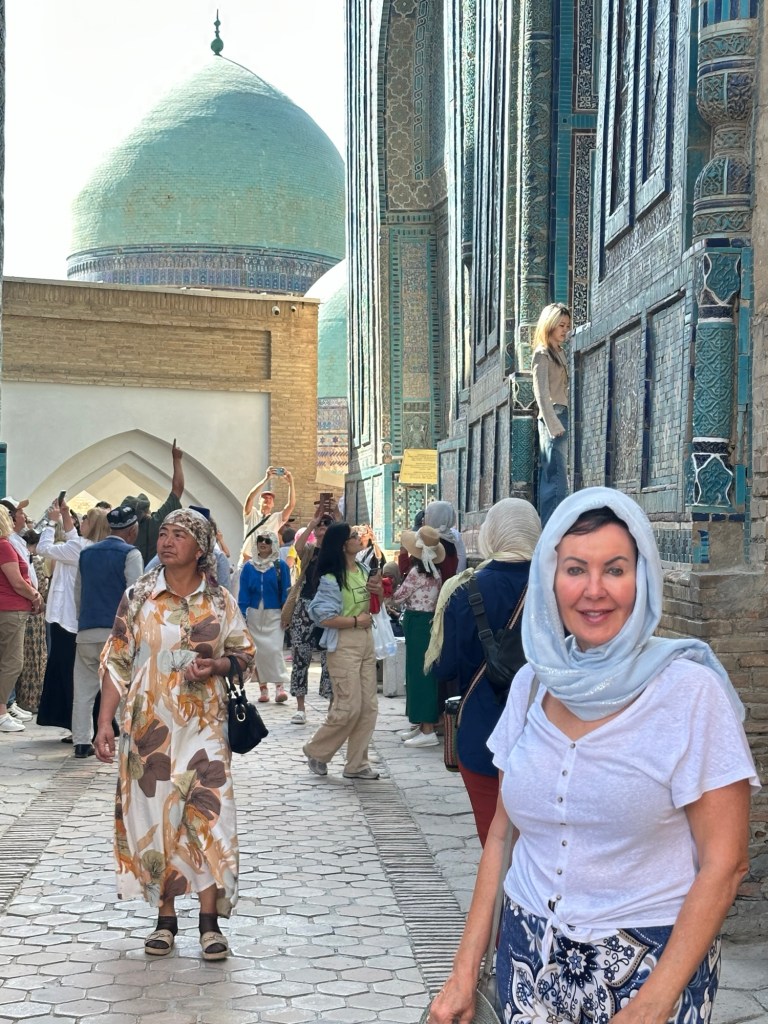
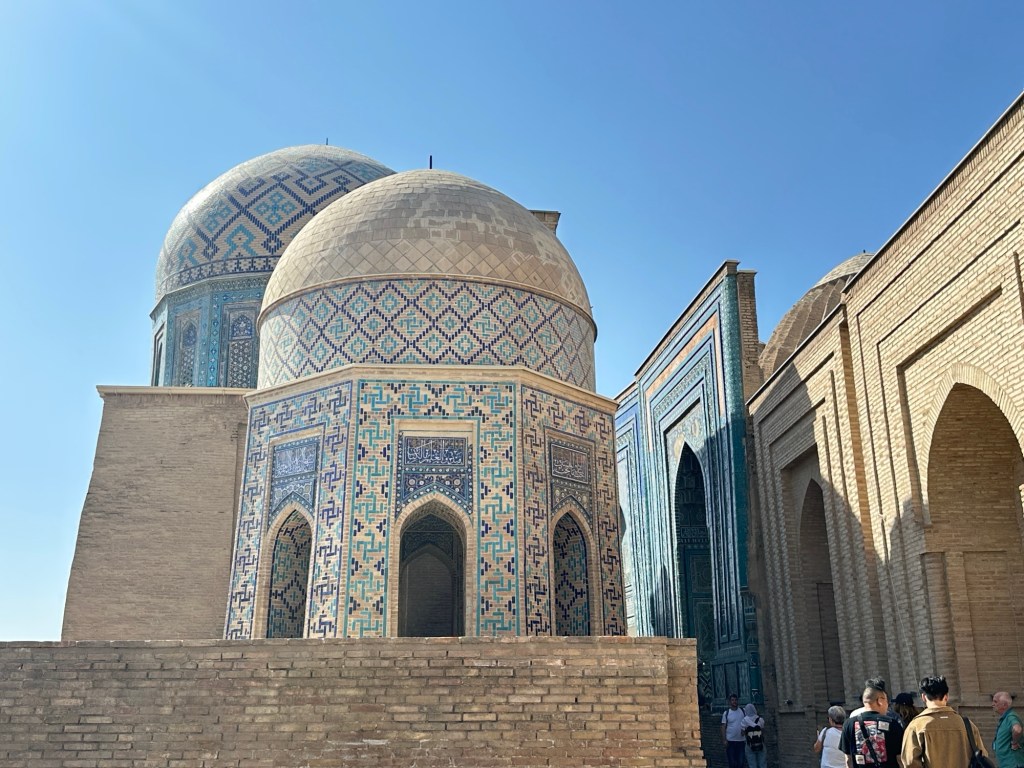
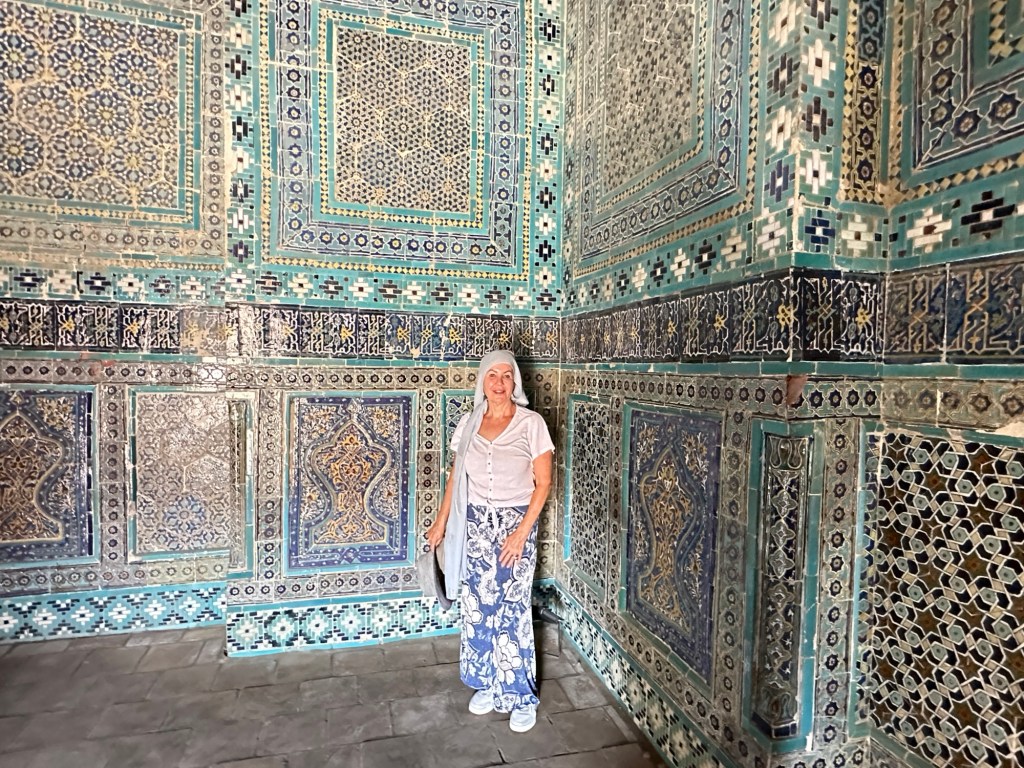
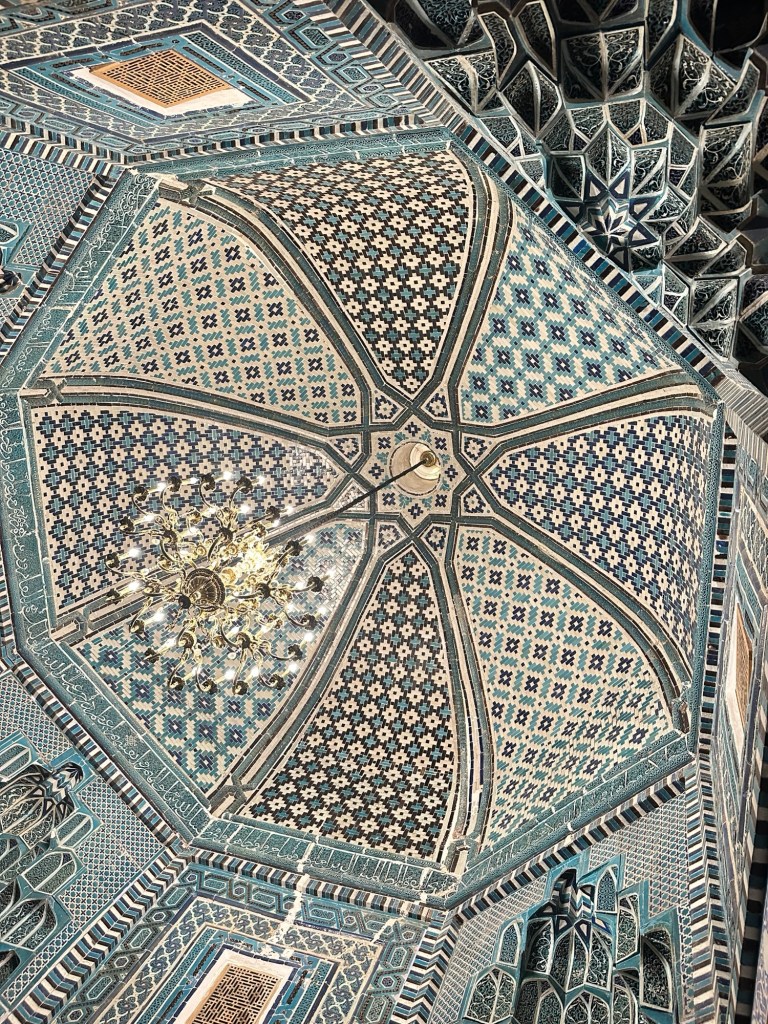
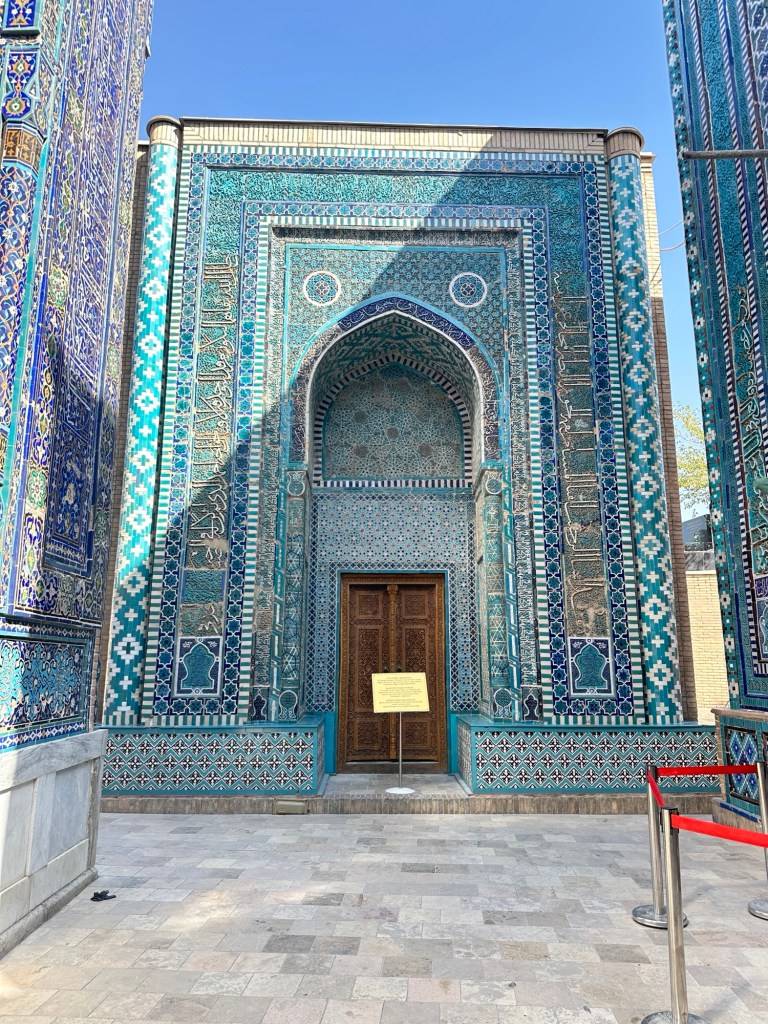
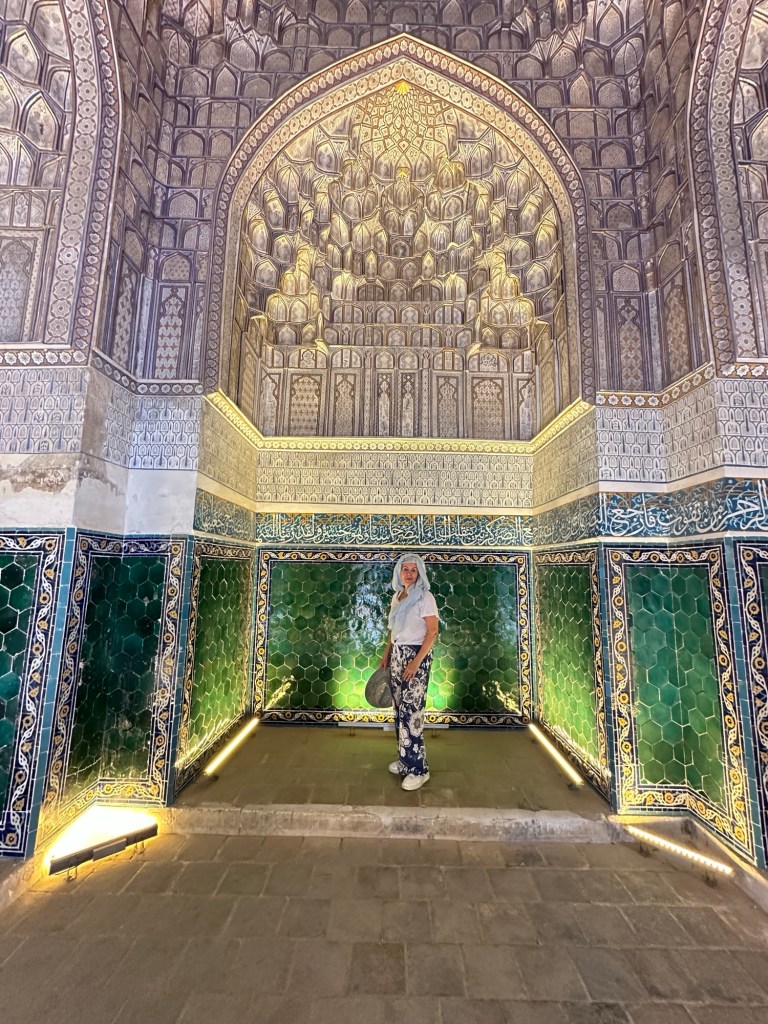
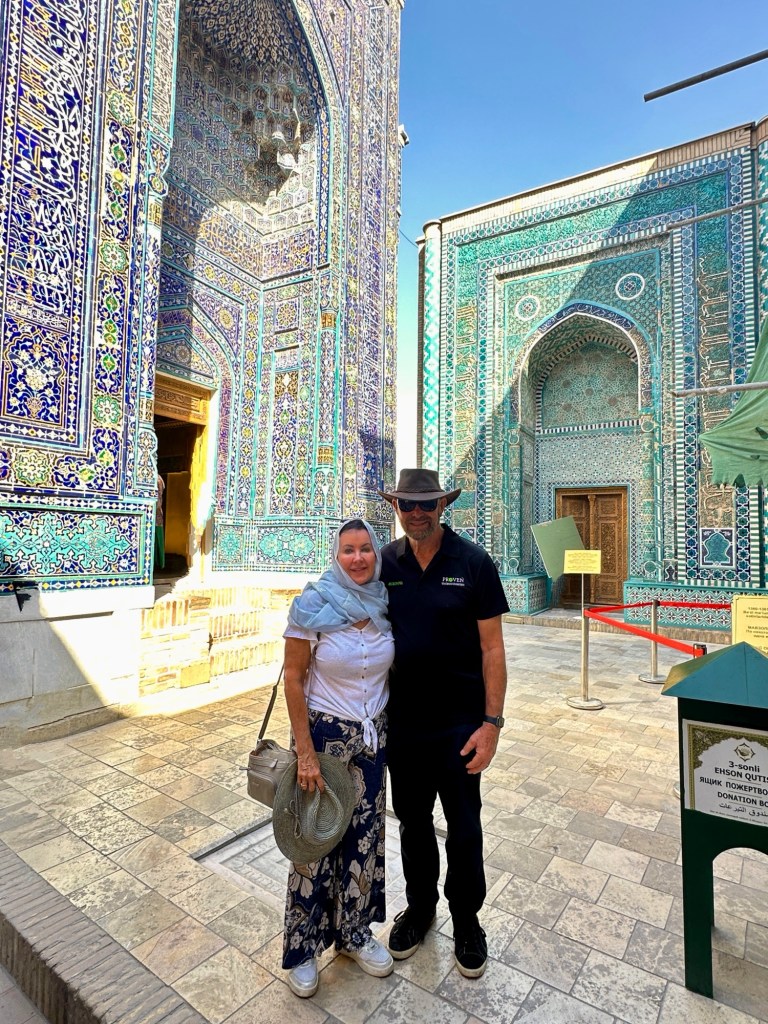
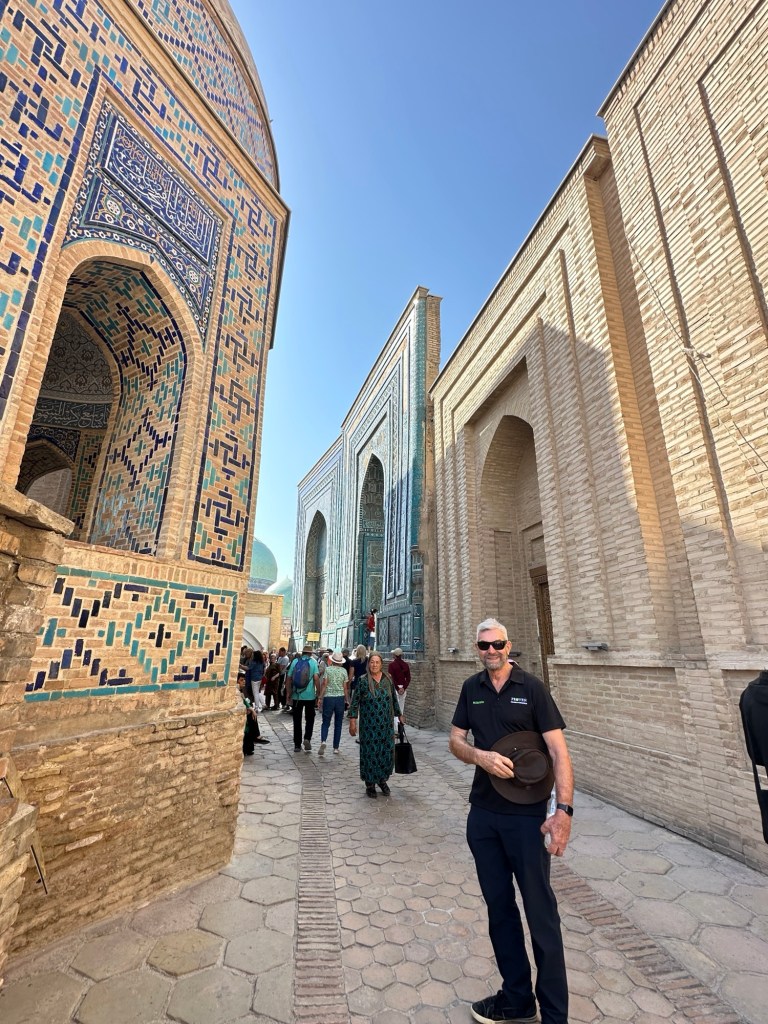
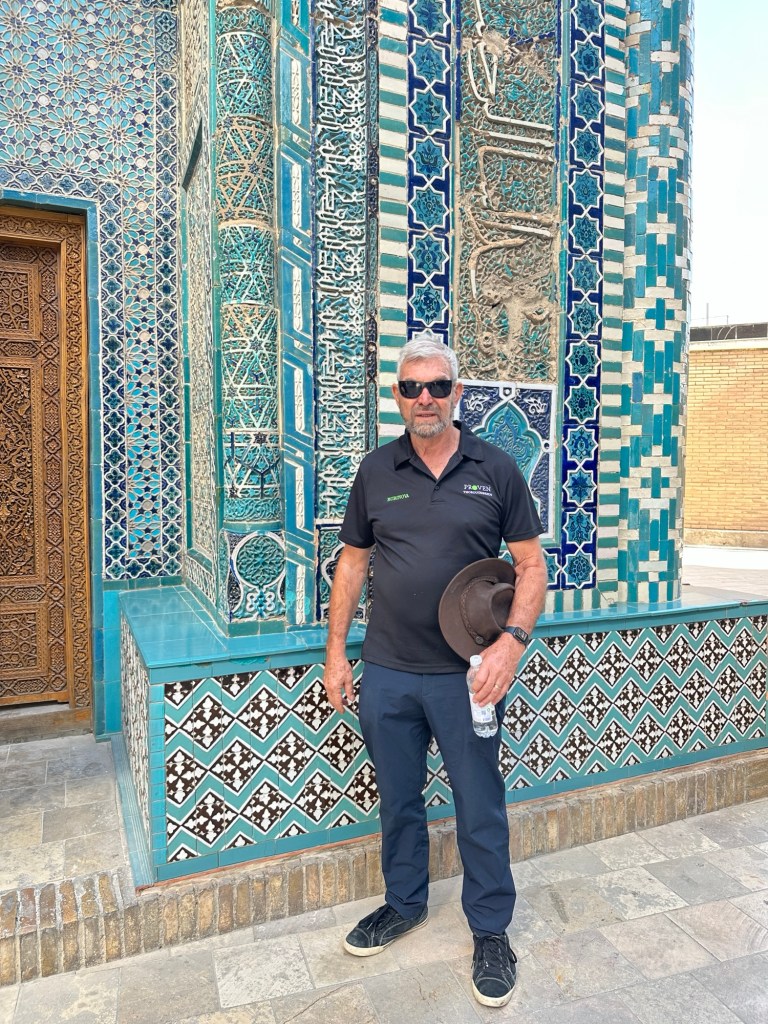
Samarkand’s other great artistic highlight is the Shah-i-Zindah, a visually absorbing necropolis and one of the great masterpieces of Timurid art. The narrow avenue of decorated tombs, dates from 1372 to 1460 and houses a veritable “Who’s Who” of Timurid aristocracy, including Timur’s niece, two of his sisters, and two wives. The tombs’ real genius lies in their range of decoration, with carved terracotta and majolica tilework set into complicated floral designs framed with stylised calligraphy, everything saturated in a dozen intense shades of blue. The focus for local pilgrims is the 11th century tomb of the Arab leader Kusam ibn Abbas, who was beheaded after his attempts to convert locals to Islam and merged into the local pre-Islamic legend of the “Living King” (Shah-i-Zindah). The mosaics here are simply stunning.
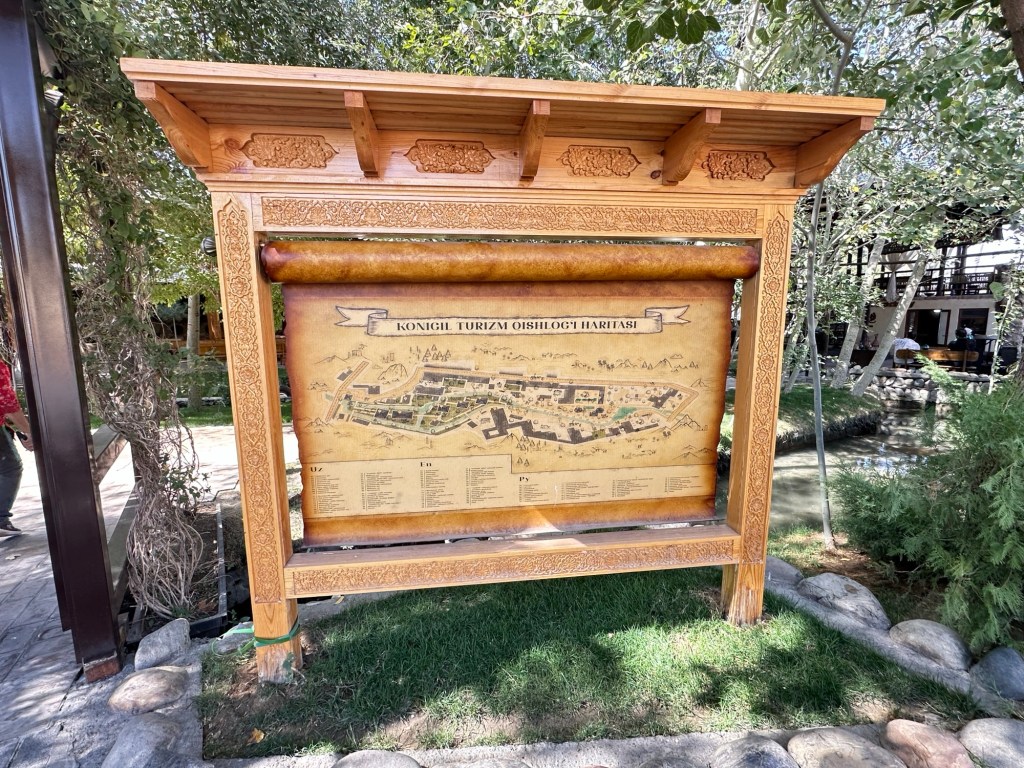
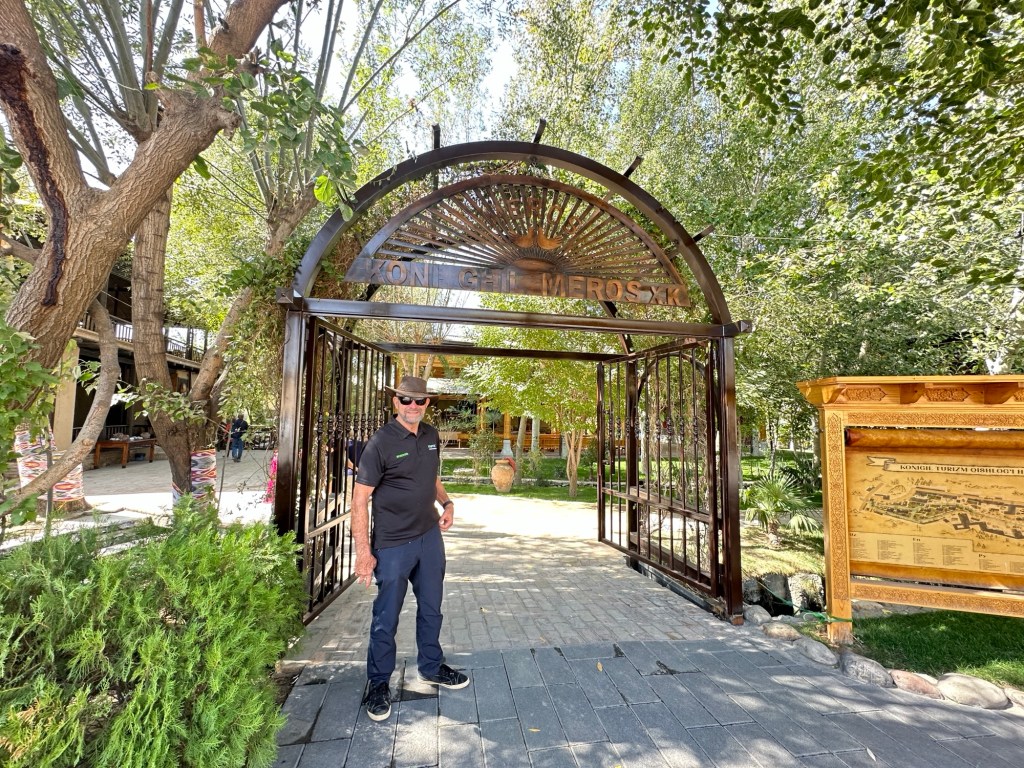
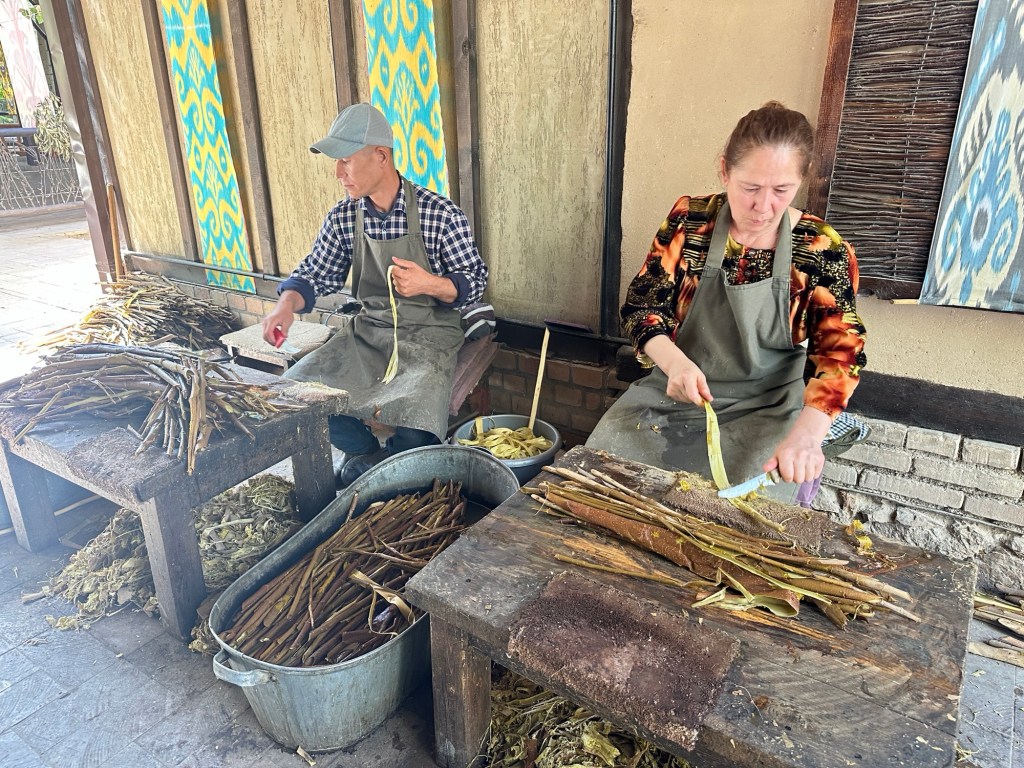
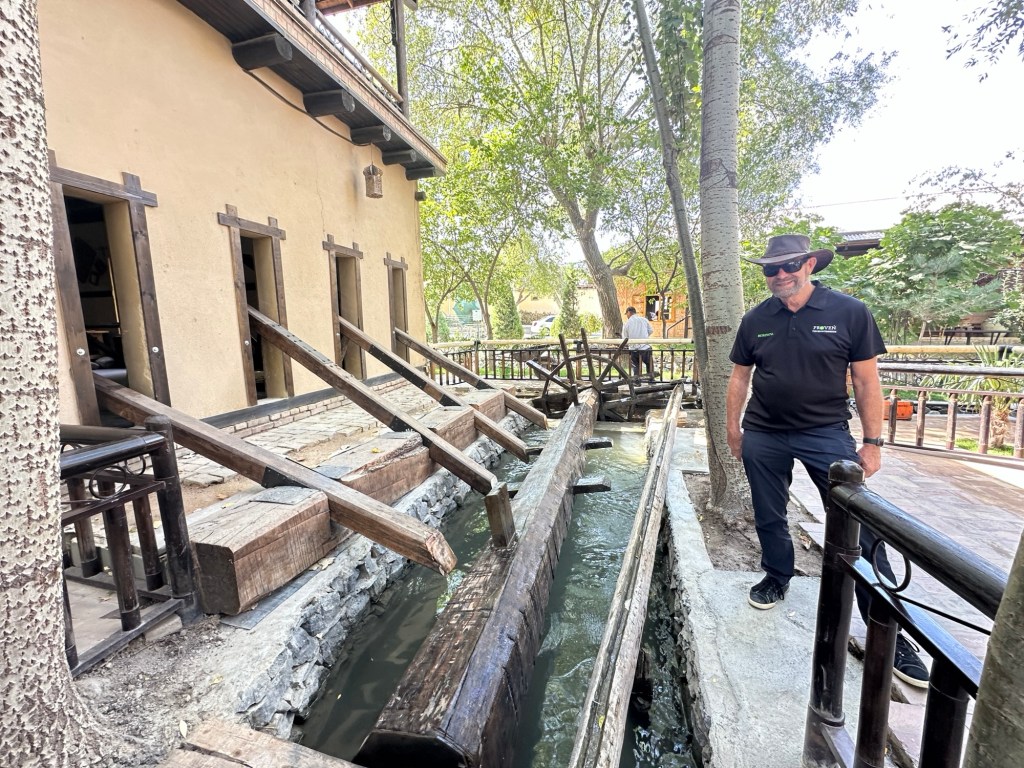
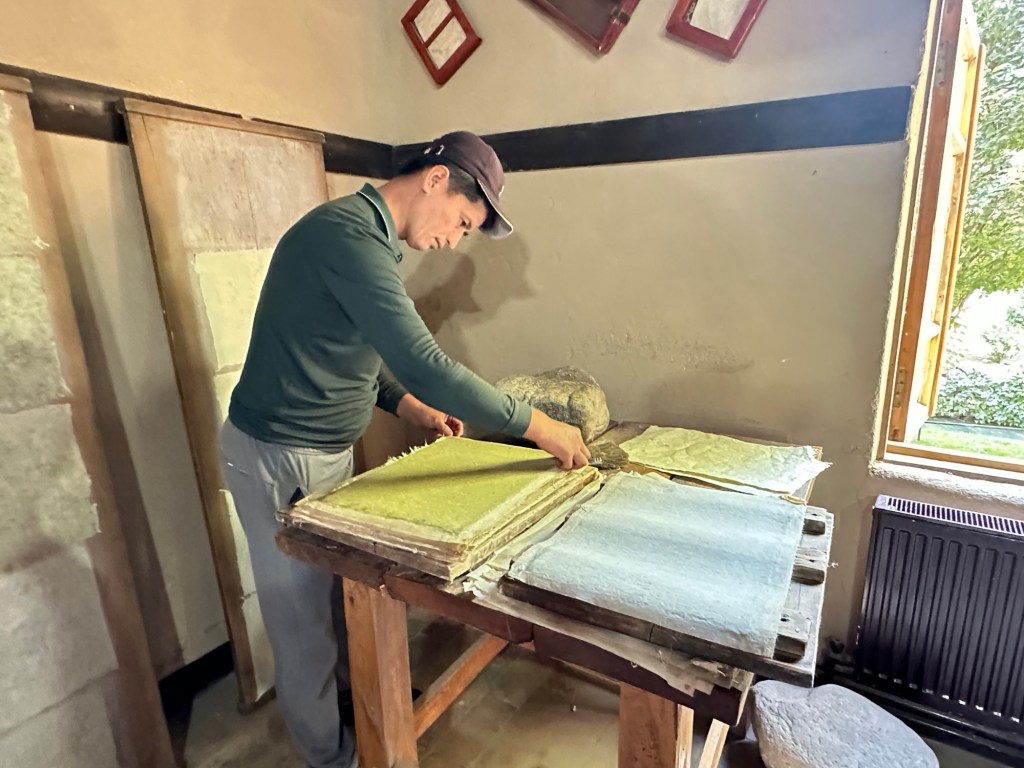
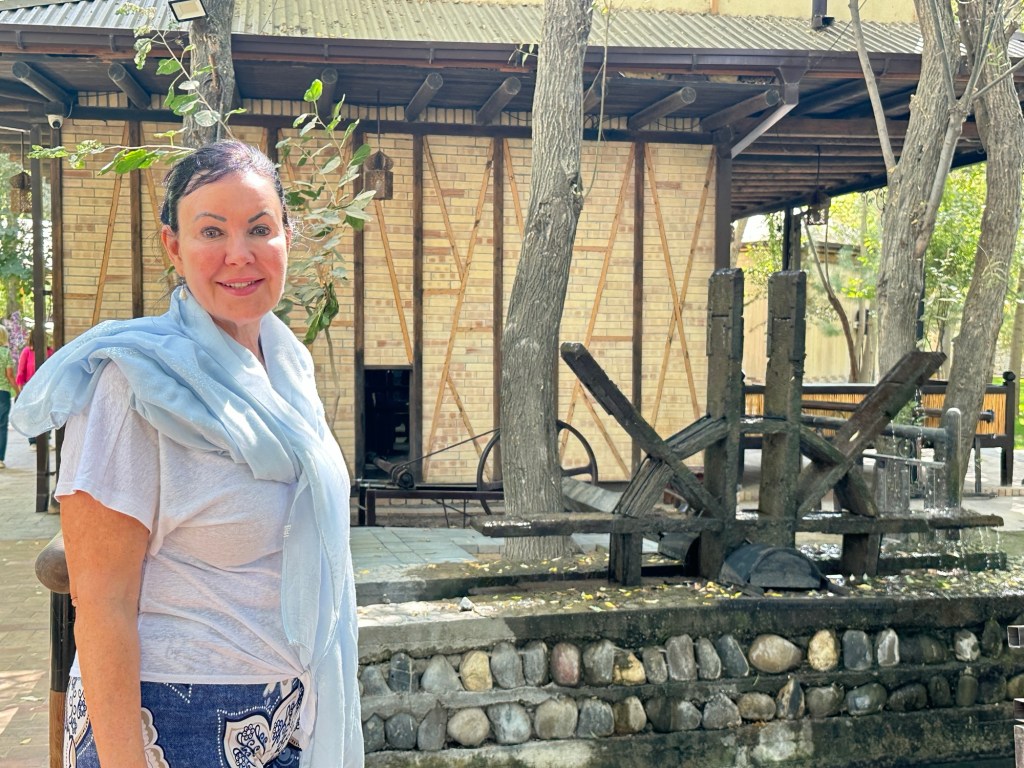
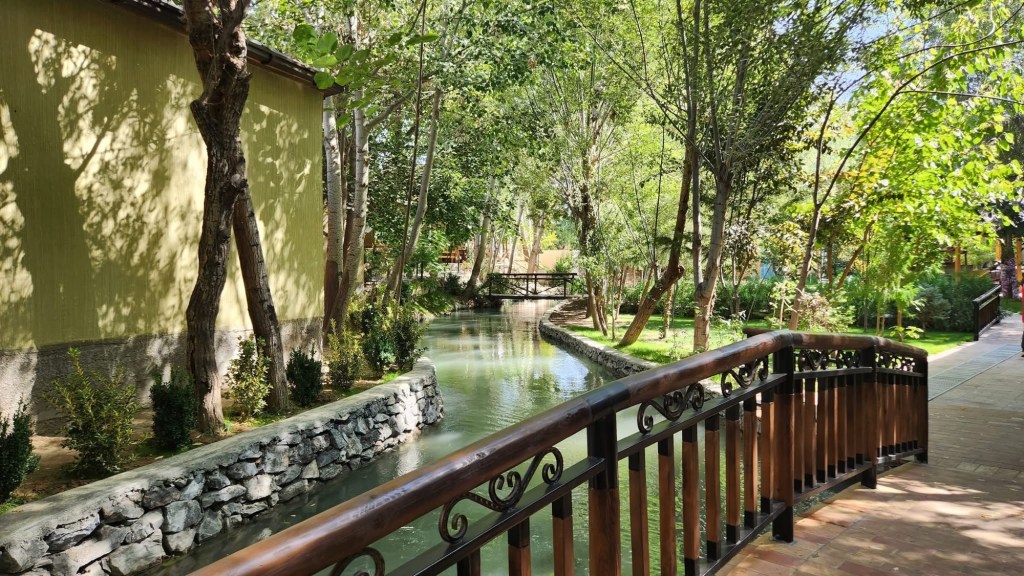
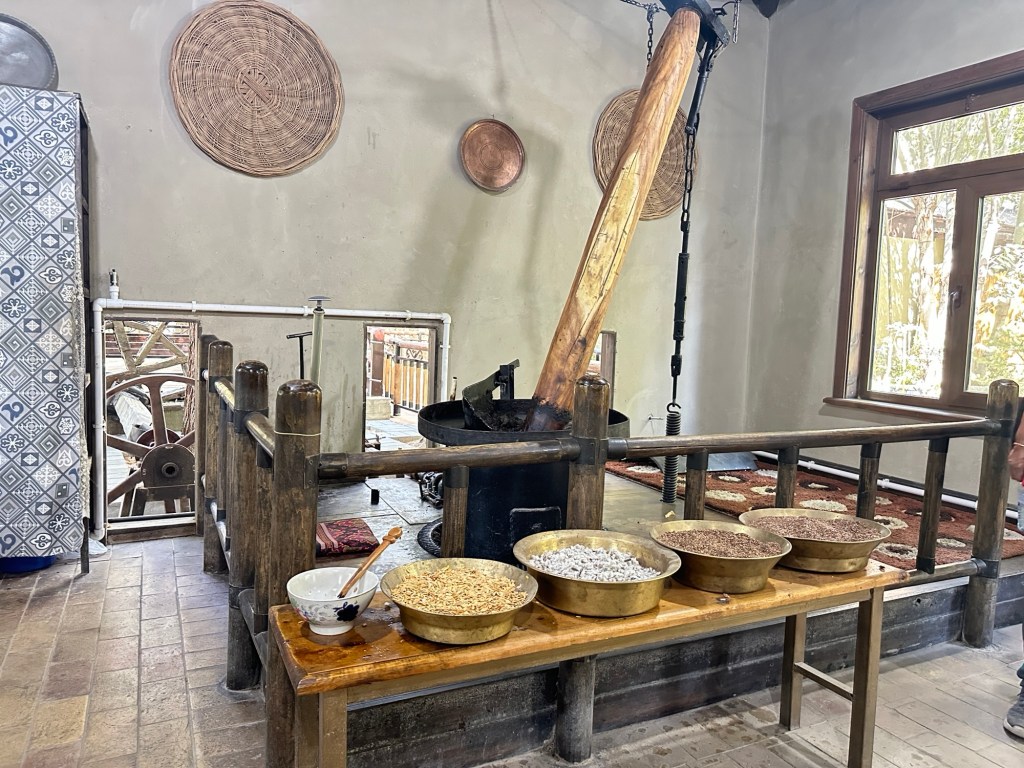
A short drive took us to the quaint village of Koni Ghil where we watched the making of silk paper from the bark of mulberry trees – you can see why it is a dying art as it is very time consuming. Also saw how cotton oil is made.
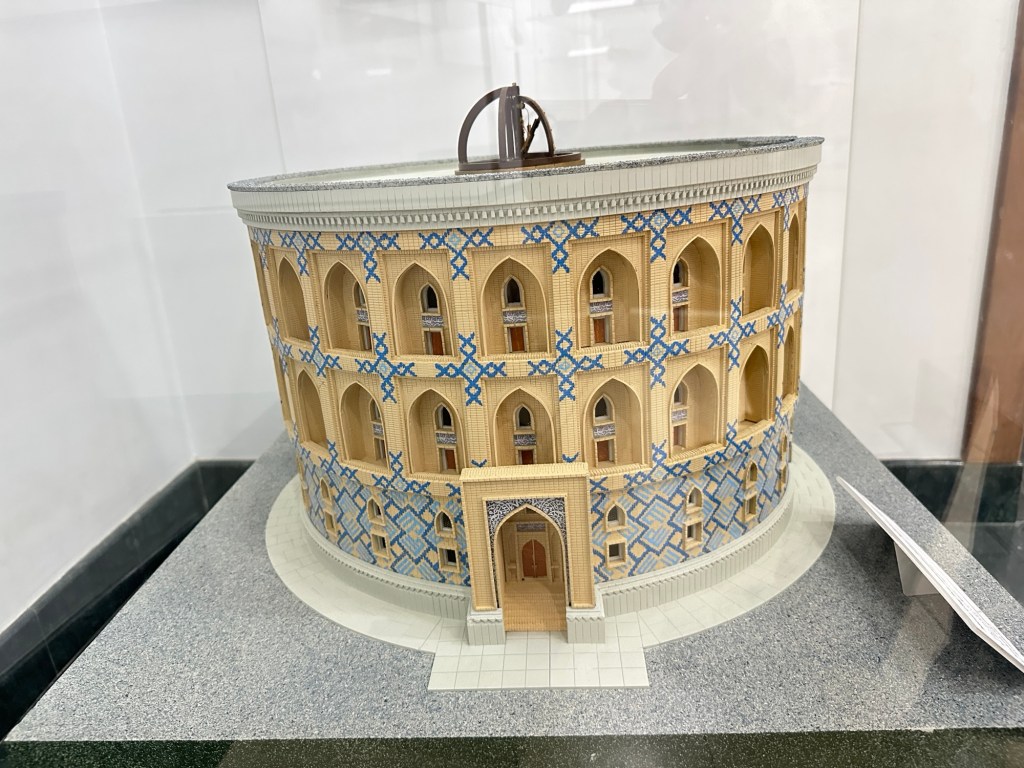
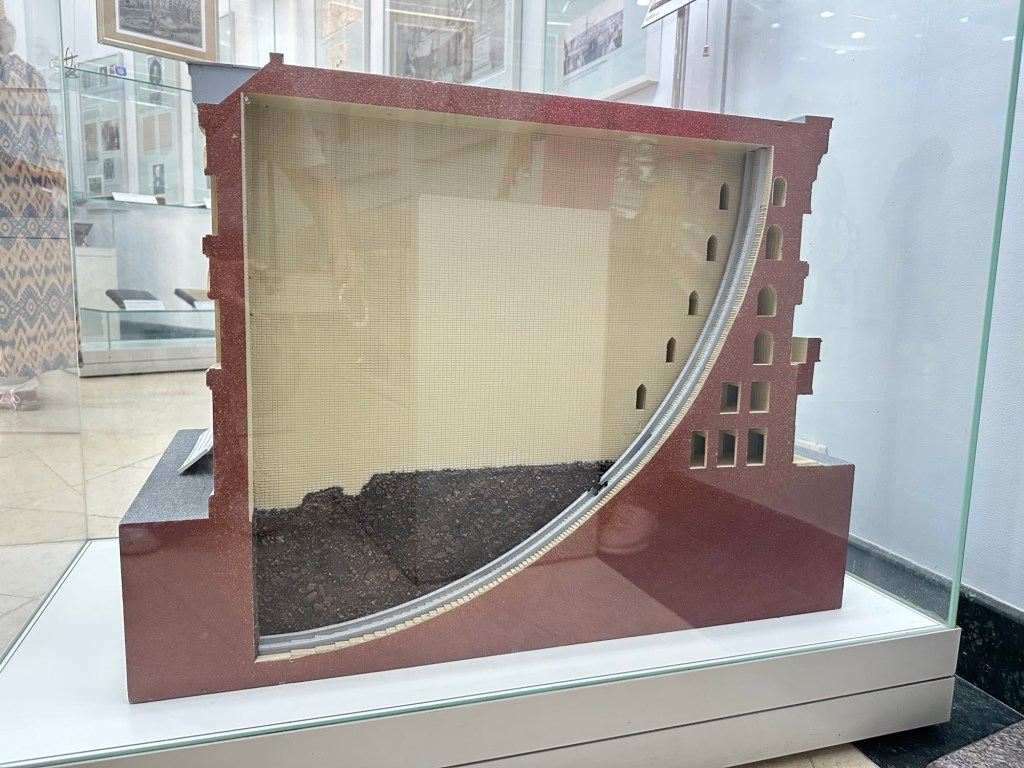
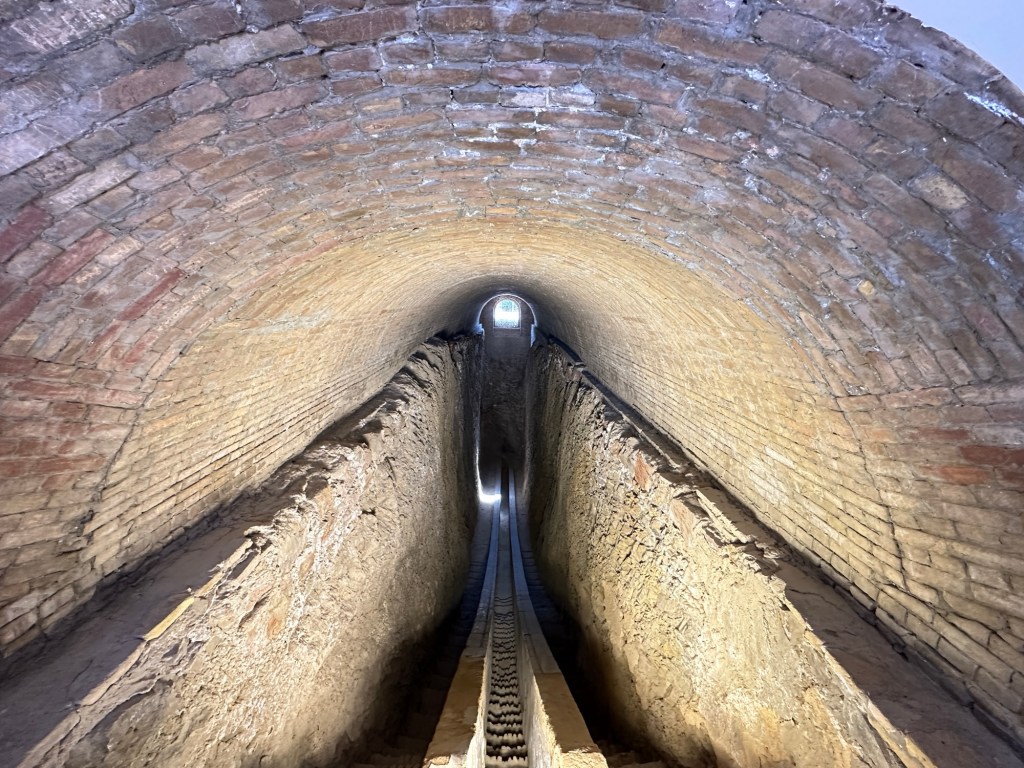
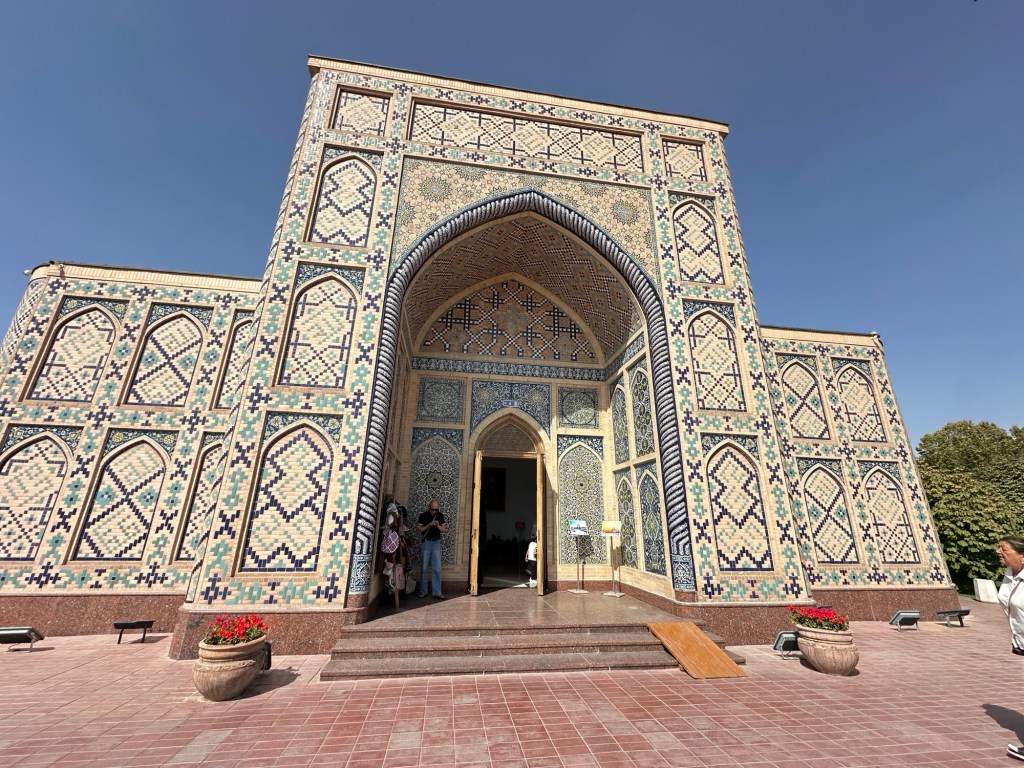
Next the observatory. Timur’s grandson, Ulug Bheg, was a sultan, but also a scientist with a passion for mathematics and astronomy. His work is remembered at the historic Ulug Bheg’s Observatory, which was built in the 1420s on a hill overlooking Samarkand. Today, it showcases the historical measurements of the sun’s path over a year, off by only one minute from today’s measurements. Amazing he was so accurate all those years ago.
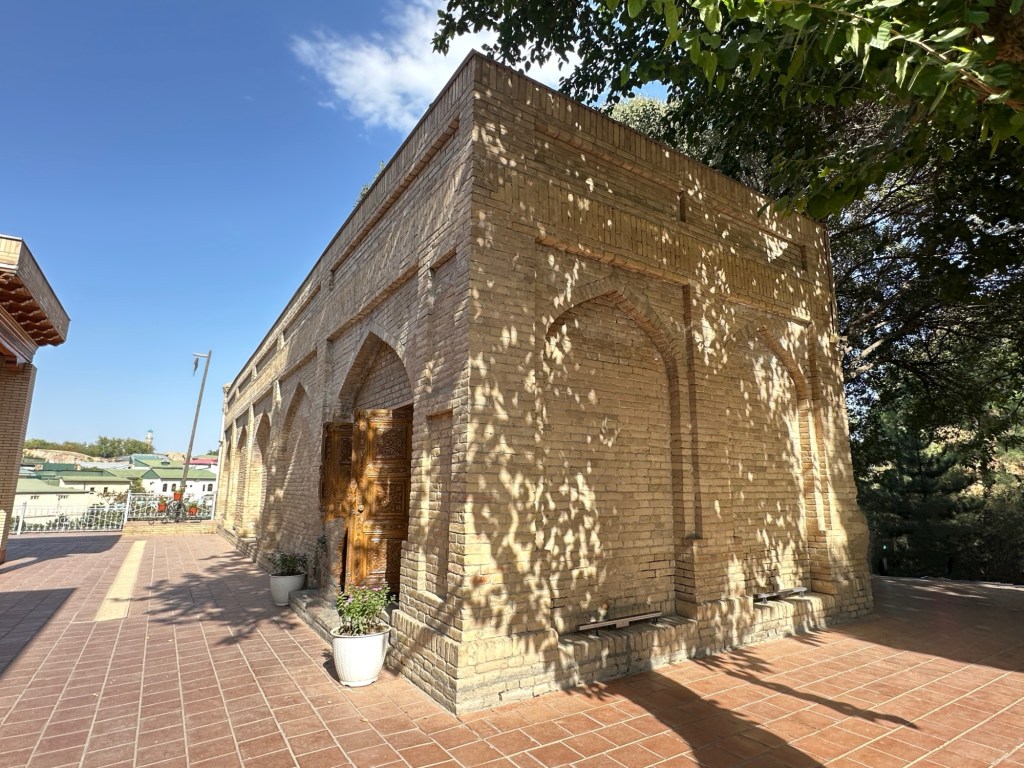
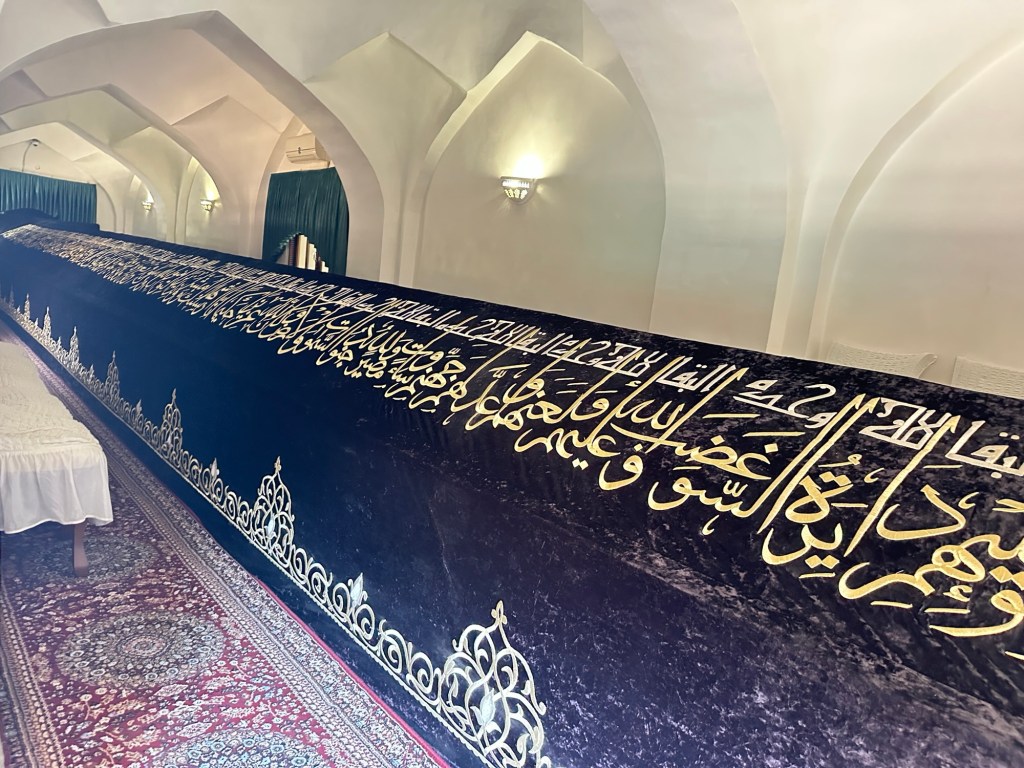
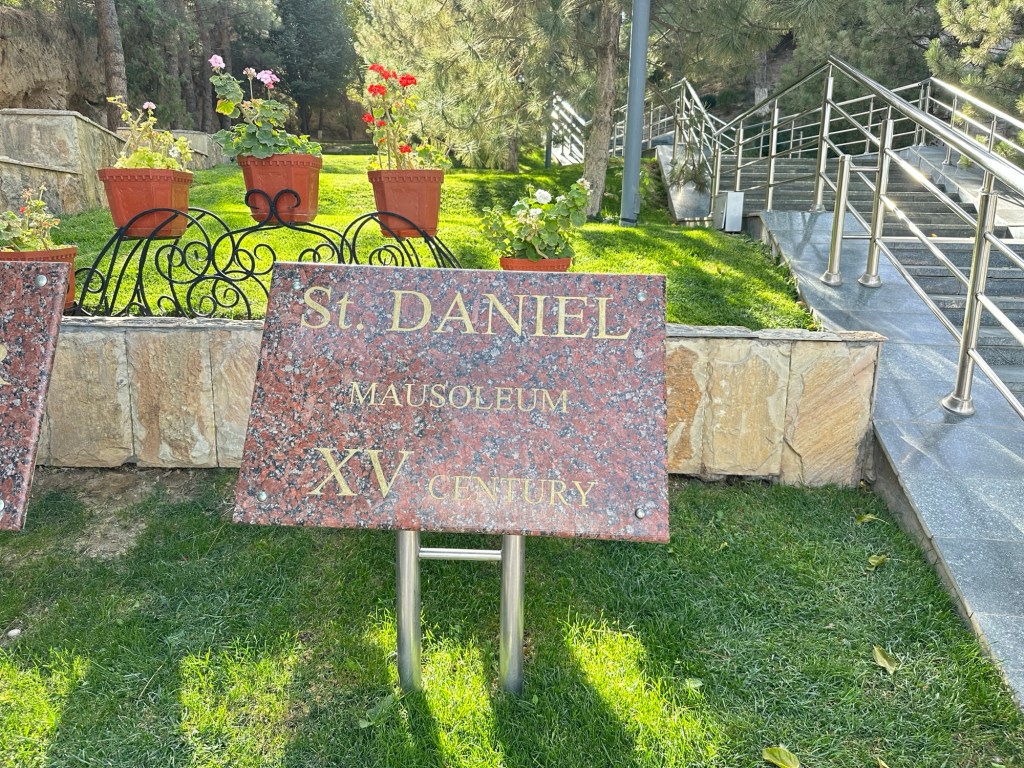
In the northeast of the city is the Mausoleum of St. Daniel, an Old Testament prophet. The exact location of his remains is a topic of debate, with numerous countries claiming to possess them. According to local legend, Samarkand’s Mausoleum of St. Daniel contains a collection of the prophet’s relics that continues to grow with time, forcing them to repeatedly extend the sarcophagus to its current length – 18 meters. A very peaceful place to visit.
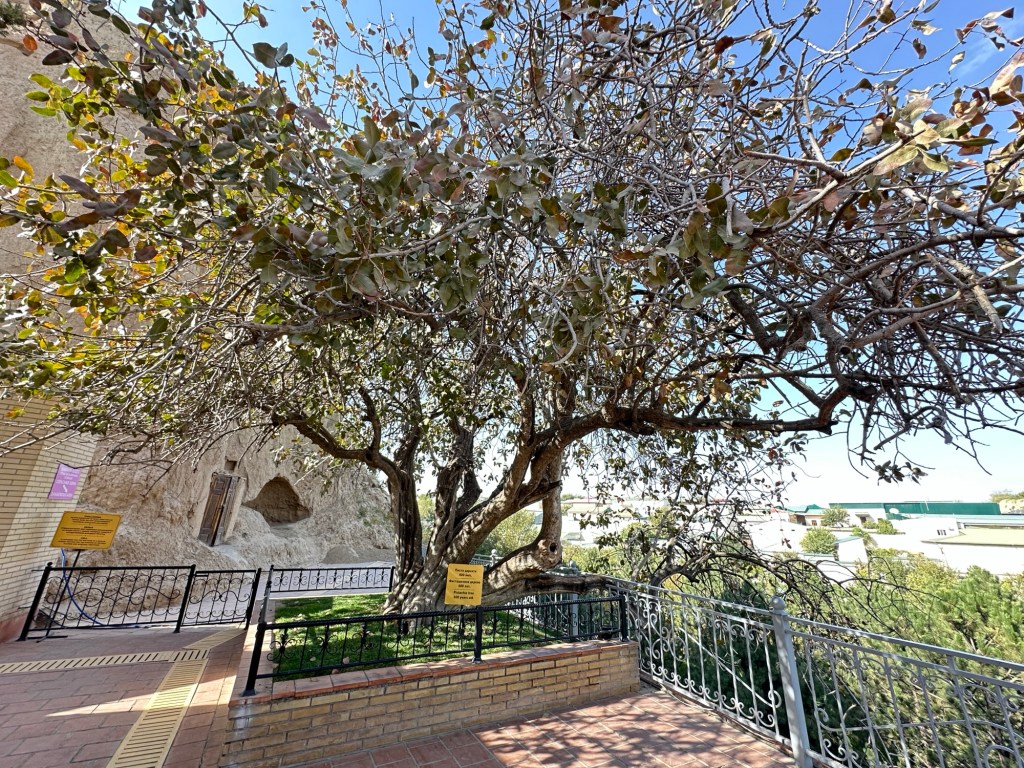
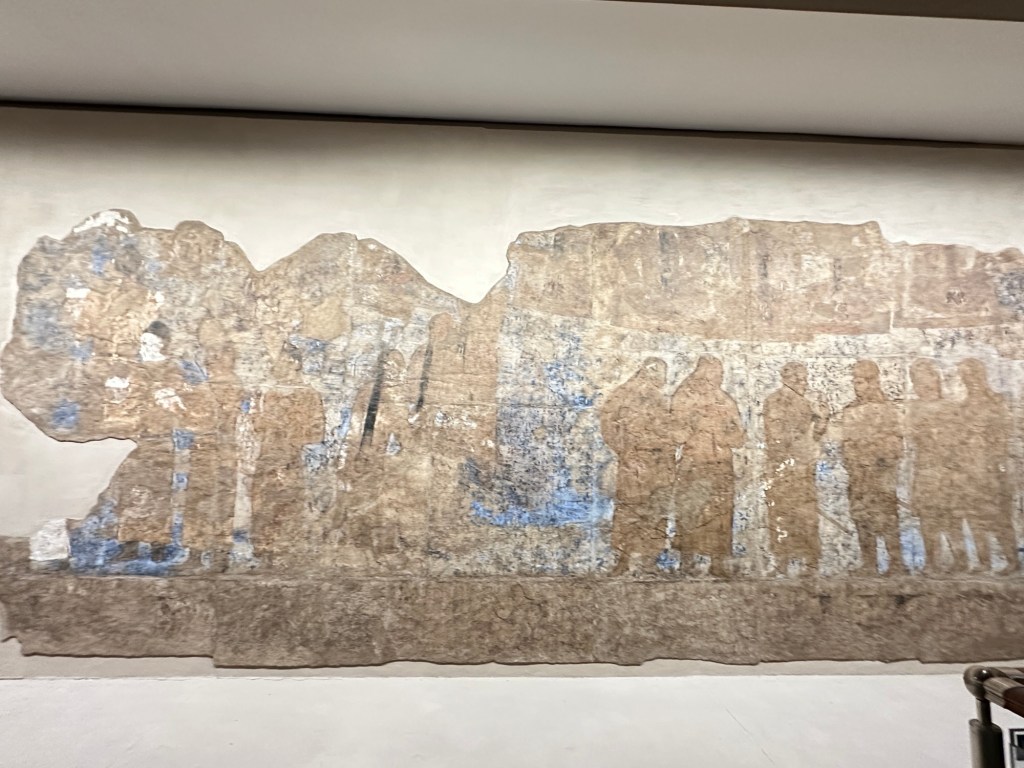
One of the few remnants of the early Silk Road are the ruins of Afrosiab, the Sogdian city that flourished from the 6th century BC until the arrival of Genghis Khan in 1220. It was here that the increasingly megalomaniac Alexander the Great killed his favourite general, Cleitus, in a drunken rage. On display in the museum are wall murals which feature a royal bridal procession atop a white elephant, a series of bearded ambassadors to the Sogdian court and a ruler in magnificent clothes meeting with silk-bearing Chinese, Turkic and even Korean envoys. These are from 700 AD. Amazing!
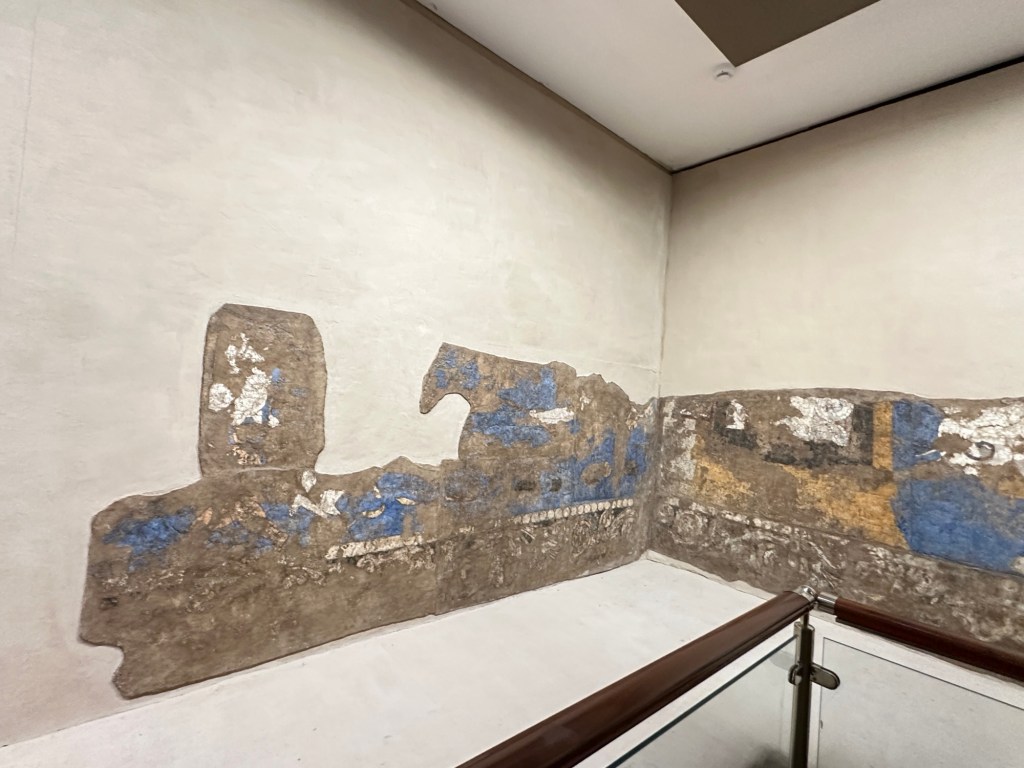
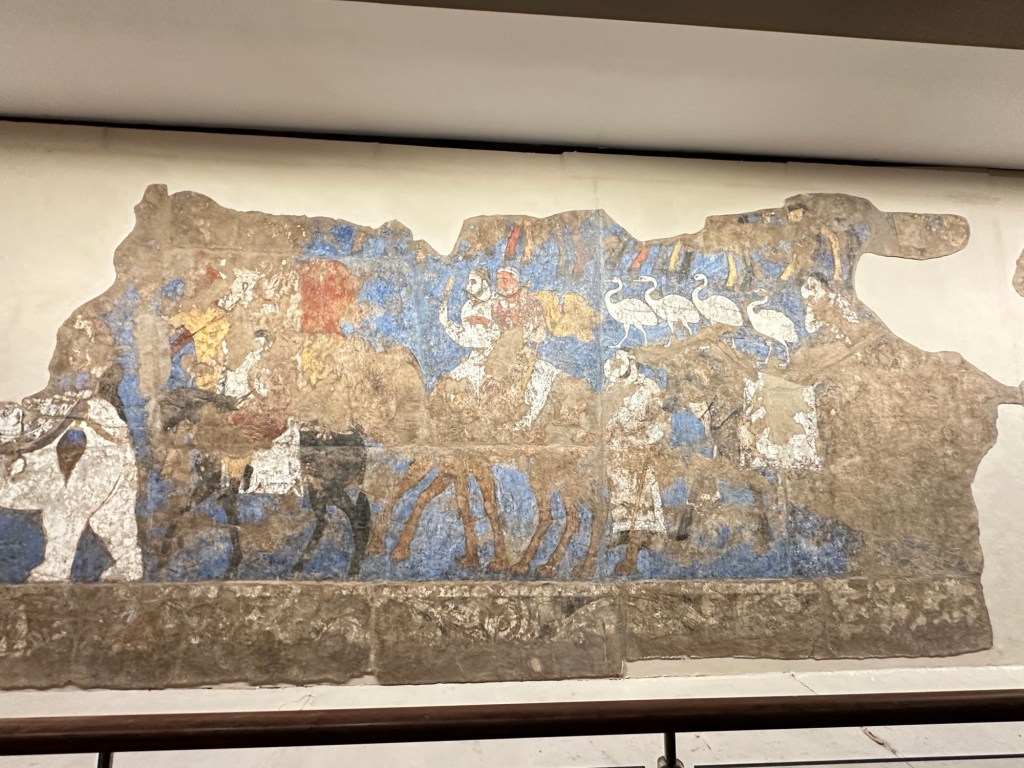
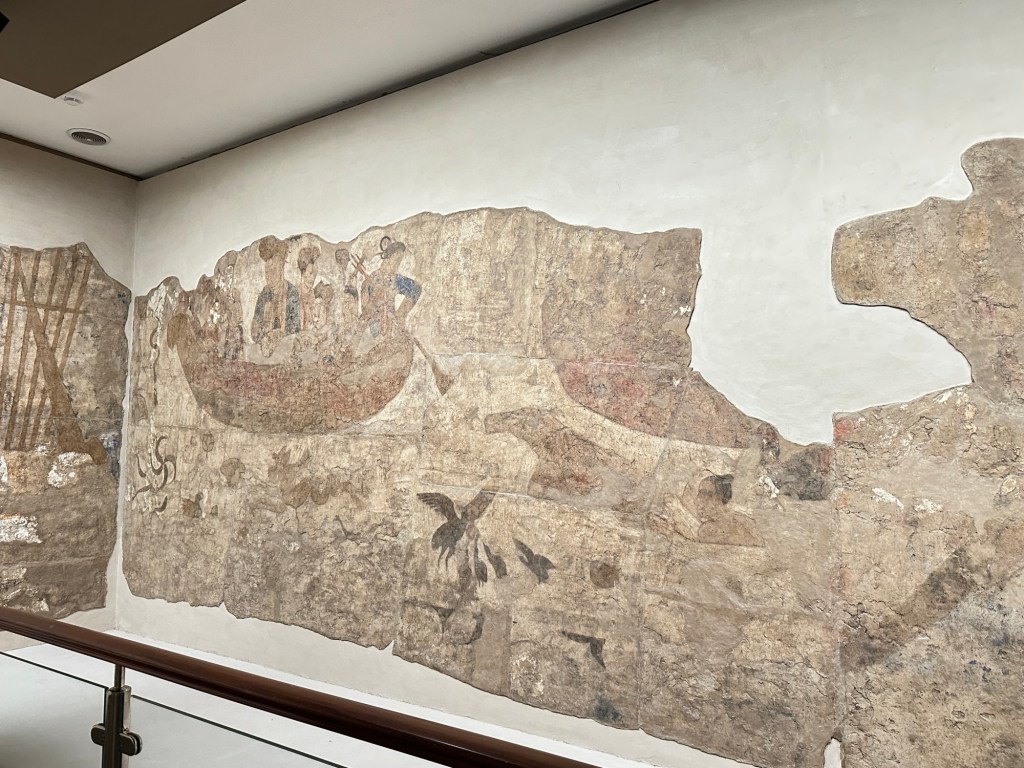
Our time in Samarkand had come to an end and it was time to negotiate the traffic to Samarkand railway station for the 5pm bullet train to Tashkent. The traffic was only the beginning of the excitement, as we headed down back streets to get there. Once on the platform at the station, there was a mad rush to get on the train, and, the most stressful part – finding somewhere to stow our bags. There was no where near enough luggage storage. We then had to share our journey at a dinette seat with a young Usbek couple and their two year old. Mind you, she was very well behaved, but we were a little tired of hearing of “Old McDonald had a farm“, and “Head Shoulders Knees and Toes” by the time we got to Tashkent two and a half hours later!
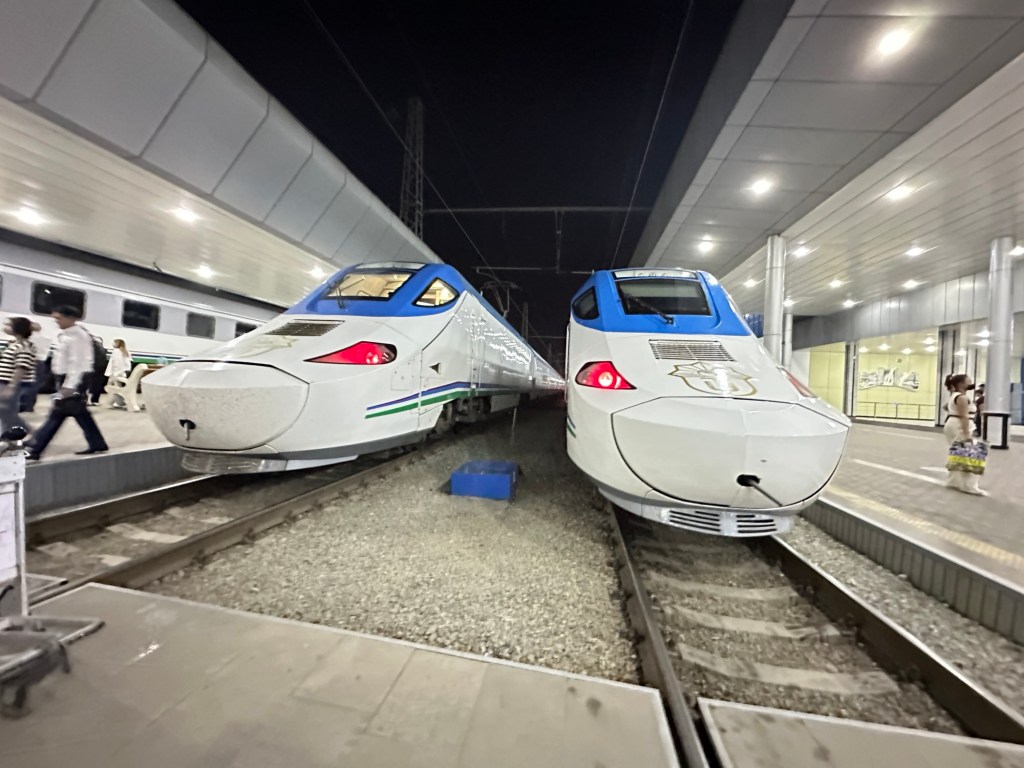
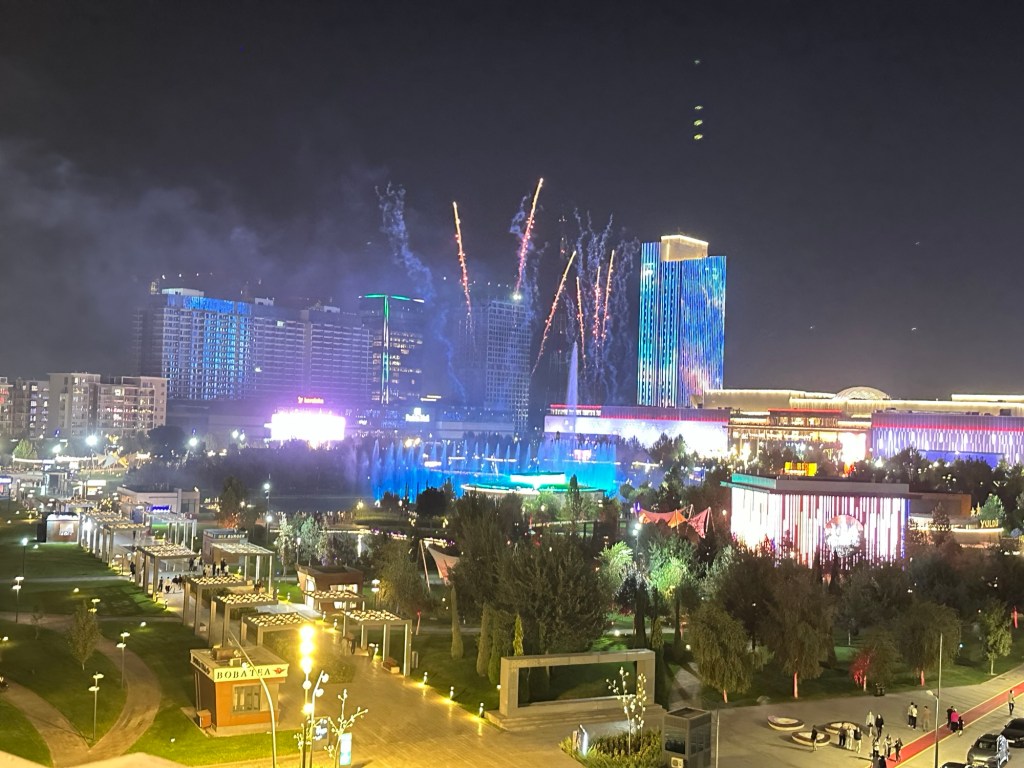
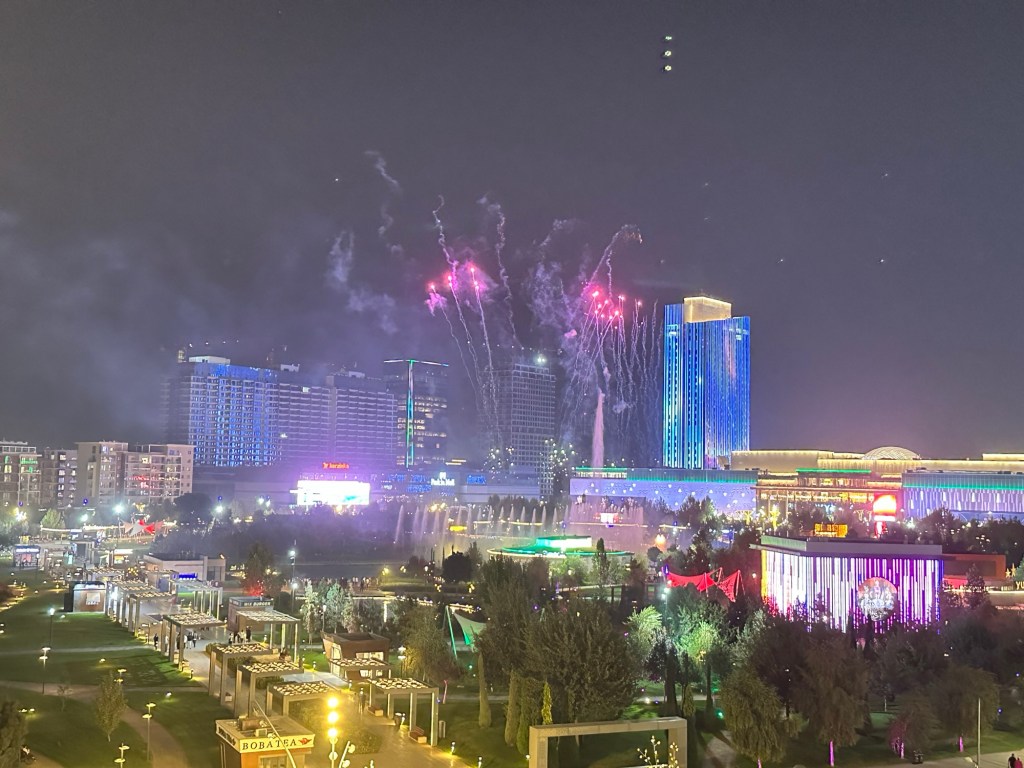
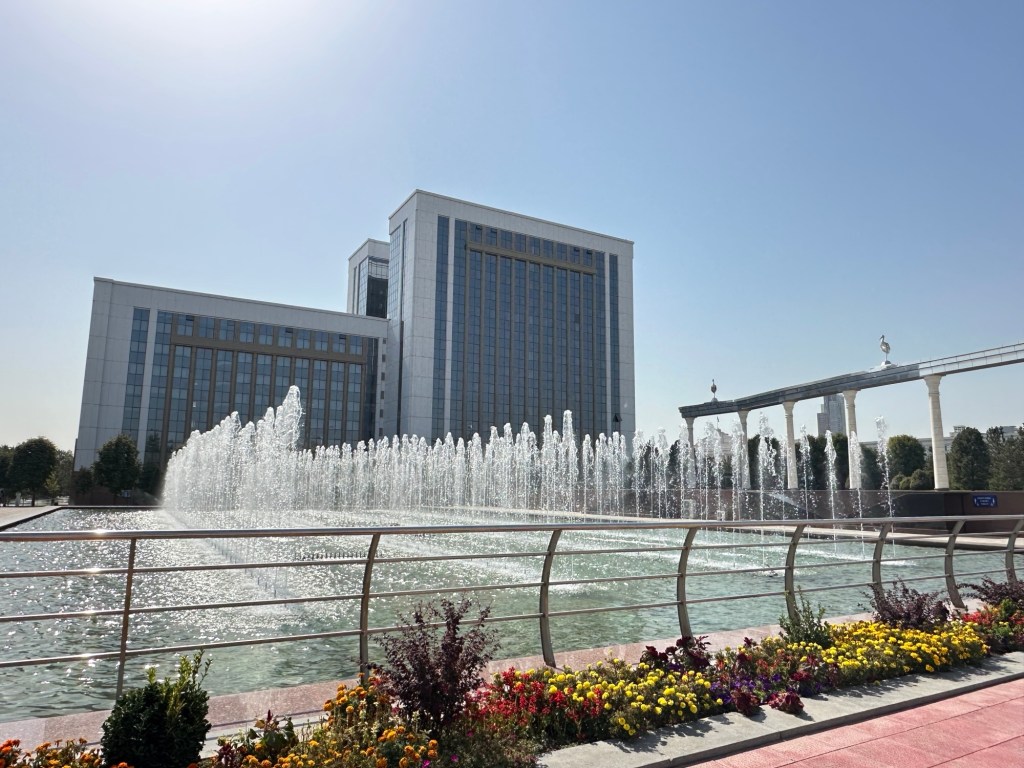
Another driver picked us up in Tashkent, more traffic, and eventually we checked into the Holiday Inn. It was 8pm by this stage. We went out to explore – the park across from the hotel was amazing. A large lake with fountains put on a colourful choreographed display accompanied by music. It seemed to go on for at least an hour. The buildings surrounding the park were all lit up with varying coloured lights.
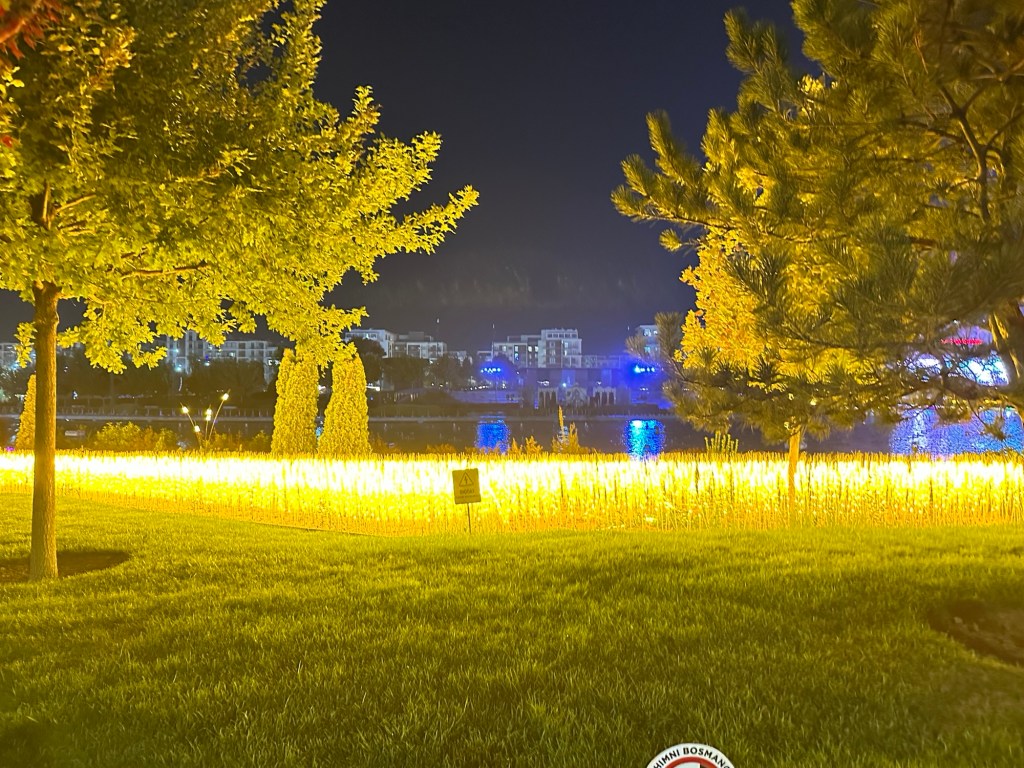
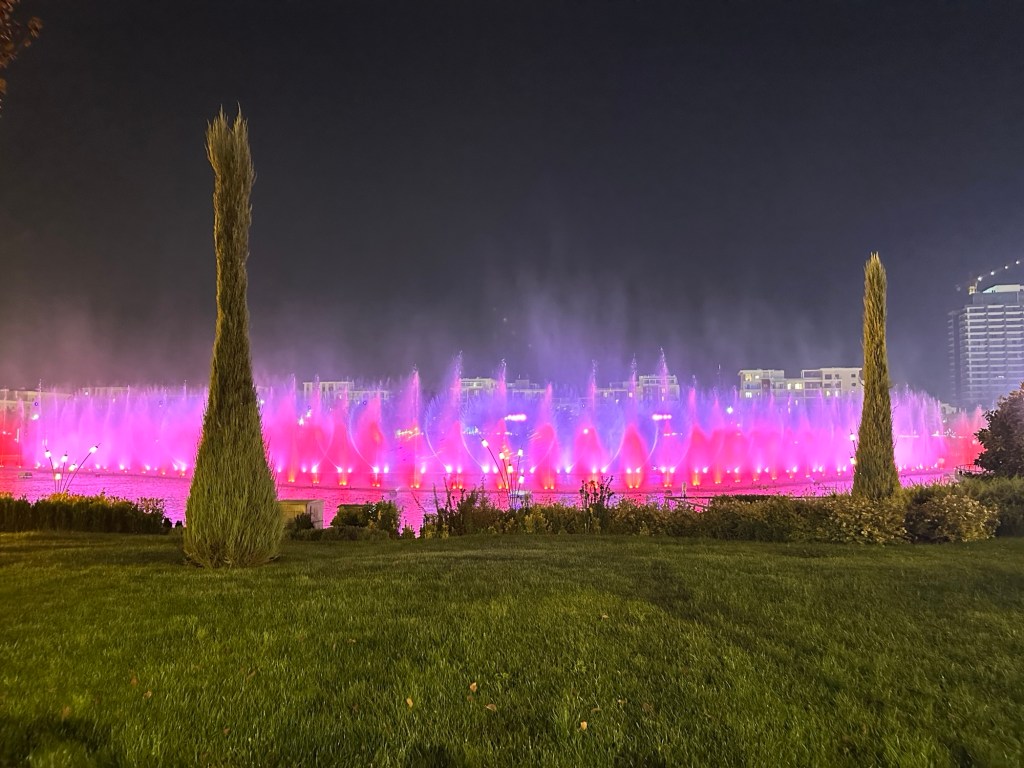
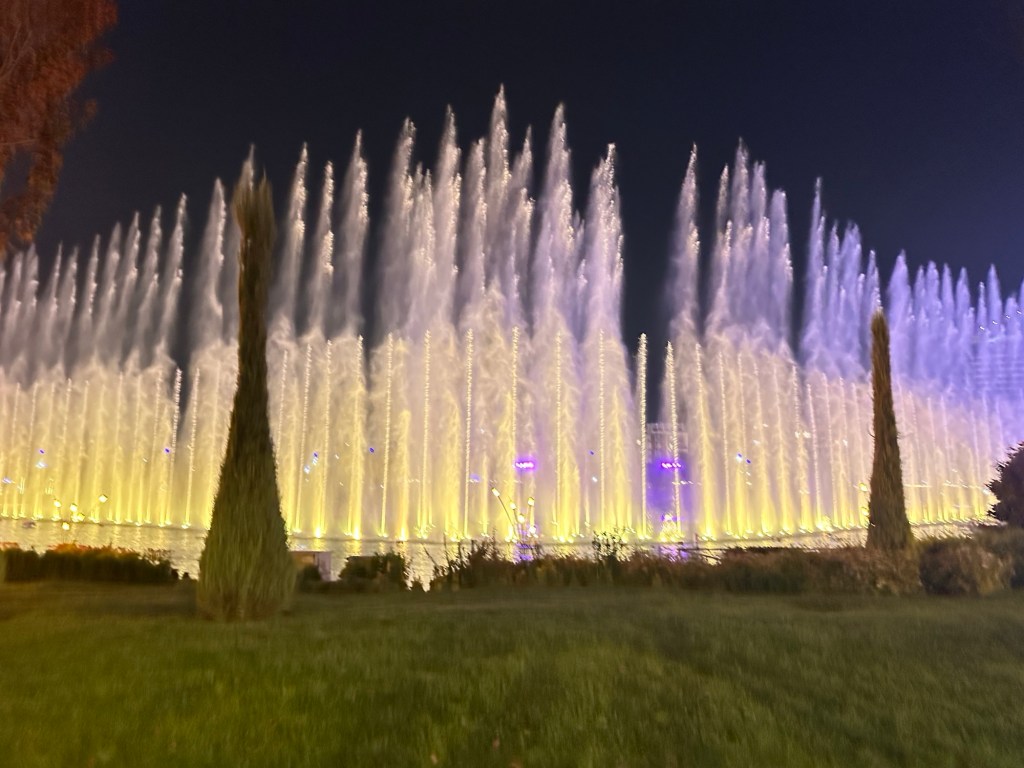
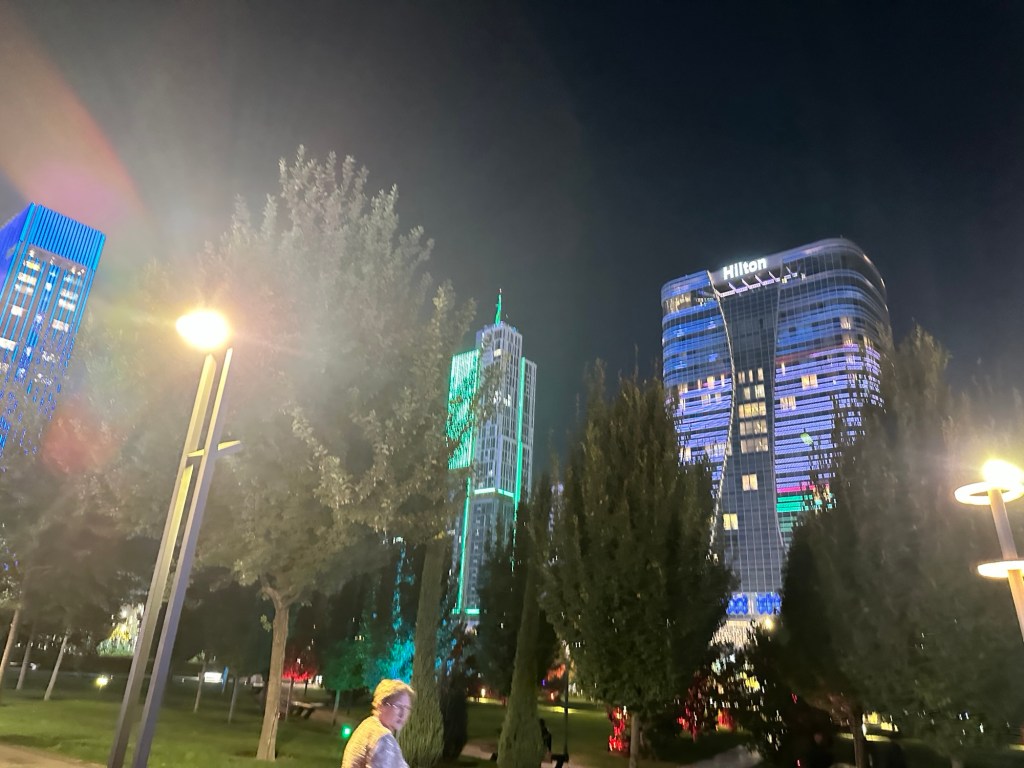
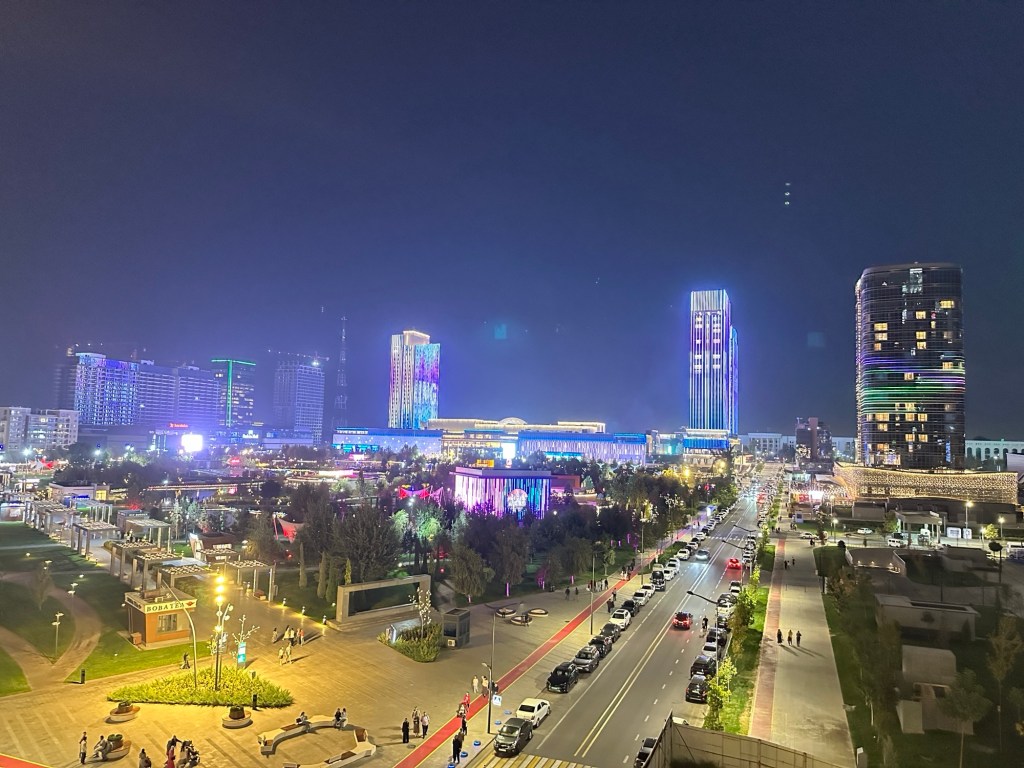
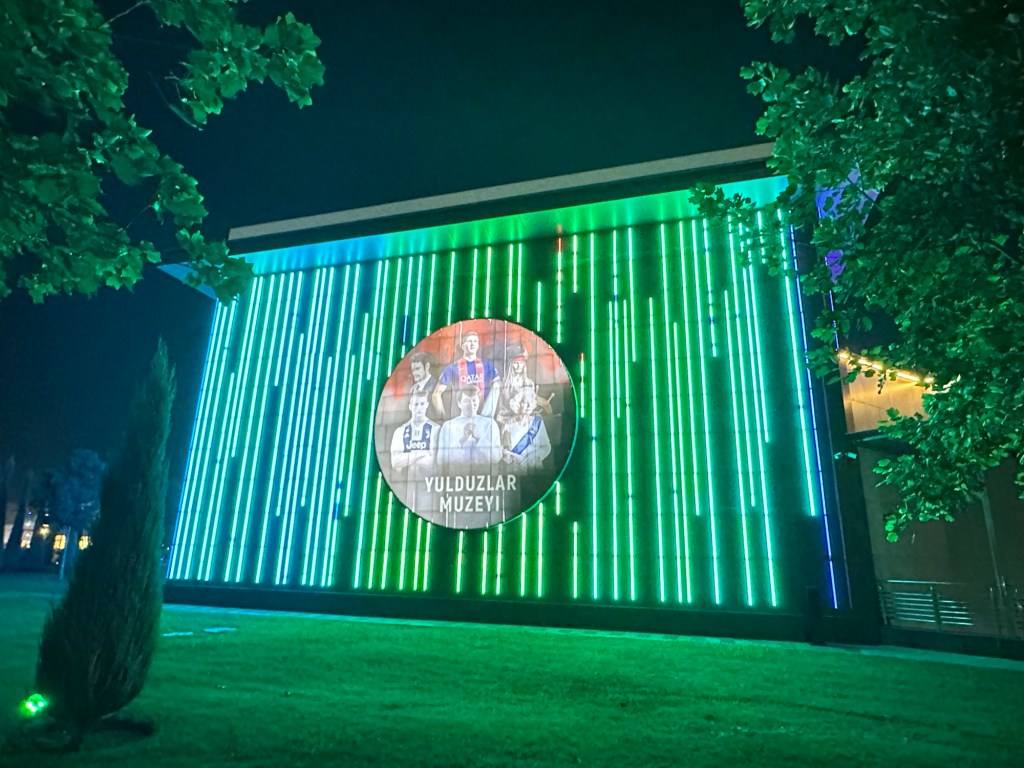
Time for a drink. On the sixth floor of our hotel there was a bar overlooking the Tashkent City Park. It so happened there was a live jazz performance at that time so we had a very pleasant evening listening to the music and enjoying the light show.
Day 17
Saturday 27th September
Tashkent
15-29 degrees, sunny
Today was a tour of Uzbekistan’s capital Tashkent, a sprawling city of 2.6 million people; the largest in Central Asia and the fourth-largest in the former USSR. Following the Russian Revolution, Tashkent became the capital of the Turkestan Autonomous Soviet Socialist Republic, a political entity that covered the territory that is now Uzbekistan, Kyrgyzstan, Tajikistan and Turkmenistan. When the TASSR was dissolved in 1924, it was succeeded by the Uzbek SSR.
Tashkent suffered a powerful earthquake in 1966 which destroyed much of the old town. The Soviets rebuilt Tashkent as a model socialist city, replete with wide boulevards and huge squares, and much of the modern city – including the stunning metro system – dates from this reconstruction. Since the collapse of the USSR, Tashkent has enjoyed further modernisation, with Soviet relics despatched in favour of symbols of the new independent Uzbekistan.
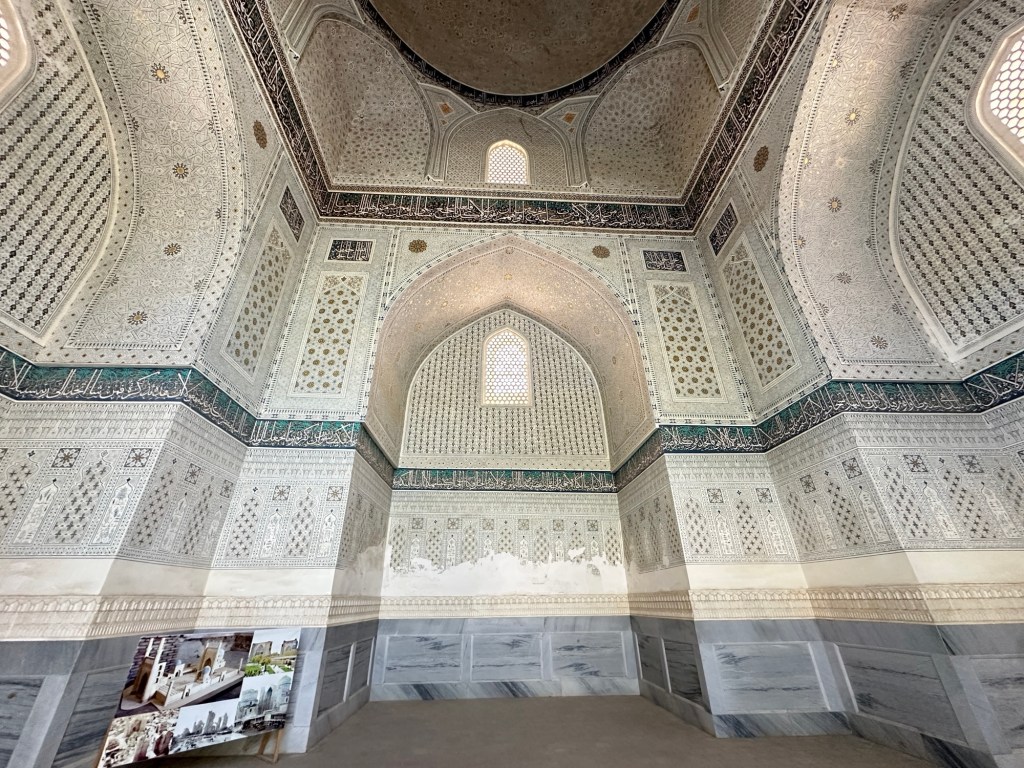
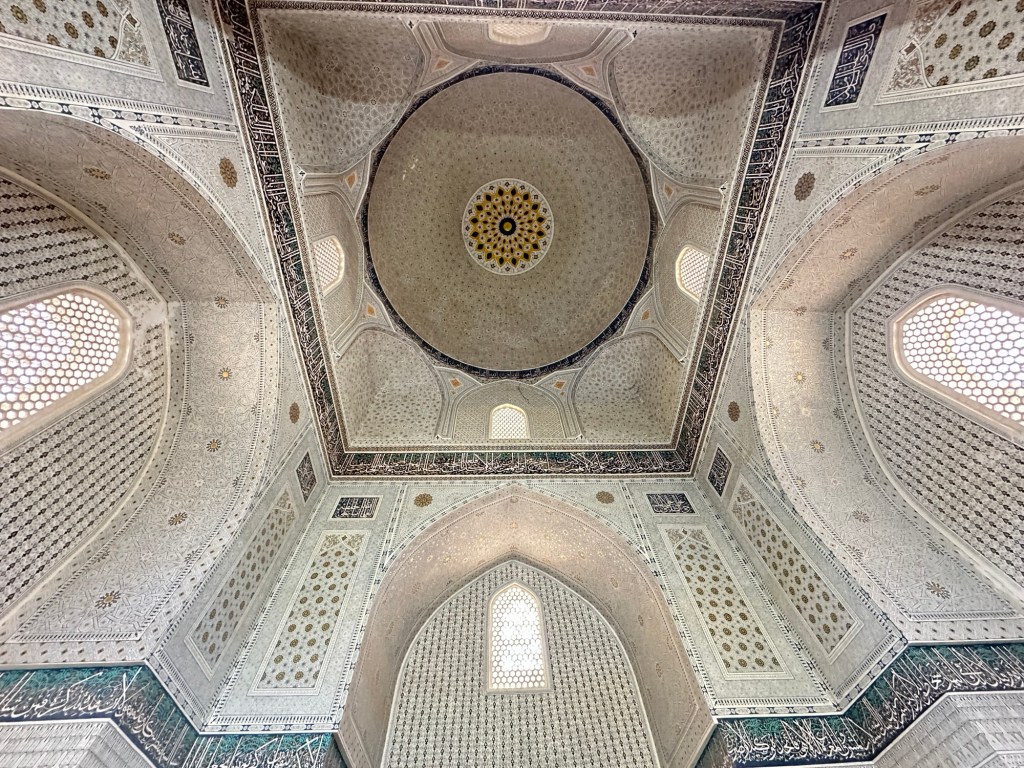
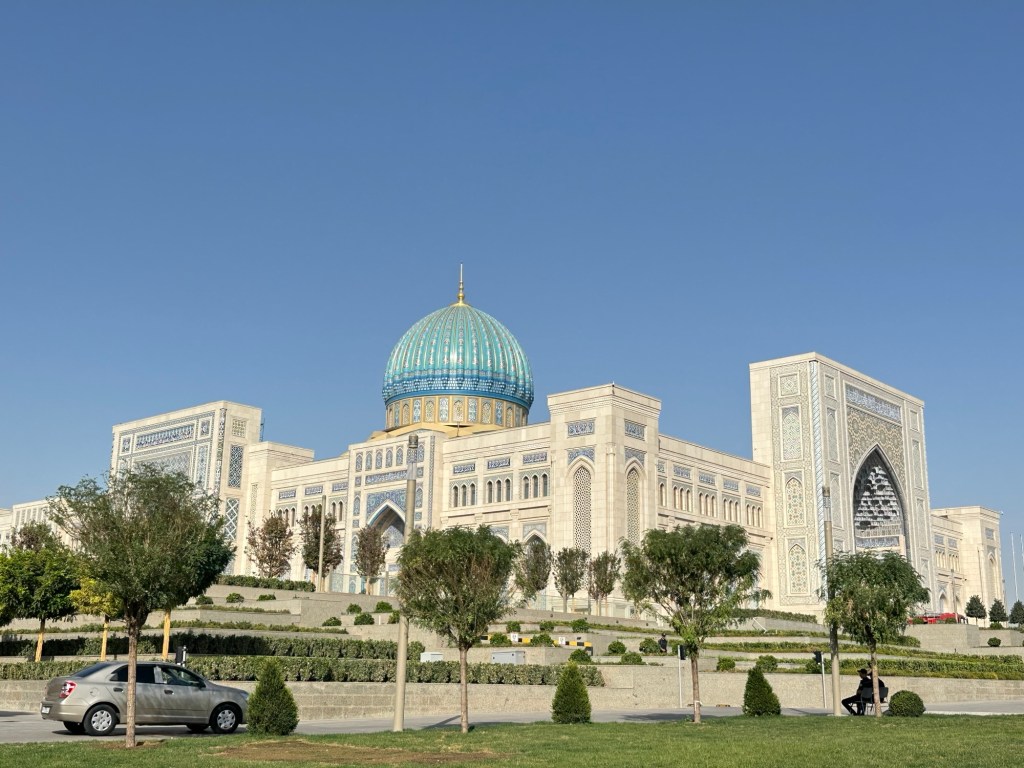
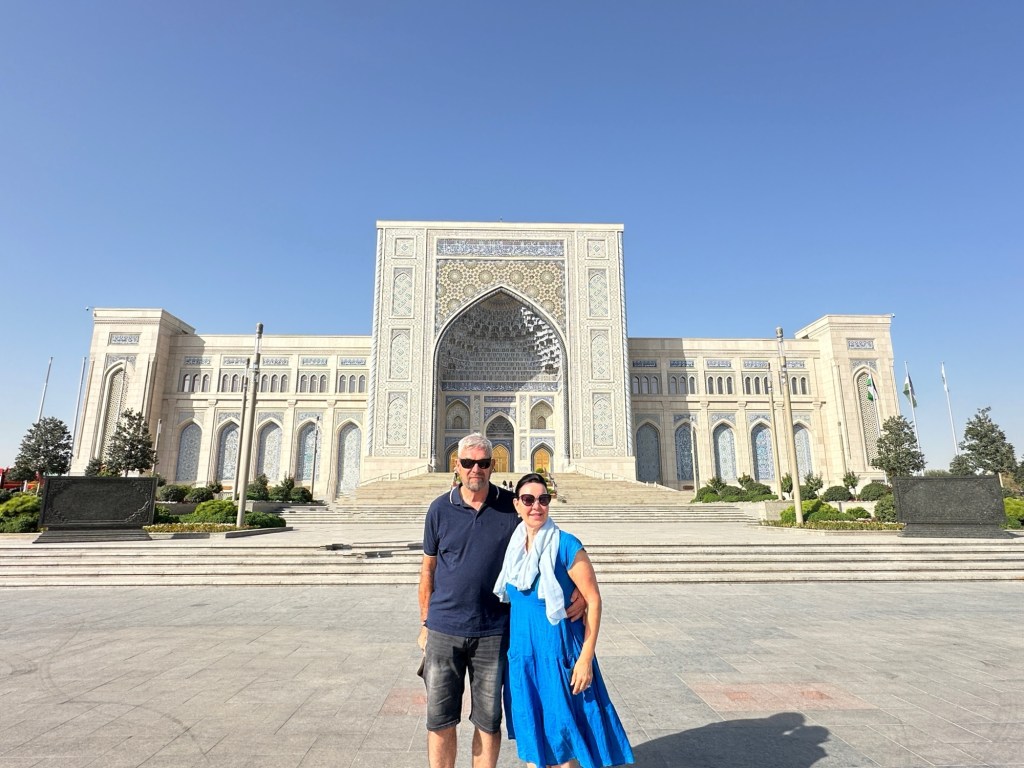
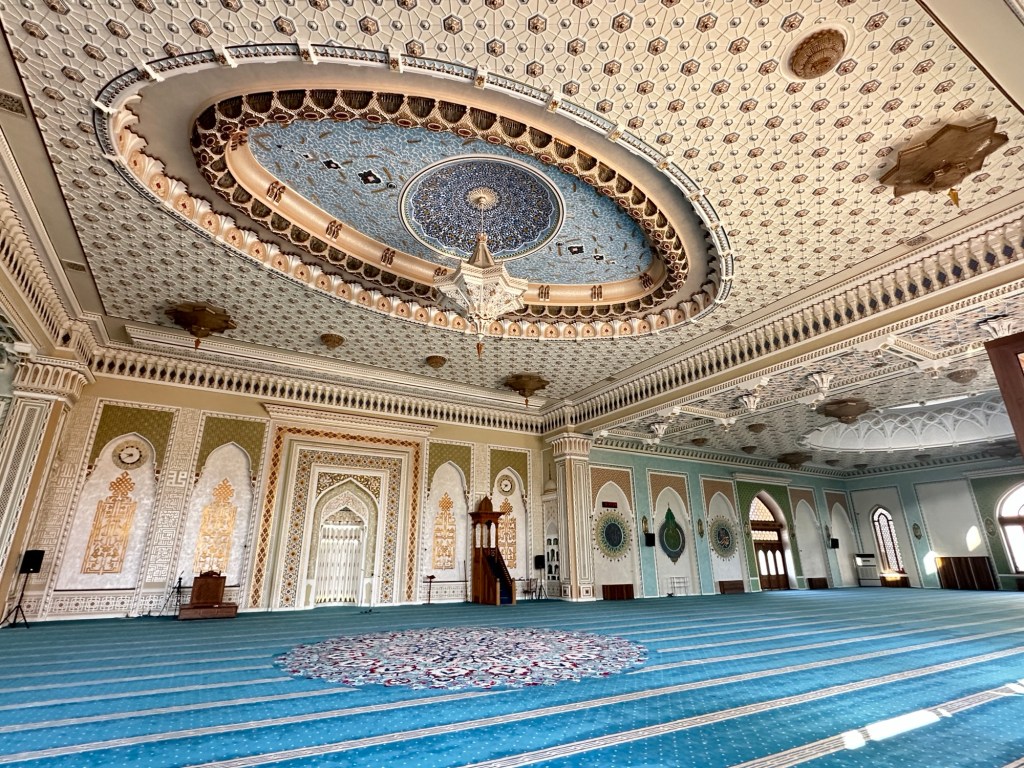
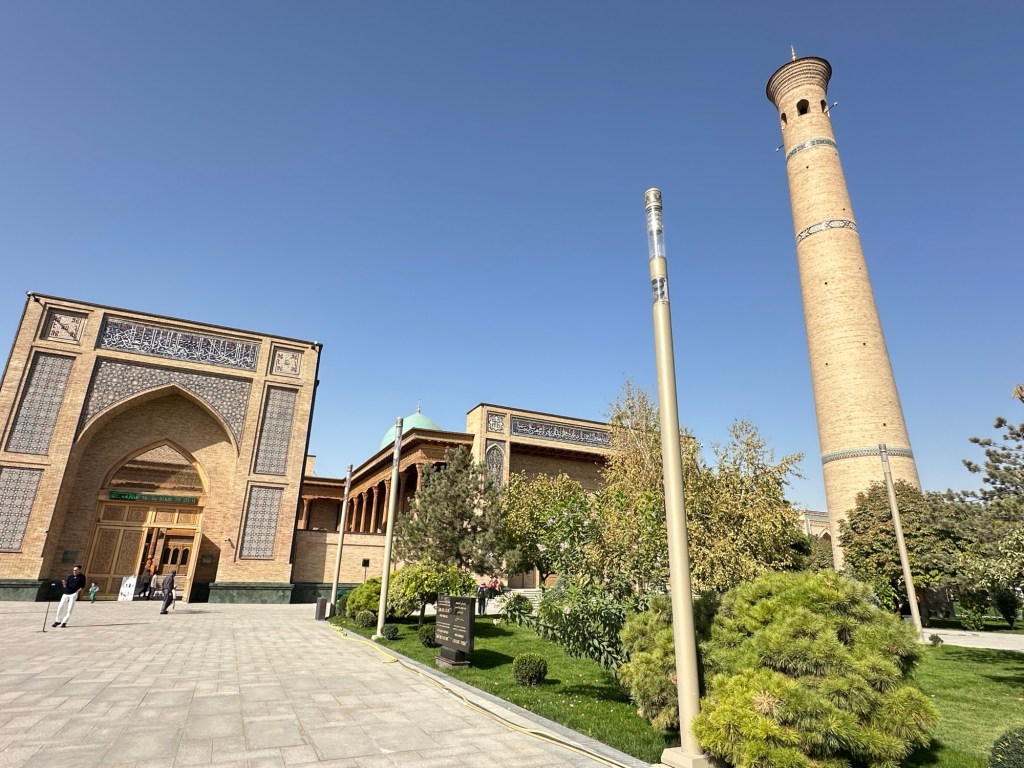
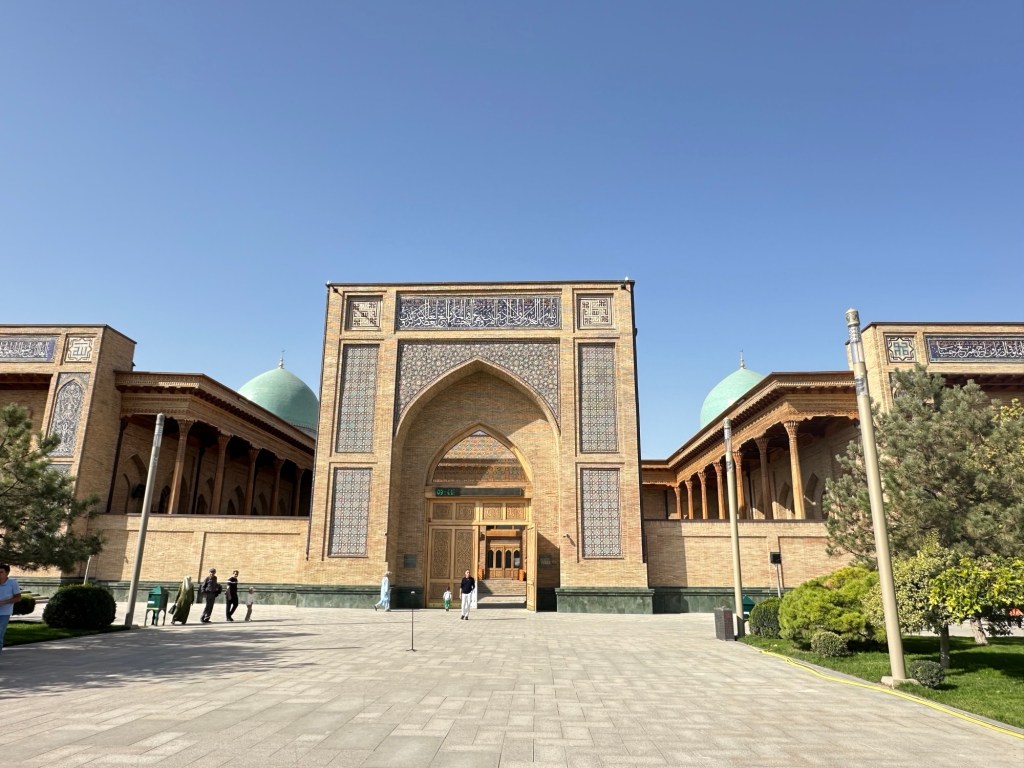
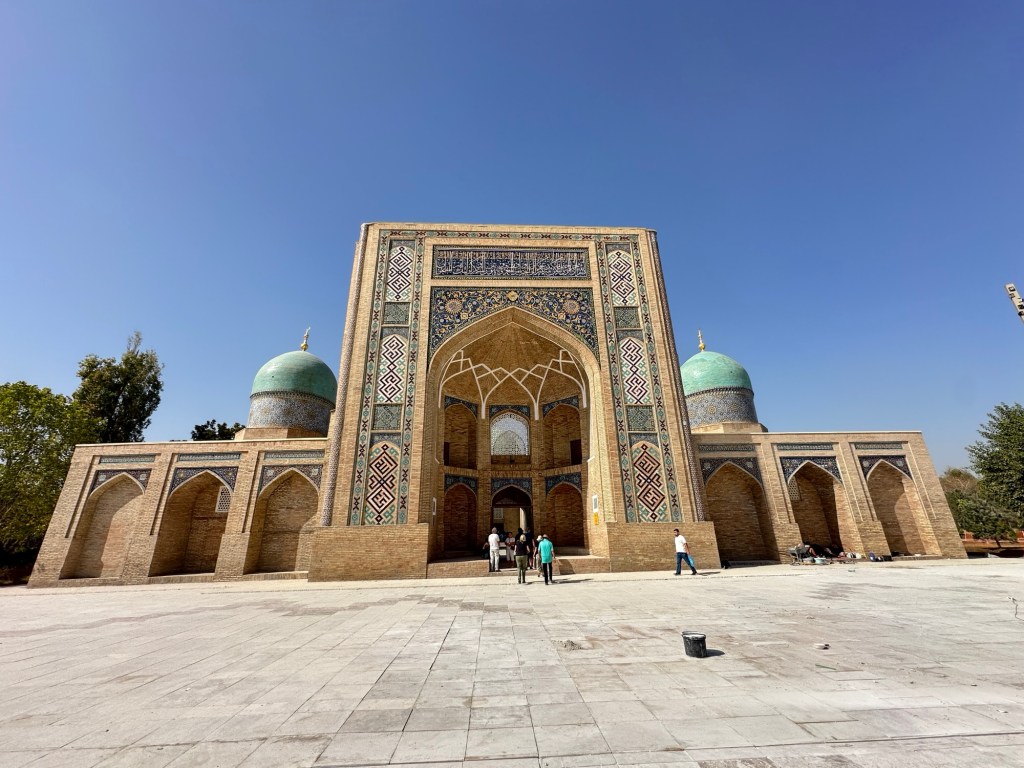
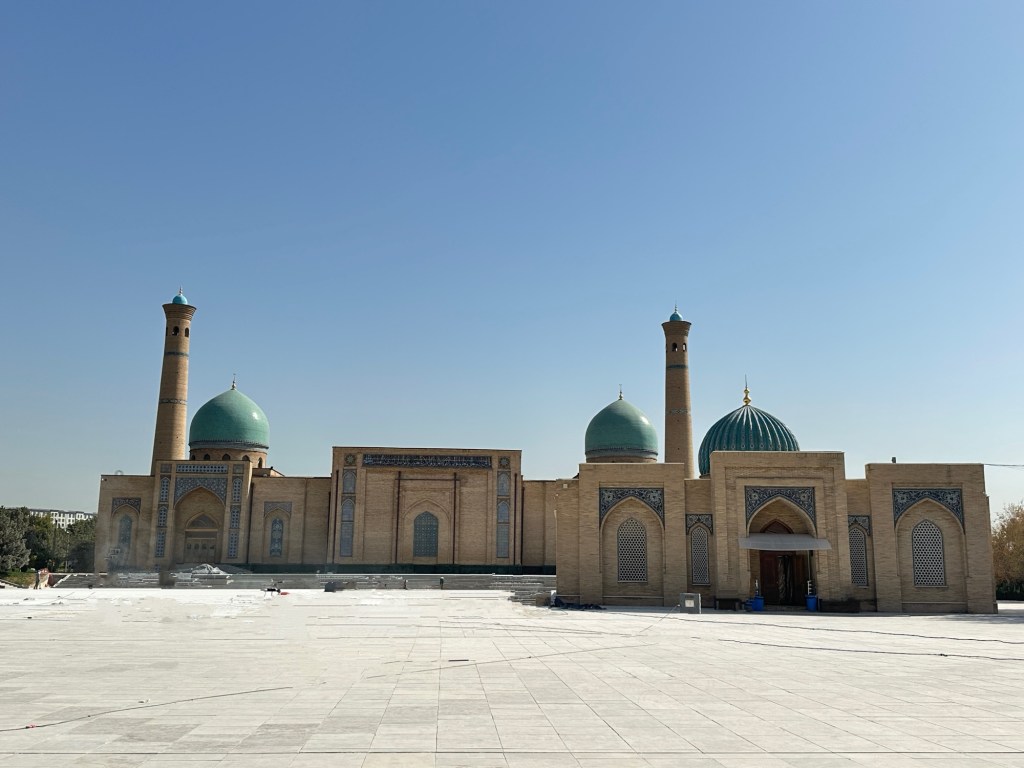
Starting in the Old Town at the religious heart of the city, we saw the Imam Ismail al-Bukhari Islamic Institute. It is still under construction but is truly a masterpiece so far.
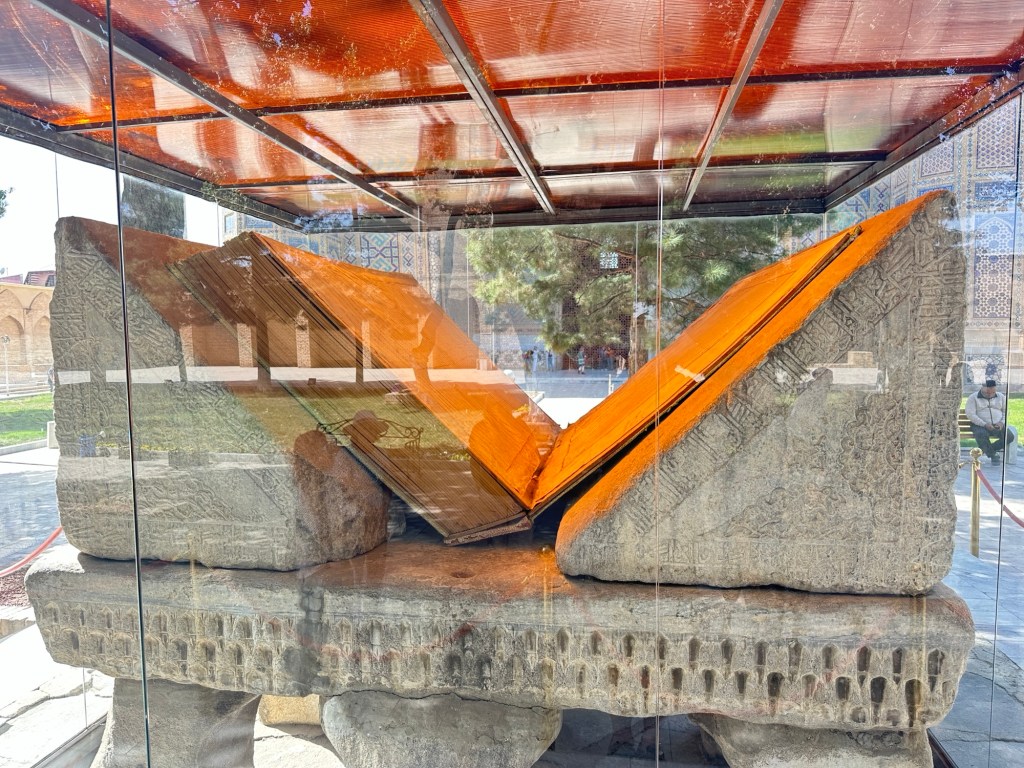
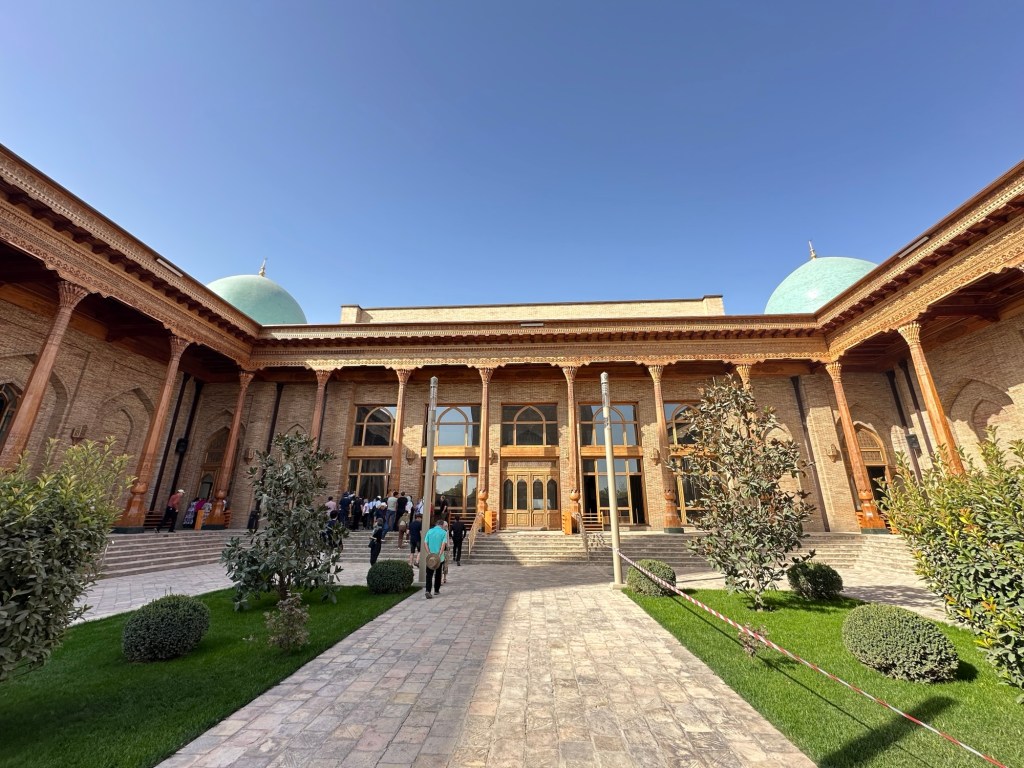
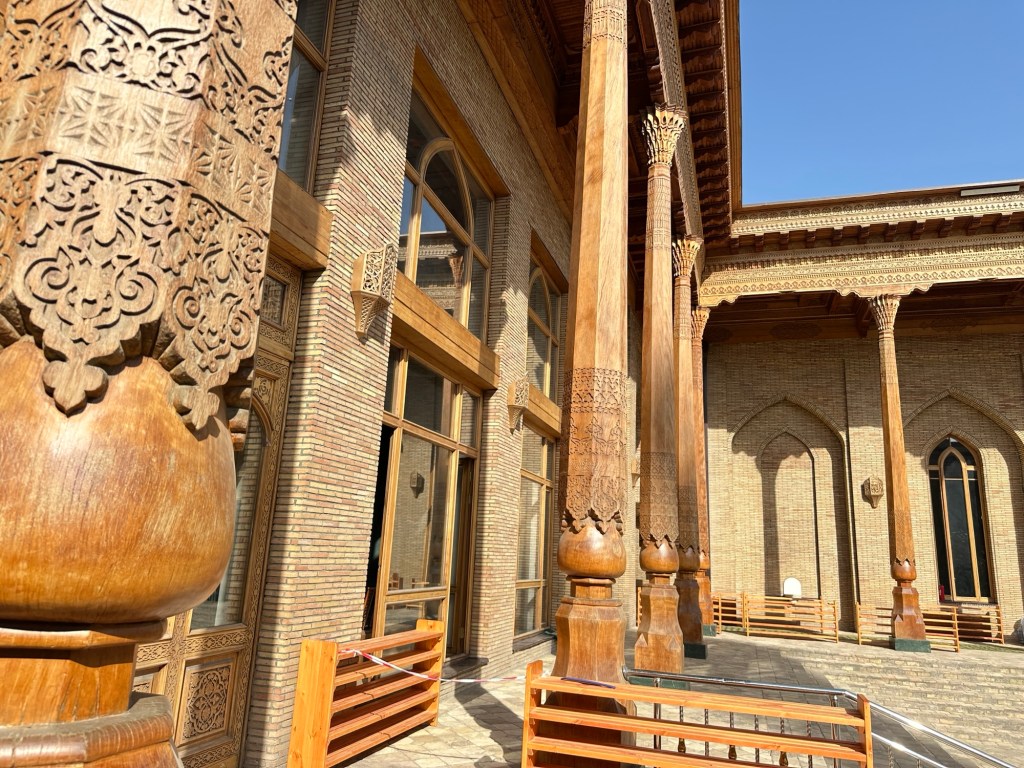
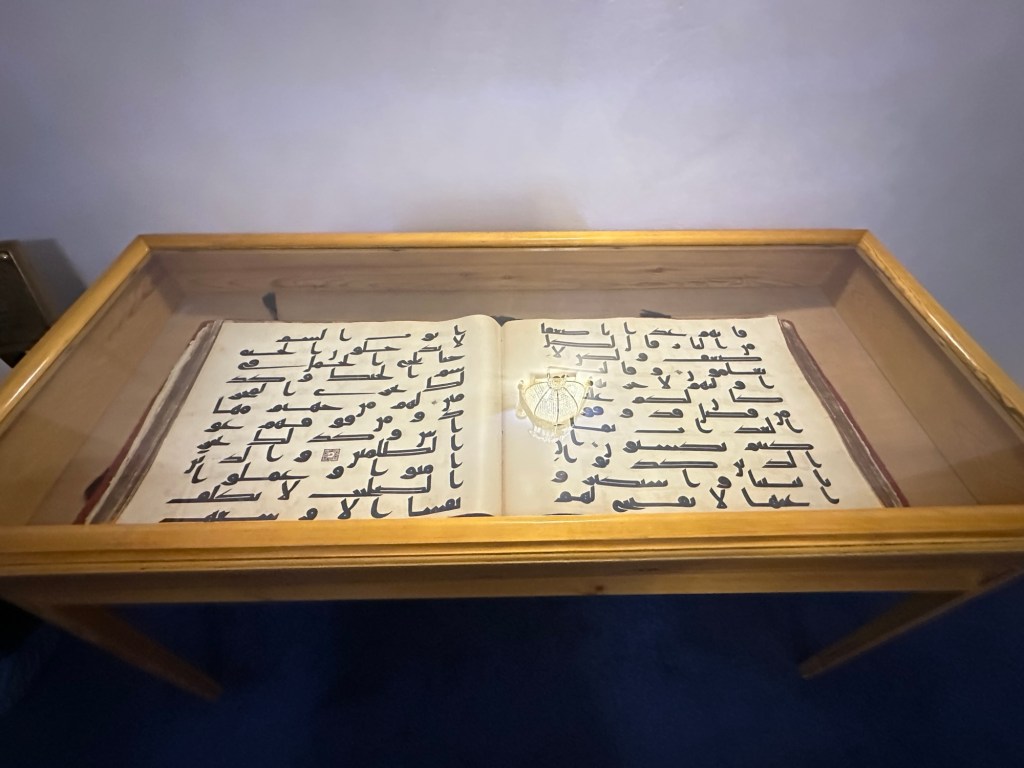
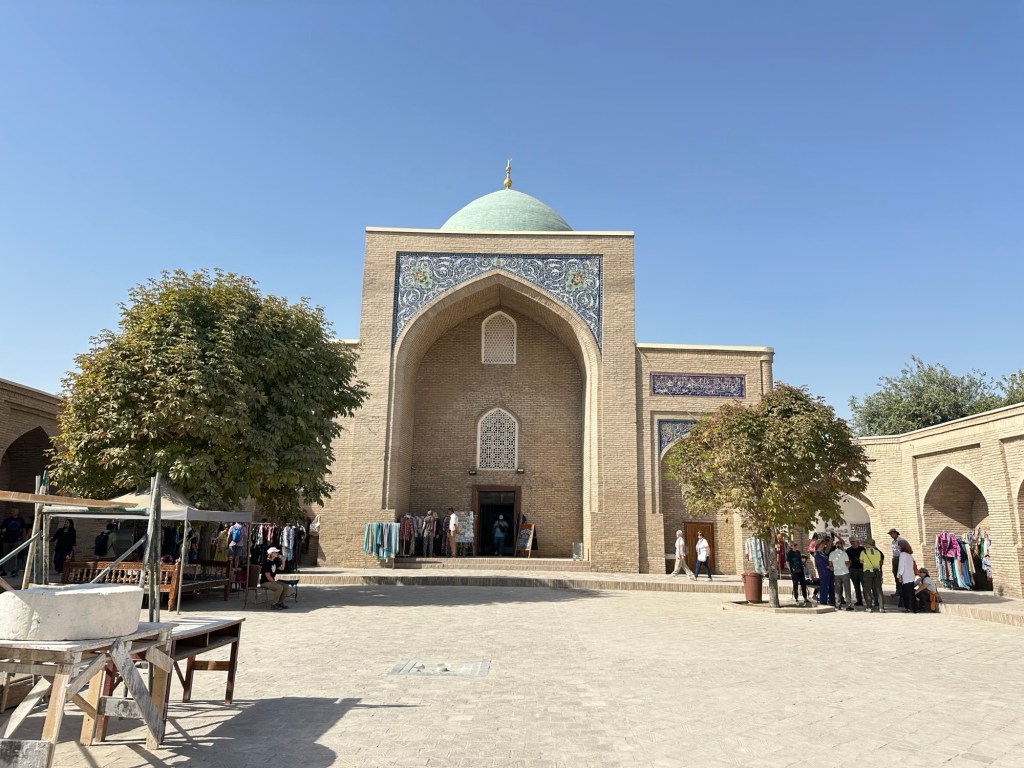
The Hazrati Iman Complex included the Tillya Sheikh Mosque, and Muyie Mubarek Library Museum which holds an unexpected treasure – the world’s oldest Qur’an. The Osman Qur’an dates from 655, and the blood of the Caliph Osman still stains several of its deerskin pages. The caliph was murdered while reading from the Qur’an, something that further fuelled the split between the Sunni and Shia branches of Islam. A caravanserai was also there which is now a home for some of Uzbekistan’s many artisans.

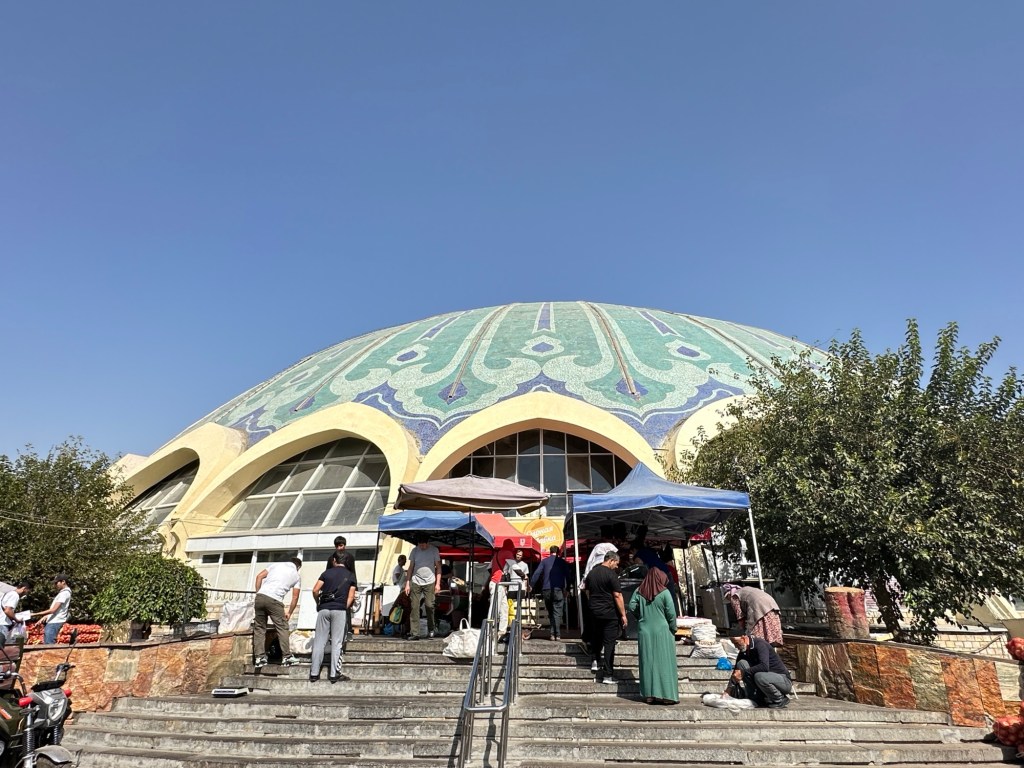
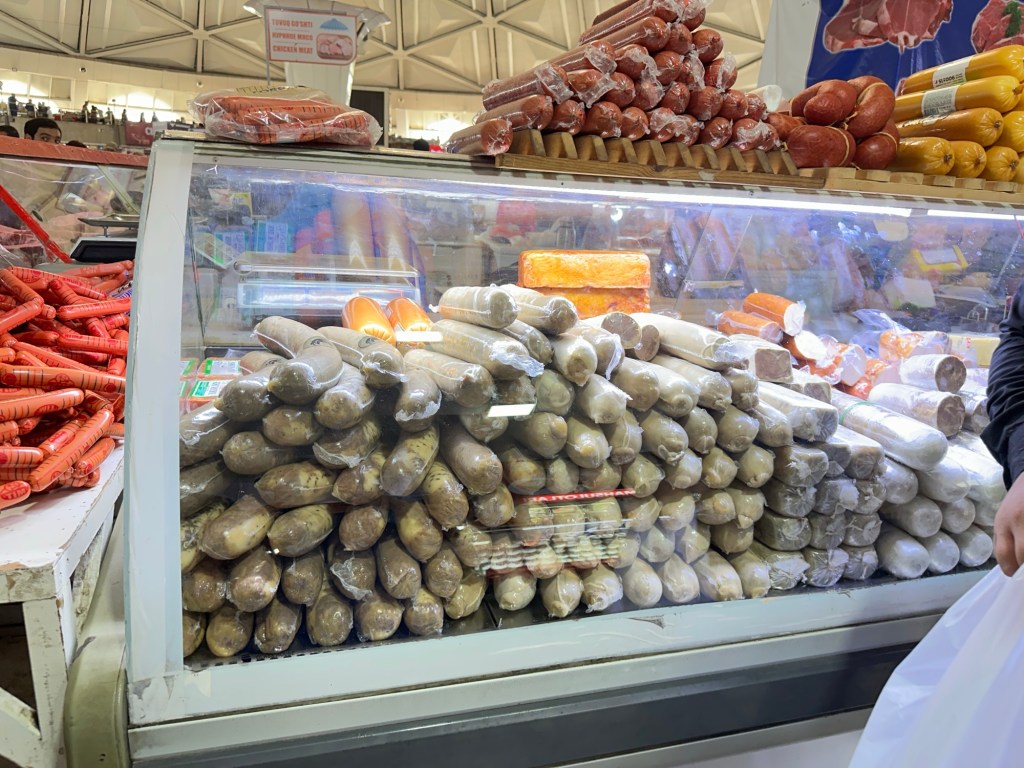
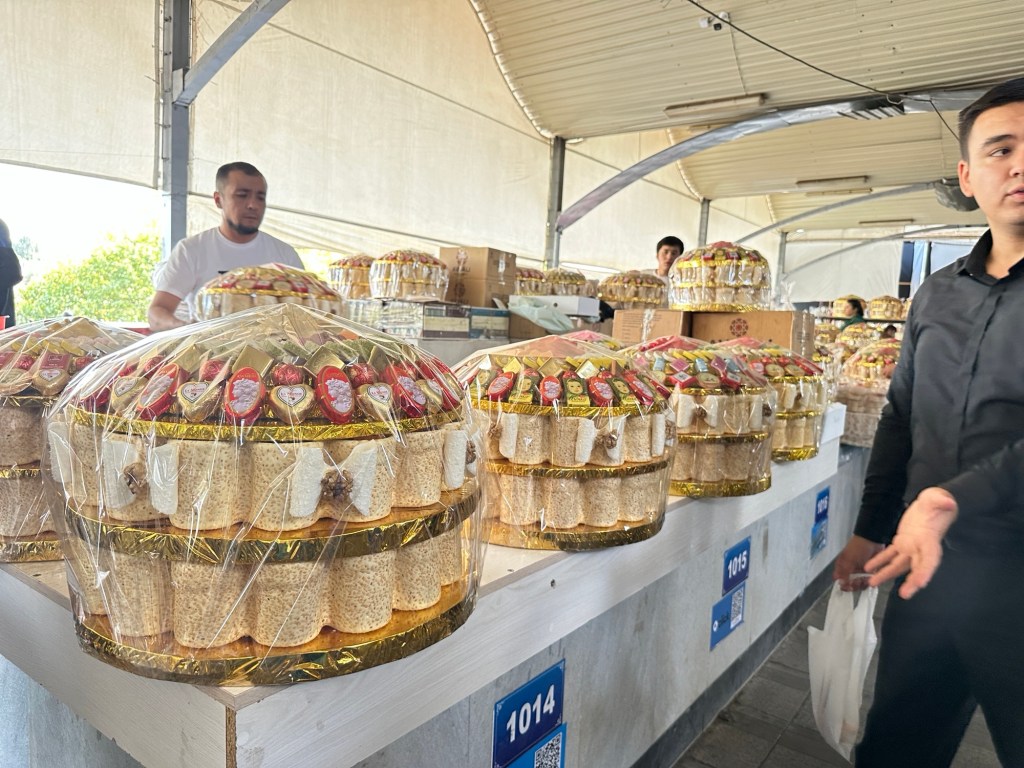
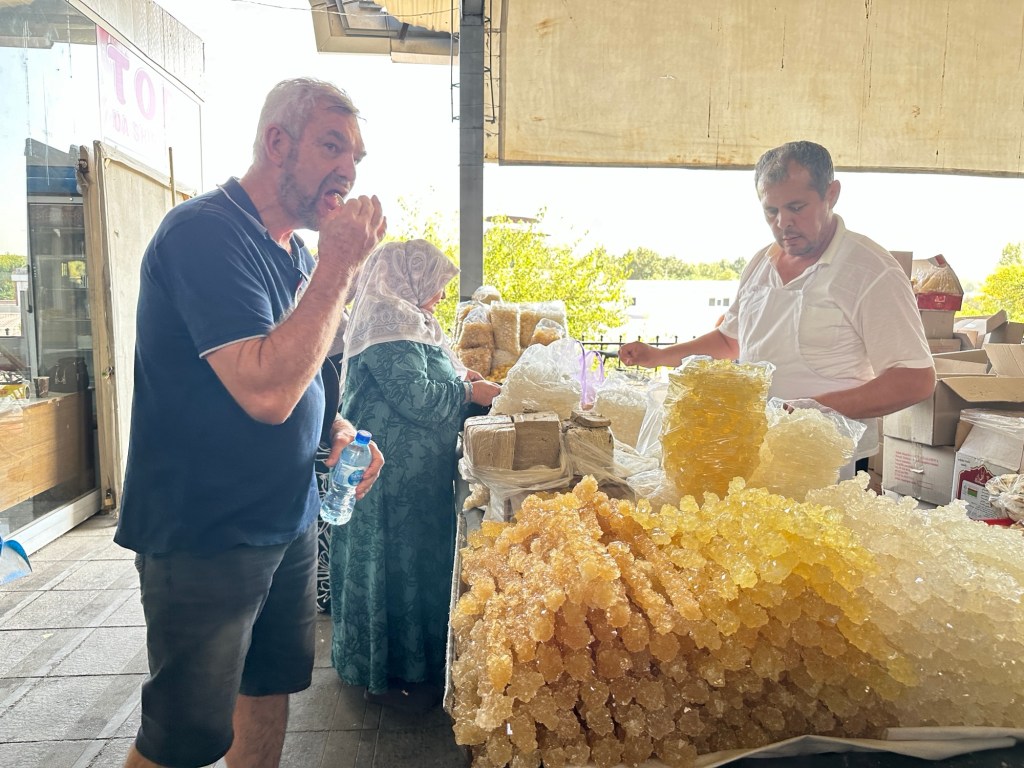
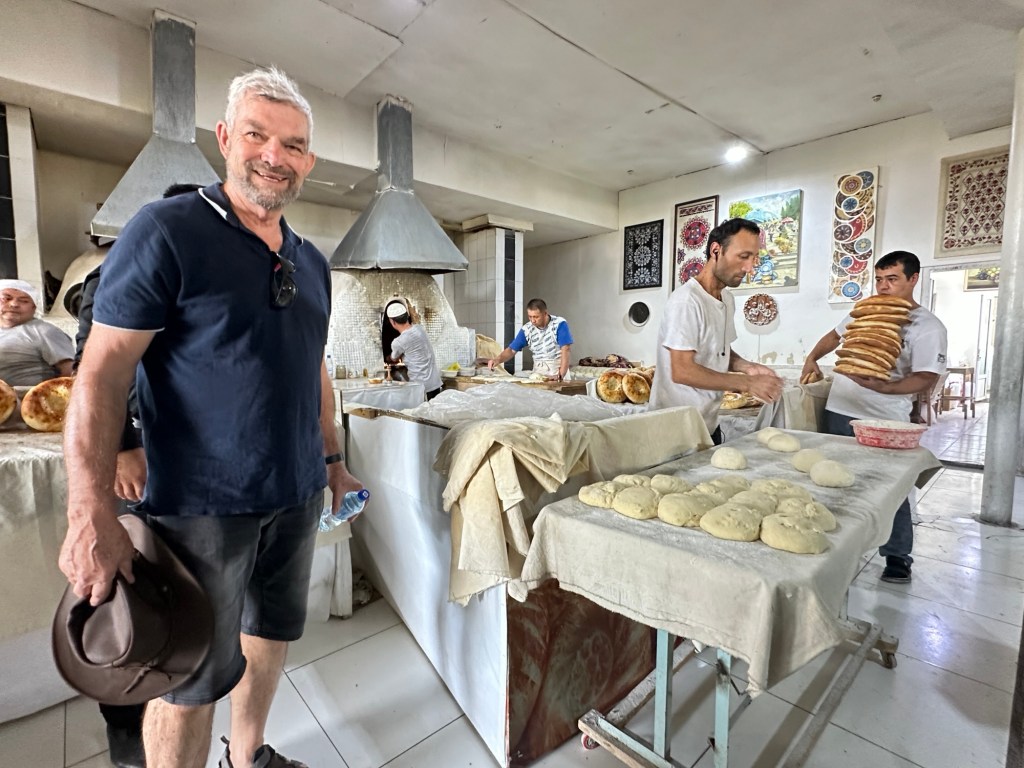
Next, time to browse the thunderous Chorsu Bazaar-more spices, nuts, fruits-dried and fresh,meat, chicken, bread- everything you could possibly need in the way of food.
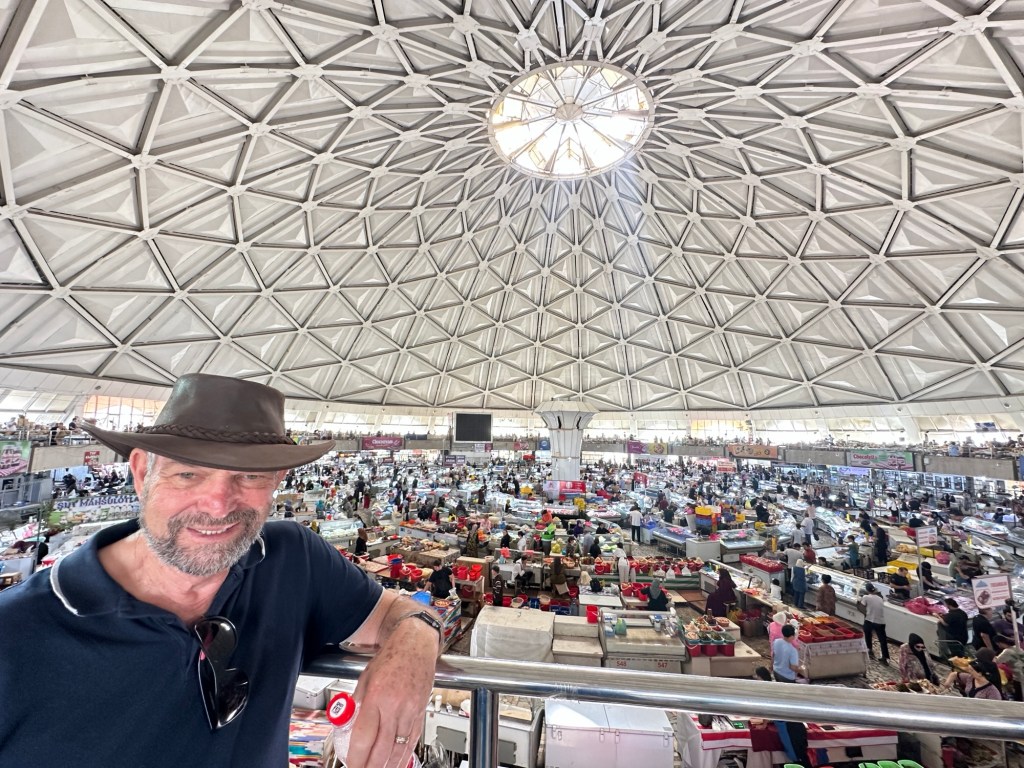
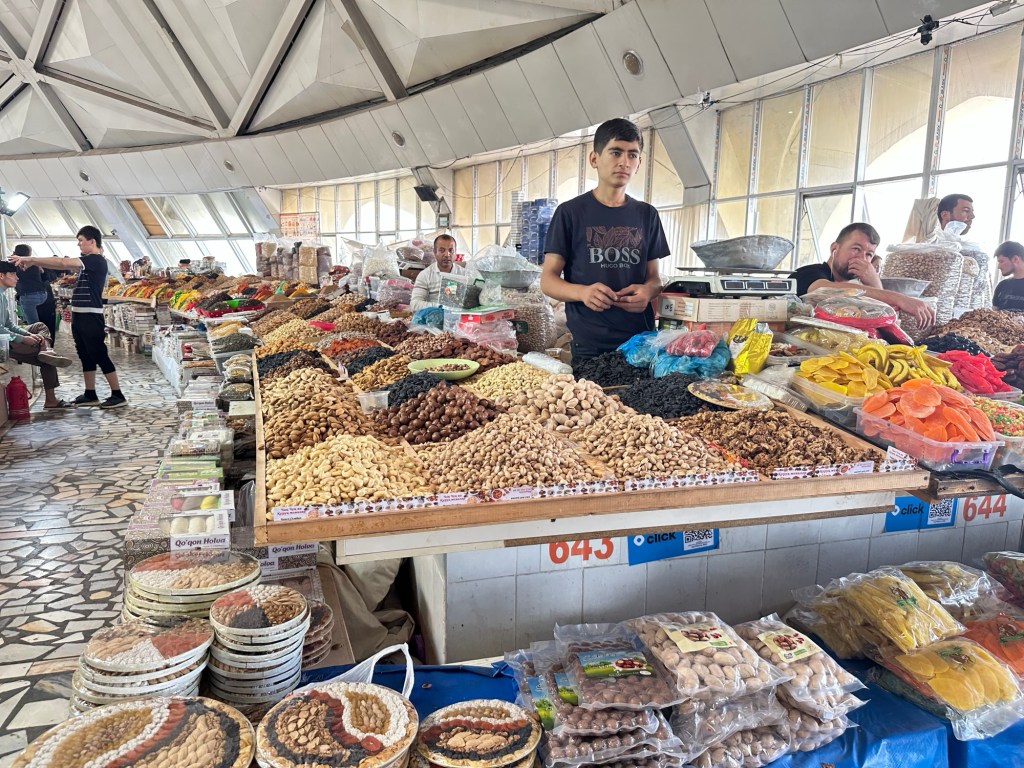
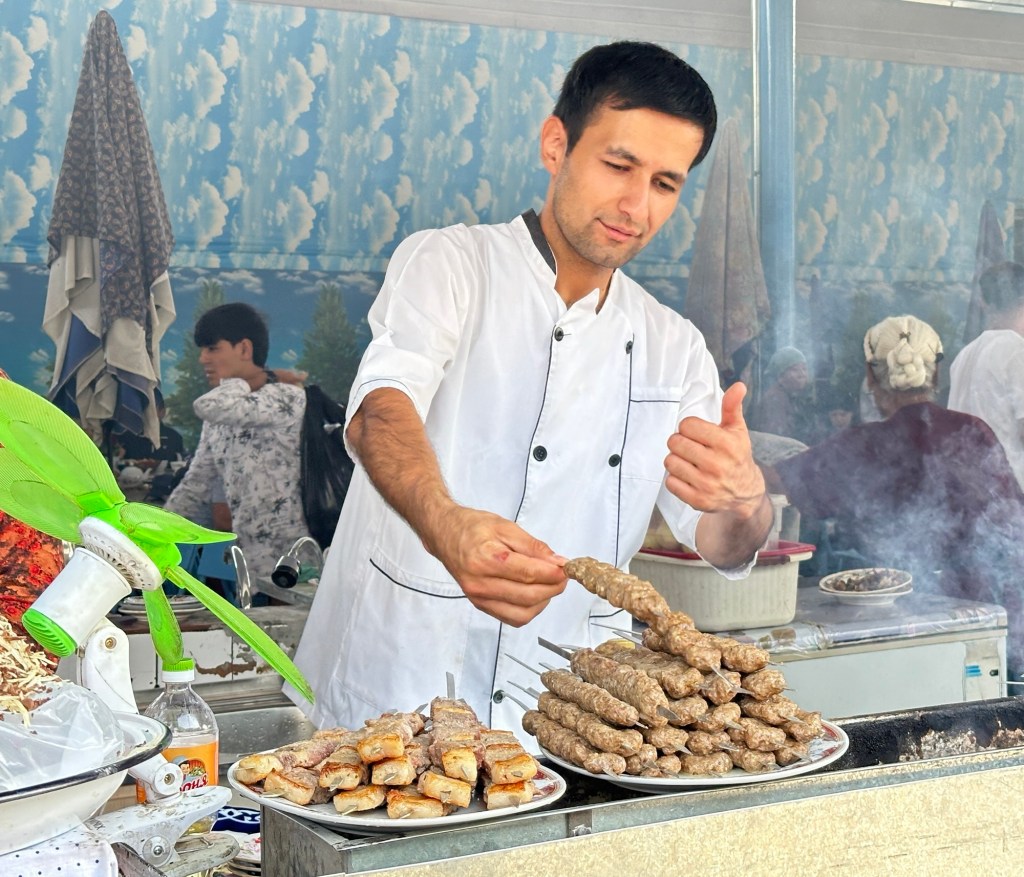
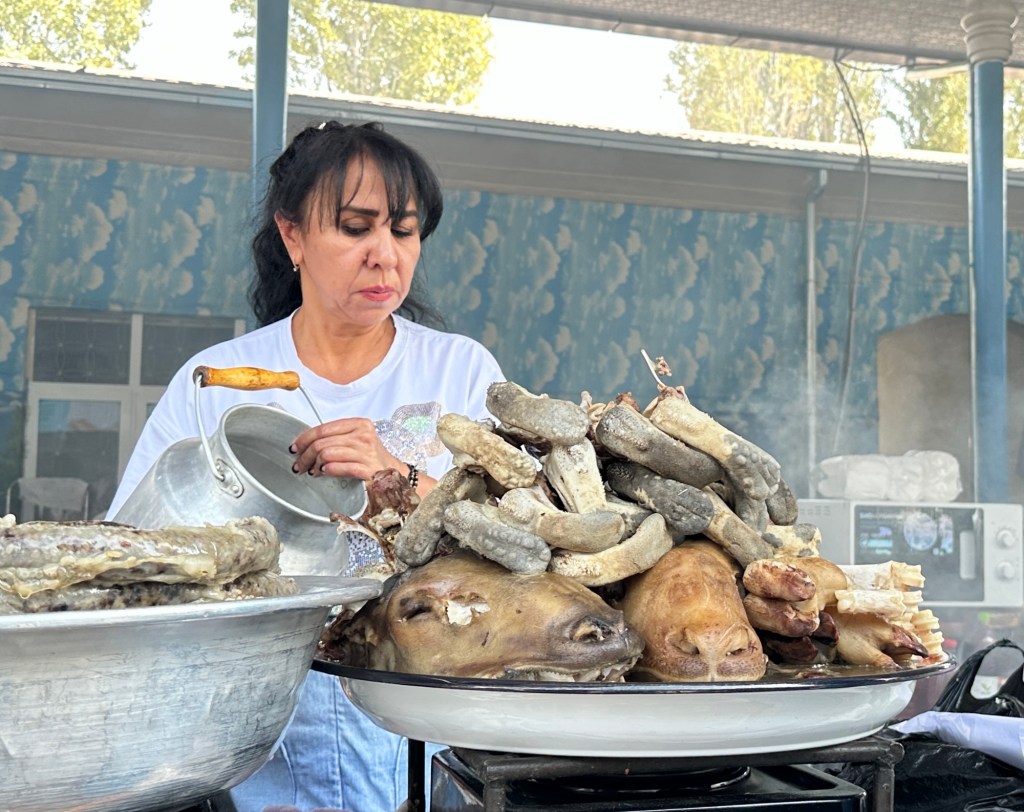

From here, time to ride the trains and view the very ornate metro stations. Such works of art. Have to say, the trains were very crowded, even though there seemed to be a train every few minutes.
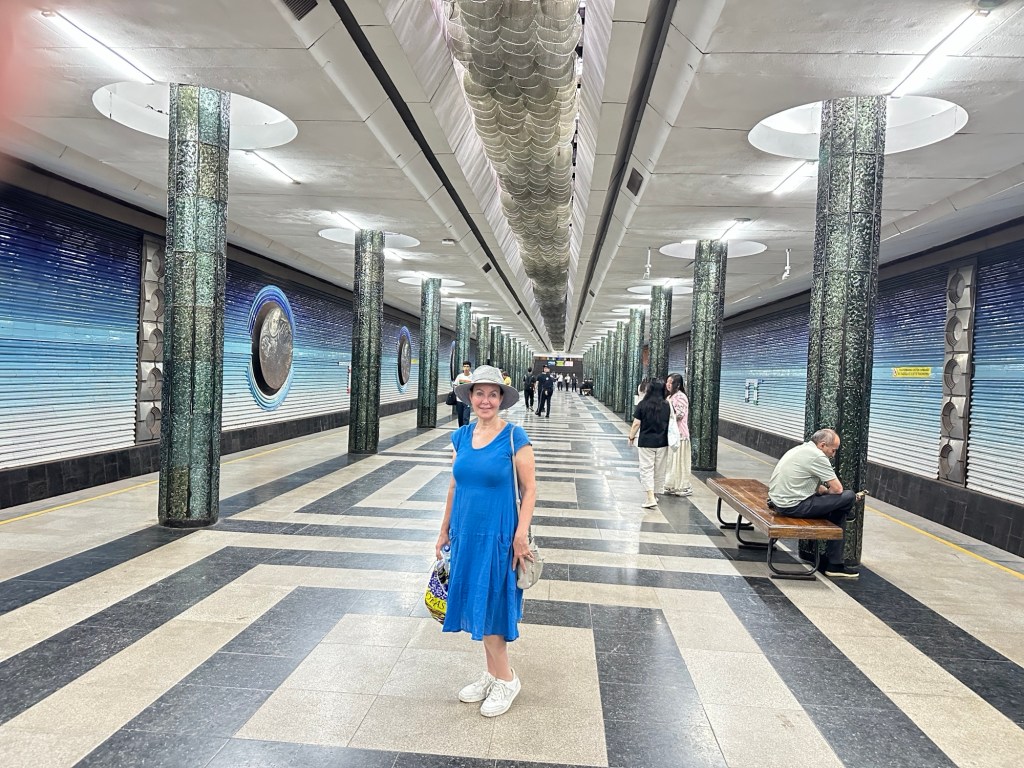

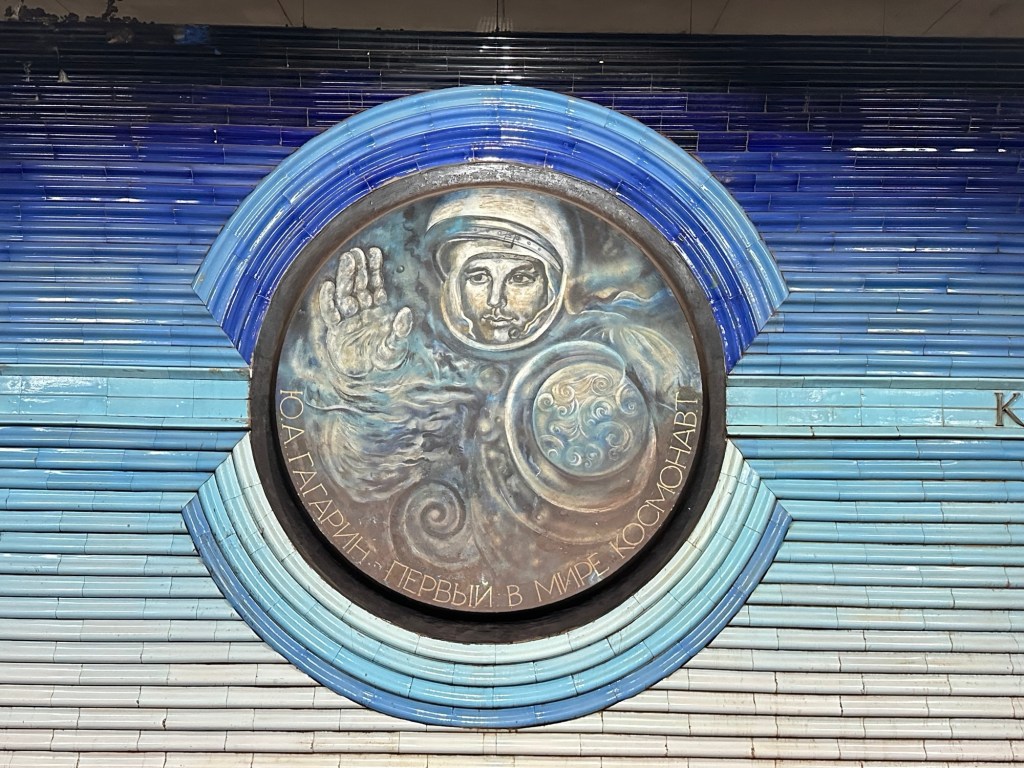
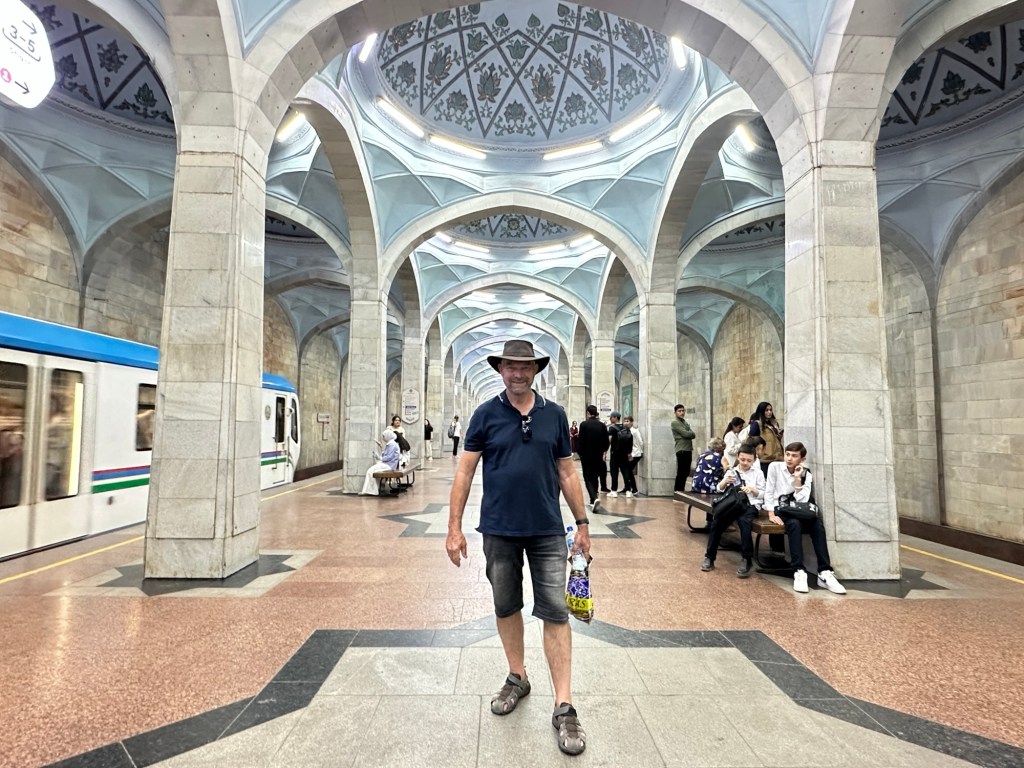
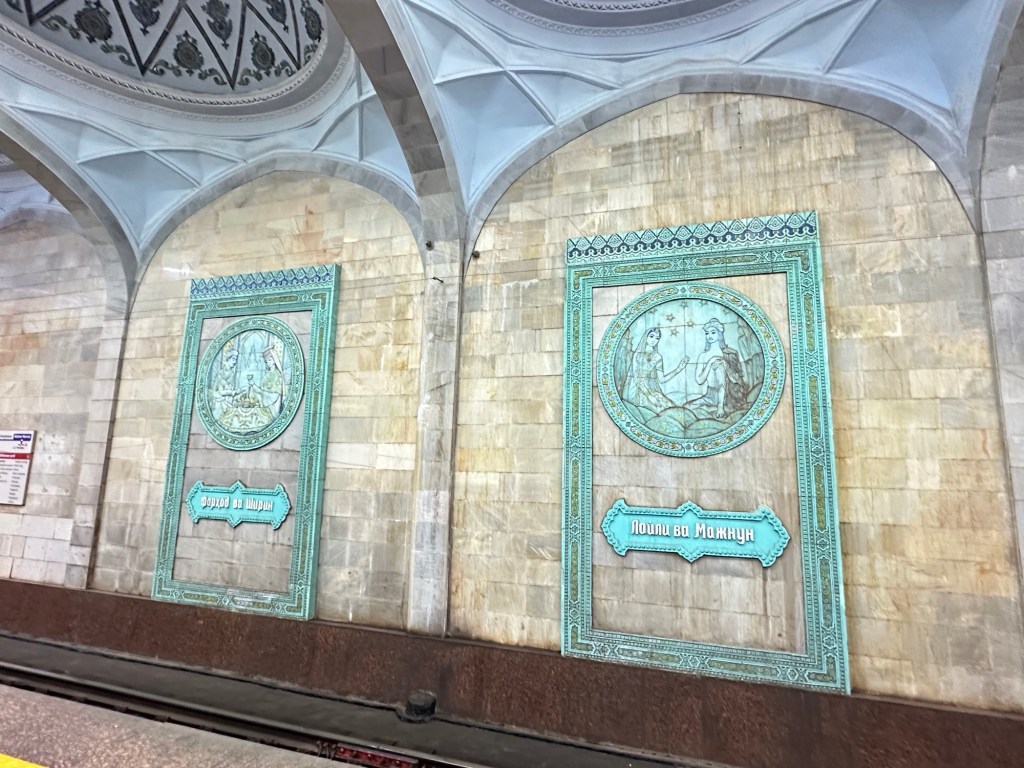
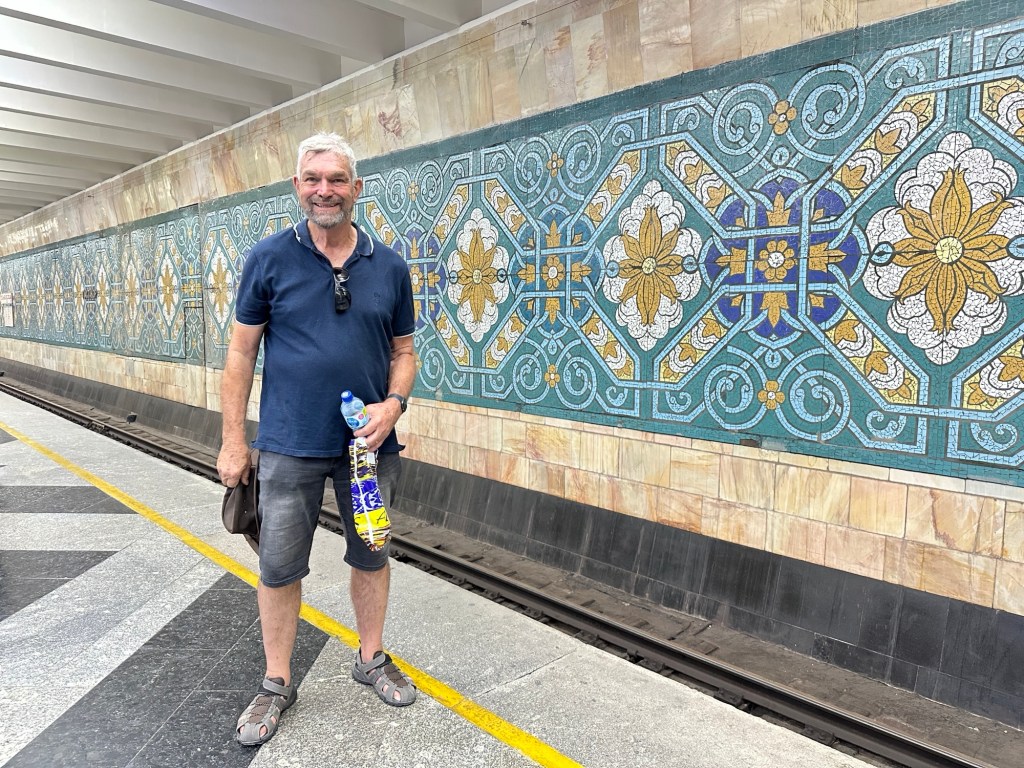
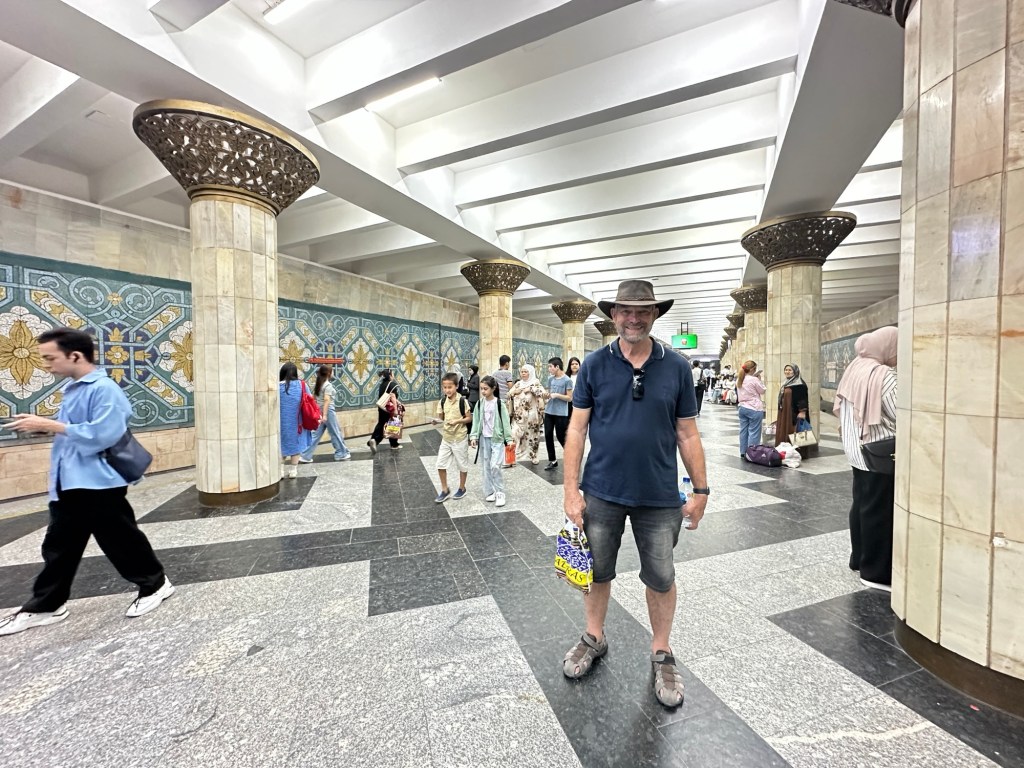
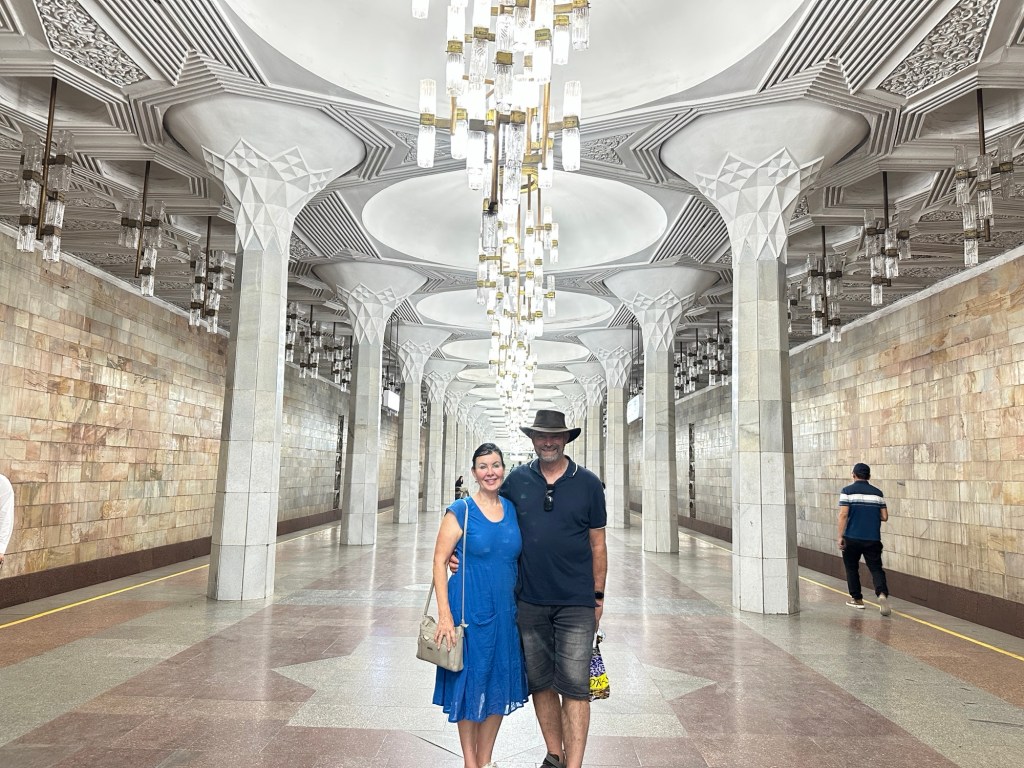
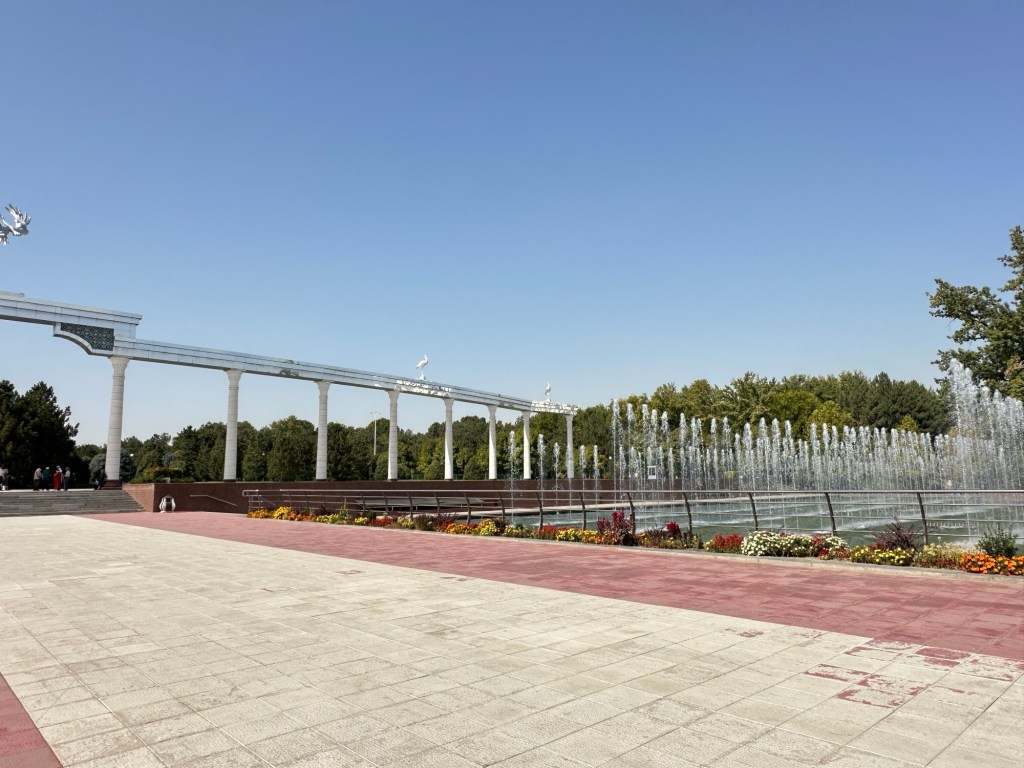
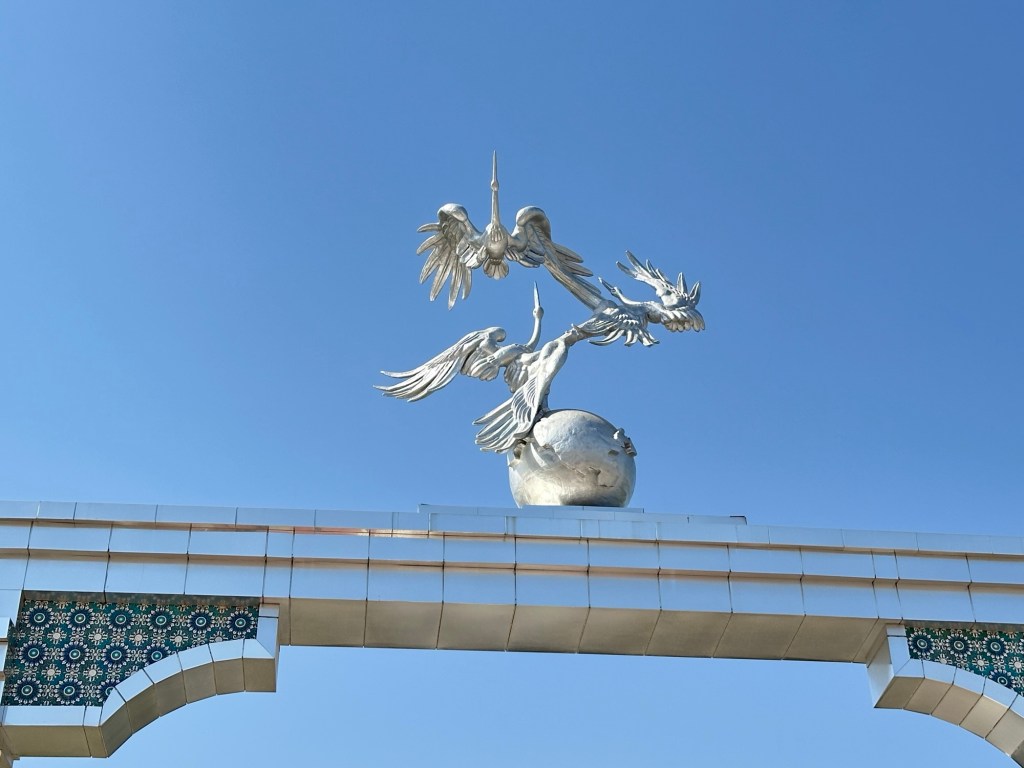
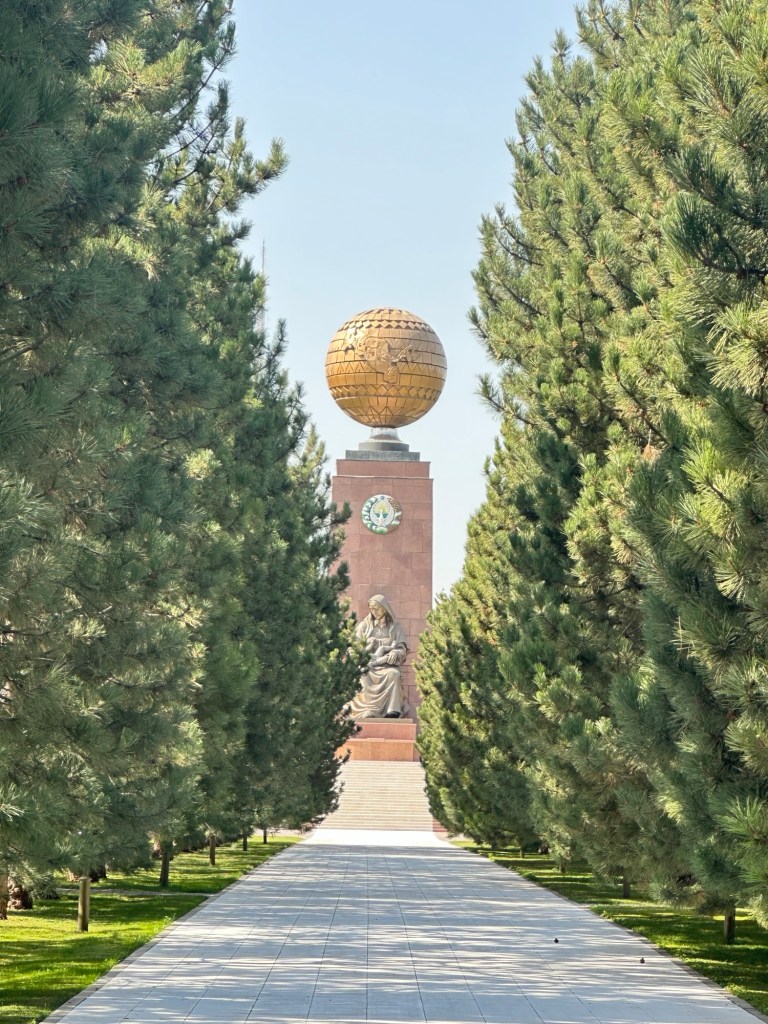
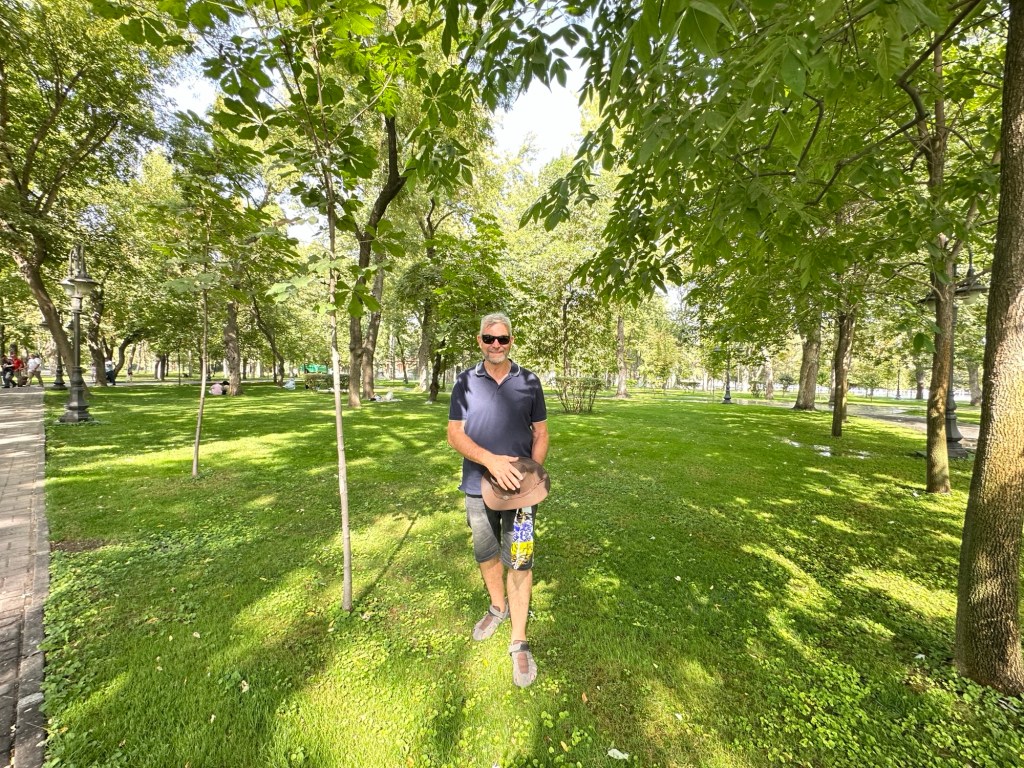
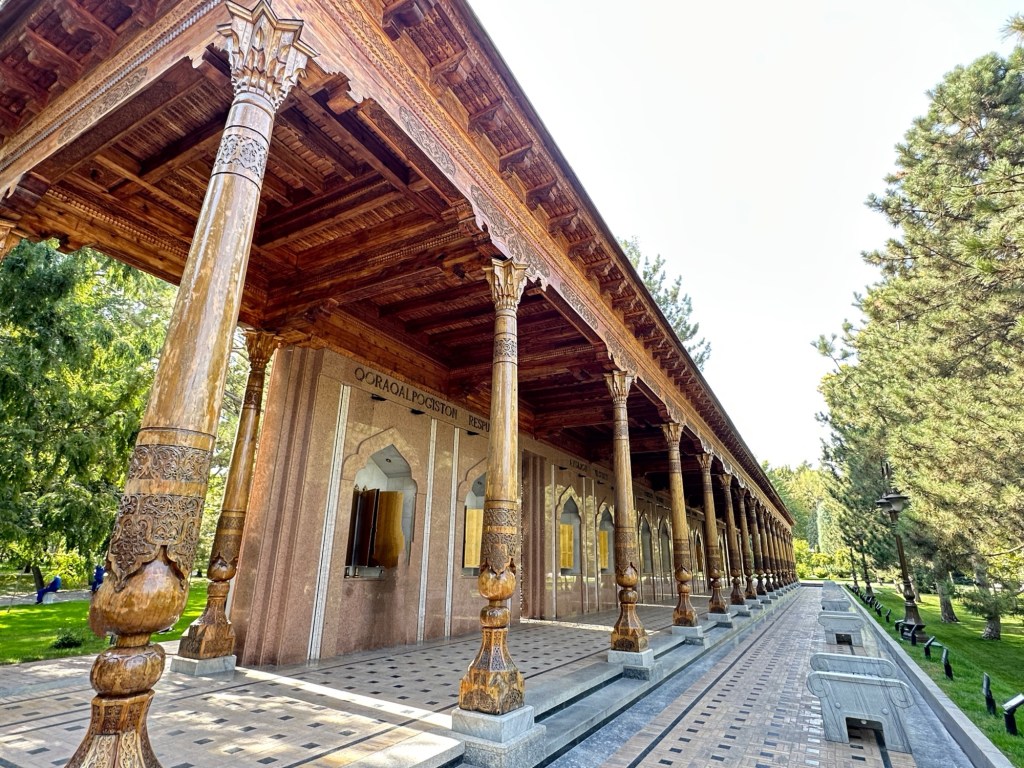
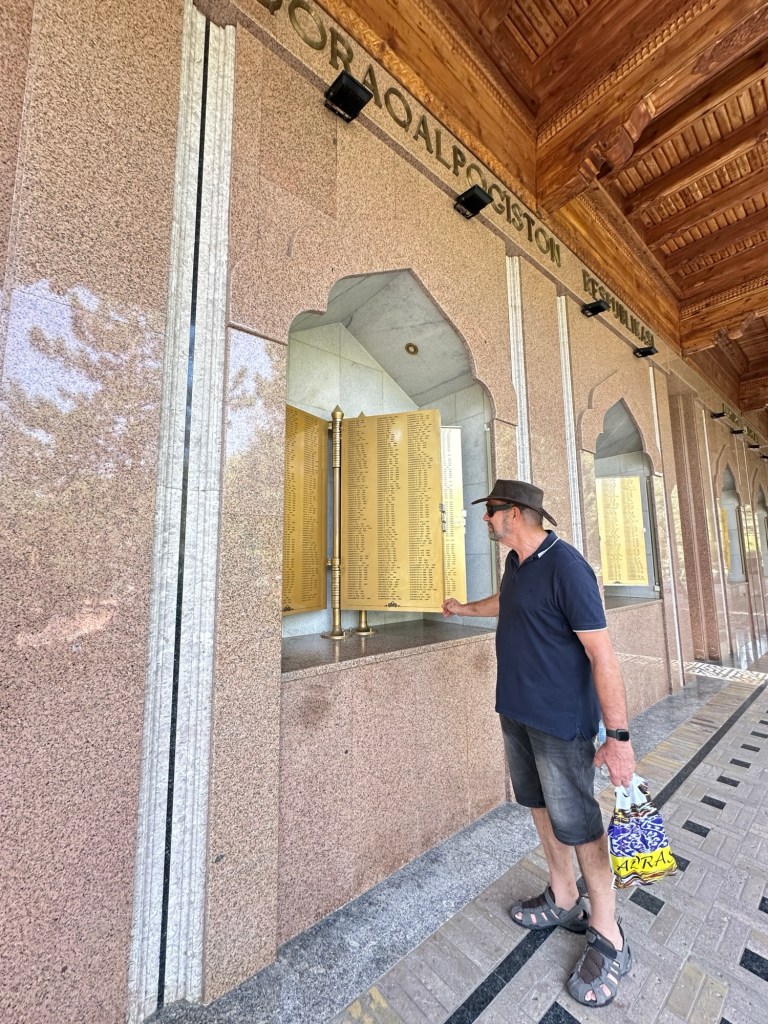
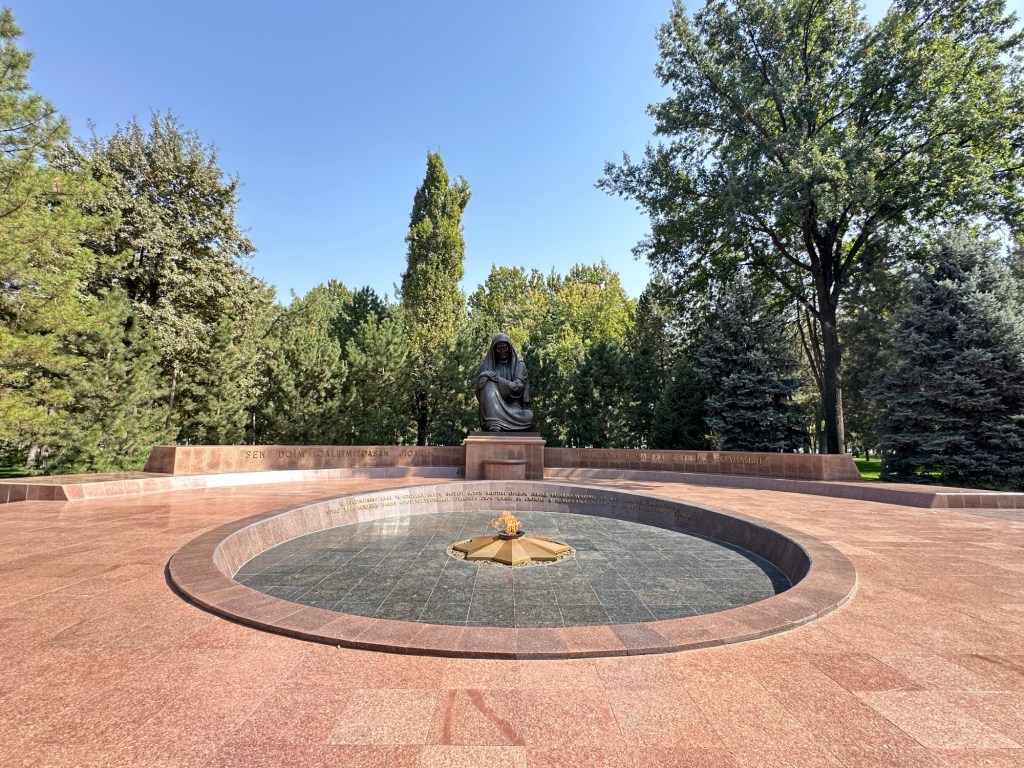
Out at Independence Park which is a large paved area surrounded by water fountains, and is home to a large globe whose only country is an oversized Uzbekistan. A short walk away, through a beautiful green park, is the Tomb of the Unknown Soldier which commemorates the 400,000 citizens of Uzbekistan who died in World War II.
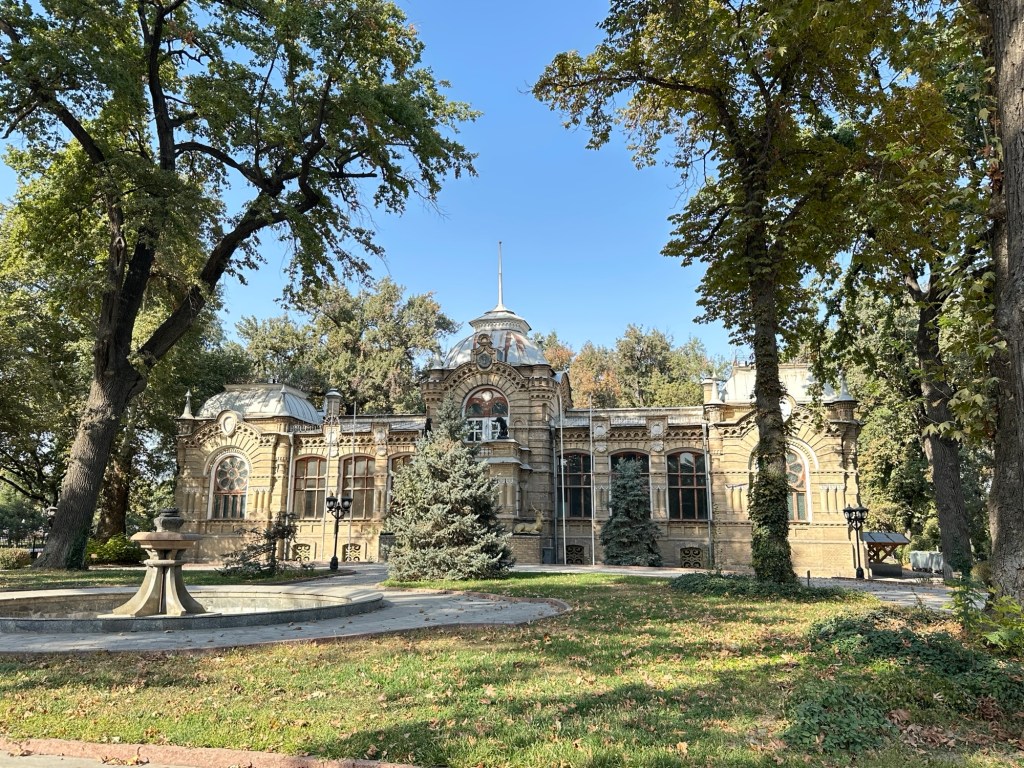
A short stop at Romanov’s Palace – this mansion was built in 1891 for the Grand Duke Nikolai Konstantinovich Romanov, a cousin of the last Russian Czar. He lived there until his death in 1918, after which his family lived there. The family was then killed when the Soviets took over. It became a museum for a while, now it is empty.
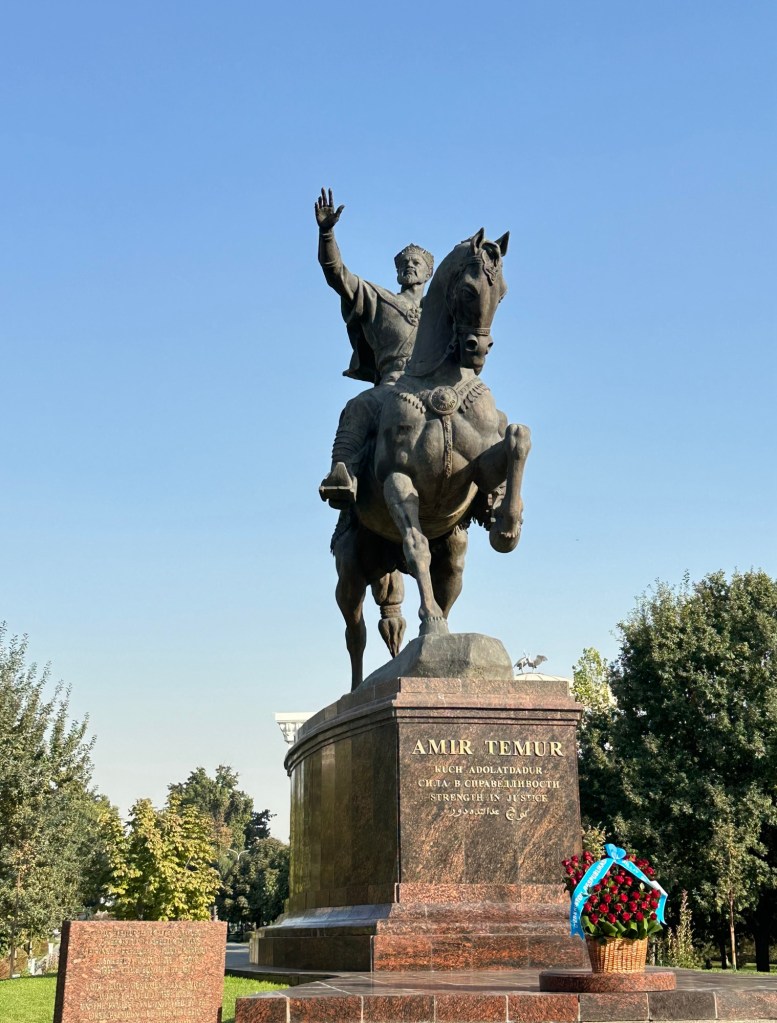
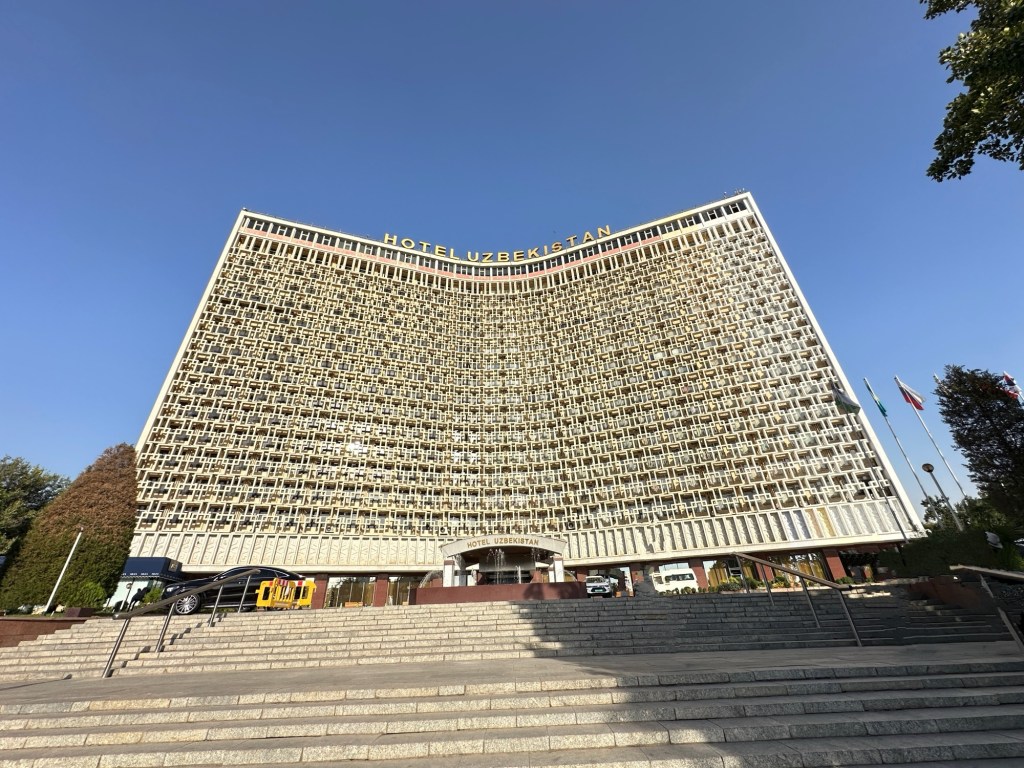
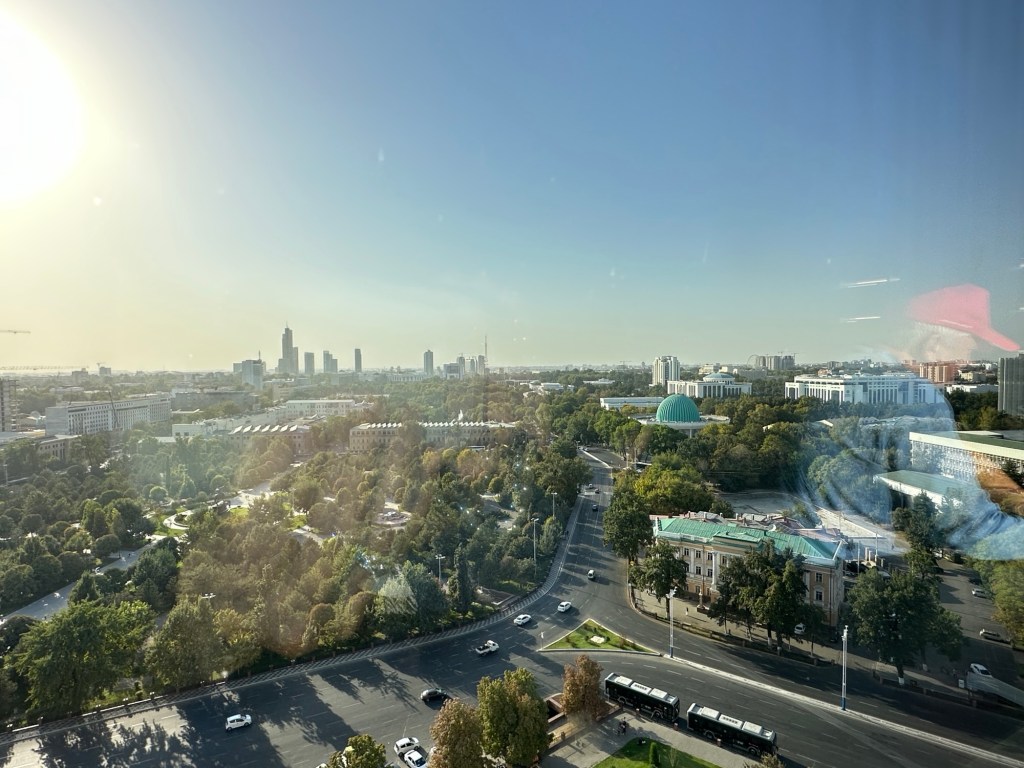
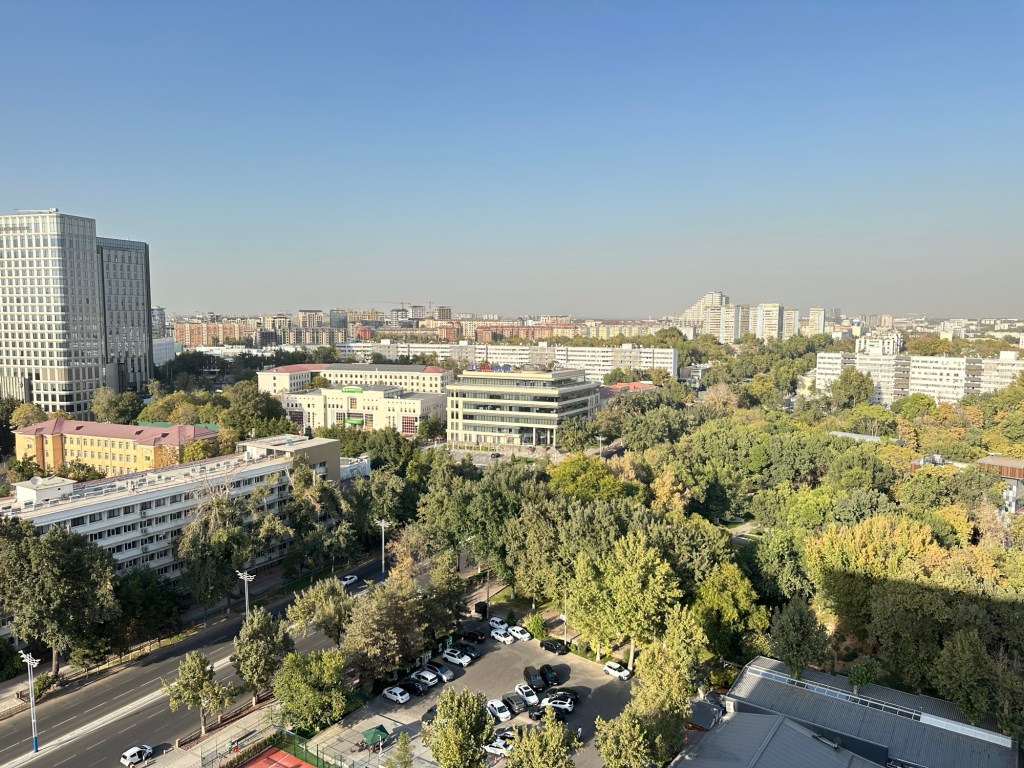
We walked through Amir Timur Square, occupied by a park with a statue of Timur in the centre, (this time he is on horseback), ending up at the monolithic Hotel Uzbekistan. This hotel dates to 1974 and looks every inch of it. We went up to the 16th floor and had an overall view of the city below.
From here it was time to go to the airport for our flight to Termez. Well that was an ordeal – they put all our bags on the belt, even the hand luggage as we couldn’t take that on the small plane apparently, then told us we had to pay $28US per couple for excess baggage – we could easily have minimised that, but there was an obvious language barrier. We should have been allowed 5kg hand luggage each but somehow we were charged for it. The joys of travelling!
After a 100 minute flight on a Silkaviar ATR72, we were picked up at the airport and taken to the Asson Hotel in Termez. It was 9.30pm by then. Well that was also interesting- the receptionist only spoke German, we only spoke English! But we muddled through. We opted for twin beds on the ground floor rather than the double room on the fourth floor once we heard there were no lifts! Very basic but comfortable rooms. I believe our accommodation becomes very basic from now on, mainly because of limited choices.
Day 18
Sunday 28th September
Termez
16-32 degrees, sunny, very hot
Today was a day exploring around Termez – this ancient city located in the southern part of Uzbekistan, is known for its unique cultural heritage and archaeological sites. Termez’ history spans over 2,500 years, blending Buddhist, Zoroastrian, and Islamic cultures.
First Fortress Kyrk-Kyz – was considered as a palace, monastery, caravanserai, house, and even an ordinary building at different times, an ordinary civil building. According to our guide it was a school for forty girls, who at the time of Genghis Khan’s invasion, successfully fought off the army.
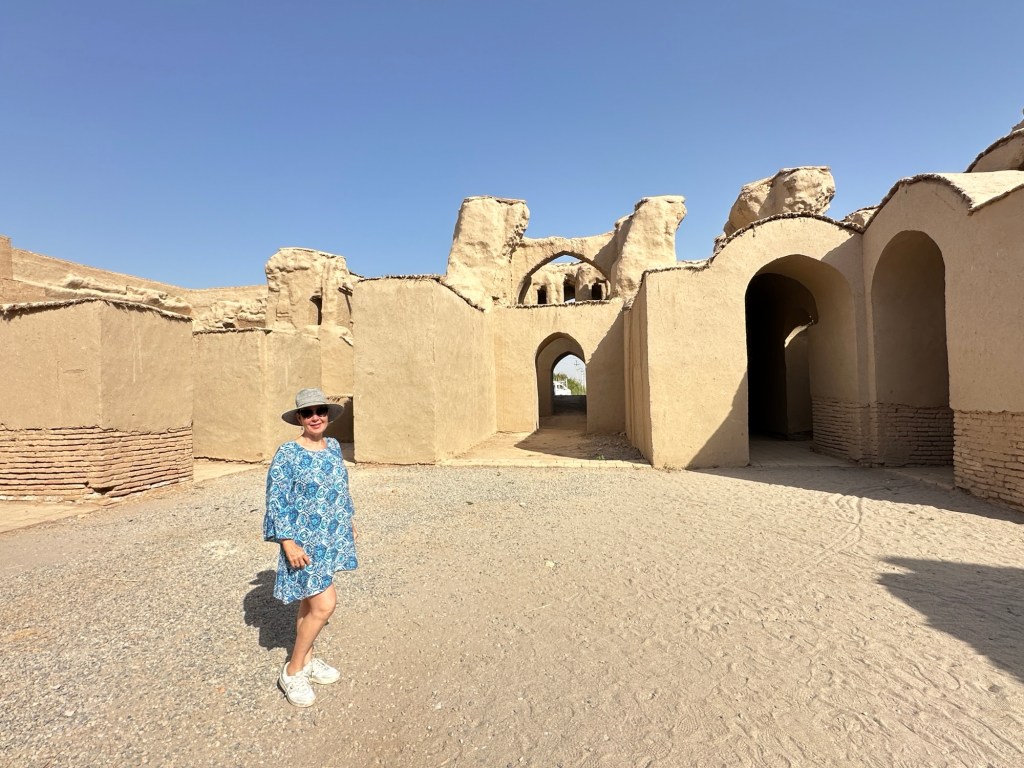
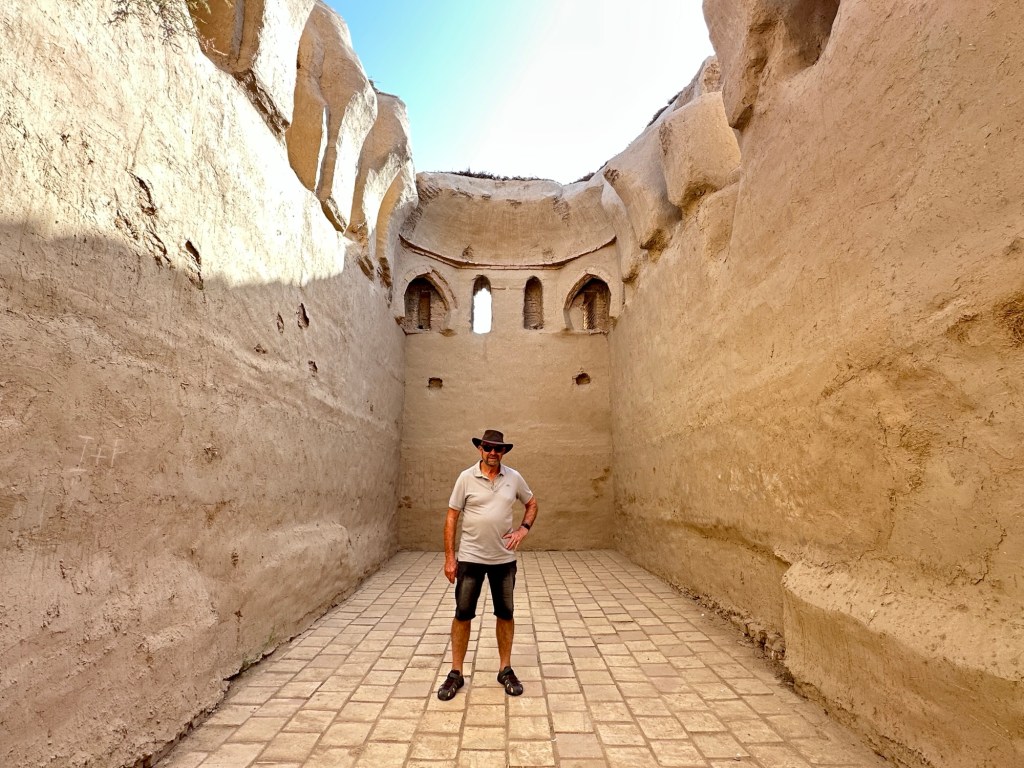
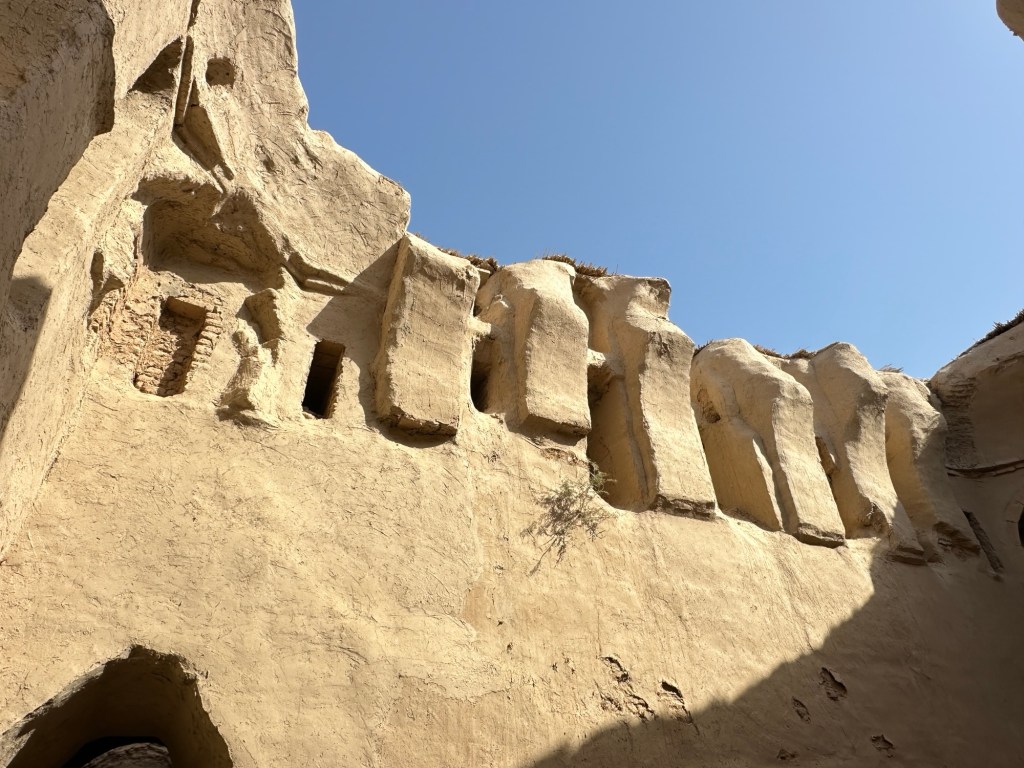
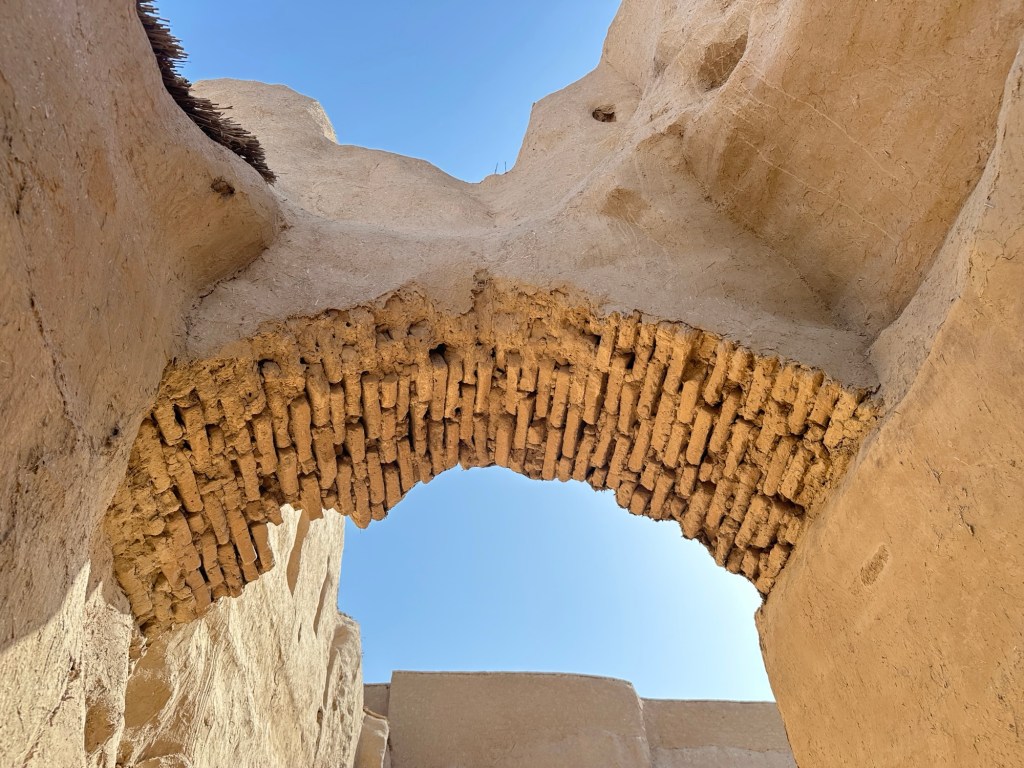
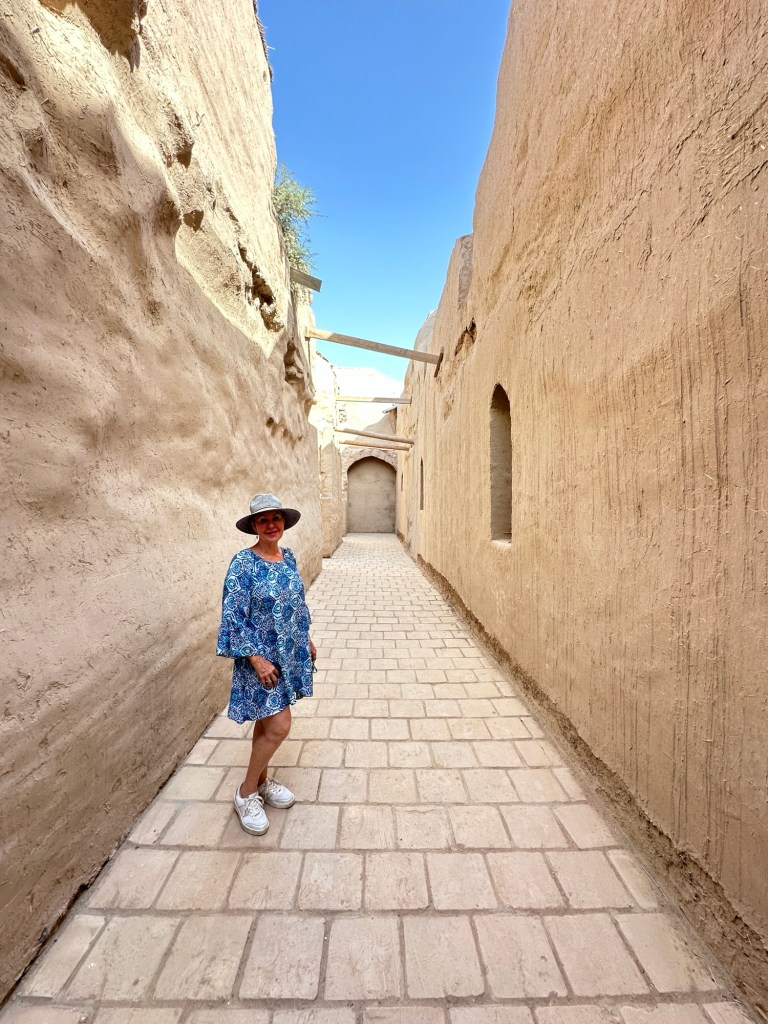
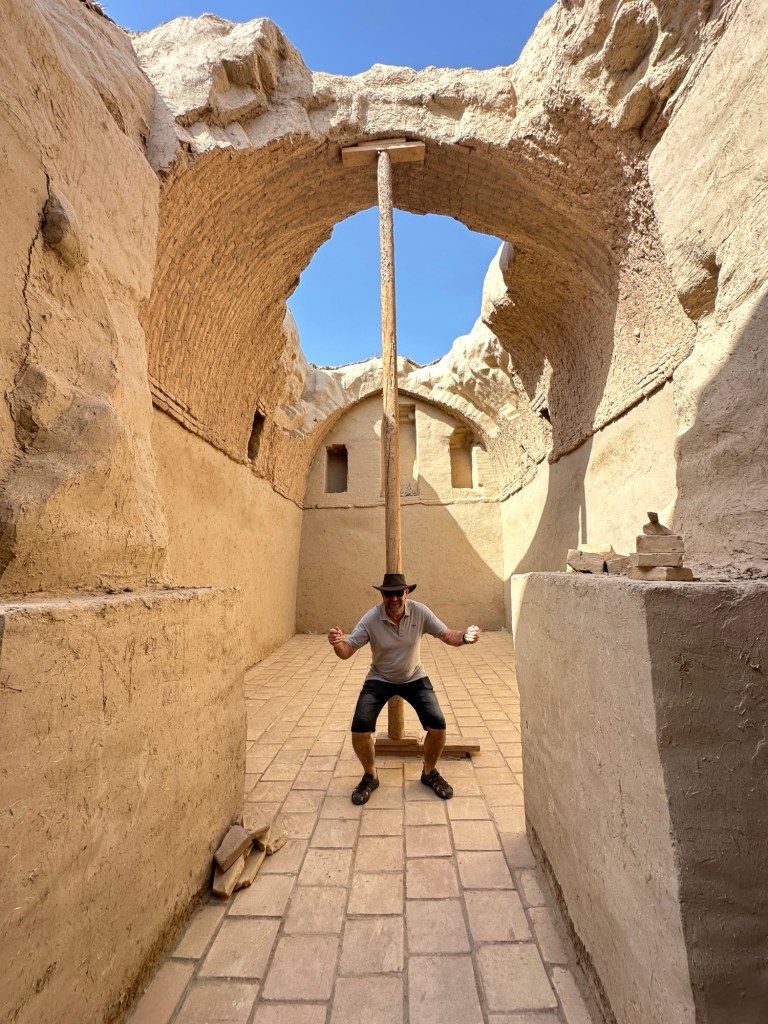
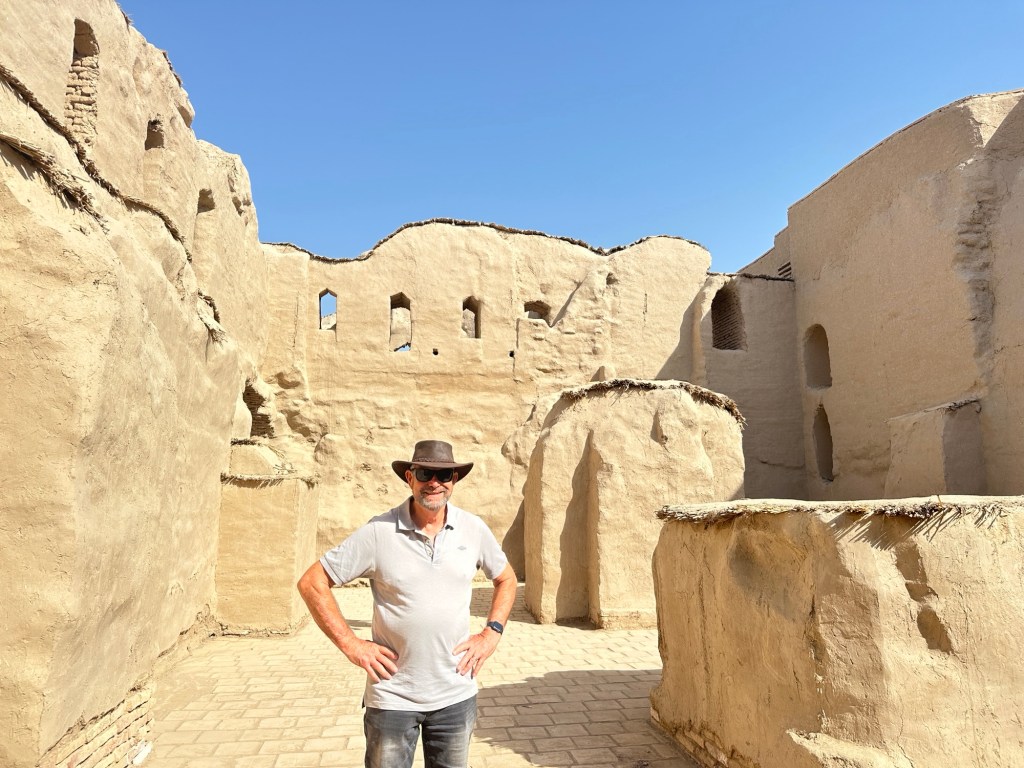
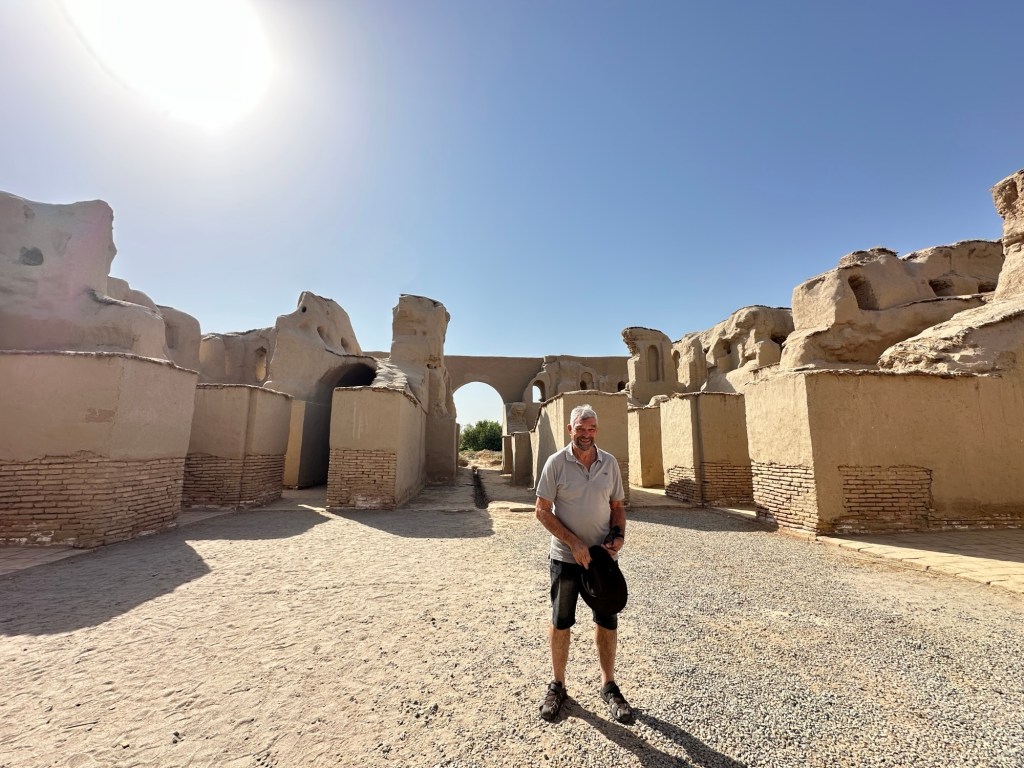
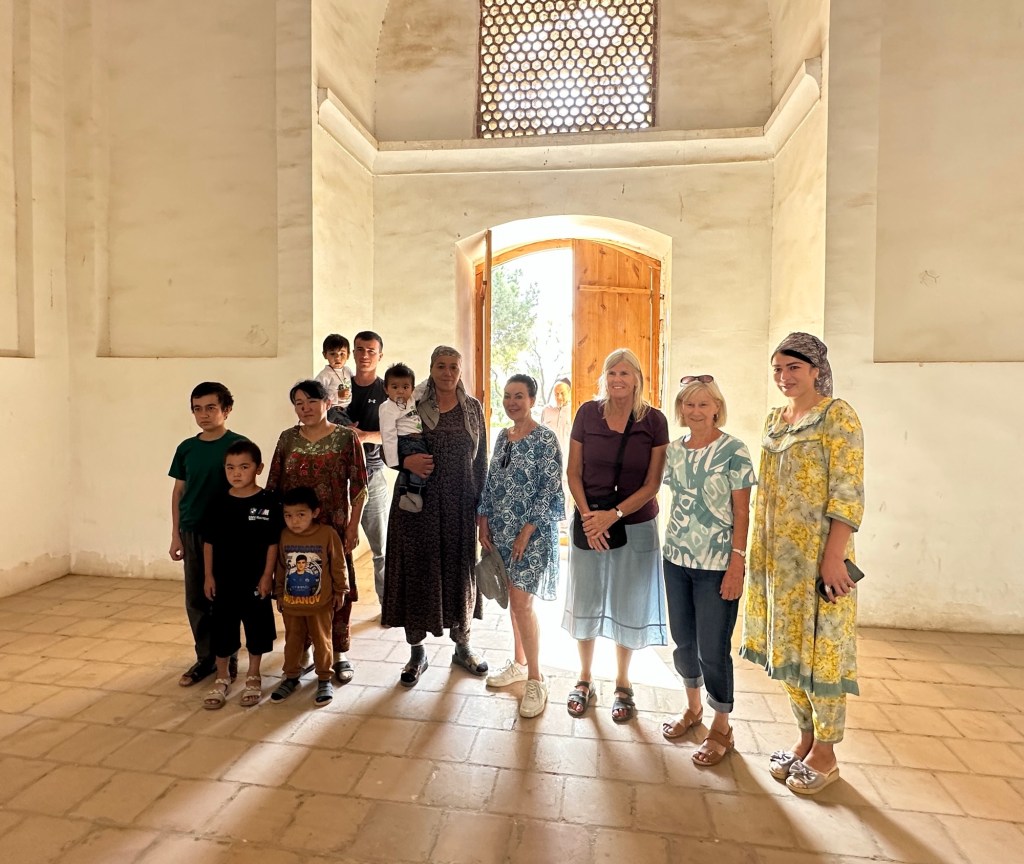
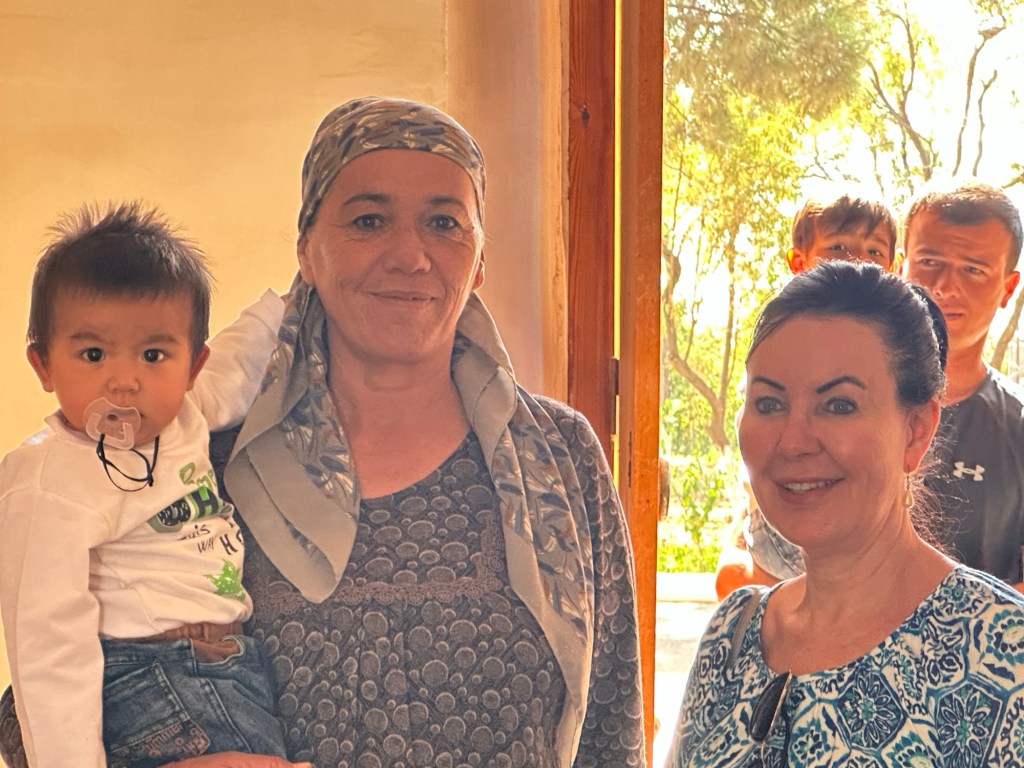
Kokildar Ata House, a 16th century architectural monument was a large building with many rooms. It turned out we were the main attraction here – a family group who came to visit was very keen to get their photo taken with us!
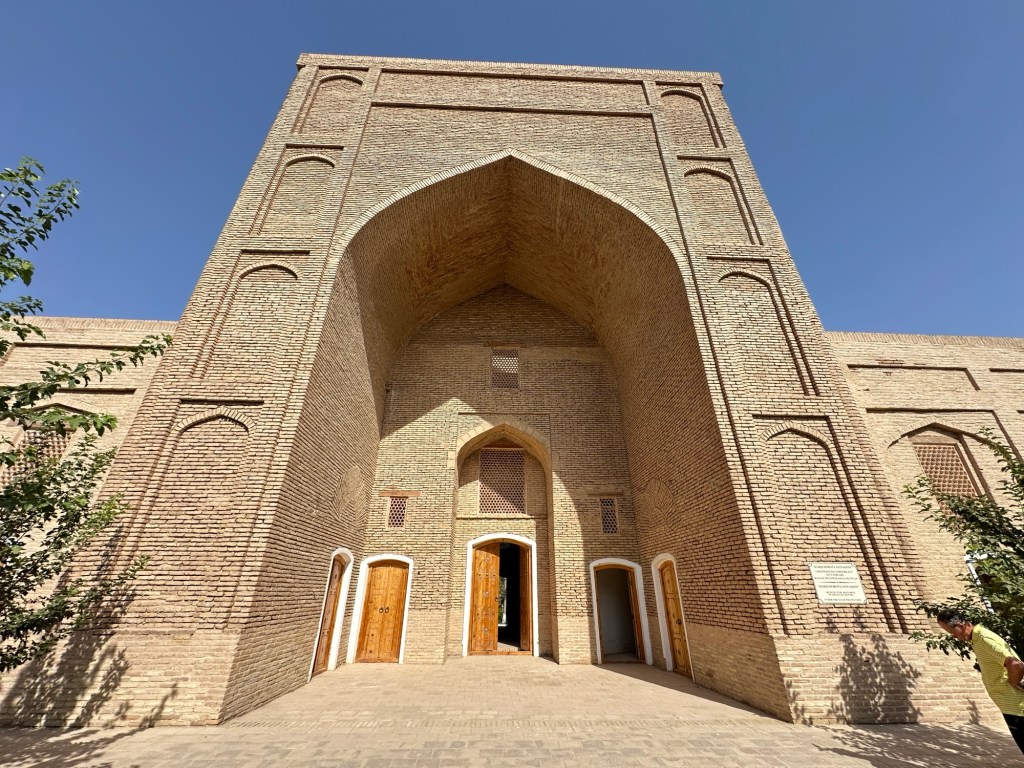
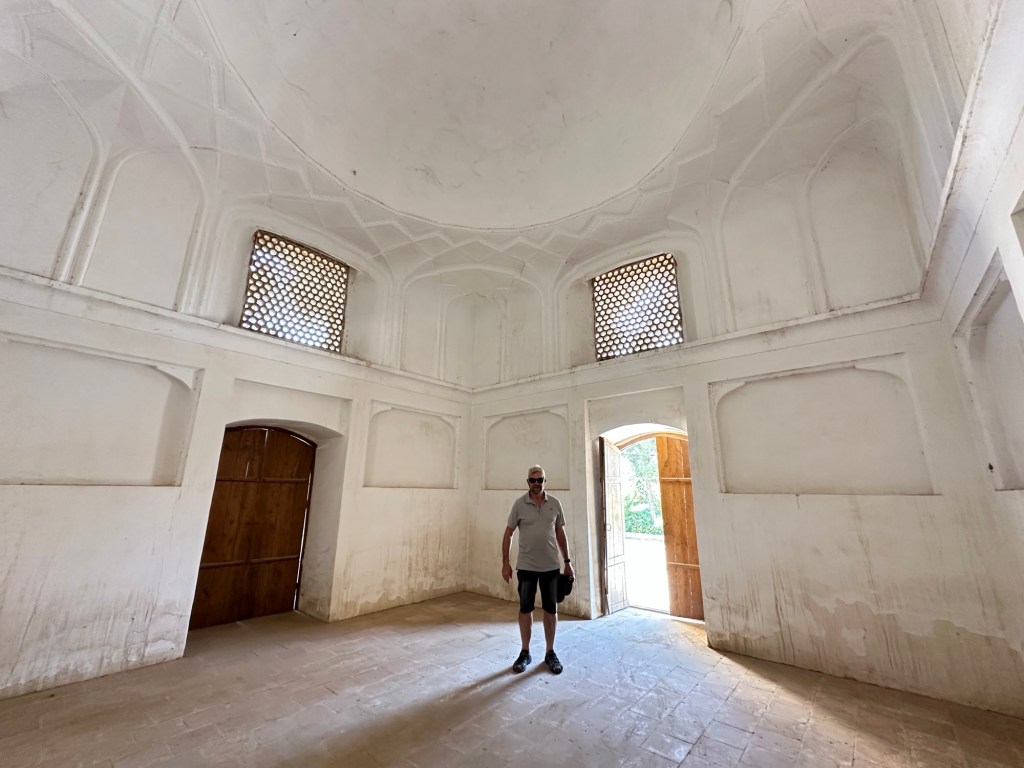
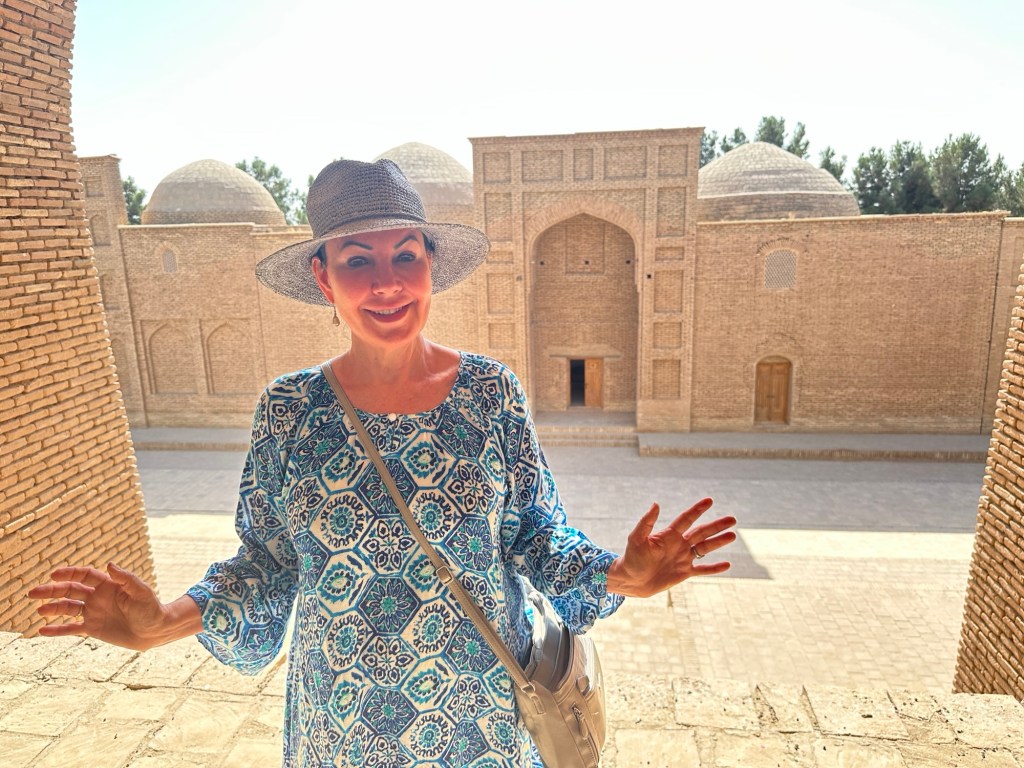
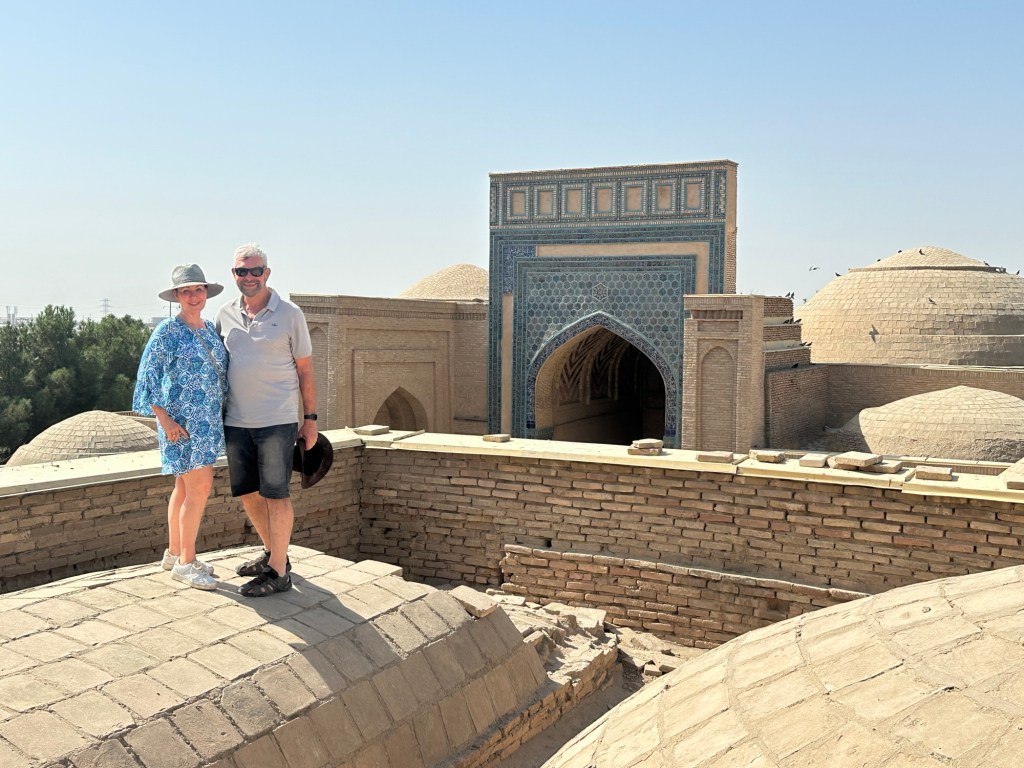
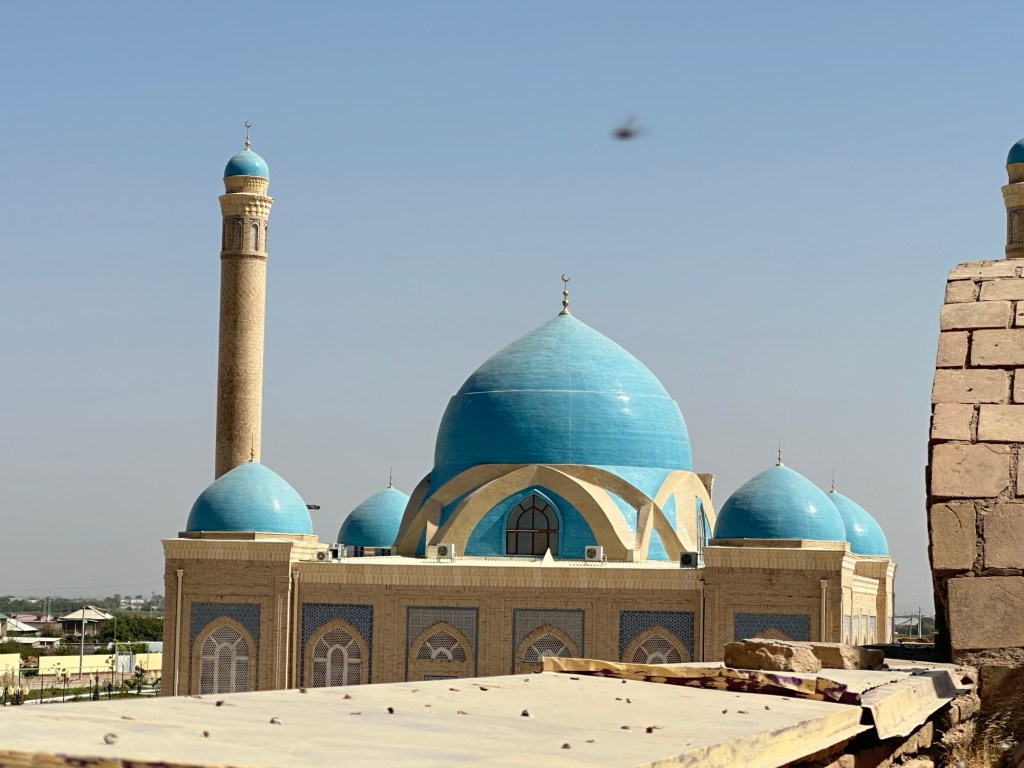
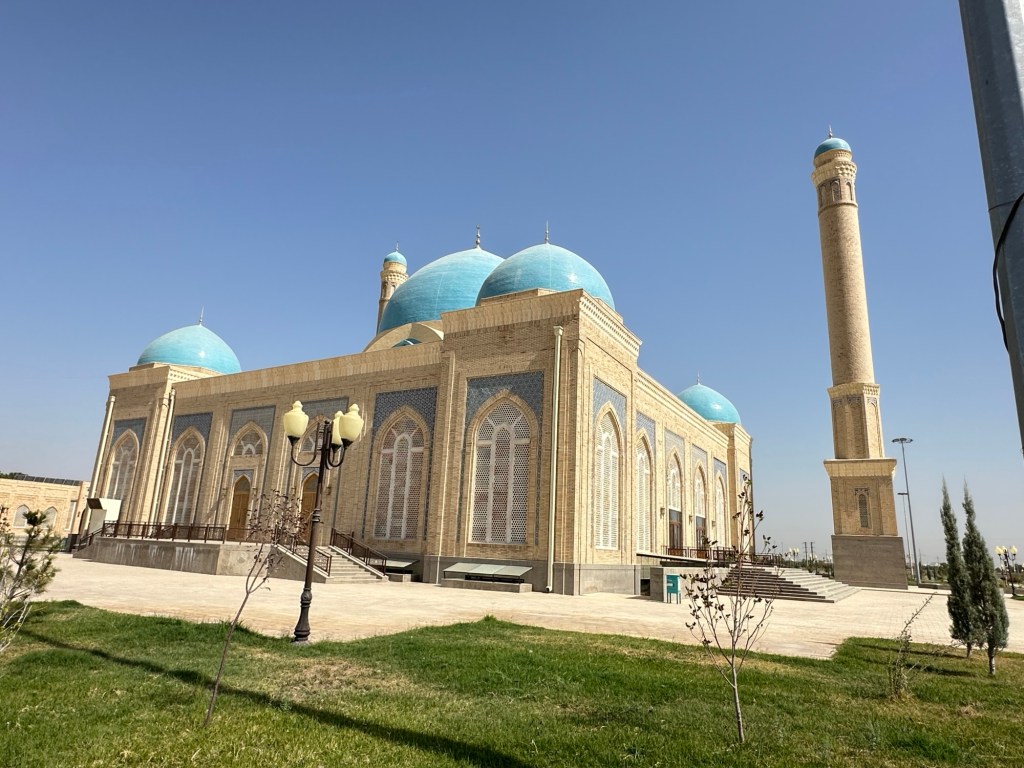
The Sultan Saodat complex is a group of mausoleum buildings with burials of representatives of the Termez Sayyid family (X-XVII centuries). Our guide had us clambering up some precarious steps to the rooftop of one of the buildings. “Maximum sit down “ he kept telling us so we didn’t bump our heads! Also some remnants of an Afghanistan mosque here.
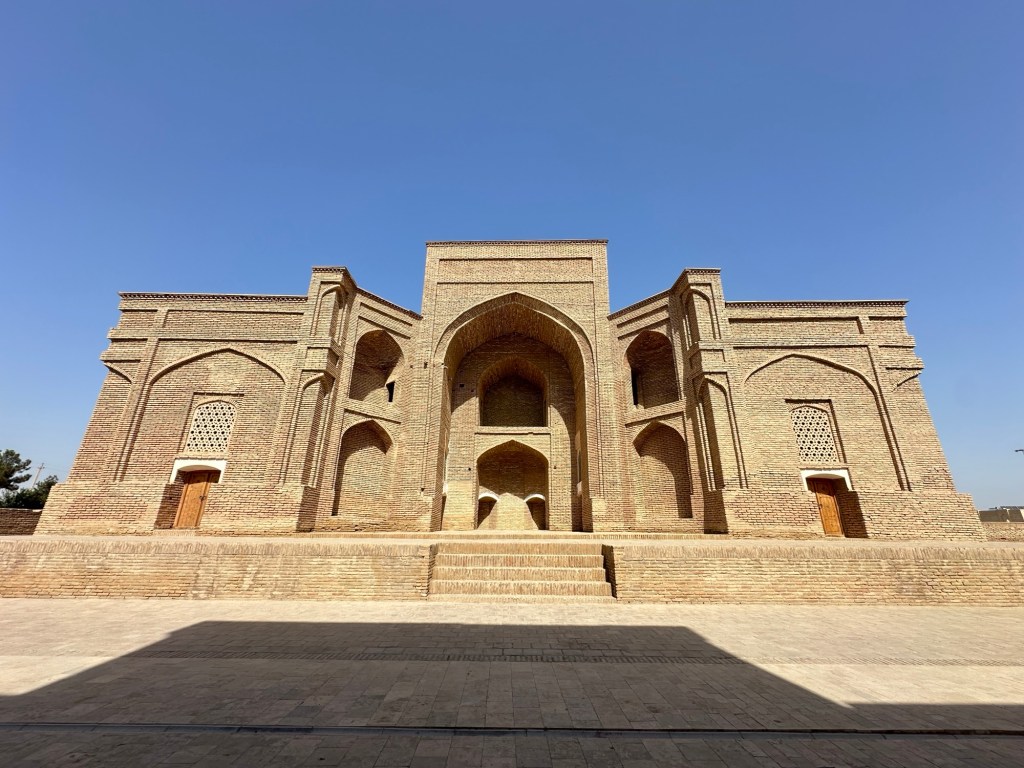
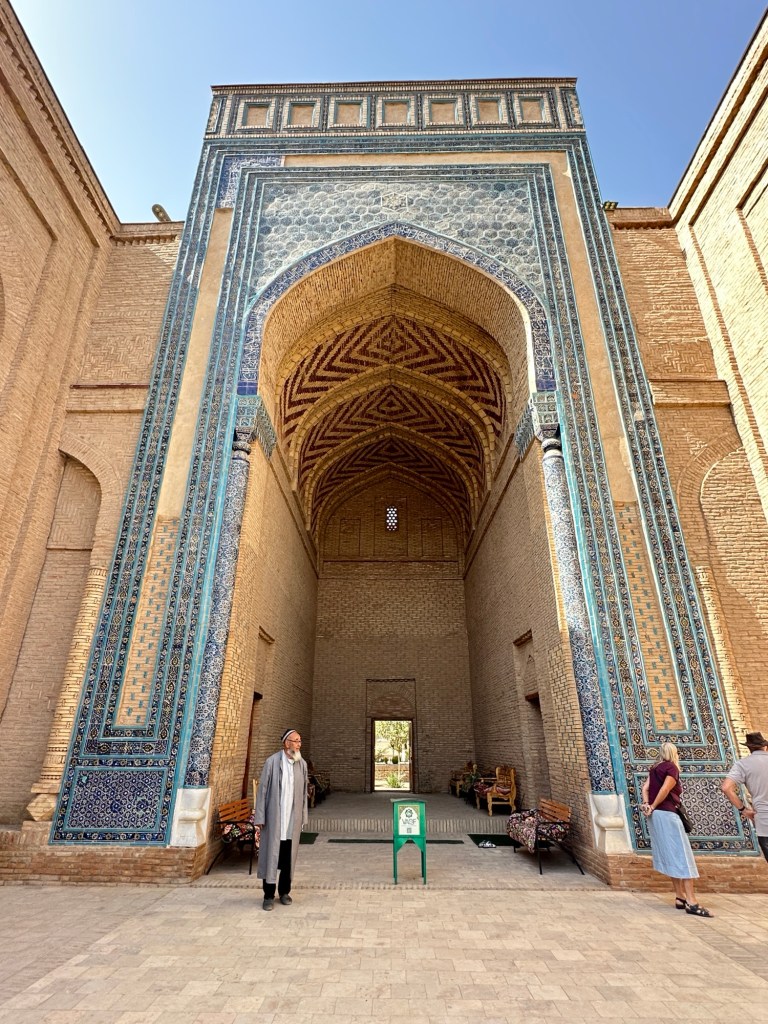
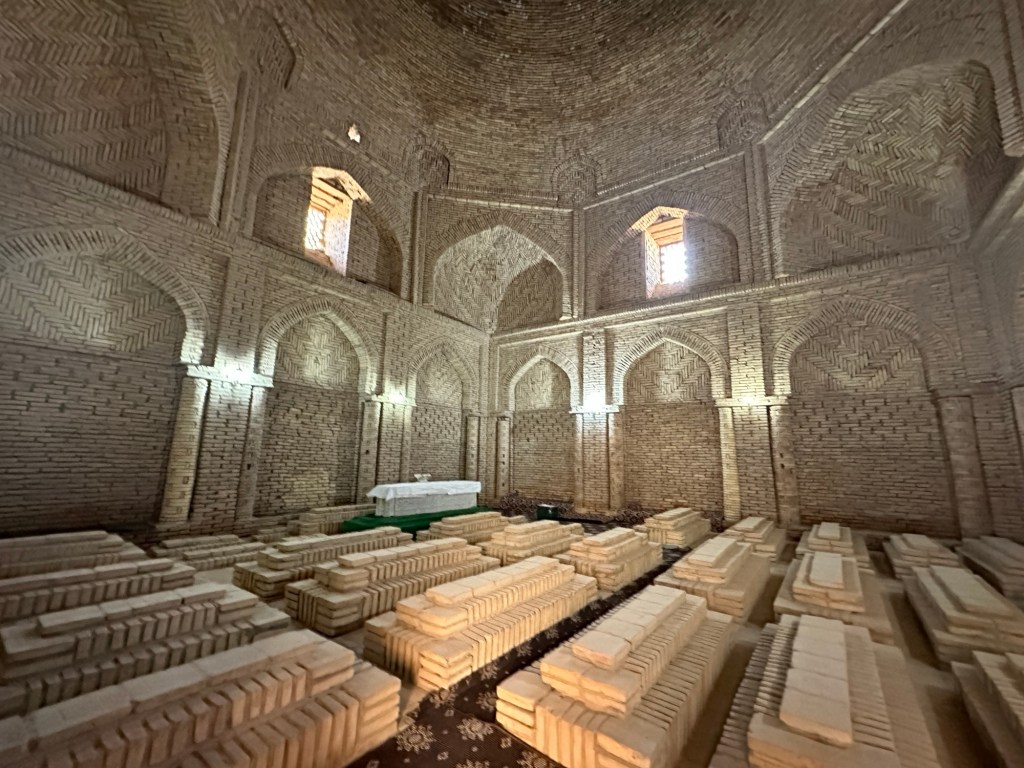
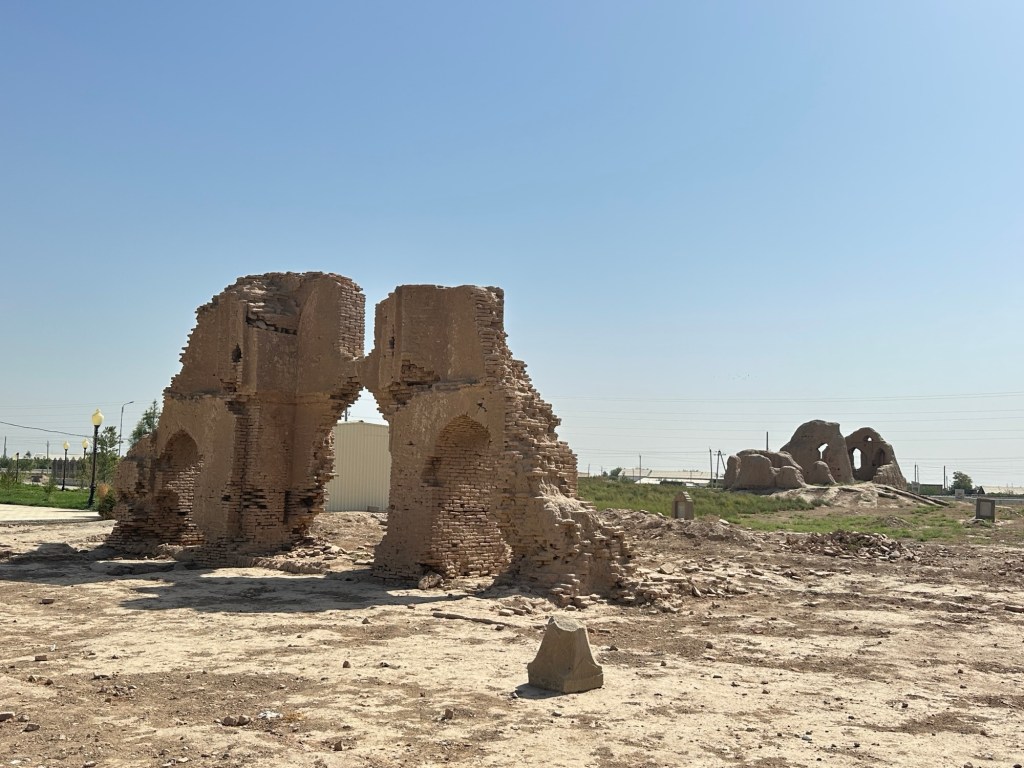
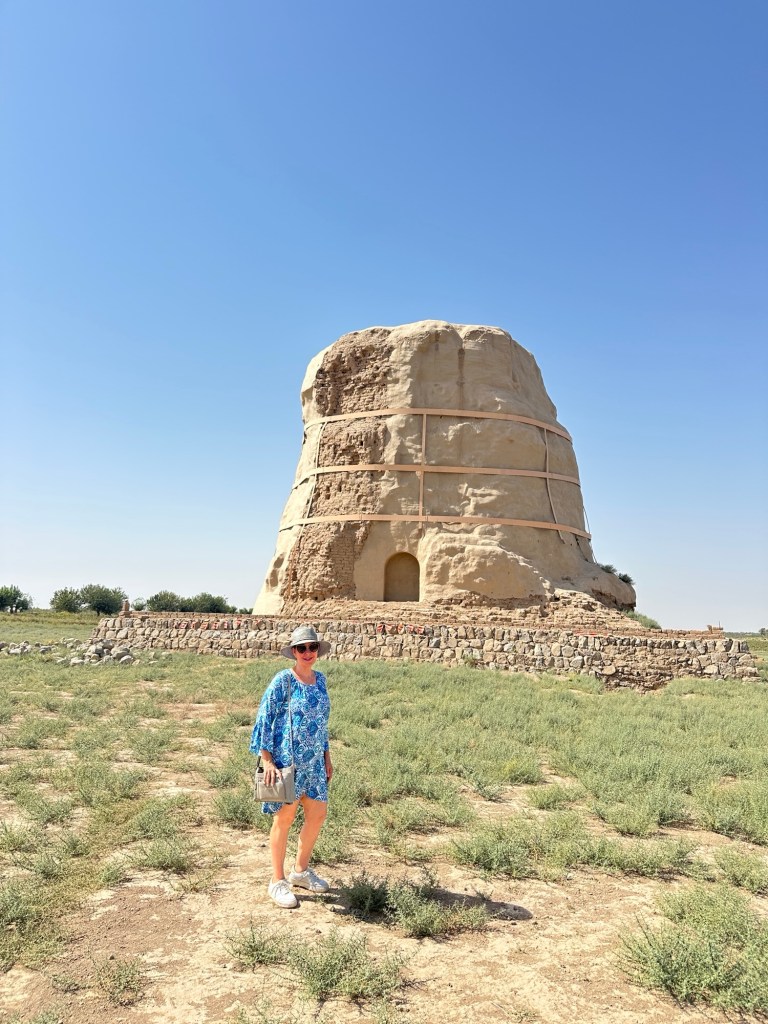
Zurmala Buddhist Stupa was the first Buddhist monument discovered in Central Asia at the beginning of the 20th century. The stupa is built of square mud bricks. All bricks have a characteristic mark in the form of a line and two holes. Such bricks were used in Bactria only during the Kushan period, i.e. in the 2nd century AD. The Stupa symbolises the death of the Buddha and his burial.
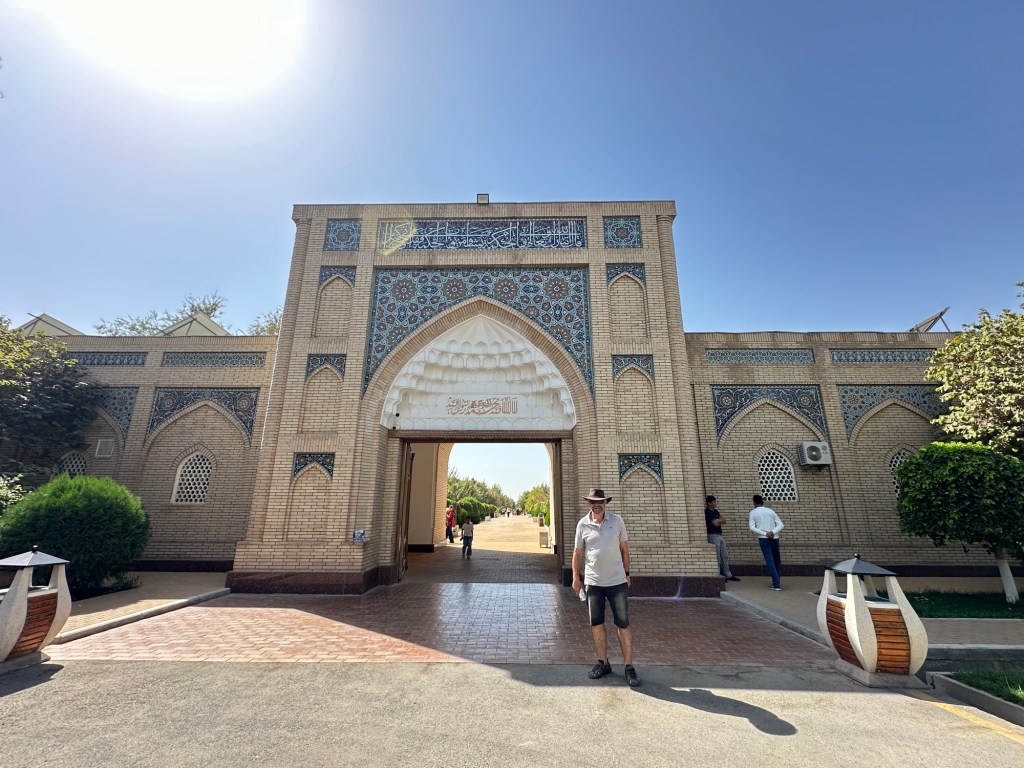
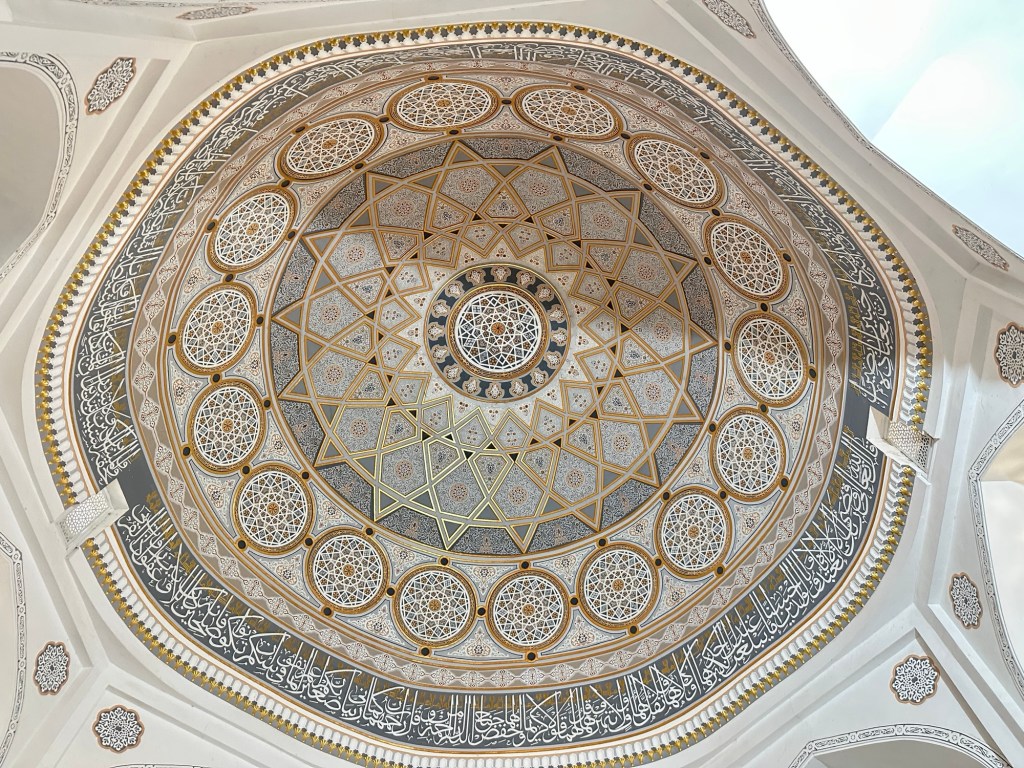
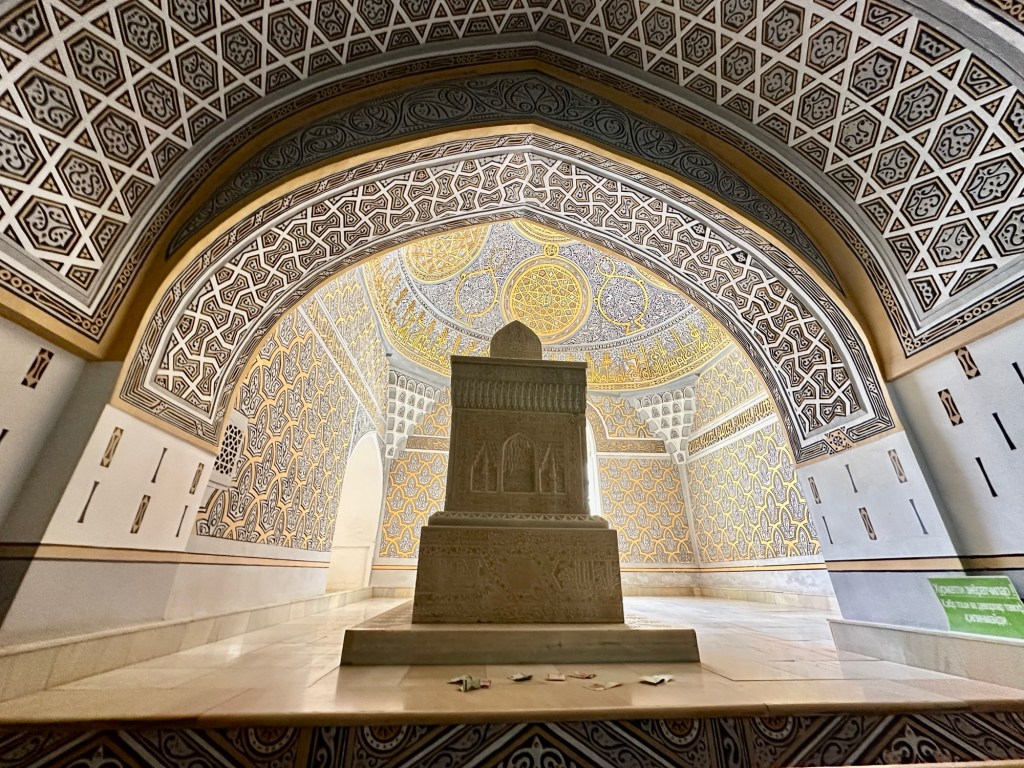
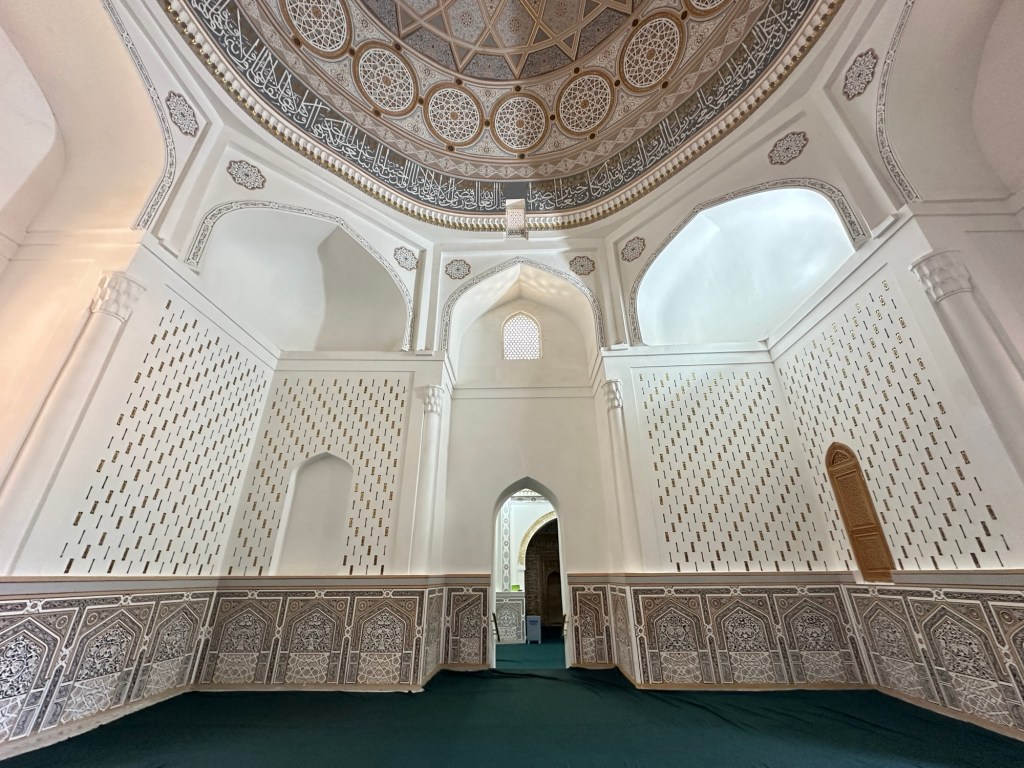
The Al-Hakim at-Termiziy complex next. The memorial monument (IX-XV centuries) is associated with the name of Abu Abdallah Muhammad ibn Ali al-Hakim at-Termizi (IX century). The complex includes a mosque, a mausoleum, a khanaka (a Sufi monastery, originally modest shelters for dervishes, but then turned into lavish entire complexes), and a room for reading the Koran. A magnificent white marble tombstone was installed over the Sufi’s grave. The gardens are beautiful, and offered a reprieve from the scorching heat.
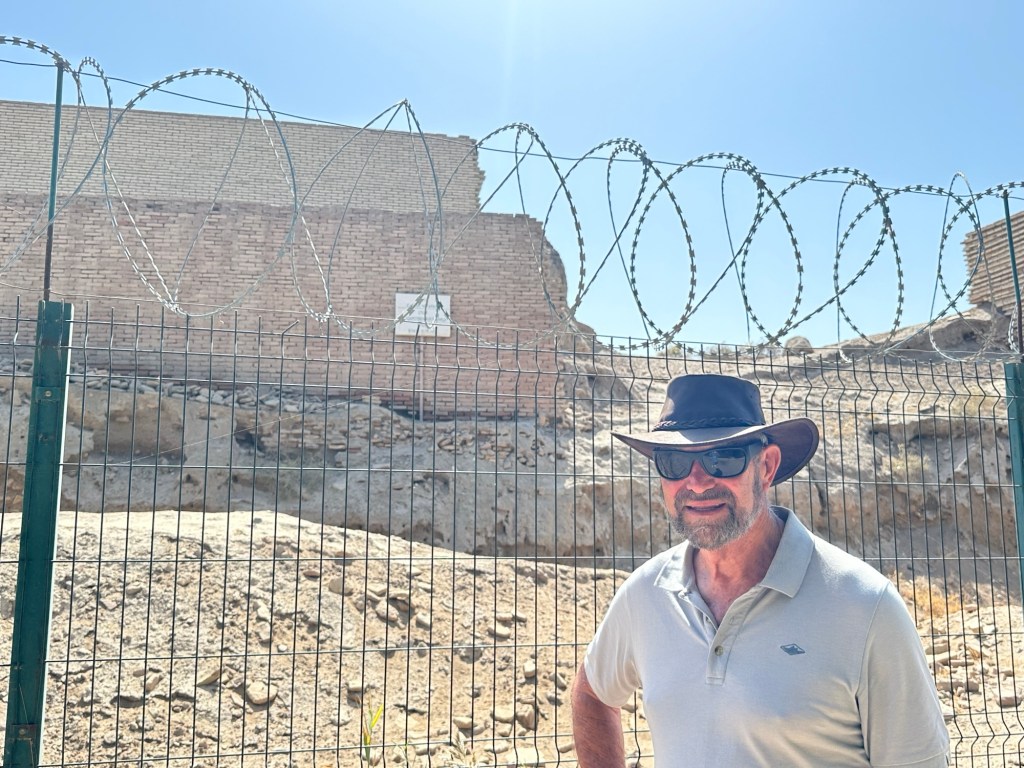
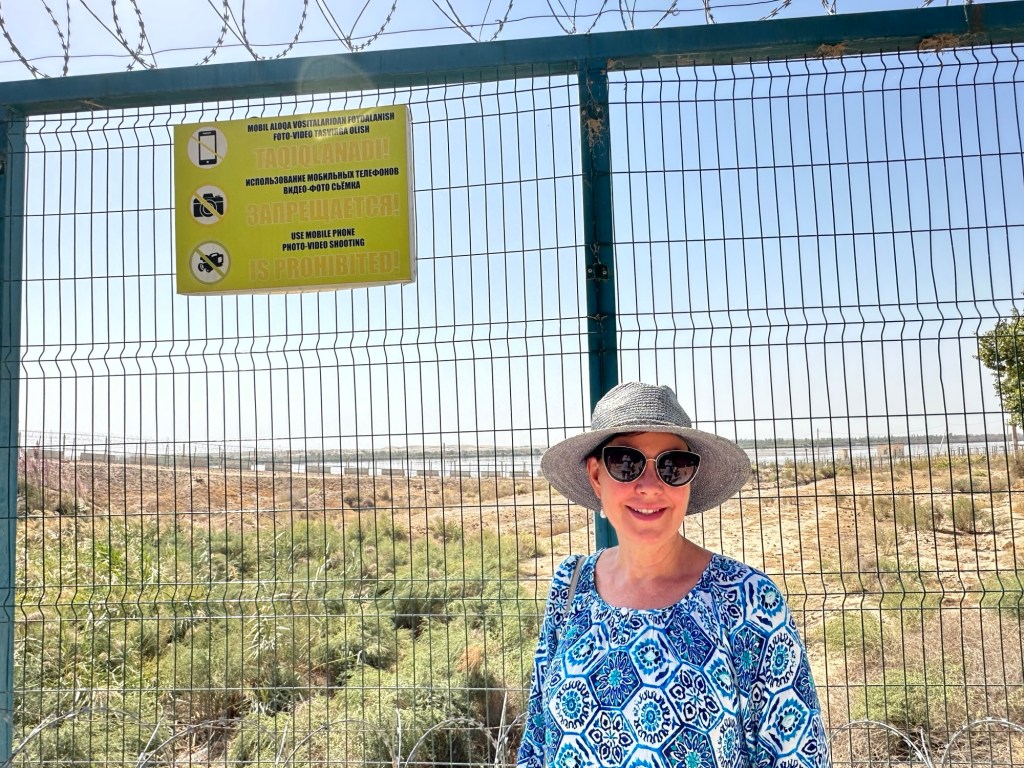
Behind the complex was the Afghanistan border. We could peer through the barbed wire fencing and see the forbidden land.
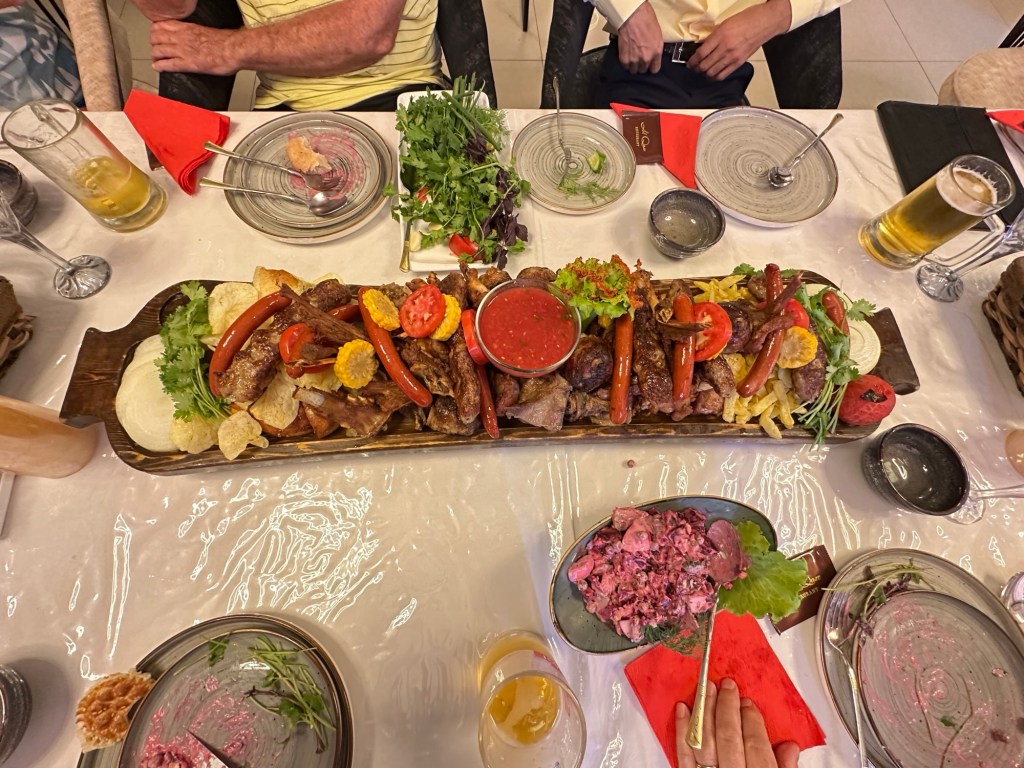
Lunch at a local restaurant, and a chance to escape the oppressive heat. Our guide ordered a traditional lunch for us… I’m not sure what army he was feeding but the biggest plate of barbecued meat soon appeared on the table. Lamb, beef, chicken, sausage, rissoles, vegetables, plus beetroot and green salads – we got through about a quarter of it! We told him to take the rest home for his family. I’m sure that would have fed them for the next week!
More archeological sites after lunch – the first showed evidence of 6th-5th century BC ancient Persian civilisation. Alexander the Great was defeated twice here.
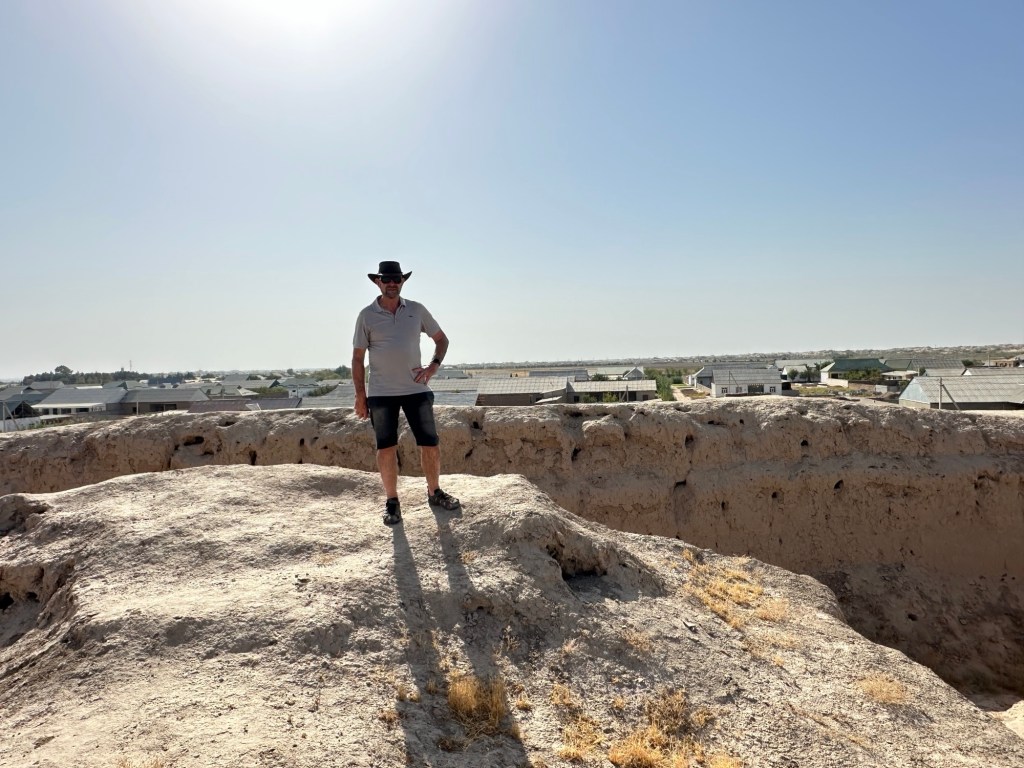
Karatepa and Faroztepa Buddhist monasteries were built on a natural hill occupying an area of 8 hectares. Consisting of onground and underground cave constructions, they were formed in the mid Ist Century AD and regularly existed until 4th Century AD. During excavations, Buddha, Bodhistva and other personages that were related to Buddhism were found.
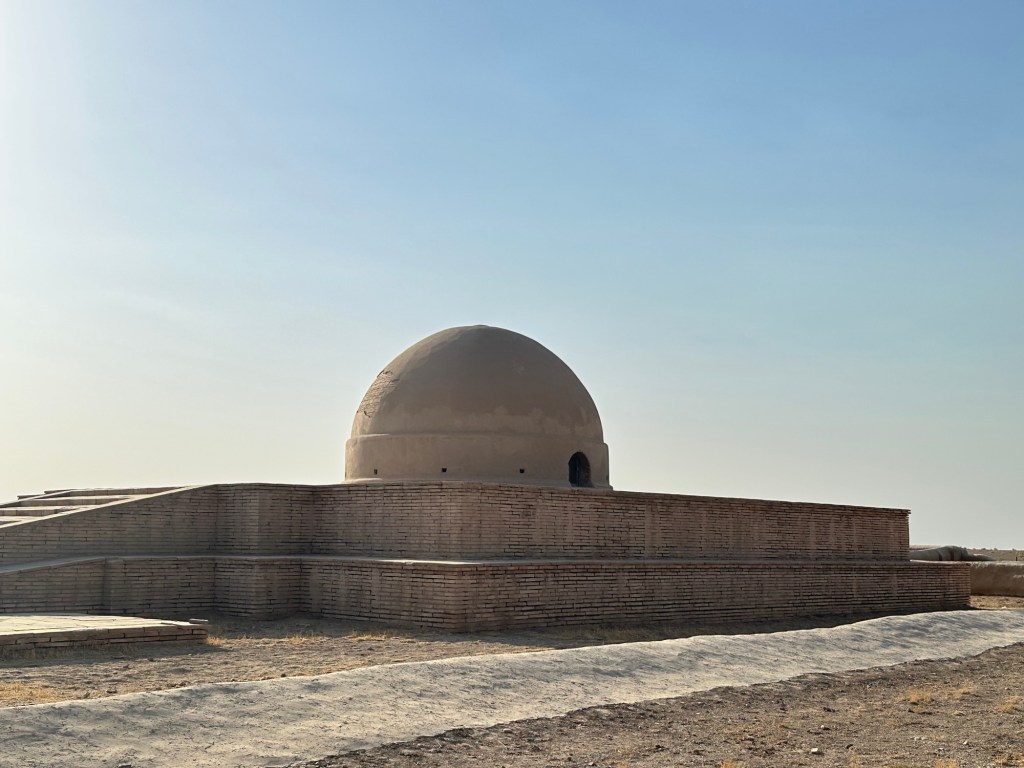
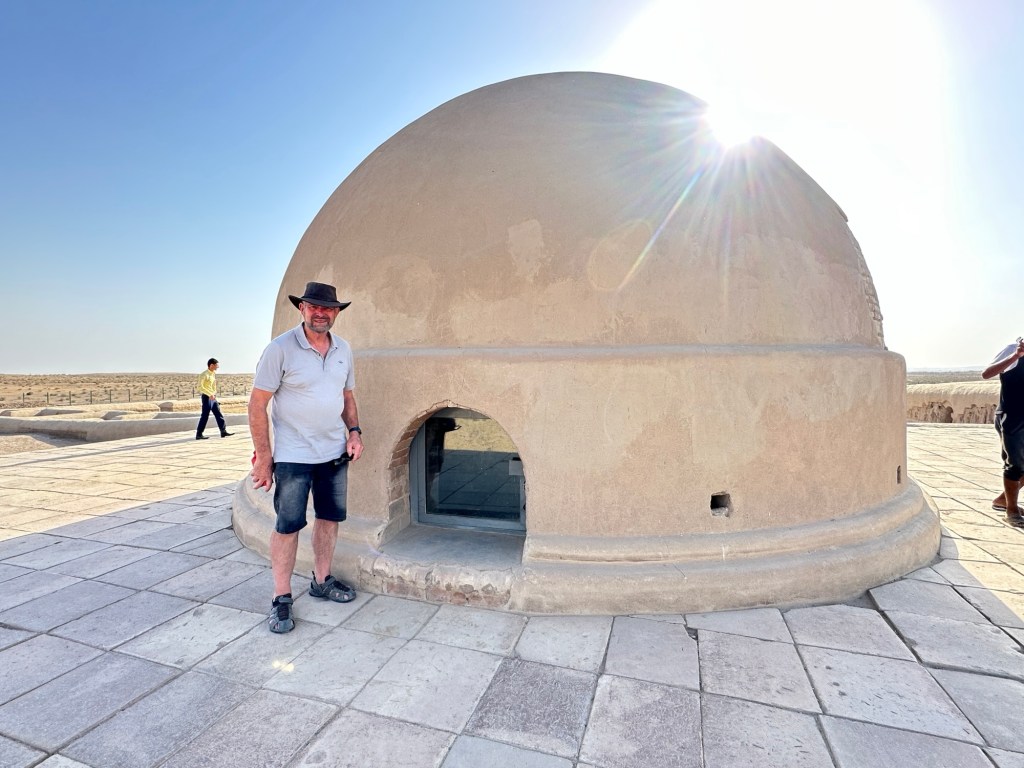
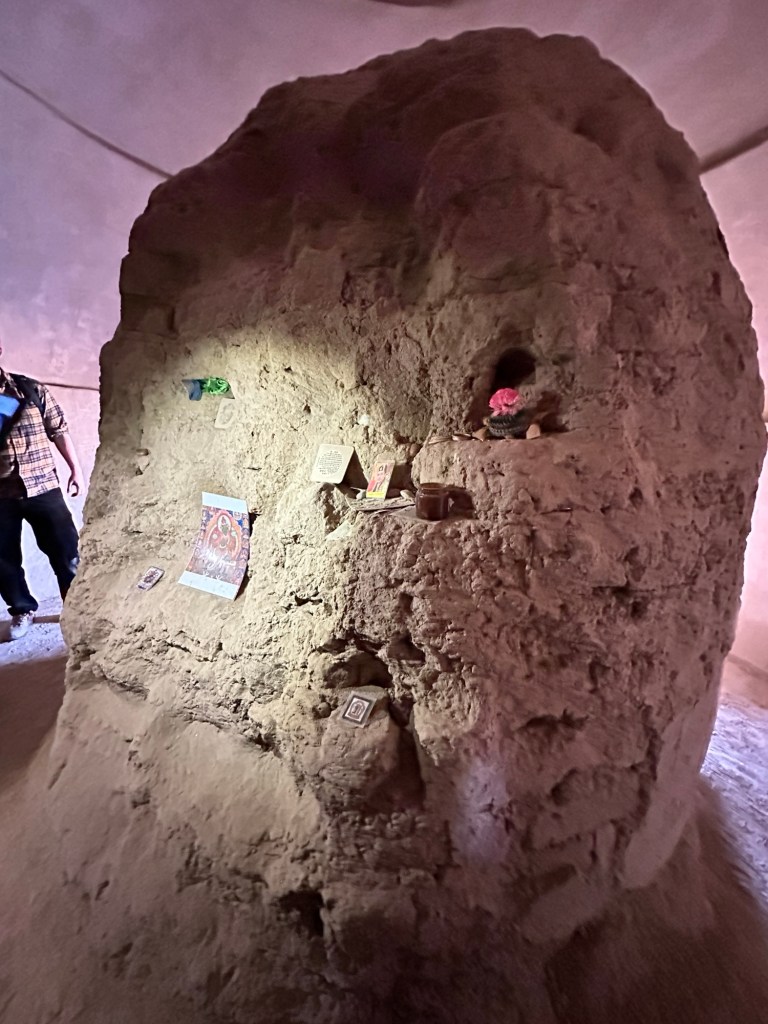
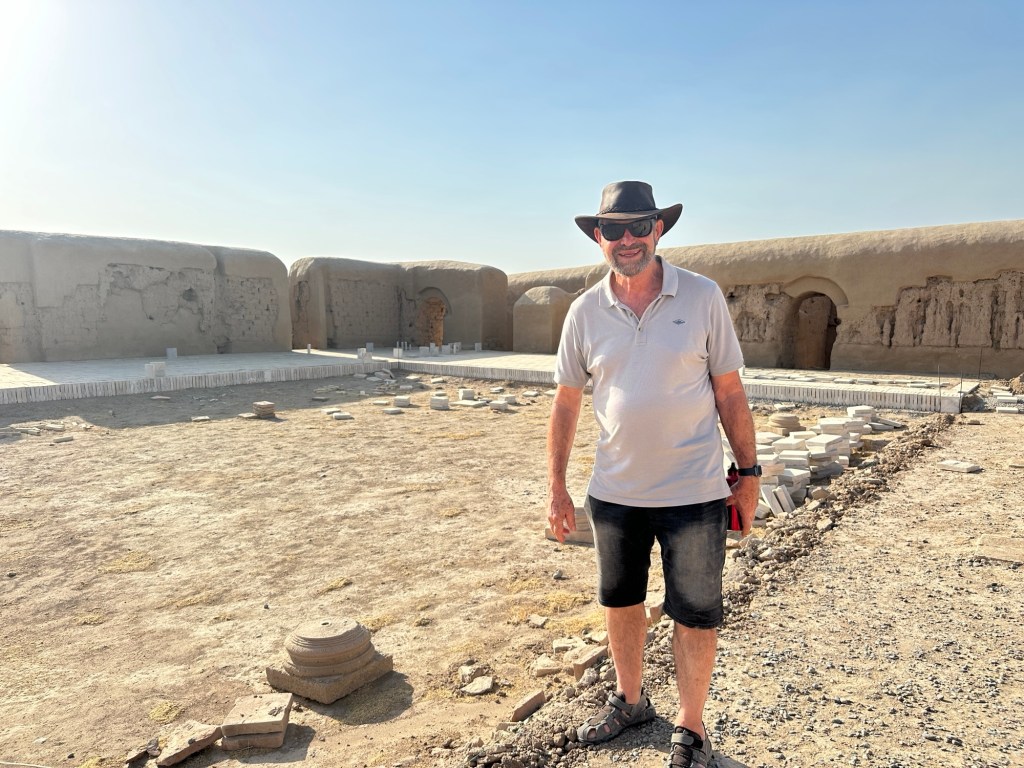
Karatepa also contained remnants of Greek occupancy. Russians trained around there during their war with Afghanistan.
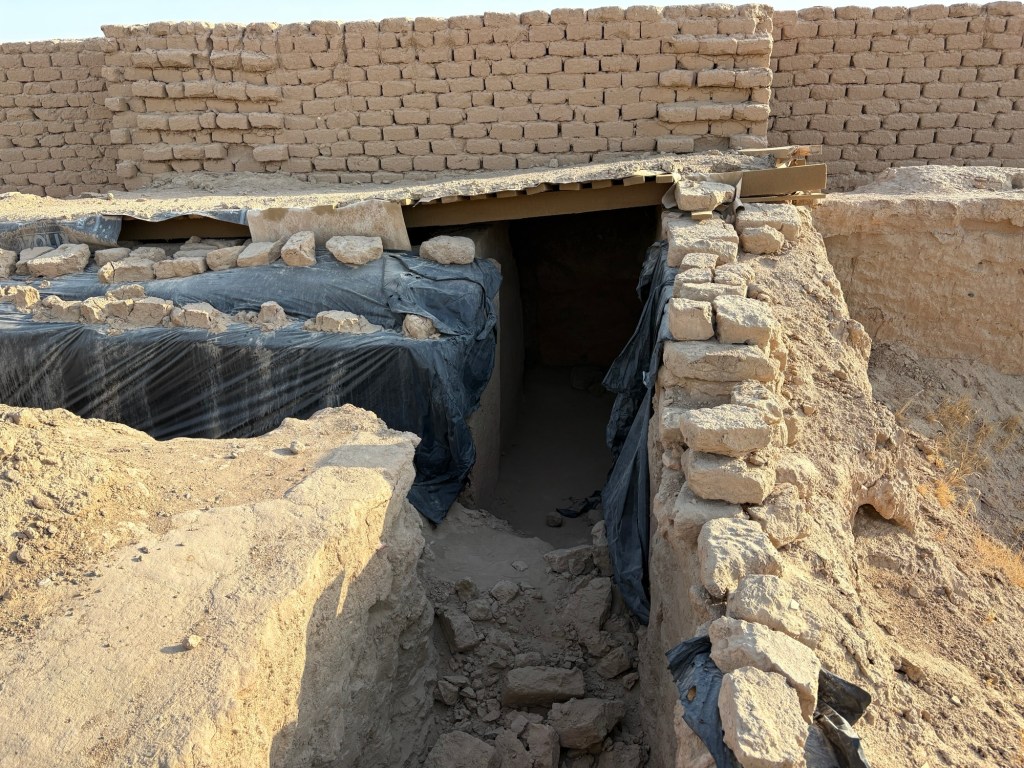
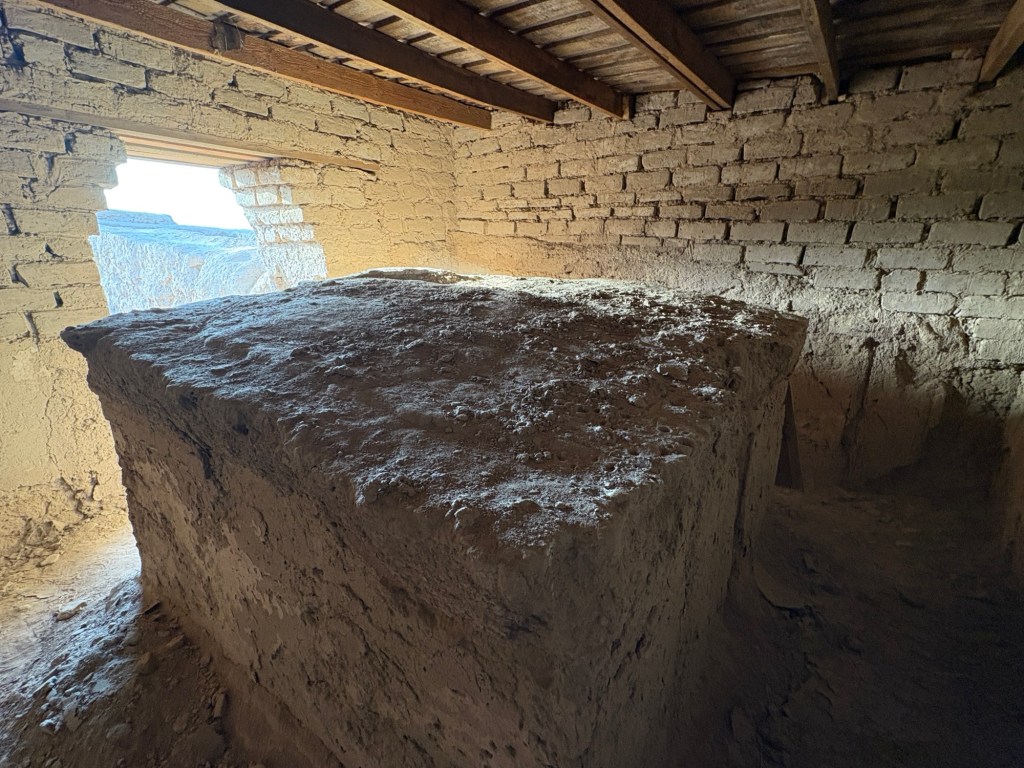
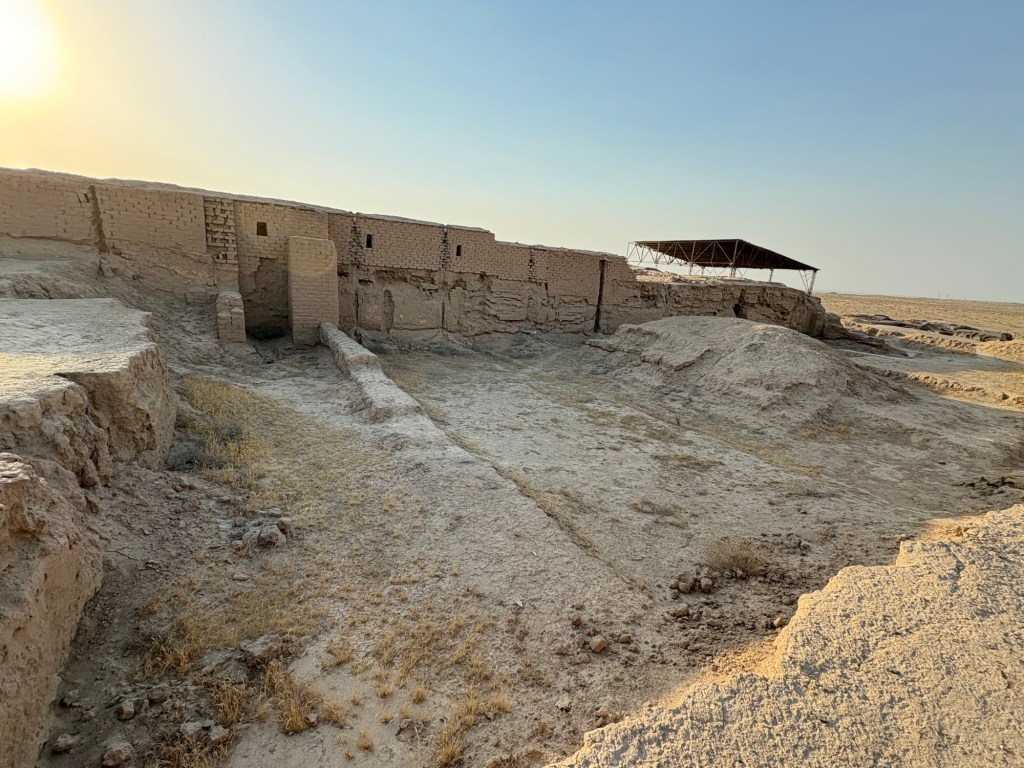
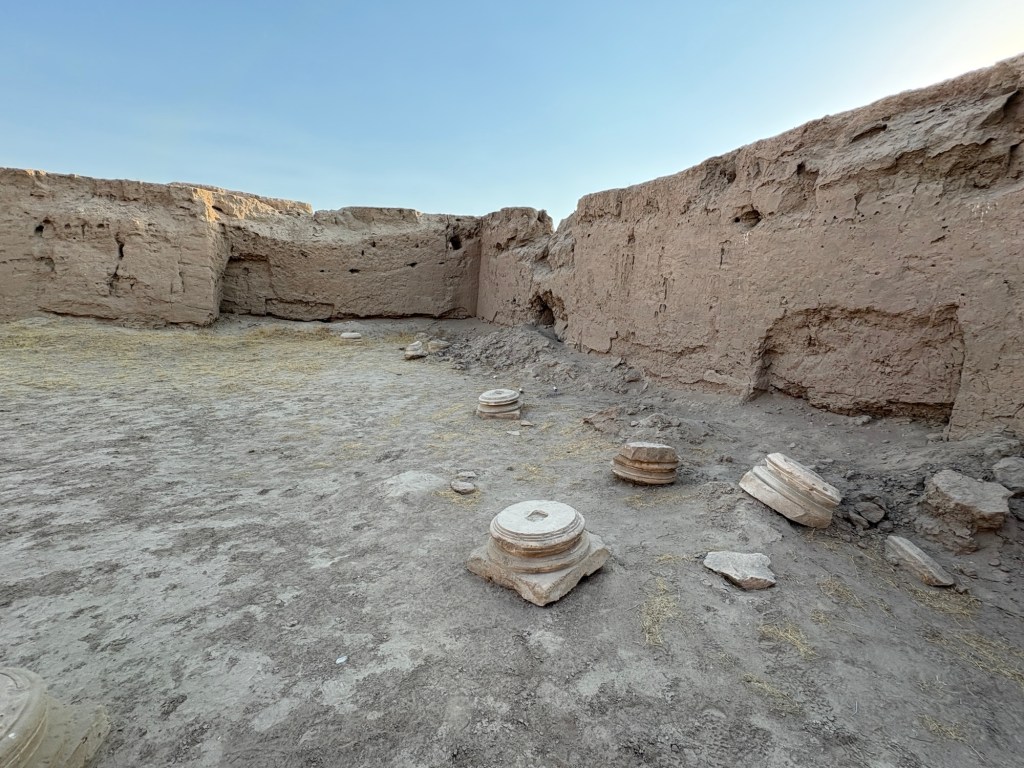
Back to the hotel – first to clean up and cool off! We were so hot and dusty! No dinner required after our feast at lunch time! Just a cleansing ale! A couple of Sarbast hit the spot – just took a while to procure them. Only place to purchase alcohol is at the Alco Mart which are few and far between. Eventually found one. Only beer and vodka to purchase, plus a few dusty bottles of wine, and going on the wine so far… not worth the risk! The beer was $1.50 per can.
Day 19
Monday 29th September
Termez to Dushanbe
15-29 degrees, sunny
Pick up was at 8am for the three and a half hour drive to the Uzbek-Tajik border. Border formalities were fairly straight forward, it was just the 400 metre walk in the heat, up a hill to get through the process that was arduous.
Interesting facts about Uzbekistan
Population 35 million
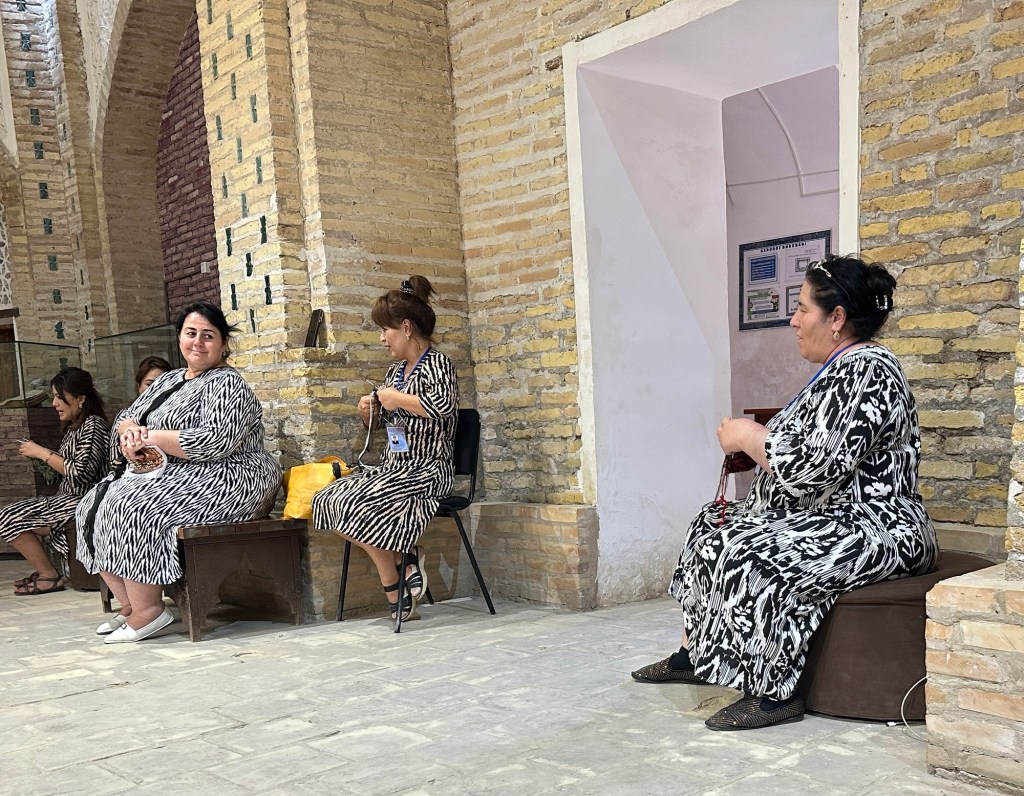
The people are so lovely, very friendly and always willing to help. Male Uzbeks everywhere wear the doppi skullcap with pride, and the elders, known respectfully as aksakal or “white beards”, still wear the striped cloaks known as a khalat or chapan. The women of the region are a riot of colour, dressed in shimmering long dresses or pant suits, and often sporting mouthfuls of gold teeth.
The cities are exceptionally clean and very safe.
Cars – the majority of cars are Chevrolets, made here. The traffic is bedlam, no one seems to adhere to the lanes, but there doesn’t appear to be too much road rage or horn beeping.
Currency is the Som – 8100 Som to $1 AUD.
90% of the population are Muslims, mostly Sunni. The women don’t wear any head coverings.
The main dish of all cities of Uzbekistan is pilaf (or plov as they call it). Traveling across the regions of the country, we were surprised at how many different types of this dish are being prepared. In every city, people are convinced that pilaf of their region is the best in the country!
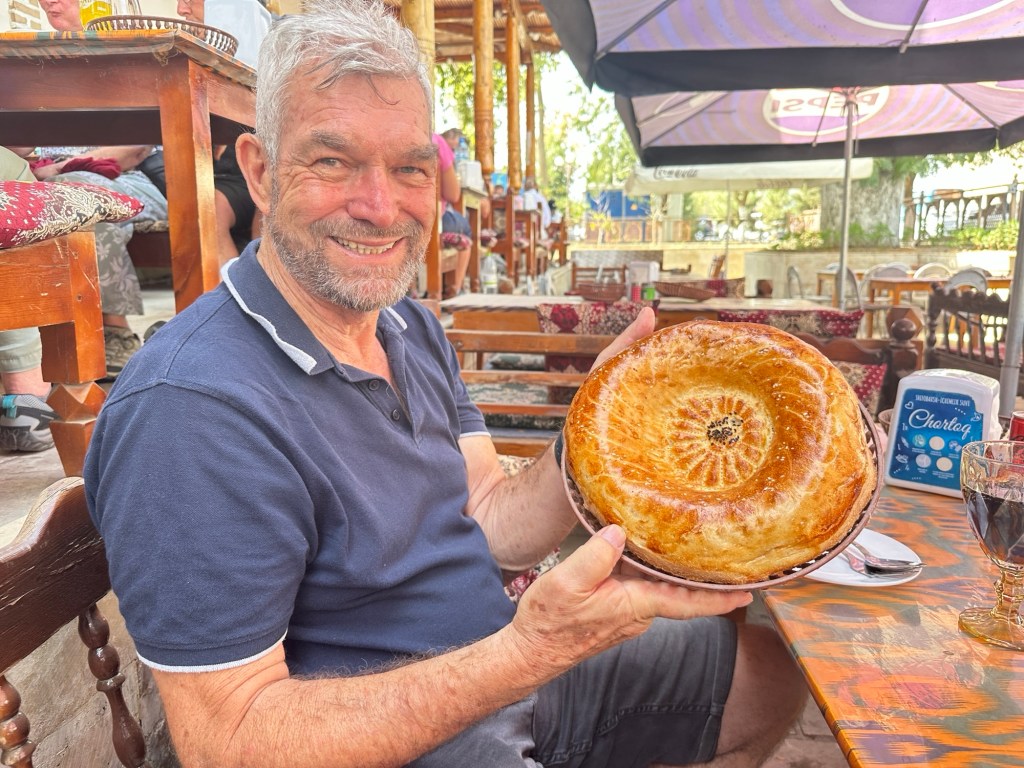
Accompanying most meals is obi non, a style of bread that’s freshly made in a clay oven, then stamped and decorated with a spiky tool that can be picked up at any given souvenir stand.
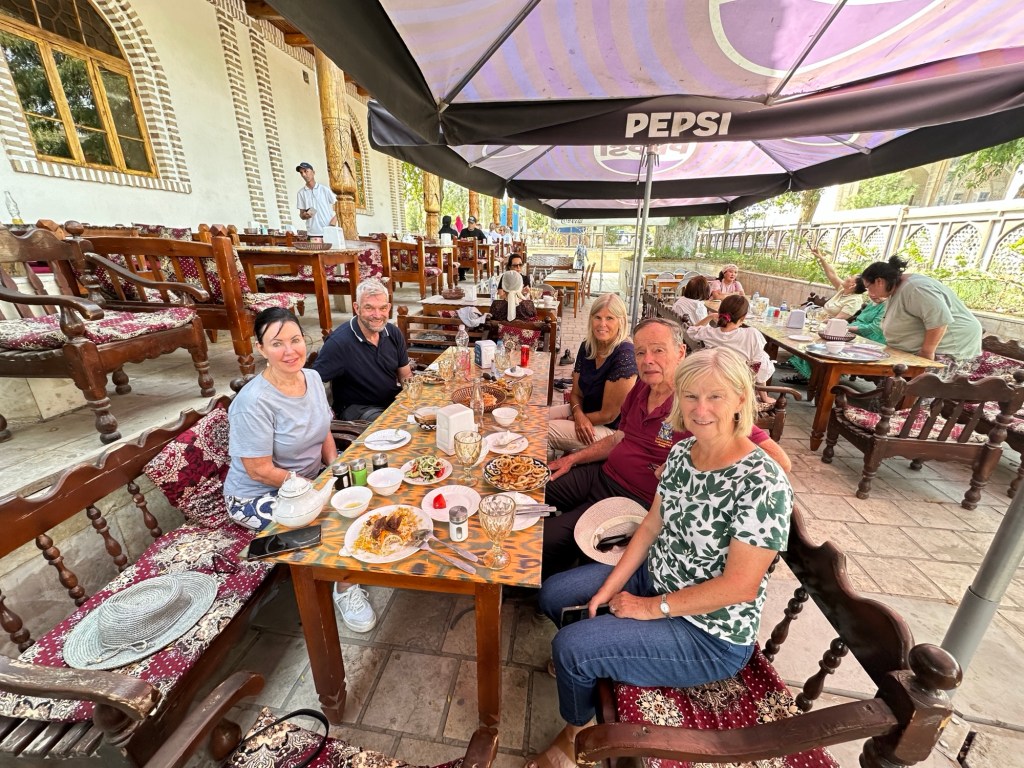
Because drinking alcohol is not common practice in Uzbekistan, tea is at the hub of the community’s social life. A chaikhana is to the Uzbeks, is what a pub is to the British. Seats are generally on a tapchan, or “tea bed”, with a low table placed on it. Green tea is the norm and shashlyk (kebabs) and local bread are generally available.
 Glammy Goes Global