
Day 1
Thursday 28th March 2024
Brisbane to Stanthorpe
Big day – packing, picking up the van, sorting out the ball weight – and finally on the road. Once out of Brisbane, the traffic was minimal- it was the opposite on the coast roads. Typical Easter Thursday traffic.
Nice night in Stanthorpe- it’s always lovely to see the family. The kids were both excited to be on school holidays. Jackson had a little drama just before dinner – slipped on the bath mat, hit the wall, and the next minute had blood pouring from his nose. Lucky he didn’t break it.
We appreciated the cool change – a pleasant 15 degrees overnight.
Day 2
Friday 29th March 2024 (Good Friday)
Stanthorpe to Lightning Ridge
14 degrees in Stanthorpe, to a very hot 31 degrees in Lightning Ridge
496 kilometres
We’d left the van hooked up ready for a quick getaway. It was going to be a long day.
Stanthorpe to Yelarbon for a a Quick Look at the silo art which we have seen before, onto Inglewood, then Inglewood to Goondiwindi where we filled up with fuel. That proved interesting. The BP only had high flow diesel in the easy to drive through bays ( those nozzles are too big for our Jeep), and the bays for the other diesel were not easily accessed with a caravan in tow. Lucky we did a walk through before driving in, otherwise we would have quite literally been stuck! Shell to the rescue.

Goondiwindi to Mungindi, with a nice lunch stop alongside the Barwon River. I drove this leg – roads here were good, only passed three cars!
Mungindi to Lightning Ridge – this is where we went wrong. Of this 148 kms stretch, we did 100 kms on rough dirt roads! Someone picked the wrong road! We picked the shortest route, the bitumen road was 28 kms longer. I will be fair and mention there was no dirt road markings on either map we were following.
We made it to Lightning Ridge Holiday Park by 4.30pm. Once unhitched, our first job was to hose down the caravan- it was covered with mud and dirt. Never again is this van going on a dirt road!
A unique and historic opal mining town in Outback NSW, Lightning Ridge is famed for its rare black opal, mining history and colourful locals.
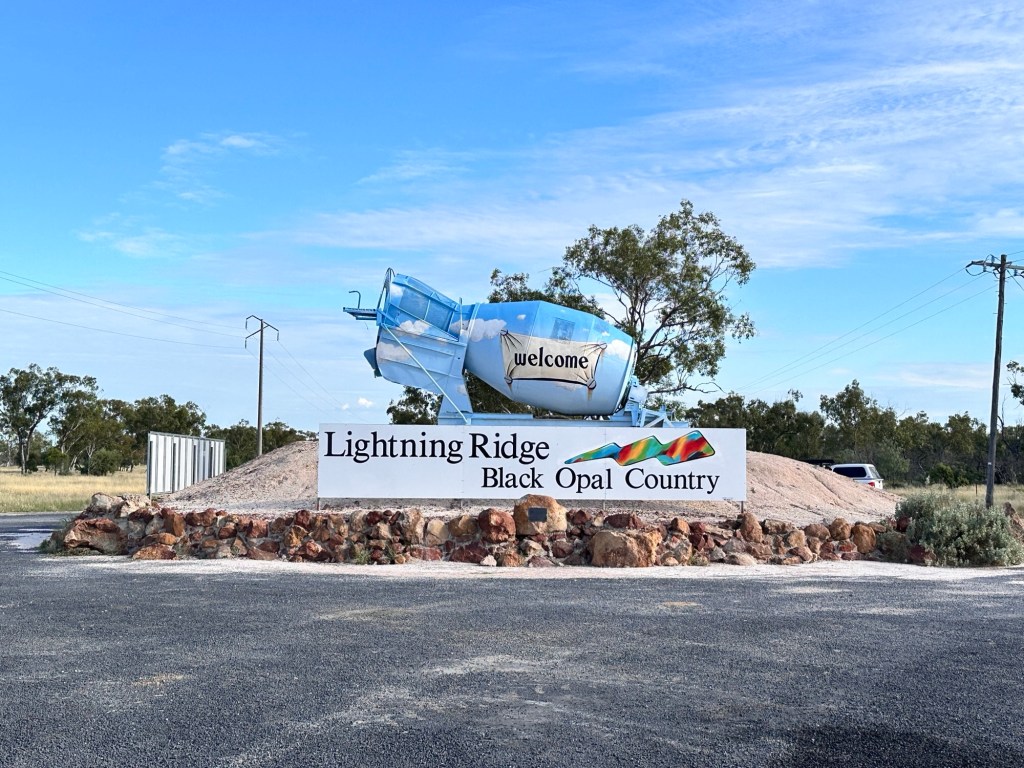
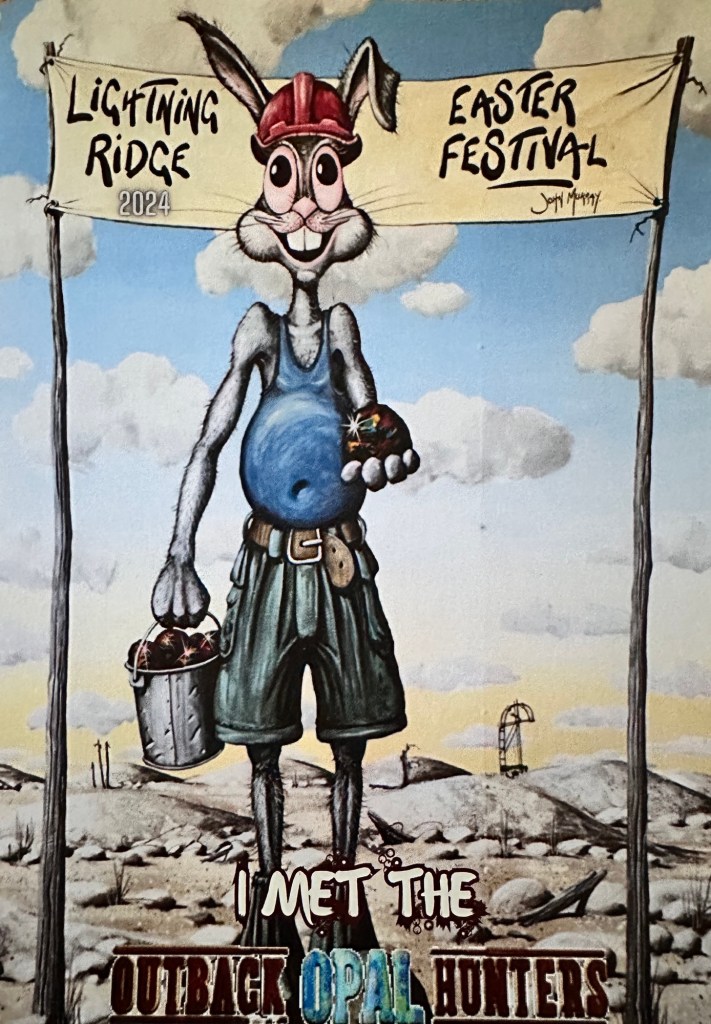


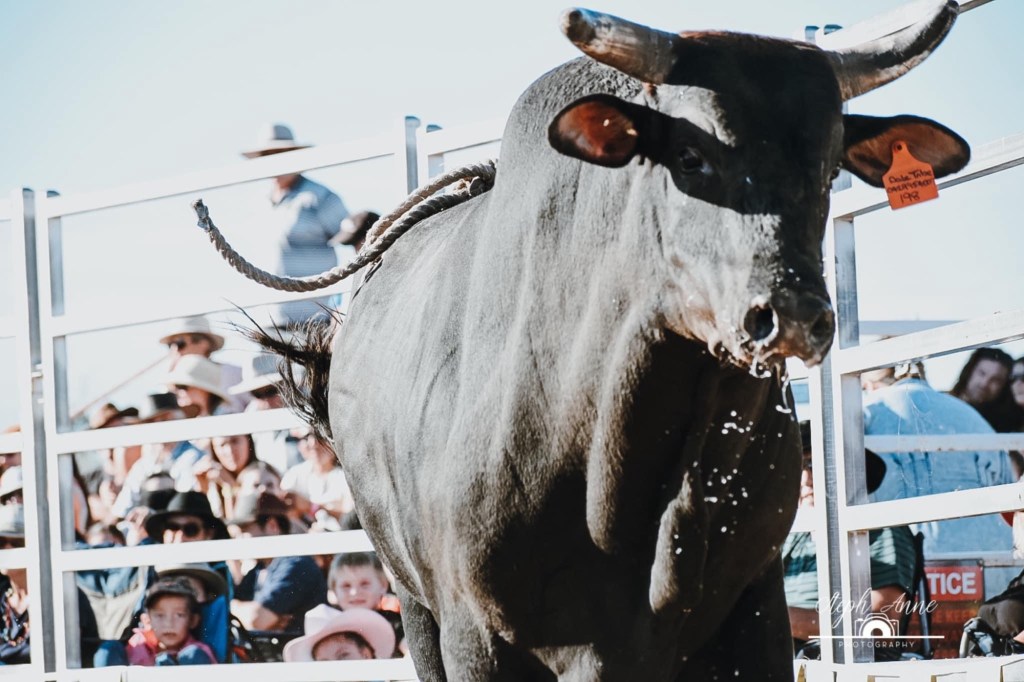
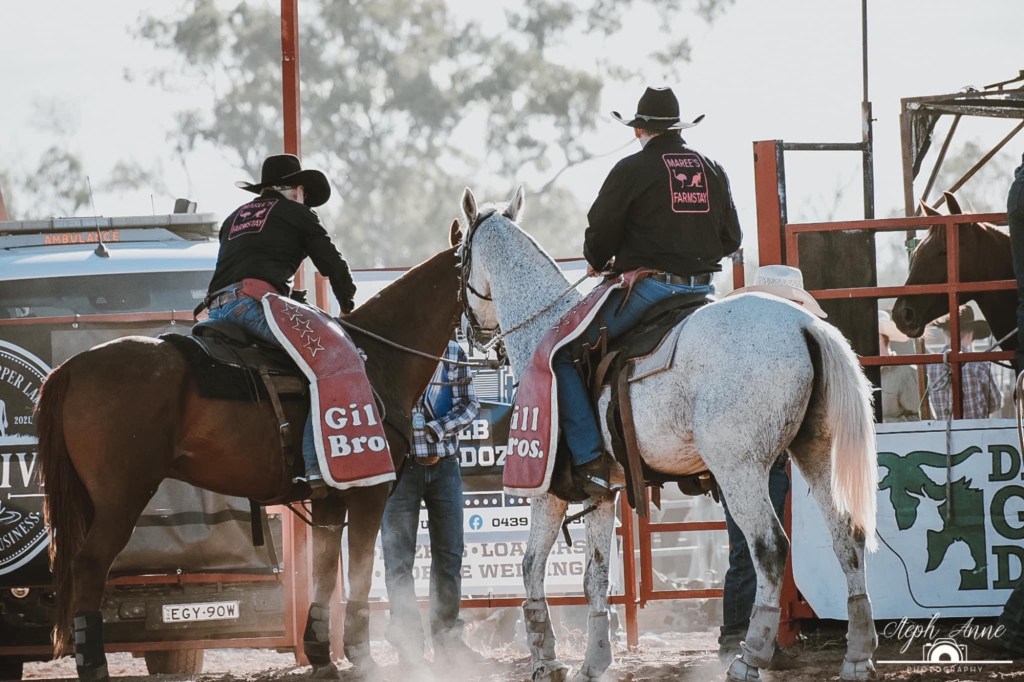
The Black Opal Bull and Bronc Ride kicked off the 2024 Easter Festival. There were some exceptional rides by both junior and experienced riders. There was also a lot of dust!! Plenty of food vans (we had some delicious smoked meat), some great entertainment including a band plus the mechanical bull ride, made for a fun night for all the locals and tourists.


Day 3
Saturday 30th March 2024
Lightning Ridge
20-32 degrees, very hot ++
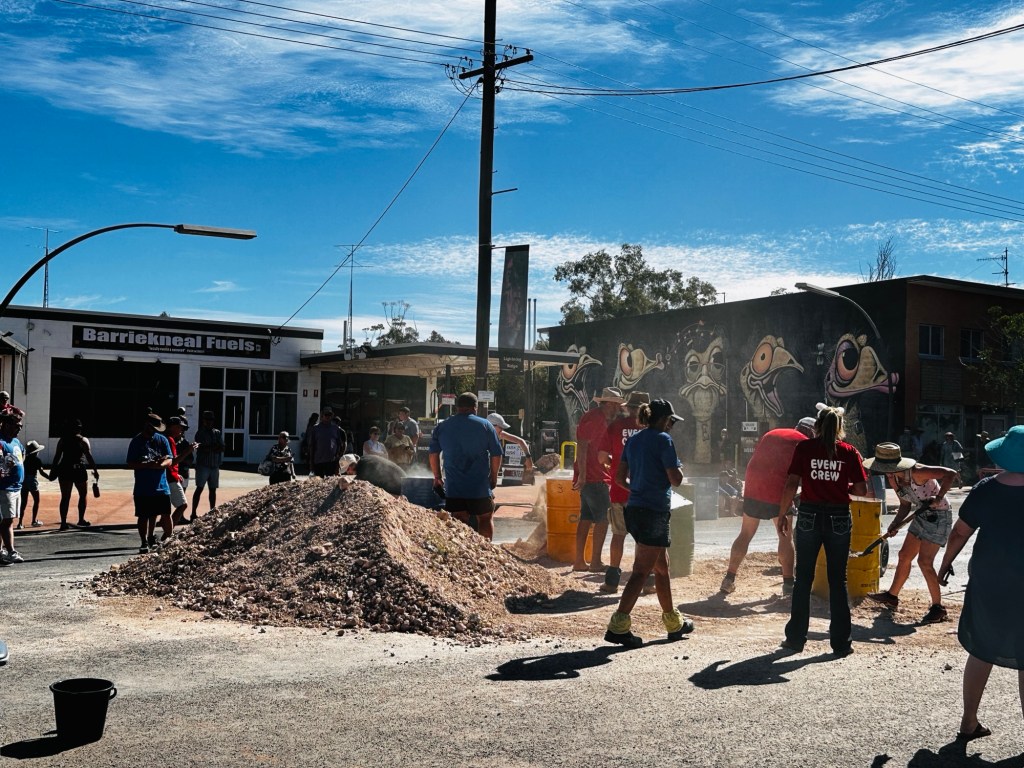
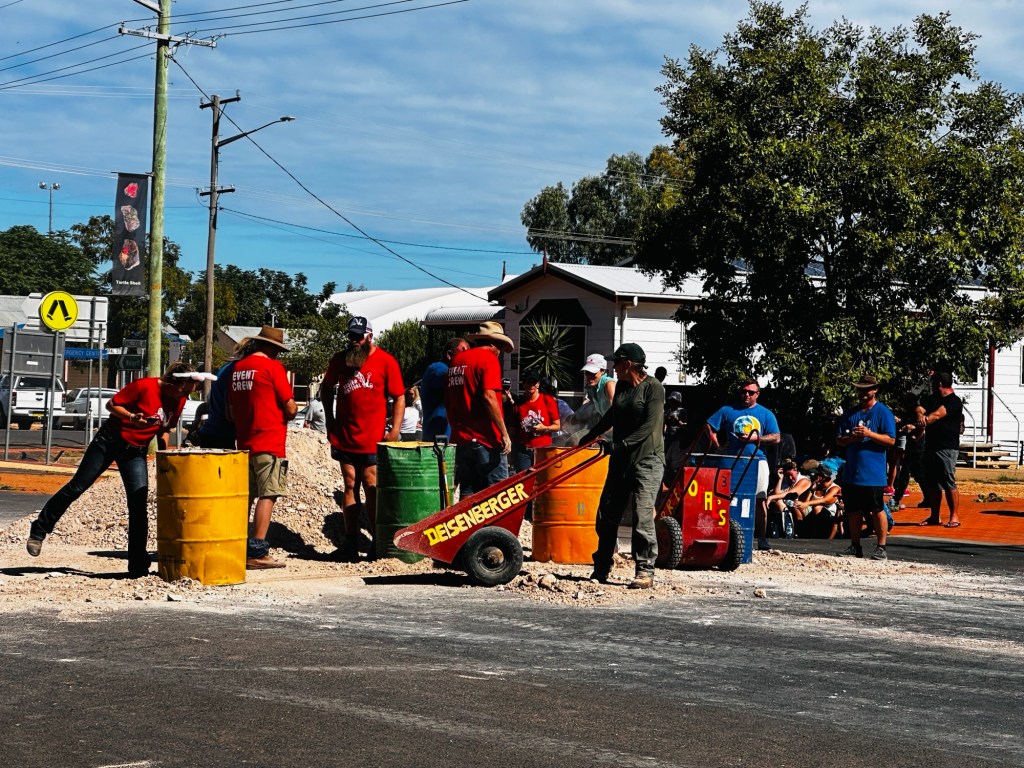
Our caravan park was only a block away from the Main Street and event area for the Easter Festival. The town was buzzing! Market stalls lined the street, they included many locals selling their opals. Many street games and races were being run, as well as the Big Dig – a lucky draw where 10 opals were hidden in 10 dirt piles. If your number came up you then had to dig through the pile and locate a tin containing an opal. Ten lucky winners, but not us! Secretly I was happy, I was not going to be digging through any dirt, in the sweltering heat!
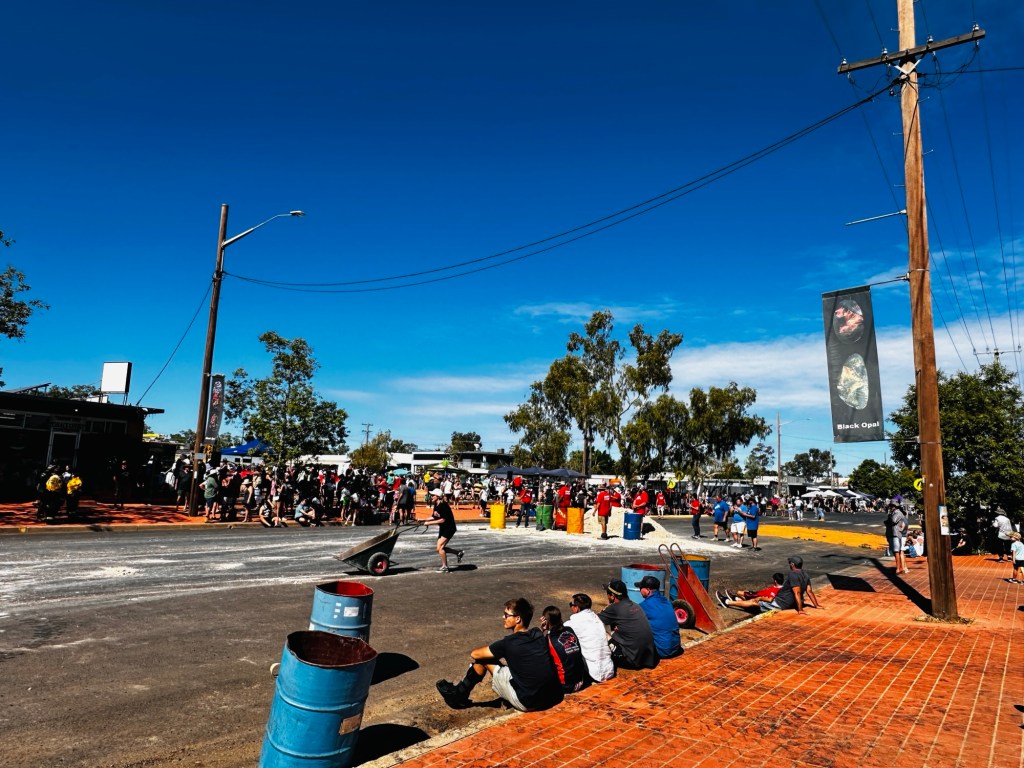

We walked around the town, found the IGA and hardware store. It was so hot- we indulged in an icy mango frappe. So refreshing!
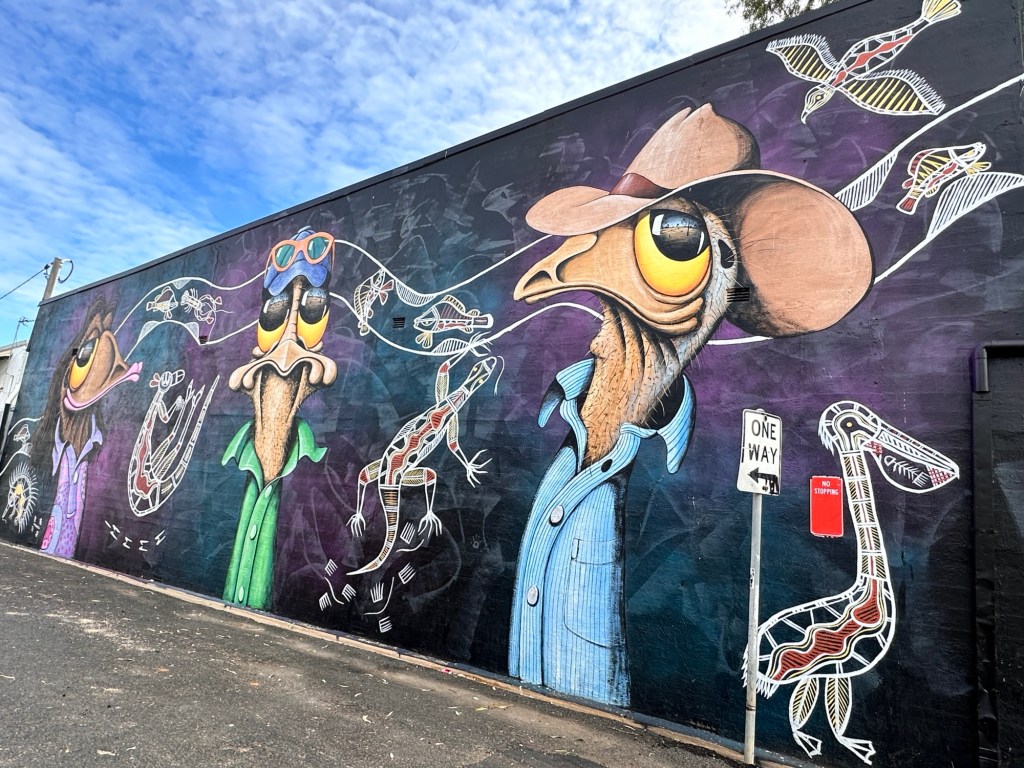
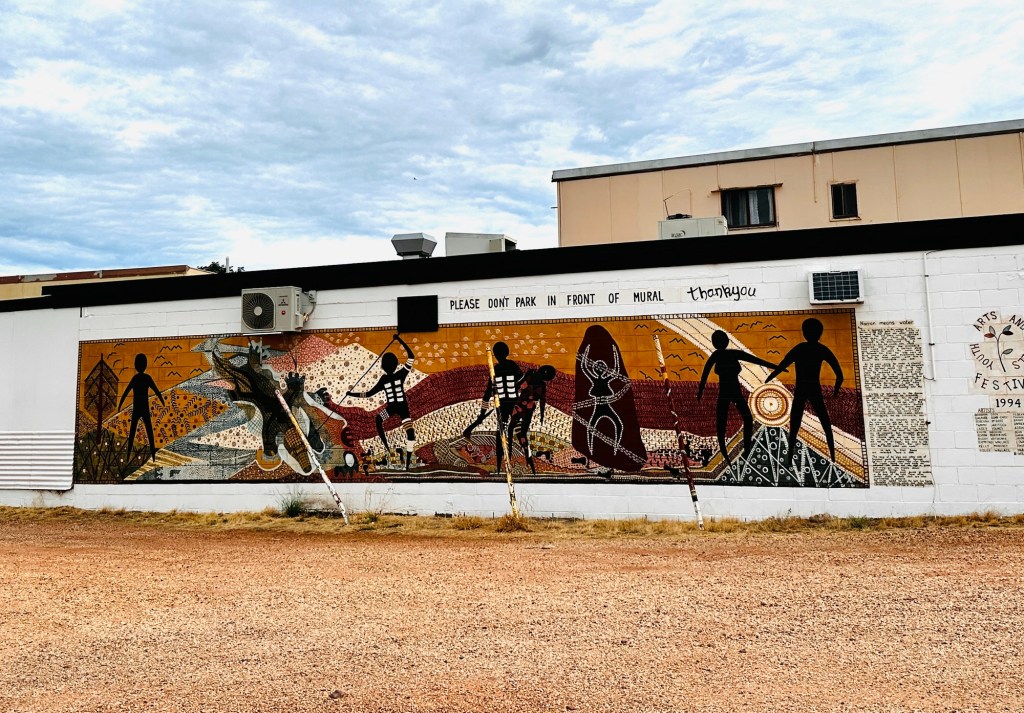
The John Murray Art Gallery is the exclusive outlet for original John Murray paintings. One of the outback’s favourite painters, we viewed his brilliant landscapes and characters first hand. Loved his artwork which is also evident on many of the town murals.

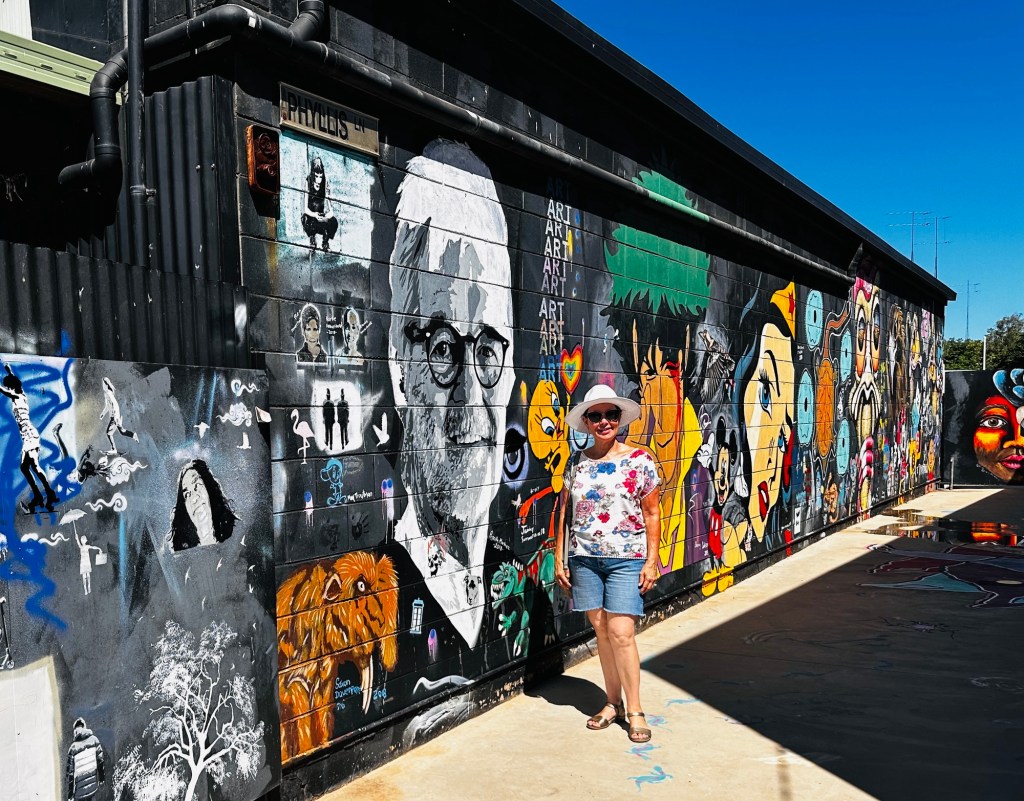
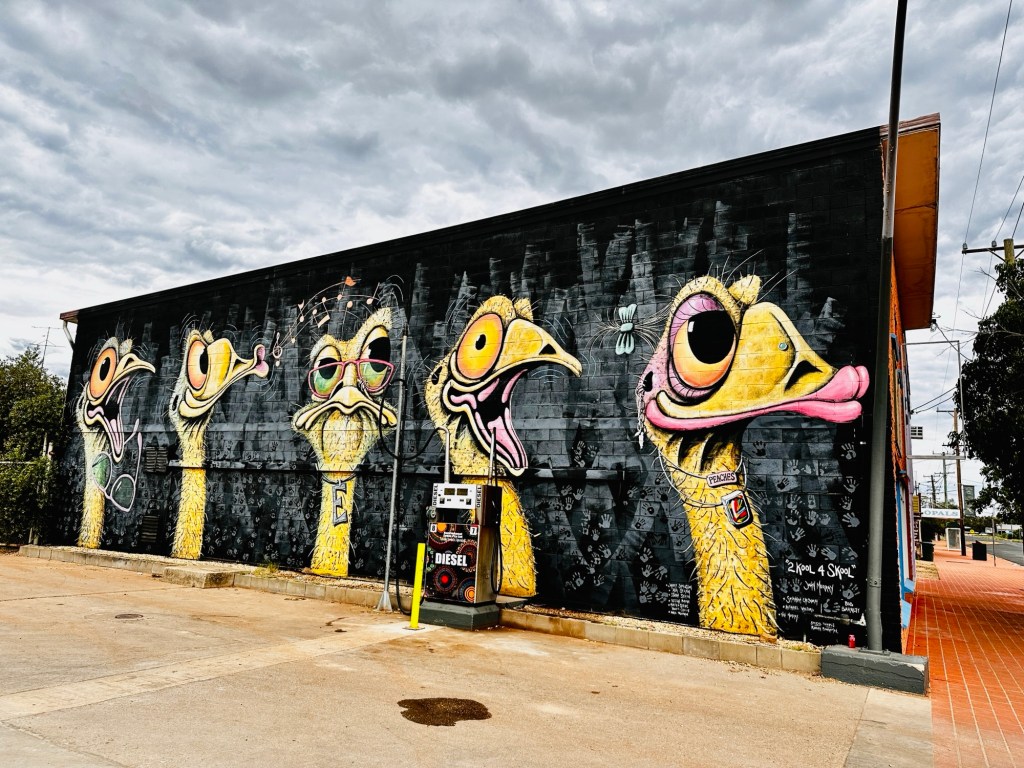
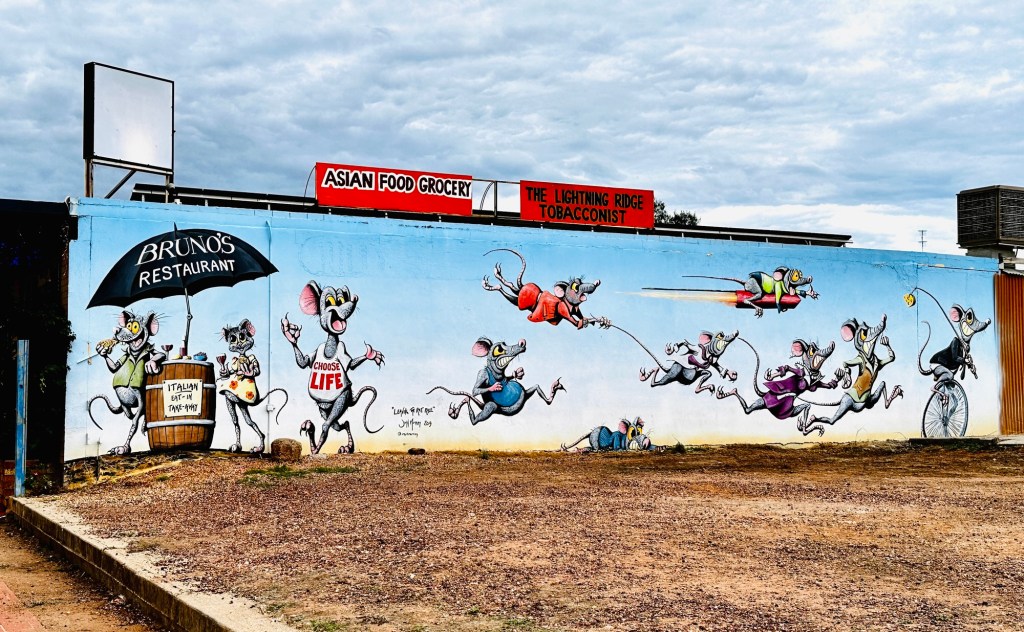
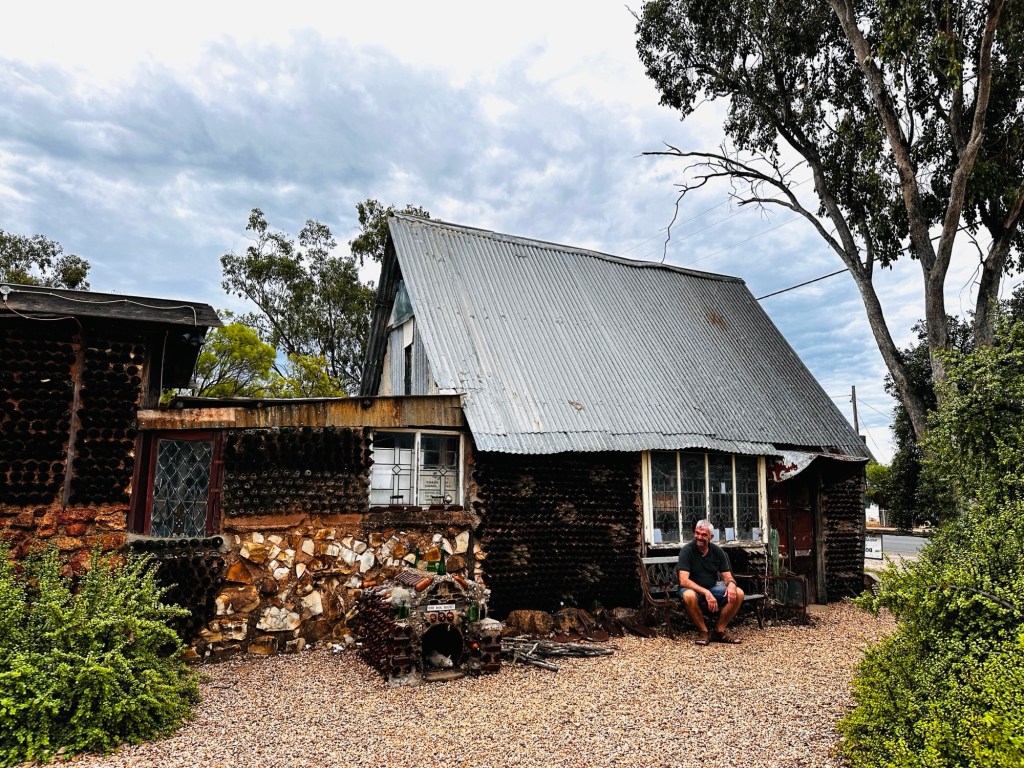
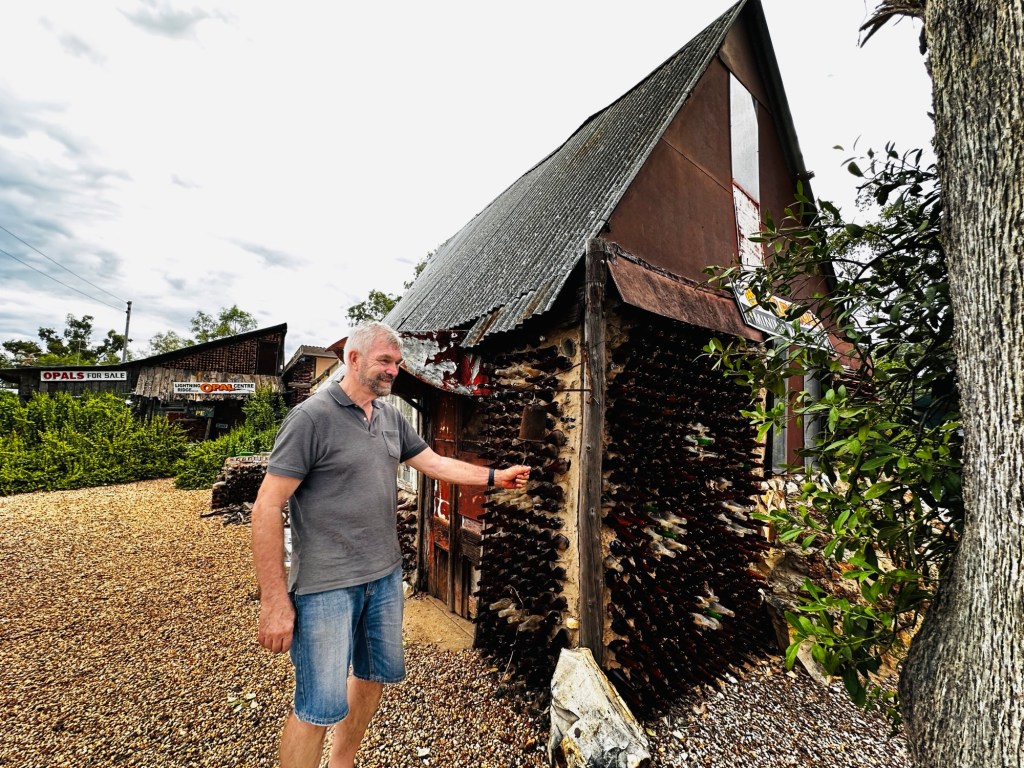
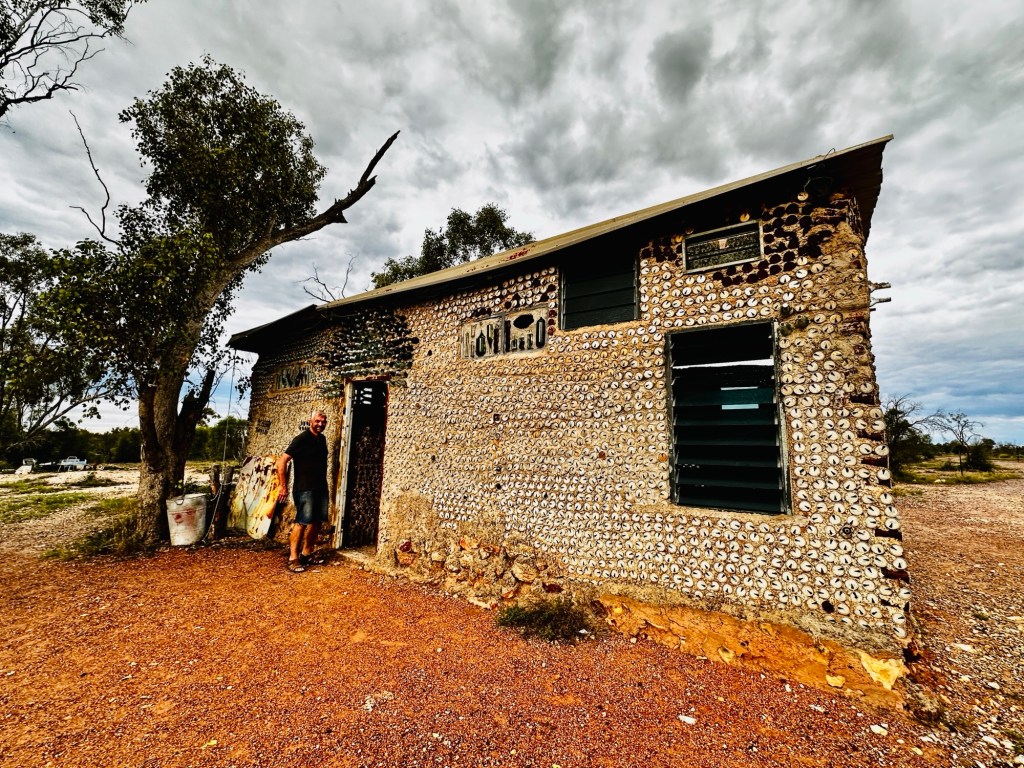
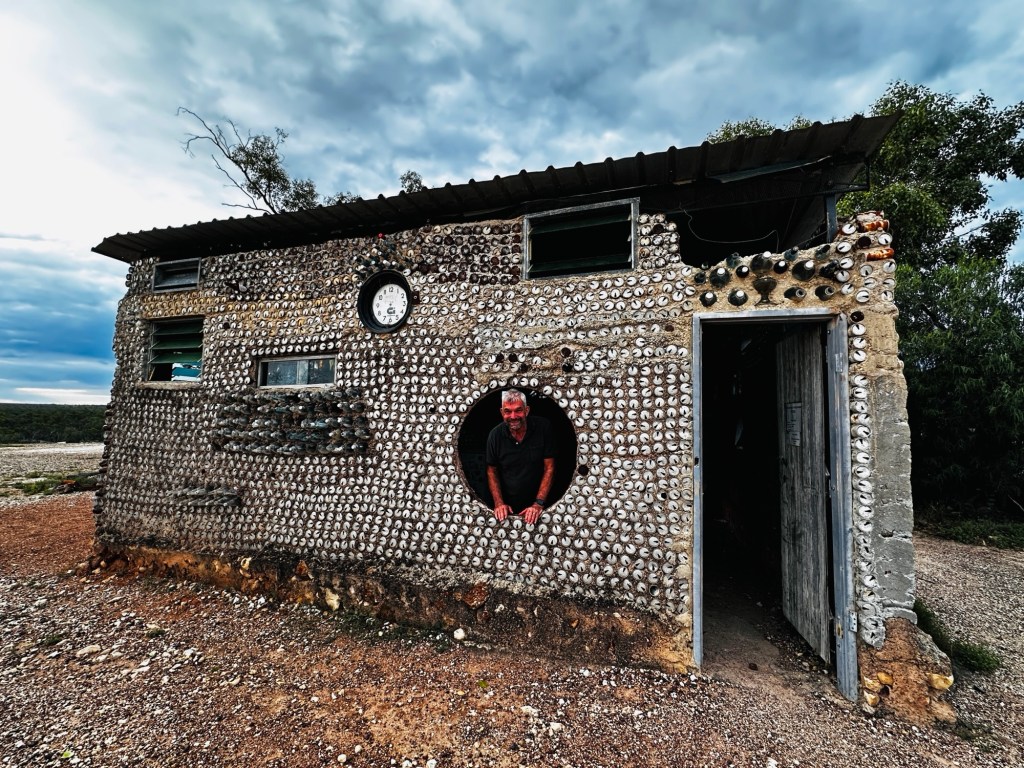
Also took a look at Cooper’s Cottage, an original miner’s home, plus the Bottle House – the house made of beer bottles. Both had been around for a long time – evident by the dust!
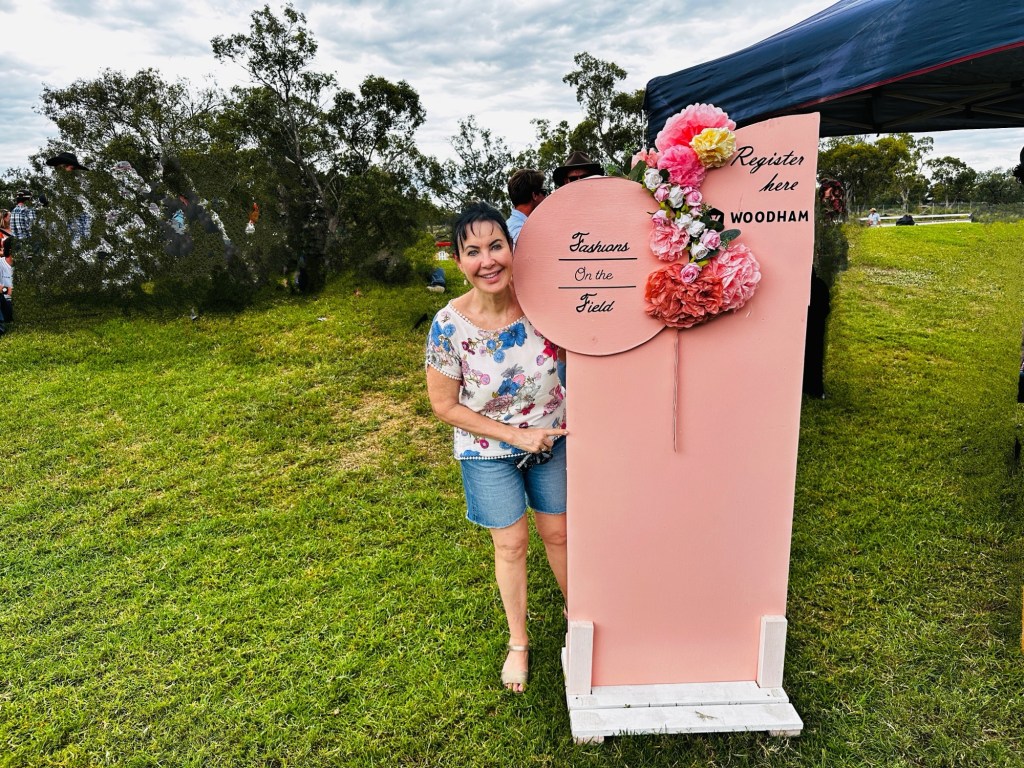
The afternoon’s event was the Horse Races. We were planning to go, but it was just so hot! We ended up going back to the van to cool off in the air conditioning. We did walk down at the end of the afternoon to have a look. Everyone was dressed up for the occasion (except us!)- they all looked like they had had a lot of fun.

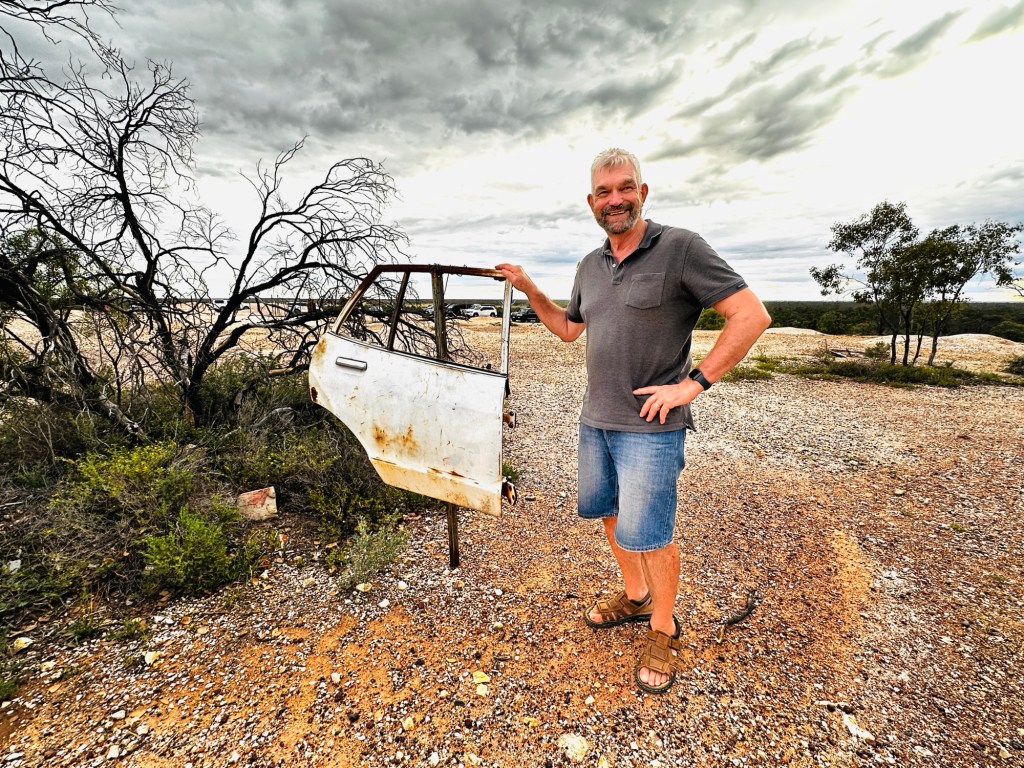
There are a series of “car door” drives you can do in the areas surrounding Lightning Ridge. We decided to do the Yellow Car Door tour…. and you guessed it, the signs were on painted yellow car doors! This route took in sites such as stone miner’s cottages, abandoned mine shafts, abandoned vehicles, the excavated site for the Australian Opal Centre, regenerated opal fields, and ending up at Lunatic Hill, a long abandoned open cut mine.
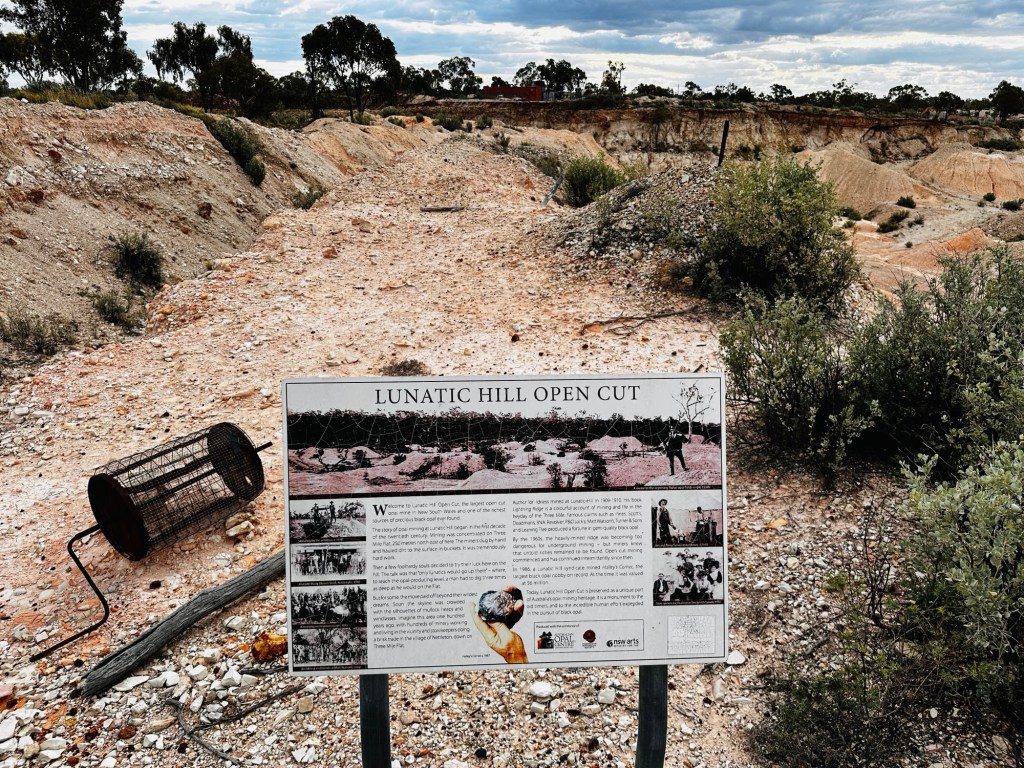
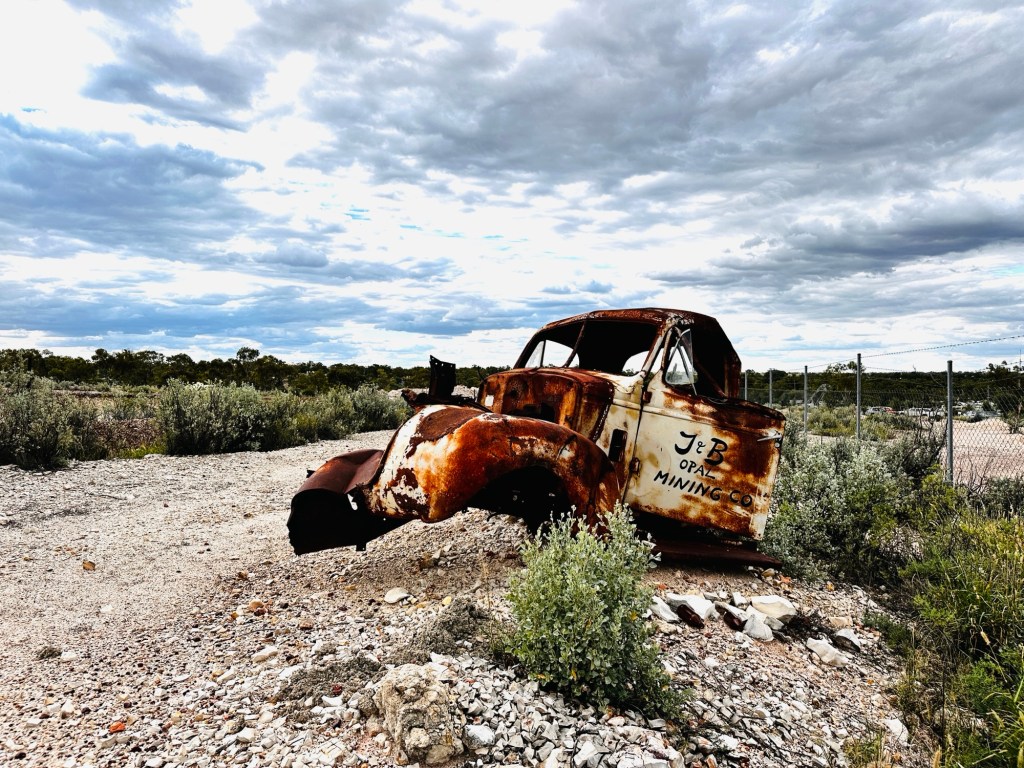

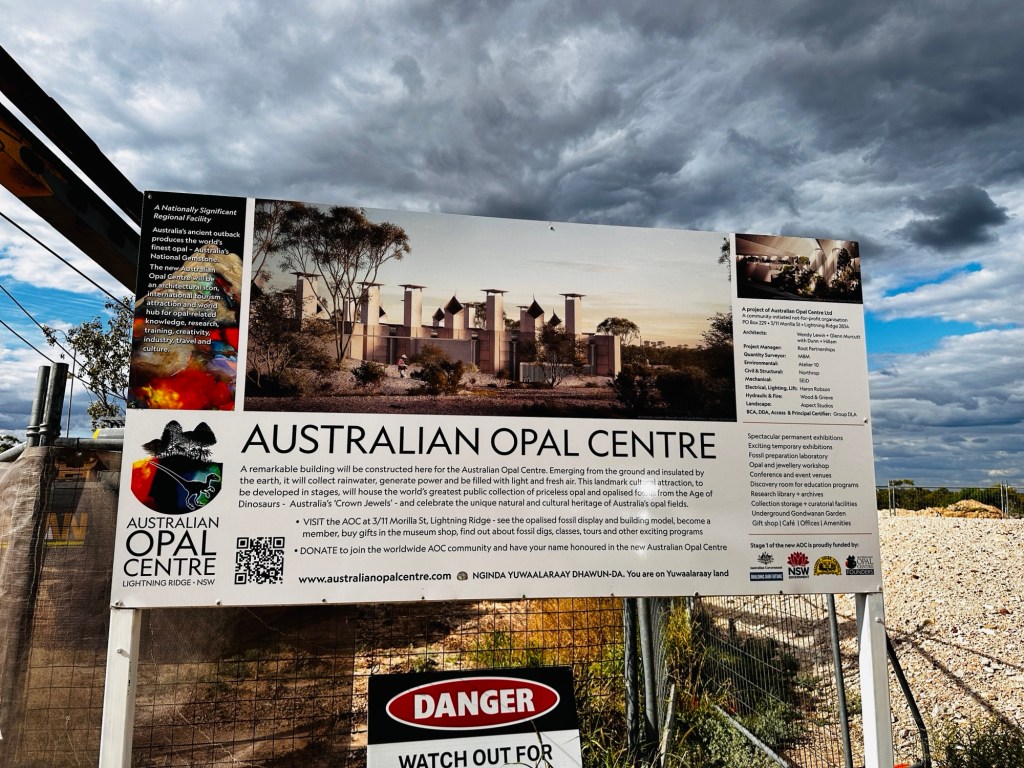
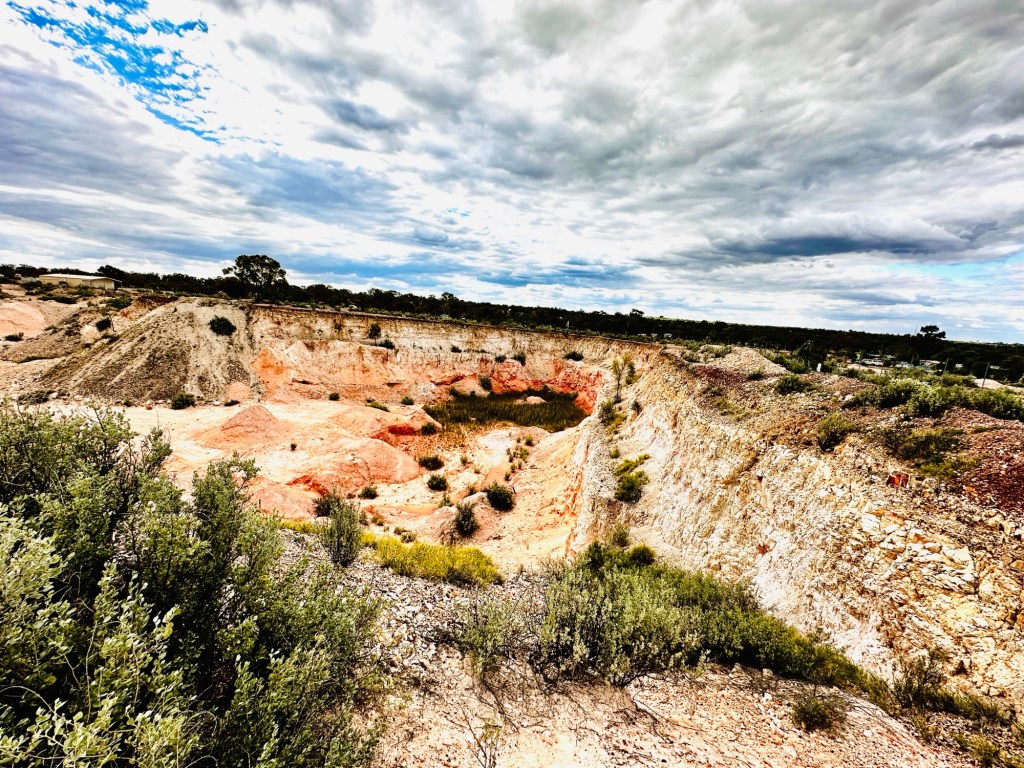
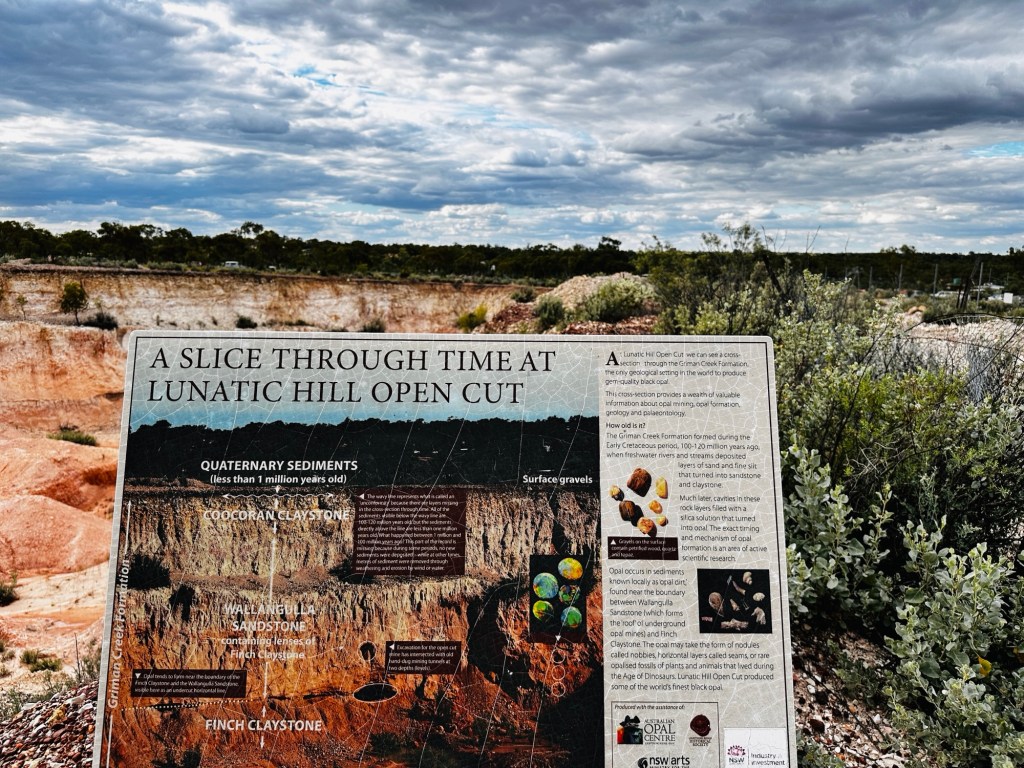
Next we did the Green Car Door route … yes green doors this time! More mine shafts and dirt piles, then ending up at Nettleton’s First Shaft Lookout. There we saw the Beer Can House (yes a hut made out of beer cans), and the Stone Labyrinth – where we watched the sunset over the Corcoran Opal Fields.


Back to town in time for the Easter Festival fireworks display.
Day 4
Sunday 31st March 2024 (Easter Sunday)
Lightning Ridge
20-33 degrees, hot ++
Today we had a tour with Outback Opal Tours – we could sit back and let someone else’s vehicle get dirty and dusty on the unsealed roads and dirt tracks! The Opal Fields are 80 kms from Lightning Ridge, with plenty of farming country to see on our way – mainly goat farms ( 90% of which is exported). Also saw a few wild emus. As we drove along we heard many colourful stories and entertaining history about the area from our driver Peter- there was not much he hadn’t seen or done!
Our first stop was Sheepyard Inn where we had a yummy Devonshire tea – the freshly made scones with jam and cream were delicious!
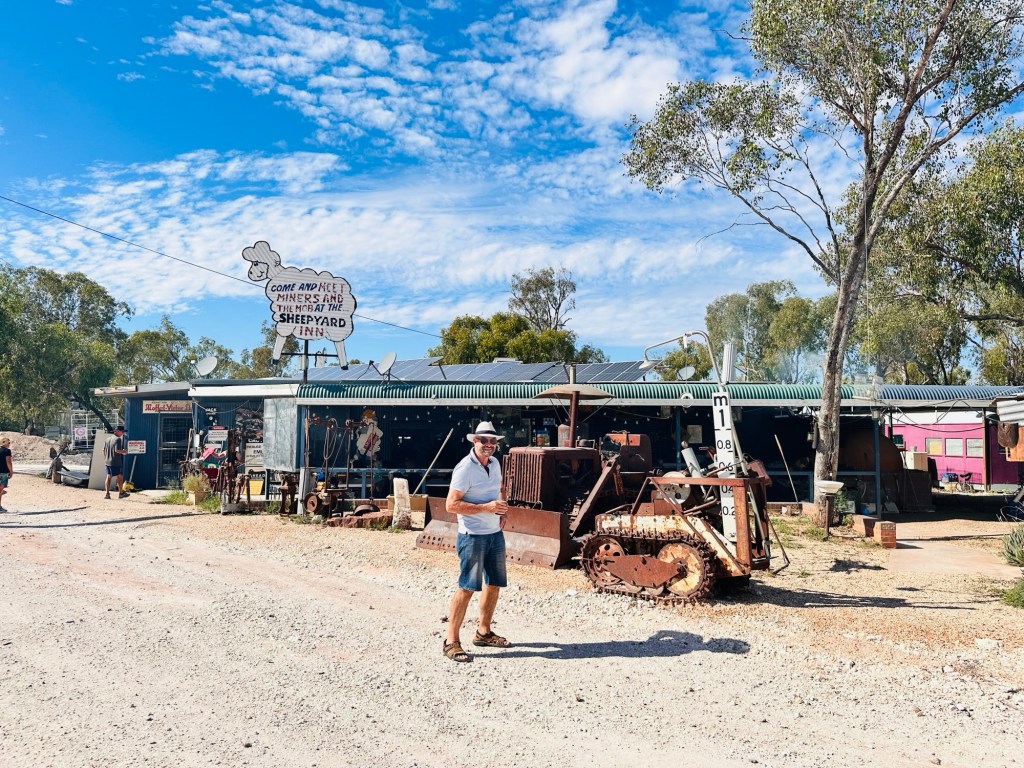
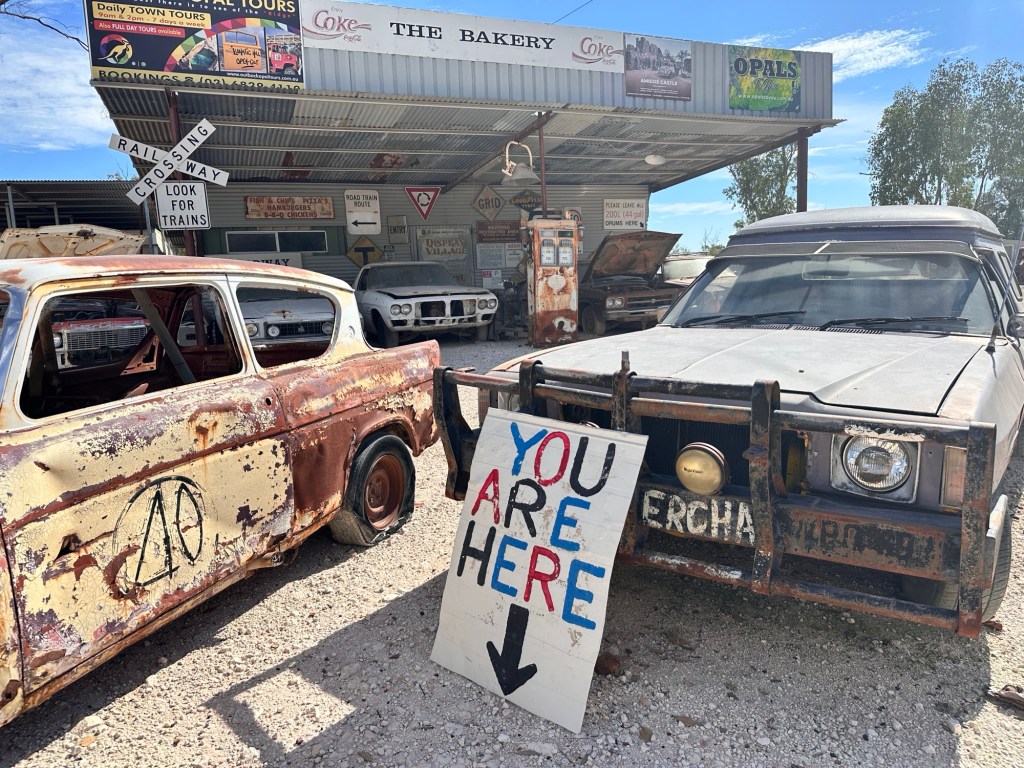
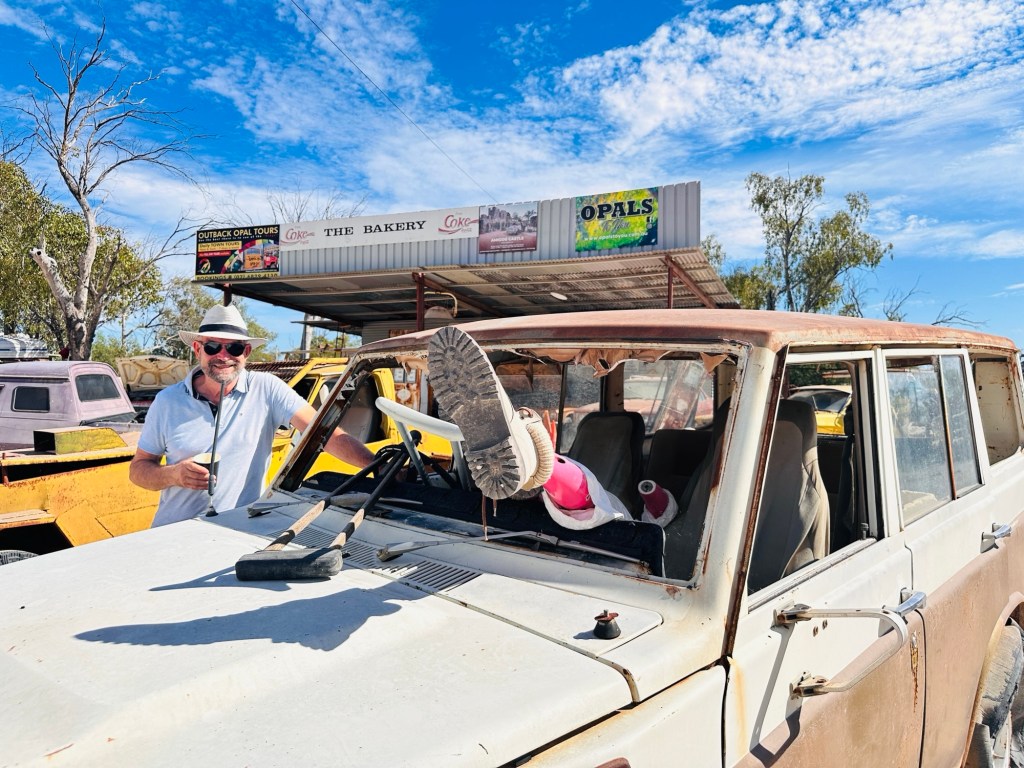
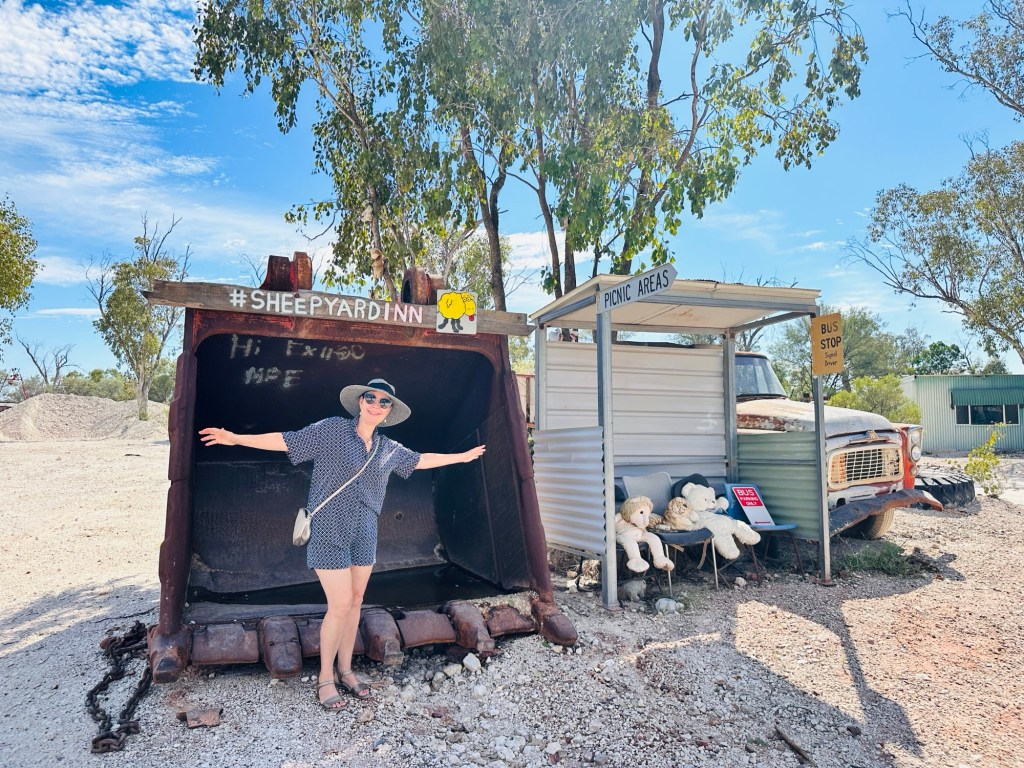

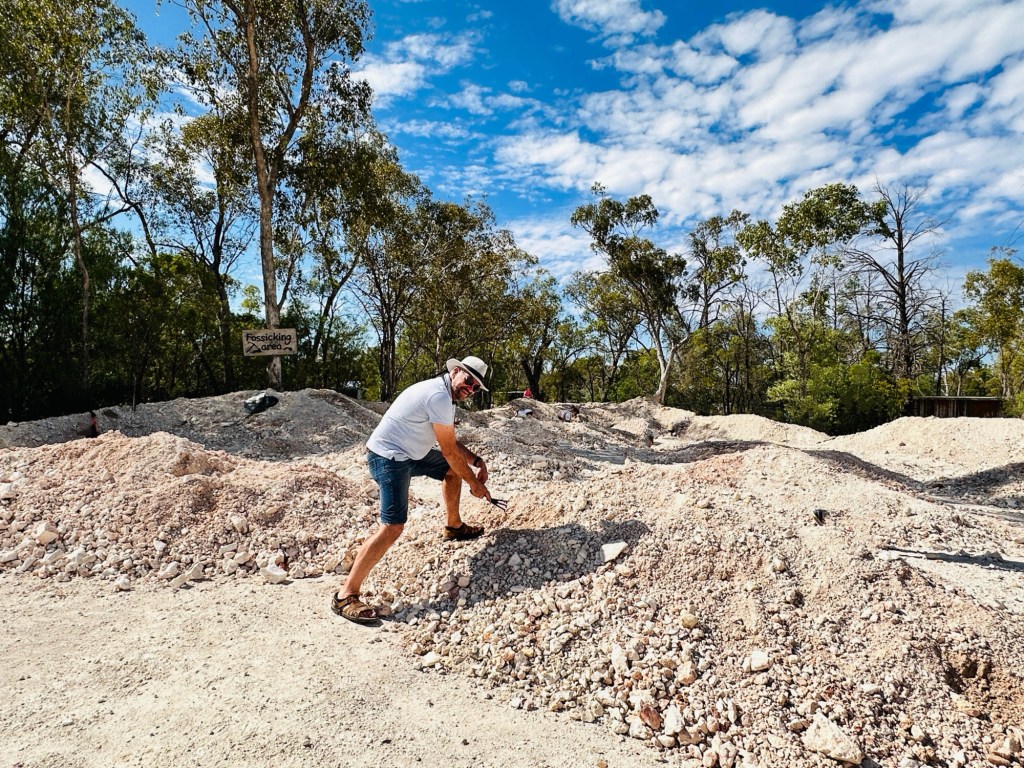
The surrounding area had a plethora of mining machinery, camps, mullock heaps, and opal mining claims. Opal mining is a way of life. I would go mad with the dust and dirt, but others love it. Everywhere you look is a piece of old machinery, or a sign – all of a humorous nature. We were able to have a quick fossick – looking for that elusive opal!
Lightning Ridge is famous for black opal. Black Opal is the most rare and valuable opal type. The dark body of black opal gives it a rich intense colour. Black opal is worth more than diamonds apparently, but not pink diamonds.
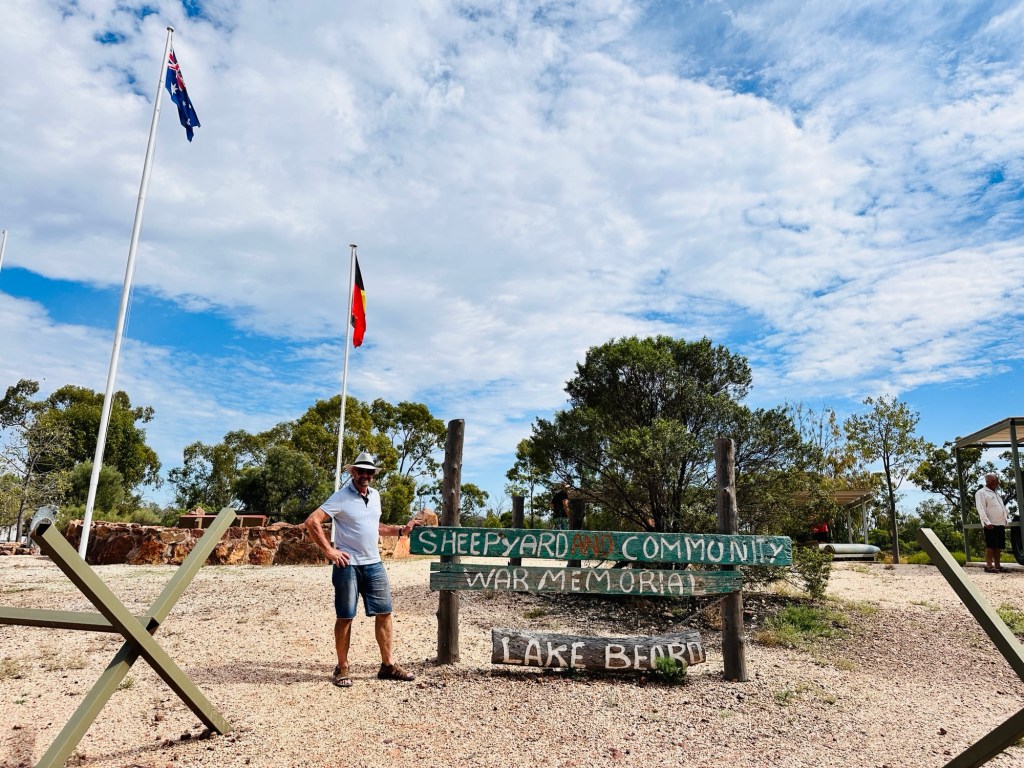
Next stop was the Sheepyard and Community War Memorial and Museum at Lake Beard – fabulous collection of war artifacts, all maintained by volunteers.

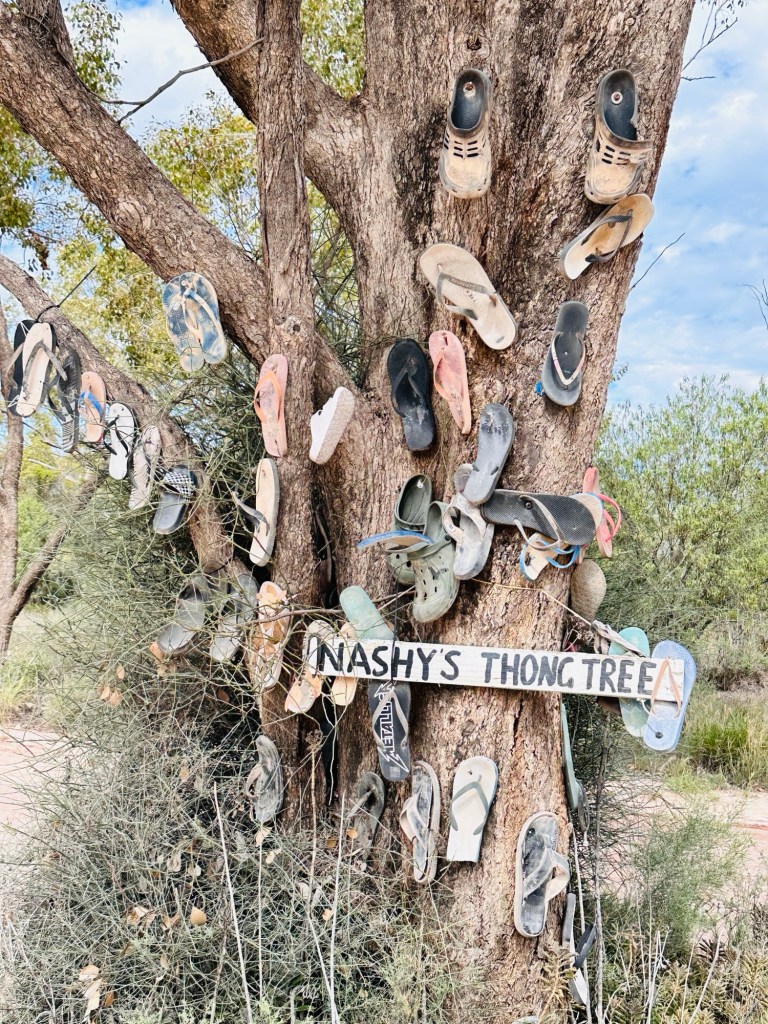

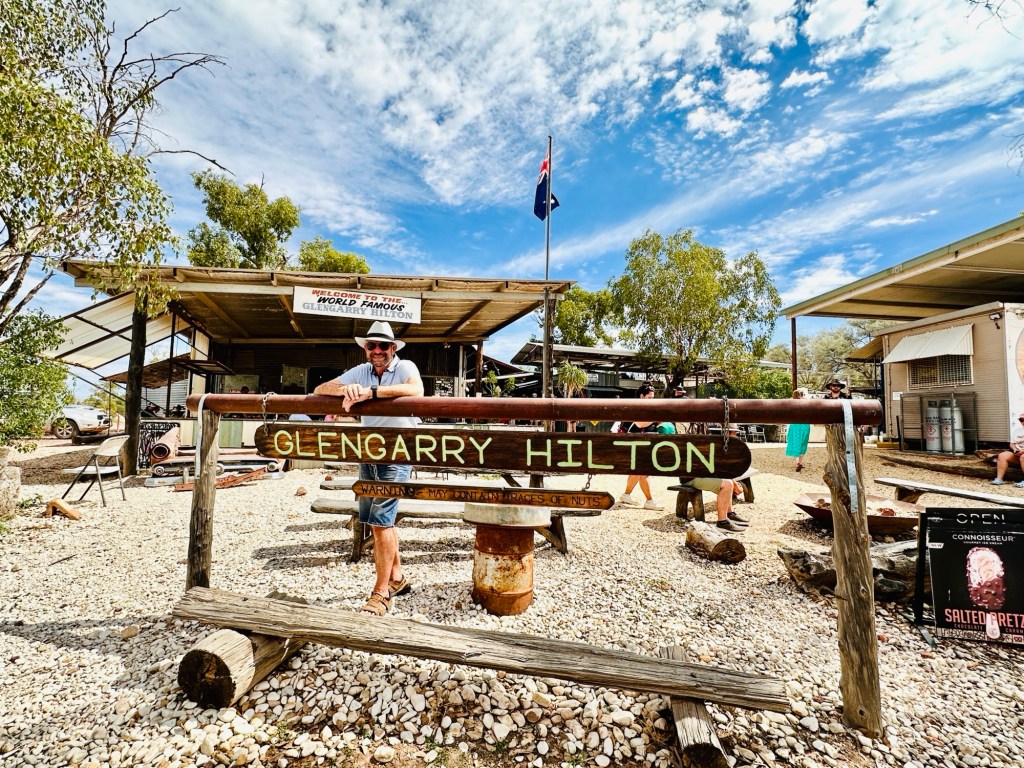
Glengarry Hilton was our lunch stop. Another outback pub with so much character. Over the way was Sweeney’s Art and Craft store with all sorts of goodies made by locals.
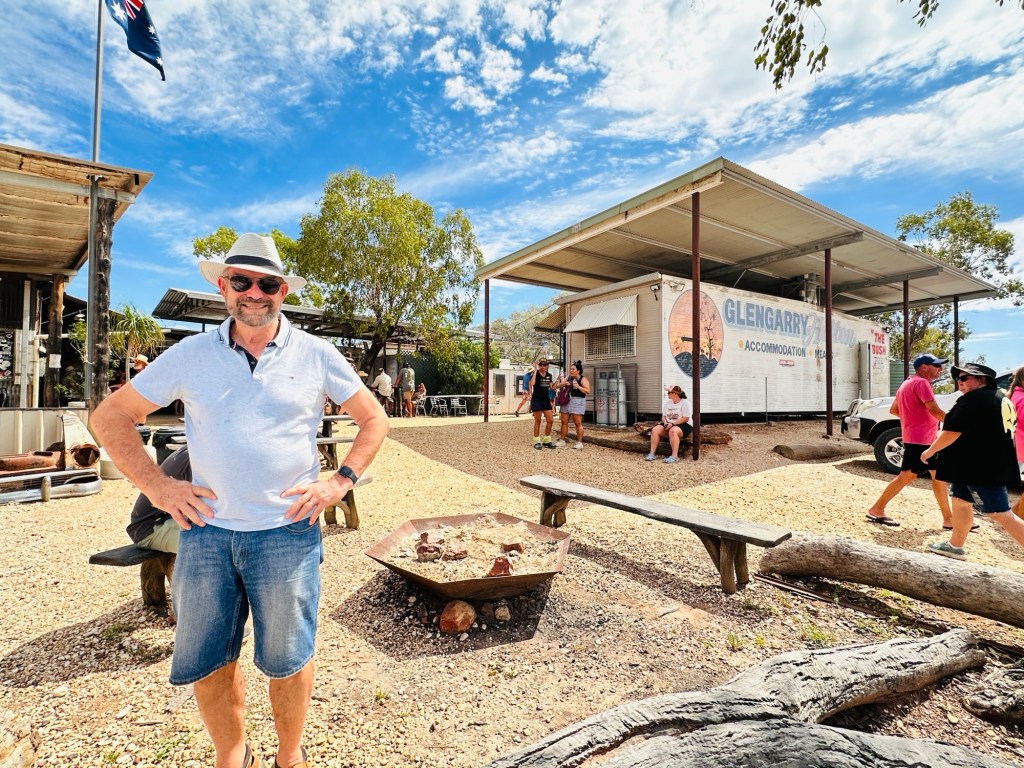


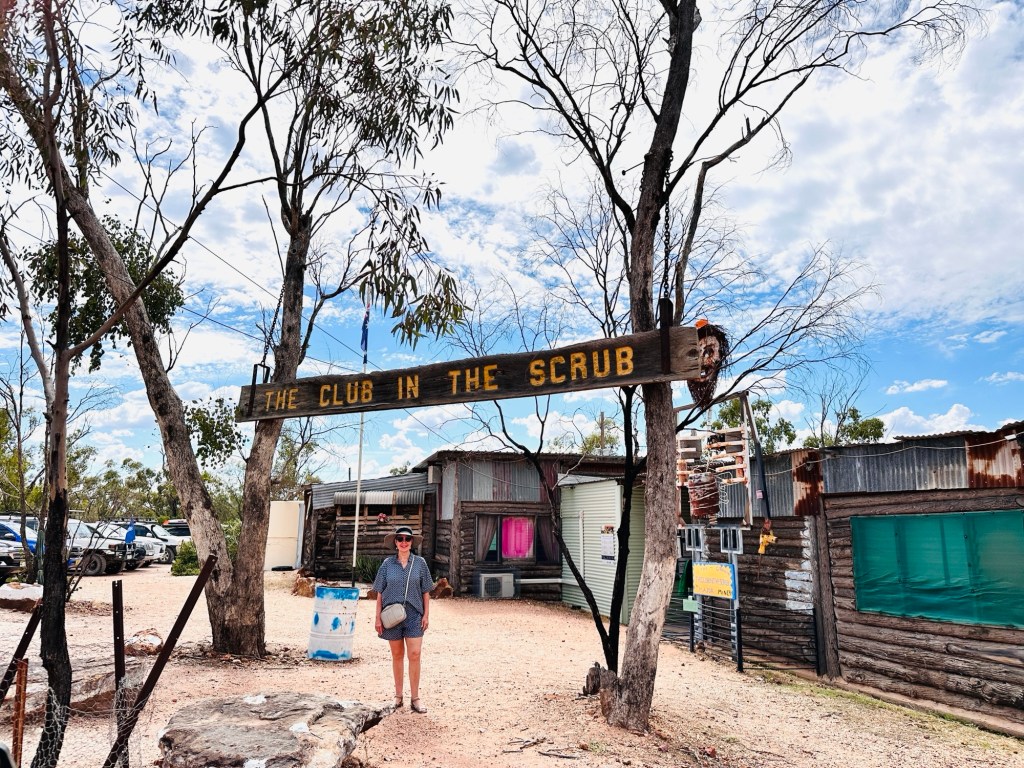
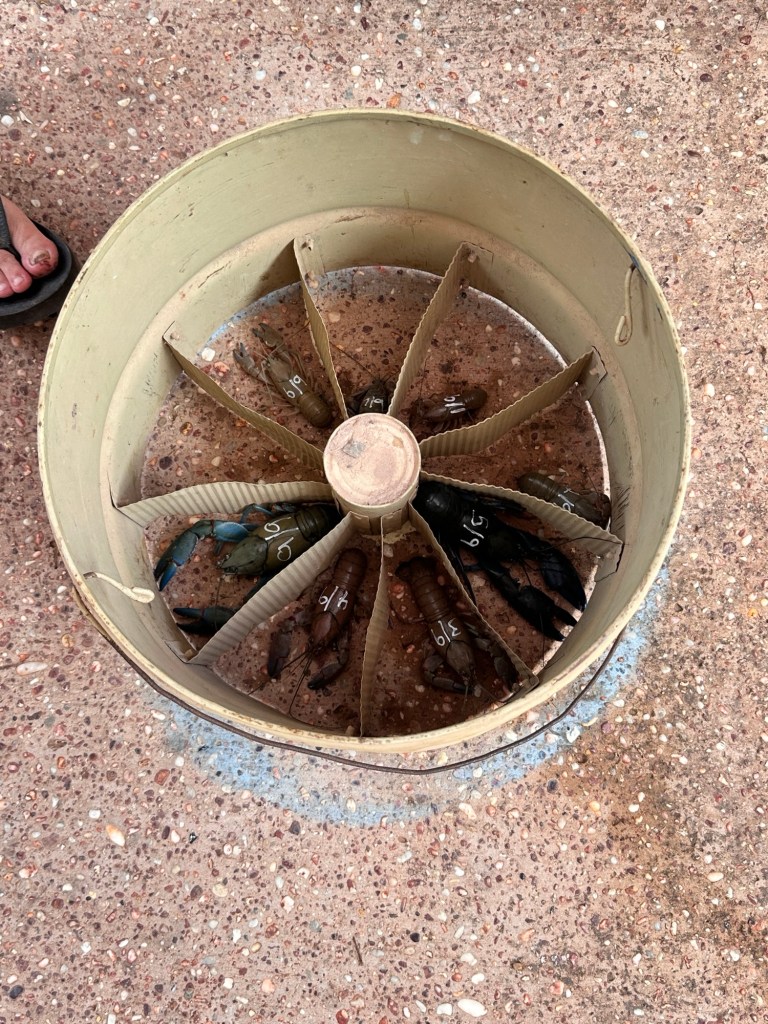
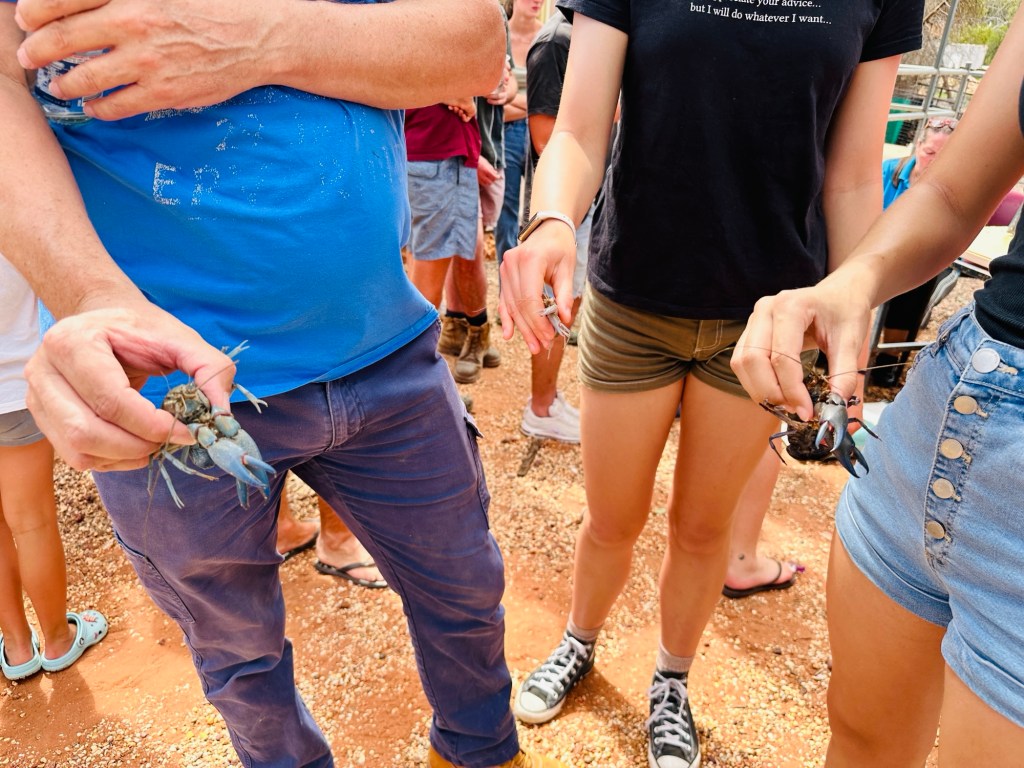
On the road again, until we reached The Club in the Scrub – another outback pub. Today, being Easter Sunday, was when the annual Yabby Races are held. This proved to be a very entertaining event – once you bought a yabby, it went into a central starting position, and the race was on to see which yabby crossed the outer ring first. A very lively audience cheered on the yabbies – large wagers had been placed so there was a keen interest in backing a winner. Next to the club is the Grawin Golf Club. Tee off is from the back of a truck!

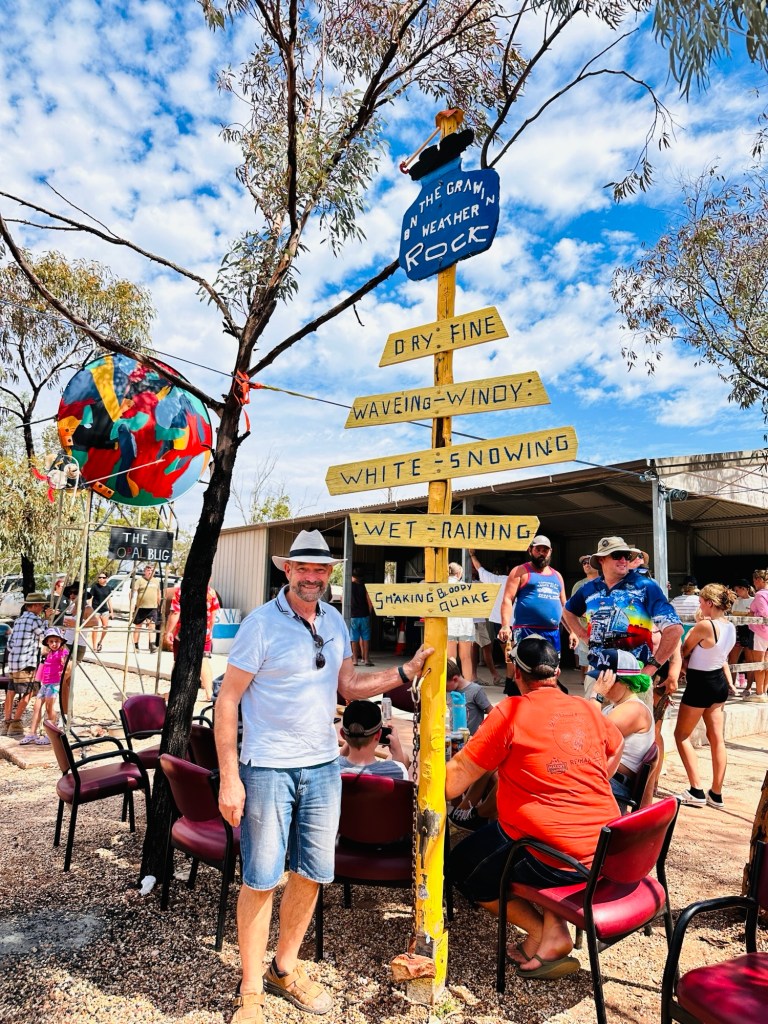

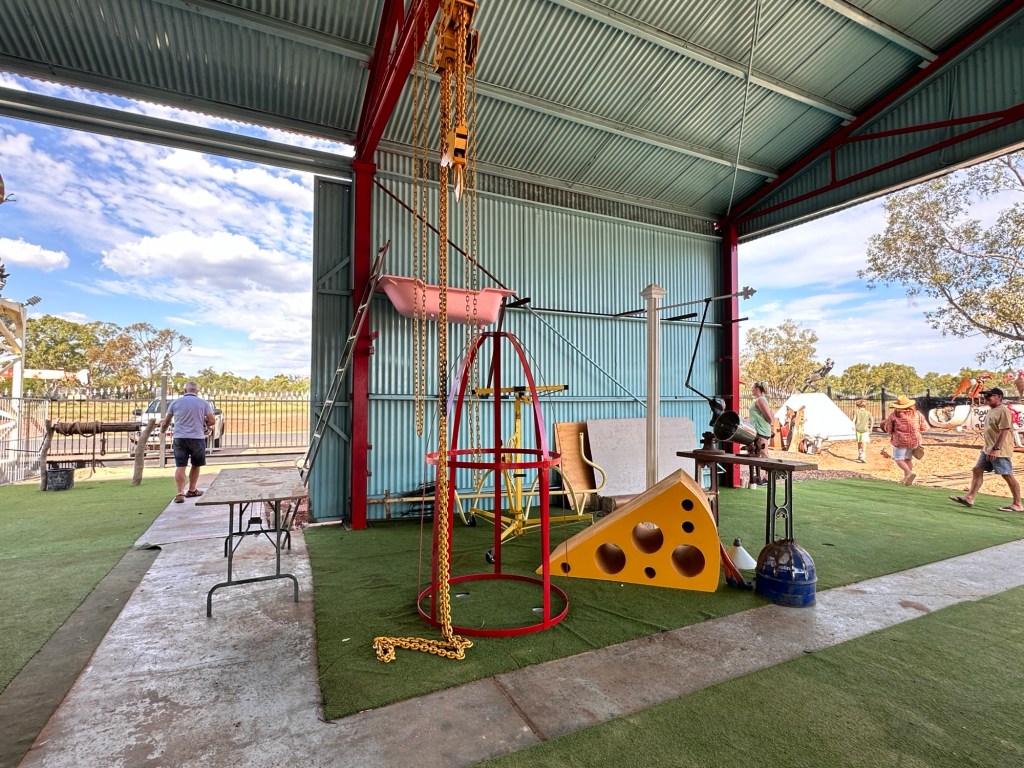
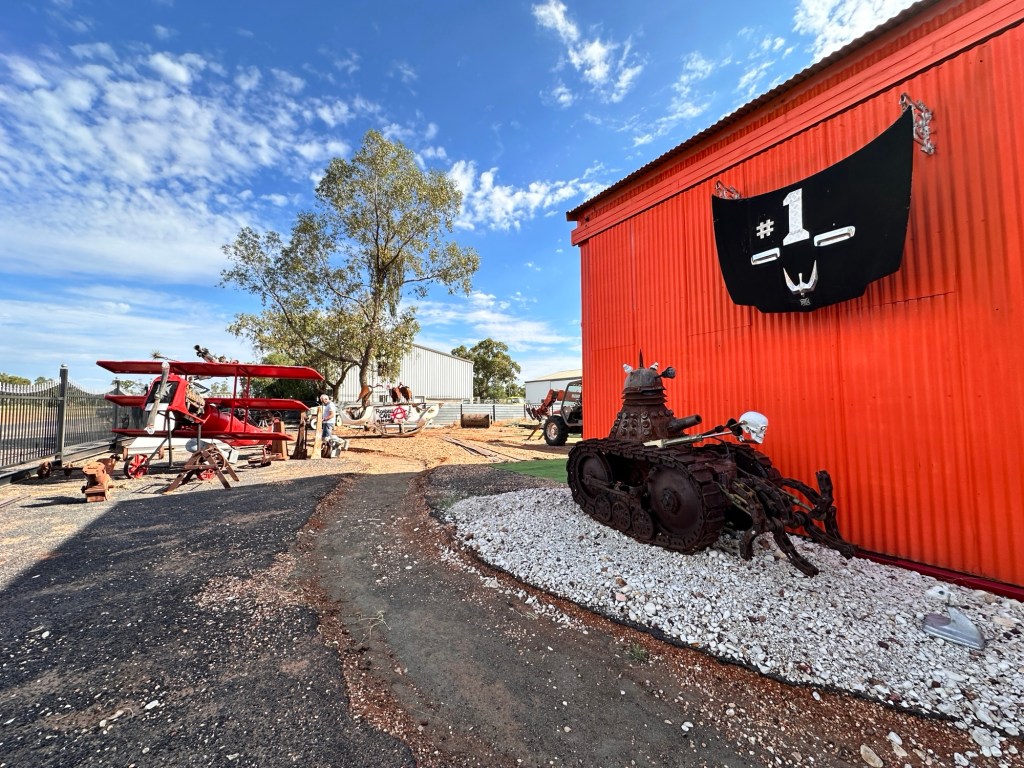
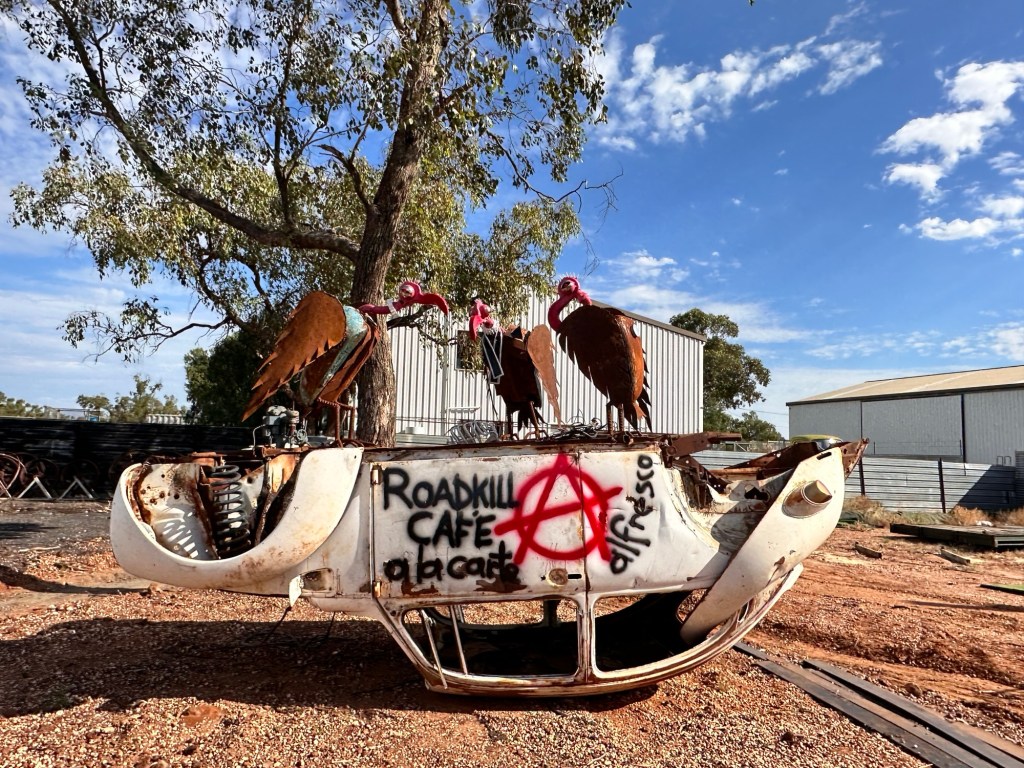
Back in town we met Peter Cooke, of Outback Opal Hunter fame, who is building a mini golf course. He has collected all sorts of paraphernalia to create fun and quirky sculptures to make the course interesting. So far he has only two holes completed, but it will be great when it’s all done.

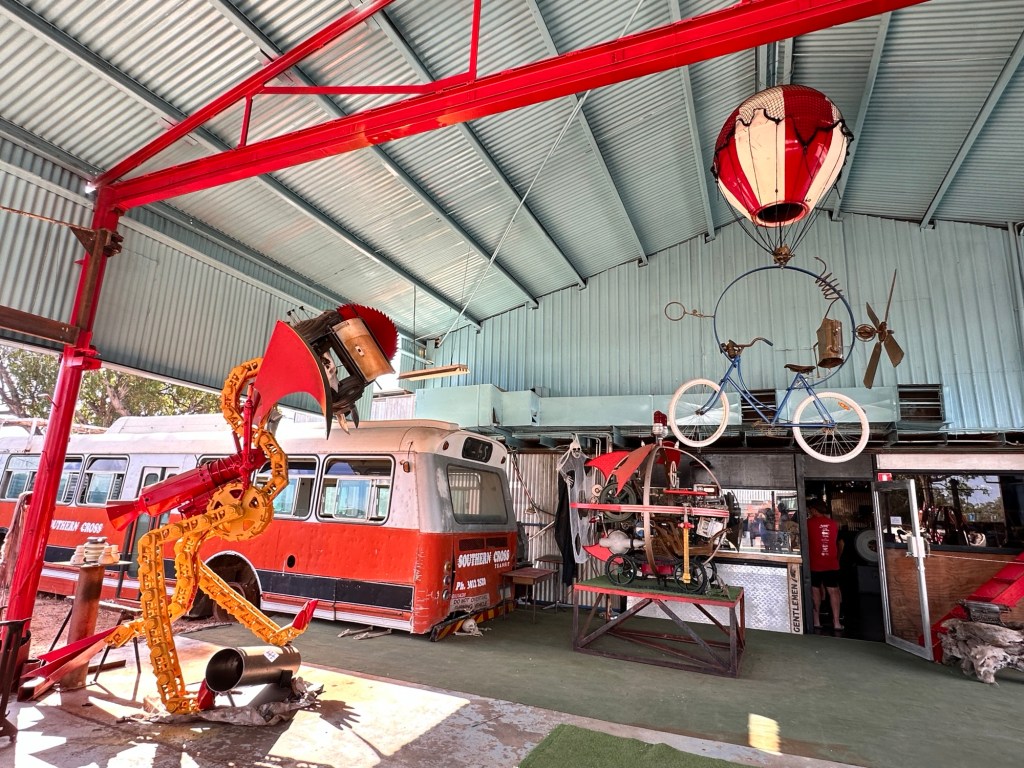
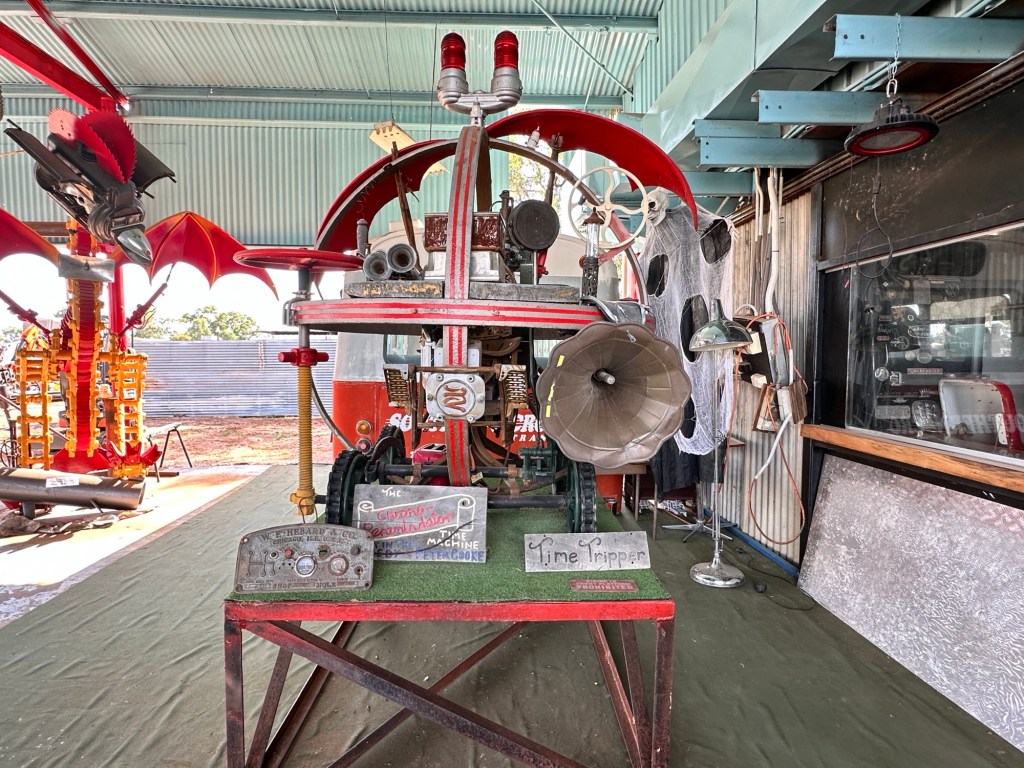
Also had a look in one of the many Opal shops in town. Black opal is the most rare and valuable Opal type. The dark body tone of black opal gives it rich intense colour. We learnt the difference between solid Opal, Opal doublet, Opal triplet and potch.
The water at Lightning Ridge comes from the Great Artesian Basin and is approximately two million years old!
Natural pressure sends the water to the surface through an artesian bore and it maintains a temperature of between 40 to 50 degrees Celsius. A lot has been done in recent years such as bore capping, and having pipes instead of open drains to minimise water loss. There is no shortage of water in Lightning Ridge.
The Lightning Ridge Bore Baths are free to use. Even though it was very hot outside, we enjoyed a short plunge in the naturally heated 40 degree bore bath. It was surprisingly refreshing – such a contrast from our recent Japanese onsen experience in very cold conditions. The bore water is very soft – a few extra rinses required when hair washing!

It had been a big day, and we had been eating a good part of it, so some nice truffle salami, vintage cheese and biscuits, with a nice bottle of red, in our air conditioned comfort, sufficed for dinner.
Day 5
Monday 1st April 2024
Lightning Ridge to Dubbo
21 – 31 degrees, still hot
356 kms
Packed up, and on our way – definitely no dirt roads! Though the roads are quite undulating… in other words, rough and bumpy! Lots of farmland – sheep, cattle and some horse studs. The country is nice and green after all the recent rain.
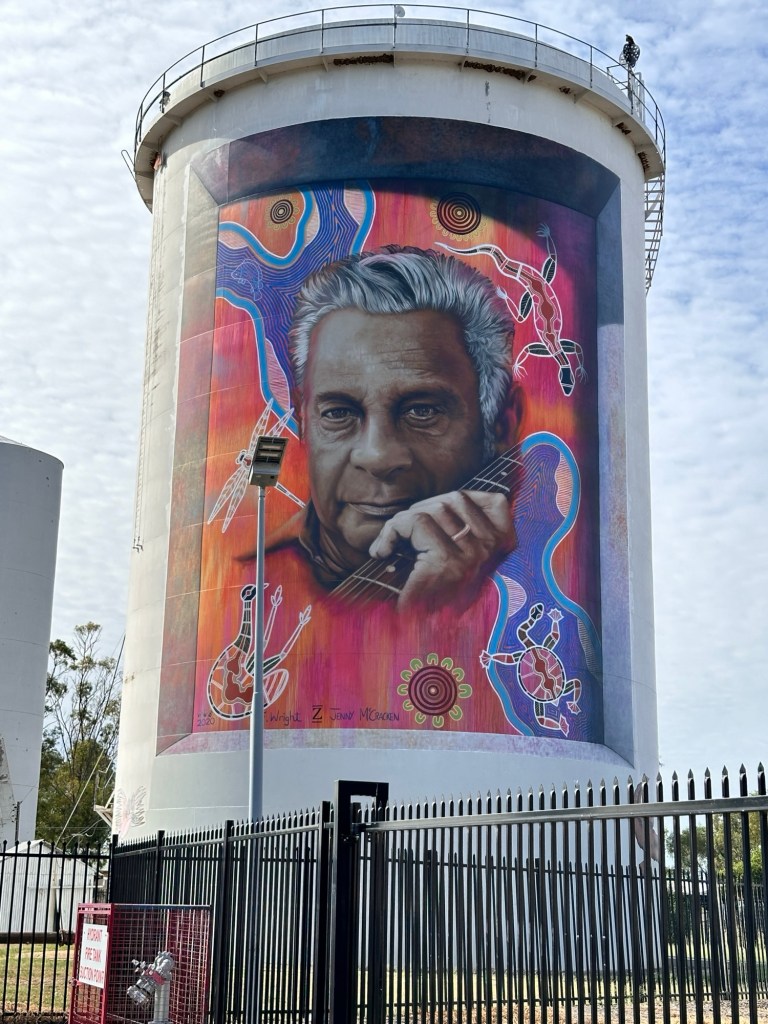
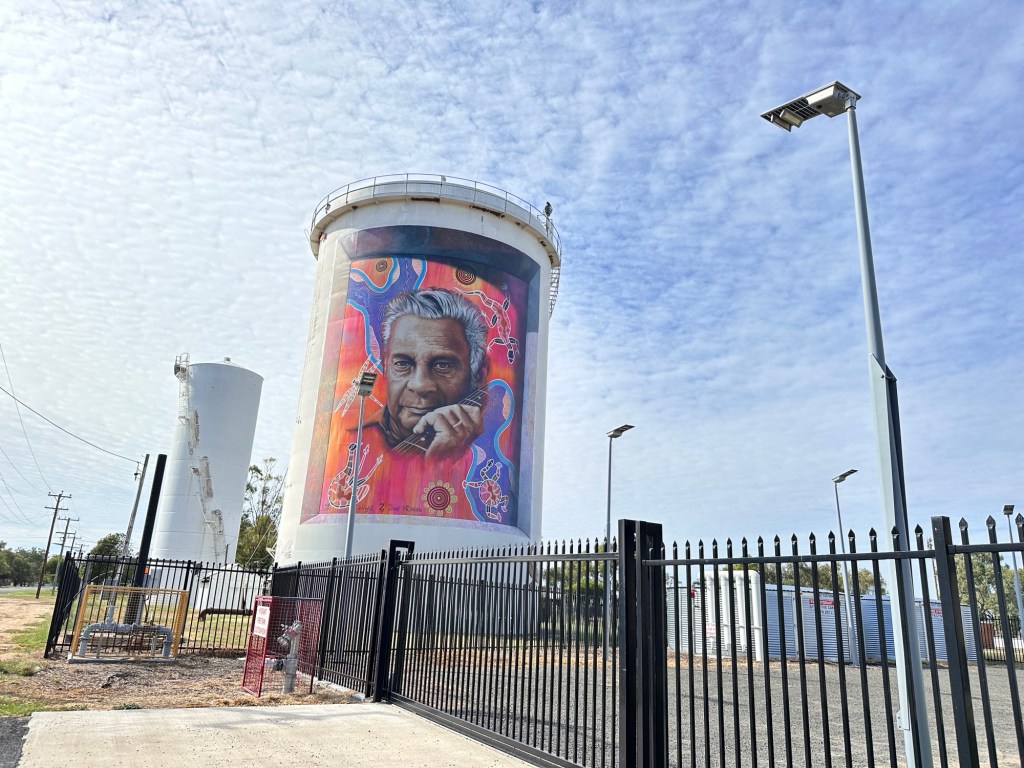
Coffee stop at Walgett. The water tower here was painted in 2020 by Jenny McCracken and Frank Wright. The mural depicts the life of Jimmy Little, a celebrated and beloved Australian Aboriginal musician, actor and advocate whose career spanned six decades.
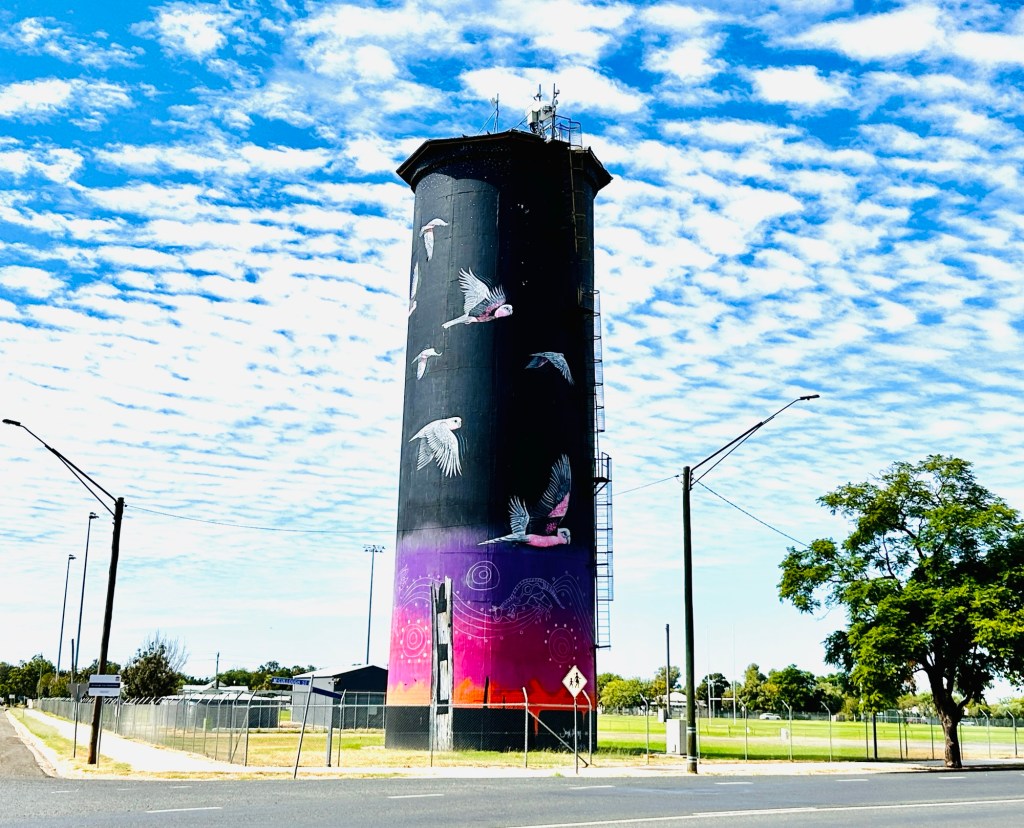
Next stop, the water tower at Coonamble. Painted by John Murray and Sooty Welsh, this piece of work was done in 2017. The artwork features Galahs, fence posts to signify the rural aspect of Coonamble, plus the sun, moon and the Southern Cross.
We ended up continuing onto Dubbo, and checked into the Dubbo Discovery Park, which we had previously booked. All we could get at the time was an ensuite site. Sounds good, but all these sites had terrible access. We reversed onto our allocated site, only to find the drainage pit was in the middle of where our awning would be positioned. The slabs were all very odd also. We moved to another site, which because of the steep kerb, and very limited turning room, took us a long time to get into position. Tempers were short by the end, but nothing like some nice barbequed lamb chops with a full bodied Cabernet Sauvignon to smooth everything over.
Day 6
Tuesday 2nd April 2024
Dubbo
11-25 degrees , a very wet morning, then sunny
We had been dodging the wet weather events that had been happening all around us, but the rain finally caught up with us this morning. It poured down for 4 hours, then stopped! We needed to shop so we bought our groceries, and did the obligatory trip to Bunnings, had lunch and by that time, the sun was out.
So we were off to the Dubbo Zoo. We had a two day entry pass. We had planned to go on our bikes, but because of the wet terrain we drove to the park and walked around. You can also drive, ride or walk.
Taronga Western Plains Zoo, formerly known as Western Plains Zoo and commonly known as Dubbo Zoo, provides more living and breeding space for large animals such as elephants and antelopes which needed more space than was available at the restricted Sydney site. The zoo is an open-range design, with walls and fences replaced by concealed moats which divide the animals from the visitors. This creates the impression of actually being with the animals in the wild.
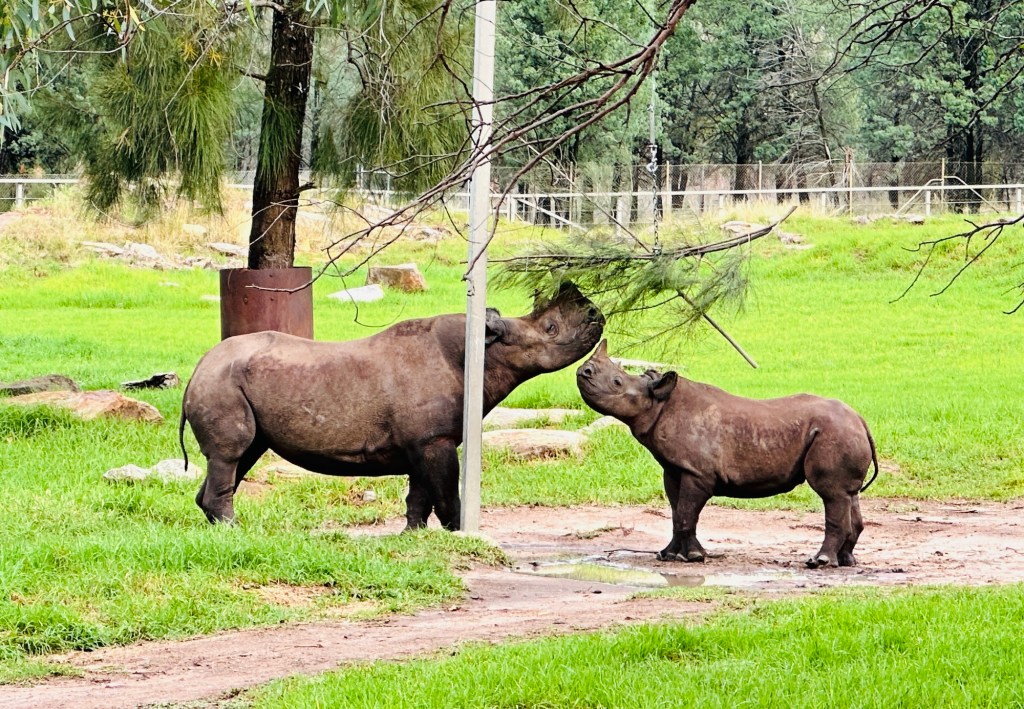
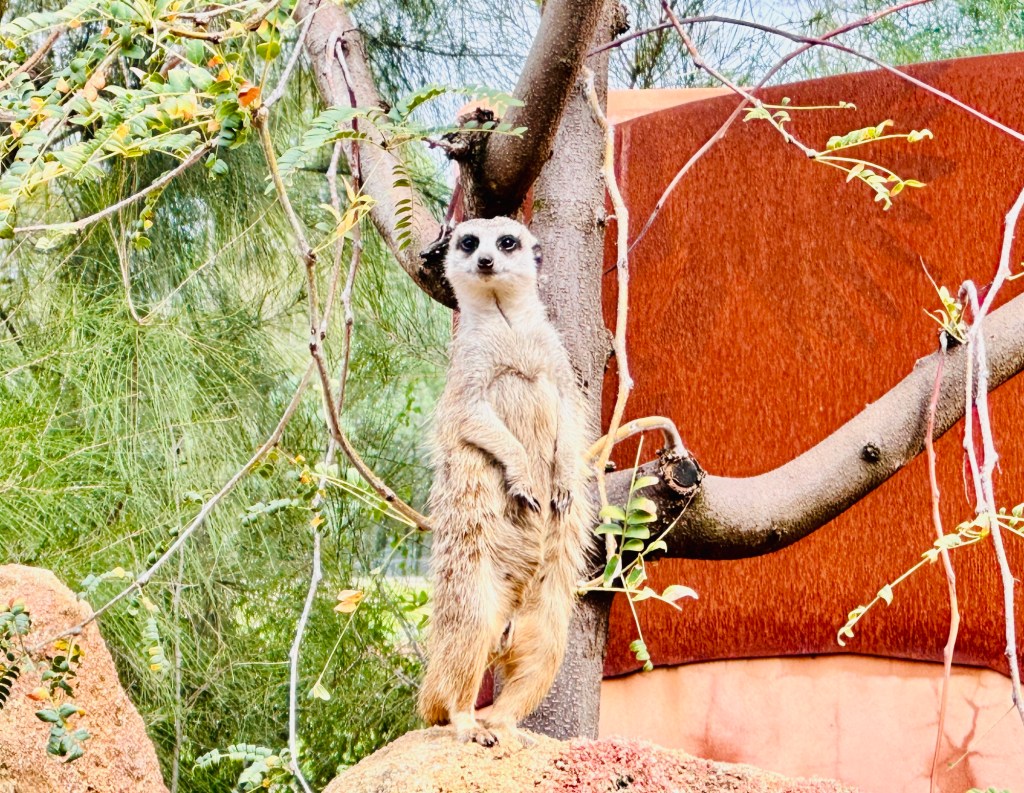
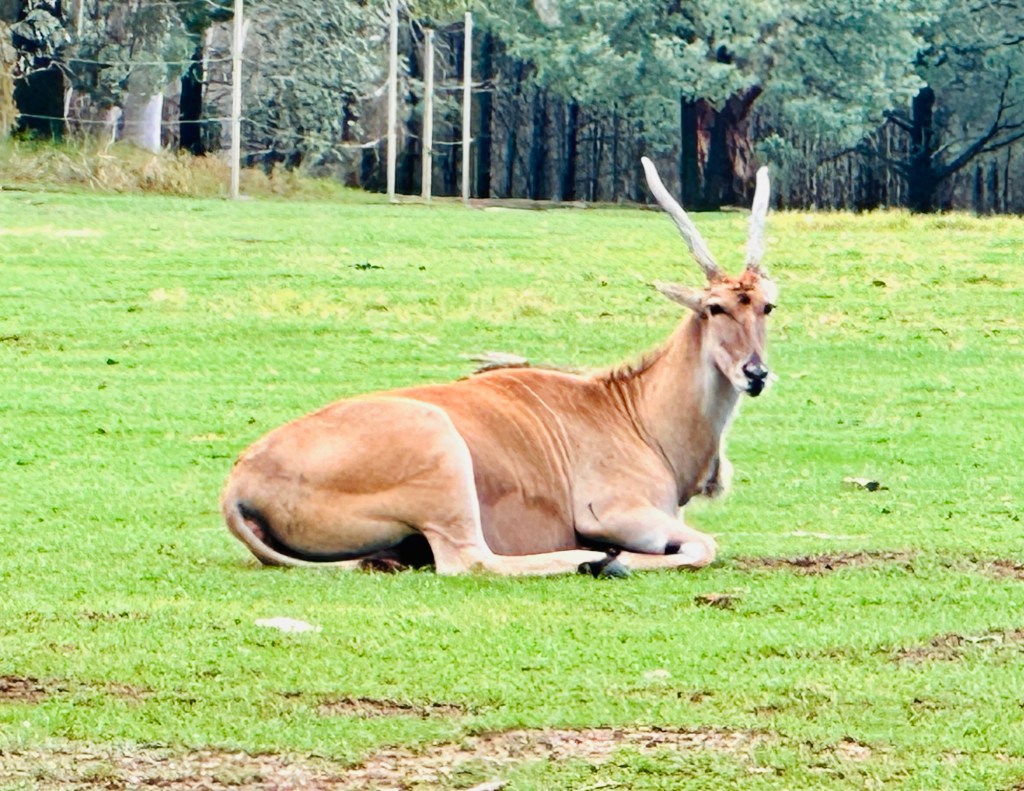
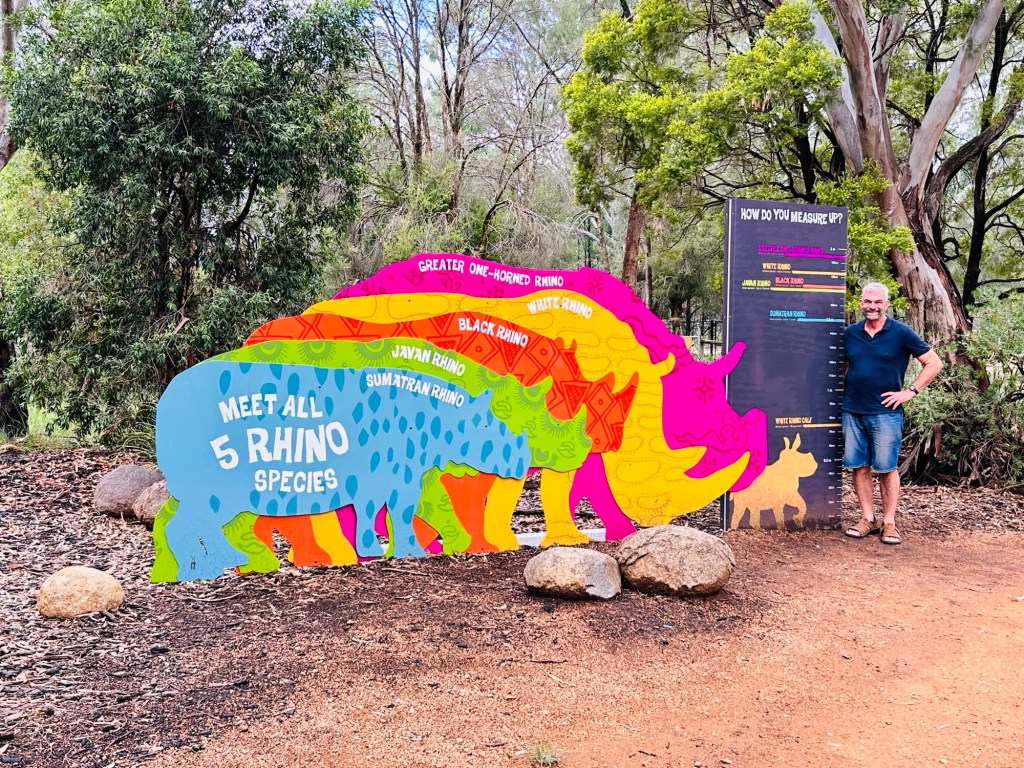


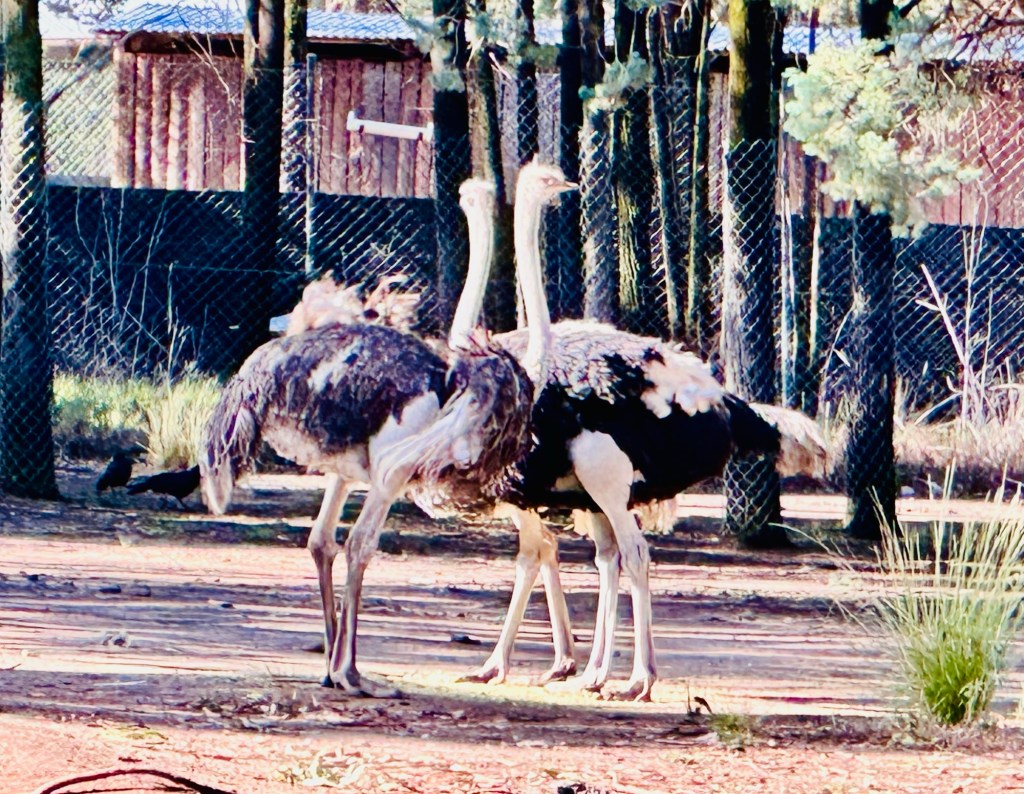
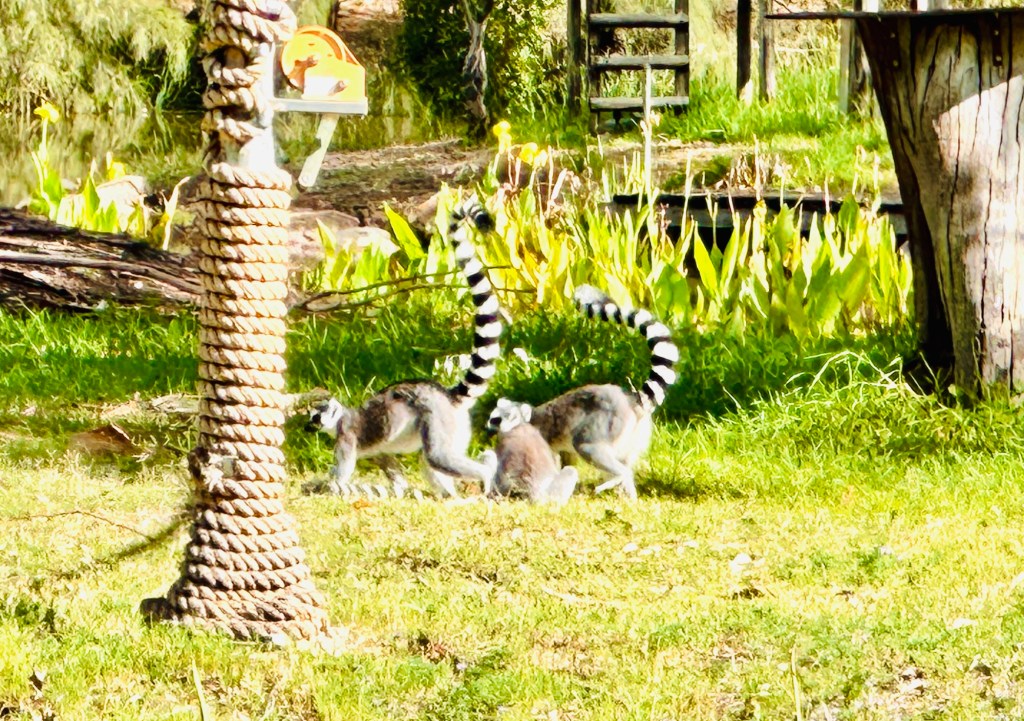
We had a wonderful three hours enjoying the animals. I think the earlier rain had deterred a lot of people from visiting , so there was no crowd – it was brilliant.
We treated ourselves to dinner at the Dubbo Club, which being next door to the caravan park, we could walk to. Nice food, and the dinner was very reasonably priced.
Day 7
Wednesday 3rd April 2024
Dubbo
14 – 25 degrees, sunny
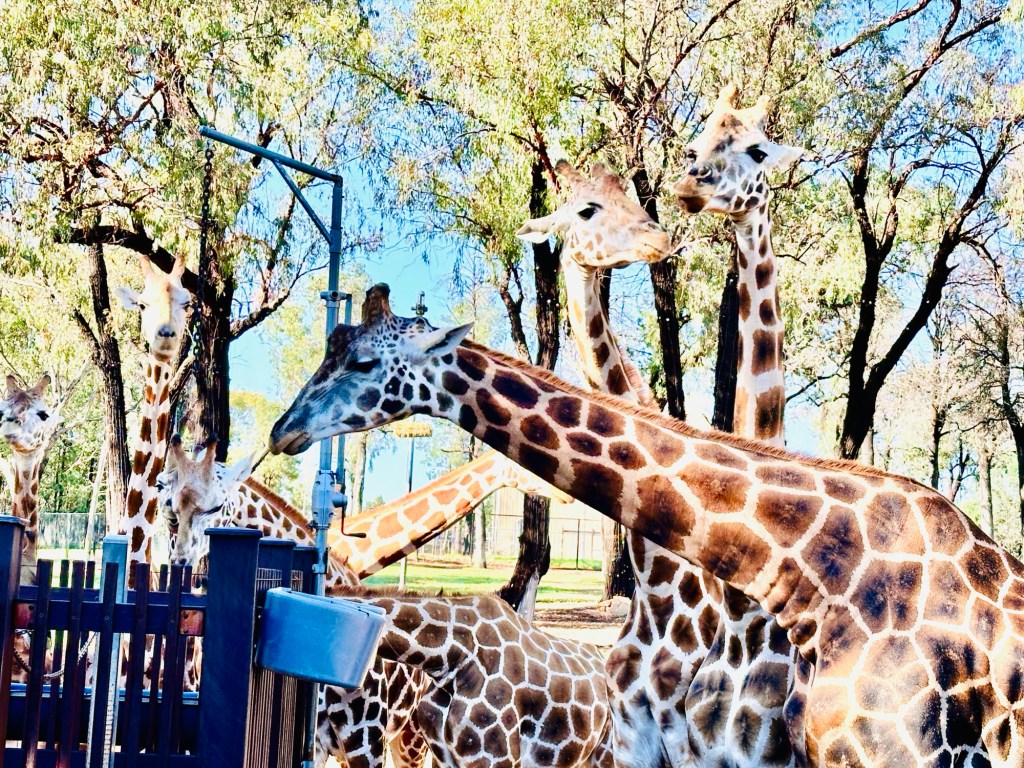
Back to the zoo, this time we rode to the zoo from the caravan park, then continued riding around the park. We were in time for the giraffe feeding – those eyelashes are amazing! The Sumatran tiger interactive talk was also fantastic.
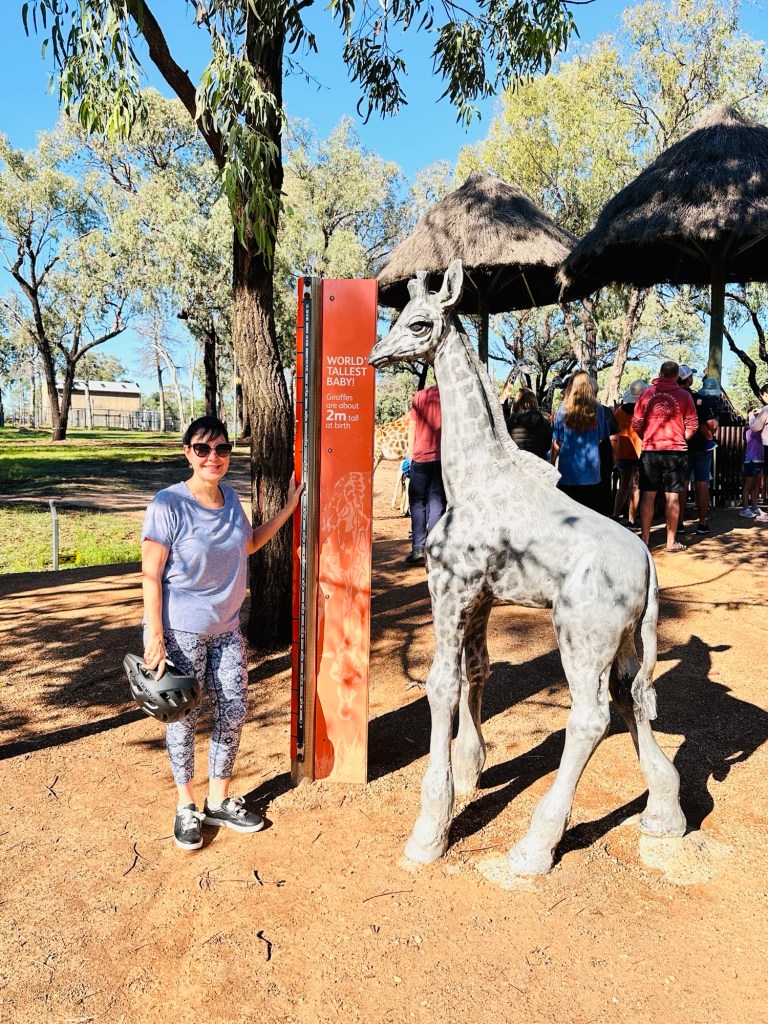


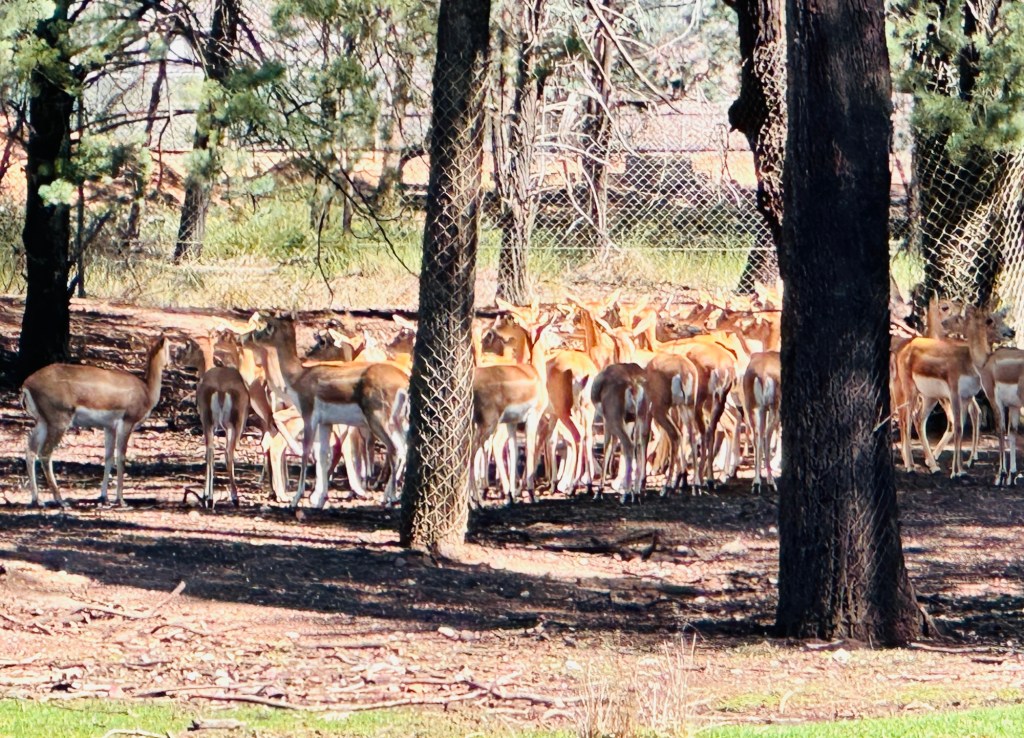
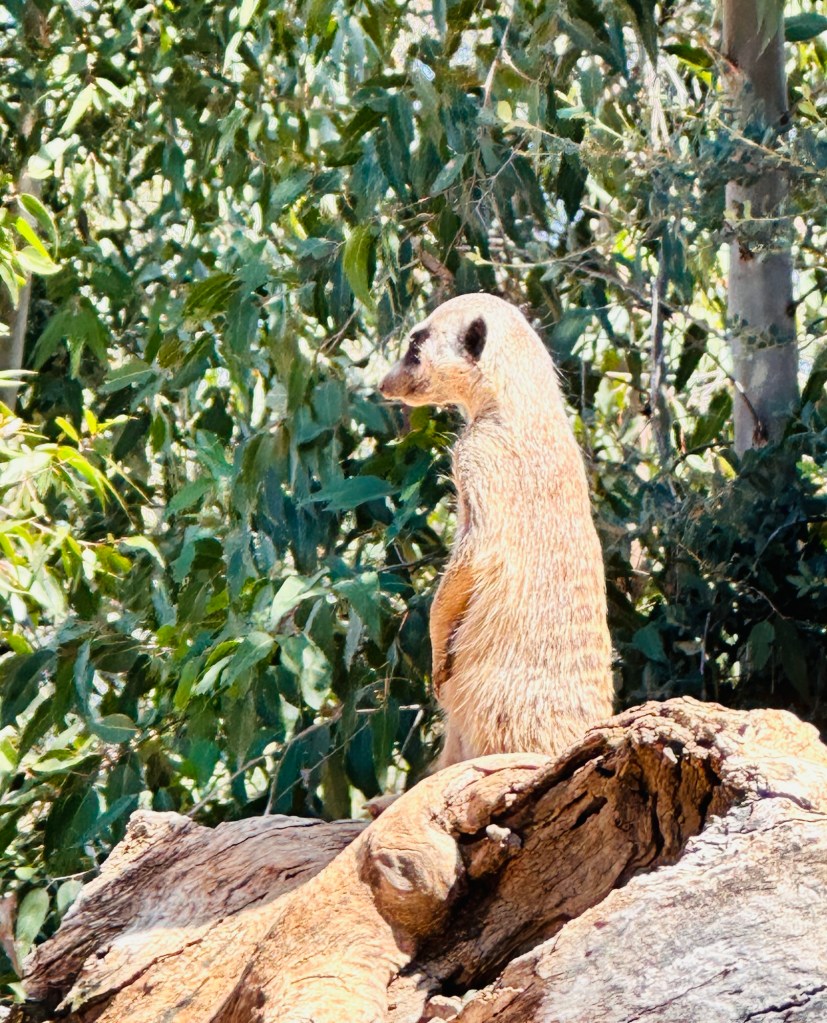
I was fascinated with the Bongo – an animal I’d never hear of before. The bongo is a large, mostly nocturnal, forest-dwelling antelope, native to sub-Saharan Africa. Bongos are characterised by a striking reddish-brown coat, black and white markings, white-yellow stripes, and long slightly spiralled horns. It was a beautiful beast.


Even though we have seen a lot of these animals in the wild, it was really interesting to hear about the conservation programmes, and a nice reminder to avoid using commercial palm oil. So many animals are endangered because of deforestation.
I felt the enclosures were all well spaced and maintained to a very high standard. All the animals were in excellent condition.
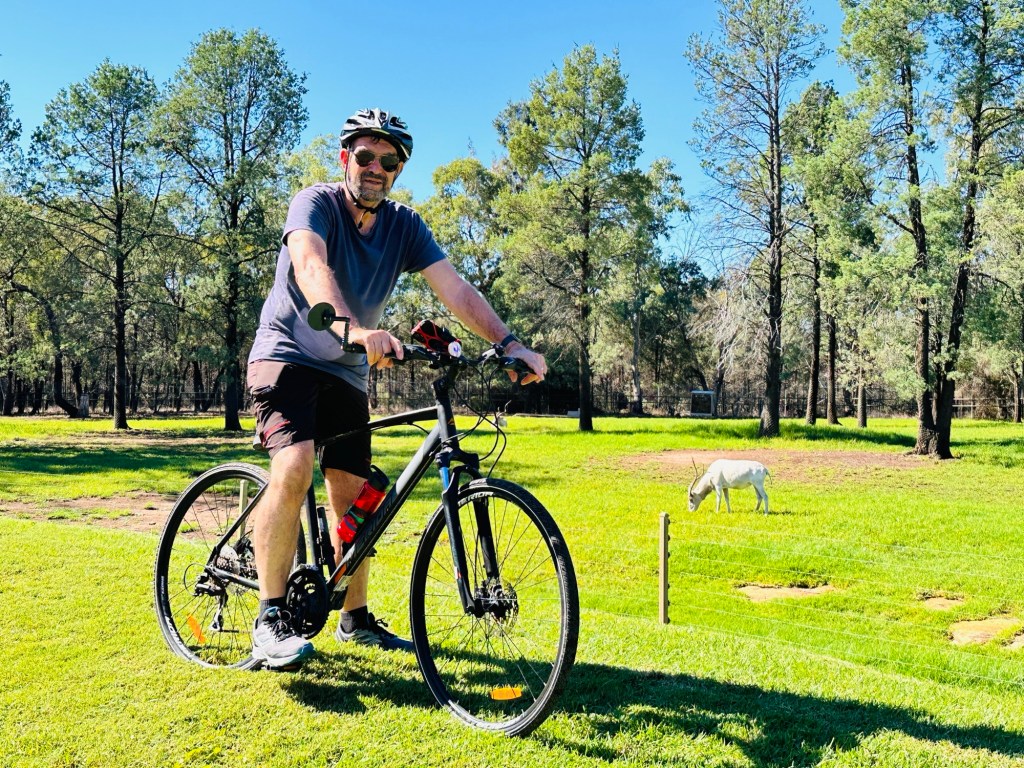
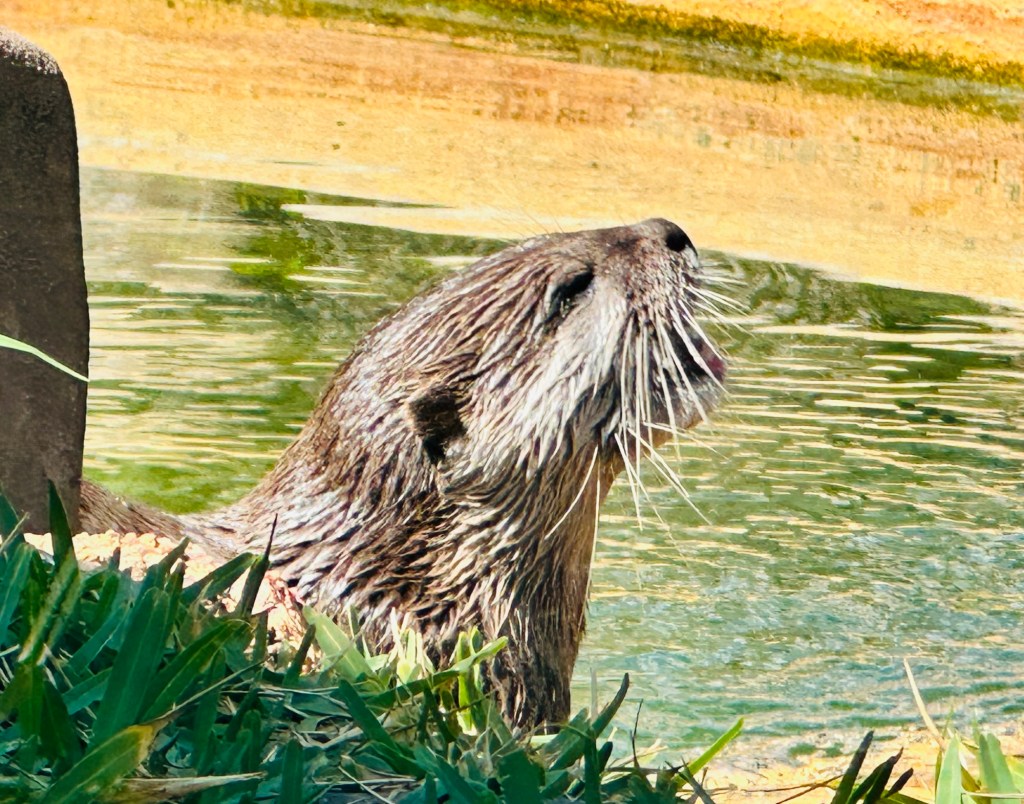
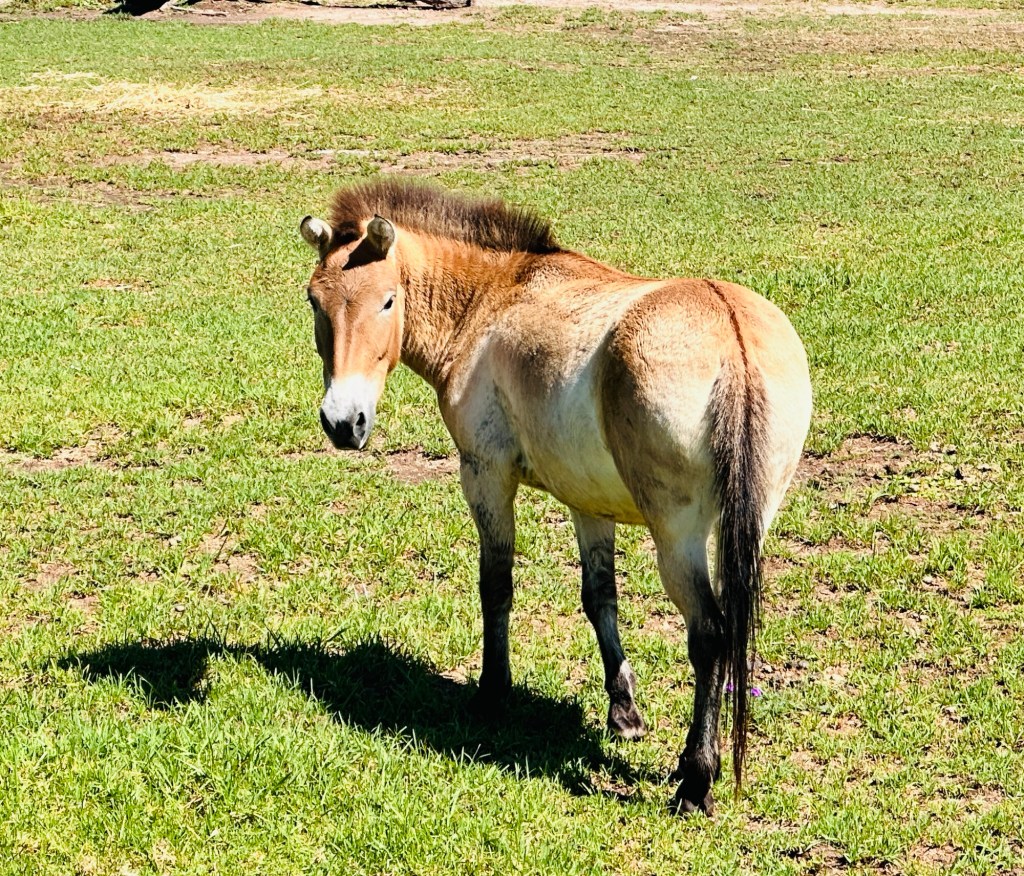

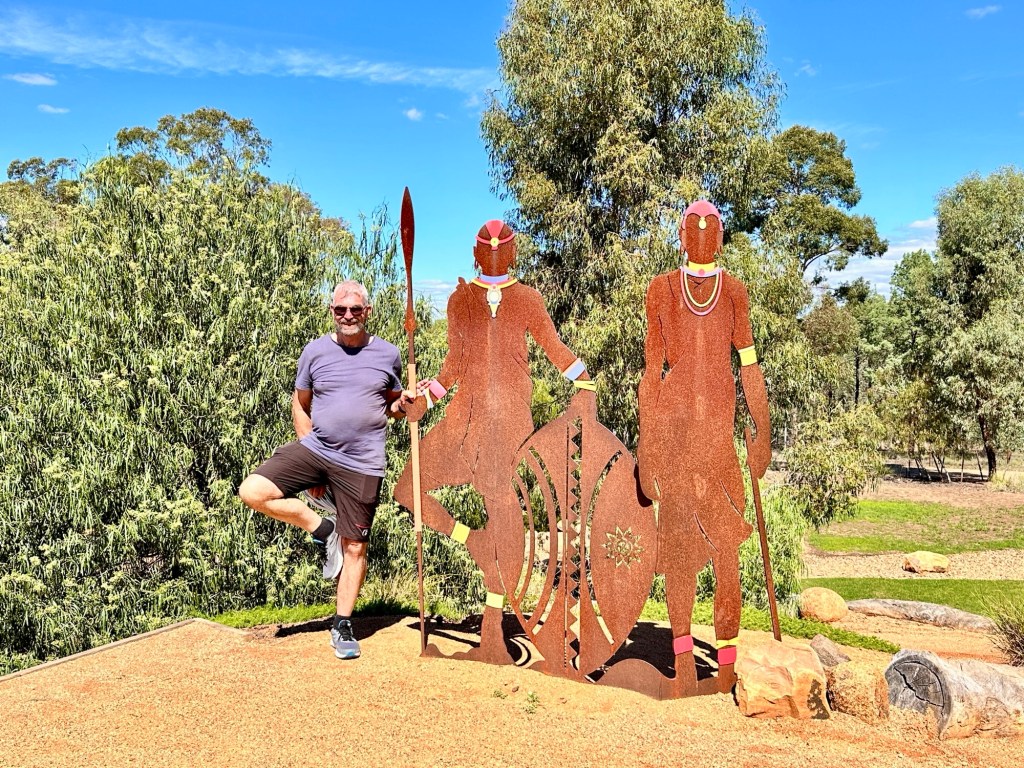
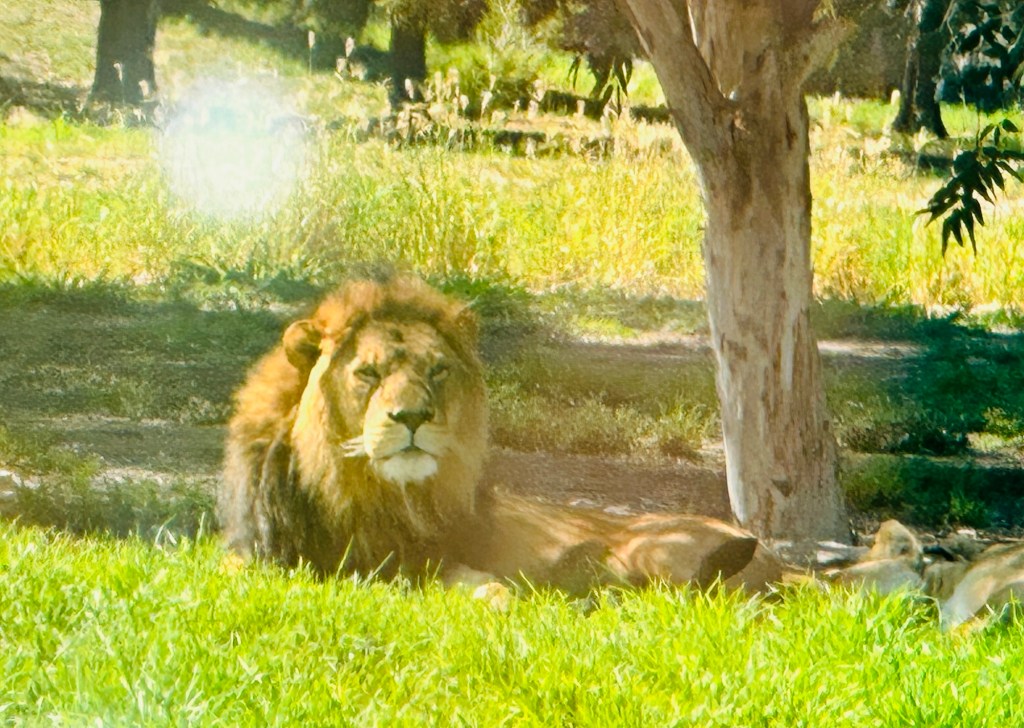
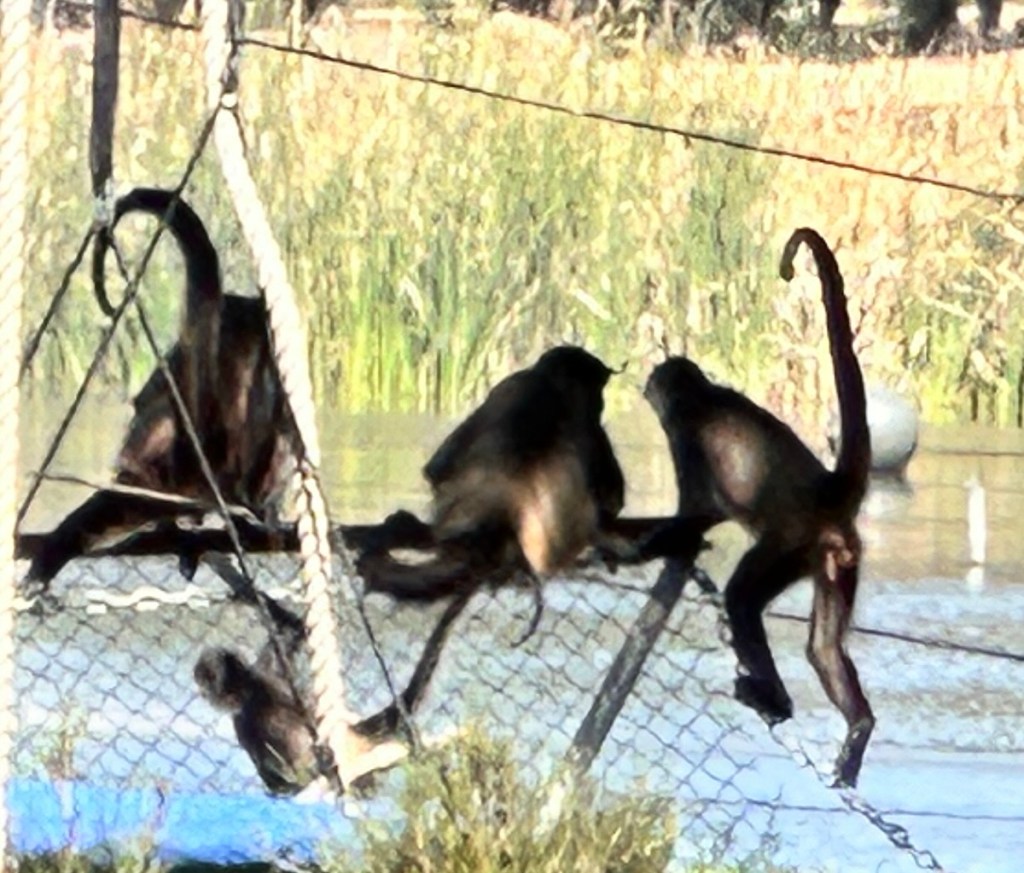
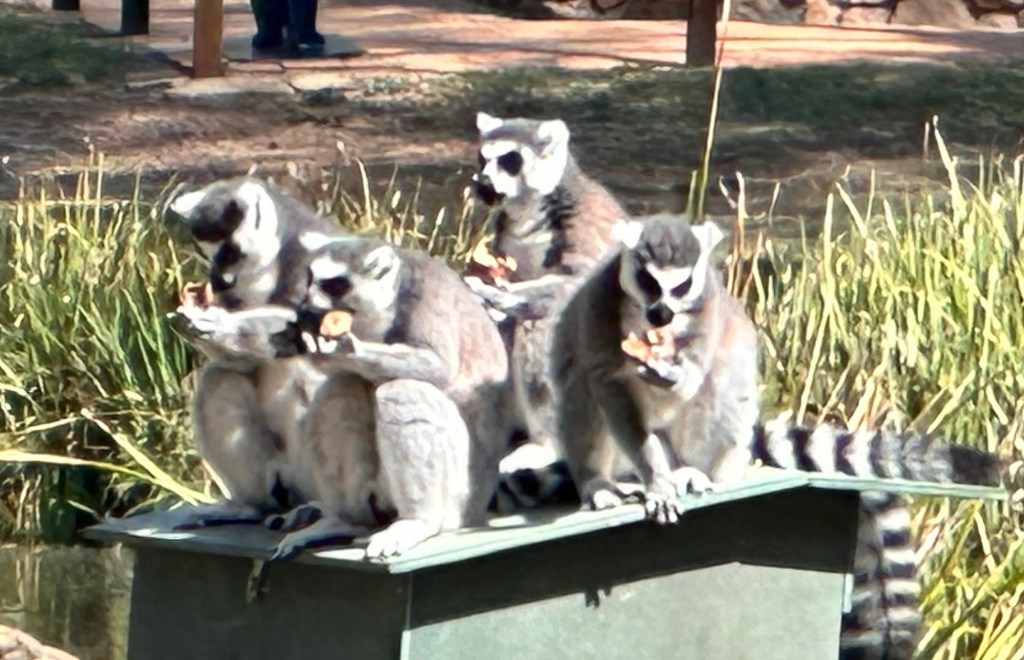
We thoroughly enjoyed our time at the zoo.
Day 8
Thursday 4th April 2024
Dubbo to Leeton
14 – 26 degrees, cloudy
388 kms
Packed up with minimal of fuss. The worst part was trying to line up the car with the hitch – small space and the steep kerb… grrrr! We then took advantage of using the car wash bay at the caravan park to wash the last of the mud of the bottom off the van. Job done!
We drove through Parkes and onto Forbes for our coffee stop. These roads were familiar after only being here three months earlier. At Forbes, we crossed the Lachlan River and headed onto West Wyalong where we had our lunch stop at one of the rest stops. An 88 year old local man on his electric bike stopped for a chat – he was lovely. Told us his how to get Weethalle to look at the silo art. I always find the local country people are generally very friendly.
The Weethalle silos were painted by Melbourne based artist Heesco Khosnaran. The large scale mural is a tribute to the rich agricultural heritage of the small community of Weethalle and the surrounding Bland Shire Communities. They portray a shearer, a grain farmer and a small flock of sheep perched high on a balcony keeping a watchful eye over the land.
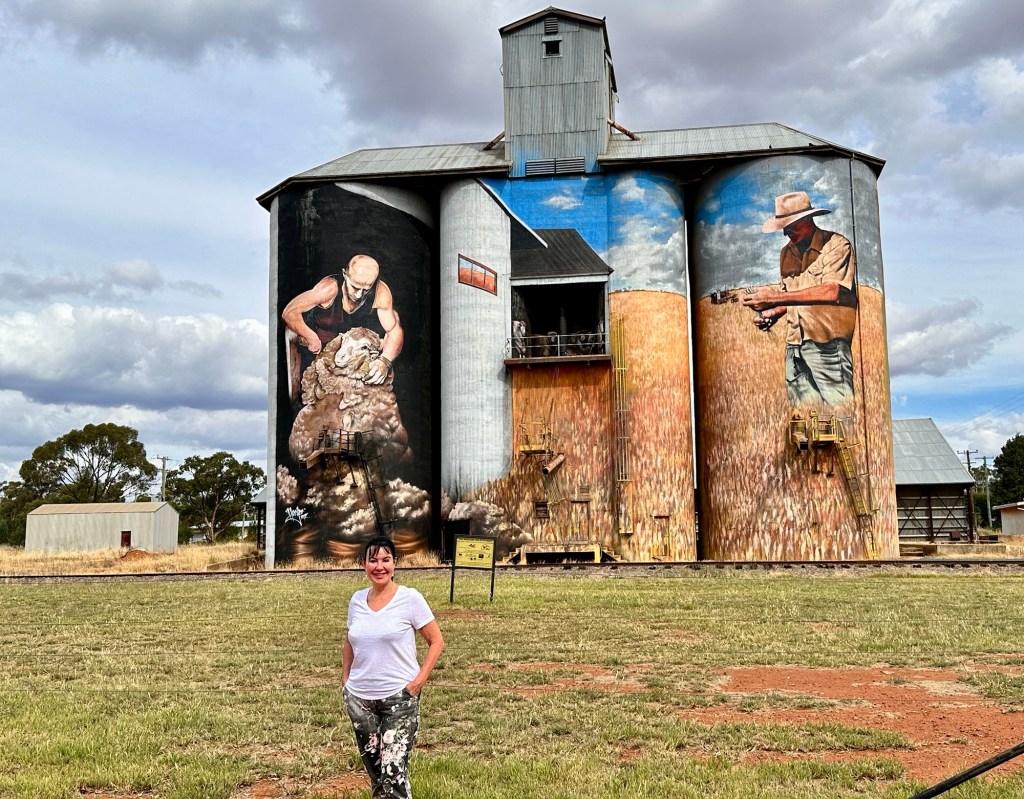
Onto Leeton, driving through typical sheep and wheat farming land. We checked into the Leeton Showgrounds for the next two nights. An easy set up, plenty of space.
Off for a bike ride to explore the lovely little town. The town still has an incredible collection of well-preserved art deco buildings, not in the least the legendary Roxy Theatre, which has been operating as a cinema since 1930. Noted architect Walter Burley Griffin may be best known for designing Canberra, but he spread his wings to Leeton (and other areas) , which he designed in the early 20th century as part of the Murrumbidgee Irrigation Scheme.
We had a lovely ride around looking at the Roxy Theatre (which is currently undergoing extensive renovations), the many art deco shop fronts, the Hydro Hotel, and the water towers, which also have an art deco touch. There is an annual art deco festival in the middle of the year- I think we might have to return!

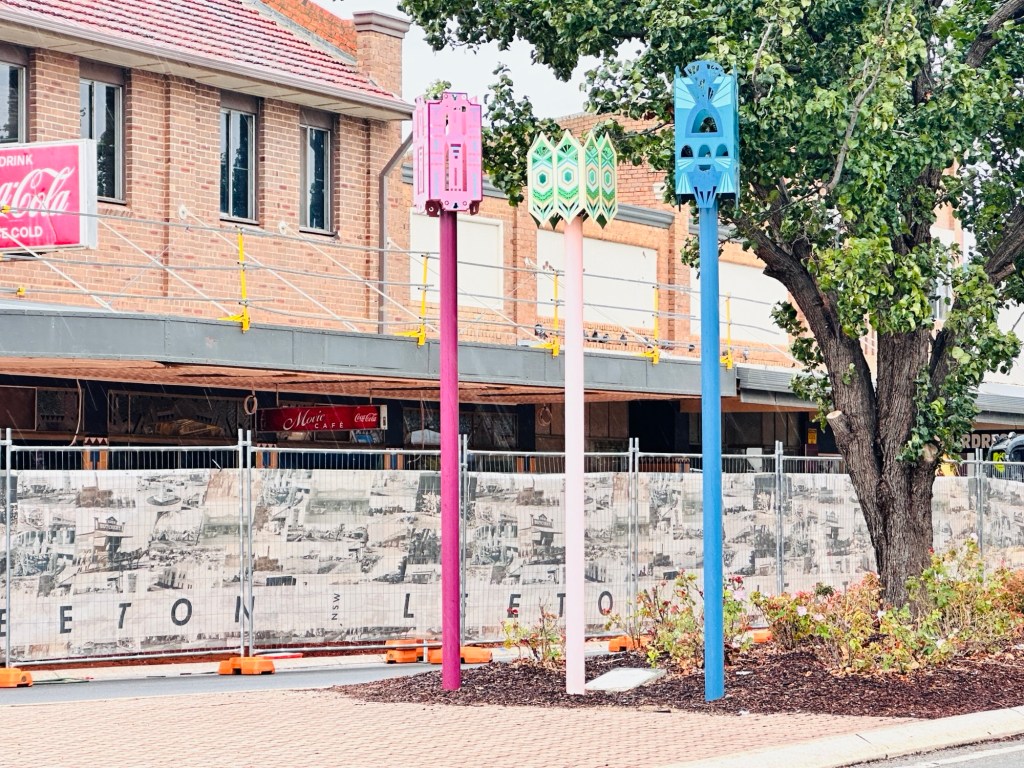
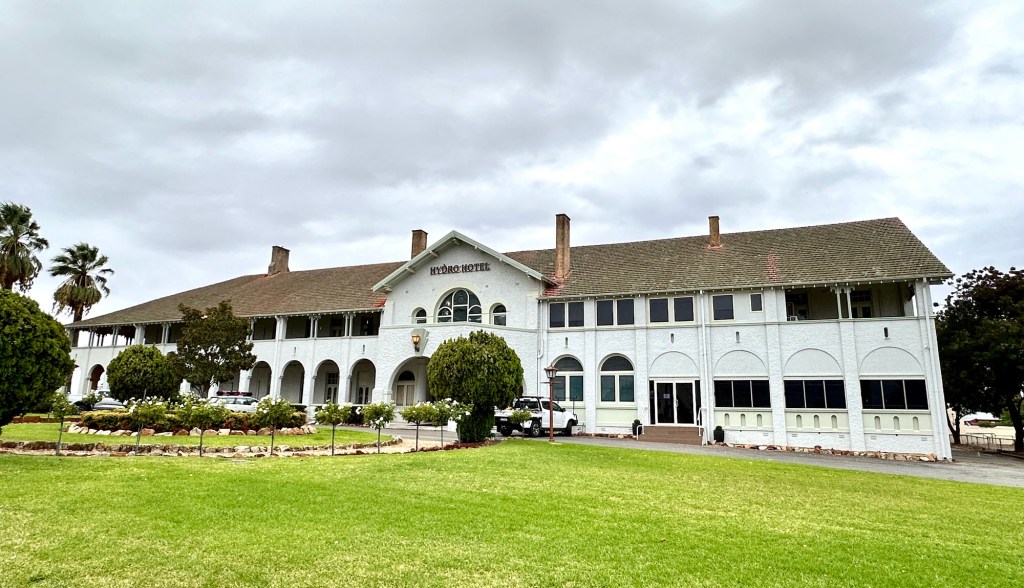
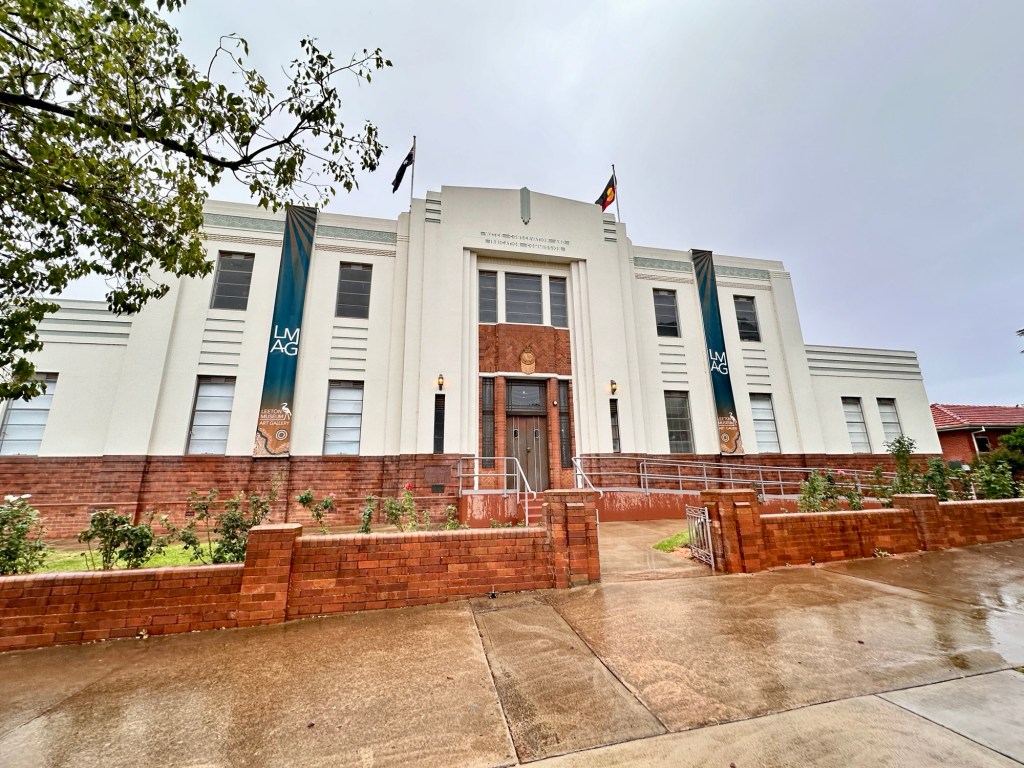
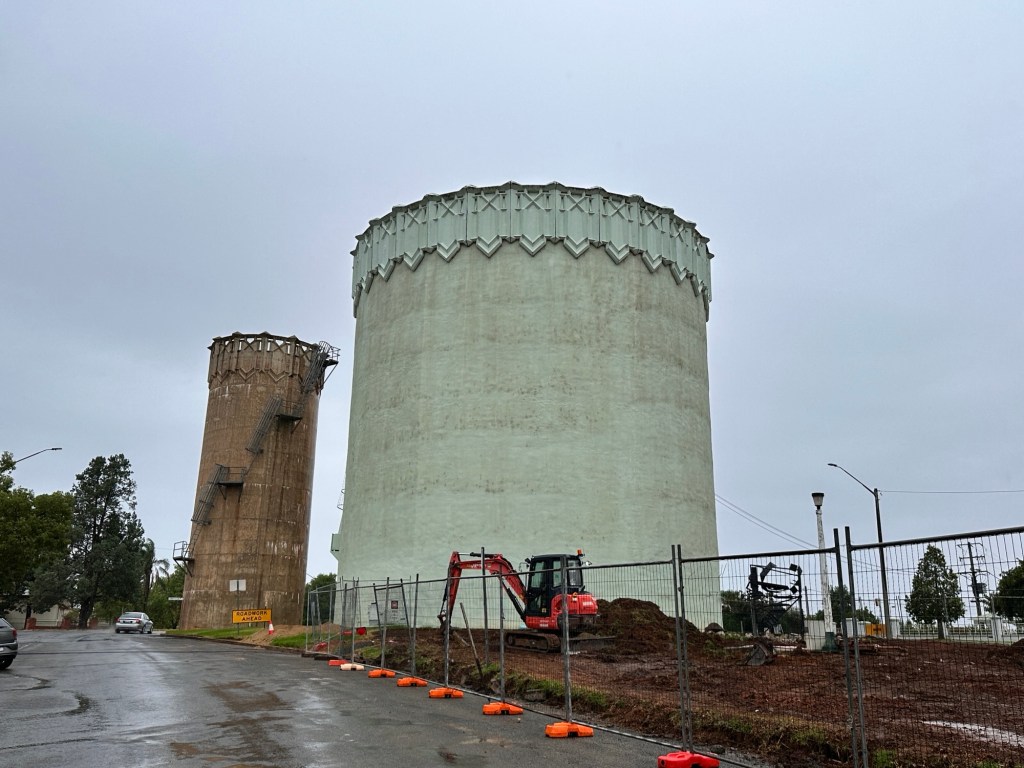

Rode home to find Frank had a flat tyre! A job for another day. Then the wind came up, so we had to batten down the hatches!
Day 9
Friday 5th April 2024
Leeton
15-19 degrees, started riding at 5am and didn’t stop all day
The information centre was our first stop. The lovely lady there armed us with information as to what to see and do in the Leeton area. Unfortunately the rain event that had been hammering down on the east coast of Australia had caught up with us. We were only on the edge of it, but nonetheless it rained all day, and was quite cool.
Leeton is one of Australia’s richest agricultural areas- it is known as the Rice Capital. As well as rice, the Leeton Shire also possesses numerous citrus, cotton, grape, walnut and wheat farms.
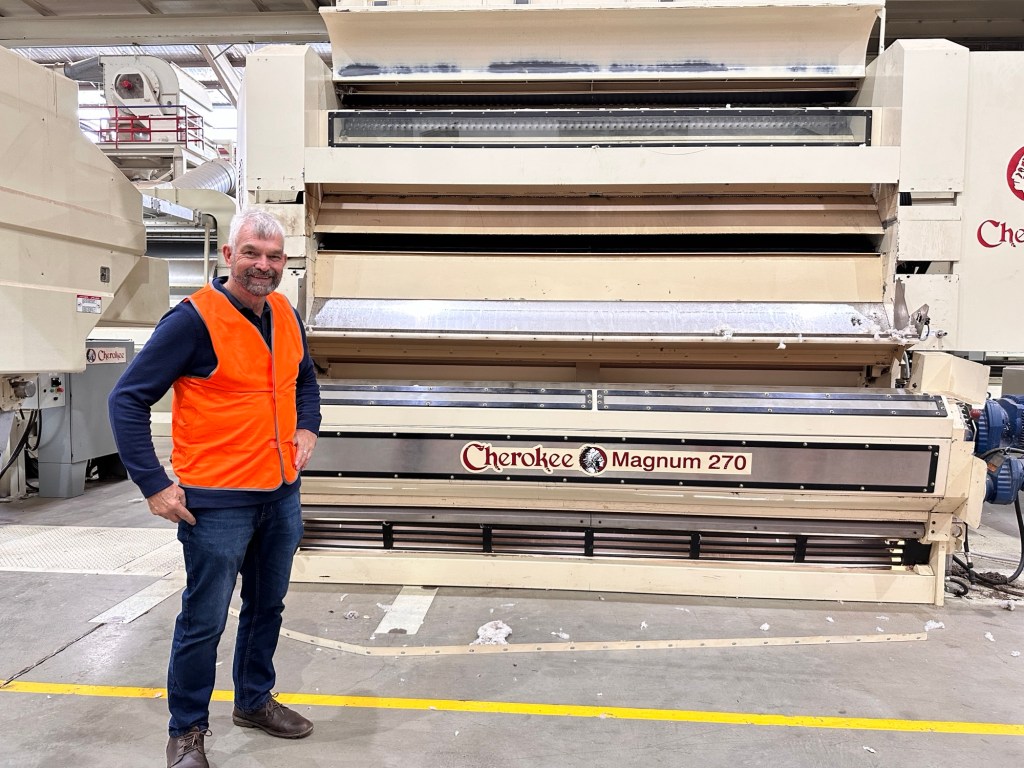
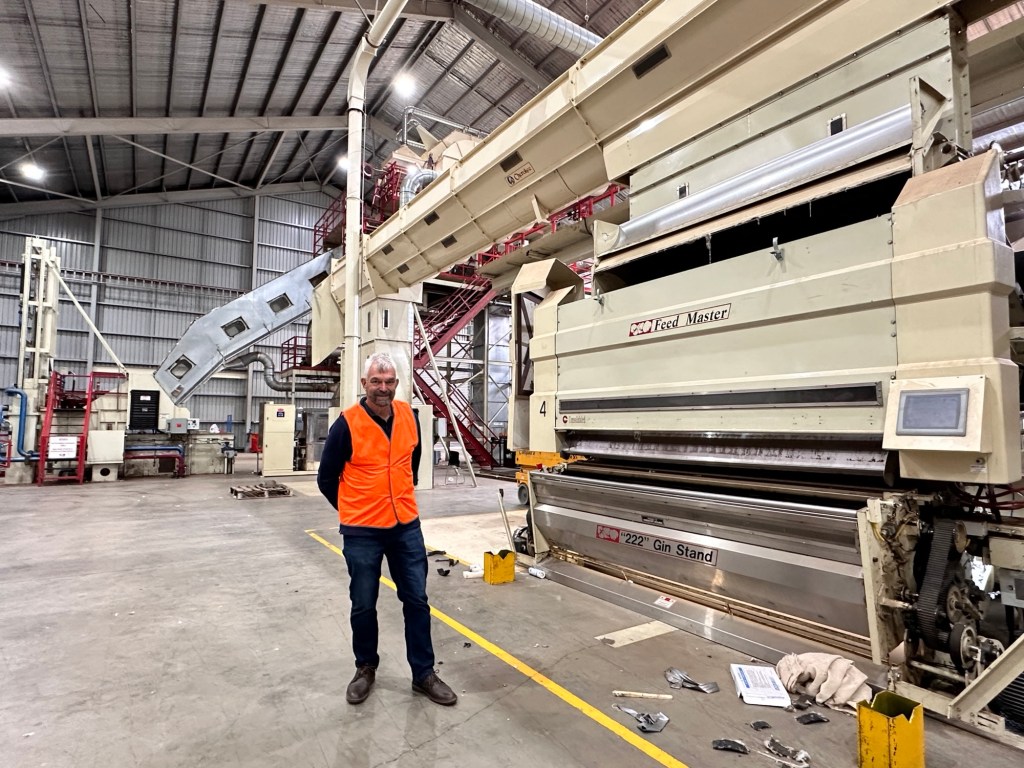
We drove to Whitton to Southern Cotton Gin, where we did a tour. It was quiet in the gin as the harvest doesn’t start until the end of April. It was very interesting seeing how cotton goes from field to fibre. The genetically modified seeds come from American. After the ginning process is completed, there is only 5% waste, which is then composted.
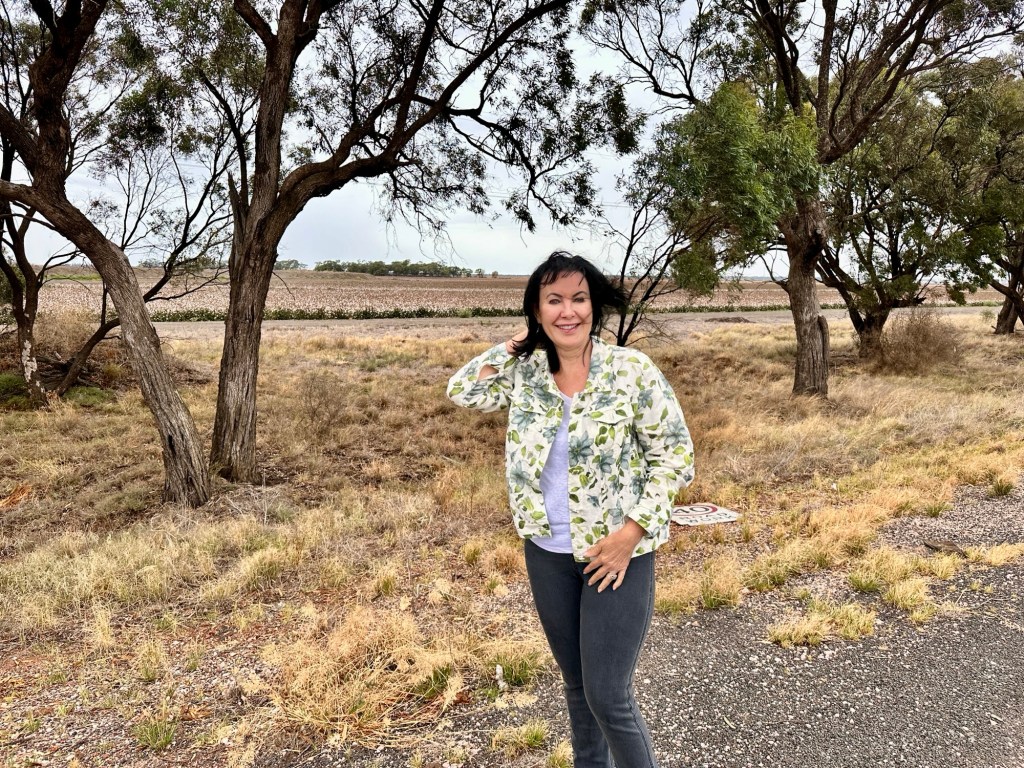

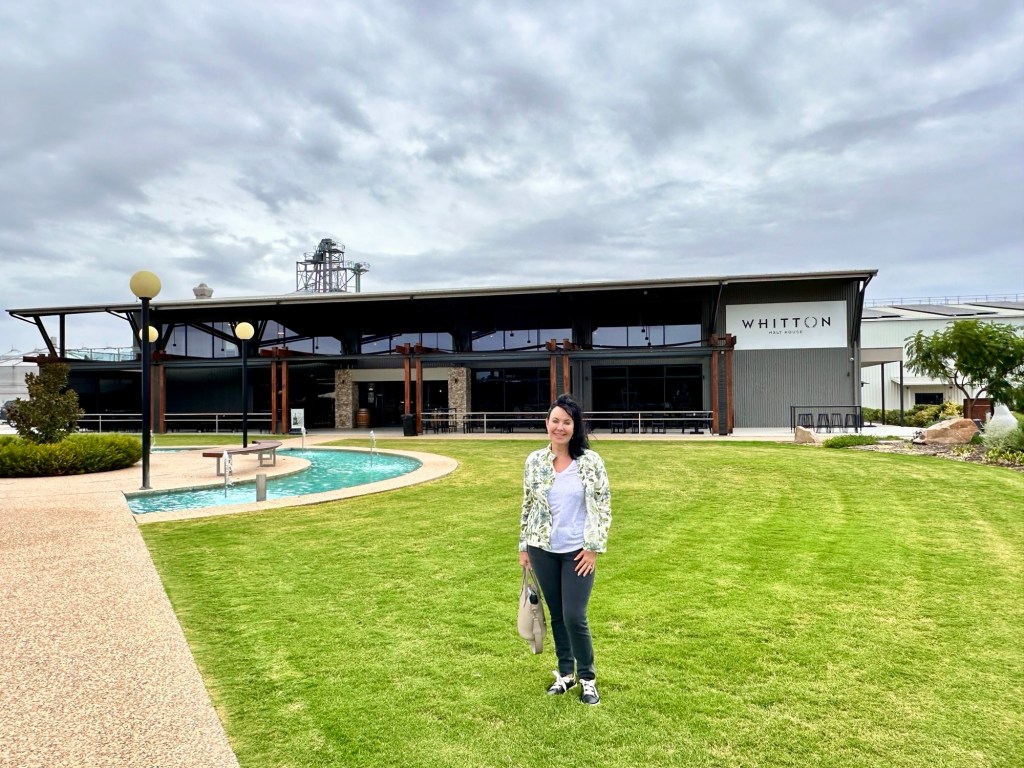
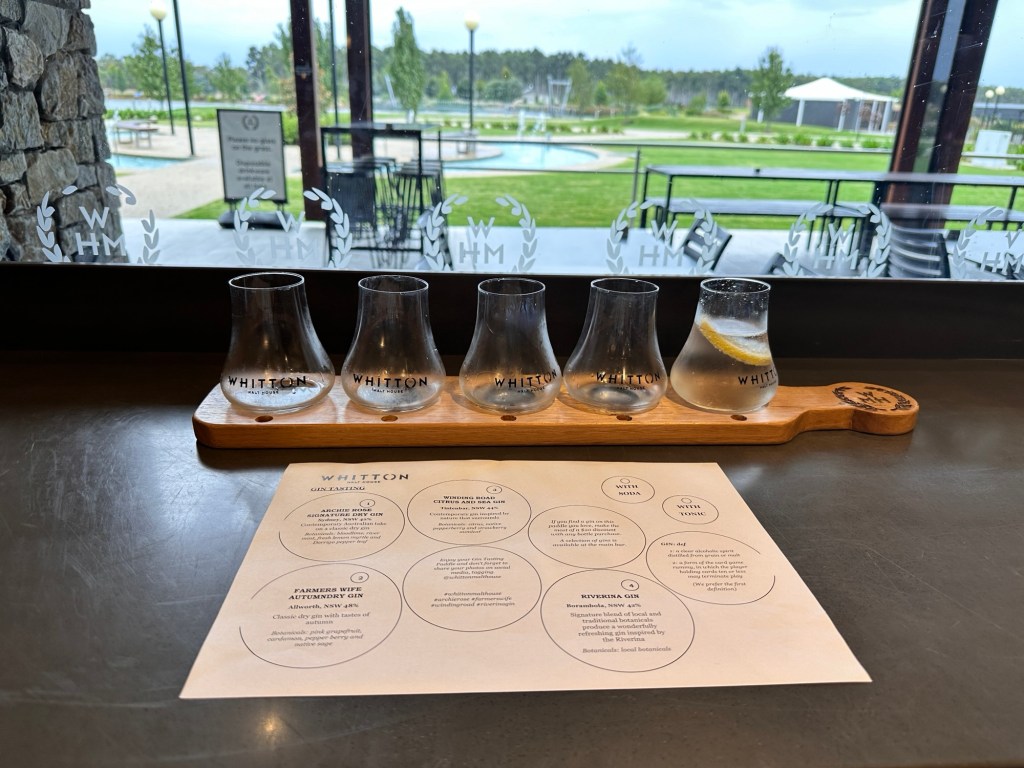
The Whitton Malt House is next door. Here you can enjoy Riverina produce, craft beers, Australian made whiskey and gins. Of course we felt obliged to do a tasting – we chose the gin tasting paddle. Some very nice gins – we like the Farmer’s Wife Autumn Dry gin the best. Beautiful gardens surround the grand building.
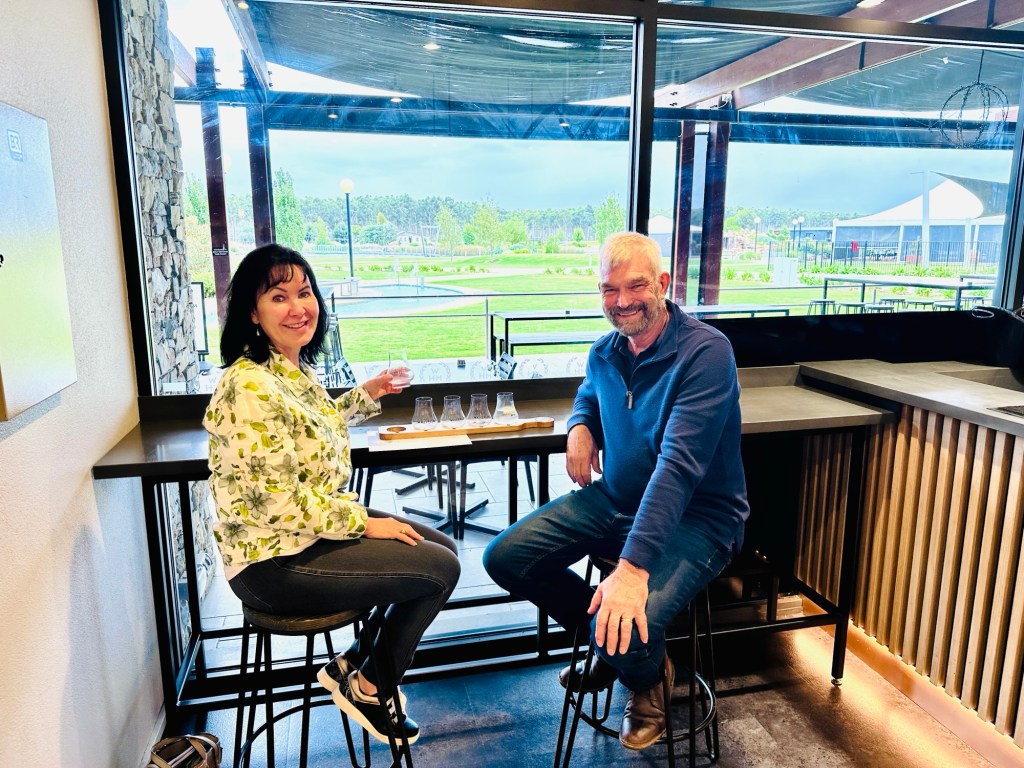
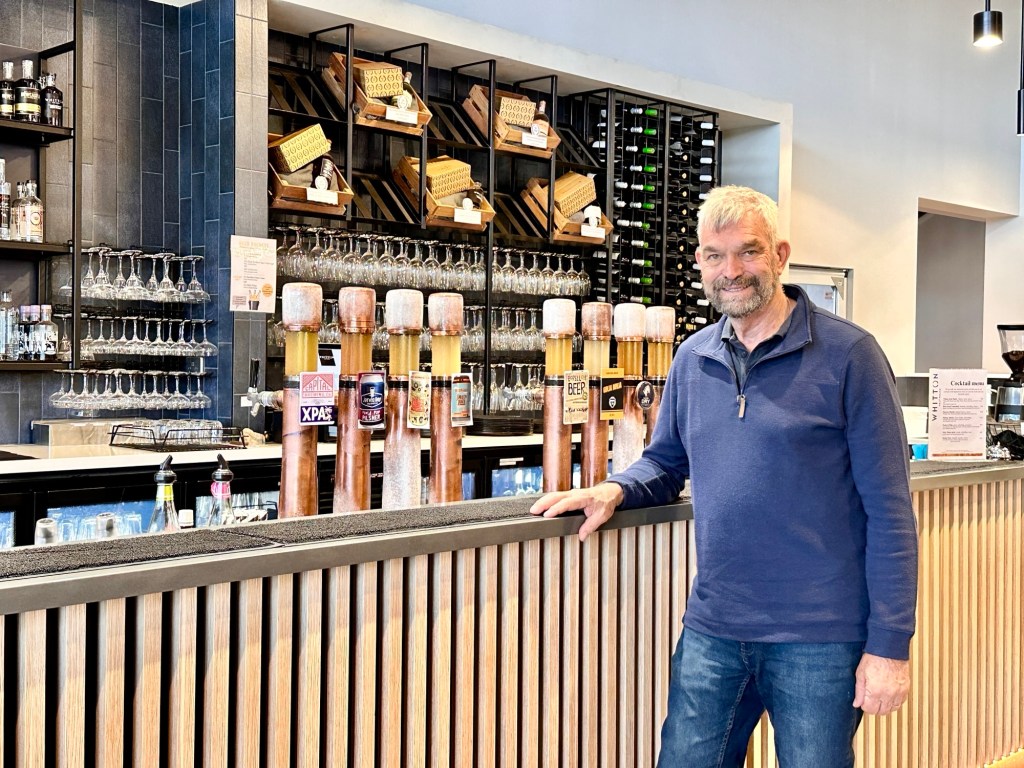
Drove past a water tower in Whitton, and some other art work. The museum was closed.
Back to Leeton, where we spent some time in the Leeton Museum – some good information about the Murrumbidgee Irrigation Scheme, and also history on the Letona Cannery (which I’m sure I went to as a child).
By 4pm, we decided we’d enough of the rain, so went back to our cosy caravan to warm up, and had a quiet afternoon/evening, catching up on some reading and tv viewing. Rain rain go away.
Day 10
Saturday 6th April 2024
Leeton to Echuca
14-22 degrees, cloudy to sunny
400 kms, approximately- did some detouring
And just like that, at 4am, the rain stopped, finally! It had been constant until then. On our way, and our first stop was the Narrandera water tower. The theme for the Narrandera Water Tower Art comes from the team of Apparition Media spending time chatting with the community and the inspired work of Narrandera artist and Wiradjuri man, Owen Lyons whose artwork inspired the symbolic concepts for the mural. The stories behind the designs include significant icons for the Narrandera Shire Council.


We stopped at the Visitor Centre to see the giant guitar. Narrandera’s Big Playable Guitar is the biggest playable guitar in Australia. The guitar was built in 1988 by Narrandera expatriate, Robert Palmer, to help promote the Country Music Club of Narrandera.
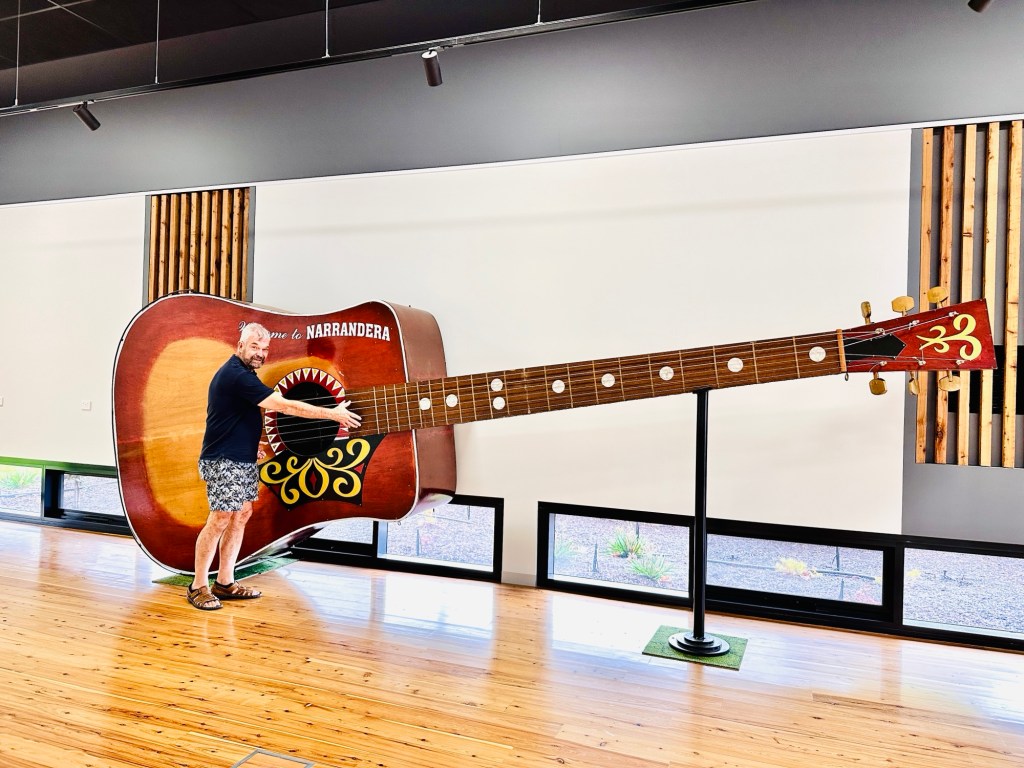
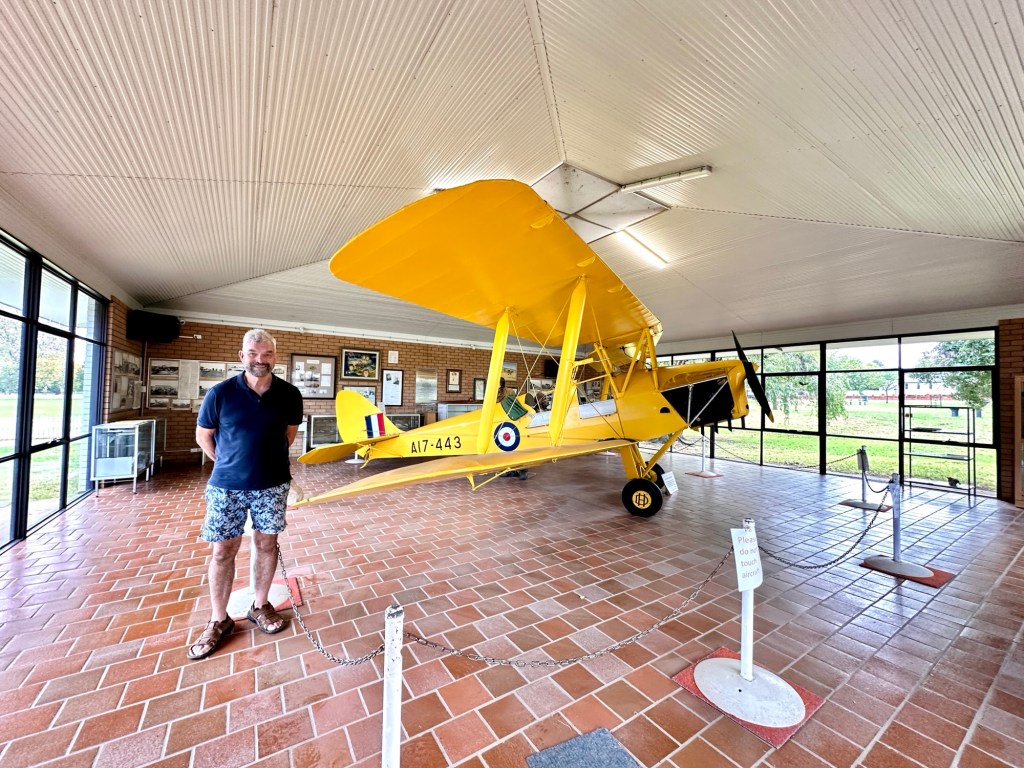
Next door was a display with a flight capable Tiger Moth and a collection of photos and memorabilia. During World War 1, the No. 8 Elementary Flight Training School was established on the site of the present airport at Narrandera. The Tiger Moth was the plane of choice in which 3,818 young men were trained in the elementary stages of flying.
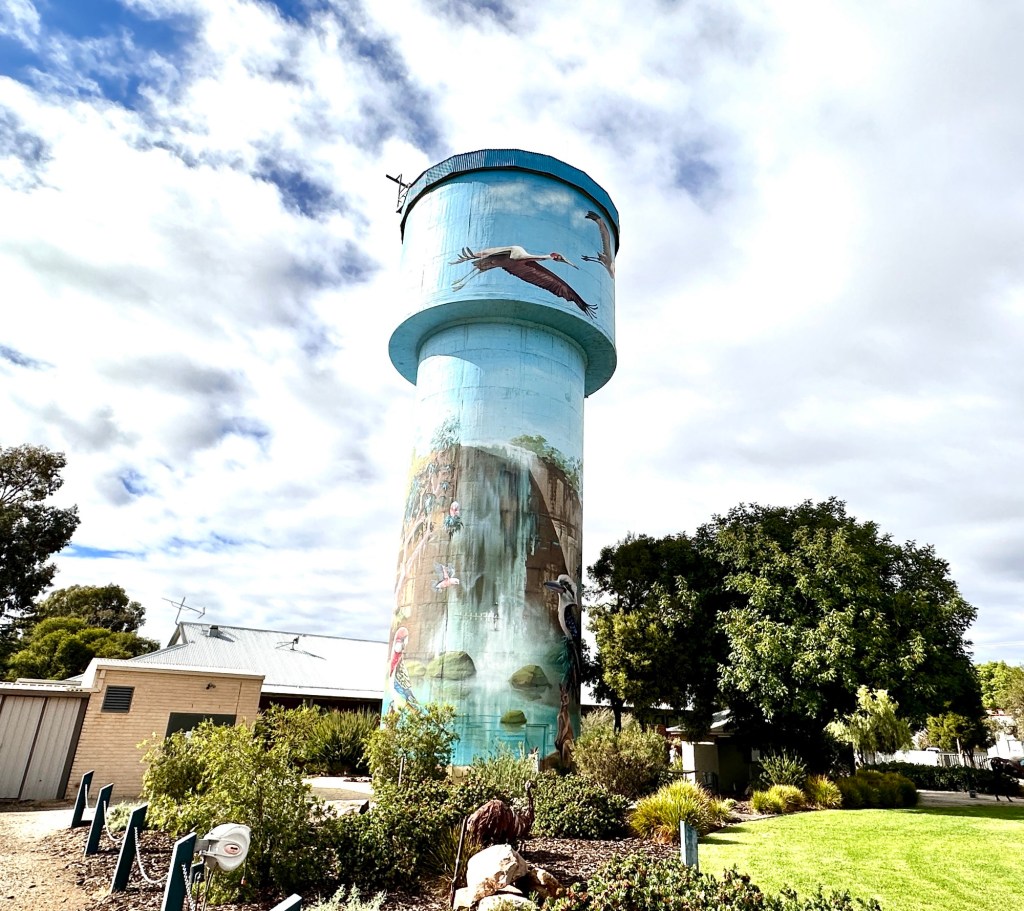
We crossed the Murrumbidgee River and took a little detour to Lockhart to see the impressive Water Tower Mural there. The mural depicts a cascading waterfall surrounded by fauna and flora native to the local landscape, reflecting the importance of one of Australia’s most vital assets – water. The artwork was designed by talented Blue Mountain artists, Scott Nagy and Krimsone (Janne Birkner).
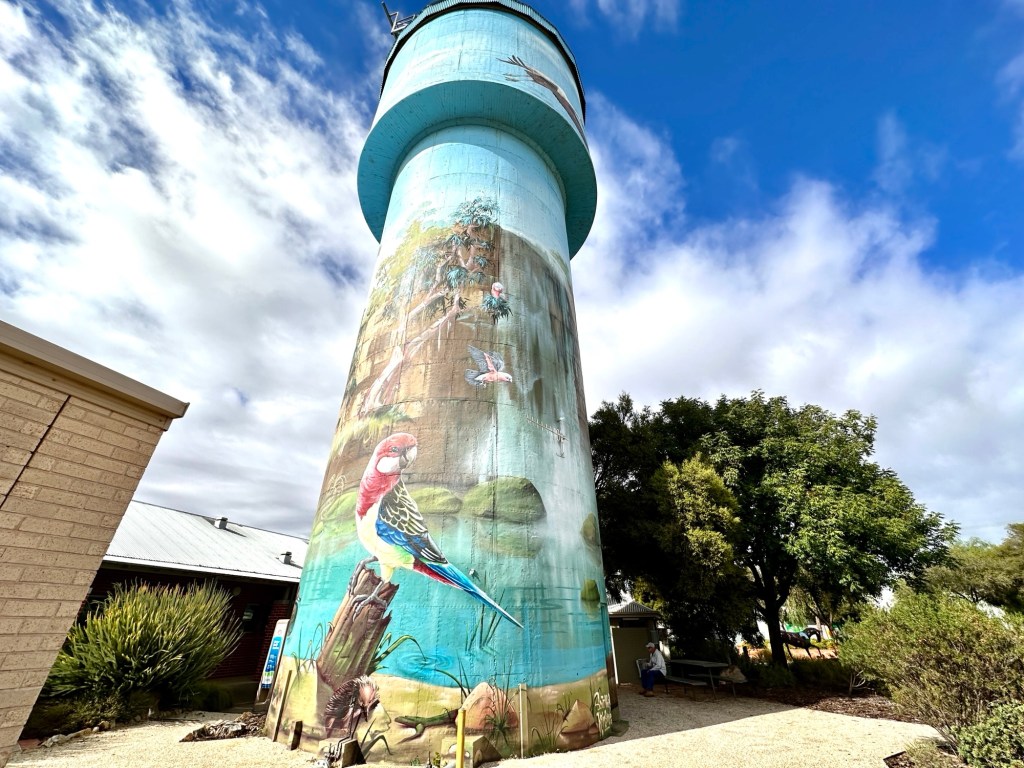
Another little detour, this time to the Milbrulong Water Tower Mural and Rosella Walk. This is a community area highlighting art, nature and heritage. The Mural of the Eastern Rosellas “nattering” away with each other was also designed by Scott Nagy and Krimsone (Janne Birkner).

Back to Lockhart for a coffee stop. Not a lot happening here – there were a lot of closed shops, but there were about 4 second hand stores that were open. Very quiet town.
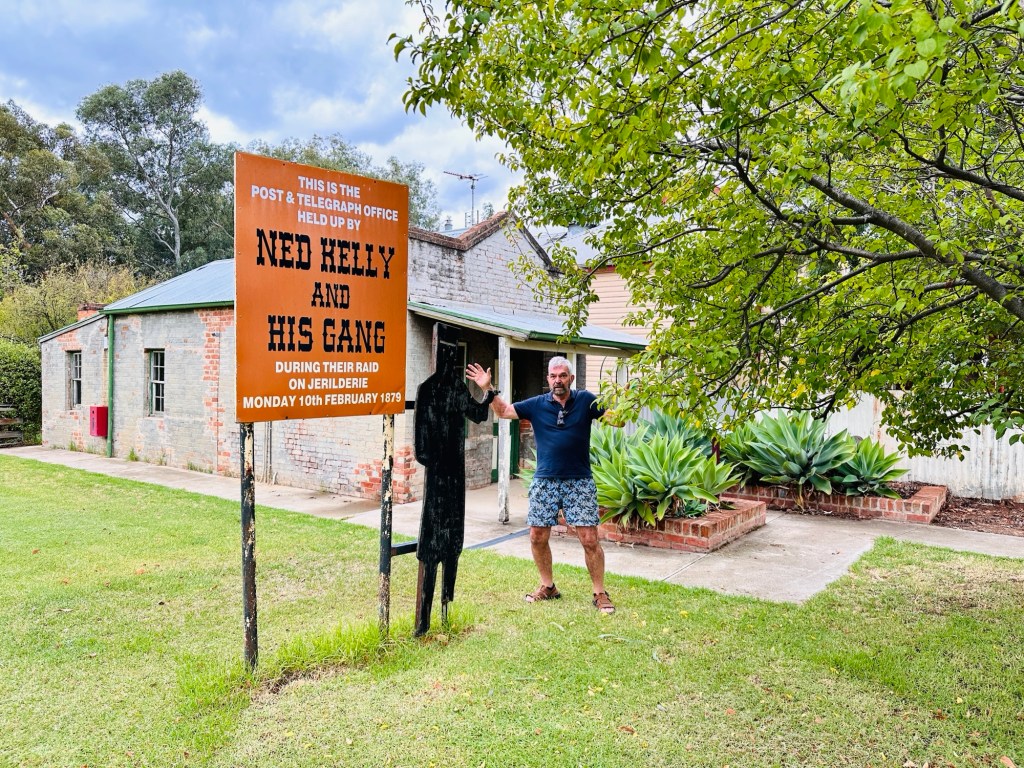
Back on track, stopping at Jerilderie for lunch, a beautiful park beside the lake. There is a Ned Kelly Raid Trail there – we looked at some of the sites. I find these little towns talk up their tourist attractions quite a lot! I wouldn’t go out of my way….
Deniliquin was the next town on our route, over the Edward River, onto Moama, across the Murray River, finishing our day at Echuca. The Echuca Holiday Park where we were staying is right on the Murray.
Once we set up, we had a little drive around Echuca familiarising ourselves with the area, and also working out times for the paddle steamer ride in the morning.
Frank changed his bicycle tube – turns out it was a thorn that caused the puncture! Onto dinner – yummy bbq lamb – and of course another bottle of red to compliment it. Life is good!
Day 11
Sunday 7th April 2024
Echuca
13-23 degrees, cloudy and sunny
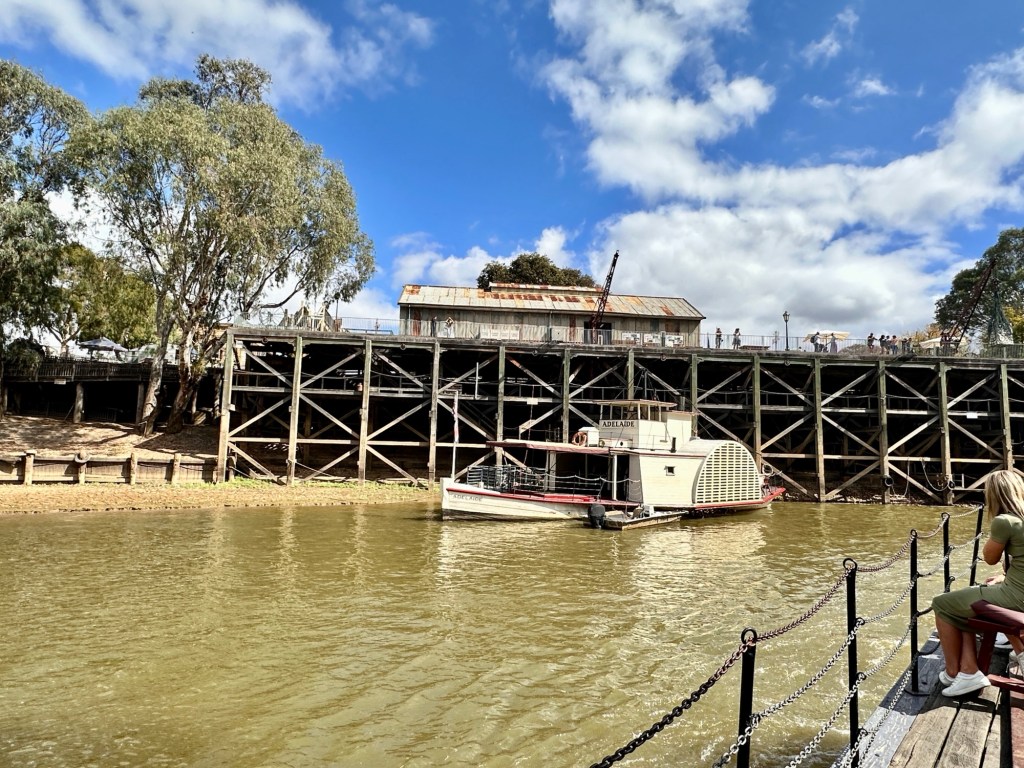
The Port of Echuca is a living monument to the 1870s and the boom of the riverboat trade. The riverboat trade exploded in the 1860s, and by 1872 the Port of Echuca was clearing 240 boats annually. Echuca was the third largest port in the country, outside Melbourne and Sydney, and the main ship building centre for the river transport industry.
At its peak, the 1865 wharf was over 300m long and supported eight red gum saw mills – it’s only a fifth of that size now. It was made famous in the TV series “All the Rivers Run” (Sigrid Thornton and Bryan Brown).
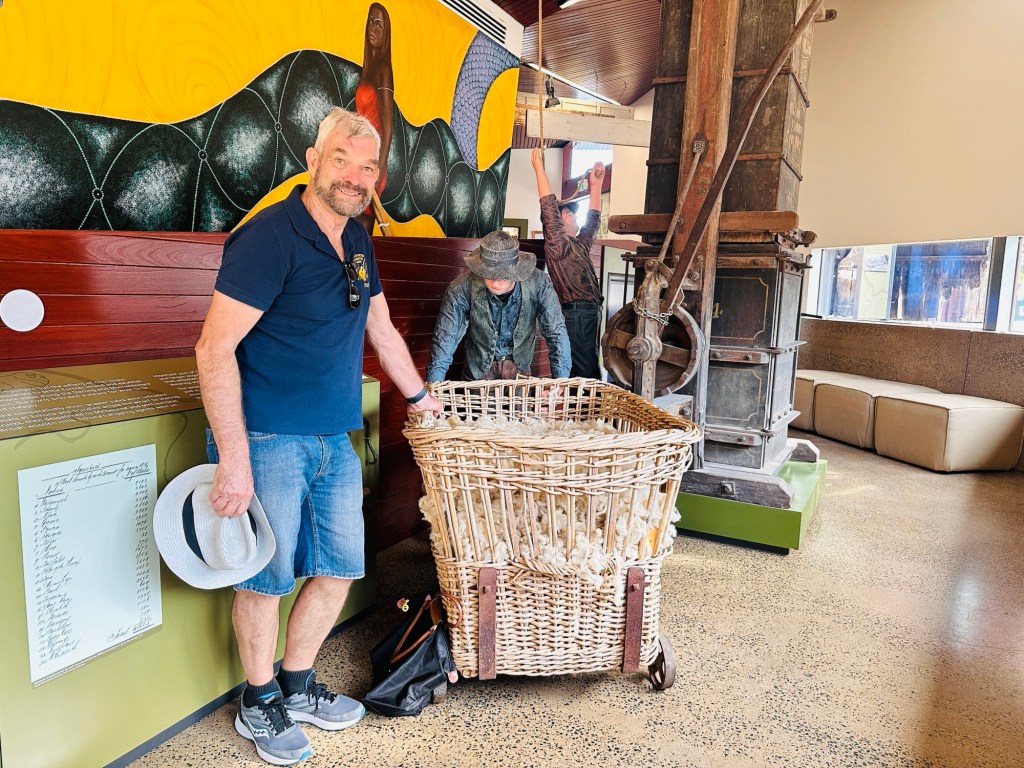
Today, the wharf is a place where you can learn about the early pioneering days at the Discovery Centre. You can view steam-powered exhibits, take a paddlesteamer cruise, and visit the surrounding historic shopfronts, pubs and cafes. It’s a busy little centre.
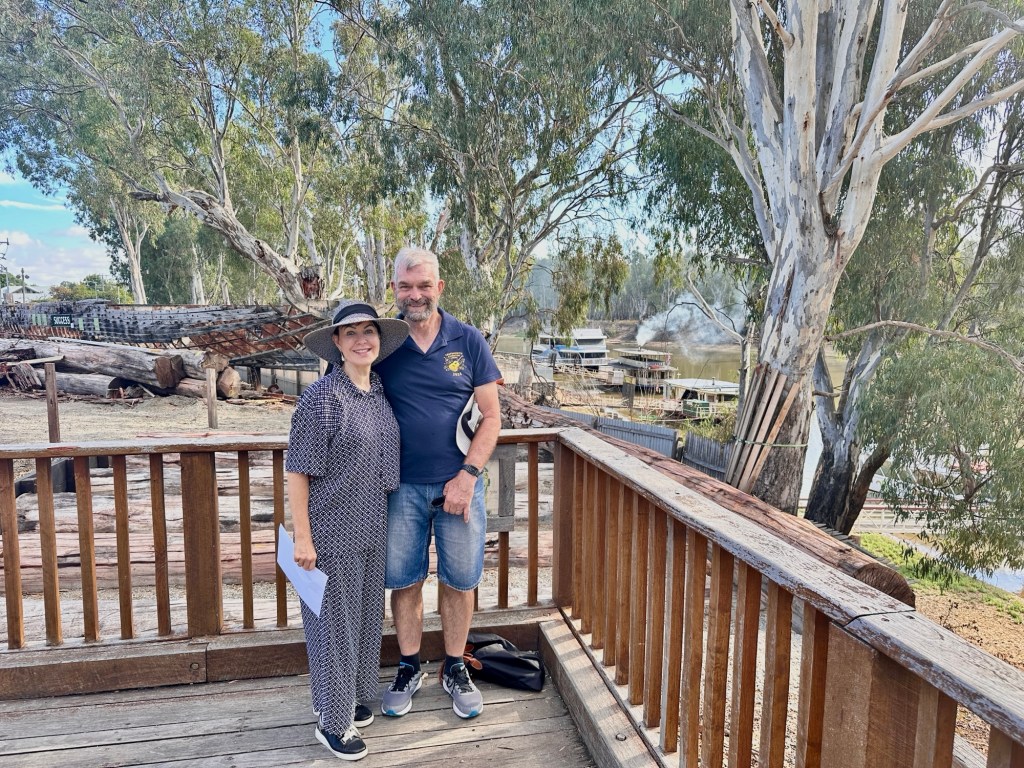

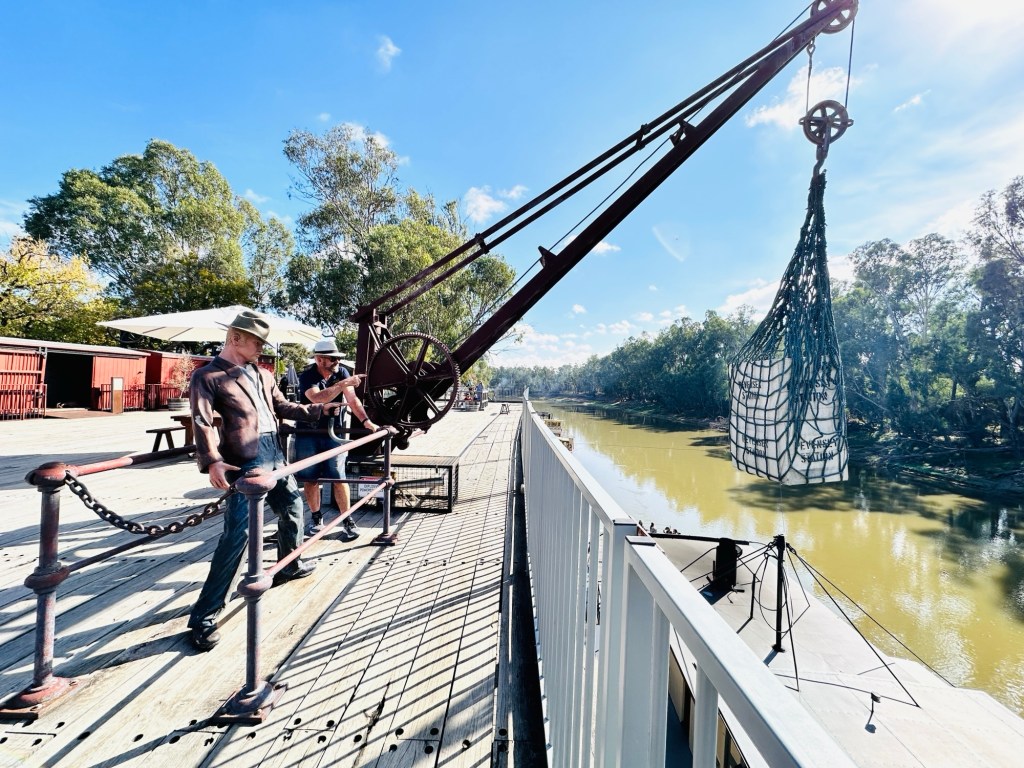
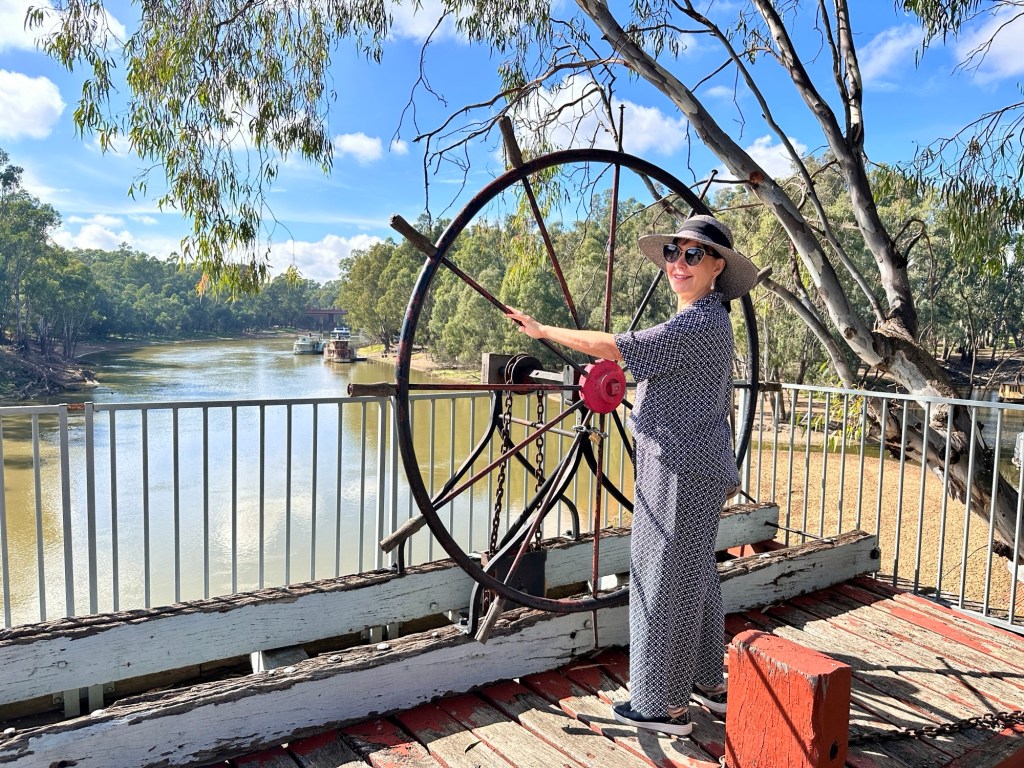

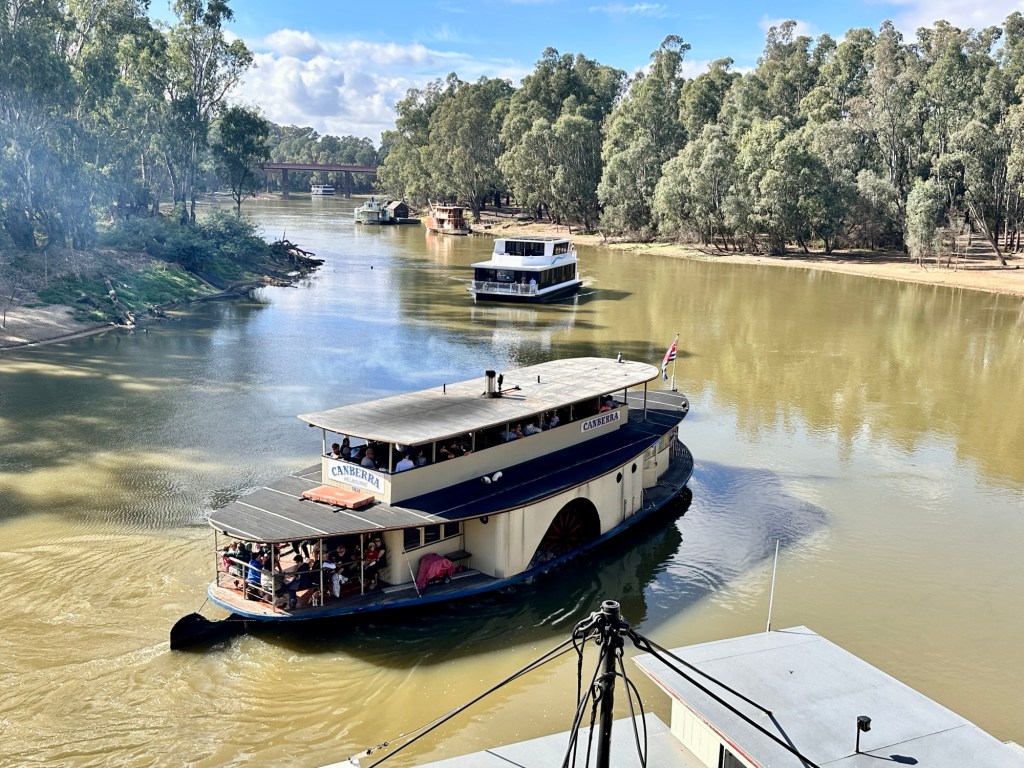
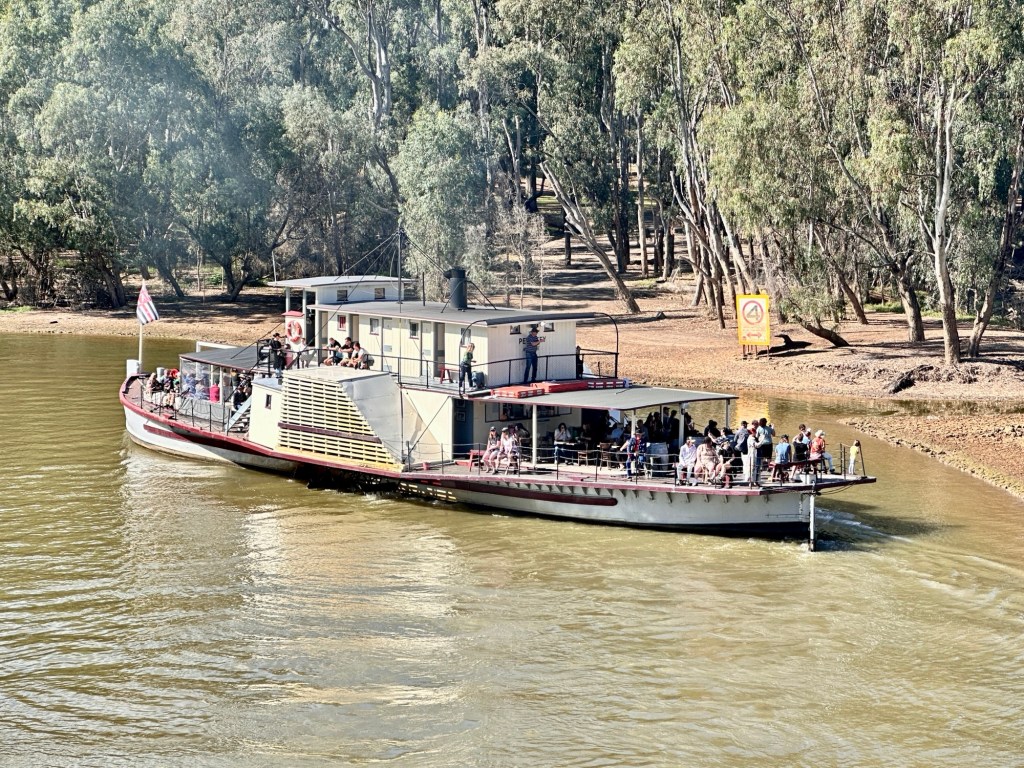
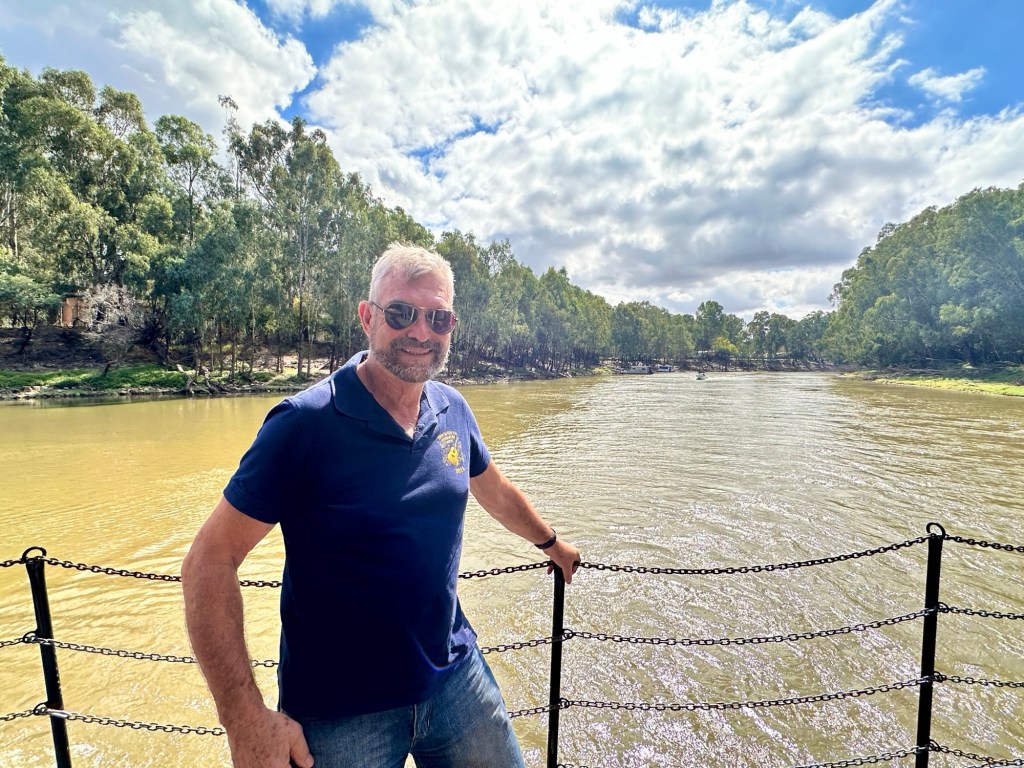
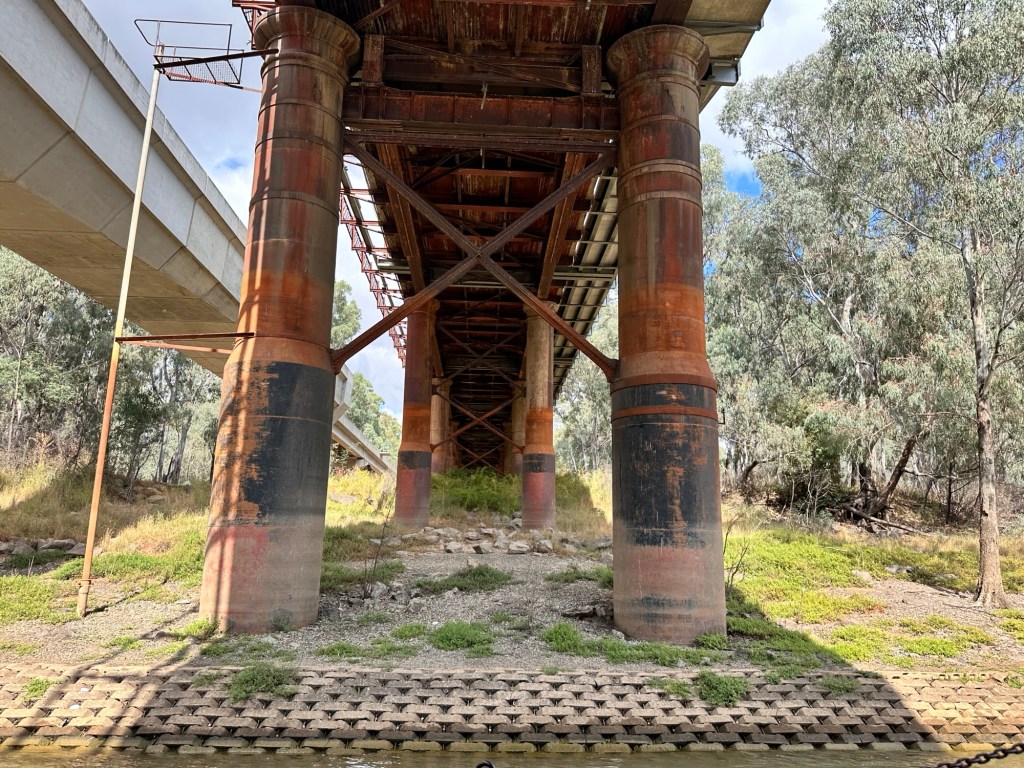
After spending some time in the Discovery Centre we did the cruise on the historic PS Pevensey on the Murray River. It was very peaceful on the river – huge red river gum trees line the river banks, flood heights were visible, people were paddling canoes, others were in luxury houseboats.


Once we disembarked, we explored some of the shops, and had a wine tasting at St Anne’s winery- found a very nice sparkling Shiraz, which I just had to purchase!
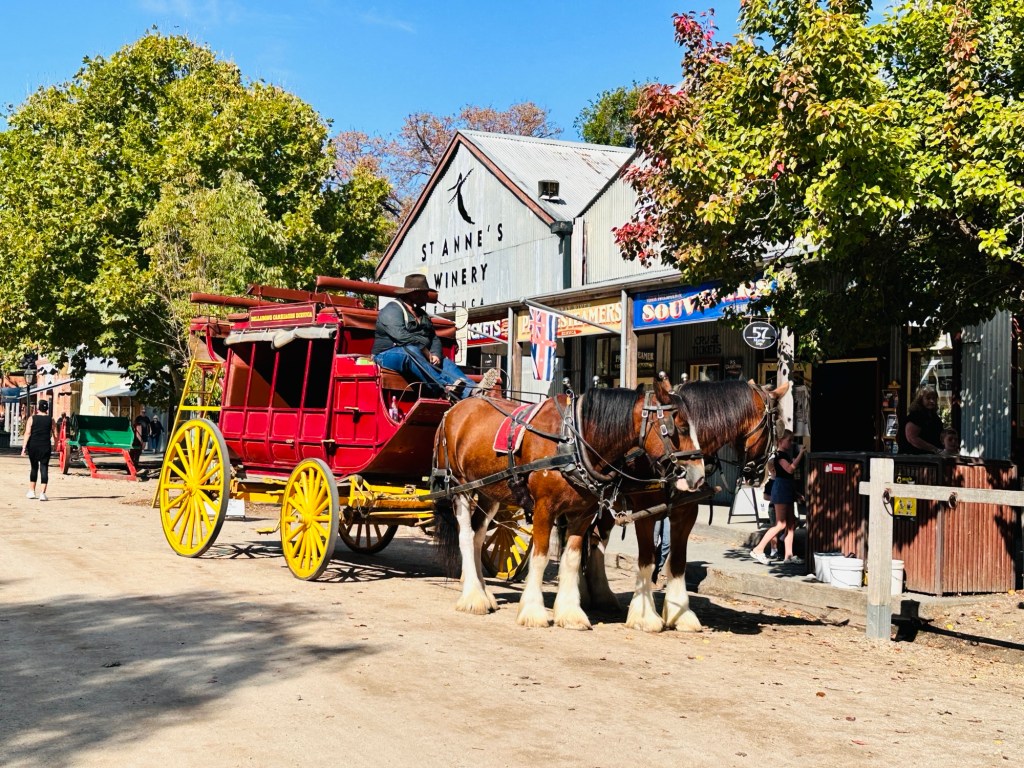

Back to our van which was only a ten minute walk, picked up our bikes, and went out for an explore of the local area. I’m very happy with my new electric bike – it sure takes me further than I would have gone on my old bike. However, when we got back I found I had a puncture – another thorn! Those thorns are deadly!
Another BBQ tonight – we had planned to go out for dinner, but all the restaurants we were interested in, were closed being a Sunday night.
Day 12
Monday 8th April 2024
Echuca to Ballarat
12 – 16 degrees
Heading to Ballarat today.
First stop was Rochester to see the silo art. Jimmy Dvate, one of Australia’s most well known mural artists was chosen to paint the GrainCorp Silos at Rochester. Jimmy chose to showcase an endemically threatened species, the large Duck-Billed Platypus, as well as the Squirrel Glider and Azure Kingfisher.
From Rochester we went onto Bendigo. Here we had a very nice stopover at the Bendigo Tramways. We were initially getting a coffee, but before we knew it, we were exploring Bendigo on the Vintage Talking Tram. It was fabulous. This one-hour tour of Bendigo allowed us to get our bearings, learn about the city’s golden heritage, and see all the historic landmarks and monuments along the way – Deborah’s Gold Mine, the Joss House, the cathedral etc. We disembarked at Charing Cross (city centre), had a yummy green chicken curry at a local Thai restaurant, and walked back to the Tramway Museum admiring all the gorgeous renovated worker’s cottages along the way. Great way to see Bendigo in a couple of hours.
Next door to the Tramways was Bendigo Woollen Mill – I just had to make a stop there – in fact I remember going there 30 years ago. This time I purchased – wool to make a shawl. Don’t hold your breath for the finished product!
We continued onto Ballarat… the gps took us down some very narrow, bumpy backroads – not the best road to be towing a caravan on. However we did see some very pretty towns, especially as the leaves on the trees are changing – all those glorious tonings!
Eventually we did get to our destination – Shady Acres Caravan Park- a nice little park on the outskirts of Ballarat. And wouldn’t you know it… the rain started soon after we arrived! We managed to get set up without getting too wet, then headed into town to get a few supplies. Good old Aldi to the rescue!
Back to the van to cook dinner, and put the heater on. The temperature dropped dramatically overnight… yes we’re in Victoria!
Day 13
Tuesday 9th April 2024
Ballarat
5-12 degrees, very cold!
The rain has stopped… but very cool this morning! Not that we are too bothered by it… it’s very warm inside our little home – with the heater on!
Had a few domestic duties first – washing for me, repairing tyre punctures for Frank.
Thought we’d head to the Information Centre first- they are always so friendly and helpful at these centres. Armed with a bundle of maps and brochures we decided to tackle local Ballarat today.
A self guided walk around the city centre was very interesting. From 1851 the world’s adventurers, non-conformists and fortune hunters flocked to Ballarat’s goldfields, and along with banks and governments, many sunk their fortunes into the streetscape. Within 10 years, Ballarat boasted the colony’s finest collection of buildings. Today, the bluestone and handmade brick structures are still as relevant and treasured as ever. They’ve been reinvented as wine bars and theatres, galleries and bustling cafes, making Ballarat an intriguing mix of old and new.
Next a drive to Lake Wendouree where we had lunch at the Yacht Club – it was very nice sitting on the waterfront enjoying the many activities going on around us. Even though it was only 10 degrees, people were out in their kayaks and paddle boats. Abundant birdlife on the water and water’s edge – corellas, ducks and lots of black swans grazing at the foreshore.
The Ballarat Tramway Museum was only a few minutes away from the Yacht Club. Here we could view seven historic trams, including the 1887 Horse Tram No 1 Tram, and an original Geelong Tram. The trams restored were beautifully done. There are more to be restored – and all are done by volunteers. What a great hobby for those enthusiasts. One volunteer we spoke to commutes from Melbourne weekly to pursue his interest. Lots of memorabilia and photos from days gone past.
We went for a 20 minute ride on a 100-year-old vintage tram along the western shores of Lake Wendouree, travelling through the beautiful Ballarat Botanical Gardens. I took photos of the flower clock and hothouses I remember visiting as a child, and again 20 years ago. The flowers in the gardens were stunning.
Next was the Eureka Centre is located at the Eureka Stockade Memorial Park, considered to be the site of the 1854 Eureka Stockade where the rebellion took place. It is home to one of Australia’s most compelling historic artefacts – the Eureka Flag. It was a great display to explore the social history and cultural impact of the Victorian gold rush, and honour the stories of the men and women who risked their lives in the fight for miners’ rights.
The many layers of Eureka commemoration are reflected throughout the Memorial park in its significant trees, interpretive plaques and monuments that honour those involved in Eureka Stockade.
That filled the day for us. Back to the caravan for an easy dinner, and to warm up – the maximum temperature today was 12 (felt like 9). Meanwhile back home the minimum was 14 – we had been warned that Ballarat was a cold place – they were not wrong !
Day 14
Wednesday 10th April 2024
Ballarat to Melbourne to Ballarat
5 – 18 degrees.
Up early to catch the 7.45am train to Melbourne – we had a full day planned there. We originally had planned to drive, but the train was recommended- and at only $5.30 each for the return trip, it was well worth it. A very comfortable ride through scenic countryside for 80 minutes was very relaxing. They even had free undercover parking at the station.
Breakfast at Mr Carpano’s at the Novotel South Wharf set us in good stead for our big day out!
Our first activity was the BBC Earth Experience at the Melbourne Convention and Exhibition Centre. Here we travelled the natural world and journeyed across the seven continents in one epic experience, narrated by Sir David Attenborough. This immersive exhibition brought together state of the art audio visual technology and breathtaking footage from BBC Studios. The photography was sensational, and being the avid nature lover that I am, found the wildlife and scenery absolutely fascinating.
A brisk walk to the opposite side of Melbourne to see the matinee performance of Groundhog Day the Musical. Groundhog Day is a musical with music and lyrics by Tim Minchin and a book by Danny Rubin. According to tradition, when a groundhog leaves its burrow, if it sees its shadow, there will be six
more weeks of winter weather. If it doesn’t see its shadow, there will be an early spring. The first Groundhog Day celebration was held on 2nd February 1877, at Gobbler’s Knob in Punxsutawney, Pennsylvania.
Neither of us had seen the movie, or had any idea of what the show was about, but we thoroughly enjoyed the performance. It was very cleverly done, had great sets, and most entertaining. Loved it!
Another brisk walk to Melbourne Museum to see Titanic: The Artefact Exhibition. This is the only exhibition in Australia to feature more than 200 real artefacts, recovered directly from the wreck site. The exhibition focused on the voyage’s compelling human stories, taking visitors on a memorable journey through the events of that fateful night. Ironically, the Titanic set sail on this exact date 112 years ago! And it was a Wednesday! Great exhibition- the only negative comment was that it was a little too crowded.
Another brisk walk (we did 16500 steps today) to Miss Mi Restaurant in Bourke St – an award-winning modern Asian Restaurant & Bar. We had the most delicious chili flavoured prawn and crab dumplings, followed by a sensational laksa and beef Rendu. Excellent food choice.
Across the road was Southern Cross Station, so that made it very easy to stagger across to the train, for our return journey to Ballarat.
Day 15
Thursday 11th April 2024
Ballarat
8 – 15 degrees, cloudy
First job today was to drop my bike at a bike shop – Frank was having trouble changing the tube with my new electric bike, so to save stress we thought we’d get by someone else to do it!
Then we had planned a full day at Sovereign Hill – this is an open air museum depicting Ballarat’s first ten years after the discovery of gold in 1851 and has become a nationally acclaimed tourist attraction. The 25 hectare site comprises over 60 historically recreated buildings, with costumed staff and volunteers. The recreation is completed with antiques, artwork, books and papers, machinery, livestock and animals, carriages, and devices all appropriate to the era.
The gold diggings are the centre point of the complex, featuring a winding creek in which visitors are able to pan for real gold. Frank had a go – I think I’ll be waiting a while for a gold chain! This area is surrounded by tents and buildings contemporary to the early years of the Gold Rush.
There are two mines which you can tour – we did both. One was self guided, the second took us by cable tram down to the first level (of 11) to a depth of 25 metres. We saw a replica of the famous Welcome Nugget – the second-largest gold nugget in the world was found in Ballarat in the Red Hill Mine. It was 69 kgs!
We watched the Gold Pour where pure gold valued at $300,000 is melted and poured into a three-kilogram bullion bar.
Main Street is lined with shops, two hotels and a theatre. There is a blacksmith’s workshop, stables, photography studio, apothecary, bakery, jeweller’s shop, grocer, tentmaker, tinsmith, bank, post office, candle-dipping shop, lolly shop, nine-pin bowling saloon and library. We can both recommend the Devonshire tea at the New York Bakery. Behind Main Street are some period cottages all furnished from the time, and a couple of schools.
It was a fabulous day – we saw so many demonstrations, all delivered with such great enthusiasm and story telling creativity.
We stayed right until close, picked up the bike, then went back to our nice cosy mobile home for a hearty warming dinner.
Day 16
Friday 12th April 2024
Ballarat
6 – 15 degrees
Today we decided to do a day trip to Hall’s Gap – we knew it really was a destination where you need to spend a few days, but at least this would give us an idea of what the area is like. Hall’s Gap is a 100 minute drive from Ballarat.
We had a coffee stop at Ararat on the way. The discovery of gold in 1857 during the Victorian gold rush transformed Ararat into a boomtown. The Main Street had some nice Art Deco buildings. There has been a decline in population over the years, but it seems a nice country town to me.
Halls Gap is a village in Victoria, Australia. It’s a gateway to Grampians National Park, known for its sandstone mountains, wildflowers and wildlife including abundant bird life, echidnas, emus, kangaroos and wallabies (we had a great show with emus and kangaroos grazing on the local oval). The area is renowned for spectacular hiking, cycling and stunning views, also canoeing and fishing in any of the four lakes.
As we only had a few hours to explore, we had our picnic lunch, then did a short hike to view the lakes. The well graded tracks took us through native vegetation and interesting rock formations, to the viewpoint, where we got a magnificent view of the Grampians, Lake Lonsdale and Lake Bellfield. You could easily spend a week here enjoying the area. Lots of accommodation options – cabins, caravan parks and motels.
We stopped at Stawell on our return trip. Stawell was another booming town during the Victorian Gold Rush. It is now famous for the Stawell Gift foot race, an event held each Easter since 1878. The Stawell Gift Hall of Fame was closed, but we did see the track where this iconic 120-metre race is run. We had a walk around the town, again interesting architecture, evidence of a rich past. We saw the Art Deco Town Hall clock chime 3.00pm – there are two figures depicting miners working on the gold fields.
A lovely drive back to Ballarat. I was surprised by the many birds feeding at the side of the road – striking Eastern Rosellas, cheeky galahs , noisy Victorian corellas, just to name the ones I knew.
The trees in this area have been a picture, all the leaves are turning their beautiful autumn colours. We really liked Ballarat and surrounding areas – the architecture, the gardens, wildlife, and the tourist attractions. Just not sure about the weather… I really hadn’t anticipated how cold it would be. If this is autumn, I am fairly confident I won’t be back for winter!
Day 17
Saturday 13th April 2024
Ballarat to Port Campbell
9 – 17 degrees
312 kms
Headed out from Ballarat, going via the outskirts of Geelong, down to Torquay. Drove through lovely green farming countryside, again seeing all the beautiful leaves changing colours.
Torquay is the start of the Great Ocean Road. Very busy town, lots of tourists and surfing beaches. Anglesea was the next town – time for our coffee stop, and what better place to stop than at the Great Ocean Road Chocolaterie and Icecreamery! Here you could watch the chocolatiers at work – but, who just wants to watch when there’s chocolate to be eaten! The dark chocolate licorice was to die for!
Now the road is getting windy. Lorne is the next town – a gorgeous beachside spot. Again very touristy, but would be a great spot for a holiday.
The heritage museum here was very interesting. The 243 km Great Ocean Road is a memorial to the lost lives and sacrifices of the Australian diggers in World War One. More than 3000 returned soldiers built the Road from 1919 onwards, conquering steep cliffs, rugged terrain and dangerous weather so that the isolated towns along Victoria’s stunning western coastline could be joined together. This road is truly a memorial to the sweat and toil of the returned soldiers, who built it painstakingly by hand over 13 years.
The scenery between Lorne and Apollo Bay was absolutely spectacular- huge sandstone cliffs and a rugged coastline carved by the Southern Ocean. The road was narrow and very windy, but did have “slow turnout “ lanes at regular intervals for people like us! It was a lot of concentrating driving this great highway.
Apollo Bay was another busy little seaside town – cafes, hotels, caravan parks, beaches, all very busy. It was the last weekend of school holidays, so that would explain why.
All of a sudden we were driving through Otway National Park- a beautiful rainforest. A total change of scenery. Next we were driving through large farming pastures – dairy and beef cattle, alpacas, and sheep.
It was a slow drive but we eventually we got to Port Campbell where we checked in at NRMA Holiday Park – lovely park in a great location. Lots of walking paths surround the park, and only a five minute walk into town.
Port Campbell is more of a sleepy seaside town – not too commercial, we both really liked the feel of it! We walked into town, stopped at the Barrel Room for a drink, and watched the sun set behind the cliffs and over the little beach. We then found Waves, a local restaurant where we enjoyed a very nice meal.
Back to the caravan, stopping a few times to look at the cute little rabbits foraging around the park – there were a lot of them. Apparently they are becoming quite prolific in the area, even to becoming a problem.
Day 18
Sunday 14th April 2024
Port Campbell
11 -17 degrees
Our day to explore the landmarks along Great Ocean Road. We were only 12 kms each way from all the good spots, so Port Campbell was a great location to base ourselves. Luckily the weather was looking good – we have found the weather to be so unpredictable! It changes every hour!
Heading east form Port Campbell we went to Loch Ard Gorge first which is the site of the most famous shipwreck on the aptly named Shipwreck Coast. The Loch Ard ran aground crashing into Mutton Bird Island in 1878. 52 of the 54 passengers died. There is a cemetery there.
The Twelve Apostles are probably the most famous of the landmarks – these soaring pillars have been chiselled out of limestone over 10 to 20 million years. However there are not twelve apostles- some have worn away with time, new ones are forming.
We then walked to Gibson Beach which is 1.1km from the 12 Apostles. The Gibson Steps are a steep 86 steps down to the beach – it was great to look up at the jagged sandstone cliffs from the beach below.
Heading west from Port Campbell, was London Bridge, one of the most iconic scenes in Australia, and offers lots of stunning views over the surrounding scenery. This stack was formed by a gradual process of erosion, and until 1990 formed a complete double-span natural bridge. London Bridge has now half “fallen down”!
Next the Grotto, a sinkhole geological formation and tourist attraction. Wooden steps wind down the cliff face to the bottom, providing visibility of the sea beyond a pool at low tide. It was amazing how quiet it was once you were down at the base.
Halladale Point gave us spectacular views back to the Bay of Martyrs which is a part of the Bay of Islands Coastal Park. More stunning scenery.
Heading back to Port Campbell we stopped at the sleepy town of Peterborough – beautiful beaches, people swimming (despite the outside temperature of 13 degrees – Victorians?? )
Along our drive we saw at least 6 Short beaked echidnas wandering along the edge of the roads. The traffic noise didn’t seem to bother them. As soon as we stopped so I could take a photo, they scurried into the scrub! Apparently they are quite active at this time if year when the days are not too hot.
Back to base, we walked out to the Port Campbell jetty to enjoy the sunset – very colourful skies over the cliffs. Then we got to enjoy the slow cooked lamb shanks we had had cooking in the slow cooker for the day. Perfect ending for a wonderful day.
Day 19
Monday 15th April 2024
Port Campbell to Port Fairy
12 -18 degrees
97 kms
Woke up to sunny skies, within an hour it was drizzly, then rained all the way on our drive to Port Fairy. Then the rain stopped and we had a sunny afternoon. The weather is so unpredictable!
Easy set up at Gardens Caravan Park on the banks of the Moyne River. Then set out to explore Port Fairy, another quaint seaside town.
We decided to explore Griffiths Island – a small island which lies at the mouth of the Moyne River next to, and within the bounds of Port Fairy. It is a sanctuary for plants, birds and animals. It took us an hour to walk around the island, stopping at the lighthouse, and watching the surfers enjoying the waves. The Short-tailed Shearwater, or “Mutton Bird” nests in large numbers on Griffiths Island. The name “Mutton Bird” was given to it by early settlers who used its fatty flesh for food and as an oil source. The adult birds had just left their nests to make their annual pilgrimage to the Aleutian Islands in Alaska, leaving their babies in the nests. When the babies are hungry , they will leave the nests and fly to Alaska as well. Nature is amazing!
A little explore of Port Fairy – is a quaint little town, lots of cafes, restaurants and boutiques. Some interesting architecture. Real estate seems on the expensive side here. The river front is especially pretty. Huge Norfolk Island pines line the streets – early settlers planted these in anticipation for the masts required on their ships. We rode our bikes along the beach and river fronts. Frank had me riding on narrow bridges with no guard rails – very traumatising for me! But I survived!
Made it back to our caravan site in time for another beautiful sunset – this time over the river. Stunning!
Day 20
Tuesday 16th April 2024
Port Fairy to Warrnambool to Port Fairy
11-17 degrees, sunny
We woke to a sunny morning – it was beautiful! Not to waste it, we walked around the Port Fairy riverfront – I wanted to have a better look at the gorgeous homes rather than worry about my cycling skills!
We then headed to Warrnambool (30 minutes away), to go to the Flagstaff Hill Maritime Village which is a maritime village and museum built on Flagstaff Hill and holds the original lighthouses and
Warrnambool Garrison. The museum is full of fascinating information and displays about the shipwreck coast of Victoria. We did the tour at 11.30 and the guide was excellent. The village is a dozen replica shops along the hill including a dressmakers, a printer and a church and gives you a very good feel of life in Australia in the 1800s. Soaking up the sunshine, we had our picnic lunch overlooking the lake in the park – it was very entertaining watching the Purple swamp hens balancing on the reeds. More Norfolk pine trees here. Pretty flower gardens, though the increasing rabbit population is making it difficult to maintain.
By mid afternoon we had seen everything so we went to the Fletcher Jones Markets which is located within the Old Fletcher Jones Clothing Factory. I remember going here 50 years ago, and the gardens were stunning. The gardens today are lovely but nowhere near as nice as I remember from all that time ago. The market is packed with antiques, antiquarian books, collectables, retro, vintage, a great collection of records, vintage clothing, new giftware and loads more. You could spend hours poking around here.
Tower Hill is an inactive volcano 18 kms west of Warrnambool, now a wildlife reserve and home to more than 150 bird species, koalas, grey kangaroos, and emus. We had an hour to spare so drove through the reserve. Lots of hiking trails. The inquisitive emus came right up to our car, hoping for some food scraps no doubt.
Back to town for an early dinner at Whaler’s Hotel. At 7pm we went back to Flagstaff Hill for the Sound and Light show, called ‘Tales of the Shipwreck Coast’. With engaging storytelling, interactive digital imagery, and dazzling lighting and sound effects the stories of our volcanic plains, the whaling industry and the famous Loch Ard shipwreck were passed onto us. We were very impressed. It was very cool outside, so we were pleased to warm up in the car driving back to Port Fairy. A great day in all.
Day 21
Wednesday 17th April 2024
Port Fairy to Naracoorte
10-17 degrees
301 kms
A rainy start – surprise, surprise! I am getting over the weather along this coastline. It was a 93 kms drive to Portland, lightly raining all the way. When we got to Portland, the rain stopped.
With only a short stop here, we jumped on the Portland Cable Tram to get an overview of this port town. A 7.4km route meanders along Portland’s foreshore, stopping at the Portland Maritime Discovery Centre, Powerhouse Museum, World War II Memorial lookout, Portland Botanic Gardens. The return trip took an hour. The trams have been restored by volunteers, who double up as tram drivers and tour guides. Great to hear about the town told by locals. Beautiful foreshore parks and playgrounds. Portland is a hub for forestry products and manufacturing, and the port is a busy area for timber, wood chip, grain and aluminium.
We joined the Princess Highway again, travelling through big plantations of blue gum and radiata pine, crossed the border just after Nelson (after making sure we’d eaten all our fresh fruit for quarantine requirements), and arrived in Mt Gambier.
The Blue Lake in Mount Gambier occupies one of the craters of the extinct volcano after which the city has been named. Early each November, the lake’s sombre blue, which is in evidence during the winter months, mysteriously changes to an intense deep turquoise blue almost overnight. The colouring remains until late February, when it gradually changes. From late March, it returns to a distinct sombre blue colouring that remains until the following November. Luckily for our visit, the lake was still a vibrant blue. Very pretty.
Umpherston Sinkhole, also known as the sunken garden, was once a cave formed through dissolution of the limestone. The sinkhole was created when the top of the chamber collapsed downwards. Now the topsoil down on the floor forms the perfect environment for the sunken garden. The sinkhole was made into a garden by James Umpherston in 1886. Now it is owned and maintained by the Town Council.
We have been enjoying the deciduous trees all through Victoria, all showing their autumn colours – purple leaf ornamental plum tree, the many varieties of the maple trees, liquid amber trees, and oak trees. The colours are just glorious. We don’t get the autumn changes like this in Queensland.
We left Mt Gambier and travelled the Riddoch Highway through the Coonawarra Winery region until we reach Naracoorte. The drive was so pretty – so many vineyards where even the grape leaves are changing colours. Sheep grazed between the vines. Magnificent gum trees stood guard over the vineyards.
Coonawarra Wine Region boasts the most sought-after vineyard soil in Australia, and with 27 Cellar Doors lining the famed terra rossa ‘strip’, there is no shortage of wine available for tasting. Best known for Cabernet Sauvignon, Coonawarra also excels in the production of premium Shiraz and cool climate Riesling. We had to stop at at least one winery, it would be rude not to – so we topped up our wine collection from Wynns Coonawarra. Good choice!
Thirty minutes later we settled in at the Naracoorte Showgrounds – what a great place. The managers were so welcoming and walked us to our site which had grass like carpet! A great find.
Town was a five minute walk away. I’d read that Naracoorte Hotel had trivia on a Wednesday night… and guess what, it was Wednesday night! So off we went to give it a go. It was great fun, this trivia had a buzzer system – not that I managed to get a hold of it! I will say, we didn’t totally embarrass ourselves (we didn’t come last), but La Triviata had plenty of room for improvement! Frank’s excuse was he wasn’t used to the buzzer!
Day 22
Thursday 18th April 2024
Naracoorte to Adelaide
7-19 degrees
330 kms
Such a great spot – we had left the van hooked up, so easy get away. I wished we had an extra day/night here, but we had already booked the next night (and being SA school holidays we needed to book!). I know I am going on about it, but the grassed oval was just amazing! There was also more to see in Naracoorte area than we had realised- but, that’s how it rolls on the road! Adelaide, here we come!
Continuing on the Riddoch Highway, we drove through gorgeous vineyards of the Padthaway Wine region. Coffee stop at Keith, then followed the Duke Highway right into Adelaide. We had a lunch stop at Tailem Bed overlooking the Murray River. Another short stop at Coonalpyn to see the silo art.
The Coonalpyn Silos are huge and very close to the road. These silos were the first silos to be painted in South Australia and were completed in March 2017. Painted by Guido van Helten, the mural depicts rural renewal through the ages.
Onto Adelaide, right through the city centre. It was a long steep descent through Adelaide Hills. We were booked into the Adelaide Showgrounds Caravan Park in Goodwood, an inner southern suburb of Adelaide – great location, only a few kms from the city. Once we were set up, it started raining – we were a bit worried we had brought the rain with us! We needed to get a few groceries, so it was a good opportunity to go out and get that done.
Day 23
Friday 19th April 2024
Adelaide
13-19 degrees, sunny
The rain has gone- thank goodness!
A few domestic duties, before catching the bus into the city (the fare was $1 each way!) to go to the Central Market. What great food and produce – so fresh and well presented. So many choices for lunch!
We had a little wander around the surrounding area before bussing it back.
Our lovely friend Sue, picked us up in the afternoon to take us back to her gorgeous house in Dulwich, a tightly held inner suburb of Adelaide. Her garden is magnificent, and we could just see the joy it gives her. Sue cooked us yummy pasta for dinner. We toasted her late husband Den – sadly he had passed very suddenly only six months earlier. Such a loss.
Day 24
Saturday 20th April 2024
Adelaide
10-22 degrees, sunny
Some retail therapy today. We caught the bus again into the city. The Rundle Mall was calling.
After I had got the shopping out of my system (it only took Frank a few minutes for that!), we did some walking – admiring the historical buildings in North Terrace. The Torrens River is bordered by very beautiful parks and architecturally interesting structures.
We thought we needed a good walk so walked 45 minutes back to our “home”, taking in all the sites along the way.
I am loving all the trees – they are turning their autumn colours. Absolutely stunning. Varieties include.. Claret Ash, the many varieties of maple, Manchurian Pear , White cedar, and the Golden Plane.
A quiet night in, with a chance for Frank to catch up on the football.
Day 25
Sunday 21st April 2024
Adelaide
9-22 degrees, sunny
Woke up to a stunning day. Great day to take a day trip to the McLaren Vale wine region. Just a 45 minute drive south from Adelaide, McLaren Vale is a wine lover and foodie’s paradise. It boasts more than 80 vineyards all on the doorstep of the Fleurieu Peninsula’s stunning coastline and sandy beaches.
We had booked to go to d’Arenberg Winery, established in 1912 by the Osborn family. It is home to the Cube – a five-storey building situated within the d’Arenberg vineyards. The Cube is a quirky glass structure which mimics a Rubix Cube. The entrance leads into a visual arts centre, the top floor is where the wines can be tasted and you can experience 360’ views of the McLaren Vale wine region. Currently on the second floor is the Salvador Dali exhibition – loved it! The whole experience was excellent. Going to the toilet was an experience in itself! The wines were a hit – of course we had to purchase, even a special wine – Dead Arm, found its way into our take home pack.
A nice drive around the McLaren Vale surrounding area, arriving at Aldinga Beach. Went to have a walk on the beach, but it was very thick with seafood. Onto Port Willunga where we had booked to go to Star of Greece restaurant for a late lunch. The location of this place can’t be beaten… it is perched on top of a cliff overlooking the site of the Star of Greece ship wreck, with views up and down the beach and right out to the bay. The food was fresh and incredibly tasty, and the wait staff were friendly and attentive. Five star reviews by us.
Time to drive home, no dinner tonight – had to recover from lunch!
Day 26
Monday 22nd April 2024
Adelaide
10-25 degrees
Clare Valley today- Sue had very generously offered to be the driver. It was 90 minutes each way. We had a coffee stop at Velvet and Willow in Auburn – a coffee shop with a rambling garden out the back for us to enjoy.
Stopped at a few wineries at Clare , Taylor’s being one of note – a few more wines to add to our collection. Beautiful autumn trees on the drive. The landscape is quite dry though – apparently this is typical, they get the majority of their rain in winter. Thousands of sheep, some cattle and alpacas.
Nestled away between the Clare and Gilbert Valleys, the township of Mintaro and its surrounding district, hold the stories of occupation by the traditional indigenous people, by early pastoralists and then by colonial settlers who came to the area during the mining and agricultural booms in the mid to late 1800s. Lots of homes made of stone and slate.
We also visited Martindale Hall, a Georgian style mansion completed in 1880. It is an outstanding example of a grand country mansion constructed by wealthy pastoralists. The property, including the mansion, its interiors, and coach house, retain a high degree of integrity and illustrate a way of life that no longer exists in South Australia. I could rather imagine myself living here though… dream on! The stately home’s claim to fame is that it featured in the movie “Picnic at Hanging Rock”.
We continue on into the heart of Clare where we end up at Mr Mick’s Cellar Door and Kitchen, our late lunch stop. Mick Wines are named after the late K.H. (Mr. Mick) Knappstein, an Australian wine making legend and Tim Adams’ mentor and friend. Tim and his wife Pam are proud custodians of the landmark property that now bears his name and houses a renowned restaurant, cellar door and gallery. We had the set tapas menu with paired wines. Excellent value! We had so much food, and plenty to drink! We were so grateful for our driver!
Also we were thankful for Sue’s local knowledge- we stopped at O’Leary’s winery, this time at the back door. Here we bought cleanskin Shiraz 2021- the same Shiraz that had just won a gold medal and retailed for $38 – we paid under $8 per bottle. Obviously it’s who you know!!!
We stayed awake for the 90 minute return trip, some minor suffering from food coma symptoms! I had had far too much to eat and drink! No dinner tonight! Quiet night in for us!
Day 27
Tuesday 23rd April 2024
Adelaide
10-25 degrees, sunny, then windy, then a cool change at 3pm
Port Adelaide today. This port has been the gateway to trade and commerce in South Australia and the first contact with South Australia for thousands of emigrants when they arrived by ship.
Now with character-laden streets awash with street art, cobbled laneways, heritage architecture and beautifully preserved 19th century warehouses, this up and coming historic port town has really come into its own. Steeped in rich maritime history we thought we would visit the Maritime Museum. There are three floors of exhibits in an 1850’s bond store – some great displays. The three school groups that happened to be there, thought so as well!
We walked around the historic precinct, very charming, found the information centre which was the original police station and holding cells. The original court next was next door. Also a historic 1864 Clipper Ship is undergoing restoration.
We drove to Garden Island, past the Ship’s Graveyard, on to the Dolphin Reserve. We walked the boardwalk looking for dolphins, but none today.
A beautiful spot for a picnic lunch though.
Next we wanted to go to the beach area of Glenelg. Just as we got there the wind came up and the cool change came in! It was like a whirly wind! Branches were flying down, and we were neatly blown over! Our visit was very short! Saw the foreshore, the jetty and the Ferris wheel, and that was it! Have heard there is a bike trail all the way from Adelaide to Glenelg – will have to do that another visit.
Back to rescue our awning from the wind, plus rug up. I’m sure the wind was straight from Antartica!
Day 28
Wednesday 24th April 2024
Adelaide
7-18 degrees, sunny
A gorgeous cool autumn day, and we were headed to the Adelaide Hills area for the day. First a quick stop in the suburb of Unley to sort out an issue at the bank. What a beautiful area!
Unley is a trendy, affluent neighbourhood known for its boutique shopping scene, with shops selling designer fashions, artisan homewares and quirky gifts. Stylish Asian and Modern Australian eateries sit next to dessert bars and chic cafes, while swank pubs and cocktail bars draw a young professional crowd. Many of the neighbourhood homes in the tree lined streets are constructed of stone blocks- we could have driven around the streets for hours!
Adelaide Hills is only a 30 minute drive from Adelaide. We drove to Hahndorf via Stirling (a very picturesque town highlighted even more by the changing autumn timings of the trees), where we enjoyed a morning tea at a very trendy cafe, Konitorei – very popular. Lovely little town. Continuing our scenic drive through little towns of Aldgate, Bridgewater and Verdun, until we reached our destination of Hahndorf.
Hahndorf is a famous small town in the Adelaide Hills. Settled by 19th-century Lutheran migrants, and is Australia’s oldest surviving German settlement. We parked and wandered up and down the Main Street. Strolling the tree-lined main street, we came across butchers, bakers and candlestick makers, shops, galleries and studios, a cheese maker, leathersmith, jeweller, a craft brewery, winery cellar doors, gin distillery, chocolatier, traditional sweet shops, German-style pubs, multicultural restaurants and cafés. We have been there a couple of times before, but it always proves a nice visit, especially when it’s chilly and the fires are on inside all the buildings.
The museum was very interesting, telling stories of the lives of Hahndorf’s pioneering families, and showcases objects relating to religion and education. Their religion underpinned their activities, and education was a prime focus.
A late lunch at The Plough (yes it was an Irish Inn, not German), was welcomed – seafood chowder for me, and a Guinness pie for Frank, with a glass of Guinness of course!
Time to head back to Adelaide, driving down the steep descent back to the city.
At 5pm, we met up with Sue and her friend, to say farewell. We walked up to a trendy little wine bar in Goodwood, Good Gilbert. Great atmosphere. Adelaide really has some fabulous little bars, creating a great vibe in the suburbs.
A few drinks later, we walked home, turned on the heater, and settled in for the night. Temperatures have certainly dropped!
Day 29
Thursday 25th April 2024, Anzac Day
Adelaide to Williamstown
7-18 degrees, sunny
75 kms
5.40am dawn service at Unley Soldier’s Memorial Gardens which features canons and a rotunda. Very nice service by the local community. Frank met up with long time Naval colleague Kevin Scarce, which was really nice for him. We passed on the Gunfire breakfast, instead enjoying a relaxing breakfast at La Scala cafe across the road.
A quick pack up, snd it was time to say farewell to Adelaide. On the road, and 90 minutes later we were at Williamstown Caravan Park. The sites were rather odd shaped – we had a drive through, but still awkward.
Had an early lunch then out to explore the Barossa Valley. We were at the southern end of the area, 30 minutes north is Nuriootpa with Lyndoch and Tanunda in between. So many wineries!
At Lyndoch we went to 1837 Barossa winery for our first wine tasting. The 1837 Barossa winery commemorates the date on which Colonel William Light named the Barossa in December 1837 on the estate. All wine names are connected with Colonel Light’s life. Nice wines, our favourite was the Merlot (and not usually a Merlot fan!) – we sipped that while enjoying the breathtaking views and landscape of rolling hills blanketed in rows of vines, punctuated with modern art sculptures.
A visit to Tanunda next, the information centre, and a nice cafe for coffee and Anzac biscuits. Needed a little caffeine fix after our early start!
Out to Seppeltsfield next, stopping first at Langmail Cellar Door (we’d been here early in our courting days), but it was closed, and then at Barossa Valley Estate. The gardens here were spectacular- one of the largest perennial gardens in Australia. The oak trees and changing colours of the grape vines were a sight to behold.
Continuing down the palm tree lined road we arrived at Seppeltsfield. I remember the grandeur of the buildings from my childhood visit here. Established in 1851, Seppeltsfield Estate has been hailed as the most historic winery and greatest showpiece in the Barossa. The Estate has evolved into a tourism village offering wine, food, craft, design, art and retail experiences, with the winery and cellar door at the centre. Lovely to visit.
By this time it was 5pm, and the cellar doors were closed. Back to our caravan for a quiet night in. Definitely a quiet night, no TV reception for the next three days.
Day 30
Friday 26th April 3024
Barossa Valley
7-17 degrees, sunny
We slept in until 8am! So then we had to rush to get out in time for our pre booked staff guided wine tasting.
Three wineries were on the agenda, starting with Grant Burge – chocolate and wine pairing. Not a bad way to start the day! Planting their roots in the Barossa Valley in 1865, the Burge’s began as a family of devoted vignerons. For five generations, they have been growing grapes and making wines that continuously exceeds expectations. Our picks were the sparkling Shiraz Cabernet, and the Filsell Shiraz. We spent 90 minutes there.
Next was St Hallett, established in 1944 by the Lindber family. Shiraz wines are the signature piece here. We enjoyed wine and cheese pairing here, looking out at the beautiful gardens.
Third stop was Rolf Binder Cellar Door -this winery was established in 1955. Here we had more wine tasting accompanied by home made pizza. The signature ‘Bull’s Blood’ Shiraz Mataro, produced since 1967, was a big hit. We sat in the gardens to eat the pizza, but moved inside to sit beside to fire to enjoy the last few drops of our wine. We were feeling very full by this time.
Maggie Beer’s Farm Shop was 2 kms away, so we enjoyed a walk to there, and then walking through the farm yard, and sitting overlooking the lake watching the turtles at play. So many interesting gourmet food items in the shop – I really didn’t know where to start.
What a lovely day it had been. We drove back to Williamstown – gourmet lamb chops on the barbie for us! Yum! So many red wine choices to go with them. We have bought 4 dozen wines so far – needless to say we are fast running out of room in the car.
Day 31
Saturday 27th April 2024
Barossa Valley
6-18 degrees , sunny
First off we drove 16kms to the commercial hub, Gawler, as we wanted to get someone to check on our new car bike rack – it wasn’t tightening on the tow ball as much as we thought it should. Mission accomplished, always something simple, but it was worth the trip. . Back to pick up our bikes, and out for a bike ride. There are a myriad of great bike trails in the Valley.
We parked just before Nuriootpa, found the bike path and rode to Angaston, one of the region’s highest towns, and home to a variety of cafes, wine bars, cheesemaker, and of course, cellar doors. The Railway Station is listed as State Heritage. As we descended back to Nuriootpa, we had panoramic views over the Valley floor and rolling vineyards that symbolise the Barossa. It was a lovely ride.
Afterwards we enjoyed a nice picnic lunch at one of the very pretty parks in town. Across the road was Penfolds Cellar Door. The 2019 Grange was $100 for a tasting (and no refund if you bought a bottle for $1000!) Thought we might pass on this – instead having a yummy cream across the way at the Barossa Ice creamery. Black licorice for me, Irish Cream for Frank. Delicious!
Bethany Village was the next destination. Bethany was the first German settlement in the Barossa Valley area. It was settled in 1842, by Prussian immigrants.
The winery is owned and run by the Schrapel family, who first planted vines from cuttings in 1852 soon after arriving from Silesia. The Cellar Door sits in a commanding position on top of a hill, with panoramic views over the valley below. The standouts for us were the Rose and Grenache. I really like the blue caps and labelling – chosen to symbolise the bluestone in the area.
Not far from Bethany was Chateau Tanunda. Established in 1890, Château Tanunda is the site of some of the Barossa Valley’s first vines planted, as well as its first winery. The majestic bluestone winery and vineyards are a living testament to the colourful history and pioneering spirit of Australia’s most famous wine region. The buildings were certainly very impressive.
Home for a shower, and out for dinner at the Cellar Kitchen at Rowland Flats, another little village between Lyndoch and Tanunda.
The food philosophy at The Cellar Kitchen is to showcase ingredients from the farms, fields and homes of fellow Barossan’s and South Australians. Inspired by the farmers, the ingredients growing wild around us, and by the seasons and what the harvest will bring, the food was certainly tasty. Frank had Potted Beef with onion jam for entree, and lamb rump with carrot and chimchurri dressing for mains, I had yellowfin tuna with sesame and wasabi, followed by quail with lentils and pomegranate dressing. All so nice! Good choice, and nice finale to our Barossa stay.
Day 32
Sunday 28th April 2024
Williamstown to Renmark
9-24 degrees, sunny
207 kms
Another perfect autumn day. Shorts weather … for Frank anyway!
We hitched up and drove to Nuriootpa – we haven’t really hadn’t seen much of this township, so parked and had a walk around. Being a Sunday many of the small shops and boutiques were closed. We did find a nice cafe however. The trees, parks and flower gardens are just so pretty.
Onto Renmark, 170 kms straight along the Sturt Highway. Passed hundred of caravans coming the other way – last day of school holidays for South Australia. Checked into Renmark River Bend Caravan Park – the most beautiful spot on the banks of the Murray River. We had lunch by the water’s edge watching the menagerie of water hens, pelicans and ducks busy going about their daily activities. Very peaceful.
Must be time for a tasting! We thought we’d try a distillery for a change. Rustons Distillery is a boutique distillery where we found a delicious range of gins all carefully handcrafted and distilled in their very own distillery. There was also the most amazing rose garden.
The Rustons story dates back to 1919 when Cuthbert Ruston was allotted the land as part of a soldier settlement program. While the property was originally a fruit orchard David Ruston, one of Cuthbert’s sons, indulged his passion for roses by planting them wherever he could. By the 1970’s, David had completely converted the property to roses which eventually housed 4,000 species of roses and the National Rose Collection. The roses were spectacular, and used in some of the gin recipes.
Next we went back into Renmark town to look at the river front. It is beautiful, so peaceful looking with all the river gums lining the banks. All the gardens have flowering roses – such a pretty town.
Over the bridge, next to our caravan park is Paringa. The Paringa Silo Art stands tall and proud, offering a glimpse into the areas past, selected historical figures and relaxed lifestyle on the Murray River. They were painted by Jack Fran and Sam Brooks.
Also went for a drive to look at Murray River Lock Number 5 – built during the 1920’s to regulate the flow and the levels of the Murray River. Beautiful picnic grounds and information boards are available for use.
Dinner at the caravan park, sitting on the edge of the Murray, such a beautiful night, enjoying our neighbour’s company, and their fire pit… maybe that’s what we need!
Day 33
Monday 29th April 2024
Renmark
8-23 degrees, sunny
Perfect day for a bike ride! We could ride from the caravan park, along the train line/ then river, right into Renmark. It felt wonderful! We stopped at the Information Centre where we got a few tips for the next few days, then onto Arrosto Coffee – Renmark’s own coffee brewer. Enjoyed the coffee, and enjoyed all the roses in town (can’t believe how beautiful the gardens are), then rode back to our caravan. It felt great… I must be getting more confident on my bike!
Lunch, then a driving tour of the local area. Berri, better known as Australia’s fruit bowl, has some of Australia’s best regional produce and is lined with rich riverbanks teeming with wildlife and a fascinating history. I remember visiting Berri as a child – the highlight was doing a tour over the Berri fruit juice factory- all the free samples! That was a real treat when you’re a child! That factory closed in 2010. Now, there is a beautiful river front walk, which we enjoyed, also the soldiers memorial (more roses). Beautiful gardens everywhere here.
A deviation to look at Berri’s Lock Number 3, then onto Loxton. Loxton’s primary productions are agriculture & horticulture. Citrus fruit, wine grapes, almond and stone fruit trees are prevalent. Lovely little town where there is a great affiliation with returned soldiers and involvement in World Wars and post World War 11 engagements. We loved that the streets were named after VC winners, military nurses and famous battles. Also had a wander through conservation park to see the 16 tree sculptures, done by locals (school students). There is a historical village here, but unfortunately closed on a Monday.
Pretty drive back to Renmark, where we managed to source our very own fire pit! I was very excited! Back to the caravan to set the fire pit up. Before long, we had our own little fire. The Barossa red wine complemented the atmosphere!
We were entertained by the purple swamp hens who were busy running around the river foreshore- not at all worried that we were right there. The water rats, were also on a mission – scavenging what they could before the sun went down. Rakali, previously known as Australia’s ‘water rat’, is an important species in Australia’s aquatic ecosystems. They can be found anywhere in Australia where there is water all year round; the species’ only habitat requirement is clean water and plenty of vegetation. I eventually got used to the idea that they weren’t really rats!
It really was so lovely sitting beside the fire on the banks of the Murray. Do we really have to get dinner??? Very relaxing!
Day 34
Tuesday 30th April 2024
Renmark, SA to Wentworth, NSW
8-18 degrees, sunny
130 kms
Only a short drive today, continuing on the Sturt Highway. Travelling from Renmark, we drove through more vineyards, and many fruit orchards ( a lot of oranges). We had decided to stay at Wentworth at a free camp beside the sports oval. We thought we’d drop off the van and do an afternoon trip to Mildura. That way we would have 30 less kms to do the next day.
We got settled at the oval, then went to look at the great rivers. Wentworth lies at the confluence of Australia‘a two most important rivers, the Darling, and the Murray. Wentworth is the gateway to the outback of New South Wales. The Murray and Darling Rivers provide a serene and lush oasis in contrast to the arid landscape of the outback. There was plenty of water in the rivers.
We then went to Mildura – it is known as the centre of Victoria’s Food Bowl and is a major producer of citrus fruits.
Once in Mildura we explored the story of how the region became an irrigated oasis in the midst of an arid land (Australia’s first irrigation colony). George and WB Chaffey came to Australia from Canada in 1887, and purchased a defunct pastoral lease and created the Mildura Irrigation Colony. The brothers developed a series of steam-driven pumps to lift the water from the Murray River to irrigate up to 33,000 acres.
We visited the very grand Rio Vista, WB Chaffey’s family home, which now also houses Mildura’s Arts Cente, and the Mildura Station Homestead (also owned by the Chaffey family), both close to the very pretty river front. Also walked across Loch 11, and Mildura Weir. Beautiful parklands, and gardens. Roses are abundant here as well.
Next, stock up on fruit and vegetables whilst in Mildura – we had had to use up all our fresh before leaving South Australia.
Back to the caravan, where we settled in early for the night. No power, so no heater. A nice curry to warm our insides, a hot shower to warm the outsides, and off to bed.
Day 35
Wednesday 1st May, 2024
Wentworth to Broken Hill
6-20 degrees, sunny
338 kms
We survived the cool night at our free campsite. The afternoon sun had warmed the van nicely, and we had kept the door and windows closed. My hot water bottle had kept my feet nice and warm. Only trouble was so that we had gone to bed so early, that we were wide awake at 2am! At least we were nice and warm.
An easy hitch up, and we were on the road by 8.30. Instead of taking the Silver City Highway, Frank wanted to go via Lake Menindee along the Darling River Road. It was an extra 70 kms, and another hour. We weren’t sure if the road was sealed the whole way – it was, give or take a few detours and potholes!
The first stretch was 118 kms to Pooncarrie on the Darling – it might have been a bustling town during the Paddle Steamer era, but now a township of 60 residents, and has a nice cafe.
Onto Lake Menindee, this section was 123 kms, we saw some farmland, mostly mallee scrub, numerous goats – some behind fences, some on the road, as well as kangaroos. Low dry vegetation.
The Menindee Lakes are actually a system of 9 lakes, fed by the Darling River. We stopped at the lookout point to see the main one. It was huge -it can be dry, or it can be full. From what we heard, it was 50% full. The lake appears to be a Mecca for birdwatchers – so many pelicans, storks, cormorants and seagulls. Unbelievable!
Another 112 kms from Lake Menindee to Broken Hill. Flat, barren, and dare I say, boring landscape. More goats.
We arrived at Outback View Holiday Park at 1pm. A drive through site made our life easy. We parked, set up, then headed to the Information Centre to find out the best way to tackle the many sights of Broken Hill. Armed with a swag of brochures, we set out to the various lookouts around town to get a feel of what Broken Hill is all about.
The beating heart of this city has always been mining. The township formed after Charles Rasp came across interesting mineral deposits – they happened to be silver, lead and zinc. A silver rush soon followed and the township boomed. BHP was founded, and shaped almost every aspect of the city since. Broken Hill was declared Australia’s first Heritage Listed City in 2015.
Overlooking the city is The Line of Lode, the ore body that bisects the town. At the top is the Miners Memorial which pays tribute to all the lives lost working in the mines. More than 800 names are etched on the structure’s walls. It’s a perfect spot to stop and reflect on the human toll that came with the city’s growth. We drove to a couple of other lookout points and saw shafts and various equipment used in days gone past.
Sunset, and a quiet night in.
Day 36
Thursday 2nd May 2024
Broken Hill
8-21 degrees ,fine
Started our day with a 2 1/2 hour walking heritage tour of the city centre. The guide had so many colourful stories to tell, of how the city evolved, of life in the mines, and what Broken Hill is today.
Our walk included many heritage buildings and parks. The mines themselves contributed massively to the early Australian economy, but Broken Hill also played an important role in the early days of the Australian labour movement.
The magnificent Trades Hall in Broken Hill was home to the fight for workers rights, as unionists battled against ownership for improved working conditions. Strikes were organized here, workers gathered, and after a long and hard battle, the union won the right to a 35-hour work week for underground workers.
Lots of other beautiful buildings, I really liked the streetscape and big side streets. Sturt Park in the town centre was very pretty- more gorgeous roses. A gracious rotunda stands as a memorial to the sinking of the Titanic and the musicians (not sure why it is there) but very nice.
Next, The Big Picture – definitely worth seeing. Broken Hill artist, Ando, had a vision and ambition to create the world’s largest acrylic painting on canvas by a single artist. And he did! The 100 metre long and 12 metre high painting is a beautiful depiction of the outback landscape- incredible detail, especially when you consider the number of brushstrokes that were required to create the painting. The foreground was just as amazing, with red dirt, saltbushes and native “animals”. A silver jewellery display there was equally as interesting. Well to me anyway!
As the city began to form, so too did the art scene. We went to the Broken Hill City Art Gallery which was founded in 1904, the oldest regional gallery in NSW. It houses a great collection of colonial, modern and contemporary Australian artworks, including the internationally acclaimed “Brushmen of the Bush”.
From here it was straight to the Pro Hart Gallery. Known for his depictions of working-class and outback life, Pro (Kevin Charles) Hart was an internationally renowned artist who worked across many forms and here we could see a wide range of Pro’s wonderful drawings, etchings and sculptures. Pro was an artisan, painter, collector, inventor, father, friend and husband. A former miner, many of Pro’s works were inspired by that life. Hart was also a performance artist who experimented endlessly with new forms of expression, a sculptor who loved metal and stone, and an inventor extraordinaire who loved tinkering in his back shed. The gallery is amazing – a bit intimate, a bit quirky and full of amazing art, stories and experiences.
Time to get freshened up, and then out to the Astra Hotel where we met up with friends we had met on our Antarctic trip – Deirdre and Graham. They have a sheep/goat station out here. We had a absolutely wonderful night catching up with them. The grand finale was seeing Deirdre drive off in her Mustang!
Day 37
Friday 3rd May 2024
Broken Hill
10-18 degrees
The Sulphide Street Railway and Historical Museum was our first port of call today- great display which is dedicated to preserving the railway history of Broken Hill and surrounding region. Interesting story of the history of the Silverton Tramway Company – they couldn’t have a train line, so they got around it by calling it a tram line, and it became the most lucrative “train” line in Australia! Also interesting migrant and hospital displays, as well as mineral collections.
Agfair Broken Hill happened to be on this weekend – it is a two-day biennial event that showcases the latest technology, products, services, food, and wares from a variety of vendors. We had a couple of hours walking around enjoying the rural displays. Watched the “Butcher Girl” cut up a beef hindquarter – we were fascinated at the ease in which she did it.
From there we drove 12 kms to the Living Desert State Park nestled amongst the Barrier Ranges, a unique 2400 ha reserve dedicated for the protection of native flora and fauna. The one hour cultural walk was easy enough – some spectacular scenery of the surrounding landscape and mountains. We then we drove to the Sculpture area – twelve sculptures sit upon a lonely hilltop. The rock sculptures were created in 1993, and are now one of Broken Hill’s icons. We enjoyed a quiet drink whilst enjoying the sunset over the sculptures and surrounding landscape.
Once the sun had set, we drove back to the van, and enjoyed a divine lamb shoulder cooked in the slow cooker! That had to be one of our cooking masterpieces of the trip! The Barossa Shiraz paired ever so nicely with it!
Day 38
Saturday 4th May 2024
Broken Hill to Silverton to Broken Hill 10-18 degrees, cloudy
Located between Broken Hill and Silverton is the Historic Day Dream Mine (operational 1882-1973). Here we did a tour of an 1880s Cornish mining settlement that once boasted a population of over 500. Complete with miner’s hats we went deep underground through tunnels and caves to get a first-hand experience of what life was like for miners working down here by candlelight. Boys as young as 8 worked in the mines. The guide was a real character,and shared many colourful stories.
Onto Silverton – famous for its role in silver mining history, and on the silver screen, the historic town of Silverton (now with a population of 48), captures the charm of the outback while feeling instantly recognisable – possibly because it has starred in many iconic Australian films. We had lunch at the iconic Silverton Pub, the heart and soul of the town, then looked at local landmarks.
Mad Max Museum – Mad Max 2 (The Road Warrior) was filmed around Broken Hill and Silverton, Mundi Mundi Lookout, in 1981. The museum was full of memorabilia, props, photographs, working scripts and vehicles. Also went to John Dynon Art Gallery – some interesting displays (the outside looked like a collection of old bikes, VWs and other old parts) and artwork.
Drove to Mundi Mundi Lookout – red dirt plains for as far as the eye could see.
Back to Broken Hill, and straight to the car wash- the red dust is unbelievable!
Tonight we had dinner at the Palace Hotel – of “Priscilla Queen of the Desert” fame! The movie was filmed there in 1994. A unique place with painted murals from ceiling to floor. Nice meal, followed at 8.30 by a performance from local rock n roll band “Fire Bucket”. Great night.
Day 39
Sunday 5th May 2024
Broken Hill to Cobar
10-20 degrees, cloudy to sunny
457 kms
So now for the long drive home. Two hours drive along the Barrier Highway- a straight road through flat plains, red dirt and salt bush, lots of goats and emus along the road edge, until we got to Wilcannia. It was a little town, with not a lot there. It did have a few nice colonial sandstone buildings which looked like they had been recently renovated. For us, a fuel and coffee stop.
Another hour’s drive until we had a lunch stop at one of the roadside rest stops. The vegetation was becoming greener, more mulga tres, some gums, acacias, and more goats.
Close to another two hours drive to Cobar. The countryside was becoming greener, evidence of recent rain. Even more goats – nanny goats, Billy goats, lots of kids – twins, triplets- so many goats!
We arrived in Cobar, found the RSL where they offered free overnight camping. We got parked in record time, and went for a walk through the bustling metropolis of Cobar. Nice little regional town, with not a lot happening. Quiet night in for us, it had been a long driving day. A few more to go!
Day 40
Monday 6th May 2024
Cobar to Cunnamella
10-22 degrees, sunny
420 kms
The homeward journey continues. First leg today Cobar to Bourke via Kidman Highway- the road was good. There has been recent rain, so it was quite green, even puddles of water laying. And, guess what – more goats! Stacks of them! Emus as well – we even had an emu charge at us as we drove by. Also had a dead wild pig on the side of the road.
At Bourke, we stopped at the Historical Wharf on the Darling River. A little walk around town, eventually found a coffee. Checked on the road status – we had heard that the road to Cunnamulla was closed due to flooding. Not so, onto Cunnamulla we go. The Mitchell Highway was a great roadway. Vegetation was very green, and goes without saying, more goats!
At Cunnamulla we checked into the Warrego Riverside Caravan Park – lovely green park on the banks of the Warrego River. All sites were drive through and we could leave the car hooked up. At 5pm they had a community campfire which was great – always nice to meet new people and get more travel tips.
When that was over, we had dinner sitting around our own little campfire- very relaxing.
Day 41
Tuesday 7th May 2024
Cunnamulla to Nundigully
12-25 degrees, sunny
340 kms
Another easy pack up, before heading to the Information Centre to see the Cunnamulla Fella. Commissioned in 2004 to personify the ‘Cunnamulla Fella’ in the famous Slim Dusty song, this statue is an icon of the town.
The Cunnamulla Water tower mural was painted in 2019 by international artist Guido Van Helten. The image represents the children and the future of the community.
Heard about the festival Outback River Lights which is held each April. Something to mark on the calendar for another year.
Headed to St George then, on the Balonne Highway. Not the best road – narrow, bumpy and unmarked a lot of the way. The land however is all so green after the rain, so much feed for the sheep and cattle. It appears we have run out of goats! We stopped at Bollon on the way through for coffee and lunch.
Another 40 kms to Nundigully. We were having a second attempt at Nindigully Pub. We had stayed here on Boxing Day 2023 – but it was closed. It only closes two days a year, and we had picked one of them! It was quite muddy this time so everyone was parked on the upper level near the pub…. and so did we! We weren’t risking getting bogged!
Happy hour was 4pm. We had a couple of drinks (mind you, just as well it was happy hour, they weren’t exactly cheap, and very limited options, happy hour or not!) Met a nice couple , John and Jenny from Bribie, who we ended up having dinner with. We had heard about the great pub food … but, turns out it was the chef’s night off! Only pizzas on the menu! They were nice however, and a great atmosphere sitting around the open fire under the stars.
Eventually we went back to our own little fire, where we could enjoy our own selection of wine.
Day 42
Wednesday 8th May 2024
Nundigully to Stanthorpe
12-18 degrees
324 kms
Getting close to the end of the holiday. Another easy pack up, and off we go – managing to avoid the mud dips at the pub. Continuing on the Barwon Highway, we arrived in Goodiwindi in time for a coffee/ lunch break. Some nice boutiques in the main street, and of course Frank found a pie at the bakery.
A very bumpy road got us to Inglewood, then not far to Stanthorpe. It was by lovely to arrive there in time to welcome Jackson and Poppie home from school. A nice family time around the table enjoying home grown steaks!
Day 43
Stanthorpe to Brisbane
11 degrees in Stanthorpe to 23 degrees in Brisbane
217 kms
Our last day!
Found a great car/caravan wash in Warwick – good to get everything clean again. Naturally that attracted the rain – we had showers on and off all the way home. Lucky it stopped while we transferring everything from the van to the car. Eventually got home at 6pm, and then it took a couple of hours to unpack the car. It was a big day… always good to be home!

